Case File · Medicare Agency, FL
Building Organic Medicare Demand Ahead of AEP
This illustrative composite example shows a Florida Medicare agency fully dependent on paid leads, with no organic presence and no AEP content plan. Building a compliant content engine, an optimized Google Business Profile, and AEP landing pages is what multiplies organic leads and pulls acquisition cost down across a single AEP cycle.
- Organic leads / mo
- 654
- Cost per acquisition
- $210$104
- GBP calls / mo
- 1173
Illustrative example modeled on real engagement patterns — verified client case files replace these as we publish them.
Illustrative composite. The figures on this page are a modeled composite showing how the method works — not verified results from a named client. Verified case data replaces this page as it is published.
The situation: total paid-lead dependence heading into AEP
A Florida Medicare agency ran entirely on paid leads. No organic presence, no Google Business Profile strategy, and no plan for the Annual Enrollment Period — the one window that makes or breaks a Medicare year.
Total paid-lead dependence is especially fragile in Medicare because demand is violently seasonal. AEP compresses a huge share of the year’s decisions into a few weeks, and during that window every agency bids for the same clicks at once — so the agency’s cost of acquisition spiked at exactly the moment it needed the most volume. With no organic footprint, they had no alternative channel to fall back on and no compounding asset: the day they stopped paying, the leads stopped cold. They were also invisible in the two places seniors actually look — the local map pack when they search for help nearby, and the plain-language answers they read while researching before they ever call. The fix wasn’t more ad budget; it was building owned demand that shows up before and during AEP without being re-rented every cycle.
Why Florida raises the stakes on a Medicare marketing program
Florida is not an average Medicare market, and that changes what an agency there should build. In 2026, 60.79% of Florida’s Medicare beneficiaries are enrolled in Medicare Advantage, against 55% nationally — KFF’s 2026 enrollment brief puts the national figure at 35.2 million of the 64.2 million beneficiaries who have both Part A and Part B.
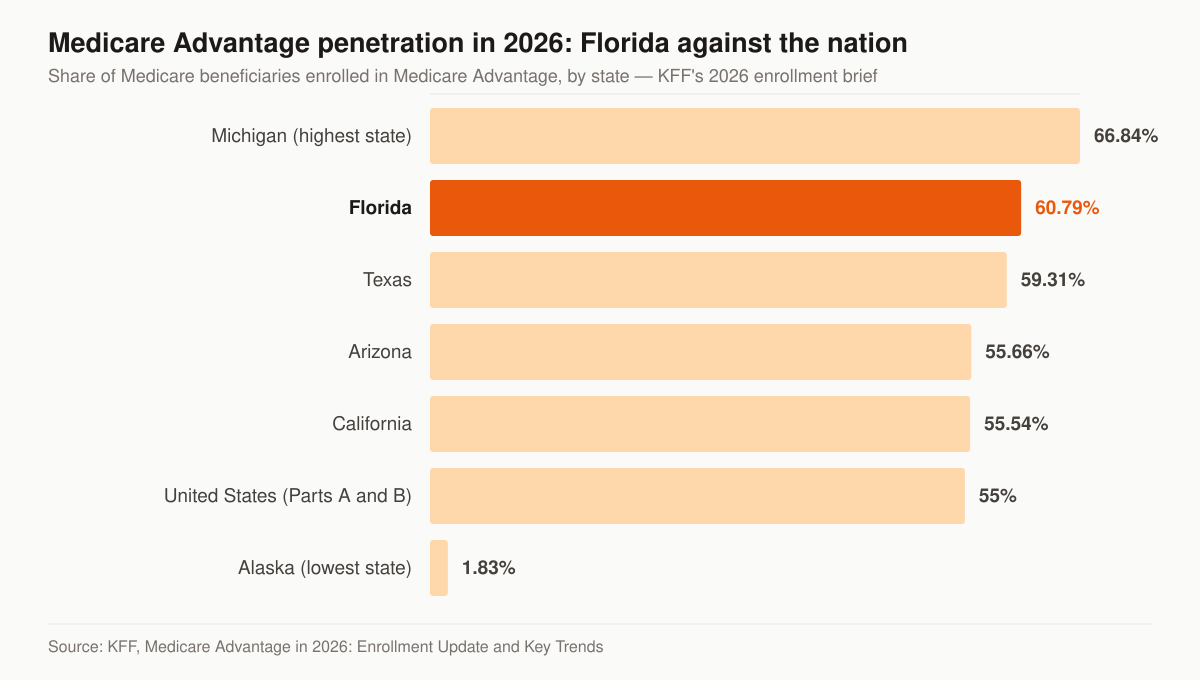
Source: KFF, Medicare Advantage in 2026: Enrollment Update and Key Trends; state shares from the brief’s state-level penetration data.
Two consequences follow, and they pull in opposite directions. High penetration means the addressable Advantage audience in the agency’s counties is large and already comfortable with the product, so the education a content engine provides is landing on people who will act on it. It also means carrier brand budgets and national call centers are already spending heavily in the same postcodes — the paid auction the agency was living in is crowded for the same reason Florida is a good market. The same KFF brief lists Florida among eleven states where special needs plan enrollment accounts for at least a quarter of Medicare Advantage enrollment, at 33%. That is worth knowing before an agency writes a single landing page: a third of the Advantage market it is talking to qualifies on a basis other than turning 65.
What we diagnosed first: CMS compliance as the design constraint
The hard constraint in Medicare is compliance, so it shaped every decision rather than being bolted on afterward. CMS rules govern how plans and benefits can be described, tighten further during AEP, and make careless “best plan” or specific-benefit claims a genuine liability. We treated that as an advantage: content that is scrupulously compliant reads as trustworthy to a cautious senior, which is exactly the trust signal that earns the call. So the plan was to answer the questions shoppers actually ask — in language CMS is comfortable with — rather than chase aggressive claims that couldn’t run.
Worth being precise about who those rules bind, because subpart V of 42 CFR part 422 splits the question in two. The marketing content and contact rules — §§ 422.2263, 422.2264 and 422.2267 — are written as obligations on MA organizations, and reach the agency through the carrier. Section 422.2274(c) requires that MA organizations “oversee first tier, downstream, and related entities that represent the MA organization to ensure agents and brokers abide by all applicable State and Federal laws, regulations, and requirements.” Section 422.2267(e)(41) puts the duty to make sure the third-party marketing organization disclaimer is used, and used in the right places, on the MA organization rather than on the TPMO itself. And § 422.2274(g)(1) adds that when a third-party marketing organization is not otherwise a first tier, downstream or related entity, “the MA organization is responsible for ensuring that the TPMO adheres to any requirements that apply to the MA plan.” Section 422.2274(b) is the other half, and it binds agents and brokers directly: those who represent MA organizations must be licensed and appointed under State law where applicable State law requires it, be trained and tested annually and achieve 85 percent or higher on all forms of testing, and secure and document a Scope of Appointment prior to a personal marketing appointment. So one set of rules arrives in your inbox as a carrier compliance review and the other arrives as a condition of your own licence — and either way, the agency that designed for them ships while everyone else re-writes.
Why the compliant Medicare channels are the inbound ones
The unsolicited-contact rules in § 422.2264(a) close most of the outbound doors and leave the inbound ones wide open, which is the entire strategic argument for an organic engine. Read the table as a channel plan rather than a compliance checklist.
| Channel | Permitted when unsolicited? | Rule |
|---|---|---|
| Conventional mail and other print media, including direct mail | Yes | § 422.2264(a)(1) |
| Email, provided every email contains an opt-out option | Yes | § 422.2264(a)(1) |
| Door-to-door solicitation, including leaving information of any kind | No, except where an appointment was pre-scheduled and the beneficiary is not home | § 422.2264(a)(2)(i) |
| Approaching enrollees in common areas such as parking lots, hallways and lobbies | No | § 422.2264(a)(2)(ii) |
| Direct messages from social media platforms | No | § 422.2264(a)(2)(iii) |
| Telephone solicitation, robocalls, text messages, voicemail — including calls based on referrals | No | § 422.2264(a)(2)(iv) |
| Returning a phone call, or calling someone who completed a business reply card requesting contact | Not unsolicited | § 422.2264(a)(3) |
| A beneficiary who searched, read your page and called you | Not unsolicited — the beneficiary initiated contact | § 422.2264(a)(3) |
The last two rows are the whole thesis of this case study. Paragraph (a)(3) states: “Calls are not considered unsolicited if the beneficiary provides consent or initiates contact with the plan.” Every dollar an agency puts into being findable is a dollar spent moving prospects into the one category the regulation does not restrict. Every dollar put into buying a list and dialling it is a dollar spent in the category that does. The rule-by-rule version of what is and is not allowed sits in our guide to CMS Medicare marketing rules for agents.
What we changed in the Medicare marketing program
- Built a compliant content engine around the questions T65 and AEP shoppers actually ask — turning-65 basics, enrollment-window timing, the difference between plan types, what to prepare before calling. This is the mechanism behind organic Medicare leads: senior shoppers research heavily before they commit, so answering their real questions clearly is what surfaces the agency in search and in the AI answers that increasingly sit above it, all without a single non-compliant benefit claim.
- Optimized the Google Business Profile for local Medicare searches, so the agency appeared in the map pack when nearby seniors looked for in-person help — the highest-intent, ready-to-call moment in the whole funnel, and one paid search leaves on the table.
- Shipped AEP-specific landing pages with clear consent capture, so the demand the content created had a compliant, conversion-focused place to land instead of dumping onto a generic homepage.
The calendar that decided what could be published, and when
Medicare marketing runs on statutory clocks, and every one of them was a scheduling input rather than a footnote. These are the dates the build was reverse-engineered from.
| Clock | What the regulation says | Citation |
|---|---|---|
| Initial coverage election period | Begins 3 months before the month the individual is first entitled to both Part A and Part B, and ends on the later of the last day of the second month after that month, or the last day of the Part B initial enrollment period | § 422.62(a)(1) |
| Marketing next contract year’s offerings | May begin October 1 of each year, with materials clearly indicating what year is being discussed | § 422.2263(a) |
| Annual coordinated election period | October 15 through December 7 for the following calendar year | § 422.62(a)(2)(iii) |
| MA open enrollment period | One election during the first 3 months of the year, for individuals already enrolled in an MA plan | § 422.62(a)(3)(i) |
| Scope of Appointment validity | 12 months following the beneficiary’s signature date, or the date of the initial request for information | § 422.2264(c)(3)(iii)(A) |
| Marketing and sales call records | Recorded and retained in their entirety for a minimum of 6 years; the first 3 years must be kept in audio format | § 422.2274(g)(2)(ii) |
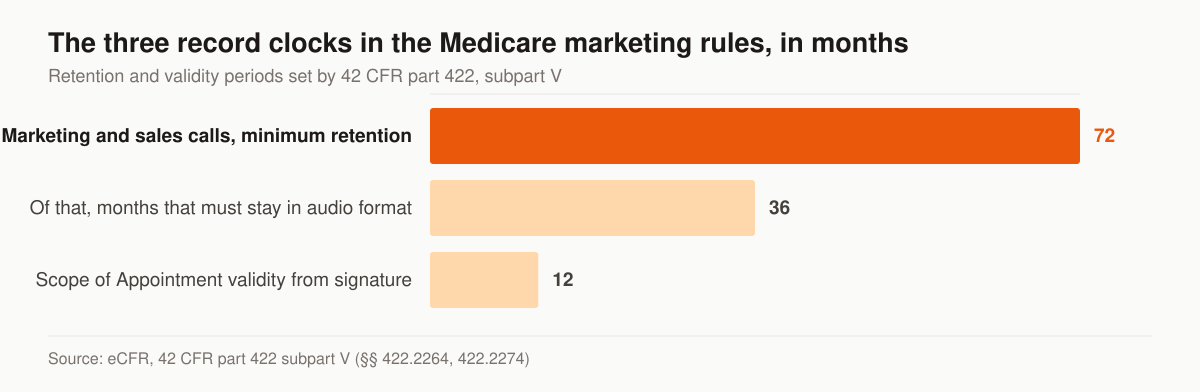
Source: eCFR, 42 CFR part 422 subpart V (§§ 422.2264, 422.2274).
Read together, the October 1 line and the December 7 line define a fixed marketing season, and the agency cannot lengthen it. What it can change is how much demand already exists when the season opens. Organic pages published in June are indexed, linked and accumulating query history by the time the auction gets expensive; the same pages published on October 2 are competing for attention from a standing start. Our AEP marketing strategies guide sets out the full phase-by-phase calendar, and the Q1 restrictions that follow AEP are covered in the OEP marketing rules.
The content engine: which questions got answered, and in what order
We sequenced the content by how close the question sits to an enrollment decision, not by search volume, because a compliant Medicare page has a narrow band of things it is allowed to say and the useful ones cluster around process rather than product.
| Question the shopper asks | Why it earns the visit | The constraint we wrote inside |
|---|---|---|
| When can I sign up, and what happens if I miss the date? | Deadline anxiety is the reason a senior starts searching in the first place | Dates are quoted from § 422.62, not paraphrased from a carrier flyer |
| I’m turning 65 and still working — what do I actually have to do? | The aging-in cohort arrives every month, outside the AEP crush | No plan or benefit specifics, so nothing needs plan-year labelling |
| What is the difference between the plan types? | The comparison question, asked before an agent is chosen | § 422.2263(b)(5) lets an MA organization compare its plan to other plans only where the information is accurate, not misleading and supportable, so the page compares plan structures rather than named plans |
| What should I have ready before I talk to an agent? | Pre-qualifies the call and lifts appointment quality | Sets expectations for the Scope of Appointment required by § 422.2274(b)(3) before a personal marketing appointment |
| Can I change my mind in January? | Captures Q1 search demand that AEP content ignores | Educational framing only; § 422.2263(b)(7)(ii) bars unsolicited materials referencing the OEP |
| Who can help me near me? | Converts at the map pack, not the blog | Service-area discipline, under the advertising limits in § 422.2263(b)(8) |
None of those six pages needs a single benefit claim to do its job, which is what makes the engine survivable in a regulated line. The aging-in question in particular runs on its own clock rather than the AEP clock, and it is the backbone of our turning-65 marketing system. The mechanics of turning a question list into a publishing schedule are the ordinary insurance content marketing process, applied under a tighter review step.
What the Google Business Profile did that paid search could not
Paid search buys a click at the moment of the query and stops when the card does. A Google Business Profile answers a different question — is there someone near me who does this? — and it answers it inside the map pack, above the organic results, for a searcher who has already decided to talk to a person. For a Medicare agency whose prospects skew local and appointment-driven, that is a materially different intent than a comparison-shopping click, and it is a surface a paid budget cannot rent outright.
The audience objection — that seniors are not online — does not hold up against the measurement. Pew Research Center’s 2025 survey of 5,022 U.S. adults, fielded February 5 to June 18, found 90% of adults ages 65 and older use the internet, up from 46% in 2011. The same 2025 figures put ages 18-29 and 30-49 at 99%, and ages 50-64 at 96%.
The profile work itself is unglamorous and mostly consists of getting the boring fields right: correct primary category, hours that are actually true when someone searches at 6pm, service areas that match where the agency is appointed, and a steady flow of reviews. Reviews carry disproportionate weight in a decision this personal — a beneficiary choosing an agent is choosing someone they may call every October for a decade — and the compliant ways to ask are covered in how to get more Google reviews for insurance agents. The full profile and citation programme is our local SEO service.
The TPMO disclaimer, and what it does to a Medicare landing page
Any agency selling plans on behalf of more than one MA organization carries a required disclaimer, and where it has to appear reshapes the page it sits on. Under § 422.2267(e)(41), if a TPMO does not sell for all MA organizations in the service area, the disclaimer consists of the statement: “We do not offer every plan available in your area. Currently we represent [insert number of organizations] organizations which offer [insert number of plans] products in your area. Please contact Medicare.gov or 1-800-MEDICARE to get information on all of your options.”
The placement rules in (e)(41)(i) through (v) require that it be used by any TPMO that sells plans on behalf of more than one MA organization, verbally conveyed during sales calls prior to the discussion of any benefits, electronically conveyed in email and online chat, prominently displayed on TPMO websites, and included in marketing materials including print and television.
“Prominently displayed” is a design instruction, not a footer note, and agencies that discover it late tend to bolt it on somewhere it damages the page. Building it in from the first wireframe costs nothing: the disclaimer becomes a short, plain block near the form, it names two real numbers the agency has to keep current, and — read from the beneficiary’s side — it says out loud that this agency will tell you what it does not sell. On a page asking a 67-year-old for a phone number, that reads as candour rather than a caveat. The wider appointment-and-consent workflow around it is covered in our guide to Scope of Appointment and TPMO compliance, and the page mechanics are the same ones behind every insurance landing page we build.
How the organic Medicare engine unfolded before AEP
Timing was the whole game. Organic and GBP work compounds slowly, so it had to be built ahead of AEP — content indexed and the profile earning trust well before the enrollment rush, so the agency was already ranking when demand peaked instead of starting from zero when it was most expensive to buy. The GBP optimization tends to move first because local intent converts fast; the content engine builds underneath it over subsequent months. The recurring obstacle was compliance review slowing publishing, which we absorbed by treating it as a fixed step in the workflow rather than a surprise. By the time AEP hit, the agency had a channel that fed leads without per-click bidding — so acquisition cost fell precisely when competitors’ costs were spiking.
What we tracked weekly through the build
We report against a short list and refuse to lengthen it, because a Medicare dashboard that measures everything gets read by nobody in October. These are the six lines, and what each one is for.
| Line | Where it comes from | What it is there to catch |
|---|---|---|
| Organic sessions to Medicare pages | Search Console and analytics, page-level | Whether the engine is being found at all, before anything else is worth reading |
| Queries sitting in positions 8 to 20 | Search Console query report | The pages one edit away from the first page, which is where we look for gains before writing anything new |
| Google Business Profile calls and direction requests | Profile performance report | Local intent, which moves earlier than blog rankings do |
| Form submissions carrying a consent timestamp | The form handler’s own record | Leads that are legitimately callable under § 422.2264(a)(3), separated from those that are not |
| Scope of Appointment completed before the appointment | The agency’s CRM | The § 422.2274(b)(3) step that is easiest to skip when the calendar is full |
| Cost per acquisition, all channels combined | Ad platforms plus enrolled-count from the CRM | Whether organic is actually displacing paid cost, rather than sitting alongside it |
The fourth line is the one we insist on before the first form goes live. A consent record is what separates a lead you can work from a lead that exposes the carrier relationship, and it has to be captured at the form, not reconstructed afterwards.
The result: organic Medicare leads and cost per acquisition
In this illustrative model, organic leads rise from ~6 to ~54 per month and cost per acquisition falls from ~$210 to ~$104 across a single AEP cycle.
How the modeled numbers were constructed
Because those figures are modeled rather than measured, the honest thing is to show how they were built so you can substitute your own inputs and see whether the shape holds for your book.
The lead line is a channel-mix model, not a growth curve. It assumes a baseline of 6 organic leads a month from a site with no dedicated Medicare content, then adds three contributions: the map pack (modeled at the Google Business Profile call volume shown in the statement card, 11 rising to 73), a set of question-led pages each carrying a small monthly volume, and the AEP-specific landing pages that only produce between October 15 and December 7 and are averaged across the cycle. Change any one of those three and the total moves; the model is a way of asking which of the three your agency is missing, not a forecast.
The cost line is simpler and more useful. Blended cost per acquisition is total acquisition spend divided by enrollments from all channels. Organic leads do not have a zero cost — they carry the cost of the programme that produced them — but they do not carry a per-click auction price that rises in October. So the model holds paid spend flat and adds organic enrollments on top, which is what drags the blended figure from $210 to $104. If your paid cost per acquisition is $150 rather than $210, run the same arithmetic against your own number before you assume the same delta.
What we deliberately did not model: renewal revenue, which is where a Medicare book’s actual economics live, and which makes any first-year acquisition figure look worse than the relationship really is. The commission ceilings that bound all of this are set annually by CMS. The regulation itself fixes the mechanism rather than a current figure — § 422.2274(a) states that “Beginning January 1, 2021, the national FMV is $539”, with later years calculated by adding the current year FMV and the product of that FMV and the MA growth percentage — and referral payments are capped separately at $100 for an MA or MA-PD referral and $25 for a PDP referral under § 422.2274(f). The current contract-year rates, and the break-even table they imply, are in our AEP marketing guide.
What a programme like this costs to run
Our published tiers are Foundation at $2,500/mo, Growth at $3,500/mo and Full-Funnel at $5,500/mo, with a one-time website build at $2,500–$8,000. We would put a Medicare agency rebuilding for AEP on Growth, because Growth is the tier that carries the ongoing SEO and content engine, AI-search visibility and reputation work — the three things this case study actually runs on. Foundation covers the site, local SEO and Google Business Profile but not the ongoing content engine; Full-Funnel adds managed paid ads, landing-page CRO and marketing automation on top, which matters if you intend to keep bidding through AEP as well as ranking. The full tier comparison, what is excluded, and what happens to your assets if you cancel are all on the pricing page.
Ad spend is separate either way, paid directly to the platforms. That distinction matters more in Medicare than in other lines, because the October auction is where an unmanaged budget disappears, and a programme fee that quietly includes media makes it impossible to see which half is doing the work.
Where this model breaks
Four failure modes are worth naming, because a case study that only describes success is marketing rather than evidence.
You are not appointed where the searches are. Organic demand arrives from wherever Google decides you are relevant, and § 422.2263(b)(8) prohibits advertising benefits that are not available to beneficiaries in the service areas where the marketing appears — unless the advertisement runs in local media that serves the areas where the benefits are available and reaching beneficiaries elsewhere is unavoidable. An engine that generates strong query volume in counties you cannot write in produces work, not enrollments.
Compliance review is not staffed. The build assumes a fixed review step with a known turnaround. Where review is a favour someone does between appointments, the publishing schedule slips, and a schedule that slips past October 1 has missed the season it was built for.
You start too late. This is the failure we plan the calendar against. Indexing, link acquisition and Google Business Profile trust do not respond to urgency, and there is no version of this programme that produces its full effect between October 15 and December 7.
Consent handling is retrofitted. Since October 1, 2024, § 422.2274(g)(4) has required that personal beneficiary data collected by a TPMO for marketing or enrolling the beneficiary into an MA plan may only be shared with another TPMO when prior express written consent is given by the beneficiary, obtained through a clear and conspicuous disclosure that lists each entity receiving the data and lets the beneficiary consent or reject the sharing with each individual TPMO. An engine built on forms that cannot evidence that is an engine that generates leads the carrier relationship cannot survive.
Does this transfer to other states, and other product lines?
The state question is answered by the chart above, and the answer is that penetration varies enormously. Florida sits at 60.79% and Michigan at 66.84%, while Alaska sits at 1.83% — a Medicare Advantage content engine in a low-penetration state is talking to a much smaller share of the local Medicare population, and the same effort is better pointed at supplement and Part D demand. Check your own state’s share before you assume the Florida shape transfers.
The product question is easier. The compliant-inbound argument in § 422.2264(a) applies to every agency selling MA and Part D, in every state, because it restricts the contact method rather than the product. The pages change; the reason for building them does not. For agencies whose book leans toward Medigap rather than Advantage, the same engine points at different questions — see Medicare supplement leads — and for agencies that want the lead-flow mechanics rather than the content programme, Medicare lead generation covers the paid side of the same funnel.
If you are ninety days from AEP
The order matters more than the effort. Fix the Google Business Profile first, because it carries local intent and, in our sequencing, it is the surface that responds before the content does. Publish the process questions second — dates, aging-in, what to bring — because they need no plan-year labelling and can go live before October 1. Build the AEP landing pages third, with the TPMO disclaimer and consent capture designed in rather than added. Do not start with the blog you have been meaning to write.
If the site itself is the bottleneck, that is a different job: our Medicare agent website page covers what has to be true of the pages before any of this compounds.
See the Medicare marketing program behind this, get a free marketing audit, or tell us what your AEP looked like last year.