Who we serve
ACA Marketing for Agents
ACA marketing for agents is the system for advertising Marketplace health plans inside the CMS agent and broker rules at 45 CFR 155.220 and the annual Open Enrollment window. It combines compliant websites, subsidy-check landing pages, SEO, and paid acquisition that turn under-65 health prospects into documented, effectuated enrollments.
Free · 15-minute teardown · no pitch deck
- We run our own final-expense book
- No pitch deck — we screen-share real numbers
- TCPA-aware · CMS/AEP-compliant · Meta Special Ad Category
- Core Web Vitals < 2.0s LCP
Most “Obamacare marketing for agents” pitches sell you traffic and leave the two hardest parts — staying inside CMS rules and beating the Open Enrollment clock — entirely on you. We build the system around those two constraints, because they’re where agents actually lose money.
We’re an operator-led shop. The credibility behind this page is a real lead operation: we run our own final-expense / senior-market lead book. ACA is a different audience, but the conversion mechanics — fast landing pages, tight ad-to-page message match, and disciplined cost-per-acquisition tracking — are the same ones we use for clients every day.
What changed in the under-65 market for 2026
Any ACA marketing plan written before 2026 is aimed at a buyer who no longer exists in the same numbers. The enhanced premium tax credits established by the American Rescue Plan in 2021 and extended through 2025 by the Inflation Reduction Act expired at the end of 2025, per KFF’s May 2026 analysis of CMS Open Enrollment data. That single expiry reset price, plan mix, and who is still shopping.
CMS reports 22,973,219 cumulative plan selections for the 2026 Open Enrollment Period across all Exchanges — 15,771,397 on HealthCare.gov and 7,201,822 in the 20 states and the District of Columbia running their own platforms, in its 2026 Open Enrollment national snapshot. Of that total, 3,382,189 were new consumers and 19,591,030 were returning consumers who selected a plan or were automatically re-enrolled.
Read those two numbers next to each other before you set a budget. The acquisition pool and the retention pool are not the same size, and a plan that spends everything on new-consumer prospecting is fishing in the smaller one.
The table below shows what the same enrollee is now paying, and how that reshaped the sale.
| What the buyer sees | 2025 | 2026 | What it does to your pitch |
|---|---|---|---|
| Average monthly premium payment, net of tax credits | $113 | $178 | Price objection arrives earlier in the call |
| Share of plan selections receiving premium tax credits | 92% | 87% | Fewer prospects qualify; subsidy screening matters more |
| Average Marketplace deductible | $2,759 | $3,786 | Deductible, not premium, is now the second question |
| Share selecting a bronze plan | 30% | 40% | More buy-downs; more coverage-gap conversations |
| Share selecting a silver plan | 57% | 43% | Silver CSR value has to be explained, not assumed |
| Share selecting a gold plan | 13% | 17% | A real segment is trading up, not just down |
All six figures are from the same KFF analysis of CMS Open Enrollment Public Use Files. KFF puts the deductible move at a 37% increase, or $1,027 per person, and calls the silver share a record low and the first time fewer than half of ACA consumers have selected a silver plan.
Who left matters as much as what they pay. KFF found that consumers with incomes above 400% up to 500% of the federal poverty level represented 3% of 2025 sign-ups but accounted for 27% of the drop in sign-ups from 2025 to 2026, with plan sign-ups for that group falling 44%, or over 321,000 people. Sign-ups among adults ages 18 to 34 declined by 542,000, or 8%, from 6.7 million to 6.2 million — 46% of the total decline in ACA Marketplace sign-ups.
Two marketing consequences follow, and neither is subtle. First, the young, healthy, price-shopping segment that responded to “$0 plans may be available” ads is thinner than it was, so the creative that used to fill a funnel now fills it more slowly and at a higher click cost. Second, the households still in the market are making a harder trade between premium and deductible, which is a consultative conversation, not a form fill. Landing pages built to capture a name and nothing else will convert worse in this market than pages that qualify income band, county, and current coverage before the appointment.
Where the ACA market actually is
Sizing before spending is the step agents skip. Marketplace demand is not spread evenly across the country; it concentrates in a handful of states, and two of them dwarf the rest.
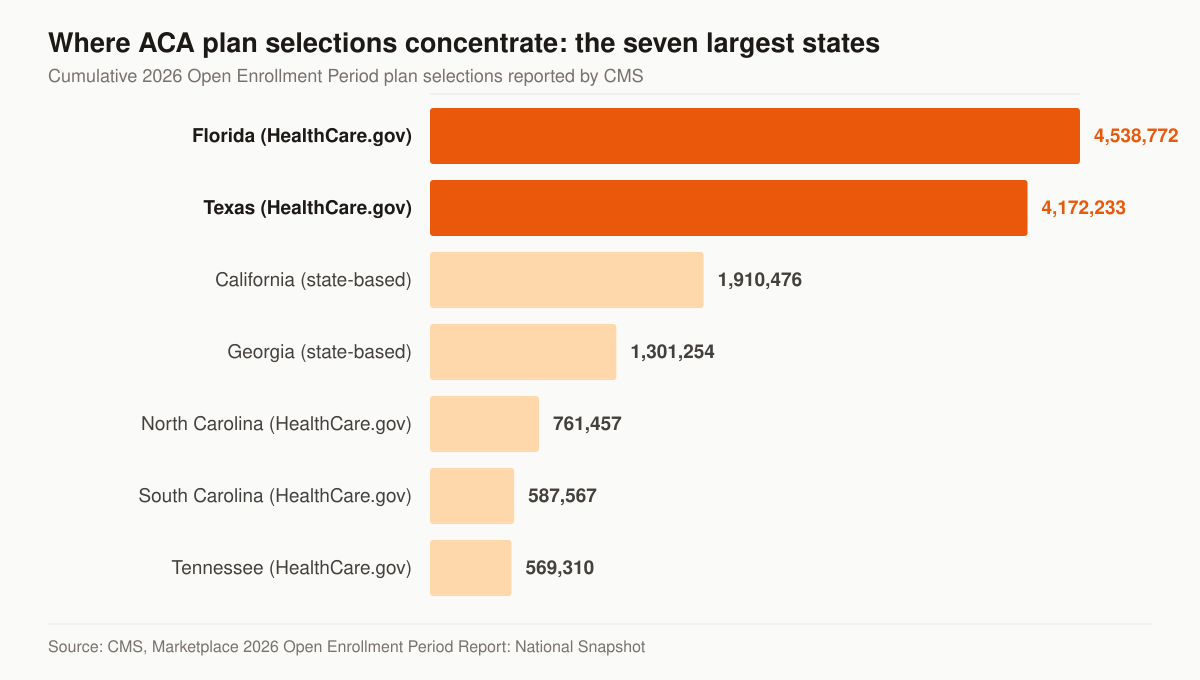
Source: CMS, Marketplace 2026 Open Enrollment Period Report: National Snapshot.
Florida recorded 4,538,772 plan selections for 2026 and Texas 4,172,233 — both on the HealthCare.gov platform. California, the largest state-based Exchange, recorded 1,910,476 and Georgia 1,301,254. If you are licensed in one of those states, the addressable market is deep enough to justify a dedicated county-level SEO and paid build. If you are licensed in a state that reported under 100,000 selections, a national health-insurance content play will outperform a hyper-local one, and non-resident licensing may be the cheaper growth lever than more ad spend at home.
Direction of travel matters too. KFF reports that Marketplace plan selections declined in 41 states in 2026, falling most in percentage terms in North Carolina (22%), Ohio (20%), West Virginia (17%) and Indiana, Delaware, and Arizona (all 16%), while New Mexico saw an 18% increase, which KFF attributes in part to the state’s supplemental financial assistance program. A shrinking state is not a reason to leave it — it is a reason to shift budget from acquisition toward retention and re-shopping, because the households already on your book are the ones being re-priced.
ACA marketing for agents starts with the CMS rulebook
Health insurance agent marketing on the Marketplace is governed advertising. You cannot imply you are the government, you cannot use misleading subsidy claims, and where a third-party marketing organization (TPMO) relationship applies, your ads and pages need the proper disclaimer. You also have to be FFM-registered and licensed to enroll.
HealthCare.gov states that “Before selling health insurance plans through the federal Health Insurance Marketplace® (FFM) on HealthCare.gov, you need to register, sign agreements, and complete required training,” and its agent and broker quick-start guide sets out five steps: create an account, identify yourself as an agent or broker, confirm your identity, take required training, and sign the privacy and security agreements. The same page notes that “Free CMS training doesn’t offer continuing education units (CEUs)” — a scheduling detail worth knowing before you plan your Q3.
We treat compliance as a trust signal, not a tax. Clean disclaimers, factual subsidy language, and honest “see if you qualify” framing convert without hype — and they keep your book off CMS’s radar. Note: we provide marketing services; you are the licensed party responsible for every enrollment. This is not legal advice.
What 45 CFR 155.220 actually prohibits in your marketing
The rule that governs agent and broker conduct in the Federally-facilitated Exchanges is 45 CFR 155.220, and its marketing paragraph is more concrete than the summaries suggest. Under (j)(3)(ii) you must “Provide consumers with correct information, without omission of material fact, regarding the Federally-facilitated Exchanges, QHPs offered through the Federally-facilitated Exchanges, and insurance affordability programs, and refrain from marketing that is misleading, materially inaccurate, coercive, or discriminates based on race, color, national origin, disability, age, or sex.”
Then (j)(3)(iii) gives named examples. The lead-in is worth quoting because it sets the scope: “Examples of prohibited misleading marketing practices agents, brokers, and web-brokers may not include in their marketing of FFE plans include, but are not limited to:” — so the list is illustrative, not exhaustive.
The table below turns each named prohibition into the campaign decision it actually governs.
| Prohibited practice, quoted from 45 CFR 155.220(j)(3)(iii) | What it rules out in a real campaign |
|---|---|
| “Providing cash, monetary rebates, gift cards, travel vouchers, or cash equivalents as an inducement for enrollment or otherwise.” | Gift-card lead magnets and enrollment bonuses, including on the thank-you page |
| “Offering gifts to consumers, unless the gifts are of nominal value, are offered to similarly situated consumers without regard to whether or not the consumers enroll, and are not in the form of cash or cash equivalents.” | Any giveaway conditioned on enrolling; note the three conditions are cumulative |
| “Falsely asserting or suggesting that consumers will always qualify for zero-dollar insurance/zero-dollar premiums.” | “Get your free health plan” headlines and $0 ad copy with no eligibility framing |
| “Falsely using identical or facsimiles of government or other official logos and notations.” | Eagle seals, .gov-styled headers, HealthCare.gov lookalike page chrome |
| “Miscommunicating enrollment timelines and deadlines.” | Deadline creative built on last year’s dates, and evergreen ads left running |
| “Misconstruing legislation, regulations, or Executive Orders, including listing fake or incorrect references or citations.” | Blog posts and AI-drafted explainers citing rules that do not say what you claim |
| “Utilizing the image or likeness and/or utilize a quote from a notable figure, such as a celebrity or politician, in an advertisement claiming that figure has endorsed you or your agency when that endorsement is not truthful.” | Political and celebrity imagery in social creative |
Two paragraphs after that list decide how you should structure an agency relationship. Under (j)(3)(iv) you “must produce any marketing material upon request, within the specified timeframe HHS mandates,” and under (j)(3)(v) you are “responsible to ensure that all marketing-related materials created, written, released, or otherwise produced by the individual or entity or on their behalf adhere to the requirements of paragraphs (j)(3)(ii) and (iii) of this section.” The words on their behalf are the ones that matter when you hire anyone. Your vendor’s ad is your marketing material. Ask for version-controlled creative you can retrieve on demand, and treat a partner who cannot produce a dated archive as an exposure rather than a bargain.
One more clause shapes the website itself. Paragraph (j)(2)(i) requires you to “refrain from conduct that is misleading (including by having a direct enrollment website that HHS determines could mislead a consumer into believing they are visiting HealthCare.gov), coercive, or discriminates based on race, color, national origin, disability, age, or sex.” That parenthetical is a design instruction: your site should look like your agency, not like the federal Marketplace. Our ACA agent websites build treats visual distinctness from HealthCare.gov as a requirement, not a style preference.
What documentation do ACA agents need to market compliantly?
ACA marketing documentation means being able to show, for any enrollment, where the lead came from, that the consumer agreed to be contacted, that your ads and pages carried the required disclaimers, and that every plan and subsidy claim in the creative was accurate. Rules tighten most plan years, so build record-keeping into the funnel itself instead of reconstructing it after a complaint.
In practice, we build funnels so four records exist by default:
- Consent — when, where, and how the consumer agreed to contact, captured at the form.
- Lead provenance — which page, ad, or campaign produced each lead.
- Creative on file — the ad and landing-page versions as they actually ran, disclaimers included.
- Claim accuracy — the factual basis for any subsidy or plan statement your creative made.
The regulation is specific about what the consent record has to contain. Under 45 CFR 155.220(j)(2)(iii)(B), the documentation must include “a description of the scope, purpose, and duration of the consent provided by the consumer or their authorized representative designated in compliance with § 155.227, the date consent was given, name of the consumer or their authorized representative, and the name of the agent, broker, web-broker, or agency being granted consent, as well as a process through which the consumer or their authorized representative may rescind the consent.” A form that captures a checkbox and a timestamp does not carry those fields. A form designed against that sentence does.
The parallel requirement at (j)(2)(ii) covers the eligibility application: you must “document that eligibility application information has been reviewed by and confirmed to be accurate by the consumer, or the consumer’s authorized representative designated in compliance with § 155.227, prior to the submission of information,” and that record must include “the date the information was reviewed, the name of the consumer or their authorized representative, an explanation of the attestations at the end of the eligibility application, and the name of the assisting agent, broker, or web-broker.” Each record has its own retention clause: the eligibility-review documentation must be kept “for a minimum of ten years” under (j)(2)(ii)(A)(3), and the consent documentation “for a minimum of 10 years” under (j)(2)(iii)(D).
Two dates are worth putting in the build plan, and the consent branch at (j)(2)(iii) states both. For plan years ending prior to January 1, 2028, the rule accepts a range of evidence, naming an electronic or handwritten signature, a verbal confirmation captured in an audio recording, or a response to an electronic or other communication you sent. For plan years beginning on or after January 1, 2028, that documentation “must be collected by having the consumer or the consumer’s authorized representative take an action to execute an HHS-approved and -created consumer consent form,” and the rule adds that “A signature that is simply typed on the documentation or a filled-in check box does not properly indicate consent was provided by the consumer or the consumer’s authorized representative.” If your intake flow currently ends in a typed name and a checkbox, it has a shelf life.
For the rule set itself, our plain-English breakdown of the CMS marketing rules for ACA agents covers disclaimers, consent, and what changes between plan years.
The Open Enrollment calendar is the whole game
ACA revenue compresses into the weeks between November 1 and mid-January. Plan the year backward from it.
The table below is the year-level plan: three phases, three different jobs for the same budget.
| Window | Months | What your marketing should be doing |
|---|---|---|
| Pre-build | Jul–Oct | Ship website/landing pages, index SEO content, warm retargeting audiences |
| Open Enrollment | Nov 1–Jan 15* | Spend hard, book consults, maximize speed-to-lead |
| Post-OE / SEP | Feb–Oct | Target qualifying-life-events and Medicaid-churn under-65 households |
*State-based Marketplaces vary; confirm your state’s dates, and read the next section before you commit creative to a January deadline.
Inside the window itself, the federal deadlines do the selling — the table below turns each one into a campaign trigger.
| Date | Federal Marketplace deadline | Marketing move |
|---|---|---|
| Nov 1 | Open Enrollment starts — first day to enroll, renew, or change plans | Full spend live; speed-to-lead at its tightest |
| Dec 15 | Last day to enroll or change plans for coverage starting Jan 1 | Deadline creative; most of the season’s volume closes here |
| Jan 1 | Coverage starts for those enrolled by Dec 15 who paid their first premium | Onboarding and referral asks; keep spend on |
| Jan 15 | Open Enrollment ends | Final-deadline push, then shift budgets to SEP |
| Feb 1 | Coverage starts for Dec 16 – Jan 15 enrollees | Post-OE follow-up; SEP audiences take over |
Dates per HealthCare.gov’s Marketplace dates and deadlines, which is the sequence that page publishes as of this writing. Between January 16 and October 31, HealthCare.gov only enrolls people who qualify for a Special Enrollment Period after a life event — which is exactly why the post-OE row exists.
Agents who only “turn on” in November overpay for clicks against every other agent and waste their best asset: an owned, indexed website that compounds all year. For the tactic-level side of the window, our Q4 open enrollment playbook lists the campaign ideas worth running, and our field notes on how ACA agents fill their pipeline during OEP cover the in-season mechanics.
Verify your enrollment dates before you print them
Here is a trap sitting directly under the table above. The regulation that sets Open Enrollment dates, 45 CFR 155.410, now reads differently for the plan years ahead. Paragraph (e)(5) states that for benefit years beginning on or after January 1, 2027, “The annual open enrollment period for all Exchanges must begin no later than November 1 and must end no later than December 31 of the calendar year preceding the benefit year,” and that it “must not exceed 9 weeks in duration.” Paragraph (f)(4) adds that for those benefit years “the Exchange must ensure that coverage is effective January 1, for QHP selections received by the Exchange on or before December 31 of the calendar year preceding the benefit year.”
Set that against the consumer-facing HealthCare.gov page, which still lists the January 15 close and the February 1 effective date. CMS described the change when it issued the 2025 Marketplace Integrity and Affordability Final Rule, stating that “Each OEP must start no later than November 1 and end no later than December 31, and the OEP may not exceed 9 calendar weeks,” that “all enrollments pursuant to Open Enrollment Period must begin on January 1,” and that “For Exchanges on the Federal platform, the OEP will run from November 1 through December 15 preceding the coverage year, beginning with the OEP for plan year 2027.”
We are not going to tell you which date your Exchange will publish for the coming season, because that is the Exchange’s announcement to make and the guidance has moved. What we will tell you is the operational answer: never hardcode an enrollment deadline into ad copy, landing-page hero text, email subject lines, or an evergreen blog post. Put the season’s dates in one place — a config value, a CMS field, a single include — and template every surface off it. That is a build decision, and it is also a compliance one, because 45 CFR 155.220(j)(3)(iii)(E) names “Miscommunicating enrollment timelines and deadlines” as a prohibited misleading marketing practice. A campaign that quietly keeps running with last year’s date is not just stale; it is the exact thing the rule describes.
A shorter window, if that is what lands, changes the media plan more than it changes the message. Every dollar you were going to spend across eleven weeks compresses into fewer, which raises auction pressure and makes the pre-built, already-indexed asset worth more than the incremental click. That argues for finishing your ACA landing pages and content in Q3 rather than Q4.
Working Special Enrollment Periods the rest of the year
The post-OE months are not dead air; they are a different targeting problem. HealthCare.gov states you may qualify for a Special Enrollment Period if you or anyone in your household “lost qualifying health coverage in the past 60 days OR expects to lose coverage in the next 60 days,” and adds that “(If you lost Medicaid or Children’s Health Insurance Program (CHIP) coverage in the past 90 days, you may qualify for a Special Enrollment Period.)” On COBRA it says: “When your COBRA coverage ends, you have 60 days to enroll in a Marketplace health plan through a Special Enrollment Period.”
Those windows are the entire targeting brief. An SEP prospect is only reachable while a clock is already running, which makes SEP marketing a speed-and-trigger discipline rather than a broad-awareness one.
| SEP trigger category | Examples HealthCare.gov lists | Where the marketing signal comes from |
|---|---|---|
| Loss of coverage | Job-based coverage or COBRA ending, losing Medicaid or CHIP, aging off a parent’s plan | Layoff news, employer changes, Medicaid redetermination cycles in your state |
| Household change | Marriage, birth, adoption or foster placement, divorce or legal separation with coverage loss | Life-event search intent, referral partners, existing book |
| Change in residence | Moving to a new ZIP code or county, moving to the U.S., students and seasonal workers moving | Moving-related local search, realtor and relocation partners |
| Other qualifying changes | Becoming a U.S. citizen, leaving incarceration, starting or ending service, disaster-affected | Community organizations and local partnerships |
Two operational notes before you build the funnel. Your marketing has to hand the enrollment side a clean trigger, because 45 CFR 155.220(j)(2)(viii) requires you to “obtain authorization from the consumer to submit the request for a determination of eligibility for a special enrollment period and make the consumer aware of the specific triggering event and special enrollment period for which the agent, broker, or web-broker will be submitting an eligibility determination request on the consumer’s behalf.” That is a form field and a script line, not an afterthought. And CMS has been tightening verification: the 2025 final rule requires Marketplaces on the Federal platform to conduct pre-enrollment verification for SEP eligibility beginning plan year 2026, and separately mandates pre-enrollment eligibility verification for at least 75% of new enrollments through SEPs beginning plan year 2026, with both provisions set to sunset at the end of the 2026 plan year. Documentation friction on the consumer’s side is now part of your conversion rate, so tell them what they will need before the appointment, not during it.
The four systems we build
Each links to a focused build you can run standalone or together:
- High-converting ACA landing pages — subsidy-check funnels engineered for speed and OE traffic spikes.
- ACA agent SEO — rank for “[city] health insurance” and subsidy questions so you’re not 100% dependent on paid clicks.
- ACA agent websites — fast, compliant, EDE-ready sites that hold up under OE load.
- Done-for-you ACA marketing services — the full retainer when you’d rather run your book than your funnel.
For the broader engine behind these, see our insurance lead generation service and how we approach AI-search and GEO visibility — increasingly where under-65 buyers ask “what’s the cheapest ACA plan in my state?” before they ever hit Google.
How does ACA lead generation work?
ACA lead generation runs on four sources: subsidy-check landing pages fed by paid traffic, local SEO that captures “[city] health insurance” searches, year-round Special Enrollment Period audiences — job changes, moves, Medicaid churn — and referrals from your existing book. Whatever the mix, route every lead into one CRM with consent captured at the form; that record is simultaneously your speed-to-lead engine and your compliance file.
Two adjacent tools get mistaken for lead generation. An EDE-capable enrollment platform shortens the path from lead to submitted application, and an FMO may add contracting support or co-op marketing dollars — but neither creates demand. Treat the platform and the FMO as processing, and the funnels above as pipeline; agents who conflate them end a plan year with great tooling and an empty book.
Build leads or buy them?
Two different motions, and most growing agencies use both:
- Generate — your owned SEO, website, and paid funnels create exclusive pipeline with lower long-run cost per acquisition. That’s what we build.
- Buy — finished ACA leads or live transfers fill volume fast during the OE crunch. We don’t sell leads on this site; when you want to purchase them as a product, you can buy leads direct from getinsureleads.
Keeping those clean matters: owned generation is your moat, bought volume is your throttle. Whichever side the lead arrives from, the follow-up cadence decides what it is worth — our insurance lead follow-up cadence breakdown is the sequence we wire into the CRM.
The free listing agents forget: Find Local Help and Help On Demand
CMS runs two consumer-facing referral surfaces that route people looking for enrollment help to licensed agents, and getting into them costs nothing but a profile setting. Per the CMS agent and broker FAQ, you update the profile in the Marketplace Learning Management System (MLMS) inside the CMS Enterprise Portal.
The gate is one setting. CMS states that “To display your contact information for Find Local Help or participate in Help On Demand, you must select one of the first three Find Local Help/Help On Demand options in your MLMS profile,” and lists them:
- “I would like all my contact information displayed for all states where I have a valid health license.”
- “I would like my contact information, except my street address, displayed for all states where I have a valid health license.”
- “I would like all my contact information displayed but only for my home state.”
CMS adds that you must click “Save/Update” rather than “Next” for the change to save, and to “Please allow one (1) to two (2) business days for the updates to process.” That is the whole task. It is the cheapest distribution an ACA agent has, it is live year-round, and it reaches consumers at the exact moment they have decided they want a person instead of a website.
Treat it as a directory listing that deserves the same discipline as your Google Business Profile: the licensed states are the targeting, the displayed contact details have to match the ones on your site, and a stale profile sends someone a phone number you no longer answer. Our local SEO service handles the same consistency problem across the rest of the map.
Calling and texting ACA leads without a TCPA problem
Consent is where ACA lead economics quietly break. The federal rule is 47 CFR 64.1200, and three of its paragraphs govern almost everything an agency does with a phone number.
The consent standard is defined at (f)(9): prior express written consent means “an agreement, in writing, bearing the signature of the person called that clearly authorizes the seller to deliver or cause to be delivered to the person called advertisements or telemarketing messages using an automatic telephone dialing system or an artificial or prerecorded voice, and the telephone number to which the signatory authorizes such advertisements or telemarketing messages to be delivered.” The rule also requires the agreement to disclose that “The person is not required to sign the agreement (directly or indirectly), or agree to enter into such an agreement as a condition of purchasing any property, goods, or services.” A consent checkbox that gates the quote is arguing with that sentence.
Paragraph (a)(2) is the dialing restriction: no person or entity may initiate a call “that includes or introduces an advertisement or constitutes telemarketing, using an automatic telephone dialing system or an artificial or prerecorded voice” to the lines it names, “other than a call made with the prior express written consent of the called party” or the other narrow bases the paragraph lists. And (c) provides that “No person or entity shall initiate any telephone solicitation to: … (2) A residential telephone subscriber who has registered his or her telephone number on the national do-not-call registry of persons who do not wish to receive telephone solicitations that is maintained by the Federal Government.” Among the exemptions listed under (c)(2) is where the caller “has obtained the subscriber’s prior express invitation or permission,” which the rule says “must be evidenced by a signed, written agreement between the consumer and seller which states that the consumer agrees to be contacted by this seller and includes the telephone number to which the calls may be placed.”
Two practical consequences for an ACA funnel. Your landing-page consent language is a legal artifact, so it should name your agency specifically rather than “our partners,” and the record of it should live with the lead. And if you buy leads, the vendor’s consent language is the one you are relying on — ask to see the exact screen the consumer saw, and keep a copy. Our guide to TCPA compliance for agents buying leads works through what a defensible vendor record looks like.
How to measure ACA marketing
CMS’s own glossary contains the measurement warning. In its 2026 Open Enrollment report, CMS defines cumulative plan selections as “the total number of people who have submitted an application and selected a plan,” and adds: “To have their coverage effectuated, consumers generally need to pay their first month’s health plan premium, if applicable. This release does not report the number of effectuated enrollments.”
Your commission follows the effectuated, paid policy — not the application. The gap between the two is real and, in this plan year, wide: KFF, citing an analysis of January premium payments by Wakely Consulting Group, reports that approximately 86% of January 2026 enrollees in the individual market paid their first month’s premium. A KFF survey fielded in late February and early March of 2026 found that 4% of returning ACA Marketplace enrollees had not yet paid their first month’s premiums and that one in six (17%) returning enrollees were not confident they could afford their premiums for the entire year.
The table below is the reporting stack we build, ordered from the number that arrives first to the one that decides the year.
| Metric | The question it answers | Where it comes from |
|---|---|---|
| Cost per lead by campaign and county | Which media is affordable at all | Ad platforms plus form and call attribution |
| Lead-to-appointment rate | Whether the page qualifies or just collects | CRM stage tracking |
| Appointment-to-application rate | Whether the audience matches the product | CRM plus your enrollment platform |
| Application-to-effectuated rate | Whether the enrollment survives first premium | Carrier or platform reporting, month two |
| Cost per effectuated enrollment | What acquisition actually cost | Spend divided by effectuated count |
| Retention through the plan year | Whether the book you bought stays bought | Carrier or platform reporting, monthly |
Watch the fourth row hardest. A funnel with a great cost per application and a poor application-to-effectuated rate is selling plans people cannot afford, and it will look like a win for exactly one reporting cycle. Retention is the same problem seen later, which is why our client retention service treats the annual review as an acquisition channel rather than a courtesy call.
What ACA marketing costs
Our retainers are flat and published, because a per-lead price hides the number that decides the year. Foundation is $2,500 a month, Growth is $3,500, Full-Funnel is $5,500, and a one-time site build runs $2,500 to $8,000. Media budget is separate and paid directly to Google or Meta; our fee covers strategy, build, and management.
The table below maps each tier to the ACA job it does, so you can pick against your season rather than against a feature list.
| Tier | Monthly | What it covers | The ACA agent it fits |
|---|---|---|---|
| Foundation | $2,500 | Optimized website and landing pages, local SEO and Google Business Profile, on-page SEO, monthly reporting | A licensed agent whose site cannot be found or cannot convert |
| Growth | $3,500 | Everything in Foundation plus the ongoing SEO and content engine, AI-search visibility, reputation and reviews | An agent building owned pipeline ahead of the next Open Enrollment |
| Full-Funnel | $5,500 | Everything in Growth plus managed paid ads, landing-page CRO, marketing automation and CRM, full-funnel reporting | An agency running paid volume through the season and SEP audiences after it |
Full pricing, what moves an agent between tiers, and what is deliberately excluded are on the pricing page. If you want the number for your state rather than the general one, that is what the audit is for.
Why operators, not “agencies”
We came up generating insurance leads, not writing decks about it. The same speed-to-lead, message-match, and CPA discipline we prove on our senior-market book is what we bring to ACA — adapted for under-65 audiences and the OE calendar. If you also work the 65+ market, our Medicare marketing playbook pairs naturally with your ACA season, and if a meaningful share of your Marketplace book is Spanish-speaking, our bilingual insurance agent marketing approach covers running the funnel in two languages without running two disconnected programs.
Want a number for your state and a look at where your current funnel leaks? Grab a free marketing audit — we’ll map your OE plan, flag any CMS exposure in your current ads, and show you the math before you spend a dollar. If you already know what you need, contact us and we’ll scope it.
Deeper guides
Go deeper on ACA / Health
ACA / Obamacare Agent Landing Page Design and Funnels
CMS-compliant ACA landing pages and Obamacare agent funnels built by people who generate insurance leads. Consent capture, faster forms. Free audit.
ACA Insurance Agent SEO Services That Win Open-Enrollment Traffic
ACA insurance agent SEO services built by an operator who actually generates leads. Rank for OEP, subsidy, and "ACA agent near me" searches that convert.
Health Insurance Agent Website Design That Stays Compliant and Converts
Health insurance agent website design built for ACA compliance and conversion: CMS-ready disclaimers, fast load, and lead capture. Free site teardown.
Marketing for Health Insurance Agents
Marketing services for health insurance and ACA agents: websites, SEO, paid ads, AI-search, and content from an operator running its own lead book.
The services behind it
Guides that go deeper