Service
White-Label Insurance Marketing for FMOs, IMOs, and Independent Agents
A white-label marketing program you can offer your whole downline — branded lead campaigns, capture pages, follow-up, and per-agent reporting run under your FMO or agency name — turning marketing into a recruiting and retention advantage instead of a recurring lead invoice.
- We run our own final-expense book
- No pitch deck — we screen-share real numbers
- TCPA-aware · CMS/AEP-compliant · Meta Special Ad Category
- Core Web Vitals < 2.0s LCP
White-label insurance marketing means an outside team builds and runs lead generation, landing pages, and follow-up that carry your brand, not theirs. For FMOs, IMOs, and agencies, it turns marketing into a program you can deploy across an entire downline — so you offer agents a system instead of just contracts and leads.
What you get
What your white label insurance marketing program includes
- White-label lead campaigns (Facebook and Google) built and operated under your FMO or agency brand, not ours
- Branded landing and capture pages your downline agents can point traffic to without building their own
- A lead-distribution and routing setup with geographic or line-based segmentation so agents don't compete for the same prospect
- Per-agent tracking and a rolled-up upline dashboard showing cost per lead and volume across the downline
- Follow-up automation (email and SMS) attached to each agent's leads so paid-for leads actually get worked
- Compliance guardrails — consent capture, recorded opt-ins, and a route for creative to pass your review before going live across agents
- A recruiting asset — a marketing program you can show prospective agents as a reason to contract under you
- Onboarding and reporting cadence to add new downline agents into the program without rebuilding from scratch
How it works
How the white label insurance marketing engagement runs
- 01
Program design
We map your downline structure, lines, and territories, then design a white-label program — branding, offer, lead distribution rules, and per-agent tracking — that scales across many agents instead of one.
- 02
Build the branded machine
We build the campaigns, capture pages, and follow-up under your brand, wire lead routing and segmentation so agents don't collide, and set up consent capture and compliance guardrails.
- 03
Roll out across the downline
We onboard agents into the program, attach follow-up to each agent's leads, and stand up the per-agent plus rolled-up reporting so you can see cost and volume across the whole book.
- 04
Manage, report, and scale
We operate the campaigns, report to you on downline-wide performance, and add new agents into the system as you recruit — the same operational discipline we run on our own campaigns.
If you run an FMO, IMO, or a recruiting agency, your agents are your product — and the agencies that keep agents are the ones that give them more than a contract. Leads help, but leads run out. A marketing program that keeps producing, under your brand, is the thing that makes a downline agent stay and makes a prospect want to contract under you in the first place.
This service is that program, built and operated for you to hand down. It is not a single-agent setup scaled by copy-paste; it is a multi-agent machine designed from the start to run across a downline without agents cannibalizing each other’s spend.
What is white-label insurance marketing?
White-label insurance marketing — written “white label insurance marketing” just as often, hyphen or not — is marketing built and operated by an outside team but delivered entirely under your brand. Your FMO or IMO’s name goes on the campaigns, the landing pages, the follow-up emails, and the reporting your agents see. The operator stays invisible; your downline experiences it as your marketing program.
The label changes more than the logo. In a plain vendor relationship, the vendor’s brand sits between you and your agents — they know exactly who supplies the leads, and any competing upline can offer them the same vendor tomorrow. In a white-label arrangement the program is an asset of your organization: it strengthens your recruiting pitch, gives producing agents a concrete reason to keep their contracts under you, and compounds your brand’s equity instead of a supplier’s. That structural difference — who owns the relationship and the reputation — is why FMOs and IMOs buy marketing this way rather than reselling someone else’s product under someone else’s name.
White-label marketing vs. white-label insurance products
Search the phrase and page one fills with something else entirely: platforms that let a brand sell a carrier’s policy under its own name — coverage embedded at a retailer’s checkout, an MGA program rebranded for a broker, a carrier’s product tailored to a distributor’s look and feel. That is white-labeling the risk product. It runs through filings, underwriting appetite, and a carrier relationship, and the people who buy it are usually building a distribution channel, not a lead flow.
This page is about the other half of the phrase: white-labeling the demand side. No policy changes hands under anyone’s name here, because the program does not sit anywhere near the policy — your agents write business with the carriers they are already contracted and appointed with. What carries your brand is the advertising, the capture page, the follow-up sequence, and the report an agent opens on Monday morning.
The two products get quoted against each other constantly, so it is worth separating them line by line before you brief anyone:
| White-label insurance product | White-label insurance marketing | |
|---|---|---|
| What carries your brand | The policy, program, or quoting flow | The campaigns, pages, follow-up, and reporting |
| Who underwrites | A carrier or MGA behind the program | Nobody — no risk is transferred |
| Regulatory surface | Product filings, licensing, carrier approval | Advertising rules, consent, Medicare marketing rules |
| Who you buy it from | A carrier, MGA, or insurtech platform | A marketing operator |
| What changes for your downline | What they are able to sell | How a prospect ever reaches them to buy it |
| Time to live | Filing and appointment timelines | Campaign build and rollout |
If you came here looking for the first column, this is not that service. If you came looking for a branded machine that puts appointments in your agents’ calendars, keep reading.
FMO, IMO, MGA, NMO: does the label change the program?
Field marketing organization, independent marketing organization, national marketing organization, managing general agent — the acronyms describe distribution position and carrier relationship, and usage drifts by line and by carrier. Two organizations that call themselves the same thing can sit at different contract levels with different override structures.
CMS does not use any of them as a defined term. Its Medicare Advantage communication rules speak instead of first tier, downstream, and related entities, and of the third-party marketing organization defined at 42 CFR 422.2260 — a category an FMO running branded lead campaigns lands in regardless of the sign on the door. For choosing an upline in the first place, the criteria are a separate exercise, covered in our guide to how to choose an FMO.
For the marketing build, the acronym changes nothing. Four structural facts do:
- How many producing agents will draw from the program, and how fast that number grows as you recruit.
- Which lines and which states they are licensed and appointed in — this sets the segmentation before anything else does.
- Who owns the offer — a single centrally set offer across the downline, or agents allowed to customize within a template.
- How a lead becomes one agent’s lead — assigned by rule, claimed first-come, or allocated by production tier.
Answer those four and the build follows. Leave them unanswered and you get twenty agents sharing one Facebook pixel and arguing about who owns a phone number.
Buying leads vs. offering a marketing program
Most uplines offer their downline leads. A smaller, stickier set offer a system. The difference is what happens when you stop paying, and how easy the agent is to poach.
Set the two side by side and the recruiting argument makes itself:
| Buying leads for agents | White-label marketing program | |
|---|---|---|
| What the agent gets | A file that empties | A running system, branded to you |
| Continuity | Stops when spend stops | Keeps producing and stays yours |
| Branding | Vendor’s or none | Your FMO/agency brand |
| Recruiting value | Low — everyone sells leads | High — few offer a real program |
| Agent retention | Weak — easy to replace supplier | Strong — the machine is yours |
This program is built on the same lead generation, landing pages, and follow-up automation we run for individual agents — reconfigured for multi-agent delivery under your brand.
The multi-agent problems a single-agent setup can’t solve
Running marketing for one agent is straightforward. Running it for twenty introduces problems that only a program built for scale handles:
- Collision — two of your agents paying to fight over the same prospect. Distribution rules and segmentation prevent it.
- Attribution — knowing which leads went to which agent and what they cost. Per-agent tracking answers it.
- Onboarding — adding a new recruit without rebuilding everything. A templated program absorbs them.
- Oversight — a rolled-up view across the downline, not twenty disconnected accounts. The upline dashboard provides it.
- Consistency — every agent’s leads worked to the same standard. Shared follow-up automation enforces it.
How lead distribution actually works across a downline
Distribution is the mechanism that turns one campaign into many agents’ pipelines, and it is where a downline program either holds together or quietly falls apart. There is no universally right rule — there are five common ones, each with a failure mode you should pick deliberately rather than discover in month three.
Choose the routing rule before the first ad runs, because changing it later means re-cutting every report you have already shown your agents:
| Routing rule | How a lead is assigned | Fits when | Fails when |
|---|---|---|---|
| Territory | By ZIP, county, or state against each agent’s licensing | Agents are geographically distinct and locally licensed | Volume is lumpy — one agent drowns while another starves |
| Line-based | By product interest captured on the form | Agents specialize by line | The form cannot reliably tell you the line |
| Round-robin | Sequentially across an eligible pool | Agents are interchangeable in a shared market | Fast responders subsidize slow ones |
| Production tier | Higher producers get first call on the pool | You want to reward and retain top writers | Newer agents never build enough volume to stay |
| Claim-based | Leads sit in a shared queue until an agent takes one | Agents are hungry and log in constantly | Nights and weekends go uncovered |
Whichever rule you pick, three build details decide whether it survives contact with a real downline. First, the routing decision has to be recorded on the lead record itself, not inferred later — an unrecorded assignment is an argument waiting to happen. Second, every agent needs a distinct tracking identity: their own call-tracking number and their own campaign parameters, so cost per lead is attributable per agent rather than smeared across the program. Third, there has to be a stated fallback — what happens when the assigned agent does not respond inside the window you set. Without one, paid leads age out inside a single inbox and the program gets blamed for a follow-up failure. That handoff discipline is the same problem our appointment setting work exists to solve at the single-agency level.
The downline economics: agents marketing alone vs. an upline program
Set aside any specific budget and look at the structure. When every agent in a downline markets alone, the same costs get paid over and over; when the upline runs one program, those costs get paid once and the learning compounds. That is the economic argument for white-label at the FMO or IMO level:
Read this table as a structural comparison, not a price comparison — the amounts vary by downline, the shape does not:
| Every agent markets alone | Upline white-label program | |
|---|---|---|
| Creative testing | Each agent pays to relearn the same lessons | Tested once, winners shared across the downline |
| Spend structure | Dozens of small, overlapping budgets | One coordinated spend with distribution rules |
| Internal collisions | Agents unknowingly bid against each other | Segmentation prevents in-house competition |
| Performance data | Trapped in individual ad accounts | Pooled across agents, so the program learns faster |
| Buying position | Retail — every agent is a small customer | Scale — the program negotiates and builds as one |
| Brand equity | Accrues to vendors, or to no one | Accrues to the FMO or IMO |
| When an agent leaves | Their whole setup walks out with them | The program stays; the next recruit plugs in |
None of this requires the upline to subsidize agents’ marketing — cost-sharing models vary. The point is that the structure of one program beats the structure of thirty solo efforts regardless of who pays which share.
Why retention is the return on a downline program
An upline’s economics rest on two numbers it does not control directly: how many agents stay, and how much the ones who stay write. Public wage data shows how wide that second number runs. The U.S. Bureau of Labor Statistics puts the median annual wage for insurance sales agents at $62,280 in May 2025, with the lowest 10 percent earning less than $37,330 and the highest 10 percent earning more than $138,140.
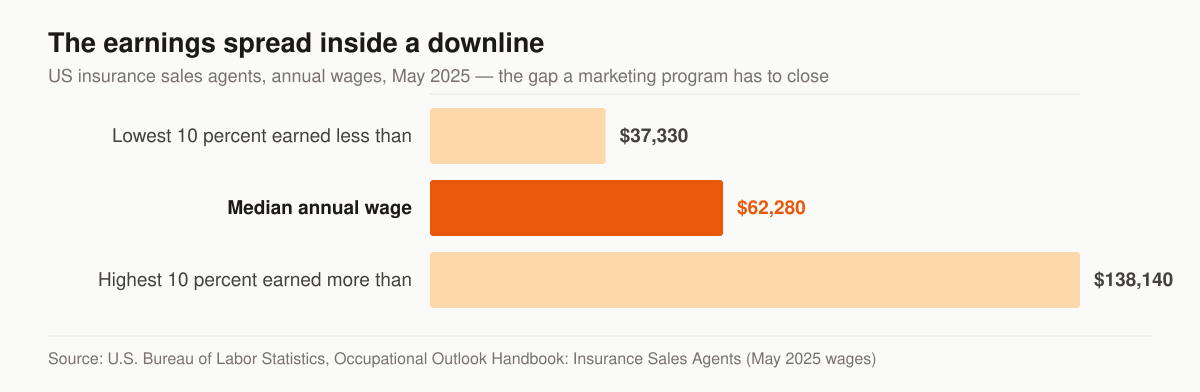
Source: U.S. Bureau of Labor Statistics, Occupational Outlook Handbook: Insurance Sales Agents, May 2025 wage data.
That spread is the whole recruiting problem in one picture. The agents at the top of it are the ones every competing upline is calling, and the agents at the bottom are the ones who quietly leave the business. A marketing program is one of the few things an upline can hand an agent that moves them along that axis, because it addresses the input — consistent, worked, attributable opportunity — rather than the output.
The churn is real and measurable too. BLS counted 572,600 insurance sales agent jobs in 2025 and projects employment to grow 3 percent from 2025 to 2035, a change of 18,800 jobs over the decade. Against that modest net growth it projects, in its own words, that “About 43,100 openings for insurance sales agents are projected each year, on average, over the decade.” BLS attributes many of those openings to “the need to replace workers who transfer to different occupations or exit the labor force, such as to retire.” An industry that replaces far more seats than it adds is an industry where retention is worth more than recruitment volume — and where the tactics in our guide to recruiting insurance agents only pay off if the agents you land have a reason to renew.
BLS also reports where these agents sit: 63 percent worked for insurance agencies and brokerages in 2025, and 12 percent were self-employed. Your addressable downline is overwhelmingly people already inside an agency structure, which is why the pitch that wins is rarely “come here for the contract” and usually “come here for what the contract comes with.”
Who this fits: FMOs, IMOs, and agency builders
The model earns its keep wherever one organization is responsible for many producers. For a senior-market FMO, that means final expense and Medicare campaigns your agents can plug into on day one of their contract. For an IMO spanning life and annuity lines, it means a recruiting story stronger than a commission grid — a real marketing engine under your name. For a growing agency building its own downline, it is the infrastructure step that separates “we have contracts” from “we have a system.” If you are still deciding whether to build this capacity in-house or hand it to an operator, the same six-criteria framework in our agency buyer’s guide applies at downline scale.
Compliance across a downline, built in
Spreading campaigns across many agents multiplies compliance exposure if it is not built for. Senior-market campaigns stay inside CMS Medicare marketing rules, consent is captured and recorded at opt-in for TCPA, and creative can route through your review before it deploys across agents — so one non-compliant ad doesn’t go live twenty times. You and your agents remain the licensed, responsible parties; we provide the marketing infrastructure and guardrails, not legal or licensed insurance advice. The senior market is where this model fits most naturally — see our final-expense marketing and senior-market marketing work for how the campaigns are built.
Your Medicare downline marketing is a TPMO activity
If any part of your downline sells Medicare Advantage, the program is not merely adjacent to CMS rules — lead generation is written into the definition. 42 CFR 422.2260 defines a third-party marketing organization as “organizations and individuals, including independent agents and brokers, who are compensated to perform lead generation, marketing, sales, and enrollment related functions as a part of the chain of enrollment (the steps taken by a beneficiary from becoming aware of an MA plan or plans to making an enrollment decision).” The same definition adds: “TPMOs may be a first tier, downstream or related entity (FDRs), as defined under § 422.2, but may also be entities that are not FDRs but provide services to an MA plan or an MA plan’s FDR.” The parallel Part D definition at 42 CFR 423.2260 is worded the same way against a Part D plan.
One scope note before anything else: these provisions sit in Subpart V of 42 CFR Part 422, which governs Medicare Advantage. The parallel Part D requirements live at 42 CFR 423.2260 and 423.2274. Neither reaches a final expense, life, or property and casualty campaign — a downline program spanning multiple lines needs the Medicare pieces walled off rather than applied to everything.
These are the obligations a branded Medicare downline program has to be designed around, with the exact provision so you can check each one yourself:
| What it governs | What the rule requires | Provision |
|---|---|---|
| Call recording | Contracts between the TPMO and an MA plan, or the plan’s FDR, must ensure that “All marketing and sales calls, including the audio portion of calls conducted via web-based technology, must be recorded and retained in their entirety for a minimum period of 6 years” — audio format for the first 3 years, audio or “complete and accurate transcript recordings” for years 4, 5, and 6 | 42 CFR 422.2274(g)(2)(ii) |
| Subcontractors | The TPMO “Discloses to the MA organization any subcontracted relationships used for marketing, lead generation, and enrollment” | 42 CFR 422.2274(g)(2)(i) |
| Monthly reporting | The TPMO “Reports to plans monthly any staff disciplinary actions or violations of any requirements that apply to the MA plan associated with beneficiary interaction to the plan” | 42 CFR 422.2274(g)(2)(iii) |
| Lead-generation disclosure | When conducting lead generating activities, the TPMO must, when applicable, “Disclose to the beneficiary that his or her information will be provided to a licensed agent for future contact” — verbally by telephone, in writing on mail or other paper, electronically by email, online chat, or other electronic messaging platform | 42 CFR 422.2274(g)(3)(i) |
| Transfer disclosure | Disclose to the beneficiary “that he or she is being transferred to a licensed agent who can enroll him or her into a new plan” | 42 CFR 422.2274(g)(3)(ii) |
| Sharing data between TPMOs | Beginning October 1, 2024, beneficiary data a TPMO collects for MA marketing or enrollment may be shared with another TPMO only on prior express written consent, obtained “through a clear and conspicuous disclosure that lists each entity receiving the data and allows the beneficiary to consent or reject to the sharing of their data with each individual TPMO” | 42 CFR 422.2274(g)(4) |
| Referral payments | Payment for a referral “may not exceed $100 for a referral into an MA or MA-PD plan and $25 for a referral into a PDP plan” | 42 CFR 422.2274(f) |
The disclaimer is the one most visible on a white-label build, because it lands on the pages and the ads your brand is on. Under 42 CFR 422.2267(e)(41), where a TPMO does not sell for all MA organizations in the service area, the standardized disclaimer is: “We do not offer every plan available in your area. Currently we represent [insert number of organizations] organizations which offer [insert number of plans] products in your area. Please contact Medicare.gov or 1-800-MEDICARE to get information on all of your options.” The rule requires that the MA organization ensure it is used by any TPMO selling plans on behalf of more than one MA organization, “Verbally conveyed during sales calls prior to the discussion of any benefits”, conveyed electronically in email and online chat, “Prominently displayed on TPMO websites”, and “Included in any marketing materials, including print materials and television advertisements, developed, used or distributed by the TPMO.”
Read that placement list against a downline program and the build implications are concrete: the disclaimer belongs in the landing-page template rather than in each agent’s hands, the organization and plan counts have to be maintained as they change, and any per-agent variation has to inherit it automatically. That is exactly why creative in this program routes through one review step before it deploys across agents — the alternative is auditing twenty copies of the same page. Our explainers on CMS Medicare marketing rules and scope of appointment and TPMO compliance go deeper on the agent-level obligations, and the Medicare marketing page covers how the campaigns themselves are built for the season.
Worth knowing too: whether a given piece of downline creative counts as “marketing” at all is a two-part test in the same definitions section. Under 42 CFR 422.2260, material is marketing when it is intended to draw a beneficiary’s attention to a plan, influence a plan selection, or influence a decision to stay enrolled — and separately when it addresses plan benefits, benefits structure, premiums or cost sharing, measuring or ranking standards such as Star Ratings or plan comparisons, or rewards and incentives. On the first prong the rule states that “In evaluating the intent of an activity or material, CMS will consider objective information including, but not limited to, the audience of the activity or material, other information communicated by the activity or material, timing, and other context of the activity or material and is not limited to the MA organization’s stated intent.” A generic “talk to a licensed agent about your Medicare options” ad and an ad naming a $0 premium are not the same regulatory object, and a downline program should know which one it is running before it scales it.
We build to these requirements; we do not interpret them for you. Confirm your own TPMO status and obligations with your counsel and with each plan you contract with.
Consent before the dial: what TCPA asks of a branded lead program
The second regime a downline program runs into is telephone consent, and white-label raises a question single-brand marketing does not: whose name is the consumer agreeing to hear from?
The rule is specific about the object of consent. 47 CFR 64.1200(f)(9) defines prior express written consent as “an agreement, in writing, bearing the signature of the person called that clearly authorizes the seller to deliver or cause to be delivered to the person called advertisements or telemarketing messages using an automatic telephone dialing system or an artificial or prerecorded voice, and the telephone number to which the signatory authorizes such advertisements or telemarketing messages to be delivered.” Note the scope: that definition governs telemarketing delivered by automatic telephone dialing system or artificial or prerecorded voice. Manually dialed telephone solicitation is governed elsewhere in the same section, chiefly the do-not-call provisions at 47 CFR 64.1200(c) and (d).
Three details in the same rule shape how a white-label capture form has to be written:
- The agreement has to be conspicuous about what it authorizes. Paragraph (f)(9)(i)(A) requires a clear and conspicuous disclosure informing the signer that by executing the agreement they authorize the seller to deliver telemarketing calls using an automatic telephone dialing system or an artificial or prerecorded voice.
- Consent cannot be a condition of purchase. Paragraph (f)(9)(i)(B) requires the disclosure to state that “The person is not required to sign the agreement (directly or indirectly), or agree to enter into such an agreement as a condition of purchasing any property, goods, or services.”
- An electronic signature counts. Paragraph (f)(9)(ii) provides that “signature” includes an electronic or digital form of signature to the extent it is recognized as valid under applicable federal law or state contract law — which is what makes a web capture form workable in the first place.
Then there is the definition that makes this a white-label question specifically. Paragraph (f)(10) defines the term seller to mean “the person or entity on whose behalf a telephone call or message is initiated for the purpose of encouraging the purchase or rental of, or investment in, property, goods, or services, which is transmitted to any person.” In a program where your FMO’s brand is on the page and your downline agent makes the call, the identification of the parties on that form is a design decision with legal weight, not a copywriting flourish. Have your counsel set the language; we build the capture, storage, and propagation around whatever they specify.
Revocation is the part downline programs most often under-build. Under 47 CFR 64.1200(a)(10), a called party may revoke consent “by using any reasonable method to clearly express a desire not to receive further calls or text messages from the caller or sender”. The rule names three methods that constitute a reasonable means per se: an automated, interactive voice or key press-activated opt-out mechanism on a call; a reply to an incoming text message using the words “stop,” “quit,” “end,” “revoke,” “opt out,” “cancel,” or “unsubscribe”; or a request made pursuant to a website or telephone number the caller designated to process opt-out requests. It also sets an outer limit: “All requests to revoke prior express consent or prior express written consent made in any reasonable manner must be honored within a reasonable time not to exceed ten business days from receipt of such request.”
Operationally that means a revocation cannot live in one agent’s phone. In a downline program the suppression has to be central — one list, applied across every agent’s outbound, every automation, and every future campaign — because the consumer opted in to your brand and is opting out of your brand. Our breakdown of TCPA compliance when buying insurance leads covers the agent-side version of the same problem.
What a white-label program costs, and who pays for what
Pricing a downline program has two halves that are worth quoting separately, because they scale on different things.
The marketing program itself is priced on our published tiers. Foundation runs $2,500/mo, Growth $3,500/mo, and Full-Funnel $5,500/mo, with a one-time website or landing-page build at $2,500–$8,000. A white-label downline build sits in the Full-Funnel tier, which is where managed paid ads, landing-page CRO, marketing automation and CRM, and full-funnel reporting live — every one of which a multi-agent program needs on day one. Ad spend is a separate pass-through paid straight to Google or Meta and never marked up by us, and programs run month to month rather than on a long lock-in. The full breakdown, including what is excluded, is on the pricing page.
The second half is scope, and it scales with agent count rather than with budget. Routing rules, per-agent tracking numbers, per-agent reporting, onboarding new recruits, and the review step on creative are all work that grows as the downline grows — a twelve-agent program and a hundred-agent program can spend the same on ads and need very different amounts of build.
Who pays which half is your decision as the upline, and each model changes agent behaviour in a predictable direction:
| Cost-sharing model | How it works | What it tends to do |
|---|---|---|
| Upline funds everything | The organization carries program fee and ad spend | Strongest recruiting pitch; weakest filter on who gets leads |
| Agent pays per lead | Leads are billed to the receiving agent at a set rate | Self-funding; agents who take leads have skin in the game |
| Split | Upline carries the program fee, agents fund their own spend | Keeps the shared infrastructure central and the volume elective |
| Production-earned | Leads are allocated as a reward against written business | Rewards producers; gives new agents nothing to start with |
What to ask a white-label marketing partner before you sign
The questions that separate an operator from a reseller are mostly about ownership and mechanics, not creative samples. Before you put your brand on somebody else’s machine, get answers in writing to these:
- Who owns the ad accounts, the pixel, the domain, and the lead data? If the answer is the vendor, the program is not white-label in any way that survives the relationship ending.
- What exactly does the agent see? Ask to see the actual agent-facing view. If a vendor logo appears anywhere in it, the recruiting value you are buying is not there.
- How is a lead assigned, and where is that decision recorded? Compare their answer against the five routing rules above and confirm the assignment is stored on the record.
- What is the fallback when an assigned agent does not respond? A program without a stated fallback window is a program that ages your paid leads inside one inbox.
- What is captured at opt-in, and does it travel with the lead? Disclosure text, timestamp, IP, source URL and the parties named — into whatever CRM the agent works from.
- How does a revocation propagate across the downline? One central suppression list, applied to every agent, is the only answer that matches the ten-business-day requirement.
- For Medicare: how is the TPMO disclaimer maintained, and by whom? Ask specifically how the organization and plan counts get updated when they change.
- What happens to the assets when an agent leaves, or when the engagement ends? Get the offboarding path documented before you need it.
Answering these is also a fair test to run on us. If you want a structured way to compare providers on the same axes, the agency buyer’s guide sets out the criteria, and you can put the same eight questions to us on the contact page.
How we run the white-label program for your downline
We operate the program and report to you; you own the brand, the offer, and the agent relationships. Whether you want a uniform program across the whole downline or a tiered setup for top producers, we build to your structure. It pairs with a fractional CMO engagement when you want strategic oversight of the whole downline’s marketing, not just execution.
Want to see what a white-label program for your agents would look like? Start with a free marketing audit of your current downline setup, or talk to the team about structure and rollout.
Guides that go deeper
Frequently asked questions
What does white-label insurance marketing actually mean here?
How is this different from just buying leads for my agents?
Can you run campaigns across many agents without them colliding?
Who handles compliance across a downline?
Do my agents need their own websites and setups?
Is a white-label marketing program a TPMO under CMS rules?
Whose consent is it when the leads carry my brand?
What does a white-label downline program cost?
See exactly where your agency is leaking leads.
15 minutes. We screen-share our own live lead dashboard and tear down your funnel line by line — no pitch deck, just numbers.
- Site speed & conversion
- Local + AI-search visibility
- Ad efficiency
- Your cost per lead vs ours
No obligation · no pitch deck