How to Choose an FMO Without Signing Away Your Book
To choose an FMO, compare contract levels alongside release policy, lead-program economics, training, tech, and carrier lineup — never the headline commission alone. An FMO earns override on everything you write, so free perks are financed somewhere, usually in your comp. Get contract level and release terms in writing before you sign anything.
Choosing an FMO is the highest-leverage contract decision an independent agent makes: it sets your commission level, your carrier access, your lead economics, and — through the release policy — how hard it is to leave if the promises don’t hold. Compare FMOs on the whole package: contract level, release terms, lead-program math, training, tech, and carrier lineup, and get every number in writing.
We build marketing systems for agents, agencies, and FMOs, which means we see this decision from both sides of the table — including how the deals are structured to look better than they pay. This is the due-diligence guide we’d hand a friend, with no vendor rankings and no named-FMO claims; the evaluation framework matters more than anyone’s top-ten list.
What does an FMO actually do?
An FMO (field marketing organization) sits between carriers and agents: it holds high-level carrier contracts, contracts agents beneath it at lower commission levels, and keeps the spread — the override — on everything those agents write. In exchange, it’s supposed to provide contracting support, training, marketing help, and sometimes lead programs. IMO is the life-side term for the same structure; evaluate both the same way.
That override is the key to reading every FMO pitch. The organization earns a slice of all your production, so everything it “gives” you — leads, tech, bonuses, trips — is funded by that spread. None of this makes FMOs bad; a good upline earns its override many times over. It just means the right question is never “what do I get free?” but “what am I paying, and what do I get for it?” It also means an FMO is not a marketing partner in the ordinary sense — the difference between an insurance marketing agency vs. an FMO comes down to who owns the demand and the assets afterward. The mechanics of levels, spreads, and advances are covered in our breakdown of final expense commission levels.
How the money moves: street level, your level, and the override
Carriers publish a top contract level — street level, in the trade — and issue it to organizations large enough to hold a direct contract. The FMO takes that level, contracts you somewhere beneath it, and keeps the difference on every policy you write for as long as that policy stays on the books. None of that is hidden in principle; it is the business model. What varies is how far beneath street you sit, and whether anyone will tell you.
Two mechanical questions decide how the money actually reaches you, and both belong ahead of the level conversation.
Who cuts your commission check? In some arrangements the carrier pays you directly on business you write. In others the upline takes assignment of commissions: the carrier pays the FMO, and the FMO pays you. Assignment is not automatically wrong — agencies use it to administer splits, advances and downline overrides — but it puts your money inside somebody else’s operating account, and it makes a dispute much harder to win. Ask which arrangement applies, carrier by carrier.
Are advances involved, and at what rate? An advanced commission is a loan against renewals the carrier expects to collect. If the policy lapses early, the advance comes back out as a debit balance. An upline that advances aggressively and releases slowly has built a structure where leaving is expensive by design, without ever writing that down anywhere.
Then ask the level question in the form that produces a usable answer: what percentage, on which carrier, in writing, and what production moves it. A verbal “we’ll take care of you at the top level” survives until your first commission statement.
FMO, IMO, NMO, MGA, GA: what the hierarchy words mean
FMO, IMO and NMO carry no statutory definition, so read those three as job descriptions rather than as tiers; “managing general agent” is the exception, because it is a defined term in state insurance code. Two organizations using the same acronym can sit at very different contract levels, and what ranks them is the level each can actually issue you.
| Term | What it usually describes | What to verify |
|---|---|---|
| FMO — field marketing organization | An upline holding carrier contracts; the label used most in Medicare and senior health | Which carriers it holds direct, and which run through somebody above it |
| IMO — independent marketing organization | The same structure, with the label used more on the life and annuity side | Whether life carriers are direct, and at what level |
| NMO — national marketing organization | A marketing label describing scale; it carries no defined contract meaning | Ask for the contract level, not the adjective |
| MGA — managing general agent | Often a rung below an FMO or IMO, sometimes with delegated underwriting authority on the P&C side; also a licensed status defined by state statute | Whether it holds the carrier paper or is itself a downline, and whether the label means the statutory MGA or the trade one |
| GA / SGA — general agent, super general agent | Mid-hierarchy positions with a downline beneath them | How many layers sit between you and the carrier |
That MGA exception is worth a moment, because the statutory version of the term describes delegated carrier authority rather than a place in a marketing hierarchy, and the two states below do not even use the same test. Virginia defines a managing general agent as a person who “manages all or part of the insurance business of an insurer” and who underwrites gross direct written premium “equal to or exceeding five percent of the surplus to policyholders of the insurer” in any one quarter or year, together with either adjusting or paying claims above an amount the Commission sets or negotiating reinsurance for the insurer (Va. Code § 38.2-1358). Texas instead defines the term as supervisory responsibility for an insurer’s local agency and field operations, or authorization by an insurer “to accept or process on the insurer’s behalf insurance policies produced and sold by other agents” — and its managing general agent chapter says it “does not apply to … the transaction of the business of life, health, and accident insurance” (Tex. Ins. Code ch. 4053). So an upline calling itself an MGA on a Texas life or health contract is using the trade sense of the phrase, not the licensed one. Ask which sense is meant, and what authority a carrier has actually delegated.
Every extra layer between you and the carrier is another override coming out of the same commission dollar. That does not make a deeper hierarchy a worse deal — a strong MGA one rung down can out-support a distant national organization — but it does mean the acronym on the letterhead tells you nothing about your economics. Ask how many uplines sit above the entity contracting you, and get the answer before you compare two offers side by side.
How to evaluate an FMO: the criteria that matter
Run every FMO conversation through the same scorecard, in writing, so two uplines can be compared on the same seven rows rather than on how the calls felt.
| Criterion | What to ask | What good looks like |
|---|---|---|
| Contract level | “What level, on which carriers, in writing?” | A specific written number per carrier, with a stated path to raises based on production |
| Release policy | “If I leave, do you grant an open release?” | Written policy, releases granted without a fight for agents in good standing |
| Lead program | “Who pays, who owns the leads, what’s the comp trade?” | Transparent pricing or a clearly stated comp reduction — not “free” with terms nobody will write down |
| Training | “What does week one to month three look like?” | A real onboarding path with product, compliance, and sales training — not just a Facebook group |
| Tech stack | “What CRM, quoting, and enrollment tools come with it?” | Working tools your team actually uses; see what a real agent CRM should do in our CRM guide |
| Carrier lineup | “Which carriers can I write, and how fast is contracting?” | The carriers that fit your market and licenses, with contracting measured in days, not months |
| Support & compliance | “Who answers when a case or a marketing rule gets messy?” | Named humans, and compliance guidance for the lines you sell |
On the tech row: an FMO’s “proprietary platform” is only worth something if it beats what you could run yourself — our guide to the best CRM setup for insurance agents is a useful baseline for judging whatever they demo.
Vet the FMO before you get on a call
Much of this diligence can be done from a browser, before anyone has your phone number and a reason to keep calling it.
Start with the staff page. An upline claiming depth in Medicare, life and group should show named people behind each of those lines rather than one shared inbox. Then look at the resources it publishes: a training calendar with dates on it, a recorded library you can actually reach, product bulletins that did not stop two years ago. An organization that cannot hold its own publishing schedule is telling you something about how it will hold your contracting timeline.
Notice what happens when you try to learn anything without submitting a form. If the only route into the organization is a recruiter call, and nothing public says which carriers it holds, what the tech does, or how releases work, you are looking at a recruiting funnel with an FMO attached to it. Uplines willing to state commercial terms on a public page are self-selecting, which is useful information before you have spent an hour on the phone.
Then talk to agents: two currently contracted, and one who left. The ones who left will describe the release process as it actually ran, which is the version of that policy that binds. Insurance is a small business with loud Facebook groups, and the same specific complaint surfacing from three unconnected agents is a pattern worth weighting more heavily than any testimonial page.
FMO with free leads: what’s the catch?
The catch is that the leads are financed, not free. An FMO funds its lead program out of the override spread, which means free or subsidized leads almost always ride on a lower contract level, a binding contract condition, or lead terms that keep you dependent. That can still be a fair trade — especially for a new agent with no marketing budget — but it’s a purchase, and you should price it like one.
Run the honest comparison before signing:
- Price the subsidy. Ask what your contract level would be without the lead program. The gap between the two levels, multiplied across your expected production, is what the “free” leads actually cost you per year.
- Ask who owns the leads. If you leave, do the leads — and the clients — stay with the FMO? Owned-by-them lead flow is a retention leash, not a gift.
- Check the strings. Production minimums to keep the lead flow, exclusivity requirements, or a no-release stance turn a lead subsidy into a lock-in.
- Compare against building your own flow. At a higher contract level, the extra commission per sale is a marketing budget. Whether that beats the subsidized deal depends on your volume and close rate — the same math we walk through in the true cost of “free” final expense leads.
There’s no universal answer — subsidized leads can genuinely be the right bridge for a first-year agent. The red flag isn’t the trade; it’s an FMO that won’t state the trade plainly.
Vesting, renewals, and what happens to your book
Vesting decides whether renewal commissions keep reaching you after you stop writing for a carrier or leave an upline. It is set in the carrier’s agent agreement and, in some hierarchies, modified by the upline’s own contract layered on top of it. Three arrangements are worth being able to name, because the gap between them can be worth more over a decade than any first-year level bump:
- Vested from issue. Renewals follow you regardless of where you contract next.
- Vested after a period. Renewals follow you only once the policy, or your appointment, has aged past a stated threshold.
- Vested with the upline. Renewals stay inside the hierarchy. Leave, and the trail either stops or continues paying somebody else.
Ask which one applies, carrier by carrier, and ask for the paragraph rather than the summary. Then ask the follow-up nobody volunteers: does the upline’s own agreement alter the carrier’s vesting terms? A carrier can vest you from issue while the FMO agreement you signed reassigns that trail back into the hierarchy on termination, and those are two separate documents that rarely arrive together.
On the life and final expense side this compounds quietly, because the renewal tail is where a mature book stops behaving like a treadmill. If you are building toward an agency rather than a personal book, vesting also decides what you can eventually sell — the constraint that runs underneath everything in growing a final expense agency.
Release policy in practice: waiting periods and blackout windows
A release is written permission to move a carrier contract to a different upline. It carries so much weight because the alternative is a waiting period. Without a release, some carriers require an agent to stop writing that carrier’s business for a set stretch before recontracting elsewhere. Ritter, which describes itself as a national FMO, puts the practice plainly on its own agent-education page: “For some FMOs, you must either get a written release from your upline, or refrain from writing business for six months.” (Ritter Insurance Marketing)
That is the mechanism. Five things to pin down before you sign:
- Is the policy written, and where? “We’re an open-release shop” said on a call is not a policy. Ask for the clause or the public page.
- What conditions attach? Open release with stipulations is normal — debit balance cleared, no open compliance matter. Open release at the upline’s discretion is not a policy at all.
- How long does processing take? A policy that grants releases but takes months to move them is a waiting period wearing a friendlier name.
- Does a carrier blackout window apply? Some carriers restrict contract movement during set periods regardless of what your upline agrees to. The FMO Action Benefits, describing its own terms, says it grants an unconditional release at any time provided the agent is not inside a carrier blackout window (Action Benefits). The caveat is the part to note, because that restriction belongs to the carrier rather than to the upline.
- What happens to a downline? If you have agents contracted under you, a release covering your personal contracts may not move theirs.
What we look for: an upline confident in its own value states release terms plainly, because it does not expect to need the leverage. The same logic is why we publish our own terms — month to month, no lock-in — on the pricing page rather than negotiating them per prospect.
How much of your Medicare pay is set by regulation, not by your FMO?
On Medicare Advantage and Part D, a large share of your compensation is fixed in federal regulation before any upline gets involved. 42 CFR 422.2274 defines a fair market value figure per enrollment and states: “Beginning January 1, 2021, the national FMV is $539, the FMV for Connecticut, Pennsylvania, and the District of Columbia is $607, the FMV for California and New Jersey is $672, and the FMV for Puerto Rico and the U.S. Virgin Islands is $370.” The same paragraph sets the escalator, providing that “FMV is calculated by adding the current year FMV and the product of the current year FMV and MA growth percentage for aged and disabled beneficiaries”, which CMS publishes each year in its rate announcement.
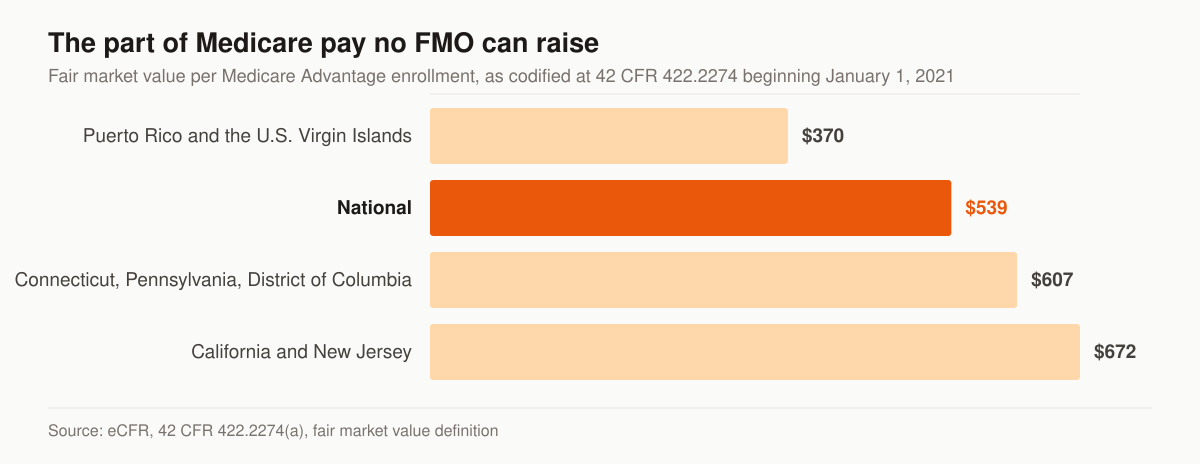
The regional fair market value figures codified at 42 CFR 422.2274(a), effective January 1, 2021, before the annual growth adjustment the same paragraph prescribes. Source: eCFR, 42 CFR 422.2274.
Three consequences for the FMO decision follow from that.
Renewal compensation is pegged, not negotiated. The section ties renewal years to half of fair market value — “at a rate of up to 50 percent of FMV” for contract years through 2024, and “at 50 percent of FMV” for contract years beginning with contract year 2025 (42 CFR 422.2274(d)(3)).
Part D is a separate and much smaller number. Part D compensation lives in its own section — 42 CFR 423.2274, not Part 422 — and that section states “Beginning January 1, 2021, the national FMV is 81” (the regulation omits the dollar sign there). An upline quoting you one blended Medicare figure is blending two regulated products with very different economics.
Referral payments are capped in dollars. Both sections cap referrals at “$100 for a referral into an MA or MA-PD plan and $25 for a referral into a PDP plan”. An organization offering meaningfully more than that for a referred enrollment is describing something the plan is not permitted to fund that way.
One live caveat before you treat any of this as settled. In 2024 CMS tried to pull administrative payments made to third-party marketing organizations — a category that includes FMOs — inside the compensation cap, and to restrict what could be written into agent contracts. Both were challenged and struck down. The Center for Medicare Advocacy, reporting the August 18, 2025 decision in Americans for Beneficiary Choice v. HHS, wrote that “The Fixed Fee and Contract-Terms Restrictions are now permanently vacated”, while the beneficiary-consent requirements were upheld (Center for Medicare Advocacy). Because the vacated language still appears in the published section, agents get confidently contradictory answers about what is in force. Treat any upline’s summary of the compensation rules as a claim to check rather than a fact, and read the rest of the marketing requirements in our walkthrough of the CMS Medicare marketing rules.
Chargebacks: what triggers one and how far back it reaches
Every FMO conversation should include a plain question about chargebacks, because on Medicare the rules are federal and an upline that cannot explain them will not be explaining your debit balance either.
The trigger with the sharpest edge is rapid disenrollment. Compensation recovery is required when “A beneficiary makes any plan change (regardless of the parent organization) within the first three months of enrollment (known as rapid disenrollment)”, and where that applies, “the entire compensation must be recovered” (42 CFR 422.2274(d)(5)). Not a portion of it.
Outside rapid disenrollment, recovery is pro-rated by month, and the regulation works the arithmetic itself: “Example: A beneficiary enrolls upon turning 65 effective April 1 and disenrolls September 30 of the same year. The plan paid full initial enrollment year compensation. Recovery is equal to 6/12ths of the initial enrollment year compensation (for January through March and October through December).” Read that example closely — it charges back the months before the enrollment began as well as the months after it ended.
The rule then carves out exceptions. One clause covers enrollments effective October 1, November 1 or December 1 that change at the Annual Election Period for a January 1 effective date. A second lists fourteen enumerated reasons an enrollment change is “not in the best interests of the Medicare program”, among them death, moving out of the service area, non-payment of premium, plan termination, and “Moving into a 5-star plan”. Those exceptions are money. An upline whose commission desk does not know them will let recoveries stand that should have been reversed.
So the questions are: who audits chargebacks on your behalf, what becomes of an open debit balance if you leave, and — on the final expense side, where advances make this sharper — how the upline treats a debit balance against future business. It is the same arithmetic that decides whether a lead program pays, which is why cost per sale rather than cost per lead is the figure to run before you agree to anything.
Red flags that should end the conversation
- No contract level in writing. “We’ll take care of you” is not a number.
- Vague or hostile release terms. If leaving is designed to be painful, the deal is designed to not need to be good.
- Recruiting pitched harder than production. If the income story is mostly about building a downline rather than writing business, you’re the product.
- “Free leads” nobody will document. No written terms on who pays, who owns, and what comp trade applies.
- Pressure to sign today. Carrier contracts follow you; a legitimate offer survives a week of diligence.
- No compliance answers. In Medicare especially, an upline that shrugs at marketing rules is a liability you inherit.
The due-diligence checklist before you sign
- Get the contract level for each carrier you’ll write, in writing, plus the production thresholds for raises.
- Get the release policy in writing — and treat a refusal to put it in writing as your answer.
- Ask exactly what the lead program costs: comp reduction, per-lead price, ownership, and strings.
- Talk to two or three agents currently contracted there — and at least one who left.
- Confirm carrier lineup and realistic contracting timelines for your states and licenses.
- Sit in on the actual training and demo the actual tech before contracting, not after.
- Read the agent agreement for vesting, chargeback handling, and any non-solicit language.
- Decide what you’ll self-fund: if you’re building your own lead flow, negotiate level, not perks.
Twelve questions to ask, and the answers that should worry you
Take this list into the call and write the answers down, because the signal is often the hesitation rather than the number.
| Ask this | A workable answer sounds like | Treat this as a warning |
|---|---|---|
| What contract level, on which carriers? | A figure per carrier, in writing | “Top level” with no number attached |
| What moves my level, and when? | Stated production thresholds and a review date | “Once you prove yourself” |
| Who pays my commissions? | The carrier, direct, on business I write | Assignment to the upline, unexplained |
| Are commissions vested, and from when? | A carrier-by-carrier answer plus the clause | A general reassurance about renewals |
| Does your agreement change the carrier’s vesting terms? | A direct no, or the paragraph that does | Uncertainty about whether it could |
| What is the release policy, in writing? | A published policy with stated conditions | Discretion, silence, or a request to trust them |
| How long does a release actually take? | A stated processing window | “It depends on the situation” |
| Are advances offered, at what rate, and what happens to a debit balance if I leave? | A specific rate and a stated policy | Enthusiasm about the advance, vagueness about the balance |
| What does the lead program cost me in level, dollars or obligations? | An explicit trade you can price out | “The leads are free” |
| Who owns the leads and the client data if I leave? | You do, stated in the agreement | The question gets reframed |
| Which carriers are held direct, and how many uplines sit above you? | A straight count | An answer about size instead of structure |
| Who handles a chargeback dispute or a compliance question? | Named people and a process | A group chat |
None of these require you to know more than the person answering. They require only that the answer exist. Ask them in the same order every time and the difference between two uplines stops being a matter of chemistry. Keep the completed sheets — the one you signed with is the document you will want when the terms and the practice stop matching.
Line-specific notes: final expense, Medicare, ACA
Final expense. FE is advance-and-chargeback country, so ask how the FMO handles chargebacks and debit balances, and weigh lead programs against your real cost per sale — the contract-level math in our final expense commission guide is the starting point.
Medicare. Agent compensation on Medicare Advantage and Part D is regulated, which narrows how much FMOs can differentiate on comp — so the real differences are support, tech, and compliance depth. An upline that keeps you inside CMS Medicare marketing rules is worth more than one that promises the moon on overrides.
ACA. The under-65 health space swings with enrollment seasons, so evaluate an ACA FMO on enrollment tooling, carrier breadth in your states, and whether its lead flow survives outside open enrollment — the seasonality problem we cover in how ACA agents fill their pipeline during OEP.
What an FMO will not do for you
Even a strong upline is a distributor, not a demand engine. It can put carrier paper in your hands, teach you the products, run your contracting, and hand you leads it bought or generated. What it does not build is an asset that keeps working after you leave, because its incentives run the other way.
That is the practical line between an upline and a marketing vendor. An FMO’s investment in your visibility pays off only while you write under its hierarchy, so the site sits on its domain, the form feeds its CRM, and the tracked phone number belongs to the program. A vendor you pay directly holds no override and no retention interest, which is why ownership terms are the clause to read there instead — the criteria are laid out in our comparison of insurance marketing providers, and the compliance side for regulated lines in insurance marketing compliance for agents.
The two paths also price differently, and that difference is the whole argument. Marketing support inside an FMO is paid for out of your contract level: invisibly, indefinitely, and at a rate you cannot read off a page. A retainer is a line item you can compare and cancel. Price them against each other honestly rather than treating either one as free.
The other side of the table
Everything above is the agent’s view. If you run an FMO or IMO, notice what the whole checklist implies: agents pick — and stay with — uplines that offer a real system, not just a contract grid. That system is what our white-label marketing program for FMOs and IMOs builds: branded lead generation, capture pages, and follow-up your whole downline can run under your name, which is also the strongest answer to every recruiting objection in our agent recruiting playbook.
And if you’re an agent doing this diligence right now, bring the numbers — contract level, lead cost, close rate — to a free marketing audit and we’ll show you what your production could fund if you owned the lead flow yourself.
- How to Recruit Insurance Agents: The Recruitment-Marketing Playbook
How to recruit insurance agents with marketing, not just job boards: employer brand, recruitment ads, funnels, and referral systems for agencies and FMOs.
- Best Insurance Marketing Agencies & Companies: A Buyer's Guide
Best insurance marketing agencies compared by provider type, real cost ranges, and the six vetting criteria that matter. See which model fits your agency.
- 40 Content Ideas for Final Expense Agents You Can Steal This Week
40 content ideas for final expense agents: cost and qualifying answers, video hooks, offline angles, and the capture step that turns views into leads.
- Best CRM for Insurance Agents: An Honest, Vendor-Neutral Guide
A vendor-neutral guide to the best CRM for insurance agents — CRM vs AMS, the best tools by line and budget, real 2026 pricing, and where marketing fits.