Service
Insurance Advertising, Run as One Funnel
One managed advertising engine — search, social, and landing pages — reported to the only number that matters, your cost per sale.
- We run our own final-expense book
- No pitch deck — we screen-share real numbers
- TCPA-aware · CMS/AEP-compliant · Meta Special Ad Category
- Core Web Vitals < 2.0s LCP
Insurance advertising is the paid engine — search ads, social ads, and the landing pages behind them — run as one funnel instead of three disconnected line items. We build and manage the full stack for agents and agencies, tracked past cost per click to cost per sale, so budget moves to whatever actually writes policies.
What you get
What your insurance advertising program includes
- Paid search and Local Services Ads campaigns on buyer-intent keywords, with negative-keyword discipline that blocks junk traffic
- Meta campaigns built correctly inside the Special Ad Category, with problem-first creative refreshed before fatigue sets in
- A dedicated landing page per offer, built for message match and speed — never your homepage
- Conversion and call tracking wired before spend scales, tying every form fill and call to its keyword, audience, and geo
- A creative testing queue — three variations live per offer, losers cut weekly, winners scaled
- One cross-channel budget reallocated weekly toward whichever channel produces the cheapest booked appointments
- Compliance-aware copy across the stack — platform policy, TCPA-conscious consent language, CMS-aware Medicare creative
- Creative batched ahead of your carrier's approval calendar, so the testing queue is not waiting on a compliance desk
How it works
How the insurance advertising engagement runs
- 01
Audit the current spend
We read your existing ad accounts and landing pages, find where the budget leaks, and show you the math before proposing anything.
- 02
Build the funnel
Search and social campaigns, dedicated landing pages, and conversion tracking go up as one system — tracking live before a dollar scales.
- 03
Launch a readable test
A test budget sized to your commission and close rate buys enough signal to judge, with the click-to-lead math shown up front.
- 04
Cut, scale, reallocate
Weekly, losing creative, keywords, and audiences are killed; budget moves across channels to whatever produces cheap booked appointments.
- 05
Report to cost per sale
Your weekly report maps spend to leads, appointments, and closed policies — the number that decides the next dollar, not CPC vanity.
Insurance advertising is a rigged comparison if you fight it head-on: six major auto insurers alone spent a combined $5.8 billion+ on advertising in 2022. You don’t outspend that — you out-aim it. Carriers buy national recall; an agent buys the local buying moment. Our job is making sure that moment lands on your funnel instead of a competitor’s, and that every dollar is accounted for at the policy level.
The economics reward discipline. In LocaliQ’s 2026 search benchmarks, the insurance category averages $3.39 per click but $74.44 per lead on a 2.64% conversion rate — which means the landing page and the offer, not the click price, decide whether your advertising is cheap or ruinous. That is why we refuse to run ads without owning the page and the tracking behind them.
What’s included in a managed insurance advertising program
The table below lists the six pieces we build and run under one engagement, and the job each one is doing in the funnel.
| Piece | What we do | Why it’s in the stack |
|---|---|---|
| Paid search | Buyer-intent keywords, LSAs, negative-keyword discipline | Catches the high-intent buying moment |
| Social ads | Special-Ad-Category-correct Meta campaigns, creative testing queue | Fills the top of the funnel at the lowest cost |
| Landing pages | One dedicated page per offer, built for message match and speed | Conversion rate is where lead cost is actually set |
| Tracking | Conversion + call tracking tied to keyword, audience, geo | Platforms optimize toward what you measure |
| Budget control | One cross-channel budget, reallocated weekly | Money moves to whichever channel closes cheapest |
| Reporting | Spend → leads → appointments → policies → ROAS | Decisions come from cost per sale, not CPC |
Each piece also exists as a standalone engagement — managed Google Ads, social media advertising, and conversion-built landing pages — but the advertising engagement runs them as one system with one scoreboard. Paid search is also where the LSA question gets settled early, since whether LSAs are available in your state and your line decides whether part of the budget buys leads instead of clicks. That’s the point: a cheap Facebook lead and an expensive search lead can’t be compared until the same tracking follows both to a closed policy.
What does insurance advertising cost?
Two separate numbers, and conflating them is how the budget conversation goes wrong before it starts. The media budget goes to the platform and is billed at cost. The management fee is what you pay to have the campaigns built, tested, reported and kept inside policy.
Our published bands sit on the pricing page: Foundation at $2,500 a month, Growth at $3,500 a month, and Full-Funnel at $5,500 a month, which is the tier that carries managed paid ads on Google and Meta alongside landing-page CRO, marketing automation and full-funnel reporting. A one-time website build runs $2,500–$8,000. Ad spend sits outside all of those and goes straight to Google or Meta.
For the media side, the closest public reference point is LocaliQ’s 2026 search advertising benchmarks, last updated June 1, 2026, drawn with WordStream from thousands of Google Ads and Microsoft Ads campaigns across more than twenty industries.
The table below sets the finance and insurance category against the all-industry average on the four numbers a search campaign is judged on.
| Metric | Finance and insurance | All industries |
|---|---|---|
| Average cost per click | $3.39 | $5.42 |
| Average click-through rate | 9.83% | 6.64% |
| Average conversion rate | 2.64% | 8.18% |
| Average cost per lead | $74.44 | $66.69 |
Source: LocaliQ / WordStream, 2026 Search Advertising Benchmarks, last updated June 1, 2026.
Read down that column and the shape of the problem is plain. Insurance buys clicks below the all-industry average and earns a click-through rate well above it — and still pays more per lead than the average advertiser. The gap opens entirely at the conversion step. LocaliQ’s own senior marketing manager Cliff Sizemore makes the same point about cost per click: “Focusing too much on cost per click can lead you to cheaper clicks that don’t convert. I pay close attention to conversion rate and cost per lead in relation to CPC,” he said in the report.
Two caveats before anyone builds a plan on that table. It is one vendor’s client base, not a census, and its “finance and insurance” bucket is far wider than final expense in one county — a bank, a lender and a Medicare agency all land in the same row. Treat it as a sanity check on a proposal, not a forecast for your metro. If you want the line-level view instead, our breakdown of insurance PPC cost per click by line is the narrower read.
Why insurance advertising wins the click and loses the conversion
The conversion rate is where the category is genuinely an outlier, and it is worth seeing against the full field rather than against a single average.
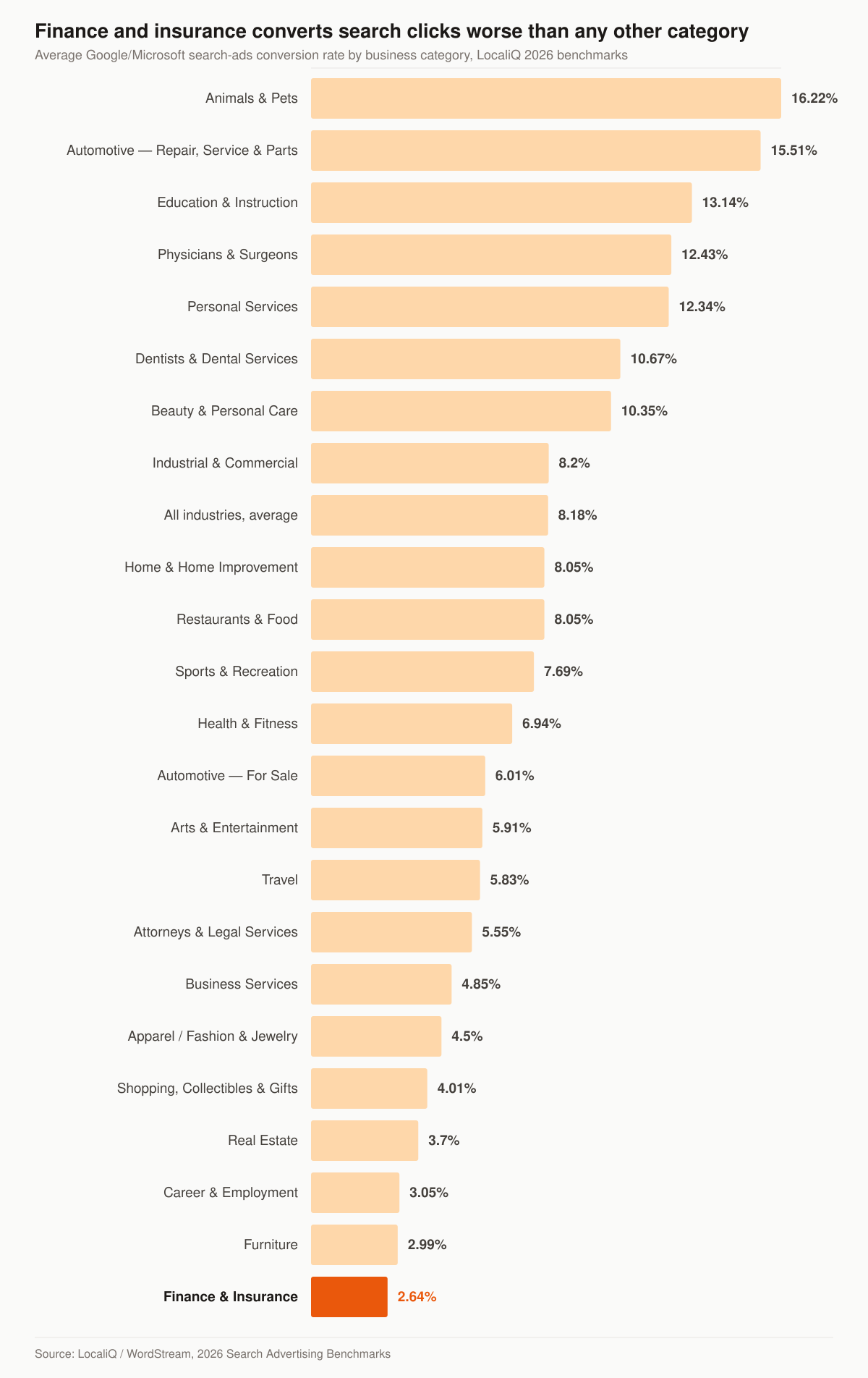
Average search-advertising conversion rate by business category. Finance and insurance sits at 2.64%, the lowest of the twenty-three categories the report lists. Source: LocaliQ / WordStream, 2026 Search Advertising Benchmarks.
Nothing about that is mysterious. An insurance click is a person mid-comparison who has three more tabs open, is being retargeted by four carriers, and has not decided whether to talk to anyone at all. The ad’s job ends at the click; everything after it is the offer, the page, the form and the speed of the callback. Which is why an advertising engagement that stops at the ad account is buying the expensive half of the funnel and leaving the cheap half unfixed.
Practically, that reorders the work. Before we raise a bid we look at whether the page matches the ad’s promise, whether the form asks for more than the offer has earned, and whether anyone answers inside the window where a lead still remembers filling in the form. Those are landing page and follow-up problems, and they move the number in the table above further than a keyword edit does.
How the insurance advertising engagement runs
- Audit — we read your current accounts and pages and show you where spend leaks before we propose anything.
- Build — campaigns, landing pages, and tracking go up as one funnel; tracking is live before scale.
- Test — a budget sized to your commission and close rate buys a readable signal, with the math shown up front.
- Cut and scale — weekly kills and reallocations across channels, not within one.
- Report to cost per sale — the weekly number that decides the next dollar.
Creative is the targeting now
Platform rules stripped most demographic levers from insurance advertisers — Meta’s Special Ad Category removes fine-grained age and geography targeting, so the ad itself has to qualify the prospect. Our creative process is built for that: problem-first hooks by line, three live variations per offer, and a refresh queue so senior-market audiences never see a fatigued ad. If you want to see the patterns we steal from — and the copy formulas we apply per line — the teardown of famous insurance advertising examples shows the receipts.
There’s also a reason to advertise where the industry under-invests. Brian Steiner, executive director of Life Happens, put it bluntly in LIMRA’s 2025 Barometer release: “Educating consumers about life insurance on social media is no longer a ‘nice to have;’ it’s a ‘must.’” The agents filling that education gap with compliant, problem-first creative are buying attention their competitors leave on the table.
Which regulator polices which part of an insurance ad?
It is easy to picture one compliance gate. There are several, they run at the same time, and clearing one buys nothing at any of the others. Meta approving your ad says nothing about your state’s advertising regulation; a carrier signing off on a headline says nothing about the FTC’s rules on the review screenshot underneath it.
The table below maps the layers a single insurance campaign passes through, and where on this site each one is covered in depth.
| Layer | Who writes the rule | What it reaches | Covered in depth |
|---|---|---|---|
| State insurance advertising regulation | Your state department of insurance, generally on NAIC model lines | Material designed to create public interest in the policy, the insurer or the producer | insurance marketing compliance for agents |
| Ad copy and claims | Same state regulation, plus the carrier’s own review | Naming, comparisons, guarantees, non-guaranteed values | insurance copywriting rules |
| Reviews and testimonials | FTC, 16 CFR Part 465 | Fake or incentivised reviews, insider reviews, review suppression, fake follower counts | reputation management |
| Calls and texts to a lead | FCC, 47 CFR 64.1200 | Consent for autodialed and prerecorded telemarketing | TCPA for agents buying leads |
| Medicare creative and callbacks | CMS, 42 CFR part 422 | TPMO disclaimer, marketing material rules, call recording | Medicare marketing |
| Platform policy | Meta and Google | Category declaration, prohibited personal attributes, ad review | Facebook ads and insurance PPC |
We are describing regulations here, not giving legal advice, and we are not the licensed party on anything we write. What we do is build the campaign so that each of those layers has an owner and a place in the process rather than surfacing as a surprise after spend has started.
What counts as an advertisement to a state insurance regulator?
Much more than the paid ad. The NAIC’s Advertisements of Life Insurance and Annuities Model Regulation defines an advertisement as material “designed to create public interest in life insurance or annuities or in an insurer, or in an insurance producer; or to induce the public to purchase, increase, modify, reinstate, borrow on, surrender, replace or retain a policy including:” That list is deliberately medium-agnostic: “Printed and published material, audiovisual material and descriptive literature of an insurer or insurance producer used in direct mail, newspapers, magazines, radio and television scripts, telemarketing scripts, billboards and similar displays, and the Internet or any other mass communication media.” A separate clause reaches “Prepared sales talks, presentations and materials for use by insurance producers.”
Line that up against a paid funnel and almost every asset is in scope. The ad is an advertisement. So is the landing page, the video, the confirmation email that urges the reader to complete an application, and the script the agent reads on the callback. The regulation is not aimed at ad platforms; it is aimed at material that creates public interest in a policy, which is exactly what a funnel is built to do.
Three scope limits belong in the same breath, because dropping them is how this rule gets misquoted. It is a model, not law — it binds only as your state adopts it, and states amend the text they adopt. It governs life insurance and annuities; accident and health advertising sits under a separate NAIC model. And the model carves things out: communications inside an insurer’s own organization, communications with policyholders other than material urging them to purchase, increase, modify, reinstate or retain a policy, and a general announcement to a group policyholder’s eligible list are excluded from the definition.
On penalties, the model’s own Section 10 reads: “An insurer or its officer, directors, producers or employees that violate any of the provisions of this regulation, or knowingly participate in or abet such violation, shall be subject to a fine up to $1000 for each violation and suspension or revocation of its certificate of authority or license.” Note both halves — a direct violation and a knowing participation in someone else’s — and note that the fine attaches per violation, which is a different exposure profile for an always-on ad set than for a single brochure. States set their own figures when they adopt.
The record-keeping side is covered in detail on our IUL compliance write-up, which walks the advertising-file requirement and its retention clock. For an advertising engagement the practical version is short: assume every asset you run is filed somewhere, and build the funnel so producing that file later is a lookup rather than an archaeology project.
How does carrier approval fit a weekly creative-testing queue?
This is the operational collision we plan for first on a new account, because it sets a ceiling on how fast the creative can improve.
Paid media rewards volume of creative. Our own build calls for three live variations per offer with losers cut weekly, and the Meta side of the funnel needs that rotation more than search does, because the creative is doing the qualifying the audience panel no longer can. But the advertising model puts a control loop in front of that rotation. Section 3B reads: “All advertisements, regardless of by whom written, created, designed or presented, shall be the responsibility of the insurer, as well as the producer who created or presented the advertisement. Insurers shall establish and at all times maintain a system of control over the content, form and method of dissemination of all advertisements of its policies. A system of control shall include regular and routine notification, at least once a year, to agents, brokers and others authorized by the insurer to disseminate advertisements of the requirement and procedures for company approval prior to the use of any advertisements that is not furnished by the insurer and that clearly sets forth within the notice the most serious consequence of not obtaining the required prior approval.”
Two things follow. Responsibility is shared, so “the agency wrote it” is not a defence available to the producer who ran it. And where a carrier requires prior approval of producer-made material, the approval desk — not Meta’s review system and not your media budget — is what sets your real testing cadence.
There is a second, discretionary gate in the same model. Section 9B provides that “If the commissioner determines that an advertisement has the capacity or tendency to mislead or deceive the public, the commissioner may require an insurer or insurance producer to submit all or any part of the advertising material for review or approval prior to use.” That is a lever a regulator can pull on a specific advertiser, which is another reason a clean record is worth more than a clever headline.
We plan around all of that rather than pretending it isn’t there. Creative gets written in batches and submitted ahead of the flight it is meant for, so the queue always has approved variations waiting; angles that need a long review go in early and quick-turn variations of already-approved copy carry the weekly tests. What your carrier actually requires comes from the carrier and from your state’s adopted rule, so the first build week includes reading both. If you run under an FMO or upline that owns the compliance desk, our white-label and FMO work is set up for that chain of approval.
Can insurance advertising use reviews and testimonials?
Real ones, handled carefully — and since October 21, 2024 there has been a federal rule squarely on the point. The FTC’s Rule on the Use of Consumer Reviews and Testimonials, 16 CFR Part 465, makes it “an unfair or deceptive act or practice and a violation of this part for a business to write, create, or sell a consumer review, consumer testimonial, or celebrity testimonial that materially misrepresents, expressly or by implication” that the reviewer exists, that they had experience with the service, or what that experience was. Section 465.4 reaches incentives: it is a violation “to provide compensation or other incentives in exchange for, or conditioned expressly or by implication on, the writing or creation of consumer reviews expressing a particular sentiment, whether positive or negative, regarding the product, service, or business that is the subject of the review.”
The clause that bites hardest in paid media is the definition of a clear and conspicuous disclosure. For an interactive electronic medium — social and the web — the rule says “the disclosure must be unavoidable. A disclosure is not clear and conspicuous if a consumer must take any action, such as clicking on a hyperlink or hovering over an icon, to see it.” That is a design constraint on an ad unit, not a legal footnote: a material-connection disclosure parked behind a “see more” fold on a social post is the exact pattern the sentence describes.
The FTC publishes its own inflation-adjusted penalty schedule at 16 CFR 1.98, which sets the maximum under section 5(m)(1)(A) of the FTC Act at $53,088 and states that the listed amounts “apply only to penalties assessed after January 17, 2025, including those penalties whose associated violation predated January 17, 2025.” Whether any particular ad draws a penalty is a question for counsel, not for a marketing page; the number is here so the order of magnitude is not a surprise.
Underneath the federal rule, the insurance-specific conditions still apply. The NAIC advertising model requires testimonials to be genuine, current, applicable to the policy advertised and accurately reproduced, and requires disclosure where the person giving one has a financial interest in the insurer. Our insurance copywriting guide maps those conditions to actual ad copy, and the review-generation side is where the raw material comes from in the first place.
Compliance is built in, not bolted on
Special Ad Category setup on Meta, CMS-aware Medicare creative, TCPA-conscious consent language on every form — compliance failures don’t just risk fines, they kill ad accounts, and a dead account is the most expensive marketing outcome there is. We provide marketing services, not licensed insurance advice; you stay the licensed party and your counsel signs off on disclosures.
How do you split one budget across search, social, and pages?
Not by percentages picked in advance. The split is an output of the reporting, and it changes month to month. What stays fixed is the job each channel is hired to do and the number that decides whether it keeps its share.
The table below is the allocation frame we manage against — what each line item buys, and the metric that moves its budget next week.
| Line item | What the money buys | What decides its next dollar | Where it is built |
|---|---|---|---|
| Paid search | People already looking for cover | Cost per booked appointment by keyword group | insurance PPC |
| Local Services Ads | Leads rather than clicks, where the category and state allow | Availability, and lead-to-appointment rate | LSAs for agents |
| Meta campaigns | Cold demand that is not searching yet | Creative rotation and speed to first contact | insurance Facebook ads |
| Organic social | The credibility check a cold clicker runs on you | Cadence and content fit, not spend | social media |
| Landing pages | The conversion rate every channel rides on | Message match, load speed, form length | landing pages |
| Follow-up and routing | Whether a lead ever becomes a conversation | Contact rate and time to first touch | appointment setting |
The comparison only works when the same tracking follows every channel to the same event. Run search on cost per lead and Meta on cost per lead and the cheaper channel wins on paper regardless of what happened afterwards — which the benchmark table above already warns against, since the category with the strong click-through rate is also the one with the weak conversion rate. Judge both on booked appointments and the ranking often inverts.
Budget size is a separate question from budget split. Our answer is that the floor is set by how many conversions the platform needs before its optimization is doing anything useful, not by a round number that sounds committed. We size a test from your average commission and close rate and show the arithmetic before you spend, which is also what the agency marketing budget guide works through in detail.
Which insurance lines does advertising run for?
The funnel structure holds across lines. What changes is the constraint that shapes the build, and we treat getting that right as prior to any bid-strategy decision.
The table below lists the lines we run advertising for and the constraint we build each campaign around.
| Line | The constraint that shapes the build | Line page |
|---|---|---|
| Final expense | Senior audience, no age targeting available to reach it, speed-to-lead decides the sale | final expense marketing |
| Medicare | CMS marketing rules govern the creative, the callback and the disclaimer chain | Medicare marketing |
| Life and IUL | Non-guaranteed values; illustrations and return language are the review risk | life insurance marketing |
| Annuities | High ticket, long consideration; the funnel has to qualify before an agent’s hour is spent | annuity agent marketing |
| Auto and home | Rate-shoppers at a switching moment; the offer has to filter and the bind has to be fast | P&C agent marketing |
| Mortgage protection | Home-ownership angles can pull the campaign into a second restricted category on Meta | mortgage protection marketing |
| ACA | Enrolment calendar drives the spend curve, and marketplace rules govern the creative | ACA agent marketing |
Calendar-driven lines deserve a note of their own. Medicare and ACA compress most of the year’s demand into a fixed enrolment window, which means the test budget has to be spent before the window rather than inside it — an account still learning during AEP is learning on the expensive weeks.
What number tells you insurance advertising is working?
Not impressions, not click-through rate, and not cost per lead. The chain that matters runs spend → click → lead → contacted → appointment held → policy issued, and only the last link pays anybody. Every link before it can look excellent while the one after it fails.
That is not a contrarian position; it is the same conclusion the benchmark publisher reaches. Katia Hausman, LocaliQ’s vice president of paid media products, states it in the 2026 report: “If you’re only tracking how many leads your campaign drove, you’re missing the point. You need to know which of those leads actually turned into customers, and that needs to feed into how you’re bidding—not just how you’re reporting.” Amy Bishop, senior vice president of performance marketing at Waystar, draws the same line between the metrics you watch and the metrics you steer by: “I generally advise that CPC and CTR are health metrics. They’re important to keep a pulse on and to use as levers to achieve your goals. However, they aren’t KPIs.”
So the instrumentation comes before the spend, not after the first disappointing month. Conversion tracking and call tracking go live before budget scales, each form fill and call carries the keyword, audience and geo that produced it, and the CRM sends the outcome back so the platform is optimizing toward appointments held rather than forms submitted. Where a line’s sales cycle is too long for that loop to close inside a reporting month, we bid to the closest reliable proxy — an appointment held — and reconcile to issued policies as they land.
The weekly report is built to answer one question: which channel, keyword, audience and creative produced booked business, and what did each one cost to get there. Everything else on it is context.
Ready to see where your current ads leak? Start with a free marketing audit — we show the math before we ask for the budget. Or compare scope against our pricing and the full services lineup, or just get in touch with the account you want read.
Guides that go deeper
Frequently asked questions
What does an insurance advertising agency do?
How is this different from hiring a PPC agency?
How much should an insurance agent spend on advertising?
Which insurance lines does advertising work best for?
Do you handle advertising compliance?
How fast do ads start producing leads?
Does a state insurance regulator treat a Facebook or Google ad as an advertisement?
Do ads have to be approved by the carrier before they run?
See exactly where your agency is leaking leads.
15 minutes. We screen-share our own live lead dashboard and tear down your funnel line by line — no pitch deck, just numbers.
- Site speed & conversion
- Local + AI-search visibility
- Ad efficiency
- Your cost per lead vs ours
No obligation · no pitch deck