Service
The Insurance Sales Funnel for Agents, Built End to End
A prospect's whole path — click, capture, nurture, booked appointment, close — runs as one connected, automated system instead of disconnected parts, so leads stop leaking between the landing page and the sale.
- We run our own final-expense book
- No pitch deck — we screen-share real numbers
- TCPA-aware · CMS/AEP-compliant · Meta Special Ad Category
- Core Web Vitals < 2.0s LCP
An insurance sales funnel for agents is the connected system a prospect moves through from first click to issued policy — capture, nurture, book, and close — with automation between each stage. Unlike a single landing page, it is the whole journey: the page captures the lead, then follow-up, booking, and CRM handoff carry it to a sale.
What you get
What your insurance sales funnel for agents program includes
- A mapped funnel for your line — every stage from ad click to issued policy drawn out with the current conversion rate and drop-off at each step, so the leak is visible before anything is built
- The capture layer — a single-purpose [landing page](/services/insurance-landing-pages) with compliant consent, wired as the funnel's entry point rather than a standalone asset
- The nurture layer — an automated email-and-SMS cadence that works the lead across the days and weeks most sales actually take, built on our [email automation](/services/insurance-email-automation) foundation
- The booking layer — speed-to-lead outreach and automated scheduling that turn a warm lead into a confirmed appointment, drawn from our [appointment setting](/services/insurance-appointment-setting) service
- CRM wiring that carries the lead's source, tags, and stage from opt-in to issued policy, so nothing is re-keyed and no stage is invisible
- Stage-level tracking so each conversion rate — click to lead, lead to contact, contact to appointment, appointment to close — is a measured number you can act on
- A monthly funnel report built on cost per issued policy and the single stage most worth fixing next, not vanity traffic or open rates
How it works
How the insurance sales funnel for agents engagement runs
- 01
Map the funnel & find the leak
We draw your current path from click to issued policy, attach the conversion rate to each stage, and find where paid-for leads are actually leaking — usually one under-measured stage, not the whole thing.
- 02
Build the missing stages
We build or connect whichever layers are weak — capture page, nurture cadence, or booking flow — to the fixed skeleton, so the funnel is one continuous path instead of tools that do not talk.
- 03
Wire the CRM & automation
We route the lead's source, tags, and stage through your CRM from opt-in onward, wiring the triggers that move it between stages so speed-to-lead and follow-up fire without anyone remembering to.
- 04
Instrument every stage
We install tracking on each conversion step so click-to-lead, lead-to-contact, contact-to-appointment, and appointment-to-close are all countable before we optimize anything.
- 05
Fix the weakest stage, then compound
Each cycle we report cost per issued policy and attack the single stage with the most recoverable drop-off, the same way we tune our own live campaigns — one leak at a time.
A steady flow of leads next to a thin book of business is not a lead problem. It is a funnel problem: leads come in fine, then leak out at a stage nobody is measuring. An insurance sales funnel is the connected system that carries a prospect from first click to issued policy — and its job is to stop that leak.
A funnel is the journey, not a single page
We treat one mistake as the starting point of every funnel audit: an agent bought one asset and runs it as though it were the whole system. A landing page captures a lead. A sequence nurtures it. A booking flow schedules it. A closer works it. When those live as disconnected tools, leads fall through the seams between them — and the seams are exactly where you cannot see the loss.
A funnel connects the stages so the handoffs are automatic and measured. That is the difference between a page that converts and a system that produces policies.
Funnel vs. landing page: the seam that matters
This table sets the two apart on the four things that decide which one you actually need built.
| Landing page | Sales funnel | |
|---|---|---|
| Scope | One conversion page | The whole click-to-policy journey |
| Job | Capture the lead | Capture, nurture, book, and close |
| Metric | Form-fill rate | Cost per issued policy |
| Automation | On the page itself | Between every stage |
| Fails when | The page is weak | Any stage between click and sale leaks |
The landing page is the funnel’s front door. If you only need that door built and tested, our landing pages for insurance agents service is the right start. If the sale keeps slipping after the form, the problem is the funnel, and that is this page.
The stages a funnel connects
- Capture — a single-purpose landing page turns a paid click into a consented lead.
- Speed-to-lead — automated outreach hits the lead within minutes, while intent is highest.
- Nurture — an email-and-SMS cadence works the lead across the days and weeks most sales actually take.
- Book — the warm lead is scheduled into a confirmed appointment instead of chased manually.
- Close — a licensed agent runs the conversation; the CRM tracks the outcome and re-works the misses.
Each stage has its own conversion rate, and because they multiply, the funnel only earns when every stage holds. For the stage-by-stage benchmarks and math behind this, read our final expense sales funnel breakdown — this service is the build of that system for your line.
Why an insurance funnel is not a generic sales funnel
Funnel templates are written for software trials and e-commerce carts, and three structural facts about insurance break them.
The contact stages are regulated before they are optimized. In a SaaS funnel, a filled form is permission to start texting. In insurance, the form is where the legal footing for every downstream message is either built or lost — 47 CFR 64.1200(a)(2) prohibits initiating “any telephone call that includes or introduces an advertisement or constitutes telemarketing, using an automatic telephone dialing system or an artificial or prerecorded voice” to a mobile number “other than a call made with the prior express written consent of the called party” — the same paragraph carves out calls by or on behalf of a tax-exempt nonprofit organization and HIPAA health-care messages. The automation you are buying is gated on what the capture page collected weeks earlier.
The close is licensed and human. A funnel can carry someone to a scheduled conversation and hand a closer everything known about them; it cannot quote, bind or issue. That puts a hard boundary in the middle of the system, and the handoff across that boundary is a stage in its own right — one that either arrives with the lead’s source, answers and timeline attached, or arrives as a name and a phone number.
The funnel does not end at the sale. Renewals, cross-sells and referrals are re-entry points, not afterthoughts, which is why the post-sale stage gets instrumented the same way the top does. That loop is the subject of our client retention work.
The funnel math: why one weak stage caps the whole thing
Stage rates multiply, so a funnel’s output is far more sensitive to a middle stage than most spend decisions assume. The arithmetic below uses round, arbitrary inputs chosen to show the mechanic — they are not benchmarks, and your own numbers will differ.
This table walks 1,000 ad clicks through four stages at illustrative rates, so you can see where the volume actually goes.
| Stage | Illustrative rate | Remaining |
|---|---|---|
| Ad clicks | — | 1,000 |
| Click to lead | 10% | 100 leads |
| Lead to contact | 50% | 50 contacts |
| Contact to appointment | 40% | 20 appointments |
| Appointment to close | 25% | 5 policies |
Now change one stage. Lift lead-to-contact from 50% to 65% — a follow-up and speed change, not a spend change — and the same 1,000 clicks produce 6.5 policies instead of 5. Doubling the ad budget instead would have cost twice as much to get to 10. That comparison is the whole argument for measuring stages before buying volume, and it is why our funnel audit starts by attaching a rate to every step rather than reviewing the ads.
The corollary is uncomfortable: a funnel with an invisible stage cannot be optimized at all. If lead-to-contact is not counted anywhere, the reporting shows leads in and policies out, and every conversation about performance becomes an argument about lead quality.
Which channels fill the top of the funnel
The entry point shapes everything downstream, and there is public data on how the entry points compare. Ruler Analytics’ Conversion Rate Benchmarks 2026, published 26 May 2026, reports on “110 million+ sessions, 5 million+ conversions and £33.8 million in tracked spend across 13 industries”. It puts the overall average conversion rate at 5.13% and the finance category at 6.3%.
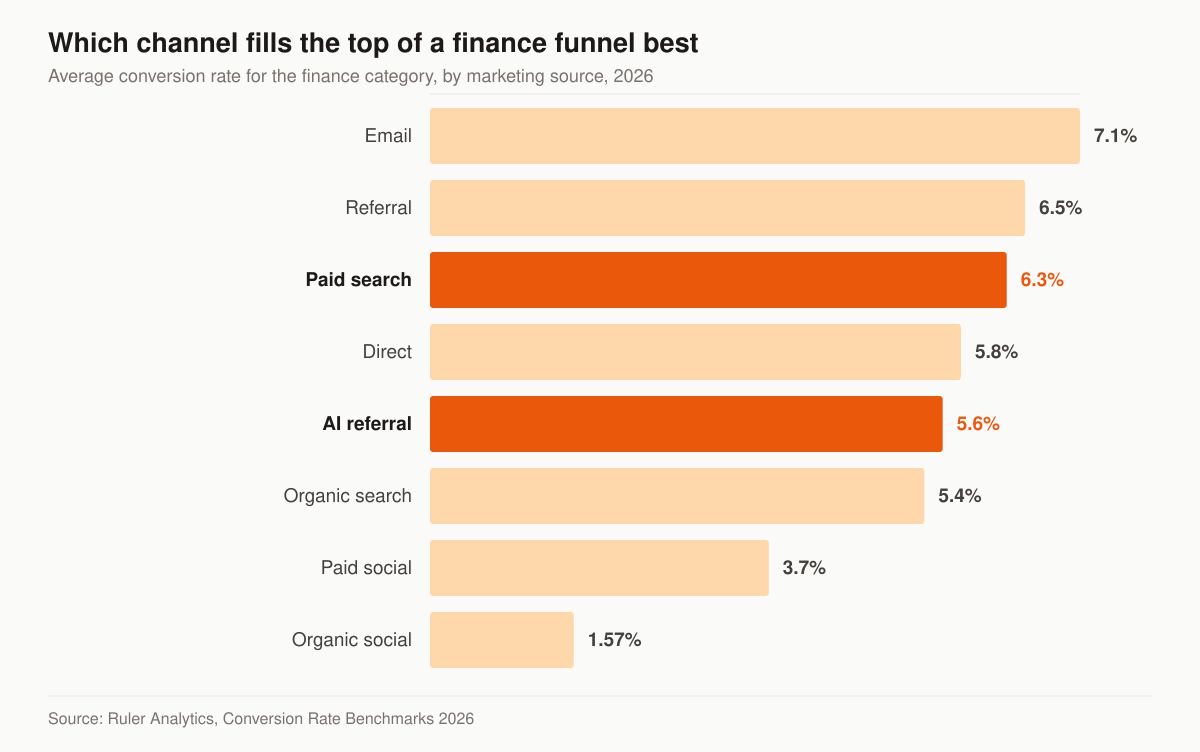
Average conversion rate for the finance category by marketing source. Source: Ruler Analytics, Conversion Rate Benchmarks 2026, figures as accessed 5 September 2026.
Read that with the definition attached. Ruler states, “we define a conversion as a qualified lead or sale,” counts phone calls alongside forms, and reports through multi-touch attribution — so these are not raw form-fill rates, and “finance” is a broader category than insurance agencies. Treat the ordering as the useful part, not the decimals.
Two findings change how a funnel gets built. Paid social converts at 3.7% and organic social at 1.57% in finance, against 6.3% for paid search — which does not mean social is worthless, only that it enters the funnel earlier and needs a longer nurture stage behind it before anyone judges it. And in the same report the finance category splits its conversions 76.1% forms and 23.9% calls. Close to a quarter of finance conversions arrive as a phone call, so a funnel instrumented only on form submissions is under-reporting its own top stage — the reason call tracking is part of the wiring rather than an upgrade.
Page-level, Unbounce’s finance and insurance benchmark reports a median conversion rate of 18.2% for the insurance subcategory against 8.3% for financial services overall, with paid search traffic at 10.1% and paid social at 9.3%. That sample is pages built on a landing-page platform, and the page does not define which companies sit inside the insurance subcategory, so it is evidence that insurance offers convert well on a purpose-built page rather than a target for your first build.
The layers we connect in an insurance sales funnel
- Capture is your landing page, wired as the entry point rather than a standalone asset.
- Nurture runs on our email and SMS automation — the cadence that catches the contacts a single dial misses.
- Booking comes from our appointment setting layer, turning warm leads into confirmed times.
- CRM ties it together so a lead’s source, tags, and stage follow it from opt-in to issued policy.
The funnel is where these stop being separate purchases and start being one system. It feeds the same lead generation engine and follow-up you run for every source, so paid, organic, and purchased leads all travel the same measured path.
What the capture stage has to collect before anything can dial or text
The consent language on the form is a funnel component, not legal boilerplate bolted on at the end. Get it wrong and the nurture and booking stages you paid for cannot run.
This table lists the provisions of 47 CFR 64.1200 that constrain an automated insurance funnel, and what each one forces into the build.
| Provision | What the regulation says | What it means for the funnel |
|---|---|---|
| 64.1200(a)(2) | Bars initiating a call that “includes or introduces an advertisement or constitutes telemarketing, using an automatic telephone dialing system or an artificial or prerecorded voice” to the numbers in (a)(1)(i) through (iii) — which include mobile numbers — “other than a call made with the prior express written consent of the called party” | The automated layer, not the manual dial, is what this paragraph reaches; the paragraph also carves out tax-exempt nonprofit callers and HIPAA health-care messages. Consent is captured at the form or the sequence does not run |
| 64.1200(f)(9) | Prior express written consent means “an agreement, in writing, bearing the signature of the person called that clearly authorizes the seller to deliver or cause to be delivered to the person called advertisements or telemarketing messages using an automatic telephone dialing system or an artificial or prerecorded voice, and the telephone number to which the signatory authorizes such advertisements or telemarketing messages to be delivered” | The form has to name the seller, name the channel, and carry the number the consent attaches to |
| 64.1200(f)(9)(i)(B) | The agreement must disclose that “The person is not required to sign the agreement (directly or indirectly), or agree to enter into such an agreement as a condition of purchasing any property, goods, or services” | The quote cannot be conditioned on accepting the marketing calls |
| 64.1200(f)(9)(ii) | The term “signature” shall include “an electronic or digital form of signature, to the extent that such form of signature is recognized as a valid signature under applicable federal law or state contract law” | A web form can carry it, provided the record of what was shown and clicked is stored |
| 64.1200(c)(1) | No telephone solicitation to “[a]ny residential telephone subscriber before the hour of 8 a.m. or after 9 p.m. (local time at the called party’s location)” | Every scheduled send and dial runs off the contact’s timezone field, never the office’s |
Two scope notes, because they get dropped in summaries of this rule. Paragraph (a)(2) reaches calls made with an automatic telephone dialing system or an artificial or prerecorded voice — it is not a blanket ban on contacting a lead. And (c)(1) governs telephone solicitations to residential subscribers. Neither replaces state telemarketing law, which is separate and stricter in several states; our insurance marketing compliance guide covers the wider surface.
What happens the moment a lead says stop
Revocation is a funnel event, and it has to write back to every sequence the record is enrolled in — not just the one that sent the last message. Paragraph 64.1200(a)(10) lets a called party revoke consent “by using any reasonable method to clearly express a desire not to receive further calls or text messages from the caller or sender”. It treats “stop,” “quit,” “end,” “revoke,” “opt out,” “cancel,” or “unsubscribe” as reasonable per se, and requires that other wording be honored too “if a reasonable person would understand those words to have conveyed a request to revoke consent.” The rule states that all such requests “must be honored within a reasonable time not to exceed ten business days from receipt of such request”. It adds that callers or senders of text messages covered by paragraphs (a)(1) through (3) and (c)(2) “may not designate an exclusive means to request revocation of consent.”
A confirmation is allowed and worth sending. Under 64.1200(a)(12), a one-time confirming text does not violate (a)(1) and (2) “as long as the confirmation text merely confirms the text recipient’s revocation request and does not include any marketing or promotional information, and is the only additional message sent to the called party after receipt of the revocation request” — and “[i]f the confirmation text is sent within five minutes of receipt, it will be presumed to fall within the consumer’s prior express consent.”
The email half of the nurture stage answers to a different statute. The FTC’s CAN-SPAM compliance guide requires that a commercial message “include your valid physical postal address”. Any opt-out mechanism you offer must “be able to process opt-out requests for at least 30 days after you send your message”, and “You must honor a recipient’s opt-out request within 10 business days.” The guide puts penalties at “up to $53,088” per violating email and notes that hiring a vendor does not move the liability: “you can’t contract away your legal responsibility to comply with the law.”
That postal-address requirement is a build dependency, not a footnote — the nurture stage cannot ship until there is a real mailing address to put in the footer.
A Medicare funnel runs on a different rulebook
If the line is Medicare Advantage, most of the standard funnel playbook is unavailable at the top. Under 42 CFR 422.2264(a)(2)(iv), unsolicited outreach may not “[u]se telephone solicitation (that is, cold calling), robocalls, text messages, or voicemail messages,” and the listed examples include “[c]alls to beneficiaries who attended a sales event, unless the beneficiary gave express permission to be contacted.” The same paragraph bars sending “direct messages from social media platforms.” What remains for unsolicited contact under (a)(1) is “conventional mail and other print media (for example, advertisements and direct mail) or email (provided every email contains an opt-out option).”
The escape hatch is the whole design. Paragraph (a)(3) says “[c]alls are not considered unsolicited if the beneficiary provides consent or initiates contact with the plan”. It gives returning a call or calling someone who completed a business reply card as examples. So a Medicare funnel is built the other way round from a final expense funnel: the top stage exists to get the beneficiary to initiate or consent in a documented way, and everything automated sits behind that record.
Booking has its own gate. Under 422.2264(c)(3)(i), “[p]rior to the personal marketing appointment, the MA plan (or agent or broker, as applicable) must agree upon and record the Scope of Appointment with the beneficiary(ies). The Scope of Appointment must be in writing for in-person personal marketing appointments.” The scope documented that way “is valid for 12 months following the date of beneficiary’s signature date or the date of the beneficiary’s initial request for information”. An appointment may not be used to “[m]arket non-health related products, such as annuities.” In practice the scheduler is not allowed to hand out a slot until the scope record exists, which makes the SOA a required field in the funnel rather than paperwork the agent does later. Our scope of appointment and TPMO guide covers the record-keeping, and Medicare marketing covers the campaign side.
Scope note: part 422 governs Medicare Advantage. The parallel Part D provisions live in part 423, and these rules bind MA organizations along with their agents and brokers.
The funnel changes shape by line
The five stages stay fixed; what each stage is allowed to do, and what it has to collect, moves with the product.
This table shows what changes between lines, so a funnel built for one is not copied wholesale onto another.
| Line | What the capture stage must establish | What constrains the stages after it |
|---|---|---|
| Final expense | State, age band, consent language covering the channels you intend to use | TCPA consent and calling-window rules; state telemarketing law |
| Medicare Advantage | Consent or beneficiary-initiated contact, on a record you can produce | 42 CFR 422.2264 contact limits; Scope of Appointment before a personal marketing appointment |
| ACA | State, household situation, whether an enrollment window or qualifying life event applies | Eligibility windows gate when a booked appointment can convert at all |
| Annuity and IUL | Age, stated planning intent, product fit before a slot is offered | Suitability and a longer education stage; a Medicare appointment cannot be used to sell these |
| P&C | Current carrier, renewal date, what is being insured, prior claims | Your appointed-carrier footprint; timing to the renewal date drives the whole cadence |
The pattern is that the qualification bar moves and the plumbing does not. A P&C funnel times itself to renewal dates; an annuity funnel spends longer in the education stage before it will hand over a calendar slot; an ACA funnel has to hold warm leads until a window opens rather than let them decay.
What to measure at each stage, and what to ignore
Traffic, impressions and open rates are diagnostic. They move when the funnel is working and also when it is spraying, which makes them poor grading instruments.
This table lists the stage rates on the monthly report, what each measures, and where the comparison comes from.
| Metric | What it measures | Reference point |
|---|---|---|
| Click to lead | Share of ad clicks that submit the capture form | Your own pre-launch baseline |
| Lead to contact | Share of leads reached by a human or a two-way conversation | Your own pre-launch baseline |
| Contact to appointment | Share of reached leads that hold a specific slot | Your own pre-launch baseline |
| Appointment to close | Share of kept appointments that become an application | Set with your closers, not by us |
| Application to issued | Share of applications that survive underwriting and first payment | Carrier-dependent; tracked per carrier |
| Cost per issued policy | Total program and media spend divided by policies issued | The number we grade the funnel on |
| Opt-out rate | Revocations per contacted lead | Watched as a cadence-health signal |
None of those reference points is an industry average dressed up as your result. Vendor benchmarks describe someone else’s lead sources, licences and definition of an appointment. Measure the four weeks before launch, then measure against that.
Do you need ClickFunnels or GoHighLevel to have a funnel?
No. A funnel builder produces pages and a sequence editor. The funnel is the wiring between them: which event fires which message, where the timezone field lives, what writes an opt-out back to every sequence at once, and how a source tag survives from ad click to issued policy. That wiring is build work, and it is the part that decides cost per issued policy.
Use the platform you already pay for where it can hold the logic. Where a builder costs you is portability — a funnel whose stage definitions live only inside one vendor’s proprietary workflow is difficult to move and difficult to audit, and the subscription usually outlives the campaign. We build in your stack so the asset stays yours; our comparison of the best CRM for insurance agents covers which systems make same-minute routing straightforward, and insurance marketing automation covers the trigger design.
What an insurance sales funnel costs
We publish rates so this can be priced before a call rather than after one. Funnel work is not sold as a standalone line item; it runs inside a monthly tier. The published tiers are Foundation $2,500/mo, Growth $3,500/mo and Full-Funnel $5,500/mo. This service maps to Full-Funnel — the tier that carries managed paid ads, landing-page CRO and marketing automation together, which is the combination a funnel actually needs, because the booking layer is only as good as the capture page and consent record feeding it.
If the capture pages, forms and tracking have to be built before any of it can run, a one-time build runs $2,500–$8,000. Where you land in that band depends on how many line variants come off the same skeleton, how deep the CRM and dialer integration goes, and whether the offer and copy already exist. Ad spend is billed at cost, straight to the platforms, and your software is billed by its own vendors on their volume models. The full breakdown is on the pricing page, and the build-versus-buy arithmetic is in insurance agency marketing budget.
How long before the funnel shows anything
Three clocks run at different speeds, and conflating them is how a program gets cancelled in week four.
Instrumentation is immediate — the day tracking goes on every stage, you can see where the leak is, which is often the entire value of the first month. Capture and speed-to-lead move next, because they act on leads you are already buying and the change is mechanical rather than persuasive. Nurture is slower by construction: a cadence built for the weeks a policy decision actually takes cannot report its own contribution until those weeks have passed. Close rate is slowest of all and the most contested, because it moves with the closer, the offer and the underwriting outcome as much as with the funnel.
None of that is a revenue promise. It is the order in which the parts start reporting, so the monthly review reads each number against the right clock.
What a sales funnel will not fix
Four problems present as funnel problems and are not, and saying so before the engagement is cheaper than discovering it in month three.
An offer nobody wants converts badly at every stage; a faster funnel reaches the no sooner. That is a copy and positioning problem, and it starts with the landing page and the copy, not the automation. A lead source reselling the same contact to several agencies is a supply problem — arriving first genuinely helps, but it does not change the arithmetic of the file, which is the comparison in exclusive versus shared final expense leads. No closer available to take booked appointments is a staffing problem, and an over-booked calendar generates cancellations from your side. And a funnel with no traffic at the top is not a funnel problem at all; it is a lead generation or search visibility problem wearing a funnel’s clothes.
The stage after the sale: renewals, cross-sell and referrals
A funnel that stops at the issued policy throws away its cheapest inventory. The people who already bought are the segment where contact is welcome, the consent record already exists, and the qualification work is done.
Three re-entry paths get wired in the same CRM as the front half. Onboarding and service touches keep the record warm and reduce the churn that quietly resets your acquisition math each year. Cross-sell triggers fire off life events and coverage gaps already recorded on the account — the account-rounding motion covered in cross-selling for P&C agencies. Referral requests are timed to a moment worth asking at, and each referral enters the top of the funnel with the trust stage already partly completed.
Instrument these the way you instrument the top. Retention rate, cross-sell rate per household and referrals per issued policy belong on the same monthly report as cost per issued policy, because a funnel that closes 5 policies and keeps them is a different business from one that closes 6 and loses two. Our client retention service runs this half, and prospects arriving from AI answers hit the same instrumented front door through AI search and GEO.
Find the leak in your insurance funnel first
You cannot fix a funnel you cannot see. Start with a free marketing audit — we map your path from click to issued policy, attach the conversion rate to each stage, and show you the one leak worth fixing first. If you would rather walk through it live, reach the team here.
For the wider plan this fits inside, read our insurance agency marketing plan and the lead follow-up cadence that drives the nurture stage. For the senior-market program this funnel is regularly built around, see final expense marketing. Rates for every tier are on the pricing page, and the whole catalogue is at agency services.
Guides that go deeper
Frequently asked questions
What is the difference between a sales funnel and a landing page?
How is this different from your final expense sales funnel article?
Where do most insurance funnels leak?
Do I need a whole new funnel or just the missing piece?
What do I need to have before you build the funnel?
How do you measure whether the funnel is working?
How much does an insurance sales funnel cost?
Can the funnel text and call new leads automatically?
See exactly where your agency is leaking leads.
15 minutes. We screen-share our own live lead dashboard and tear down your funnel line by line — no pitch deck, just numbers.
- Site speed & conversion
- Local + AI-search visibility
- Ad efficiency
- Your cost per lead vs ours
No obligation · no pitch deck