Who we serve
Medicare Marketing Agency for Agents and Agencies
A Medicare marketing agency builds and runs the acquisition and retention system behind a Medicare book: AEP and T65 campaigns, CMS-compliant creative, tracking, and follow-up. Judge a provider on cost per enrolled member, not leads delivered. Our flat retainers run $2,500 to $5,500 a month, and the licensed agent keeps final compliance sign-off.
Free · 15-minute teardown · no pitch deck
- We run our own final-expense book
- No pitch deck — we screen-share real numbers
- TCPA-aware · CMS/AEP-compliant · Meta Special Ad Category
- Core Web Vitals < 2.0s LCP
Medicare is a calendar business wrapped in a rulebook. Agents lose money two ways: they buy every lead in the same eight-week window everyone else does, and they treat CMS marketing rules as paperwork instead of a moat. This page lays out what we run for Medicare agents as their marketing agency — what to do, when, and how to measure it.
For context on how we report numbers: we run our own senior-market lead book.
The market context matters too. More than half (55%) of eligible Medicare beneficiaries — 35.2 million of the 64.2 million with both Parts A and B — are enrolled in Medicare Advantage plans in 2026, per KFF’s June 2026 analysis of CMS enrollment data. MA is where the competition and the CMS rulebook both concentrate, which shapes everything below.
What a Medicare marketing agency does, and what stays with you
A Medicare marketing agency owns the demand system: the site that ranks and converts, the ad accounts, the lead capture and consent language, the follow-up cadence, and the reporting that ties spend to enrolled members. It does not own the sale, the plan recommendation, or the compliance sign-off. Those stay with a licensed agent, and any provider who blurs that line is selling you a problem.
The split matters more in Medicare than in any other line, because CMS assigns responsibility to named parties. Marketing materials used by agents must be submitted to CMS through HPMS before use, and that submission runs through the MA organization under 42 CFR 422.2274(c)(7). An agency can build the piece and prepare the file; it cannot approve it.
The table below splits a Medicare program into who does the work and who carries the responsibility.
| Workstream | Agency runs it | Licensed agent or agency principal owns it |
|---|---|---|
| Website, landing pages, tracking | Build, hosting, speed, forms, call tracking | Final wording of any plan-related claim |
| Paid search and paid social | Account structure, bids, budgets, creative production | Approval of every marketing asset before use |
| SEO and AI search | Topic plan, on-page work, schema, internal links | Accuracy of product statements |
| Lead capture and consent | Form fields, disclosure copy, consent capture and storage | Confirming the disclosure matches carrier and state requirements |
| Follow-up and nurture | Cadence design, email and SMS build, CRM wiring | Who dials, what is said, scope of appointment |
| Carrier submission | Prepares the file and the version history | Submits through the MA organization to CMS via HPMS |
| Reporting | Cost per lead, cost per appointment, cost per enrolled member | Deciding what a member is worth and what to spend |
Read that table before you sign anything. The failure mode in Medicare agency relationships is rarely bad ads — it is an unclaimed column. Nobody submitted the piece, nobody kept the recording, nobody could produce the consent record when a carrier asked.
The seasonality problem: three windows, three different jobs
Medicare has three timing windows that should shape your whole spend plan:
- AEP (Oct 15–Dec 7) — the loud window. Highest intent, highest competition, highest lead cost. The Medicare AEP marketing strategies for agents playbook sequences how to enter it with a warm list instead of cold spend.
- OEP (Jan 1–Mar 31) — Medicare Advantage members can make one switch. A quieter cleanup window, with strict limits on what you can market — see the OEP marketing rules before you run anything in Q1.
- T65, year-round — people age into Medicare every single month, at lower acquisition cost and with a longer client lifetime. The turning-65 marketing system for Medicare agents works that window month by month.
The mistake is concentrating most of the budget into AEP. You bid against every carrier and agent at once and your cost per enrolled member balloons. The better play is steady Medicare lead generation across the year so AEP becomes a conversion event on a list you already own — not a cold-buying scramble.
One date is worth putting in your own calendar even though it is a carrier deadline: MA organizations must have full compensation structures in place for the following plan year by October 1, including the payment amounts for initial and renewal enrollment years (42 CFR 422.2274(c)(6)). Your acquisition budget for AEP is being set against numbers that are knowable before AEP starts.
Channels that actually pull for Medicare
No single channel wins. The mix and the timing do — our channel-by-channel breakdown of how to get Medicare clients as an agent ranks nine of them by cost, speed to first appointment, and CMS risk.
| Strategy | Best window | Typical role | Watch-out |
|---|---|---|---|
| T65 direct mail + landing pages | Year-round | Predictable aging-in flow | Slow to scale; needs follow-up |
| Paid search (PPC) | AEP + T65 | High-intent capture | Costs spike Oct–Dec |
| Paid social | Educational, pre-AEP | List building, retargeting | Meta’s financial-products Special Ad Category limits targeting |
| SEO + AI search | Compounding | Lowers blended cost over time | 6–12 month payoff |
| Email / SMS nurture | Year-round | Convert and retain owned list | TCPA consent rules apply |
A few specifics worth naming. Paid social for Medicare carries a platform constraint on top of the CMS one. Meta folded insurance into its Special Ad Categories in October 2024: “Examples of financial products and services ads include those promoting insurance, bank accounts, investment services and payment services,” and “Starting January 21, 2025, using the Special Ad Category designation is required for advertisers based in the United States or reaching audiences in the United States running financial products and services campaigns,” per Meta’s Business Help Center. Selecting the category limits the audience tools that a Medicare campaign would reach for first — Meta lists age, gender, ZIP code or postal code, exclusion targeting, lookalike audiences and saved audiences as limited or unavailable, with city and pin-drop radii expanded. The 65-plus age filter a Medicare campaign would naturally start from is therefore not a lever you can rely on, so qualification has to happen in the creative and on the landing page instead. The mechanics of running compliant campaigns live on our Medicare Facebook ads page. And organic visibility compounds: a strong Medicare agent website that ranks and converts lowers your blended cost every year you keep it.
The outbound side has a hard federal edge. Under 42 CFR 422.2264(a), unsolicited conventional mail, print advertising and email with an opt-out are permitted, while unsolicited door-to-door contact, approaching people in parking lots, hallways and lobbies, direct messages from social media platforms, cold calls, robocalls, texts and voicemails are not — and the rule names the traps specifically, including calls based on referrals, calls to people who attended a sales event without their express permission, and calls just to confirm someone received your mailer. A call is not unsolicited when the beneficiary consented or initiated contact, which is exactly why the consent field on your landing page is a revenue asset and not a legal formality. Our insurance email automation build treats that consent record as the first field in the database, not the last.
Medicare is one line inside our wider senior-market insurance marketing practice, so the compliance discipline and T65 pipeline work here feed the same senior audience you reach for final expense and life.
How many plans your prospect is choosing between
Medicare marketing is a share-of-attention problem before it is a persuasion problem. In 2026 the average Medicare beneficiary can choose from 32 Medicare Advantage prescription drug plans, two fewer than the 34 available in 2025, and 39 plans across all individual Medicare Advantage options versus 42 in 2025, per KFF’s first look at 2026 plan offerings. Nationwide, 3,373 individual Medicare Advantage plans are available for 2026, a 9% decrease of 346 plans from 2025.
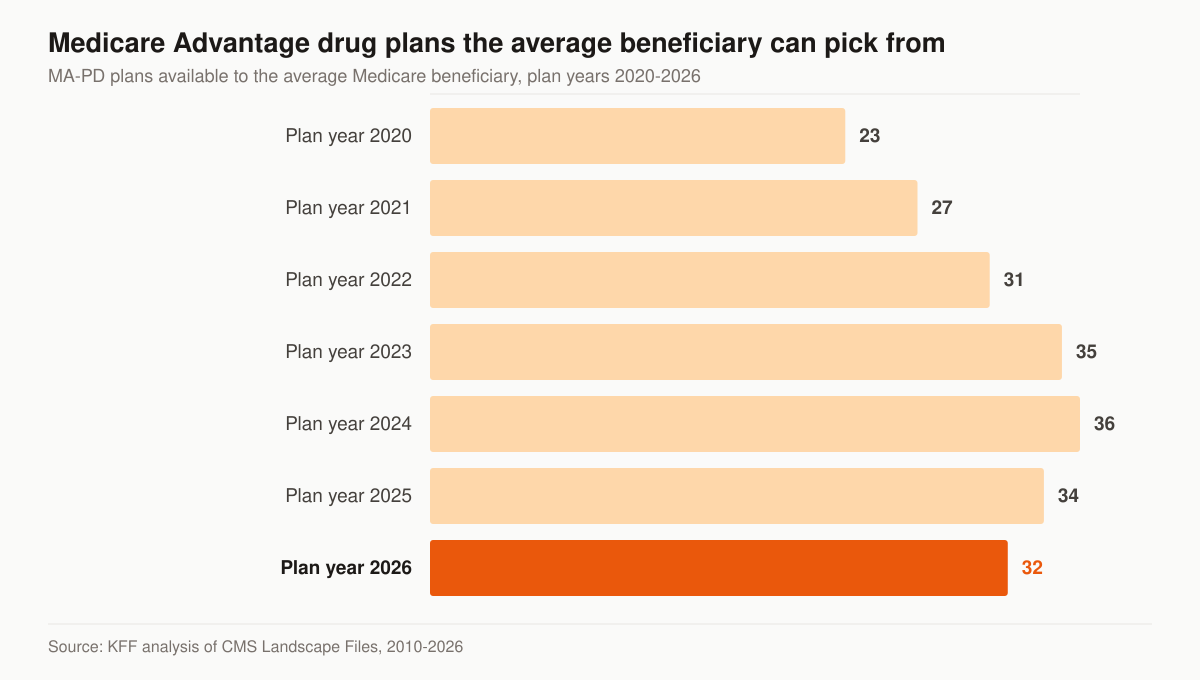
Source: KFF analysis of CMS Landscape Files, 2010–2026, Medicare Advantage 2026 spotlight: a first look at plan offerings.
Two things follow for your marketing. First, the shelf is crowded but not infinitely so: the average beneficiary can choose from among plans offered by eight firms in 2026, the same as in 2025 and 2024, and nearly three in ten (29%) can choose from plans offered by 10 or more firms or other sponsors, per the same KFF analysis. You are competing with carrier brand budgets, not just other agents.
Second, and more useful, most beneficiaries do not shop. KFF’s analysis of the CMS Medicare Current Beneficiary Survey found that nearly 7 in 10 (69%) beneficiaries did not compare their own source of Medicare coverage with other options in their area during the 2021 open enrollment period, and 43% of Medicare Advantage enrollees did not review their current plan for changes in premiums or other out-of-pocket costs.
That single pair of numbers should reorder your budget. If most of the market is not actively comparing, the marginal dollar spent shouting at switchers in December is competing for the smaller slice of attention, in the weeks when every agent and carrier is bidding at once, while the annual review call to your own book — cheap, compliant, and welcomed — is competing against nobody. Inertia works for whoever holds the relationship.
Marketing Medicare Advantage vs Medigap: two different sales
A costly strategy mistake, after mis-timing AEP, is running one message for two products that sell opposite promises. Medicare Advantage and Medicare Supplement (Medigap) reach the same 65-plus buyer but ask them to value different things — and they sit under different rulebooks and calendars.
| Dimension | Medicare Advantage (MA) | Medigap (Medicare Supplement) |
|---|---|---|
| The promise | Bundled benefits, low or $0 premium, networks | Predictable out-of-pocket costs, any provider, no networks |
| Rulebook | Full CMS/TPMO marketing rules, Oct 1 benefit-marketing limit | State DOI + carrier rules; not under CMS MA/PD marketing rules |
| Seasonality | AEP and OEP driven; competitive, spiky | Year-round; turns on the Medigap open-enrollment window |
| Underwriting | Guaranteed acceptance in-window | Medically underwritten outside guaranteed-issue windows |
| Buyer mindset | Cost-sensitive, network-tolerant | Wants freedom and predictability, will pay the premium |
| Lead timing | Concentrated in the loud window | Steady, anchored to T65 aging-in |
The practical upshot: a T65 prospect deciding between MA and Medigap needs an even-handed, compliant education path, not a benefits pitch aimed at the wrong product. Route the message to the product the beneficiary actually qualifies for and wants — steering a healthy 66-year-old out of a Medigap plan they’d pass underwriting for, or into an MA plan whose network drops their doctor, is how you earn a complaint instead of a renewal.
The Medigap side has its own year-round playbook — open-enrollment windows, medical underwriting, birthday rules, and Plan G/N positioning — laid out in our guide to Medicare supplement leads for agents.
What are the CMS Medicare marketing rules?
CMS Medicare marketing rules govern how agents market Medicare Advantage and Part D plans. The core requirements: a TPMO disclaimer on marketing materials and calls, no marketing of next year’s plan benefits before October 1, restrictions on inducements and on the word “free,” call recording and retention, and documented scope of appointment before a personal marketing appointment. Medigap sits outside these CMS rules and follows state insurance department and carrier guidelines instead.
The specifics are worth reading in the regulation rather than in a summary, because the prohibitions are narrower and stranger than a paraphrase can carry. 42 CFR 422.2263(b) bars cash or other monetary rebates as an inducement, bars gifts unless they are of nominal value under HHS OIG guidance and offered to similarly situated beneficiaries regardless of whether they enroll, and bars meals to potential enrollees “regardless of value.” It bars marketing non-health-care-related products during any MA sales activity, which is what makes an annuity cross-sell inside a Medicare appointment a compliance event rather than a good idea. It permits plan comparisons only where they are accurate, not misleading, and supportable. And it requires that the organization or marketing name appear in the material — 12-point font in print, not as a disclaimer or fine print, and for television, online or social media either read at the pace of the phone number or displayed throughout the ad at a size equivalent to the advertised phone number.
The word “free” has its own rule, and the rule has two halves. 42 CFR 422.2262 opens with the general standard — MA organizations “may not mislead, confuse, or provide materially inaccurate information to current or potential enrollees” — and then, at (a)(1)(xi), bars using the term “free” to describe “a $0 premium, any type of reduction in premium, reduction in deductibles or cost sharing, low-income subsidy, or cost sharing pertaining to dual eligible individuals.” The other half is a permission: (a)(2)(iii) allows the term “free” “in conjunction with mandatory, supplemental, and preventative benefits provided at a zero cost share for all enrollees.” So “free” is not a banned word; it is barred as a description of price. That is why compliant Medicare creative says “$0 premium plans may be available in your area” and never “free Medicare plan.”
The Open Enrollment Period has a rulebook of its own inside 42 CFR 422.2263(b)(7). During OEP an MA organization may market to age-ins who have not yet made an enrollment decision, send materials when a beneficiary proactively requests them, take one-on-one meetings at the beneficiary’s request, and publish educational (not marketing) information about OEP on its website. It may not send unsolicited materials advertising the ability to make another change, buy mailing lists to target people who chose during AEP, promote agent activity aimed at OEP as a further sales opportunity, or call former enrollees who selected a new plan during AEP.
We treat all of this as a trust signal rather than a tax — agents who get it right keep their contracts and their clients. We provide marketing services, not licensed insurance advice: the licensed agent owns final compliance sign-off on every piece, and we build campaigns to fit the framework. For the full breakdown of what’s allowed and when, read our guide to CMS Medicare marketing rules for agents; for two mechanics that trip agents up, see scope-of-appointment and TPMO compliance.
Are you a TPMO, and what changes if you are
Many agents assume “third-party marketing organization” describes a call center in another state. The definition is broader. Under 42 CFR 422.2260, a TPMO means “organizations and individuals, including independent agents and brokers, who are compensated to perform lead generation, marketing, sales, and enrollment related functions as a part of the chain of enrollment.” If you are paid to move a beneficiary from awareness to an enrollment decision, you are inside the chain.
Four obligations follow, and each one is an operational build, not a policy statement.
The disclaimer. 42 CFR 422.2267(e)(41) is standardized content — the wording is fixed, not paraphrasable. A TPMO that does not sell for every MA organization in the service area must state: “We do not offer every plan available in your area. Currently we represent [insert number of organizations] organizations which offer [insert number of plans] products in your area. Please contact Medicare.gov or 1-800-MEDICARE to get information on all of your options.” A TPMO that does sell for all of them uses the shorter variant ending “You can always contact Medicare.gov or 1-800-MEDICARE for help with plan choices.”
The table below shows where that disclaimer has to appear, straight from the rule.
| Surface | Requirement in 42 CFR 422.2267(e)(41) | What it means for the build |
|---|---|---|
| Sales calls | Verbally conveyed prior to the discussion of any benefits | Script line before the first benefit sentence, not at the end |
| Email, chat, other electronic | Electronically conveyed when communicating with a beneficiary | Template footer plus chat greeting, not a linked PDF |
| Your website | Prominently displayed on TPMO websites | Visible placement with a live organization and plan count |
| Print and TV materials | Included in any marketing materials developed, used or distributed | Baked into the artwork template, with the counts as a variable |
| Who it applies to | Any TPMO selling on behalf of more than one MA organization | Captive single-carrier producers are outside this one |
Two operational notes. The count of organizations and products is specific to the service area, so a national landing page and a county-level landing page carry different numbers, and whoever owns your site has to be able to change them. And the verbal placement is “prior to the discussion of any benefits” — the older habit of dropping the disclaimer somewhere in the first minute is not the current standard.
Recording and retention. Under 42 CFR 422.2274(g)(2)(ii), all marketing and sales calls, including the audio portion of calls conducted via web-based technology, must be recorded and retained in their entirety for a minimum of 6 years. For the first 3 years the records must be kept in audio format; for years 4, 5 and 6 they may be audio or complete and accurate transcripts. That is a storage and retrieval requirement, which means it is a systems question your marketing stack has to answer — where the recording lives, how it is indexed to the lead, and who can produce it on request.
Lead-generation disclosures. When a TPMO conducts lead generating activities, it must tell the beneficiary that their information will be provided to a licensed agent for future contact — verbally on the phone, in writing on paper, electronically in email, chat or other messaging — and must tell them when they are being transferred to a licensed agent who can enroll them. In practice this is form copy, IVR copy and transfer-script copy, and it should be version-controlled like any other asset.
Data sharing between TPMOs. Since October 1, 2024, personal beneficiary data collected by a TPMO for marketing or enrollment may be shared with another TPMO only with the beneficiary’s prior express written consent, obtained through a clear and conspicuous disclosure that lists each entity receiving the data and lets the beneficiary accept or reject each one individually. A generic “we may share your information with our partners” checkbox does not satisfy that. If you buy leads, ask the vendor to show you the exact consent interface the beneficiary saw. Our guide to TCPA compliance for agents buying leads covers the parallel federal telephone rules that apply to the same record.
CMS also keeps changing this layer. The contract year 2027 final rule includes “Removing restrictions on the time and manner by which beneficiaries can have conversations with licensed agents and brokers,” which is a loosening of contact mechanics rather than of disclosure duties. Build your process against the regulation text, and re-read it each spring when the final rule lands.
Educational event or sales event: the line that decides your seminar
Live events are a high-trust touch and easy to get wrong, because 42 CFR 422.2264(c) defines three separate activities with three separate permission sets. Advertising an event as educational and then presenting plan benefits is not a grey area; it is a different category of event.
This table maps what each event type allows, which is what your invitation copy and your room setup have to match.
| Educational event | Marketing or sales event | Personal marketing appointment | |
|---|---|---|---|
| Advertising label required by the rule | Yes — educational events “must be advertised as such” | No labeling requirement in the rule text | Not applicable |
| Market specific plans or benefits | No | Yes | Yes |
| Distribute or accept applications | No | Yes | Yes |
| Distribute business cards | Yes | Yes | Yes |
| Collect scope-of-appointment forms | Yes | Yes | Required beforehand |
| Sign-in sheets required to attend | Not applicable | Prohibited | Not applicable |
| Health screenings or surveys to segment attendees | Not applicable | Prohibited as cherry-picking | Needs review permitted within scope |
| Scope of appointment | Not applicable | Collected for future appointments | Agreed and recorded first; written for in-person |
Two details are worth building into the event process. A marketing event may directly follow an educational event only if attendees are told the educational event is ending, told a marketing event is starting, and given a real opportunity to leave first. And the scope of appointment is valid for 12 months from the beneficiary’s signature date or initial request for information, with a separate scope required to add a health-related line of business — and non-health products such as annuities cannot be marketed in that appointment at all.
The room-filling side of this, from invitation lists through compliant follow-up, is in our Medicare seminar marketing guide.
What Medicare marketing costs, and the unit that decides it
Our engagements are flat monthly retainers: $2,500 Foundation, $3,500 Growth, $5,500 Full-Funnel, plus a one-time site build at $2,500 to $8,000. Media spend is separate and yours. We publish the tiers because a Medicare provider that quotes only per-lead pricing is choosing the metric that flatters them, and it is not the metric that decides your year.
The number that does is cost per enrolled member, and the reason is on the revenue side of the equation. CMS caps what a carrier may pay an independent agent, and the cap changed shape in 2025. Under 42 CFR 422.2274(d), initial enrollment year compensation was payable “at or below FMV” only “for contract years through contract year 2024”; after that, “Beginning with contract year 2025, MA organizations are limited to the compensation amounts outlined in this section,” and renewal compensation is set at 50 percent of FMV for contract year 2025 and beyond. The section’s definition of fair market value writes the baseline into the text: “Beginning January 1, 2021, the national FMV is $539, the FMV for Connecticut, Pennsylvania, and the District of Columbia is $607, the FMV for California and New Jersey is $672, and the FMV for Puerto Rico and the U.S. Virgin Islands is $370,” with a one-time $100 increase for contract year 2025 and annual indexing after that by the MA growth percentage published in the rate announcement. Referral payments are capped separately, under paragraph (f), at $100 for a referral into an MA or MA-PD plan and $25 for a referral into a PDP plan.
Three consequences for how you budget.
- Your ceiling is fixed and public. You cannot out-earn a bad acquisition cost by negotiating a better commission, because the commission is capped. The only variables you control are cost per enrolled member and how many renewal years you keep.
- The renewal stream is half the initial, forever. A member kept five years is worth far more than a member written twice, which is why retention spend competes directly with acquisition spend for the same dollar, and why we fund it first.
- Rapid disenrollment erases the sale entirely. If a beneficiary changes plans within the first three months of enrollment, the entire compensation is recovered from the agent under 42 CFR 422.2274(d)(5), with narrow exceptions. A cheap lead that produces a mismatched plan is not a cheap lead.
The table below compares the four ways agents buy Medicare marketing, on the terms that actually differ.
| Model | Typical cost shape | What you own afterwards | Where it breaks |
|---|---|---|---|
| Per-lead purchase | Variable, spikes Oct–Dec | Nothing but the contact record | Price is set by the loudest bidder in your county |
| FMO-provided marketing | Bundled into your contract | Little; assets usually stay with the FMO | Shared with every other agent on the same contract |
| In-house hire | Salary plus tools, fixed | Everything, if the person stays | One person rarely covers ads, SEO, CRM and compliance |
| Agency retainer | Flat monthly, predictable | Site, pixel, list, content, tracking | Only pays off if you keep the assets and the cadence |
If you run an FMO or a downline and need the marketing layer delivered under your own brand, that is a different structure again — see white-label insurance marketing for FMOs. And the month-by-month version of this math, mapped against commission timing, is in our insurance agency marketing budget guide.
Agency, FMO, lead vendor, or in-house: which one you actually need
The four models above are not competitors so much as different answers to different bottlenecks. Diagnose the bottleneck first.
If your problem is not enough conversations, and you have dial capacity sitting idle, a lead vendor fills the calendar, and you pay for every lead whether or not it enrolls. If your problem is the same conversations everyone else is having, because you and six other agents bought the same shared lead, you need owned demand: a site that ranks, a list you built, and a follow-up cadence — that is the agency case. If your problem is contracts and carrier access, an FMO solves it and its marketing support is a bonus, not a strategy. If your problem is execution volume across a large book, we would put an in-house marketer alongside an agency for the specialist layers rather than pick one.
A useful test: ask what happens if you stop paying. Stop paying a lead vendor and the flow ends that day. Stop paying an agency that built you a ranking site, an email list and a tracked CRM, and the assets keep working while they decay. That asymmetry is the entire argument for the retainer model, and it is also the reason a retainer is a bad idea if you plan to switch providers every six months.
For agencies that want the strategy layer without a full build, our fractional CMO for insurance agencies engagement sits above whichever execution model you choose.
Retention is where the margin lives
A first-year Medicare commission is fine. The renewal stream over five years is the actual business. Strategies that protect it:
- Onboarding contact within the first week of effective date — confirm the plan, set expectations.
- A quarterly touch so you’re the name they recall, not a call center.
- An AEP review every year — proactively, before a competitor’s mailer reaches them.
- Reputation management so your reviews show up when a T65 prospect searches your name.
The KFF finding above — 43% of Medicare Advantage enrollees did not review their current plan for cost changes — is the whole case for item three. Your annual review call is not a sales call competing for attention; for the 43% who would otherwise let the plan renew unexamined, it is the only review that happens. Systematise it: a fixed contact window, a script that starts with plan changes rather than product, and a calendar that survives the year you get busy. The mechanics of that cadence, including what to automate and what must stay human, are in our insurance client retention service and our lead follow-up cadence guide.
Reviews carry real weight in this niche, because a 66-year-old choosing an agent is choosing a person for a decade. Getting more Google reviews is slow, compounding work with the same shape as SEO, and it feeds the same local search visibility that carries “Medicare agent near me” queries.
Live events belong in this mix too. A CMS-compliant seminar puts you in a room of local prospects who chose to show up, provided you stay on the right side of the educational-versus-sales line.
Retention is cheaper than acquisition, and a retained client refers. It is easy to underspend here because it doesn’t feel like “marketing.”
How to sequence a year: the Medicare marketing calendar
Every window has one job. The calendar below maps the enrollment periods to the marketing move each one rewards:
| Window | Months | What changes | The marketing move |
|---|---|---|---|
| T65 / aging-in | Year-round — each prospect’s enrollment window around their 65th birthday | New beneficiaries age in every month | Steady T65 (turning-65) pipeline at the year’s lowest lead costs |
| Pre-AEP build | Jul–Sep | Education season; no plan-specific benefit marketing yet | Grow the owned list, ship SEO and content, pre-book October appointments |
| AEP warm-up | Oct 1–14 | Plan-specific marketing becomes permitted | Warm the list, schedule AEP appointments |
| AEP | Oct 15–Dec 7 | Anyone can join or switch; peak competition and cost | Convert the list you own; run paid only where intent is highest |
| OEP | Jan 1–Mar 31 | MA members get one switch; strict limits on OEP-targeted marketing | Onboarding, retention touches, reviews, and referrals |
| Lock-in stretch | Apr–Jun | Most MA members can only change plans with a Special Enrollment Period | Retention cadence, seminar season, and next cycle’s T65 build |
The first 90 days with a Medicare marketing agency
Depth of work is easy to promise and hard to sequence. What follows is the order we run, and the order you should expect from any provider — the compliance and measurement layers go in before the spend, because both get more expensive to retrofit than to build.
| Weeks | What gets built | What you should see |
|---|---|---|
| 1–2 | Tracking, call attribution, CRM fields, consent capture, TPMO disclaimer placement | A dashboard that can tell a lead from an appointment |
| 3–4 | Site fixes, landing pages, schema, service-area pages | Faster pages and forms that record consent correctly |
| 5–8 | Paid search and paid social launch, follow-up cadence live | First appointments attributable to a channel |
| 9–12 | Content and SEO build, review cadence, reporting review | Early organic movement; first cost-per-appointment read |
| Ongoing | Iterate on channel mix ahead of the pre-AEP build | A cost per enrolled member you can defend |
Two honest caveats. Organic search and AI-search visibility in this niche take longer than a quarter — plan on 6 to 12 months before they change your blended cost, which is why the AI search and GEO work starts in month one rather than month nine. And no marketing program fixes a plan mismatch: if the enrollments do not fit the beneficiary, rapid disenrollment recovery takes the commission back regardless of how the lead was sourced.
How to vet a Medicare marketing agency
Ask these before you sign. The answers separate a Medicare specialist from a generalist with a Medicare page.
- Which TPMO obligations do you carry, in writing? Recording, six-year retention, disclaimer placement, lead-gen disclosures, data-sharing consent — name the owner of each.
- How do you set the organization and plan counts in the disclaimer? A provider who cannot vary them by service area has not built a compliant site.
- What is your submission process for marketing materials? The correct answer routes through the MA organization to CMS via HPMS, with the agent approving before submission.
- What do you report on, and how often? Cost per lead is a starting metric; cost per appointment and cost per enrolled member are the ones that survive a year.
- What do I own if we stop? Domain, site, ad accounts, pixel, list, content and call recordings should all be yours, named in the contract.
- How do you handle the October 1 line? Ask specifically what changes in the creative calendar on that date.
- Who writes the consent language on the forms? And who reviews it against your carrier and state requirements.
- What is your T65 program, separately from AEP? A provider whose whole answer is AEP is selling you the October 15 to December 7 window, when every agent and carrier is bidding at once, and nothing for the rest of the year.
- Can you show the work, not the logos? Ask for a walkthrough of an actual build and its reporting rather than a client list.
If a provider’s answer to any of the first three is vague, that is not a communication problem. It is a scope problem, and it will land on your licence rather than theirs.
Where to start with Medicare agent marketing
If you want a numerate read on your own funnel — cost per enrolled member, channel mix, compliance gaps — grab a free marketing audit and we’ll show you the math. Engagements are flat monthly retainers — $2,500 Foundation, $3,500 Growth, $5,500 Full-Funnel, plus a one-time site build at $2,500–$8,000 — and what sits in each tier is itemized on the Medicare marketing pricing page. Compare this program against our other insurance marketing services, or start a conversation about your book. For a worked example of these levers on a single book, read our Medicare agency case study. The agents who win Medicare aren’t the loudest in December. They’re the ones who built the list in July.
Deeper guides
Go deeper on Medicare
The Turning-65 System That Owns the IEP Window
A CMS-compliant T65 marketing system for Medicare agents: reach the turning-65 cohort six months early and own their IEP window. Free funnel teardown.
Facebook Ads for Medicare Advantage Agents
Facebook ads for Medicare Advantage agents under two rulebooks — CMS/TPMO marketing rules and Meta's Financial products and services Special Ad Category.
Medicare Supplement Leads for Agents: Marketing Medigap Year-Round
Medicare supplement leads for agents: Medigap vs MA buyers, six-month open enrollment window, underwriting, birthday rules, and year-round selling outside AEP.
Medicare Seminar Marketing for Agents: CMS-Compliant Educational Events
Medicare seminar marketing for agents: CMS educational vs sales event line, registration funnels, SOA boundary, direct-mail and Facebook promotion, follow-up.
Medicare Agent Website Design Built for CMS Compliance and Booked Calls
Medicare agent website design built for CMS compliance, multi-plan clarity, and lead capture, from a team running senior-market campaigns. Free teardown.
Medicare Lead Generation for Agents
Medicare lead generation for agents: T65 timing, AEP and SEP windows, exclusive vs shared leads, TPMO rules, and cost-per-sale math. Get a free audit.
The services behind it
Guides that go deeper
- CMS Medicare Marketing Rules for Agents: A Plain-English Walkthrough
- How to Get Medicare Clients: 9 Channels Ranked by Cost and Risk
- Insurance Marketing Compliance for Agents: What Actually Trips People Up
- Medicare AEP Marketing Strategy for Agents: The 2026 Playbook
- Medicare OEP Marketing Rules: What Agents Can and Can't Do (Jan 1–Mar 31, 2027)
- Scope of Appointment & TPMO Compliance: The Agent's Operational Guide