Who we serve
Medicare Agent Website Design Built for CMS Compliance and Booked Calls
Medicare agent website design is the build of a site that captures Medicare leads while satisfying CMS marketing rules — required disclaimers, no misleading plan claims, and clear TPMO language. Done right, it shows multiple plan types, an honest scope, and a lead form that books calls instead of triggering a complaint.
Free · 15-minute teardown · no pitch deck
- We run our own final-expense book
- No pitch deck — we screen-share real numbers
- TCPA-aware · CMS/AEP-compliant · Meta Special Ad Category
- Core Web Vitals < 2.0s LCP
From our own book
- Page load target
- < 2s LCP
Illustrative
A Medicare agent website has a harder job than most insurance sites. It has to capture leads like any landing page — and it has to do that inside CMS marketing rules that govern what you can say, which disclaimers must appear, and when you can publish AEP messaging. Get the conversion right and the compliance wrong, and one complaint can cost you more than the site ever earned.
This page covers the build spec. It’s part of our Medicare marketing program, and the underlying build work runs through our insurance web design service.
Which rulebook your Medicare site answers to
Before any design decision, settle which body of law is looking at the page. A site that markets Medicare Advantage answers to 42 CFR part 422, subpart V. A site that markets a Part D drug plan answers to the mirrored text at part 423, subpart V. A Medicare Supplement page sits outside both — Medigap is state-regulated insurance, governed by your state department of insurance and the carrier’s own advertising rules, which is why we treat it separately on the Medicare Supplement marketing page. An agent site that sells across all three lines has to satisfy the strictest of them wherever the content mixes.
One scope note that matters, because it is the thing agents get wrong when they read the regulation cold. Subpart V writes almost every duty below as an obligation on the MA organization, not on you. It reaches an independent agency through two doors. 42 CFR 422.2274(c) requires MA organizations to “oversee first tier, downstream, and related entities that represent the MA organization to ensure agents and brokers abide by all applicable State and Federal laws, regulations, and requirements”. Paragraph (g)(1) adds that where a TPMO is not otherwise a first tier, downstream or related entity, “the MA organization is responsible for ensuring that the TPMO adheres to any requirements that apply to the MA plan”. In practice the carrier’s contract is where those duties land on your website. The TPMO disclaimer at § 422.2267(e)(41) is the exception that names TPMOs directly.
We provide marketing services, not licensed insurance advice — you’re the licensed agent, and the site is built to keep your license clean. Where this page quotes a regulation, it quotes the current published text.
What CMS-compliant Medicare website design actually requires
CMS treats your website as marketing material, which means the same third-party marketing organization (TPMO) rules that cover your calls apply to your pages. The non-negotiables:
- The TPMO disclaimer — if you don’t represent every plan in your area, the site must say so, with the count of organizations and plans you offer. We template it once so it updates everywhere.
- No misleading plan claims — no “best plan,” no unverified benefit promises, no implying you’re Medicare or a government agency.
- A clear scope path — content routes toward a Scope of Appointment before a sales conversation, not around it.
- Accurate plan-year context — benefits change annually; the design has to make the active year obvious and easy to swap.
The floor under all of it is the first sentence of 42 CFR 422.2262: “MA organizations may not mislead, confuse, or provide materially inaccurate information to current or potential enrollees.” Every layout decision below is downstream of that sentence — a benefit claim buried in a caption, a plan year that is right in one paragraph and stale in another, a comparison table with no source. Those are compliance defects, not design taste.
Which pages are marketing, and which are only communications
This is the structural decision that shapes the whole sitemap, and it has a written test rather than a judgment call. 42 CFR 422.2260 defines communications as the wider category and then says plainly: “Marketing is a subset of communications.” Marketing means “communications materials and activities that meet both the following standards for intent and content”. Both. Not either.
The content prong is the one you can design around. A material meets it when it addresses “The plan’s benefits, benefits structure, premiums, or cost sharing”, or “Measuring or ranking standards (for example, Star Ratings or plan comparisons)”, or “Rewards and incentives as defined under § 422.134(a)”. Nothing else on that list. A page explaining what Part C is, how an enrollment window works, or what a Scope of Appointment does names no benefit, no premium, no cost share and no Star Rating — so it fails the content prong and stays a communication.
The intent prong is not yours to declare. The regulation is explicit that in evaluating intent, “CMS will consider objective information including, but not limited to, the audience of the activity or material, other information communicated by the activity or material, timing, and other context of the activity or material and is not limited to the MA organization’s stated intent.” Labelling a page “educational” in the H1 does not make it one if the body quotes a premium.
This table sorts the pages an agent site normally carries by the prong each one trips, which is what decides the review path in the next section.
| Page | Marketing or communication | What decides it |
|---|---|---|
| “What is Medicare Advantage” explainer | Communication | Names no benefit, premium, cost share or Star Rating |
| Enrollment-window calendar (IEP, AEP, OEP, SEP) | Communication | Dates and eligibility only, no plan content |
| “Compare our 2026 MA plans” with premiums | Marketing | Meets the content prong on premiums and cost sharing |
| Star Ratings badge or plan-ranking table | Marketing | Measuring or ranking standards are named in the content prong |
| Scope of Appointment request page | Communication | Process content, no plan-specific claim |
| Seminar or webinar invitation | Depends on the event | A marketing or sales event invitation carries marketing rules; see our Medicare seminar marketing page |
| Contact and about pages | Communication | Agency information, not plan information |
Build the site so the communications pages carry the traffic and the marketing pages are few, deliberate, and versioned by plan year. That is the whole architectural argument, and it is why our page templates put the plan-type explainers at the top of the funnel rather than a benefits grid.
What the TPMO disclaimer says, and which of the two versions is yours
Agents talk about “the” TPMO disclaimer. 42 CFR 422.2267(e)(41) contains two, and which one you display depends on your appointments.
If a TPMO does not sell for all MA organizations in the service area, the standardized content is: “We do not offer every plan available in your area. Currently we represent [insert number of organizations] organizations which offer [insert number of plans] products in your area. Please contact Medicare.gov or 1-800-MEDICARE to get information on all of your options.” If the TPMO does sell for all MA organizations in the service area, the standardized content is: “Currently we represent [insert number of organizations] organizations which offer [insert number of plans] products in your area. You can always contact Medicare.gov or 1-800-MEDICARE for help with plan choices.”
Read clause (i) before the placement clauses, because it is the scope limiter. The MA organization must ensure the disclaimer is “Used by any TPMO, as defined under § 422.2260, that sells plans on behalf of more than one MA organization”. An agent appointed with a single MA organization sits outside that clause. For everyone else, the placement clauses follow, and one of them is written for websites specifically.
This table maps each placement clause of § 422.2267(e)(41) to the part of the funnel it governs.
| Clause | Regulation text | Where it lands on a website build |
|---|---|---|
| (ii) | “Verbally conveyed during sales calls prior to the discussion of any benefits” | Call script, not the page — but the trigger is the point before benefits come up, not a fixed number of seconds |
| (iii) | “Electronically conveyed when communicating with a beneficiary through email, online chat, or other electronic means of communication” | Autoresponders, live chat widget, SMS follow-up |
| (iv) | “Prominently displayed on TPMO websites” | Site-wide footer plus the plan-content templates |
| (v) | “Included in any marketing materials, including print materials and television advertisements, developed, used or distributed by the TPMO” | Downloadable guides, landing pages, PDF one-pagers |
“Prominently displayed” is the phrase that decides the design. A disclaimer set in 10-pixel grey at the bottom of a 4,000-pixel page satisfies the word “displayed” and argues with the word “prominently”. We template it as a bordered block in the footer at body-text size and repeat it inside every plan-type template, so a visitor who lands mid-site on a Part D page still meets it. The counts are the one part nobody can template for you.
Does a Medicare agent website need CMS approval before it goes live?
This is the question that decides your launch date, and it follows directly from the marketing-versus-communications split.
42 CFR 422.2261(b) states that MA organizations “may not distribute or otherwise make available any marketing materials or election forms” unless one of three things happens: CMS reviews and approves the material; the material is deemed approved because “CMS has not rendered a disposition for the material within 45 days (or 10 days if using CMS model or standardized marketing materials as outlined in § 422.2267(e) of this chapter) of submission to CMS”; or the material is accepted under File and Use, which lets certain designated marketing materials be distributed “5 days following the submission”.
Paragraph (c) is the relief valve: “CMS does not require submission, or submission and approval, of communications materials prior to use, other than the following exceptions” — the named exceptions being certain materials critical to understanding or accessing benefits, and materials that warrant extra oversight based on complaints or review data.
Two more mechanics matter to an agency. Submissions run through the HPMS Marketing Module, and § 422.2261(a)(2) provides that where materials have been developed by a TPMO for multiple MA organizations or plans, they are submitted “by a Third Party Marketing Organization with prior review of each MA organization on whose behalf the materials were created or will be used”. And § 422.2274(c)(7) puts the duty on the MA organization to “Submit agent or broker marketing materials to CMS through HPMS prior to use, following the requirements for marketing materials in this subpart”.
The practical consequence for a launch plan: the communications pages can ship on your schedule, and the marketing pages ship on the carrier’s. A build that pretends otherwise stalls at go-live, which is why we sequence the site so the SEO-earning pages are not the ones waiting in a review queue. Our plain-English guide to CMS Medicare marketing rules walks the same test from the agent’s side.
Multi-plan structure that educates instead of overpromising
A Medicare prospect arriving on the site may not know Advantage from Supplement from Part D. A site that explains the plan types — without hard-selling a specific plan’s benefits — converts better and stays inside the rules.
This table gives each plan-type page one job and one compliance constraint, so the template can enforce both.
| Plan type | Page job | Compliance note |
|---|---|---|
| Medicare Advantage (Part C) | Explain bundled coverage, route to SOA | Avoid plan-specific benefit promises |
| Medicare Supplement (Medigap) | Compare gap coverage, standardized letters | Letter plans are standardized — state them plainly |
| Part D (drug coverage) | Explain formularies, late-enrollment penalty | Keep claims plan-year accurate |
| Dual / SNP eligibility | Pre-qualify, capture intent | Eligibility language must be precise |
Each page ends in the same place: one form, one offer. For how we treat the form itself, see our Medicare lead capture approach.
Two constraints shape how comparison content on those pages is written. Plan comparisons are permitted, but § 422.2263(b)(5) allows them only where “the information is accurate, not misleading, and can be supported by the MA organization making the comparison” — support means a citation on the page, not a recollection. And § 422.2263(b)(9) requires that products, plans, benefits or costs not be marketed “unless the MA organization or marketing name(s) as listed in HPMS of the entities offering the referenced products or plans, benefits, or costs are identified in the marketing material”. For online and social material the same paragraph sets a display standard: the name must be “read at the same pace as the phone number or must be displayed throughout the entire advertisement in a font size equivalent to the advertised phone number, contact information, or benefits”. That is a typography instruction sitting inside a marketing regulation, and it is easy to lose when a template sets contact details in small print.
The words a Medicare page may not use
Copy review on a Medicare site is not a matter of tone. 42 CFR 422.2262(a)(1) is a list of specific prohibitions, several of which read like ordinary marketing headlines.
This table pairs the prohibition with the phrasing it rules out and the honest alternative we write instead.
| Rule | What it prohibits | What the page says instead |
|---|---|---|
| § 422.2262(a)(1)(v) | Stating or implying plans “are only available to seniors rather than to all Medicare beneficiaries” | “For people enrolled in Medicare” — a phrasing that also serves under-65 disabled beneficiaries |
| § 422.2262(a)(1)(ix) | Claiming to be “recommended or endorsed by CMS, Medicare, the Secretary, or HHS” | Paragraph (a)(2)(i) permits stating the organization “is approved to participate in Medicare programs or is contracted to administer Medicare benefits or both” |
| § 422.2262(a)(1)(xi) | The term “free” for a $0 premium, a premium or cost-sharing reduction, a low-income subsidy, or dual-eligible cost sharing | Paragraph (a)(2)(iii) permits “free” for mandatory, supplemental and preventative benefits at a zero cost share for all enrollees |
| § 422.2262(a)(1)(xii) | Implying “that the plan operates as a supplement to Medicare” | Name the product: Medicare Advantage, or Medicare Supplement, never blurred |
| § 422.2262(a)(1)(viii) | A plan name without its plan type appended | “Super Medicare Advantage (HMO)” is the regulation’s own worked example |
| § 422.2262(a)(1)(xvii) | Misleading use of “the Medicare name, CMS logo, and products or information issued by the Federal Government, including the Medicare card” | Skip the red-white-and-blue card graphic — the same clause says use of the Medicare card image “is permitted only with authorization from CMS” |
That last row is a design finding as much as a copy one. If a Medicare card illustration sits in your hero, it is the one asset in the layout carrying an explicit authorization requirement.
One more clause changes the footer. Under § 422.2262(c)(1), where a customer service number appears, the hours of operation must be prominently included at least once, and a toll-free TTY number must appear “in conjunction with the customer service number in the same font size”. Where 1-800-MEDICARE or the Medicare TTY number appears, its hours — 24 hours a day, 7 days a week — must be prominently included at least once. Paragraph (c)(2) exempts outdoor advertising, banners or banner-like ads, and radio; a website’s own contact block is none of those.
Testimonials and reviews on a Medicare agent site
Ask a website vendor what a Medicare agent site needs and a testimonial section will be on the list. 42 CFR 422.2262(b) attaches four conditions to one, and a scrolling carousel of first-name quotes satisfies none of them.
- “The speaker must identify the MA organization’s product or company by name.” An anonymous “great service, highly recommend” identifies nothing.
- Medicare beneficiaries endorsing or promoting the MA organization “must have been an enrollee at the time the endorsement or testimonial was created”. A quote collected before enrolment does not qualify.
- The endorsement “must clearly state that the individual was paid for the endorsement or testimonial, if applicable”.
- Where an actor portrays a real or fictitious situation, the material “must state that it is an actor portrayal” — which rules out stock-photo faces beside invented names.
The regulation also treats the reuse of a prior social post as an endorsement in its own right, whether or not the MA organization originated it. So a screenshot of a Facebook comment on a plan page is inside these rules.
We build the trust block from things that survive that test: named licensure, states of appointment, years in the senior market, and the agent’s own photograph rather than a purchased one. Under E-E-A-T that is the stronger signal anyway, because Medicare is a Your-Money-Your-Life topic where an identifiable, credentialed author outperforms an anonymous brand voice.
When next plan year’s content may appear on the site
42 CFR 422.2263(a) gives the date directly: “MA organizations may begin marketing prospective plan year offerings on October 1 of each year for the following contract year. MA organizations may market the current and prospective year simultaneously provided materials clearly indicate what year is being discussed.”
Two build requirements fall out of that sentence. First, October 1 is a publish date, not a content-writing date — the pages get drafted, reviewed and staged in advance, then released. Second, “clearly indicate what year is being discussed” only works if the plan year is a field the template prints, not a number typed into a paragraph. A site with the plan year hard-typed into the prose of every page will still be saying 2026 in March 2027, and the fix becomes a find-and-replace job every year forever. Our AEP marketing playbook covers the campaign side of the same calendar.
The Open Enrollment Period carries its own website clause. § 422.2263(b)(7) prohibits knowingly targeting or sending unsolicited marketing materials to any MA enrollee during the OEP, and the list of permitted activities at (b)(7)(i) includes one aimed squarely at a website: an MA organization may “Include educational information, excluding marketing, on the MA organization’s website about the existence of OEP.” The prohibitions at (b)(7)(ii) still bite — no unsolicited materials advertising an additional enrollment change or referencing the OEP, no calling former enrollees who selected a new plan during AEP. Our OEP rules guide sets out the January-to-March position in full, and the turning-65 system covers the age-in carve-out that keeps a T65 funnel running through the same window.
One site, every county: the service-area problem
A mailer lands in one ZIP code. A website is visible in all of them, and § 422.2263(b)(8) is written with a geographic assumption. It prohibits advertising “benefits that are not available to beneficiaries in the service area(s) where the marketing appears, unless the advertisement is in local media that serves the service area(s) where the benefits are available and reaching beneficiaries who reside in other service areas is unavoidable.”
Read the exception carefully: it is written for local media, and it turns on unavoidability. We read a publicly indexed web page as a poor fit for that carve-out, and design around it rather than argue it. The design response is to keep benefit-level content off pages that anyone can land on, and to put plan-specific material behind a ZIP or county gate that establishes the service area before the benefit appears. County and state pages then do the organic work with communications-grade content — enrollment windows, plan-type explainers, local SHIP and provider context — which is also what earns the local pack. That pairing is what our local SEO service builds against.
Lead capture that respects TCPA and books calls
The form is where compliance and conversion meet. TCPA still governs the consent you collect, even though the FCC’s one-to-one consent rule was vacated in January 2025 — so clear, specific consent language is a trust signal, not friction.
- Short form first — name, ZIP, phone. ZIP lets you pre-route by service area.
- Explicit consent line — plain-language, tied to the actual call you’ll make.
- Honest CTA — “compare plans with a licensed agent,” not “get the best plan.”
- Fast confirmation — set the callback expectation so the lead doesn’t go cold.
Beyond TCPA, two clauses of § 422.2274(g) are written for exactly this form. Under (g)(3)(i), a TPMO conducting lead-generating activities must “Disclose to the beneficiary that his or her information will be provided to a licensed agent for future contact”, and clause (C) requires that disclosure to be given “Electronically when communicating with a beneficiary through email, online chat, or other electronic messaging platform”. Under (g)(3)(ii) the TPMO must also “Disclose to the beneficiary that he or she is being transferred to a licensed agent who can enroll him or her into a new plan”. We place both above the submit button rather than inside a privacy policy nobody opens.
The data-sharing clause is the one that redesigns the checkbox. Since October 1, 2024, § 422.2274(g)(4) provides that personal beneficiary data collected by a TPMO for marketing or enrolling them into an MA plan “may only be shared with another TPMO when prior express written consent is given by the beneficiary”, and that consent “must be obtained through a clear and conspicuous disclosure that lists each entity receiving the data and allows the beneficiary to consent or reject to the sharing of their data with each individual TPMO.” A single blanket tick-box reading “I agree to be contacted by marketing partners” does not list each entity and does not allow a per-entity choice. If your form was built by a lead vendor, that checkbox is the first thing to read.
On the telephony side, § 422.2274(g)(2)(ii) requires that all marketing and sales calls, “including the audio portion of calls conducted via web-based technology, must be recorded and retained in their entirety for a minimum period of 6 years”, with audio format required for the first three years. A click-to-call button and a web-conference booking link both sit inside that sentence, so the recording stack is part of the website spec rather than an afterthought. The federal consent standard the form is drafted against is the definition of prior express written consent at 47 CFR 64.1200(f)(9), which requires a written agreement bearing the signature of the person called — an electronic signature counts — authorizing the specific number given to receive those messages, carrying a clear and conspicuous disclosure and attaching no condition of purchase. Our TCPA guide for agents buying leads covers the vendor side, and the Scope of Appointment walkthrough covers what has to be documented before the appointment itself: § 422.2274(b)(3) requires agents to “Secure and document a Scope of Appointment prior to a personal marketing appointment.”
Designing for the eyes that actually read the page
Your audience is 65 and over, and part of that audience is reading at reduced contrast sensitivity, with a screen reader, or at 200% zoom. Accessibility on a Medicare site is not a legal box, it is the conversion mechanic — an unlabelled form field is a lead you never receive.
The scale of the default failure is measurable. WebAIM’s 2026 study of the top one million home pages found detected WCAG 2 failures on 95.9% of them, averaging 56.1 errors per page, and it reports that six failure types account for 96% of everything detected.
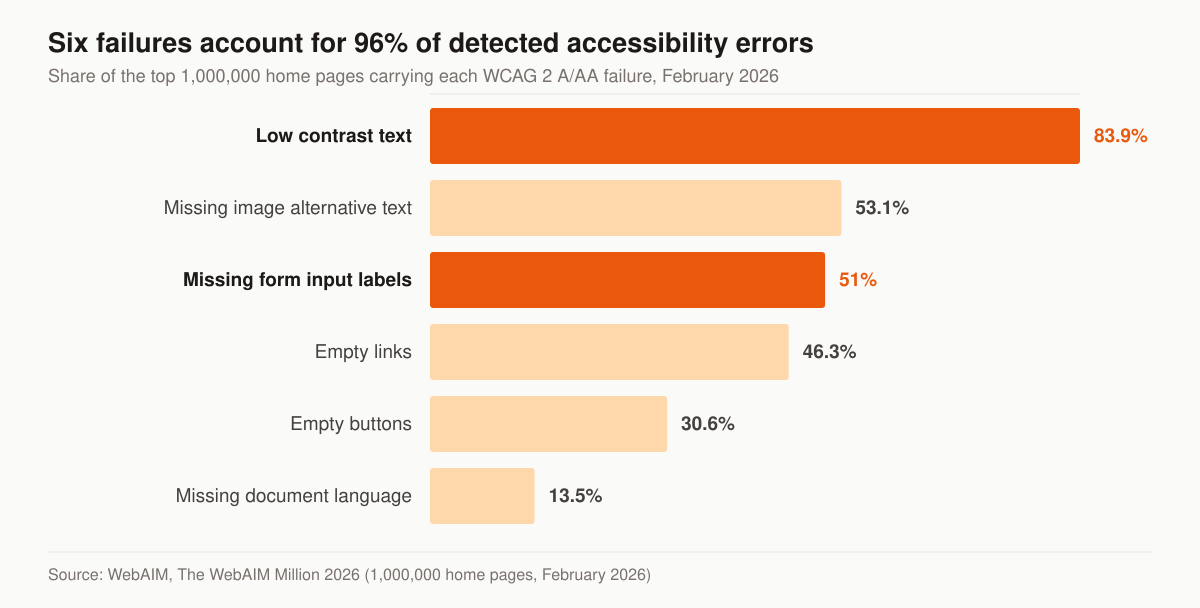
Share of the top 1,000,000 home pages carrying each WCAG 2 A/AA failure. Source: WebAIM, The WebAIM Million 2026, February 2026 sample.
Three of those six are load-bearing on a Medicare funnel. Low contrast text appeared on 83.9% of pages, and WebAIM counted an average of 34 distinct instances of low-contrast text per home page across the whole sample — on a site read by people with age-related vision change, that is the difference between reading the disclaimer and skipping it. Missing form input labels appeared on 51% of pages, and WebAIM found a third of all form inputs (33.1%) were not properly labelled by any of <label>, aria-label, aria-labelledby or title; an unlabelled ZIP field is a screen-reader dead end in the middle of your lead form. Missing image alternative text appeared on 53.1% of pages, which on a Medicare site means the plan-comparison graphic is invisible to part of the audience and to the crawlers reading the page for AI answers.
Two more findings from the same study shape the build. Ambiguous link text — “click here”, “more”, “continue” — appeared on 15.2% of pages, and descriptive anchors are simultaneously an accessibility fix and an internal-linking one. And only 17.1% of pages carried a skip link, with one in ten of those broken. None of these are expensive; they are decisions made once in the template and then inherited by every page.
Speed, trust, and AI search
Seniors and their adult children abandon slow pages. The thresholds are published rather than folklore: Google’s Core Web Vitals guidance puts a good Largest Contentful Paint at 2.5 seconds, a good Interaction to Next Paint at 200 milliseconds, and a good Cumulative Layout Shift at 0.1 or less, each assessed at the 75th percentile of page loads and segmented across mobile and desktop. Our own build target sits under two seconds for LCP, which is a margin against that threshold rather than the threshold itself.
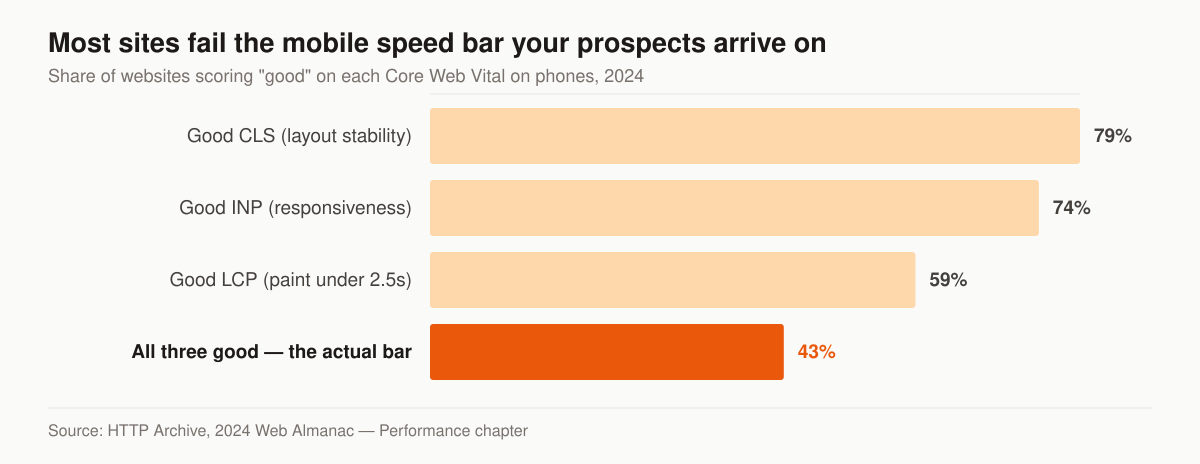
Share of websites scoring “good” on each Core Web Vital on phones. Source: HTTP Archive, 2024 Web Almanac — Performance chapter.
The gap in that chart is the opportunity. Passing one vital is common; passing all three on mobile was true of 43% of sites in the 2024 sample, and the vital fewest sites passed was Largest Contentful Paint — the one a senior notices first.
Named agent, real credentials, and visible licensing matter here too: Medicare is a Your-Money-Your-Life topic, so E-E-A-T signals carry weight with both Google and AI engines. Structured, question-shaped content is what gets quoted when an adult child asks an assistant which local agent to call, which is the surface our AI search and GEO service is built for.
For context from our own senior-market book: we run these pages on live campaigns, not in theory. Compliant pages don’t cost you conversions — sloppy ones cost you your license.
The page inventory a Medicare agent site actually needs
Agents ask how many pages the site should have. The honest answer is that the count follows the compliance split and the service area, not a package tier.
This table sets out the minimum inventory we build and what each page is accountable for.
| Page | Job | Classification |
|---|---|---|
| Home | Establish the licensed agent, route to plan type | Communication |
| One page per plan type (MA, Medigap, Part D, SNP) | Explain the category, route to a conversation | Communication while it names no benefit or premium |
| Enrollment-window page | IEP, AEP, OEP and SEP dates in one place | Communication |
| One page per county or metro served | Local intent, service-area context | Communication |
| Scope of Appointment page | Capture the SOA before any plan discussion | Communication |
| Plan-year comparison page, if you run one | Named plans, premiums, Star Ratings | Marketing — carrier review path |
| Seminar and event pages | Registration and event disclosures | Depends on event type |
| About, contact, privacy | Trust, NAP consistency, consent record | Communication |
Notice how few pages carry a marketing classification. That ratio is deliberate: it keeps the organic surface large and the review queue small. Our content marketing service feeds the plan-type and county pages that rank and stay compliant.
What a done-for-you Medicare website program includes, and what it costs
This is the commercial side of the page — what we build and run when an agency hands the Medicare site over:
- A compliance-templated build, with the TPMO disclaimer, plan-year field and contact block rendered from one source so a change propagates everywhere instead of page by page.
- A plan-type architecture that keeps the traffic-earning pages on the communications side of § 422.2260 and isolates marketing-classified pages for the carrier review path.
- A lead form drafted against the actual clauses — the licensed-agent disclosure at § 422.2274(g)(3), per-entity data-sharing consent under (g)(4), and consent wording written against 47 CFR 64.1200(f)(9), stored with a timestamp and source URL.
- Accessibility and speed baked into the template — contrast, labelled inputs, descriptive anchors and a working skip link, measured against the Core Web Vitals thresholds above rather than a page-speed screenshot.
- County and plan-type content produced on a calendar that stages next plan year before October 1 rather than scrambling in week one of AEP.
Pricing is published rather than quoted: Foundation at $2,500 per month, Growth at $3,500, and Full-Funnel at $5,500, with a one-time website or landing-page build of $2,500 to $8,000. Foundation covers the site or landing pages, local SEO and Google Business Profile, on-page SEO and monthly reporting; Growth adds the ongoing SEO and content engine, AI-search visibility, and reputation and reviews; Full-Funnel adds managed paid ads, landing-page CRO and marketing automation. Ad spend is billed at cost to the platforms rather than marked up. The full breakdown, including what sits outside the monthly fee, is on the pricing page.
What to measure once the site is live
A Medicare site earns its keep on four numbers, and impressions is not one of them:
- Form starts against form completions. A wide gap points at the form, not the traffic — usually a field that is unlabelled, a consent block that reads as a legal wall, or a phone field asked for too early.
- Cost per booked appointment, split by plan type. Medigap, Medicare Advantage and Part D prospects arrive with different intent and close on different timelines; a blended number hides which page is carrying the site.
- Share of sessions on communications pages versus marketing pages. If the marketing-classified pages are carrying the traffic, your organic surface is smaller than it needs to be and your review queue is longer.
- Disclaimer coverage. A crawl that confirms the TPMO block renders on every indexable page is a five-minute check that prevents the complaint the whole build is designed around.
Those are the same measurement habits we apply across the Medicare marketing cluster, and they are why we report on cost per lead and cost per appointment rather than rankings alone.
How the pieces connect
A Medicare site doesn’t work alone. It anchors a system: organic visibility, paid traffic, and a follow-up cadence that turns form fills into appointments. The Medicare lead generation page covers the sourcing side, and the seminar programme covers the room the site fills.
Want a second set of eyes on your current Medicare site — disclaimers, plan pages, form, and load time? Start with a free marketing audit, or contact us if you would rather talk it through first. We’ll show you exactly where a page is leaking leads or risking a complaint, with the fixes ranked by what moves booked calls first.