Service
AI Appointment Setting for Insurance Agents Who'd Rather Sell Than Dial
Fresh leads get contacted in minutes and booked into confirmed calendar appointments automatically — with reminders that cut no-shows and a CRM that hands your closers a day of scheduled conversations instead of a list of numbers to dial.
- We run our own final-expense book
- No pitch deck — we screen-share real numbers
- TCPA-aware · CMS/AEP-compliant · Meta Special Ad Category
- Core Web Vitals < 2.0s LCP
AI appointment setting for insurance agents is the layer that turns a fresh lead into a booked, calendar-confirmed appointment within minutes — instant text-and-email outreach, automated back-and-forth to lock a time, and reminders that cut no-shows. It converts speed-to-lead into scheduled conversations, so closers spend their day selling instead of chasing dials.
What you get
What your ai appointment setting for insurance agents program includes
- A speed-to-lead trigger that starts SMS and email outreach within minutes of opt-in — because booking rates fall fast once a lead goes cold
- An automated booking flow that qualifies the lead and locks a specific time, writing a confirmed appointment straight to your calendar
- A no-show reduction cadence — confirmation at booking plus timed SMS and email reminders before the appointment, with one-tap reschedule links
- Calendar and CRM integration so every booked appointment carries its lead source, tags, and notes into the system you already run
- Lead routing and qualification rules so only appointments that fit your license, state, and product get onto the calendar
- A warm-handoff path — live transfer or a booked call slot — so a ready-now lead reaches an agent instead of waiting
- Consent capture and automatic opt-out handling built into the form, with records kept for TCPA
- Monthly reporting on speed-to-first-contact, booking rate, show rate, and appointments per lead — not vanity activity counts
How it works
How the ai appointment setting for insurance agents engagement runs
- 01
Speed-and-booking audit
We measure how long leads currently wait for first contact, how many actually get booked, and where ready-now prospects fall through — then map a realistic booking and show-rate target for your market and dial capacity.
- 02
Build the booking flow
We build the speed-to-lead outreach, the automated qualify-and-schedule flow, and the calendar plus CRM wiring so a confirmed appointment lands in your system with its source and notes attached.
- 03
Wire reminders and consent
We build the confirmation-and-reminder cadence with reschedule links to protect show rate, and build consent capture and automatic opt-out handling into the form so every outreach is documented and compliant.
- 04
Launch and hand off warm
Outreach goes live, leads start booking themselves into your calendar at the agreed cadence, and ready-now leads route to a live transfer or a booked call slot instead of waiting.
- 05
Tune to show rate
We tune off real signals — speed-to-first-contact, booking rate, and show rate — shifting cadence and channel toward what actually produces kept appointments, not just booked ones.
Every insurance lead has a shelf life measured in minutes. A prospect fills out a form, and their intent is at its peak right then — not an hour later when your team gets around to the dial, and definitely not the next morning. AI appointment setting exists to close that gap: it contacts the lead in seconds, does the scheduling back-and-forth, and drops a confirmed appointment on your calendar while the prospect is still leaning in.
We build and run this the same way we run acquisition on our own book — as the front end of a lead engine, not a bolt-on gadget. The goal is simple: your closers should start the day with a calendar of scheduled conversations, not a spreadsheet of numbers to chase.
What an AI appointment setter actually does
An AI appointment setter is software that reaches a lead, handles the qualifying and scheduling back-and-forth, and writes a confirmed time onto a calendar without a person driving it. Four separate jobs hide inside that sentence, and vendors bundle them differently, so it is worth pulling them apart before you compare anything:
- Contact. Outbound SMS, email or a synthesized voice call fired off the moment a lead record is created — or an answer on an inbound line that nobody picked up.
- Qualify. A short, fixed set of questions that decides whether this person should occupy a slot on a licensed agent’s calendar at all.
- Schedule. Reading real availability from the calendar, offering specific times rather than “someone will call you,” and holding the slot the moment one is picked.
- Write back. Putting the appointment, the answers, the lead source and the consent record into the system your agency actually runs on.
The fourth job is where the category splits, and the vendors know it. Sonant’s published comparison of AI appointment setters for insurance weights “AMS write-back and insurance workflows” at 30% of its score — the heaviest single weight in its rubric — and lists EZLynx, Applied Epic, HawkSoft and AMS360 as the agency management systems it checks against. Its stated reason for putting the weight there is that write-back “is the hardest thing to fake and the biggest source of saved admin time.” Treat that as a buying criterion rather than a vendor claim: a setter that books into a calendar but leaves a CSR re-keying the record afterwards has moved the work, not removed it.
Why minutes decide whether a lead becomes an appointment
Speed-to-lead is one of the most reliable levers in the entire funnel, and it’s mostly mechanical. Two things happen as time passes after an opt-in:
- Intent decays. The prospect who just asked for a quote is distracted, on to the next thing, or no longer in the headspace that made them fill out the form.
- Competition compounds. On shared and internet leads, other agents are dialing the same person. Whoever reaches them first, in a useful way, usually wins the conversation.
That competition is sharpest on bought lists, and the source decides what a booking layer is even allowed to do. If your inbound is telemarketed rather than opt-in, start with telemarketing insurance leads and what they really cost — Do Not Call scrubbing, consent or an established business relationship, and the contact rate that turns a cheap list into an expensive one all sit upstream of the calendar.
A human team can’t hold the line at “first contact within minutes” all day, every day — lunches, other calls, and dropped leads guarantee gaps. Automation doesn’t have those gaps. It fires the first text and email within seconds of opt-in, every time, which is exactly where the highest booking rates live. This is the same principle behind our done-for-you lead generation — generation fills the top of the funnel, and fast booking makes sure the leads you paid for actually turn into sat appointments.
Almost nobody answers an unknown number, so the first touch is a text
Speed only helps if the channel works, and the channel an agency reaches for first — the dial — is the one consumers have largely stopped using. Pew Research Center surveyed 10,211 U.S. adults between July 13 and 19, 2020 and asked what they generally do when their cellphone rings with a number they do not recognize. Nineteen percent said they generally answer it. Sixty-seven percent said they do not answer but check a voicemail if one is left. Fourteen percent said they generally ignore the call and any voicemail after it.
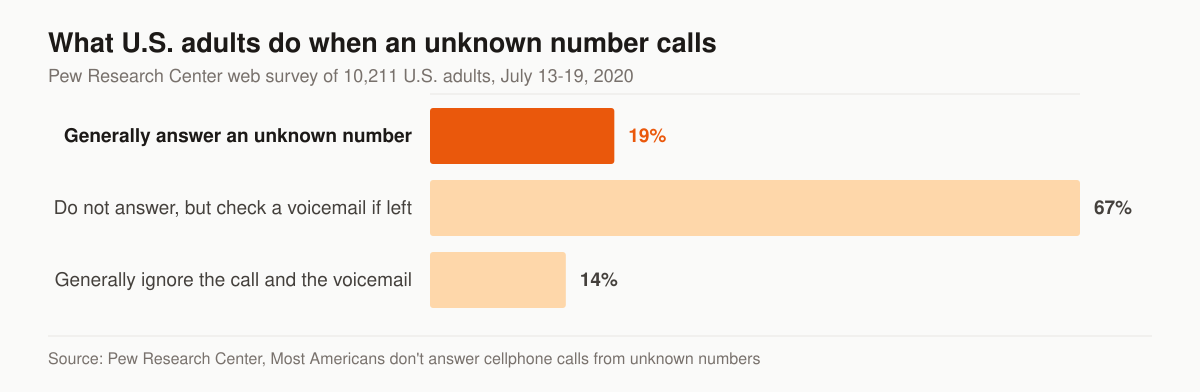
Source: Pew Research Center, “Most Americans don’t answer cellphone calls from unknown numbers”, published December 14, 2020, from a web survey of 10,211 U.S. adults conducted July 13-19, 2020.
Three build decisions fall straight out of that chart. The first is that the opening touch is a text, not a ring — a text arrives whether or not the prospect is willing to pick up a strange number, and it carries your name in the body where caller ID cannot. The second is that if you do dial, you leave a voicemail, because two-thirds of the sample said the voicemail is the part they check. The third is that the dial is worth making anyway, as the second touch rather than the first, once a text has made your number a recognized one.
There is no comfortable demographic escape hatch either. Pew’s write-up notes that “at most, a quarter of Americans from any demographic group say they generally answer the phone for an unknown number”, and that the age skew runs against the folk wisdom: adults aged 18 to 29 were more likely than older age groups to take the call. For final expense and Medicare books, whose buyers sit at the far end of that age range, that is the unhelpful direction. The same survey suggests why people screen — nine in ten U.S. adults think people often (49%) or sometimes (42%) pretend to be someone else in order to try to steal people’s personal information. An unrecognized number in 2026 is read as a risk before it is read as an agent.
One honest caveat: this is 2020 survey data, and it is behaviour, not booking rate. It tells you which door to knock on first. It does not tell you what share of your leads will book.
Booking vs. nurture: two different jobs
Appointment setting is often confused with follow-up automation. They’re related but do opposite jobs, and an agency buying leads at any volume needs both.
The table below separates the three layers that get lumped together as “follow-up,” by the job each one does, when it runs, and what it hands back.
| Layer | Job | When it runs | What it produces |
|---|---|---|---|
| AI appointment setting | Book the ready-now lead | First minutes after opt-in | A confirmed calendar appointment |
| Email/SMS nurture | Work the not-yet-ready lead | Days and weeks after | A warmed lead that re-enters booking later |
| Live transfer | Hand a hot lead to a closer now | Real time | A dialer-ready conversation |
Booking captures the leads who are ready today. Nurture recovers the ones who aren’t — and feeds them back into booking when they warm up. If you only nurture, you leave hot leads waiting; if you only book, you throw away everyone who wasn’t ready on day one. Our email marketing automation service is the nurture half of this pair, and the two are designed to run together.
What “appointment setting” actually includes
A complete booking layer is more than an auto-reply. It covers:
- Speed-to-lead outreach — SMS and email that fire within minutes of opt-in, so you’re first.
- Automated qualify-and-schedule — the back-and-forth that confirms the lead fits and locks a specific time.
- Calendar write-back — a confirmed appointment on your actual calendar, not a “we’ll call you” promise.
- No-show reduction — a reminder cadence with reschedule links, because a booked appointment isn’t a kept one.
- Routing and qualification — rules so only appointments that fit your license, state, and product hit the calendar.
- Consent and records — TCPA consent captured at opt-in and opt-outs honored automatically.
Inbound and outbound are two different booking problems
Agencies usually describe both as “we need appointments,” but they are separate builds with separate failure modes.
Outbound booking starts from a lead record: a fresh opt-in, an aged file, a renewal date, a turning-65 birthday. You control the timing, which means you also own the consent question, the quiet-hours question and the do-not-call question in full. It is graded on booking rate per lead — how many of the records you paid for became a held slot.
Inbound booking starts from a ring you did not schedule: the call that comes in while a producer is already on another call, the one at 7pm, the ones stacked five deep in the third week of AEP. Compliance is easier here, because the prospect initiated the contact, which is exactly the distinction both the TCPA and the CMS marketing rules turn on. The metric is different too: what share of rings ended in a booked slot rather than a voicemail nobody returned.
An agency can be leaking on both sides and only notice one. The outbound leak is visible because you can count the leads you bought. The inbound leak is invisible, because a missed call leaves no row in a spreadsheet. If you have never pulled a month of call logs and counted unanswered rings against booked appointments, that comparison is the cheapest diagnostic in this whole document.
What the setter asks before it gives away a slot
A slot on a licensed agent’s calendar is the scarce resource in this system, and a setter that books anyone who says yes will fill the day with conversations that cannot close. Qualification is the part that protects the calendar, and it is written per line of business rather than once.
The table below shows what the booking flow confirms before it offers a time, by line, and what happens when the answer disqualifies the lead.
| Line | Confirmed before a slot is offered | If it fails |
|---|---|---|
| Final expense | State, age band, whether the person is the decision-maker, best window for a phone conversation | Routed to nurture, not booked |
| Medicare | State, whether the beneficiary consented or initiated contact, product line, whether a Scope of Appointment is on file | No appointment is offered until the scope is recorded |
| Annuity and IUL | Age, stated retirement-planning intent, product fit for the appointment being booked | Routed to a longer education sequence |
| P&C | State, current carrier and renewal date, what is being insured, prior claims | Booked only inside your appointed-carrier footprint |
| ACA | State, household size, whether an enrollment window or qualifying life event applies | Held until a window opens |
Two rules sit under every row. The first is that a state you are not licensed in is a hard stop, not a soft one — a booked appointment you cannot legally write is worse than no appointment, because it consumed a slot and burned a prospect. The second is that the qualification questions are recorded as fields on the contact record, not as free text in a note, because the fields are what the reporting and the routing later read. Annuity work carries the tightest bar of the five, which is why annuity appointment setting is built as its own flow, and IUL appointment setting as another.
Where the AI stops and a licensed agent starts
The boundary matters more than the technology. Confirming interest, capturing facts, offering times and booking a slot are setting tasks. Quoting a premium, comparing specific plan benefits, recommending a product or binding coverage is licensed activity, governed by the state that issued your license and not by any software vendor. So the flow is built to route rather than answer: a coverage question, a premium question, a plan-comparison question or a claim goes to a licensed person, and the automation says so plainly instead of improvising.
There is a second boundary on the voice leg specifically. 47 CFR 64.1200(b) opens “All artificial or prerecorded voice telephone messages shall:” and then requires, at (b)(1), that the message “At the beginning of the message, state clearly the identity of the business, individual, or other entity that is responsible for initiating the call”, and, at (b)(2), that it “During or after the message, state clearly the telephone number (other than that of the autodialer or prerecorded message player that placed the call) of such business, other entity, or individual.” Paragraph (b)(3) adds, for prerecorded-voice messages that include or introduce an advertisement or constitute telemarketing and are delivered to a residential line or the lines described at (a)(1)(i) through (iii), an “automated, interactive voice- and/or key press-activated opt-out mechanism for the called person to make a do-not-call request, including brief explanatory instructions on how to use such mechanism, within two (2) seconds of providing the identification information required in paragraph (b)(1)”. Whether a given AI voice agent is an “artificial voice” for the purposes of that paragraph is a legal question your compliance counsel answers, not a marketing one — but the safe build identifies the agency by name at the top of the call, gives a working callback number, and offers an opt-out, because that is what the section describes on its face.
No-shows are a scheduling problem, not a lead problem
The expensive failure in appointment setting isn’t a lead who won’t book — it’s a lead who booked and didn’t show. That’s a slot your closer held for nobody. The fix is a cadence, not hope:
- Confirm at booking — an immediate confirmation so the appointment feels real.
- Remind on a schedule — timed SMS and email touches leading up to the appointment.
- Make rescheduling trivial — one-tap links so a conflict becomes a moved time instead of a dead lead.
We treat the reminder cadence as the first fix on show rate, and it is the first thing we measure and tune. We report on show rate, not just booking rate, because a calendar full of no-shows is worse than useless — it hides the problem.
A fourth step earns its place once the first three are running: a no-show recovery path. A missed appointment is not a dead record, it is a record with a known interest and a known reason it failed. The recovery touch goes out the same day, offers two concrete alternatives rather than asking an open question, and moves the contact into nurture only after it goes unanswered. Rescheduling something that was already booked once is a shorter conversation than booking it the first time.
The TCPA rules a booking and reminder cadence runs on
A booking cadence is a text-and-call program aimed at consumer phones, which puts it squarely inside 47 CFR 64.1200. Four provisions shape how the automation is built, and each one carries a scope limiter that gets dropped when it is quoted casually.
The table below lists the four paragraphs a booking cadence has to satisfy, the operative words in each, and the mechanism we build against it.
| Provision | What the regulation says | What we build |
|---|---|---|
| 64.1200(a)(10), revocation | A called party may revoke consent to calls or texts made under (a)(1)-(3) and (c)(2) “by using any reasonable method to clearly express a desire not to receive further calls or text messages” | Any-word opt-out handling, not a keyword whitelist, writing back to the contact record |
| 64.1200(a)(10), timing | Revocation requests “must be honored within a reasonable time not to exceed ten business days from receipt of such request” | Suppression applied at receipt, across every sequence the record is enrolled in |
| 64.1200(a)(12), confirmation | A one-time confirmation of an opt-out is permitted if it “merely confirms the text recipient’s revocation request and does not include any marketing or promotional information” | One plain confirmation message, sent inside five minutes, carrying no offer |
| 64.1200(c)(1), send window | No telephone solicitation to “[a]ny residential telephone subscriber before the hour of 8 a.m. or after 9 p.m. (local time at the called party’s location)” | Every send scheduled on the contact’s timezone field, never the office’s |
Read the scope on each of those, because it is the half that matters. The revocation paragraph is written to calls and texts “made pursuant to paragraphs (a)(1) through (3) and (c)(2) of this section” — the autodialer, artificial-or-prerecorded-voice and national do-not-call paragraphs, which is exactly where an automated agency cadence sits. Inside that scope, replying “stop,” “quit,” “end,” “revoke,” “opt out,” “cancel,” or “unsubscribe” “constitutes a reasonable means per se to revoke consent”, and other wording still counts: the caller “must treat that reply text as a valid revocation request if a reasonable person would understand those words to have conveyed a request to revoke consent.” The same paragraph provides that callers or senders covered by those paragraphs “may not designate an exclusive means to request revocation of consent”, so a CRM that only recognizes one magic keyword is not compliant plumbing.
The send-window rule has its own limiter. Paragraph (c) applies to a “telephone solicitation”, and paragraph (f)(15) defines that term as the initiation of a call or message encouraging a purchase, “but such term does not include a call or message: (i) To any person with that person’s prior express invitation or permission; (ii) To any person with whom the caller has an established business relationship; or (iii) By or on behalf of a tax-exempt nonprofit organization.” A lead who filled in your form arguably sits inside exclusion (i). We still schedule on the contact’s local time, for two reasons: the exclusion depends on a consent record you have to be able to produce later, and an 11pm reminder is a bad appointment-setting decision even where it is a lawful one. Paragraph (e) is what carries paragraphs (c) and (d) across to texting at all — it makes those rules “applicable to any person or entity making telephone solicitations or telemarketing calls or text messages to wireless telephone numbers to the extent described in the Commission’s Report and Order, CG Docket No. 02-278, FCC 03-153”.
Paragraph (d) adds the piece agencies skip: an internal do-not-call list, with minimum standards. It requires “a written policy, available upon demand, for maintaining a do-not-call list”, that personnel “be informed and trained in the existence and use of the do-not-call list”, and that a request be recorded “at the time the request is made” and honored “within a reasonable time from the date such request is made. This period may not exceed ten (10) business days from the receipt of such request.” Paragraph (d)(6) sets the retention: “A do-not-call request must be honored for 5 years from the time the request is made.” That is a five-year suppression obligation living inside a CRM that may be rebuilt or replaced long before then — which is why we treat the suppression list as a permanent asset that survives platform changes, rather than a campaign setting. The lead-buying side of the same problem is covered in our guide to TCPA compliance for insurance agents buying leads, and the wider view is in insurance marketing compliance for agents. None of this is legal advice; your compliance officer or upline makes the call on your specific setup.
Medicare appointments have their own rulebook
Medicare is the line where the appointment itself is regulated, not just the outreach that produces it, and the rule reaches individual agents rather than only carriers. 42 CFR 422.2264 opens by defining beneficiary contact as “any outreach activities to a beneficiary or a beneficiary’s caregivers by the MA organization or its agents and brokers.” Standalone Part D sits under the parallel section at 42 CFR 423.2264, worded the same way with “the Part D sponsor or its agents and brokers” substituted.
Three things follow for a booking program. First, the unsolicited channels are closed. Paragraph (a)(2)(iv) prohibits unsolicited use of “telephone solicitation (that is, cold calling), robocalls, text messages, or voicemail messages,” and names specific examples including “Calls based on referrals”, “Calls to beneficiaries who attended a sales event, unless the beneficiary gave express permission to be contacted”, and “Calls to prospective enrollees to confirm receipt of mailed information”. Paragraph (a)(1) leaves email open as the one unsolicited digital channel, and only “provided every email contains an opt-out option”. Paragraph (b)(1)(v) closes the side door as well: an organization “may not make unsolicited calls about other lines of business as a means of generating leads for Medicare plans.”
Second, the release valve is consent or beneficiary-initiated contact. Paragraph (a)(3) states that “Calls are not considered unsolicited if the beneficiary provides consent or initiates contact with the plan”, and gives as its examples “returning phone calls or calling an individual who has completed a business reply card requesting contact”. That single sentence is why a Medicare booking program is built around inbound and around business reply cards, and why the consent record is a stored field rather than a memory.
Third, the appointment carries its own paperwork. Paragraph (c)(3)(i) requires that “Prior to the personal marketing appointment, the MA plan (or agent or broker, as applicable) must agree upon and record the Scope of Appointment with the beneficiary(ies). The Scope of Appointment must be in writing for in-person personal marketing appointments.” The scope also has a shelf life: a scope documented in a Scope of Appointment, business reply card or request for information is “valid for 12 months following the date of beneficiary’s signature date or the date of the beneficiary’s initial request for information”, and marketing additional health-related lines not identified beforehand needs “a separate Scope of Appointment”. Non-health products are out of bounds during the appointment entirely — the section lists “Market non-health related products, such as annuities” among what an agent may not do. Practically, that makes the SOA a gate in the booking flow rather than a form the agent remembers to bring: no recorded scope, no confirmed slot. The mechanics live in our guide to scope of appointment and TPMO compliance, the wider rule set in CMS Medicare marketing rules for agents, and the seasonal timing in Medicare AEP marketing strategies.
Built into your calendar and CRM, so it compounds for you
A booked appointment is only valuable if it lands where you work. We wire booking into your CRM and calendar — GoHighLevel, HubSpot, or a dialer-integrated system — so every appointment carries its lead source, tags, and notes with it, and the reminders and follow-up all live in one place. The system stays your asset. For the senior market, that often means booking a scheduled phone call rather than a video meeting, since final-expense and Medicare buyers respond better to the phone — and for Medicare, the cadence respects CMS marketing rules and the AEP calendar.
P&C agencies add a second system to that list. The book of record for a P&C shop is an agency management system rather than a sales CRM, which is why the write-back question is asked twice: once for the calendar, once for the AMS. If your producers work out of EZLynx, Applied Epic, HawkSoft or AMS360, an appointment that lands only in a Google Calendar invite has created re-keying work for a CSR. If you are still choosing the CRM layer underneath all this, the CRM comparison for insurance agents and the marketing automation guide cover what each platform includes before you pay for a second one.
The line changes the qualification bar, not the plumbing. A final-expense booking is a short confirmation call, whereas annuity appointment setting has to screen for age, investable assets and product fit before it takes a slot — on a high-ticket sale, one kept income-review call is worth more than ten dials that were never suitable.
What to measure, and what to ignore
Activity counts are cheap for a booking vendor to report and thin to read. Dials placed, texts sent and “leads touched” all go up when the system is working and also when it is spraying.
This table lists the numbers on the monthly report, what each one actually measures, and where the reference point comes from.
| Metric | What it measures | Reference point |
|---|---|---|
| Speed to first contact | Minutes from lead creation to the first outbound message | Your own pre-launch baseline |
| Booking rate | Share of contacted leads that hold a specific slot | Your own pre-launch baseline |
| Show rate | Share of booked appointments that are actually kept | Your own pre-launch baseline |
| Qualification pass rate | Share of booked appointments the closer agrees were suitable | Set with your closers, not by us |
| Reschedules recovered | No-shows converted into a second held slot | Zero before the recovery path exists |
| Cost per kept appointment | Total program and lead spend divided by appointments sat | The number we grade the program on |
| Opt-out rate | Revocations per contacted lead | Watched as a cadence-health signal |
Nothing on that list is an industry average dressed up as your result. The reference column says “your own pre-launch baseline” for a reason: appointment-setting benchmarks published by vendors describe their own book, their own lead sources and their own definition of a booked appointment, and none of those match yours. Measure the four weeks before launch, then measure against that.
What AI appointment setting will not fix
Four problems look like booking problems and are not, and it is cheaper to say so before the engagement than after.
A lead source reselling the same contact to every agency that will buy it is a lead-source problem. Booking faster means you reach the person first, which genuinely helps, but it does not change the arithmetic of the file — the comparison is in exclusive versus shared final expense leads. No closer available to take the appointments is a staffing problem, and an over-booked calendar produces cancellations from your side, which damages show rate faster than anything the prospect does. An offer nobody wants is a product and copy problem; a faster setter just gets you to the “no” sooner, and the fix starts with the landing page and the copy that promised the appointment in the first place. And a phone number already flagged as spam by the carriers is a reputation problem measured in weeks of re-warming, not a settings change — which is one more argument for leading with text and email.
How much does AI appointment setting for insurance agents cost?
Appointment setting is not sold here as a standalone line item; it runs inside a monthly tier. The published tiers are Foundation $2,500/mo, Growth $3,500/mo and Full-Funnel $5,500/mo. This program maps to Full-Funnel, the tier that carries managed paid ads, landing-page conversion work and marketing automation together — the combination matters, because a booking flow is only as good as the opt-in form and consent capture feeding it. If those forms and pages need building first, a one-time build runs $2,500–$8,000. The full breakdown is on the pricing page.
Your software is billed separately by its vendor and is the smaller number in the stack. Conversational-AI platforms, dialers and CRMs each price on their own volume model, and a program that texts more will cost more to run than one that only emails. Deciding whether to build this in-house or buy it is the same calculation covered in insurance agency marketing budget.
How long before the calendar fills
Three clocks run at different speeds, and conflating them is how agencies talk themselves out of the program in week three.
Speed to first contact changes the day the trigger goes live, because it acts on leads you are already buying. Booking rate needs a few weeks, because the qualification script has to be tuned against real objections rather than imagined ones, and because the first version always books people your closers then tell you were not suitable. Show rate is the slowest of the three and the most rewarding to fix: reminder timing, slot spacing and the reschedule path each need a full cycle of booked appointments before you can tell which change moved the number.
None of that is a revenue promise. It is the order in which the parts start working, so the monthly report gets read against the right clock.
Where appointment setting sits in the funnel
This service is the connective tissue between the leads you generate and the sales you close. It compounds with the rest of the stack:
- With lead generation, it makes sure fresh leads get booked before they cool.
- With email and SMS automation, it books the ready-now leads while nurture works the rest.
- With AI search and GEO, the prospects who find you through AI answers hit the same fast-booking front door.
For the senior-market programs this plugs into, see final-expense marketing and Medicare marketing. And if you want the timing logic behind the outreach, our insurance lead follow-up cadence guide breaks down what to send and when. For the phone-side skills your closers need once the slot is held, how to sell final expense over the phone is the companion piece.
Want to see how many of your leads are going unbooked because first contact is too slow? Start with a free marketing audit, compare the full set of agency services, or talk it through with the team.
Guides that go deeper
Frequently asked questions
What is AI appointment setting for insurance agents?
How is this different from your email automation service?
Does faster contact really book more appointments?
How do you reduce no-shows on booked appointments?
Is automated SMS appointment setting TCPA compliant?
Will this work with my calendar and CRM?
Does appointment setting fit the senior market for final expense and Medicare?
Can an AI appointment setter answer coverage or premium questions?
See exactly where your agency is leaking leads.
15 minutes. We screen-share our own live lead dashboard and tear down your funnel line by line — no pitch deck, just numbers.
- Site speed & conversion
- Local + AI-search visibility
- Ad efficiency
- Your cost per lead vs ours
No obligation · no pitch deck