Service
Generative Engine Optimization Agency for Insurance Agents (GEO/AEO)
When a buyer or their adult child asks ChatGPT, Perplexity, Gemini, or Google's AI Overviews for an insurance agent, your agency is named and cited in the answer instead of your competitor.
- We run our own final-expense book
- No pitch deck — we screen-share real numbers
- TCPA-aware · CMS/AEP-compliant · Meta Special Ad Category
- Core Web Vitals < 2.0s LCP
Generative engine optimization for insurance agencies is structuring your site so AI search engines like ChatGPT, Perplexity, Gemini, and Google's AI Overviews cite your agency in their answers. Where SEO competes for ten links, GEO competes for one sentence inside the AI response plus the citation beside it.
What you get
What your generative engine optimization for insurance agencies program includes
- A baseline AI-visibility report showing how ChatGPT, Perplexity, Gemini, and Google AI Overviews answer your 20-30 core buyer prompts today, and which competitors they cite instead of you
- Answer-first rewrites of your money pages, each section opening with a 40-60 word passage a model can lift and quote verbatim
- Organization, Service, and FAQPage JSON-LD schema deployed and validated with zero errors in Google's Rich Results Test across your core pages
- An entity sheet stating your agency name, licensed lines, service area, and NAP as consistent facts across your site and top insurance directories
- A robots.txt and crawl configuration that admits GPTBot, ClaudeBot, PerplexityBot, Google-Extended, and Bing Copilot, verified against your server logs
- A Core Web Vitals remediation pass targeting INP under 200ms so AI crawlers render your pages fully
- A monthly AI-citation tracker listing the specific prompts where your agency is now named, quoted, or linked
How it works
How the generative engine optimization for insurance agencies engagement runs
- 01
AI-answer baseline audit
We prompt ChatGPT, Perplexity, Gemini, and Google AI Overviews with your 20-30 core buyer questions and record who gets cited today, then audit your schema, entity data, AI-bot crawl access, and Core Web Vitals to find the gaps keeping you out of the answer.
- 02
Entity and schema fix
We deploy Organization, Service, and FAQPage schema, make your name, licensing, lines, and service area unambiguous across the site and top directories, and open robots.txt so GPTBot, ClaudeBot, PerplexityBot, and Google-Extended can read and trust your facts.
- 03
Answer-first page rewrite
We rewrite your money pages so every section leads with a 40-60 word extractable answer, structured around the exact final expense, Medicare, and life questions seniors and their adult children ask AI.
- 04
Track and expand
We monitor which prompts start naming you, report the citations that actually appear, and feed the wins back into the SEO and content engine, expanding coverage one line at a time.
Type “GEO” into a marketer’s brief and you may get geospatial maps back. We mean the other thing: getting your agency named when a senior or their adult child asks ChatGPT, Perplexity, Gemini, or Google’s AI Overviews “who’s a good final expense agent near me?” That answer is the new first impression.
What is generative engine optimization for an insurance agency?
Generative engine optimization (GEO), also called answer engine optimization (AEO), is the practice of structuring your site so AI search engines cite you in their generated answers. Traditional SEO competes for ten blue links. GEO competes for one sentence inside an AI response, plus the citation link next to it.
The shift matters because the buyer journey changed. A prospect no longer scrolls a results page; they read one synthesized answer and trust the names inside it. If the model doesn’t know your agency exists as an entity, you’re not in the consideration set, and there’s no second page to climb to.
Two terms travel together on this page and are worth separating once. Generative engine optimization is the whole discipline: making an agency legible, crawlable and quotable to systems that generate answers. Answer engine optimization is the narrower craft inside it — writing the passage that gets lifted. Vendors use them interchangeably. We price them as one program because you cannot buy half of the foundation.
Do your insurance buyers actually use AI search?
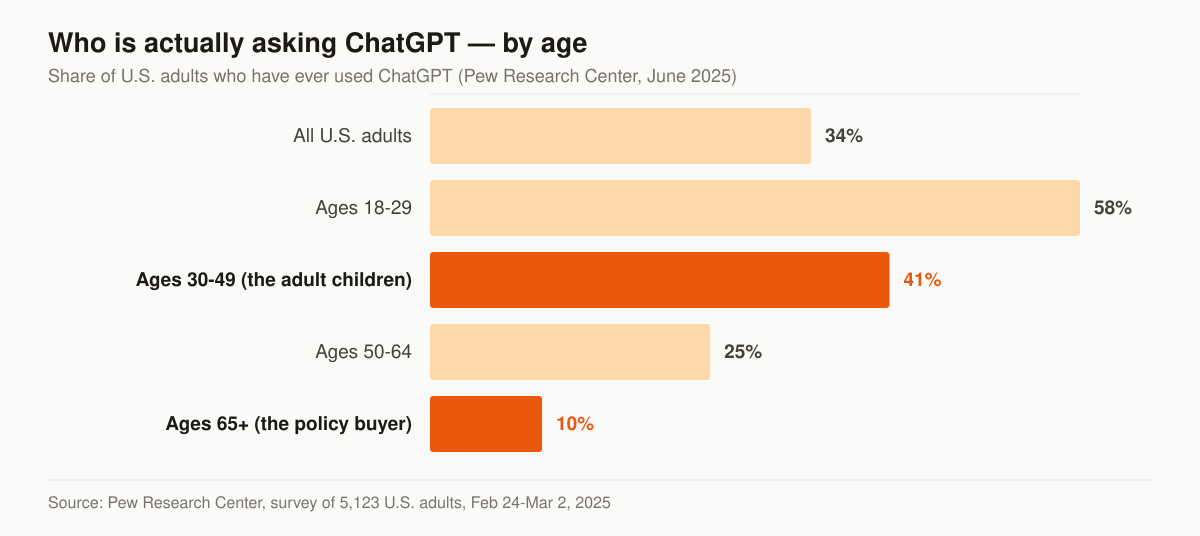
Adoption is real but uneven, and the split runs straight through the senior-market household. Pew Research Center found 34% of U.S. adults have ever used ChatGPT, including 41% of adults aged 30 to 49 and 10% of adults aged 65 and older (Pew Research Center, survey of 5,123 U.S. adults, February 24 to March 2, 2025).
Source: Pew Research Center, June 2025.
Read that chart as a household, not as a demographic. The person who signs a final expense or Medicare application sits in the 10% band. The daughter who opens a laptop, types “is my mom’s Medicare Advantage plan any good” and forwards three agency names sits in the 41% band. Agents who dismiss AI search because “seniors don’t use ChatGPT” are reading one half of a two-person decision.
The 58% figure for adults under 30 is the other reason not to wait. That cohort is the mortgage-protection and term-life book of the next decade, and it is already asking a model before it asks a person.
What an AI citation is actually worth
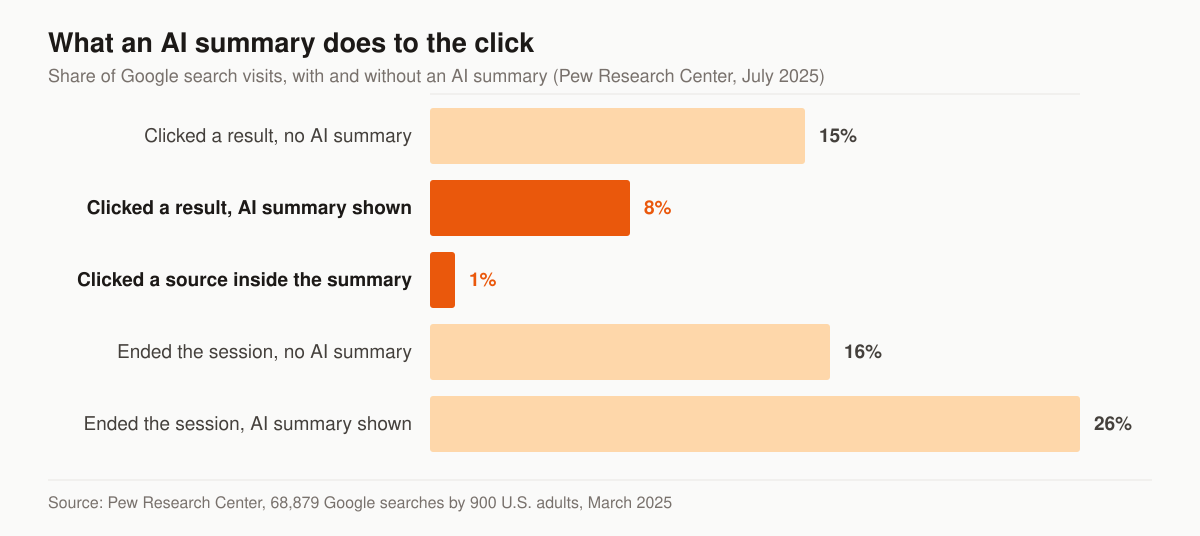
An AI citation is worth less traffic and more trust than a page-one ranking, and any agency that will not say so out loud is selling you something. Pew tracked 68,879 Google searches by 900 U.S. adults in March 2025 and measured what the answer block does to behaviour.
Source: Pew Research Center, July 2025.
Table: what Pew measured on Google search visits with and without an AI summary, and what each number means for an agency’s pipeline.
| What Pew measured | Without an AI summary | With an AI summary | What it means for you |
|---|---|---|---|
| Clicked a traditional search result | 15% of visits | 8% of visits | The click you were optimising for is roughly halved when the answer block appears |
| Clicked a link inside the AI summary | — | 1% of all visits | Being the cited source is a branding win far more often than a traffic win |
| Ended the browsing session on that page | 16% of pages | 26% of pages | The answer often ends the search, so the answer has to carry your name |
Two more figures from the same study set the ceiling. About one-in-five Google searches in March 2025 produced an AI summary (18% overall), and 88% of those summaries cited three or more sources. So the surface is not yet universal, and when it appears there is usually room for more than one name in it. That is the opening.
The honest conclusion: treat a citation as a brand impression in front of a buyer at the exact moment of decision, not as a traffic channel. Price it accordingly, measure it accordingly, and keep the conversion path on your own site short enough that the 8% who do click convert.
How much does a generative engine optimization agency cost?
GEO and AEO ship inside the $3,500/mo Growth tier. $2,500/mo Foundation buys the layer underneath it — the site, local SEO and on-page work GEO sits on — and $5,500/mo Full-Funnel adds managed ads and landing-page CRO on top. A one-time build with GEO structure baked in runs $2,500–$8,000. We could not find a published GEO-specific pricing survey, so the closest published benchmark is SEO pricing. Every number is on the pricing page too — there is no quote gate.
Table: what each of our published prices buys, and the closest published benchmark we could find for it.
| What you are buying | Our price | Closest published benchmark (SEO — we found no GEO-specific survey) |
|---|---|---|
| Foundation: the site, local SEO and on-page layer GEO sits on | $2,500/mo | Ahrefs’ survey of 439 SEO providers calls $501–$1,000 the “most popular monthly retainer rate,” charged by 20.4% of respondents |
| Growth: GEO and AEO shipped with the SEO and content engine | $3,500/mo | Same survey; 68.8% of respondents charge $2,000/mo or less, and it puts the “most common monthly retainer range” for consultants at $2,501–$5,000 |
| Full-Funnel: GEO plus managed ads and CRO | $5,500/mo | Above both of those bands, though the survey records retainers well above ours too |
| One-time build, GEO structure included | $2,500–$8,000 | Same survey’s per-project data: it calls $2,501–$5,000 the “most popular per-project fee” (21.2% of respondents), with 60.6% charging $1,001 or more |
| Buying the same visibility with ads instead | Not offered | “generative engine optimization agency” carries a $114.49 CPC at 390 searches/mo (DataForSEO keyword database, checked 2026-08-23 — a vendor estimate, not a Google figure) |
That last row is the comparison we do not see published on this SERP. At $114.49 a click, a month of the Growth tier buys about thirty clicks, and the clicks stop the day the spend does.
There is one further asymmetry worth naming. A classic SERP has ten organic links to compete for. The AI Overview on “generative engine optimization agency” returns one answer block and five citation slots (measured 2026-08-23). Fewer positions, and the ones that exist are winner-take-most.
GEO vs traditional SEO: what’s different
Both still depend on a fast, crawlable, authoritative site. GEO adds extraction and entity layers on top.
Table: the five dimensions where a generative engine optimization program diverges from a traditional SEO program.
| Dimension | Traditional SEO | Generative engine optimization |
|---|---|---|
| Goal | Rank a page in the results | Get cited inside the AI answer |
| Unit that wins | The page | The passage (one extractable answer) |
| Surfaces | Google, Bing | ChatGPT, Perplexity, Gemini, AI Overviews |
| Trust signal | Backlinks + content | Entity clarity + citations + schema |
| Format reward | Keyword + depth | Answer-first + structured data + clean facts |
The good news for agents: GEO and insurance SEO share the same foundation. We don’t run them as separate budgets; GEO is the extraction layer we build on top of the organic work — the technical, local, content, and authority work laid out in the four layers of insurance SEO is what that layer sits on.
The five things that get an insurance agency cited
- Answer-first passages — every section opens with a 40–60 word direct answer the model can lift verbatim. Buried answers don’t get extracted.
- Entity clarity — your agency, the lines you write (final expense, Medicare, life), your service area, and your licensing stated as unambiguous facts the model can attach to your name.
- Structured data — Organization, FAQPage, and Service schema so machines read your facts without guessing. We deploy it for machine legibility, not for a rich result: Google restricted FAQ rich results to “well-known, authoritative government and health websites” on 8 August 2023, and said in the same post that unused structured data “does not cause problems for Search, but also has no visible effects in Google Search” (Google Search Central). The value that remains is real — schema forces your page into clean question-and-answer pairs, which is the shape an engine can lift.
- Citations and corroboration — being referenced across directories, reviews, and a consistent name-address-phone so the model trusts the entity. This is the same signal set that wins the map pack, which is why we run it alongside local SEO for insurance agents.
- Crawlability for AI bots — admitting the right tokens in robots.txt, which is a longer list than GPTBot alone and is covered in full two sections down, plus Core Web Vitals. Google’s threshold for a good Interaction to Next Paint is 200 milliseconds or below at the 75th percentile (web.dev), so that is the number our remediation pass targets.
Which AI crawlers your site has to admit, and which ones do not matter
Blocking GPTBot does not keep you out of ChatGPT’s search results, and allowing it does not put you in them. Those are two different tokens, and the distinction decides whether an engine can quote you at all. OpenAI’s own documentation says GPTBot crawls content “that may be used in training our generative AI foundation models,” while OAI-SearchBot is the crawler “used to surface websites in search results in ChatGPT’s search features” (OpenAI).
Anthropic splits the same way — ClaudeBot collects content that may contribute to training, Claude-SearchBot “navigates the web to improve search result quality for users” (Anthropic) — and so does Perplexity, whose PerplexityBot is “designed to surface and link websites in search results on Perplexity” and “is not used to crawl content for AI foundation models” (Perplexity).
Table: the crawler tokens that decide whether an answer engine can cite your agency, taken from each vendor’s own published documentation.
| Vendor | robots.txt token | What the vendor says it does | What blocking it costs you |
|---|---|---|---|
| OpenAI | OAI-SearchBot |
Surfaces websites in search results in ChatGPT’s search features | Your listing inside ChatGPT search |
| OpenAI | GPTBot |
Crawls content that may be used in training foundation models | Training exposure only, not search visibility |
| OpenAI | ChatGPT-User |
User-initiated fetches; OpenAI notes robots.txt rules may not apply | Little — it is triggered by a person, not a crawl |
| OpenAI | OAI-AdsBot |
Validates the safety of pages submitted as ads on ChatGPT | Eligibility for ChatGPT ad placements |
| Perplexity | PerplexityBot |
Surfaces and links websites in Perplexity results; not used for model training | Your citation in Perplexity |
| Perplexity | Perplexity-User |
Supports user actions; generally ignores robots.txt | Little, for the same reason |
| Anthropic | Claude-SearchBot |
Navigates the web to improve search result quality | Your appearance in Claude’s search results |
| Anthropic | ClaudeBot |
Collects web content that could contribute to training | Training exposure only |
| Anthropic | Claude-User |
Supports Claude users asking questions | Little; user-initiated |
Google-Extended |
Limits AI training and grounding in some of Google’s other systems | Grounding in those systems, not Search ranking |
Two operational notes that separate a real audit from a checklist. First, verify against your server logs, not your intentions — a token you meant to allow and a token the crawler actually resolved are different facts. Second, audit the live file over the network, because the robots.txt your CMS serves may not be the robots.txt the crawler reads. That is the next section.
The robots.txt your CDN wrote without telling you
Turn on Cloudflare’s managed robots.txt setting and Cloudflare “generates and maintains a robots.txt file that instructs known AI crawlers to stay away from your content” (Cloudflare). That managed block is injected at the edge, above whatever your site serves, and the documented version disallows eight tokens: Amazonbot, Applebot-Extended, Bytespider, CCBot, ClaudeBot, Google-Extended, GPTBot and meta-externalagent. It also emits Content-signal: search=yes, ai-train=no, use=reference.
Cloudflare frames that as keeping your domain “SEO-friendly” while signalling no to AI training, which is a defensible default for a publisher protecting a content library (Cloudflare). It is a strange default for an insurance agency that wants to be quoted. The same post notes only about 37% of the top 10,000 domains have a robots.txt file at all. If you never wrote one, the managed file is the only one there is, and it went live without an announcement.
Untangling it is a parsing question, not a guessing game. The robots exclusion protocol standard says matching groups “MUST be combined into one group” (RFC 9309 §2.2.1) and that where an allow rule and a disallow rule are equivalent, “the ‘allow’ rule SHOULD be used” (§2.2.2) (RFC 9309). So an explicit Allow: / for each blocked token resolves the record to allowed for a conforming parser. Two caveats survive that fix, and we name them rather than hide them: the ai-train=no content signal keeps flying until the setting is turned off in the Cloudflare dashboard, and a parser that honours the first matching group instead of merging will still read the disallow.
This site runs that exact configuration, and you can check it: fetch www.insurancemarketingco.com/robots.txt and you will find every answer-engine token named with an explicit allow, sitting under a Cloudflare managed block we have to out-argue on our own domain. A GEO service that quietly blocks the engines it sells access to has failed its own audit.
What Google says you do and do not need
Google publishes the answer, and it contradicts most of what is sold as GEO. Its documentation on AI features states there are “no additional requirements to appear in AI Overviews or AI Mode, nor other special optimizations necessary,” and adds: “You don’t need to create new machine readable files, AI text files, or markup to appear in these features. There’s also no special schema.org structured data that you need to add” (Google Search Central).
Table: claims commonly made in GEO proposals, set against what Google’s own documentation says.
| The pitch | What Google’s documentation says | What we actually do |
|---|---|---|
| “You need special AI schema” | No special schema.org structured data is needed for AI Overviews or AI Mode | Ship Organization, Service and FAQPage schema for machine legibility, and say plainly that it is not a citation lever |
| “You need an AI text file” | No new machine-readable files are required for these features | Publish one because it costs almost nothing, while telling you it is not the lever |
| “FAQ schema gets you the accordion” | FAQ rich results run only for well-known, authoritative government and health sites since August 2023 | Keep the markup for structure, not for the SERP feature |
| “There are AI-specific optimizations” | No additional requirements or special optimizations exist | Fix indexing, speed, entity clarity and extractable passages — the standard requirements, done properly |
| “Blocking Google-Extended hurts your ranking” | Google-Extended limits AI training and grounding in some of Google’s other systems | Treat it as a licensing decision, and allow it when you want to be grounded |
That is an uncomfortable table for our own category, and it is the reason we sell GEO as a layer on insurance SEO rather than a separate product. If the requirements are the standard requirements, then the work is being genuinely indexable, genuinely fast, genuinely specific and genuinely trustworthy — done to a standard rather than to a checklist. The advantage is execution, not a secret file.
Why this matters specifically for insurance buyers
Senior-market shoppers and their adult children are exactly the audience asking AI for vetted recommendations: “is final expense worth it,” “best Medicare plan for my mom,” “find a licensed agent near me.” These are high-intent, compliance-sensitive questions, and the models lean on sources that read as trustworthy and explicit. A page that states your licensing, lines, and process plainly reads as a better citation than a vendor’s generic landing page.
Compliance is a GEO asset, not a tax. CMS rules govern Medicare AEP marketing and Meta limits Special Ad Category targeting; pages that handle those honestly signal exactly the trust these engines reward. We provide marketing services, not licensed insurance advice, and you remain the licensed party.
GEO and the CMS rules that govern your page copy
An AI engine lifts your words. That is the whole mechanism, and it is why Medicare page copy is now a compliance surface twice over. Federal regulation requires a standardized third-party marketing organization disclaimer from any TPMO “that sells plans on behalf of more than one MA organization” (42 CFR 422.2267(e)(41)(i)), and § 422.2267(e)(41)(iv) requires the disclaimer be “Prominently displayed on TPMO websites” (eCFR).
The rule prescribes the wording. For a TPMO that does not sell for every Medicare Advantage organization in the service area, the disclaimer reads: “We do not offer every plan available in your area. Currently we represent [insert number of organizations] organizations which offer [insert number of plans] products in your area. Please contact Medicare.gov or 1-800-MEDICARE to get information on all of your options.”
Three things follow for a generative engine optimization program.
- What the model quotes is what your page says. Strip the disclaimer from a Medicare page and the passage an engine lifts is missing it too, on a surface you do not control and cannot correct after the fact.
- An AI chat widget is electronic communication. The same paragraph requires the disclaimer be “Electronically conveyed when communicating with a beneficiary through email, online chat, or other electronic means of communication” (42 CFR 422.2267(e)(41)(iii)). A chat widget bolted onto a Medicare page does not carry that disclaimer unless someone wires it in.
- The disclaimer is good entity data. Filling in the organization and product counts the rule asks for turns the disclaimer into a specific, checkable, first-party fact about your agency — precisely the attribute shape an engine can attach to your name. Compliance copy is entity copy.
The rest of the Medicare marketing rulebook interacts with GEO the same way, and we cover the operational version in the CMS marketing rules for Medicare agents and the wider compliance guide for insurance marketing. Nothing here is legal advice; your upline, carrier and compliance officer own the final review, and we build the page around what they approve.
How each AI engine decides who to cite
They don’t all source the same way, so “get cited by AI” is really five slightly different jobs sharing one foundation. Knowing where each engine pulls from tells you which lever moves it.
Table: where each answer engine sources its answers, and what earns a citation on that specific surface.
| Engine | Where it pulls answers from | What earns the citation |
|---|---|---|
| ChatGPT / SearchGPT | Live web via its own crawl (OAI-SearchBot, GPTBot) plus Bing’s index | Crawlable pages with clean, extractable passages it can fetch and attribute |
| Perplexity | Real-time retrieval; cites and links sources inline by default | Direct, well-structured answers it can quote — Perplexity shows its sources, so quotability wins |
| Google AI Overviews | Google’s own index, synthesized by Gemini | Pages already earning organic rankings, reinforced by schema and answer-first structure |
| Gemini | Google’s index and Knowledge Graph, gated by the Google-Extended signal | Entity clarity Google already trusts, plus deep topical coverage |
| Bing Copilot | Bing’s index | Being indexed in Bing at all — submit your sitemap in Bing Webmaster Tools first |
The pattern underneath: every engine rewards a page that is crawlable, states its facts plainly, and answers the question in a liftable passage. Optimize the foundation once and you show up across all five, which is why we never build engine-by-engine one-offs.
llms.txt and the machine-readable layer
llms.txt is a proposed convention — a plain-text file at your root that hands AI models a curated map of your most important pages, the way robots.txt guides crawlers. Be clear-eyed about it: no major engine has publicly confirmed it as a ranking or citation factor, so it is not a shortcut. We publish one anyway because it costs almost nothing, keeps your key URLs and descriptions machine-legible, and can only help as adoption grows.
The proposal moved on in ways worth knowing before you pay anyone to “implement llms.txt.” The v2 spec adds a second, more useful half: publish a clean markdown version of each important page at the same URL with .md appended, and point to it with rel="alternate" type="text/markdown", with rel="describedby" pointing at the llms.txt that covers it (llmstxt.org). The spec notes that OpenAI, Anthropic and Gemini all publish llms.txt files for their own developer documentation, and that Chrome’s Lighthouse now audits sites for one as part of its agentic browsing checks. None of that makes it a citation factor. It makes it cheap infrastructure with a rising floor.
The heavier machine-readable lifting is still done by structured data and entity consistency: Organization, Service, and FAQPage JSON-LD that render without errors, and a name, licensing, lines, and service area that read identically across your site and the directories these models trust. llms.txt is the cheap belt; schema and entity clarity are the suspenders that actually hold.
How we measure AI visibility
A screenshot of one favourable ChatGPT answer is not measurement. The honest metric is your share of AI voice: across a fixed set of your core buyer prompts, how often does each engine name, quote, or link your agency versus your competitors?
- Fix the prompt set. We lock 20-30 real buyer questions — “best final expense agent near me,” “who can help my mom pick a Medicare plan” — so the measurement is comparable month over month.
- Run them across engines on a schedule. The same prompts through ChatGPT, Perplexity, Gemini, and Google AI Overviews, logged the same way each time.
- Score three outcomes per prompt. Named, quoted, or linked — because “mentioned” and “cited with a clickable link” are very different wins.
- Track the trend, not a single snapshot. AI answers vary run to run; the direction of the line across the prompt set is the signal, not any one response.
This is deliberately unglamorous. It ties GEO work to whether real buyers hear your name from the machine they now ask first, and it pairs with the insurance SEO reporting so you see organic rankings and AI citations on one dashboard.
What generative engine optimization cannot do
Four limits, stated up front, because every one of them will otherwise arrive as a disappointment in month three.
It cannot outrun your authority. Google’s AI Overviews synthesise from Google’s index, so a page Google does not rank is a page the overview will not reach for. Depth and structure make a ranked page quotable; they do not manufacture the domain authority that gets it ranked in the first place. That is link and reputation work, and it runs on a longer clock.
It cannot be guaranteed. No engine publishes a citation API, a ranking factor list, or an appeals process. Ask two models the same prompt twice and you can get two different source sets. Any agency quoting you a guaranteed placement in an AI answer is describing something that does not exist.
It cannot fix a page nobody should cite. A model that pulls three sources into an answer is making an editorial judgment about which pages read as reliable. Thin content, unnamed authors, unsourced claims and stock stat-padding read badly to a model for the same reasons they read badly to a person.
It cannot replace the click path. With a summary on screen, Pew measured clicks on traditional results at 8% of visits and clicks inside the summary at 1%. Winning the citation and losing the next step is an expensive outcome, which is why we run GEO against real insurance landing pages rather than against a homepage with a phone number in the header.
How to buy generative engine optimization without getting sold a myth
In-house, agency, or nothing
Table: the three ways an insurance agency staffs generative engine optimization, what each actually costs, and where each one breaks.
| Approach | What it costs | What it gets you | Where it breaks |
|---|---|---|---|
| Do nothing | $0 | Whatever the engines already say about you today, which you will not know until you ask them | Competitors who do the work become the named default answer, and there is no second page to climb to |
| In-house, part-time | A producer’s hours, redirected from selling | Answer-first rewrites and schema on your top pages, eventually | Crawler configuration, log verification and monthly prompt tracking are specialist, repetitive work that gets dropped first when the pipeline is hot |
| Retained agency | $2,500–$5,500/mo on our published tiers | The full stack — audit, entity and schema fix, rewrites, crawl access, monthly citation tracking | You are buying a program, not a guarantee; and a bad agency will bill you for an AI text file and call it a strategy |
Nine questions that separate a real GEO agency from a rebranded one
Ask these on the call. Every one of them has a checkable answer, and a vendor who fumbles more than two is guessing.
- Which OpenAI token governs whether ChatGPT search can surface a page, and is it allowed in your client’s live robots.txt right now?
- Pull up a client’s live
/robots.txtover the network and name every AI token in it, including anything a CDN injected. - What is my prompt set, who wrote it, and how many of the prompts are questions a buyer would actually type?
- Do you log named, quoted and linked as three separate outcomes, or report a single “mentions” number?
- Where in Google’s documentation does it say the schema you are selling produces the result you are promising?
- What is the primary source for each statistic in this proposal, and can I open it?
- Who reviews Medicare, final expense and life copy against CMS and state rules before it ships?
- If I leave in month seven, what do I still own?
- What will you refuse to promise?
Our answer to the last one is on this page: no guaranteed citations, no claim that word count buys rank, and no statistic we cannot link to a source you can open.
The first 90 days of a GEO engagement
The sequence is fixed — access before structure, structure before copy, copy before measurement — because rewriting money pages on a site the engines cannot reach wastes the retainer.
Table: what ships in each 30-day phase of a generative engine optimization engagement, and the signal you should be able to check yourself at the end of it.
| Phase | What we deliver | What you should be able to verify |
|---|---|---|
| Days 0–30 | Baseline AI-answer audit across your 20-30 core buyer prompts; live robots.txt fetched and every crawler token resolved; CDN-injected blocks unwound; Core Web Vitals punch-list against the 200ms INP threshold; entity sheet drafted | Your own fetch of /robots.txt shows the answer-engine tokens allowed, and you have a written record of who the engines name today |
| Days 31–60 | Organization, Service and FAQPage JSON-LD deployed and validating with zero errors; answer-first rewrites of the money pages; NAP and licensed lines made identical across the site and top directories; llms.txt published | Server logs show the answer-engine crawlers fetching the rewritten pages, and your schema validates clean |
| Days 61–90 | Second run of the full prompt set against the baseline; citation tracker live; findings fed back into the content engine and the organic program | A month-over-month comparison on the same prompt set, scored named, quoted and linked |
Ninety days is enough to fix the foundation and see the first movement on a prompt set. It is not enough to build the entity authority that makes a citation durable — that is the program, not the onboarding.
How we deliver it
We audit how the major engines currently answer your core queries, fix the entity and schema gaps, rewrite your money pages answer-first, and track which prompts start citing you. It plugs into the broader insurance marketing services program and pairs naturally with content built for extraction and Medicare marketing, where AEP timing makes AI visibility most valuable.
Want the deeper playbook? Read how to get your insurance agency recommended by ChatGPT, the mechanics of earning a citation from Perplexity and AI Overviews, or the line-specific version for annuity agents facing AI search. The prices above are all published on the pricing page.
Then book a free marketing audit and we’ll show you, live, who the engines name today and what it takes to be one of them. If you would rather skip the audit and scope the work directly, get in touch.
Guides that go deeper
Frequently asked questions
How much does a generative engine optimization agency cost?
What is generative engine optimization (GEO) for an insurance agency?
How is GEO different from traditional insurance SEO?
Which AI engines does answer engine optimization target?
Does GEO help with insurance compliance, or create risk?
How fast does generative engine optimization show results?
Should my insurance agency publish an llms.txt file?
How do you measure whether GEO is actually working?
See exactly where your agency is leaking leads.
15 minutes. We screen-share our own live lead dashboard and tear down your funnel line by line — no pitch deck, just numbers.
- Site speed & conversion
- Local + AI-search visibility
- Ad efficiency
- Your cost per lead vs ours
No obligation · no pitch deck