How to Get Cited by Perplexity and Google AI Overviews as a Local Business
To get cited by Perplexity and Google's AI Overviews, publish answer-first passages an engine can lift verbatim, back every claim with structured data and third-party citations, and keep your name, address, and phone consistent everywhere. These engines quote sources they can verify across many independent places, not the loudest marketer.
Search is splitting into two motions. One is the familiar list of links. The other is a synthesized answer — from Google’s AI Overviews or from Perplexity — where a handful of sources get quoted and everyone else is invisible. For a local business, the goal has shifted from “rank in the top ten” to “be the sentence the engine lifts.”
The good news: the work that earns citations is concrete, documented by the engines themselves, and mostly under your control. The bad news: it is not the work a marketing pitch usually leads with. Loud copy, keyword stuffing, and thin location pages actively hurt you here, because these engines reward verifiability, not volume.
How Perplexity and AI Overviews actually choose sources
Perplexity performs its own live retrieval: it searches the web for a query, pulls candidate pages, and cites the passages that most directly answer the question. Google’s AI Overviews synthesize from Google’s index and ranking signals, then attach citations to the pages that support each claim. The retrieval plumbing differs, but the selection logic rhymes:
- The page states a specific answer near the top, in language the engine can lift.
- The claim is corroborated elsewhere — reviews, directories, other sites.
- The page is easy to parse: clean headings, short answers, tables, FAQs.
- The source carries entity trust: consistent identity across the web.
Google names its own mechanic in writing. Its generative AI guidance describes retrieval-augmented generation as a technique used “to improve the quality, accuracy, and freshness of AI responses by relying on our core Search ranking systems to retrieve relevant, up-to-date web pages from our Search index” (Google Search Central). The same page names a second mechanic, query fan-out: “A set of concurrent, related queries generated by the model to request more information and fetch additional relevant search results to address the user’s query.”
Fan-out is the part that changes how a local agency should plan pages. One typed question becomes several unasked ones, and your page can be retrieved for a phrasing the prospect never entered. That argues for depth on a narrow topic rather than a page per phrasing — and Google says the same, warning that creating separate content for every possible variation of how people might search, done primarily to manipulate rankings or generative AI responses, “violates Google’s scaled content abuse spam policy.”
This is why a modestly ranked page can out-cite a “top” page. The engine is not rewarding your domain’s ego score; it is rewarding the cleanest resolution of the exact question a person asked. That does not make ranking optional — retrieval still pulls from pages that are crawlable, indexed, and trusted, so the insurance agent SEO playbook is the floor this work stands on, not something GEO replaces. Google is explicit about the floor for its own features: “To be eligible to be shown in generative AI features on Google Search, a page must be indexed and eligible to be shown in Google Search with a snippet, fulfilling the Search technical requirements.”
Classic SEO vs getting cited by AI engines
Table: the same page competes in two different contests, and the losing move is different in each.
| Dimension | Classic SEO | Perplexity / AI Overviews |
|---|---|---|
| What you win | One of ten blue links | One sentence + a citation |
| Unit that matters | The page | The passage |
| Rewards | Authority, backlinks, relevance | Extractable answers, corroboration, entity trust |
| Losing move | Thin, duplicate pages | Vague, hype-heavy copy an engine cannot quote |
| Speed to surface | Weeks to months | Often faster; live retrieval refreshes quickly |
Which crawlers have to reach your pages, and what each one does
Before any of the content work matters, the robots have to get in. Perplexity publishes its user agents and says plainly what each one is for, which means a blanket “block the AI bots” line in robots.txt can remove you from the citation surface you were trying to win.
Table: the documented Perplexity agents, described in Perplexity’s own words, and what each one controls.
| Agent | What Perplexity says it does | What that means for your robots.txt |
|---|---|---|
PerplexityBot |
“is designed to surface and link websites in search results on Perplexity. It is not used to crawl content for AI foundation models.” | Perplexity writes that “To ensure your site appears in search results, we recommend allowing PerplexityBot in your site’s robots.txt file and permitting requests from our published IP ranges” |
Perplexity-User |
“supports user actions within Perplexity. When users ask Perplexity a question, it might visit a web page to help provide an accurate answer and include a link to the page in its response.” | “Since a user requested the fetch, this fetcher generally ignores robots.txt rules.” A robots rule does not reliably govern this path |
Source: Perplexity crawler documentation.
Three operational details on that page get skipped and then cost citations. First, timing: Perplexity states that each robots.txt setting works independently and that it may take up to 24 hours for its systems to reflect changes, so a fix is not a same-hour test. Second, the firewall. Perplexity notes that if you use a Web Application Firewall, “you may need to explicitly whitelist Perplexity’s bots to ensure they can access your content” — an agency site behind an aggressive bot-fighting rule can be perfectly crawlable in robots.txt and still return a challenge page to the crawler. Third, verification: Perplexity publishes IP lists at perplexitybot.json and perplexity-user.json on its own domain and tells site owners to treat those endpoints as the source of truth for firewall rules, updating them on a schedule rather than pasting a snapshot once.
The distinction between the two agents is the one to hold onto. PerplexityBot is the automated crawl that decides whether you exist in Perplexity’s search results at all. Perplexity-User is what happens when a prospect pastes your URL into a chat and asks a question about you. You can influence the first with a file. You cannot count on that file governing the second, so write the page assuming a buyer can always fetch it. The same audit belongs inside ordinary insurance SEO work, because a crawl-blocked page fails classic search for exactly the same reason.
The Search Console setting that decides whether Google can cite you at all
There is now a single switch in Search Console that governs whether Google’s generative surfaces may use your site, and it is worth checking before you spend a quarter on answer-first rewrites. Google calls it the Search generative AI control, and notes that “As of August 31, 2026, we’ve rolled out this control to all websites worldwide” (Search Console Help).
The control covers three surfaces: AI Overviews, AI Mode, and generative AI features in Google Discover. Its two settings are described in Google’s own terms. Include means your site’s content “can appear in Search generative AI features, including showing up as links and helping to ground AI responses in these features,” and Google adds that this “is the default control for all properties.” Exclude means content “is prevented from being visible to users in Search generative AI features,” with the blunt consequence that “You won’t receive any traffic or impressions from these features.”
Four clarifications on that page settle arguments that otherwise run for weeks:
- Excluding is not a ranking penalty, and including is not a ranking boost. Google states the control “isn’t used as a ranking or inclusion signal affecting other parts of Search.”
- It is not the training switch. Google writes that the control “doesn’t affect AI training; to limit training of the models used to generate responses in Search generative AI features, use Google-Extended.”
- It propagates in days, not minutes. “Content will be excluded within 1-2 days after the control goes live, but some content may take longer to be excluded due to caching and propagation across Google systems.”
- It inherits. A property follows the control of its closest parent that stopped inheriting, so a subdomain or path property can be carrying a decision someone made at the domain level and forgot.
For an agency with a marketing site, a separate quote subdomain and an old blog path property, that inheritance rule is the practical trap: the setting you are looking at may not be the setting that applies. Open the control on the property that actually serves the pages you want cited, and confirm the value rather than assuming the default survived.
What Google says decides whether a local business shows up
Citations for a “near me” question do not come out of nowhere. Google’s guidance for its generative features says directly that “Where appropriate, generative AI responses can include product listings, product information, and information about local businesses,” and that using products like Merchant Center and Google Business Profiles “can help your products and services to be visible in both AI responses and other Google Search results.” For an agency, that sentence puts Business Profile hygiene inside the AI-citation project rather than beside it.
Google’s separate Business Profile guidance is where the ranking factors are named. It states that “Local results are mainly based on relevance, distance, and popularity,” then defines the three:
- Relevance — “how well a Business Profile matches what someone is searching for,” which is why complete category and service detail beats a bare listing.
- Distance — “how far each business is from the customer who’s searching,” and Google adds that if a customer does not share their location, it uses what it knows about their location.
- Prominence — “how well-known a business is,” a factor Google says is “also based on info like how many websites link to your business and how many reviews you have” (Google Business Profile Help).
Two lines from that same page are worth quoting to any vendor who offers to fast-track you. Google writes: “There’s no way to request or pay for a better local ranking on Google.” And on verification: confirming the profile “tells Google that you’re authorized to represent the business, so it’s more likely to show up in search results.” Completeness carries the same framing — “Businesses with complete and accurate info are more likely to show up in local search results.”
Read those three factors against what an answer engine needs. Distance you cannot change. Relevance and prominence are both descriptions of an entity that is easy to identify and hard to contradict — the same property that makes a source safe to quote. That overlap is the reason we treat local SEO for insurance agents and AI-search work as one workstream rather than two line items, and why a suspended Google Business Profile is an AI-visibility incident and not only a maps problem.
Five levers that earn citations for a local business
- Answer-first passages. Lead each page and each H2 question with a 40-60 word, self-contained answer. That block is what gets lifted. Bury the answer under three paragraphs of preamble and you are handing the citation to a competitor who did not.
- Structured data. Mark up your business, services, and FAQs with valid schema so engines can resolve what you are without guessing. Local business, service, and FAQ schema do the heavy lifting.
- NAP consistency. Your name, address, and phone must match across your site, Google Business Profile, and every directory. Inconsistent identity fractures entity trust and quietly disqualifies you from being cited.
- Third-party corroboration. Reviews, directory listings, and independent mentions are what let an engine verify you. This is where reputation work and GEO overlap — steady, genuine reviews feed both. See how to get more Google reviews for insurance agents.
- Crawlable, parseable pages. Server-render your content, keep headings logical, and consider an llms.txt file that lays out your key pages and facts. It is a supplement, not a substitute for the four levers above.
On that last point, be honest about what the file buys. Google’s guidance lists llms.txt files and other “special” markup under the things you can ignore for Google Search, stating: “You don’t need to create new machine readable files, AI text files, markup, or Markdown to appear in Google Search (including its generative AI capabilities), as Google Search itself doesn’t use them.” Other engines are less documented, and the file is cheap to ship. Publish it if you like; do not bill a quarter against it.
What your LocalBusiness schema should claim, and what it must not
Structured data is where agency sites over-claim, and the over-claim is the part an engine can check. Google’s own position is that markup is optional for AI answers and useful anyway: “Structured data isn’t required for generative AI search, and there’s no special schema.org markup you need to add. However, it’s a good idea to continue using it as part of your overall SEO strategy, as it helps with being eligible for rich results on Google Search.”
So mark up identity, not flattery. Google’s LocalBusiness reference lists only two required properties and then a set of recommended ones, and it puts an explicit fence around the rating fields.
Table: what Google’s LocalBusiness documentation actually asks for, and the constraint attached to each field.
| Property | Status in Google’s docs | The constraint that gets missed |
|---|---|---|
name |
Required | The name of the business — matched against every directory listing you own |
address |
Required | A PostalAddress; Google says to “Include as many properties as possible” because “The more properties you provide, the higher quality the result is to users” |
telephone |
Recommended | “A business phone number meant to be the primary contact method for customers. Be sure to include the country code and area code” |
url |
Recommended | “The fully-qualified URL of the specific business location. The URL must be a working link” |
geo |
Recommended | Latitude and longitude precision “must be at least 5 decimal places” |
openingHoursSpecification |
Recommended | Array or single object; 24-hour operation is expressed as opens “00:00” and closes “23:59” |
priceRange |
Recommended | “This field must be shorter than 100 characters. If it’s 100 characters or longer, Google won’t show a price range for the business” |
aggregateRating / review |
Recommended, with a fence | Google labels both “only recommended for sites that capture reviews about other local businesses” |
Source: Google Search Central, local business structured data.
That last row is the one to act on. A rating you assert about yourself is a claim with no independent corroboration behind it, which is precisely the shape of claim an answer engine has no way to verify — and Google’s documentation already tells you the property is not meant for that. Let the rating live where a third party publishes it and let the engine find it there.
Two smaller instructions from the same reference save a rebuild later. Google says to “Use the most specific LocalBusiness sub-type possible” — for an agency that is InsuranceAgency, which schema.org files under FinancialService, itself a subtype of LocalBusiness. And if you genuinely operate as more than one type, Google says to “specify them as an array (additionalType isn’t supported),” so the common workaround of bolting on additionalType produces markup Google does not read. Validate the result in the Rich Results Test before you ship it, which is the step Google’s own build sequence puts third.
How to build corroboration without breaking the FTC review rule
Third-party corroboration is the half of GEO that agents skip, and it is also the half with a federal rule attached. The FTC’s Rule on the Use of Consumer Reviews and Testimonials sits at 16 CFR Part 465, is sourced in the eCFR to 89 FR 68077, August 22, 2024, and the eCFR timeline for the part shows it taking effect on October 21, 2024. It governs exactly the activity a citation strategy depends on: asking for reviews, publishing testimonials, and deciding which reviews appear on your own site.
The rule is not a reason to stop asking. It is a set of edges around how you ask.
Table: what Part 465 forbids, and the practice it leaves open for an agency building corroboration.
| Provision | What the rule says | What it leaves you free to do |
|---|---|---|
| § 465.4, buying sentiment | Forbids a business providing “compensation or other incentives in exchange for, or conditioned expressly or by implication on, the writing or creation of consumer reviews expressing a particular sentiment, whether positive or negative, regarding the product, service, or business that is the subject of the review” | Ask without conditioning anything on the rating you get back |
| § 465.2(d)(1), the solicitation carve-out | Paragraphs (b) and (c) “do not apply to” reviews or testimonials “that resulted from a business making generalized solicitations to purchasers to post reviews or testimonials about their experiences with the product, service, or business” | Send every client the same request, on the same schedule |
| § 465.5(a), insider reviews | An officer or manager who writes a consumer review or testimonial about their own business must give “a clear and conspicuous disclosure of the officer’s or manager’s material relationship to the business,” unless, in the case of a testimonial, the relationship is otherwise clear to the audience | Have staff disclose the relationship rather than post anonymously |
| § 465.1(c)(4), what “clear and conspicuous” means online | In an interactive medium “the disclosure must be unavoidable. A disclosure is not clear and conspicuous if a consumer must take any action, such as clicking on a hyperlink or hovering over an icon, to see it” | Put the disclosure in the visible text, not behind an asterisk |
| § 465.7(b), review gating | Forbids materially misrepresenting that displayed reviews “represent most or all the reviews submitted” when reviews are being suppressed “based upon their ratings or their negative sentiment” | Apply withholding criteria “equally to all reviews submitted without regard to sentiment” |
| § 465.6, your own review site | Forbids materially misrepresenting that a site or entity a business “controls, owns, or operates provides independent reviews or opinions, other than consumer reviews, about a category of businesses” | Publish comparisons under your own name, labelled as yours |
Source: eCFR, 16 CFR Part 465.
Two of those provisions carry a knowledge element worth reading in full rather than in summary. Section 465.2(b) reaches a business that disseminates a testimonial “which the business knew or should have known materially misrepresented” that the testimonialist exists or had the experience described. Section 465.8 likewise reaches purchasing or procuring fake indicators of social media influence “that they knew or should have known to be fake and that materially misrepresent their influence or importance for a commercial purpose.” The standard is not strict liability, and it is not a free pass either — “should have known” is doing the work in both.
The strategic reading is that the compliant path and the citable path are the same path. A generalized, unconditional review request produces reviews that engines can corroborate against a real transaction history. A purchased five-star block produces a rating that contradicts everything else about the entity, which is the pattern that makes a source unsafe to quote. Google says the analogous thing about mentions: seeking inauthentic “mentions” across the web “isn’t as helpful as it might seem”, because its ranking systems focus on high-quality content while other systems block spam. Our fuller treatment of the compliance surface sits in insurance marketing compliance for agents, and the operational side is what reputation management covers.
Which sources AI summaries actually cite
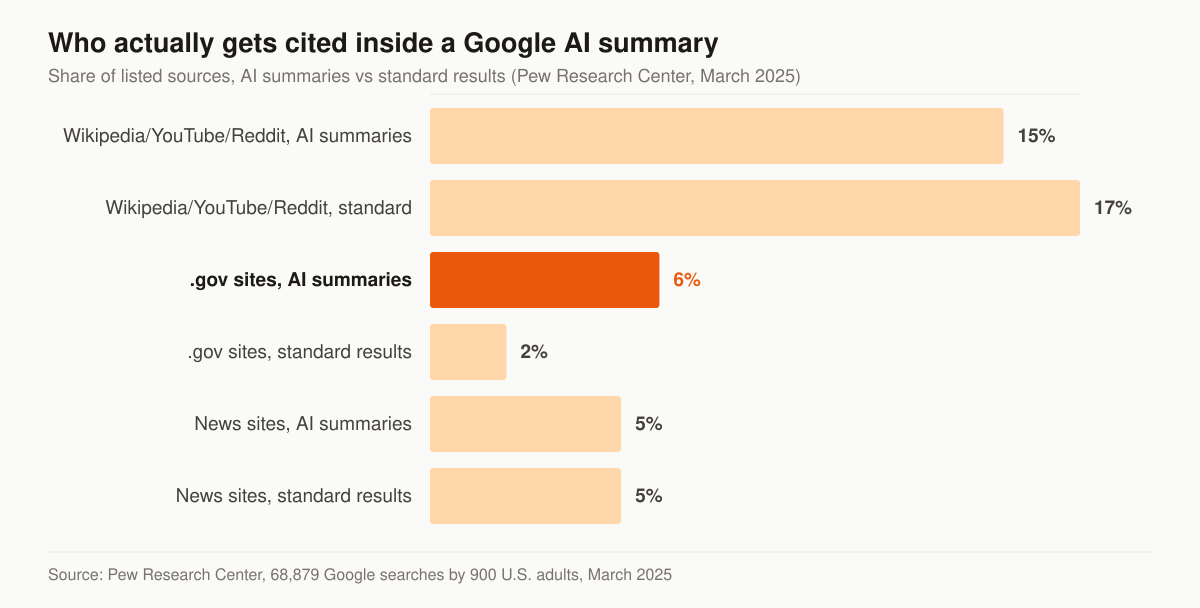
Before you build a plan around being the cited source, look at who the citations currently go to. Pew Research Center collected browsing data from 900 U.S. adults and examined 68,879 unique Google searches from March 1-31, 2025, of which 12,593 produced an AI summary. Its source-mix finding is uncomfortable and useful.
Source: Pew Research Center, July 2025, analysing searches collected March 2025.
Read those bars as a seating chart. Wikipedia, YouTube and Reddit together took 15% of the sources listed in the AI summaries Pew examined, and 17% of the sources in standard search results. Government sites took 6% of AI-summary sources against 2% of standard-result sources — a gap that says the summary leans on .gov harder than an ordinary results page does. News sites took 5% of each.
Three consequences for a local insurance agency. First, a meaningful share of every citation slot is already spoken for by a handful of mega-domains before any independent business is considered, so plan on sharing the block rather than owning it. Second, since .gov is over-represented in the summary specifically, align your explanations with the government and regulator sources on the same subject instead of contradicting them; a page that agrees with CMS or your state department of insurance and adds the local specifics is a safer thing to quote than one that argues with them. Third, the platforms in that first group are places you can actually appear — a substantive answer under your own name in a community thread, or a video that explains the same thing your page does.
There is room in the block. In the same study, 88% of AI summaries cited three or more sources, and only 1% cited a single source. This is not a winner-take-all slot; it is a short list, and short lists have a third seat.
What a citation is worth once you have it
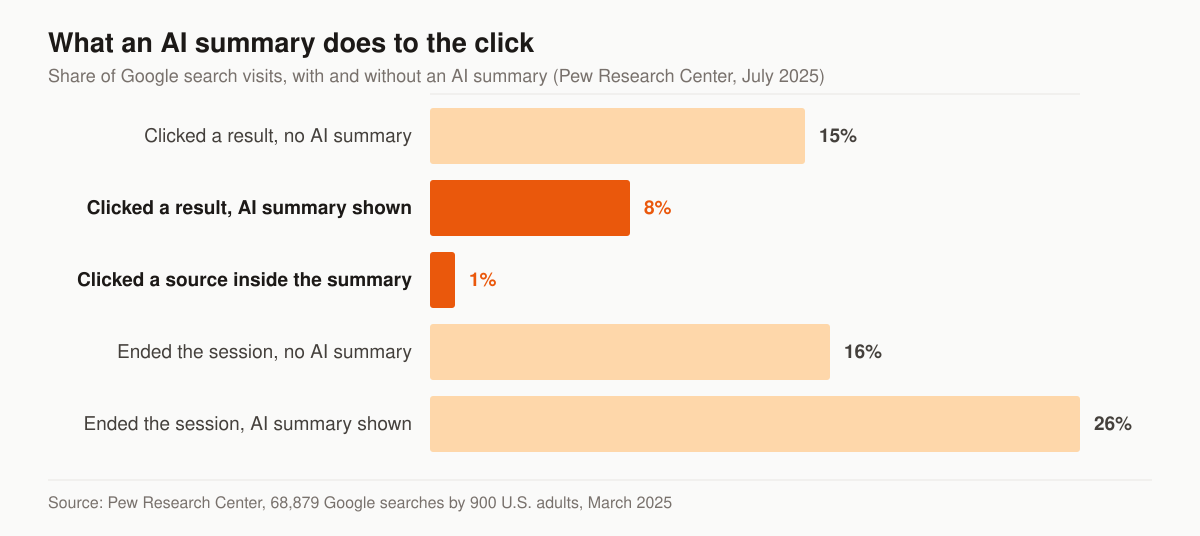
Set expectations before you invest a quarter in this. Pew’s click data is the honest version of what an AI citation buys.
Source: Pew Research Center, July 2025.
Users who encountered an AI summary clicked a traditional search result on 8% of visits, against 15% of visits with no summary. They clicked a link inside the summary itself on 1% of visits. And browsing sessions ended on 26% of pages carrying an AI summary versus 16% of pages without one.
A citation is therefore a brand impression far more often than it is a session. That has two design consequences. The passage you want lifted has to carry your name and your positioning, not only your URL, because the name may be all the prospect ever sees. And the length has to survive compression: Pew found the median AI summary ran 67 words, with the shortest at seven and the longest at 369. Write the answer at roughly the length of a short paragraph and it can be quoted whole; write it as a three-paragraph build-up and the engine will paraphrase you instead, which drops the attribution.
That also settles the sequencing question. If a citation mostly buys an impression, the pages behind it have to convert the small share of people who do click, which is why the content marketing engine and the conversion path matter as much as the citation itself.
Perplexity and AI Overviews are not the same as ChatGPT
It is worth separating the engines, because the tactics tilt slightly. Perplexity and AI Overviews retrieve and cite live sources, so passage clarity and corroboration dominate. ChatGPT’s recommendations lean more on entity-level trust the model has absorbed, which we cover in how to get your insurance agency recommended by ChatGPT. Build for all three and the overlap is large — but if you are chasing citations specifically, optimize the extractable passage first.
There is a fourth surface arriving that changes the shape of a page again. Google’s guidance now describes agentic experiences, in which “browser agents may access your website to gather the data they need to complete these tasks, such as analyzing visual renderings (like screenshots), inspecting the DOM structure, and interpreting the accessibility tree.” A quote page that reveals its content only after several JavaScript steps and a modal gives a browser agent very little to read. Semantic headings, real form labels and a usable accessibility tree stop being an accessibility nicety and start being a retrieval requirement.
How to measure AI-search visibility for a local agency
You have exactly one first-party measurement surface for AI search, and it covers Google only. Search Console’s generative AI performance report “shows data about how your site performs in generative AI features on Google Search”, and Google notes that “As of August 31, 2026, we’ve rolled out these insights to all websites worldwide” (Search Console Help).
What it gives you is narrower than most reporting decks imply, so read the specification before you build a dashboard on it:
- It counts impressions from AI Overviews and AI Mode. Discover has a separate report.
- You can group by pages, countries, dates and devices — and most performance data in the report is assigned to the page’s canonical URL, not to a duplicate URL.
- Data from Search Labs experiments is excluded, “as these experiments are still in active development.”
- The usual performance-report limits apply, including the 1,000-row limit.
- If the report is missing entirely, one documented cause is that you excluded the site using the Search generative AI control.
For Perplexity, ChatGPT and Claude there is no equivalent report, and the honest method is manual. Keep a fixed list of the 20 to 30 questions a local prospect actually asks — coverage questions, cost questions, “do I need X in my state” questions — run them monthly in each engine from a clean session, and log who gets cited and what the cited passage says. It is unglamorous, and on those surfaces it is the one reporting method that does not rest on inference. Pair it with your ordinary ranking work, since ranking an insurance agency website and citation share move together.
What running this as a program costs
We publish prices rather than quoting per call. AI-search visibility sits inside the Growth tier at $3,500 per month, which also carries the ongoing SEO and content engine, reputation and reviews work, and monthly reporting. Foundation is $2,500 per month and covers the website, local SEO and Google Business Profile work, and on-page SEO. Full-Funnel is $5,500 per month and adds managed paid ads, landing-page CRO and marketing automation on top. A one-time website build runs $2,500 to $8,000, and ad spend is billed separately, straight to the platforms. The full breakdown is on the pricing page.
GEO sits at Growth rather than Foundation for a sequencing reason, not an upsell one. Answer-first rewriting on a site that is slow, thin or crawl-blocked buys nothing, because the retrieval step never reaches the passage. Fix the foundation, then write the answers.
A quick self-audit
- Open your top service page. Is there a clean, quotable answer in the first 60 words? If not, that is lever one.
- Search your core question in Perplexity. Who gets cited, and what does their answer passage look like?
- Check your NAP across three directories. Any mismatch is a trust leak.
- Confirm your schema validates and your pages render without JavaScript.
- Read your robots.txt for
PerplexityBot, and check your firewall logs for blocked crawler traffic before you conclude the file is the problem. - Open Search Console → Settings → Search generative AI on the property that serves your money pages, and confirm the value it is actually using rather than the one you assume it inherited.
- Look at your
LocalBusinessmarkup and delete anyaggregateRatingyou applied to yourself.
If you want this done systematically for an insurance agency — schema, answer layers, and the entity trust that gets you quoted — that is the core of our generative engine optimization work, and you can start with a free marketing audit that includes an AI-visibility check. For a vertical-specific worked example, see AI search for annuity agents.
The takeaway
Getting cited by Perplexity and AI Overviews is not a mystery and it is not a growth hack. It is answer-first structure, valid schema, consistent identity, and real third-party corroboration — the same signals that make you trustworthy to a human, expressed in a form an engine can lift. Almost every requirement in this guide is published by the engine that enforces it: Perplexity names its crawlers, Google names its ranking factors, its eligibility gate and its measurement report, and the FTC names the edges around your reviews. Read the primary sources, fix the mechanics they describe, then write the sentence you want quoted and earn the trust that lets it be believed.
- How to Get Your Insurance Agency Recommended by ChatGPT
A practical GEO playbook to get your insurance agency recommended by ChatGPT: entities, schema, llms.txt, reviews, citations, and answer-first content.
- Insurance SEO Cost, Timeline, and the DIY-vs-Hire Decision
What insurance SEO costs in 2026, how long it takes to pay back, and whether to run it yourself or hire it out — with the four layers ranked by payback.
- Insurance SEO Prices: Every Published Number We Could Verify
We opened 12 insurance SEO vendors' own pricing pages on 6 September 2026. Nine publish a monthly figure, from $150 to $7,000. Here is every number.
- Google Business Profile Suspended: The Insurance Agency Recovery Guide
Why insurance agency Google Business Profiles get suspended and how to appeal using Google's own process — evidence checklist, steps, and prevention.