Insurance SEO Cost, Timeline, and the DIY-vs-Hire Decision
Insurance SEO costs most businesses $500 to $5,000 a month — Ahrefs' survey of 439 providers put 63% in that band, with agencies averaging $3,209 — and a program typically takes six to twelve months to pay back. Anything under about $1,000 a month usually buys thin content or link schemes rather than rankings.
Every buying guide repeats the same three tips: claim your Google Business Profile, write blog posts, be patient. All true, and all useless without the decisions that come first — what the work actually costs, how long before it pays back, and whether you should run it or hire it.
This is the money-and-timeline guide. It covers what a real program costs, how long each layer takes to return anything, where DIY beats a retainer, and how AI search changes the picture in 2026. For the service itself — scope, tiers, and what we run month to month — see our SEO for insurance agents service page. When you’re ready to execute yourself, the build sequence lives in our companion piece on how to rank an insurance agency website on Google. This page prices the decision; that page does the work.
What are you actually paying for?
Insurance SEO buys four separable things: local visibility, content, technical health, and AI-search presence. They have different price tags and very different payback curves, which is why “how much does SEO cost” has no single answer until you decide which layers you are funding.
It is not lead buying and it is not PPC. Those rent attention for exactly as long as you pay for it. SEO builds an asset that keeps producing after the spend stops, which is why its cost per lead falls while every paid channel’s drifts up. It also now has a twin discipline — GEO, generative engine optimization — that points the same content at ChatGPT, Perplexity, and Google’s AI Overviews. Everything below is the order to do it in: whether it’s worth your budget, how insurance search differs, the four layers, what it costs, and how long it takes.
Is SEO worth it for insurance agents?
If you plan to be in the business three years from now, yes: SEO is the only lead channel whose cost per lead falls over time, because a page that ranks keeps producing without a per-lead invoice. It is the wrong channel if you need appointments this month or plan to exit within a couple of years.
The honest way to decide is to treat SEO as buying an asset instead of renting a channel. Paid leads and PPC bill from day one and stop producing the day you stop paying. SEO inverts that: you pay in time or retainer for months before rankings arrive, and then the economics flip — a page that ranks keeps producing leads with no per-lead invoice attached. That is the entire case for it. Not that it’s cheap, but that its cost per lead falls over time while every paid channel’s cost per lead drifts up as competition bids in.
SEO is the wrong first channel when:
- You need appointments this month. Nothing in organic search moves that fast. Run paid traffic for cash flow and build SEO underneath it — the sequencing logic is laid out in our digital marketing playbook for insurance agents.
- You’re within a couple of years of exiting. The compounding mostly lands after month six. If you won’t be around to harvest it, spend elsewhere.
- You can’t sustain it. Two months of effort followed by silence produces roughly nothing. Half-done SEO is the most expensive kind, because you pay the ramp-up cost without reaching the payoff.
If none of those apply, the question isn’t whether to do SEO. It’s which layer to start with — and that depends on your line, which is where most generic advice falls apart.
How is SEO different for insurance than other industries?
Insurance SEO differs in three ways. Google holds insurance content to a higher trust bar because it is a “Your Money or Your Life” category. Carriers and aggregators own the broad head terms, so agents win on local and niche searches instead. And compliance — CMS marketing rules, TCPA — constrains what you publish and how you follow up.
1. Google holds insurance content to a higher bar. Insurance is a “Your Money or Your Life” (YMYL) category. Google’s own documentation says its systems “give even more weight to content that aligns with strong E-E-A-T” — experience, expertise, authoritativeness, trust — “for topics that could significantly impact the health, financial stability, or safety of people” (Google Search Central). In practice: anonymous, thin, or AI-spun content that might scrape by for a landscaping company gets buried for an insurance agency. Named licensed authors, accurate carrier and product information, real contact details, and clear disclosures aren’t compliance decoration here — they’re ranking inputs.
2. The head terms aren’t winnable, and don’t matter. Search “life insurance” and the first page is carriers, aggregators, and national lead vendors with domains you will not out-muscle. That sounds like bad news; it’s actually the strategy. The searches that produce policies for an agent — “medicare broker in [your city],” “final expense agent near me,” the specific product questions in your line — are local and niche, far less defended, and far closer to a buying decision. Insurance SEO is a flanking game, not a frontal assault.
3. Compliance rides along. Medicare content has to live inside CMS marketing rules, and the outreach you do with the leads SEO produces has to respect TCPA. Most SEO advice ignores both, because most SEO advice wasn’t written for a regulated industry. Build inside the guardrails from the first page, not retroactively.
The four layers of insurance SEO
“SEO” bundles four different disciplines, and most advice fails agents by treating them as one job. Separate them:
- Local SEO — winning the map pack and near-me searches through your Google Business Profile, reviews, citations, and location pages. Highest intent, fastest results, and the layer most local agents should start with.
- Content SEO — publishing pages that answer what your buyers actually search, organized into topic clusters that build authority in your line. Slowest to pay, biggest ceiling.
- Technical SEO — site speed, mobile rendering, clean indexing, and schema markup: Article on posts, BreadcrumbList for structure, and Organization or LocalBusiness for the entity (schema.org even publishes a dedicated InsuranceAgency type). It doesn’t win rankings on its own; it stops the other layers from being wasted.
- GEO and AEO (answer engine optimization) — structuring content so ChatGPT, Perplexity, and Google’s AI Overviews cite and recommend you. This is where AI citations are won, and it’s the only answer to zero-click searches that end inside a generated summary instead of on your site. The newest layer, and the one where we currently see the least competition.
Which layers matter most depends on who you sell to and how you sell:
| Layer | What it wins | Best fit | Speed to results |
|---|---|---|---|
| Local SEO | Map pack, “[city] insurance agent” searches | P&C and any agent with a real service area | Weeks to a few months |
| Content SEO | Question and comparison searches across your line | Telesales final expense, Medicare, life — any non-local book | Months, then compounding |
| Technical SEO | Nothing alone — protects everything else | Every site, fixed once, then maintained | Immediate once fixed |
| GEO / AEO (AI search) | Citations and mentions in AI answers | Every line; biggest edge while competitors ignore it | Weeks to months |
The pattern by agent type: a local P&C agent goes local-first, content second — your buyers search with a city in mind. A telesales final expense or Medicare agent goes content-first, GEO close behind — your buyers aren’t searching “near me,” they’re searching questions. Everyone fixes the technical floor first, because a slow or unindexable site caps every other layer.
What are the best SEO keywords for insurance agents?
The best keyword is the one typed by someone about to buy from an agent like you. Volume tools mislead in this vertical: insurance is full of terms with tiny reported volume and outsized policy value, and full of huge head terms that will never produce a client. Sort your targets into four buckets and work them in this order:
- Local-transactional — “medicare broker in [city],” “insurance agent near me,” “[city] home insurance quotes.” Lowest volume, highest close rate. These belong on your homepage, service pages, and location pages — not blog posts.
- Buyer questions in your line — “how much does final expense insurance cost,” “do I need life insurance after 60.” Top-of-funnel volume that builds topical authority and feeds your email list and retargeting.
- Comparison searches — “term vs whole life,” “medicare advantage vs supplement.” The searcher is actively deciding; a genuinely useful comparison page converts far above its traffic numbers.
- Situation and objection searches — “life insurance with COPD,” “medicare when still working at 65.” Low volume, near-zero competition, and the searcher has a specific problem you can solve. This bucket is where small agencies quietly out-rank everyone.
You don’t need paid tools to find these. Google’s autocomplete and People Also Ask boxes show what real searchers type around every query. Your own Search Console lists queries where you already get impressions but sit in poor positions — the fastest wins available on any site. And your sales calls are a keyword tool: every question a prospect asks on the phone is being typed into Google by someone else.
One rule across all four buckets: one page per keyword cluster. Don’t write five thin posts circling the same query. Write one page that settles it, then update that page as the answer changes.
What insurance keyword data actually looks like, by line
Most guides tell you keywords matter and never show you a number. Here is measured July 2026 search data for agent-facing terms across the major lines — and it makes the two points above concretely: the volumes are small, and the costs-per-click are not.
| Line | Keyword | Searches/mo | CPC | Intent | 12-mo trend |
|---|---|---|---|---|---|
| Medicare | turning 65 medicare leads | 140 | $31.74 | informational | — |
| Medicare | medicare leads for agents | 70 | $41.60 | informational | — |
| Medicare | medicare supplement marketing | 10 | $24.30 | informational | −80% |
| Final expense | final expense leads | 1,300 | $14.28 | informational | — |
| Final expense | final expense direct mail leads | 90 | $27.11 | transactional | +57% |
| Final expense | aged final expense leads | 70 | $10.78 | informational | −36% |
| Life | life insurance leads | 1,900 | $18.18 | navigational | — |
| Life | life insurance leads for agents | 210 | $26.33 | informational | +88% |
| Life | how to get life insurance leads | 170 | $23.45 | informational | −47% |
| P&C | property and casualty insurance leads | 10 | $72.30 | navigational | — |
| P&C | home insurance leads for agents | 10 | $32.13 | informational | +100% |
| General agency | insurance leads for agents | 1,300 | $37.28 | informational | — |
| General agency | seo for insurance agents | 720 | $58.37 | commercial | −45% |
| General agency | crm for insurance agents | 590 | $59.58 | commercial | −56% |
| General agency | marketing consultant insurance | 70 | $220.01 | commercial | −76% |
Source: DataForSEO Labs, July 2026 — United States, English. Trend is the 12-month change in search volume; “—” means the volume is too low or too flat to score.
Read the CPC column as what advertisers pay Google for a single click. “Marketing consultant insurance” gets 70 searches a month and costs $220.01 per click — which tells you exactly what one ranked page for a term like that is worth. This is the economics of the whole vertical in one table: you don’t win insurance SEO on traffic volume, you win it by owning a basket of tiny, expensive, high-intent terms. And note the trend column — most of these terms are shrinking in Google year over year, which is not demand disappearing. It’s demand moving, and that’s the next section.
How do you do local SEO as an insurance agent?
Google says local ranking comes down to three factors — relevance (how well your profile matches the search), distance, and prominence, which includes “how many websites link to your business and how many reviews you have” (Google Business Profile Help). You can’t move your office, so the work is relevance and prominence:
- Complete the Business Profile completely. Google states outright that businesses with complete and accurate information are more likely to show in local results. Every field filled, accurate categories, real photos, services listed, hours current.
- Make reviews a weekly habit, not a campaign. Review count and ratings feed prominence directly, and they close prospects who never mention them. Build the ask into your post-sale process — the tactical system is in our guide to getting more Google reviews as an insurance agent.
- Keep NAP identical everywhere. Name, address, phone matching exactly across your site, your profile, and every directory listing. Mismatches erode Google’s confidence in who and where you are.
- Build a real page per service area. Unique local substance — the carriers you write there, the communities you actually serve — not one paragraph with the city name swapped. Copy-swap city pages are doorway pages, and Google ignores them.
How hard this layer gets is mostly geography. The map pack for “insurance agent near me” in a Texas or California metro — Dallas, Houston, Los Angeles — is contested by captive-carrier offices with a decade of reviews behind them; in a smaller county seat, a complete profile and a steady review habit can take it inside a quarter. Same playbook either way, very different runway, and it’s the single biggest variable in what SEO costs you.
For most local agents, this layer alone decides whether the phone rings. If you’d rather have it run for you, our local SEO service for insurance agents handles the profile, citations, reviews, and location pages as one program.
SEO vs AI search (GEO) for insurance agents
SEO and GEO are the same work pointed at two surfaces. SEO wins positions on a results page; GEO — generative engine optimization — wins citations inside the answers ChatGPT, Perplexity, and Google’s AI Overviews generate. The inputs overlap almost entirely: crawlable pages, direct answers, consistent facts, a named entity behind the site. An agent doing SEO properly is already most of the way to AI visibility; the difference is who gets counted.
The keyword table above already showed the shift in our own data: nearly every core agent-marketing term is in year-over-year decline — “seo for insurance agents” −45%, “crm for insurance agents” −56%, “marketing consultant insurance” −76% (Source: DataForSEO Labs, July 2026). The questions haven’t gone away. A growing share are being asked to AI assistants instead of typed into a search box, which means the answer surface — not just the results page — is now territory you either hold or forfeit.
Zero-click search is the mechanism, and it is measurable. Pew Research analyzed 68,879 Google searches made by 900 U.S. adults in March 2025 and found that users who saw an AI summary clicked a traditional search result in 8% of visits, while those who saw no AI summary clicked one “nearly twice as often (15% of visits)” (Pew Research Center). Read that as a scoreboard change, not a death notice: the click you used to win at position three is increasingly spent inside the answer box, so AI citations — not just rankings — are now what an agency page is competing for.
Google’s own documentation is blunt about what qualifying takes: “There are no additional requirements to appear in AI Overviews or AI Mode, nor other special optimizations necessary,” and “you can apply the same foundational SEO best practices for AI features as you do for Google Search overall” (Google Search Central). No magic file, no secret markup — the same fundamentals, executed better than the sites you compete with. The research version of the same point: the study that named the field, presented at KDD 2024, found that content-side optimization “can boost visibility by up to 40% in generative engine responses” (Aggarwal et al., GEO: Generative Engine Optimization).
Where the two disciplines actually diverge:
| Classic SEO | AI search (GEO) | |
|---|---|---|
| Where you win | A position on the results page | A citation inside a generated answer |
| Unit of competition | The page | The passage — a self-contained block an engine can lift whole |
| What gets rewarded | Relevance, authority, links | Direct answers, cited data, quotable structure, consistent entity facts |
| How you measure it | Positions, impressions, clicks (Search Console) | Mentions and citations in AI answers; assistant referral traffic |
| Cost of ignoring it | Slow decline you can see | Absence from answers your competitors are quoted in |
In practice, the content that wins both is:
- Answer-first. A direct, self-contained answer in the opening sentences of a page or section, not buried under wind-up.
- Structured. Headings that match real questions, tables, visible Q&A blocks — formats a machine can lift cleanly and attribute.
- Consistent. The same facts about your agency — name, lines, service area — everywhere they appear, so the model is confident about who you are.
- Attributable. A named author and a clear entity behind the site: the same E-E-A-T work Google already demands on YMYL topics.
The extra work on top of solid SEO is small, and the payoff is asymmetric because almost no agents are doing it yet. We’ve written a tactical walkthrough of how to get cited by Perplexity and AI Overviews, and the done-for-you version is our AI search and GEO service.
Which schema types still matter in 2026?
Three schema types still earn their keep on an agency site in 2026: Organization — or LocalBusiness, and specifically InsuranceAgency for agents with an office — to define the entity behind the domain; Article with a named author on posts; and BreadcrumbList to clarify structure. FAQPage and HowTo rich results are retired; keep the visible Q&A anyway.
What each one still does:
- Organization / LocalBusiness / InsuranceAgency — declares who the entity behind the site is, and for local agents carries the name-address-phone that must match your Business Profile and citations. Schema.org publishes a dedicated InsuranceAgency type, nested under LocalBusiness → FinancialService, and it is the most specific label you can hand a machine. This is the markup AI engines lean on to be confident about who they’re citing.
- Article with author — attaches a named person to YMYL content, reinforcing the E-E-A-T signals Google says it weights on financial topics.
- BreadcrumbList — clarifies site hierarchy and still renders in results.
FAQPage rich results are gone: Google’s structured-data documentation states the feature “will no longer appear in Google Search starting May 7, 2026” (Google Search Central), finishing a wind-down that started with its August 2023 “Changes to HowTo and FAQ rich results” announcement — which also retired HowTo. Existing FAQPage markup is harmless to leave in place and still gives a parser a clean question-answer pair, but it no longer produces anything visible in Search. What still pays is the visible question-and-answer text itself: real questions as headings, direct answers under them. That’s what gets pulled into People Also Ask and AI answers — the markup was only ever the wrapper.
How long does insurance SEO take?
Plan on four to nine months before insurance SEO compounds, and longer in a defended market like Medicare in a major metro. Impressions move first, usually inside 60–90 days; clicks follow; leads follow those. Anyone quoting weeks is selling something that will embarrass you later. The realistic arc, quarter by quarter:
- Month 1 — foundation. Technical audit and fixes, Google Business Profile completed, Search Console verified, money pages (services, contact, about) rewritten around the terms they should own.
- Months 2–3 — local signals and first content. Citations cleaned up, review cadence started, first content cluster published against your best keyword buckets. Expect impressions before clicks.
- Months 4–6 — the grind. Two to four pages a month, internal links tightened, early rankings appear on long-tail and situation searches. This is where programs get abandoned — forfeiting everything the first three months paid for.
- Months 7–12 — compounding. Winning pages get updated and expanded, map-pack positions stabilize, and organic leads become a line on your report instead of an anecdote.
The execution detail for each stage — the technical checklist, content cadence, and link approach — is in our step-by-step ranking guide, which picks up exactly where this page leaves off.
How much does SEO cost for insurance agents?
Insurance SEO costs most businesses $500–$5,000 per month. Ahrefs’ survey of 439 SEO providers put 63% of businesses in that band, with agencies averaging $3,209 a month; the most popular retainer band was $501–$1,000, taken by 20.4% of respondents. Local-only work for a single-location agent sits at the low end, multi-line or major-metro programs at the high end, and below about $1,000 a month you are usually buying thin content or link schemes. Insurance runs above the general-market average because YMYL content needs licensed, named authors — our own programs start at $2,500 a month, itemized on the pricing page.
That range is not an outlier. Ahrefs surveyed 439 SEO service providers and reported that SEO costs “usually range from $250 to $10,000 per month, with most businesses (63%) spending between $500 and $5,000,” with agencies charging an average of $3,209 a month (Ahrefs). Insurance lands in the upper half of that band, and the reason is the YMYL bar from earlier on this page: credentialed authors and genuine product depth cost more to produce than $500-a-month blog filler.
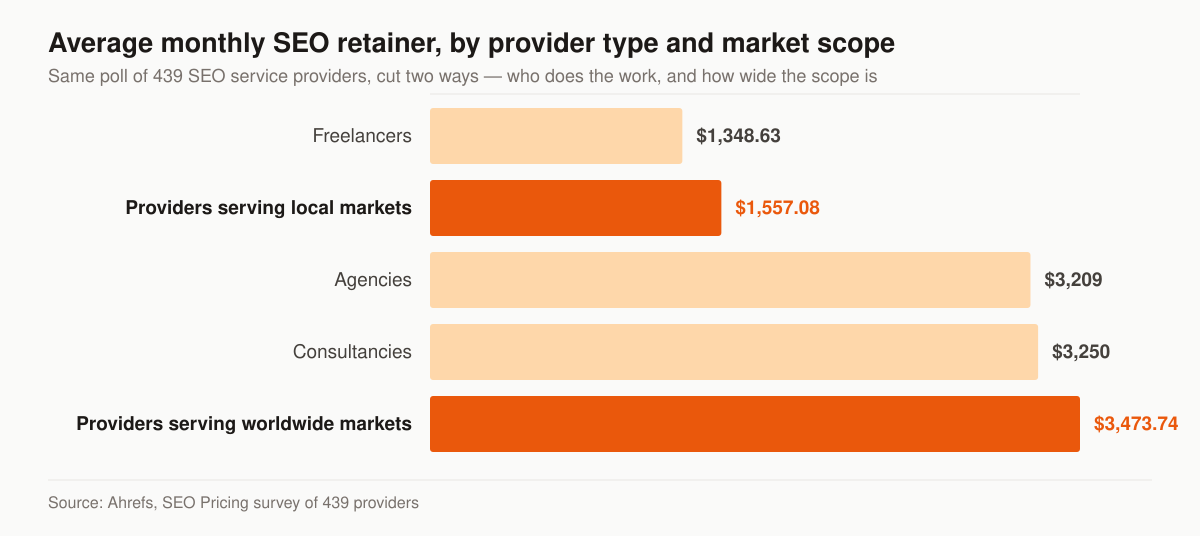
Providers serving local markets average $1,557.08 a month; those serving worldwide markets average $3,473.74 — a 123.1% difference in the same poll. Scope of the brief, not only who does the work, sets the number. Source: Ahrefs, SEO Pricing survey of 439 providers.
Three inputs move your number. How many lines you sell — each one needs its own content cluster. How defended your metro is — the Dallas map pack is not the Waco map pack. And whether you need local signals, content, or both. Our tiers and exactly what each includes are published, no quote gate, on the insurance SEO service page.
Should you do SEO yourself or hire it out?
The honest answer: the foundation is DIY-able and the compounding usually isn’t — not because the work is hard, but because it loses the calendar fight against selling. Do the local basics yourself, delegate the monthly cadence you won’t realistically sustain, and be honest about which of those two agents you actually are.
| The work | DIY? | Worth delegating when |
|---|---|---|
| Business Profile, reviews, NAP | Yes — build it into your sales process | You manage multiple locations |
| Monthly content cadence | Yes, if you’ll sustain 2–4 real pages a month | Writing keeps losing to selling |
| Technical fixes and schema | With patience and a weekend | You’d rather have it fixed once, correctly |
| GEO / AI-search structure | Few agents know the patterns yet | You want the edge before it’s crowded |
If you hire, vet hard: insurance-specific experience, named-author content, no ranking guarantees, and reporting in leads rather than traffic. Our insurance SEO program exists because we run this exact playbook on our own lead-generation pages — the service is the same cadence pointed at your agency, and we’ll tell you plainly if paid traffic should come first for your situation.
How do you measure whether SEO is working?
You measure insurance SEO with three numbers, watched in the order they move: impressions and average position in Google Search Console first, organic clicks to your money pages second, and leads or calls from organic search last. Review monthly, judge quarterly — movement inside a single month is mostly noise. In sequence:
- Impressions and average position (Google Search Console). The earliest signal — usually months before clicks. Rising impressions on the queries you targeted means Google is testing your pages; falling average position on those queries means the tests are going well. Free, first-party, and more honest than any rank tracker.
- Organic clicks to money pages. Traffic to blog posts is nice; traffic to your service, quote, and contact pages is the pipeline. Segment the two, because a report that lumps them together hides whether the strategy is producing buyers or just readers.
- Leads and calls from organic. The number that pays. Tag your forms by source and track calls — with one caution: if you use call-tracking numbers, configure them so your real number stays consistent on your Google Business Profile and citations, or the tracking gains cost you local-signal consistency.
The quarter-over-quarter trend in those three numbers is the verdict. And when a page works, feed it — updating and expanding a proven page usually beats writing a new one.
The mistakes that quietly kill agent SEO
Five patterns account for most of the failed programs we audit:
- Stopping at month three. The cost is front-loaded and the payoff is back-loaded; quitting early buys the cost and skips the payoff.
- Chasing head terms. “Life insurance” is a vanity target. The policies live in local, comparison, and situation searches.
- Copy-swap location pages. Ten pages with the city name changed read as doorway pages to Google and to humans.
- Buying links. Link schemes are the one shortcut that can take rankings you already earned. Directories, associations, local press, and partners are the safe inventory.
- Reporting rankings instead of leads. Position three for a term that never produces a quote request is decoration. Track organic leads and calls, and let that number steer the content plan.
SEO is the slowest channel you’ll run and the only one that gets cheaper every month you keep it up. If you want a straight read on where your site stands before committing — what’s winnable in your market and what order to attack it — start with a free marketing audit and we’ll map it against your line and budget.
- How to Rank an Insurance Agency Website: The Insurance Agency SEO Guide
How to rank an insurance agency website on Google: a practitioner's SEO guide to technical setup, content, local signals, and the cadence that holds it.
- How to Get Cited by Perplexity and Google AI Overviews as a Local Business
How to get cited by Perplexity and Google AI Overviews as a local business: answer-first passages, structured data, consistent NAP, and third-party citations.
- How to Get More Google Reviews for Insurance Agents (Without Gaming It)
How to get more Google reviews for insurance agents: when to ask, the direct-link method, texting requests, responding to reviews, and staying compliant.
- Insurance SEO Keywords: Real Data by Line and Intent
See real insurance SEO keywords with measured volume, CPC, and difficulty from a July 2026 DataForSEO pull, sorted by line, intent, and page type.