Who we serve
Mortgage Protection Insurance Agent Marketing
Mortgage protection insurance agent marketing puts your offer in front of newly-mortgaged homeowners and converts them into booked appointments, through compliant Facebook ads, direct mail tied to property records, and landing pages that qualify the buyer before a human dials. The constraint is not the audience; it is running a fast, compliant system around them.
Free · 15-minute teardown · no pitch deck
- We run our own final-expense book
- No pitch deck — we screen-share real numbers
- TCPA-aware · CMS/AEP-compliant · Meta Special Ad Category
- Core Web Vitals < 2.0s LCP
Most mortgage protection campaigns fail for a boring reason: the agent treats Facebook like it’s 2018, gets throttled by Meta’s housing rules, and blames the leads. The constraint isn’t the audience — homeowners with a fresh mortgage and young kids are everywhere. The constraint is running a compliant, fast-converting system around them. That’s what mortgage protection insurance agent marketing actually is.
We’re an operator-led shop. Our authority comes from a lead operation we run every day in the senior market — live campaigns, not theory. Mortgage protection isn’t final expense, but the machinery transfers: ad discipline, speed-to-lead, and landing pages that qualify before a human ever dials.
Three things have moved under this niche since the last time a lot of agents rebuilt their funnel: Meta added a second Special Ad Category that catches insurance offers, Congress narrowed the mortgage trigger-lead pipe by statute, and the buyer’s demographic profile shifted far enough that a 2015 persona now misses. Each of those is below, with the primary source attached.
What mortgage protection insurance actually is, and what it is not
One recurring friction in this funnel is a naming problem, and it shows up as a low conversion rate on otherwise good traffic. Three different products share the same shelf in a prospect’s head:
- Mortgage protection insurance. A life insurance policy the homeowner owns and pays for. It pays a death benefit to a beneficiary the household names. Sometimes written as decreasing term, so the face amount steps down alongside the amortising balance; sometimes written as level term instead, because the household would rather keep the surplus.
- Private mortgage insurance (PMI). Protects the lender against default. The borrower pays it, the lender collects on it, and the household gets nothing. Commonly required by the lender when the down payment is small.
- Lender-offered credit life. Names the lender as the beneficiary and pays down the loan directly. The homeowner has no discretion over the money.
Your creative has one job before it has any other job: make the first product distinguishable from the second and third inside the first two lines. Mail that arrives shortly after closing lands in a pile of lender correspondence, and a piece that reads like more of the same gets binned unread. This is also why we push the product distinction onto the landing page rather than saving it for the call — a prospect who arrives already understanding what they requested a quote for is a different conversation.
The related sale sits right next to it. The same household just took on a large secured debt and, in a lot of cases, first bought or upgraded a homeowners policy in the same month. If you write both lines, the home insurance agent marketing playbook covers that side, and the two campaigns can share one landing-page framework.
The Meta Housing Special Ad Category changes everything
Mortgage protection is tied to homeownership, so Meta classifies these ads under the Housing Special Ad Category. That removes your ability to target by age, gender, ZIP-radius, and most detailed-interest segments. Agents who ignore this get accounts flagged or ads that quietly underdeliver.
The workaround isn’t a trick — it’s design. You go broad on delivery and narrow on message. Creative and landing copy do the qualifying that the targeting engine no longer can. Our full breakdown of creative, audiences, and budget pacing lives on the mortgage protection Facebook ads page, and the mortgage protection Facebook ads guide on the blog walks the same ground for agents running the account themselves.
Housing or financial products: which Special Ad Category does the ad belong in?
There are now two categories that can catch this offer, and picking is a real decision rather than a formality. Meta’s own help centre records the change:
“In October 2024, a new Special Ad Category “Financial products and services” was introduced, replacing the previous Credit ads category. … Examples of financial products and services ads include those promoting insurance, bank accounts, investment services and payment services.”
The same page states that “Starting January 21, 2025, using the Special Ad Category designation is required for advertisers based in the United States or reaching audiences in the United States running financial products and services campaigns.”
Meta’s category-selection page adds the consequence of getting it wrong in one line: “Ads may be rejected if an appropriate category is not chosen.”
So a mortgage protection ad sits on a seam. The offer is an insurance product, which the financial-products examples name outright. The hook is homeownership, which is what Housing covers. Our working rule is to categorise on what the ad is about rather than what the advertiser sells: an ad whose creative leads on the house, the mortgage, or the closing goes in Housing; an ad whose creative leads on the policy, the premium, or the underwriting goes in financial products and services. Document the reasoning inside the ad account so a later reviewer — yours or Meta’s — can follow it.
The practical relief is that this is not a trap with two very different outcomes. Both categories draw from the same restricted set of audience tools, so a campaign built to survive one is already built to survive the other.
Here is what Meta says it takes away once any of these categories is on the campaign, in its own words. Read the middle column as a design constraint rather than a loss.
| Audience tool | Status under the category | What replaces it |
|---|---|---|
| Age | “limited or unavailable” | Message-level qualification in the first line of creative |
| Gender | “limited or unavailable” | Household framing that both partners recognise |
| ZIP code or postal code | “limited or unavailable” | State or metro delivery, with the address collected on the form |
| Exclusion targeting | “limited or unavailable” | Negative qualifiers written into the copy |
| Lookalike audiences | “limited or unavailable” | Creative iteration against the offer, not the seed list |
| Saved audiences | “limited or unavailable” | Rebuild the audience inside the restricted campaign |
| Some interests | “will also be unavailable” | Broad delivery plus a landing page that filters |
| City or pin-drop radius | “will include an expanded radius” | Plan the mail drop for the tight geography instead |
Source: Meta Business Help Center, How to choose a Special Ad Category, which lists the restricted tools as “age, gender, ZIP code or postal code, exclusion targeting, lookalike audiences and saved audiences” and adds, “We encourage you to broaden—not restrict—your audience.”
That last sentence is the strategy, stated by the platform. Stop trying to reconstruct a 2018 audience out of the pieces Meta left you. Spend the effort on the offer and the page.
Who the mortgage protection buyer is now, not in 2015
The persona this niche was built around — a couple in their early thirties, first house, two small children — has drifted away from the published data, and it drifts further every year. The National Association of REALTORS® surveys this directly. In July 2025 it mailed a 120-question survey to 173,250 recent home buyers who had purchased a primary residence between July 2024 and June 2025, and received 6,103 responses from primary-residence buyers.
What came back reframes the targeting problem. NAR’s announcement of the report opens on it: “The share of first-time home buyers dropped to a record low of 21%, while the typical age of first-time buyers climbed to an all-time high of 40 years.” Its own summary adds the trend line — “Since 2010, the age of first-time buyers has been incrementally climbing from age 30.” — and notes that repeat buyers have moved further still: “In 1981, the median age of repeat buyers was 36. Today it is 62.”
Then the number that should change your creative brief:
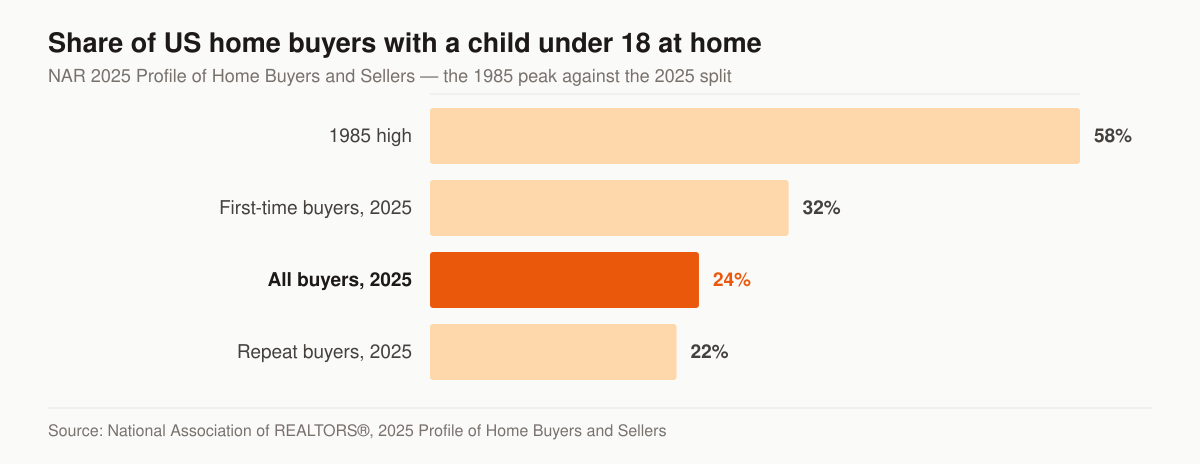
Source: National Association of REALTORS®, Top 10 takeaways from the 2025 Profile of Home Buyers and Sellers, reporting that the share of buyers with children under 18 at home “has dropped to a historic low of 24% of buyers, from a high of 58% in 1985,” with 32% among first-time buyers and 22% among repeat buyers.
Read that as three separate campaigns rather than one. The buyer with kids at home is now roughly a quarter of the market, and concentrated among first-timers whose median age is 40. The larger share is a household without dependent children, often on a second or third property, whose reason to buy coverage is the surviving partner’s ability to hold the house rather than a nursery down the hall. A single “protect your family” creative speaks clearly to the smaller group and vaguely to the bigger one.
Because the Special Ad Category has taken age targeting away anyway, you cannot solve this by splitting the audience. You solve it by running parallel creative and letting each piece self-select its reader. That is the entire discipline in this niche, and it is also why we plan creative sets rather than single ads on our insurance Facebook ads engagements.
The three channels that actually fill a pipeline
Each channel does a different job, and the compliance note in the last column is what determines the build, not a footnote to it.
| Channel | Best for | What it costs you | Compliance note |
|---|---|---|---|
| Facebook / Meta ads | Volume, young families | Ad spend + creative | Housing Special Ad Category — no age/ZIP targeting |
| Direct mail | New homeowners post-closing | Per-piece + list | Tie to recorded-deed / new-mortgage data |
| SEO + owned site | Long-term, lower-cost inbound | Time, content | Slow to start, compounds over time |
Direct mail still earns its place. Mail keyed to new-mortgage and recorded-deed records lands right after closing, exactly when Facebook’s housing limits hurt most. Pair every drop with a high-converting landing page and a call-back system so responses don’t leak through the cracks.
The three are not interchangeable and they do not start at the same time. Mail produces responses in the week it lands and stops when you stop paying for it. Paid social produces volume you can turn up or down the same day. Search produces the cheapest lead you will ever get and produces nothing at all for the first several months, which is why we treat it as a parallel track rather than a first move — the reasoning behind that sequencing is set out in our insurance agency marketing budget breakdown.
Where the mailing list comes from, and what changed for trigger leads
Direct mail in this niche lives or dies on the list, and there are two very different pipes feeding it.
The first is public property records. County recorders publish deeds and mortgage instruments, and list compilers turn those filings into a weekly feed of addresses where a purchase just closed. That is a public-records product. It carries no credit data, and the Act discussed below does not touch it.
The second is the credit-bureau prescreen pipe, better known as trigger leads: when a consumer applies for a mortgage, the bureau records the inquiry and resells a list of those consumers to other firms. That pipe has now been narrowed by statute. The Homebuyers Privacy Protection Act (H.R. 2808) became Public Law 119-36 on September 5, 2025, and amends the Fair Credit Reporting Act to add this limitation:
“(B) Limitation.—If a person requests a consumer report from a consumer reporting agency in connection with a credit transaction involving a residential mortgage loan, that agency may not, based in whole or in part on that request, furnish a consumer report to another person under this subsection unless— (i) the transaction consists of a firm offer of credit or insurance; and (ii) that other person— (I) has submitted documentation to that agency certifying that such other person has, pursuant to paragraph (1)(A), the authorization of the consumer to whom the consumer report relates; or (II)(aa) has originated a current residential mortgage loan of the consumer to whom the consumer report relates; (bb) is the servicer of a current residential mortgage loan of the consumer to whom the consumer report relates; or (cc)(AA) is an insured depository institution or credit union; and (BB) holds a current account for the consumer to whom the consumer report relates.”
Page-break markers from the Statute at Large printing are omitted from that quotation; nothing else is. The Act states that it “shall take effect on the date that is 180 days after the date of enactment of this Act.” Read the two conditions as cumulative: a firm offer of insurance still clears the first gate, but the buyer of the list also has to clear the second one, and an independent insurance agency is not the consumer’s originator, servicer, depository institution, or credit union. Documented consumer authorization is the remaining route. Take that to your counsel before your next data order rather than after it; nothing on this page is legal advice.
Compare the two data pipes before you commit a mail budget to either.
| Data source | What it is | Timing relative to closing | Status under Public Law 119-36 |
|---|---|---|---|
| Recorded deeds and mortgages | County public records of the completed transaction | After the deed is recorded | Not a consumer report; unaffected |
| New-homeowner compiled lists | Property records plus appended contact data | Days to weeks after closing | Not a consumer report; unaffected |
| Mortgage trigger leads | Consumer reports resold off a mortgage inquiry | Before closing, at application | Restricted to the recipients listed in the Act |
For scale on the underlying market, the CFPB’s summary of the 2023 HMDA data states: “The 2023 data include information on 10 million home loan applications.” It goes on: “A total of 5.7 million applications resulted in loan originations. Among them, 4.4 million were closed-end mortgage originations.” The same summary records that “closed-end, 1-4 family home purchase lending decreased by 20.6 percent from 4.3 million.” Even in a slow year the addressable pool renews at a scale no single agency can work — which means list selection and cadence beat list size every time.
What direct mail costs before anyone answers
Lead prices get quoted agent to agent; the floor underneath them, which is postage, does not. USPS publishes it. As listed on the USPS business prices page, USPS Marketing Mail starts “From $0.227 for Commercial Pricing,” and Every Door Direct Mail – Retail is “$0.26 for Flats up to 3.3 oz.”
Those two rates bound the cheap end of a mail program; everything else is a decision you make.
| Cost line | Published or quoted | What moves it |
|---|---|---|
| USPS Marketing Mail postage | From $0.227 per piece, commercial pricing | Presort depth, piece weight and shape |
| EDDM Retail postage | $0.26 per flat up to 3.3 oz | Carrier-route saturation, no address list needed |
| List | Quoted by your compiler | Recency of the recorded deed, contact append |
| Print and production | Quoted by your printer | Piece format, colour, reply mechanism |
| Reply handling | Your own time or a service | Whether the piece drives to a phone number or a page |
Source: USPS, Postage Rates & Prices.
The reason to know the floor is that it settles an argument. EDDM saturates a carrier route with no list at all, which is attractive until you remember the Special Ad Category problem does not apply to mail — precision is exactly the advantage mail has over paid social here. Paying a list compiler to hand you households that closed last week is what mail is for. Spending the same budget blanketing a route throws away the one thing the channel is better at.
Building the lead engine (not just buying clicks)
A campaign without a system is a leak. The pieces that matter:
- Offer framing — decreasing term that pays off the mortgage if the breadwinner dies. Concrete, not abstract.
- A purpose-built page — one form, one promise, fast load. See our agent website standards.
- Speed-to-lead — we treat five minutes as the outer limit on first contact and hold the program to it.
- Follow-up automation — we build the cadence for contacts three through six rather than for a single dial, and treat it as a build item, not a habit.
We assemble all four on our mortgage protection lead generation build, and route paid traffic through our insurance PPC management team so spend maps to booked appointments, not vanity clicks. The cadence itself is documented in our insurance lead follow-up cadence playbook, and the sequences are built and monitored under insurance email automation.
Calling the people who respond: the consent windows that decide your dial plan
A reply card and a form fill are not the same permission, and the FCC’s rules draw the line in a place worth memorising. Under 47 CFR 64.1200, the term established business relationship for telephone solicitations means, verbatim:
“a prior or existing relationship formed by a voluntary two-way communication between a person or entity and a residential subscriber with or without an exchange of consideration, on the basis of the subscriber’s purchase or transaction with the entity within the eighteen (18) months immediately preceding the date of the telephone call or on the basis of the subscriber’s inquiry or application regarding products or services offered by the entity within the three months immediately preceding the date of the call, which relationship has not been previously terminated by either party.”
Three numbers fall out of that sentence and they are not the same number. A purchase or transaction gives eighteen months. A bare inquiry or application gives three. And either window closes early if the relationship “has not been previously terminated by either party” ceases to be true — a person who tells you to stop has terminated it.
Separately, the same section’s written-permission route requires that permission be documented, not remembered: “Such permission must be evidenced by a signed, written agreement between the consumer and seller which states that the consumer agrees to be contacted by this seller and includes the telephone number to which the calls may be placed.”
For a mortgage protection program that means the design work happens before the drop, not after the response:
- The reply card and the landing-page form both capture a phone number and the consent language, stored with a timestamp.
- The three-month inquiry window governs how long an unconverted mail respondent stays dialable, which in turn governs how long your follow-up sequence can run.
- Consent lives in the CRM record, not in the rep’s memory, because the record is what you will be asked for.
Full text: 47 CFR 64.1200, Delivery restrictions. Our wider treatment of consent capture, disclosures, and record-keeping sits in insurance marketing compliance for agents. Have your own compliance counsel sign off on scripts and forms.
Paying a loan officer for referrals is a RESPA question, not a handshake
Sooner or later a mortgage protection agent gets offered the same deal: a loan officer or realtor sends you closings, and you send business back. The insurance side of that trade is usually fine on its own. The return leg is where the exposure lives, because sending a borrower to a lender is a referral of settlement-service business on a federally related mortgage loan.
Regulation X states the prohibition without qualification at 12 CFR 1024.14(b):
“No person shall give and no person shall accept any fee, kickback or other thing of value pursuant to any agreement or understanding, oral or otherwise, that business incident to or part of a settlement service involving a federally related mortgage loan shall be referred to any person.”
Two adjacent paragraphs are what make this a live risk rather than a theoretical one. The rule defines a thing of value expansively — the list at 1024.14(d) includes “the opportunity to participate in a money-making program,” “services of all types at special or free rates,” and “trips and payment of another person’s expenses,” among many others. And 1024.14(e) removes the “we never wrote anything down” defence:
“An agreement or understanding for the referral of business incident to or part of a settlement service need not be written or verbalized but may be established by a practice, pattern or course of conduct. When a thing of value is received repeatedly and is connected in any way with the volume or value of the business referred, the receipt of the thing of value is evidence that it is made pursuant to an agreement or understanding for the referral of business.”
There is a carve-out, and it is narrower than the co-marketing pitch decks suggest. Section 1024.14(g)(1)(vi) permits “Normal promotional and educational activities that are not conditioned on the referral of business and that do not involve the defraying of expenses that otherwise would be incurred by persons in a position to refer settlement services or business incident thereto.” Both halves of that sentence have to hold. Paying for the loan officer’s client-appreciation dinner defrays an expense they would otherwise have carried, so on the face of the rule the second condition is no longer met.
The rule also carries a five-year retention requirement: “Any documents provided pursuant to this section shall be retained for five (5) years from the date of execution,” per 1024.14(h).
The practical version for a mortgage protection program is to build referral partnerships that trade information rather than value: a genuinely useful closing-packet insert, a co-hosted education session neither side would otherwise have paid for, an introduction that carries no fee and no reciprocity condition. Run the arrangement past counsel before it starts. Full text: 12 CFR 1024.14, Prohibition against kickbacks and unearned fees.
Marketing for mortgage protection agents to young families
The buyer many agents picture is a household that just signed for a house and now lies awake doing the math on what happens if the income stops. Because the Housing category blocks age and gender targeting, you reach them through message, not filters — copy and imagery that say “you, with this mortgage, with these kids.” The wrong prospects self-select out. That’s the whole game for marketing for mortgage protection agents under current rules.
What the NAR figures above add is that this household is a minority of the market rather than the whole of it, so the family-framed creative should run alongside a second line aimed at the household with no dependent children and a surviving-partner problem instead. Our blog piece on marketing mortgage protection to young families covers the first of those in depth; the second borrows its arguments from ordinary term-life positioning, which is the ground our life insurance marketing practice covers.
How we read a mortgage protection campaign
Cost per lead is the number agents ask about and the least decisive one in the chain. A mail respondent who answers the phone and a Facebook form fill that never picks up are not the same asset at any price.
These are the five numbers we report on, in the order they constrain each other.
| Metric | What it tells you | Where it usually breaks in this niche |
|---|---|---|
| Cost per lead by channel | What the top of the funnel costs | Housing-category delivery pushing spend into the wrong metro |
| Contact rate | Whether the lead is reachable at all | Bad phone data on appended lists; no consent captured |
| Speed to first contact | Whether the system is actually running | Leads landing in an inbox nobody watches on a Saturday |
| Appointment rate | Whether the offer and the page agree | Page promises a quote, the call opens with underwriting |
| Cost per issued policy | What the budget actually answers to | Never calculated, because issue dates live in the carrier portal |
The last row is the one that changes decisions. Until issued-policy data comes back into the same report as ad spend, every channel comparison you make is a guess with a decimal point on it. Wiring that loop is part of the build, not an add-on.
What a mortgage protection marketing program costs
We publish our rates rather than quoting them case by case. Managed programs run at $2,500 a month on Foundation, $3,500 on Growth, and $5,500 on Full-Funnel, with a one-time website build of $2,500–$8,000. Ad spend and mail costs are yours, billed at cost straight to the platforms and vendors, never marked up.
| Tier | Monthly | Fits a mortgage protection agent who |
|---|---|---|
| Foundation | $2,500 | Needs the site, landing pages, local SEO and on-page work in place before spending on mail or ads |
| Growth | $3,500 | Has the asset and needs the ongoing SEO and content engine, AI-search visibility and reviews behind it |
| Full-Funnel | $5,500 | Is ready for managed Meta and Google campaigns, landing-page CRO, and marketing automation on top |
Full scope for each tier, what is excluded, and what happens to your accounts if you cancel is set out on the pricing page.
The first 90 days, in order
- Weeks 1–2 — decide the category and the data. Settle Housing versus financial products for the ad account, and choose between recorded-deed lists and a consented data source. Both decisions gate everything after them.
- Weeks 2–4 — build the page and the consent capture. One offer, one form, the phone field and the consent language, wired into a CRM that timestamps both.
- Weeks 4–6 — first mail drop and first creative set. Mail to the tight geography, run broad-delivery social against the wider one, and let the copy do the qualifying in both.
- Weeks 6–10 — fix the answer rate before raising the budget. Contact rate and speed to first contact tell you whether more volume would help or just cost more.
- Weeks 10–13 — close the issued-policy loop. Get carrier issue data into the same report as spend, then decide which channel earns next quarter’s money.
Where to start with mortgage protection marketing
- Want proof the mechanics work? Read how our final-expense lead operation runs its numbers.
- Ready to plug the leaks in your current funnel? Book a free marketing audit and we’ll map your CPL, speed-to-lead, and landing-page conversion against what we see in live campaigns.
- Prefer to talk it through before anything is scoped? Contact us and describe the funnel you have now.
A word on buying leads
Some agents want appointments tomorrow, not a system in 60 days. Fair. But this is a marketing site — we build pipelines, we don’t sell leads here. If you need to buy mortgage-protection leads or live transfers as a product, buy leads direct from getinsureleads instead. Keeping that off this page keeps the model honest: here, you own the asset.
Mortgage protection rewards operators who pick the right ad category, mail a list the law still lets them use, keep consent on the record, and answer the phone fast. Build that, and the leads stop being the problem.
Deeper guides
Go deeper on Mortgage Protection Agent Marketing
Mortgage Protection Facebook Ads, Run Under the Housing Category
Done-for-you Facebook ads for mortgage protection agents inside Meta's Housing Special Ad Category. Targeting, creative, lead math. Free ad audit.
Mortgage Protection Lead Generation for Agents Who Want to Own the Pipeline
Build a mortgage protection lead generation system you own, run with the conversion discipline behind our senior-market lead book.
Mortgage Protection Agent Website Design Built to Book Appointments
Mortgage protection agent website design built by operators who run real lead campaigns. See page structure, speed, and forms. Free site teardown.
The services behind it
Guides that go deeper