Service
Content Marketing for Insurance Agents, Built From a Lead Engine
A topical-authority content engine — articles, video, and AI-ready answer pages — that turns the questions your senior-market buyers already type into ranked pages and captured leads, not a feed nobody reads.
- We run our own final-expense book
- No pitch deck — we screen-share real numbers
- TCPA-aware · CMS/AEP-compliant · Meta Special Ad Category
- Core Web Vitals < 2.0s LCP
Content marketing for insurance agents works when each piece answers a real senior-market question and links to a place that captures a lead. We build topical authority around final expense, Medicare, and life — pillar articles, video, and repurposed clips — so search engines and AI tools cite you instead of your competitor.
What you get
What your content marketing for insurance agents program includes
- A 12-month keyword + content map for your primary line (final expense, Medicare, or life) — one pillar plus 8–15 supporting pages, each tied to a specific search intent and a lead-capture target
- 4 expert-reviewed articles per month (900–1,500 words), each with an answer-first intro, a comparison table, and an internal link to a money page
- 1 recorded video per month cut into 5 placements: a YouTube upload, 3 vertical clips (Reels/Shorts/TikTok), a blog embed, an email segment, and a clip you can text to a lead who asked that question
- FAQ and answer blocks with FAQ schema markup, structured so pages get cited by ChatGPT, Perplexity, and Google AI Overviews
- An internal-linking map that routes every new page back to your quote form or lead-capture point
- A monthly report ranking each article by leads produced and AI/search citations earned — not likes or impressions
- A quarterly competitor content-gap audit that names the next cluster to build
How it works
How the content marketing for insurance agents engagement runs
- 01
Content audit & keyword map
We pull your existing pages, your competitors' clusters, and the searches your buyers actually type, then build a 12-month keyword + content map for your primary line — every topic tied to an intent and a funnel target before a word is written.
- 02
Build the pillar cluster
We write and publish the pillar page plus its first supporting answers — answer-first intros, comparison tables, and internal links to a capture point. Depth on one niche before volume across many, because that is what search engines and AI tools reward.
- 03
Record once, repurpose five ways
We send you shot prompts, you record one 5-minute talking-head or screen-share, and we cut it into a YouTube video, three vertical clips, a blog embed, an email segment, and a clip you can text to a lead who asked that question. One recording, five placements.
- 04
Structure for AI search & capture
We add FAQ schema and clean answer blocks so pages get extracted and cited by ChatGPT, Perplexity, and AI Overviews, and we wire every page to your quote form so earned traffic becomes consented leads instead of bounces.
- 05
Report, prune, and expand
Each month we report leads and citations by article — the same way we track our own book — kill what does not pull, and expand the clusters that rank.
Most insurance agents treat content as a chore: a daily post, a stock quote graphic, a “did you know” fact nobody asked for. That fills a feed. It does not build a book.
We run content the way we run lead campaigns — every piece answers a question a real senior-market buyer or agent is typing, and every piece points to a place that captures a lead. Our own book runs on the same engine, built on live campaigns, not theory.
What does an insurance content marketing agency actually do?
An insurance content marketing agency plans, writes, and distributes the content that pulls buyers to your agency: keyword and topic research, an editorial calendar, drafting, licensed-agent review, publishing, and repurposing into video and email — then reports on leads produced, not impressions. The difference from a generalist shop is line knowledge: final expense, Medicare, and life each demand different topics, reading levels, and compliance guardrails.
If you take one thing from this page: every piece gets a keyword, an intent, and a funnel target before a word is written. Everything below is how we operationalize that.
What does content marketing cost for an insurance agency?
Content marketing is sold three ways — per piece, per word, or as a monthly program — and the three are not comparable purchases. Per-piece and per-word buys you drafted text. A program buys the keyword map, the internal-link architecture, the licensed-review loop, the repurposing, and the reporting that decides what gets written next month.
The table below is what named vendors publish on their own live pricing pages, next to the tiers this service is sold in.
| What you are buying | Published price | Where the price is published |
|---|---|---|
| Self-service blog post, 300–500 words | Starts at $110 | ContentWriters pricing |
| Self-service white paper, 1,500 words | Starts at $380 | ContentWriters pricing |
| Self-service email newsletter, 400–500 words | Starts at $100 | ContentWriters pricing |
| Managed content service | Starting at $2,500 per month including management fee and content spend, 6-month minimum | ContentWriters pricing |
| AI-plus-human hybrid writing | $0.06 per word, plus a $49.50 monthly platform fee | Verblio pricing |
| 100% human writing | $0.16 per word, no platform fee | Verblio pricing |
| Our Foundation tier | $2,500 per month | Pricing |
| Our Growth tier — where this service sits | $3,500 per month | Pricing |
| Our Full-Funnel tier | $5,500 per month | Pricing |
Two details in that table matter more than the headline numbers. ContentWriters states its rates “can range anywhere from $0.13 per word to $0.61+ per word, depending on the content type, word count of the content, expertise required, and expected turnaround time” — expertise required is the variable that moves insurance content, because a writer who has never read a final expense application produces copy your licensed review has to send back. And Verblio’s managed tier starts at a 50-articles-per-month minimum, which is a volume no independent agency needs and no independent agency should pay for.
The honest framing for an agent: a per-piece vendor is the right buy when you already own the keyword map and the publishing process and just need words. A program is the right buy when nobody in the office is deciding what to publish next. If you are still sizing the whole marketing line rather than this one channel, work through the insurance agency marketing budget breakdown first, then come back to this page.
What actually decides whether content works
Content programs fail for reasons that are boring and fixable. The closest thing to industry data on why is the 16th annual content marketing survey from Content Marketing Institute and MarketingProfs, fielded June 24 to August 14, 2025. It drew 1,229 global responses, and the published article “reports on the 1,015 B2B marketers, mostly from North America.” Read it for what it is: no insurance category appears in its industry breakdown, which runs technology (25%), agency (21%), consulting (11%) and financial services (9%). It describes B2B content operations in general, not a benchmark your agency should measure itself against.
One cut inside it bears directly on how an agency should spend. Respondents first rated their own effectiveness over the prior 12 months, and 59% called their efforts at least somewhat effective. CMI then asked what moved the needle, and the chart below is that subgroup’s answer — the effective teams, not the full sample. Their answers rank people and quality far above tools and budget.
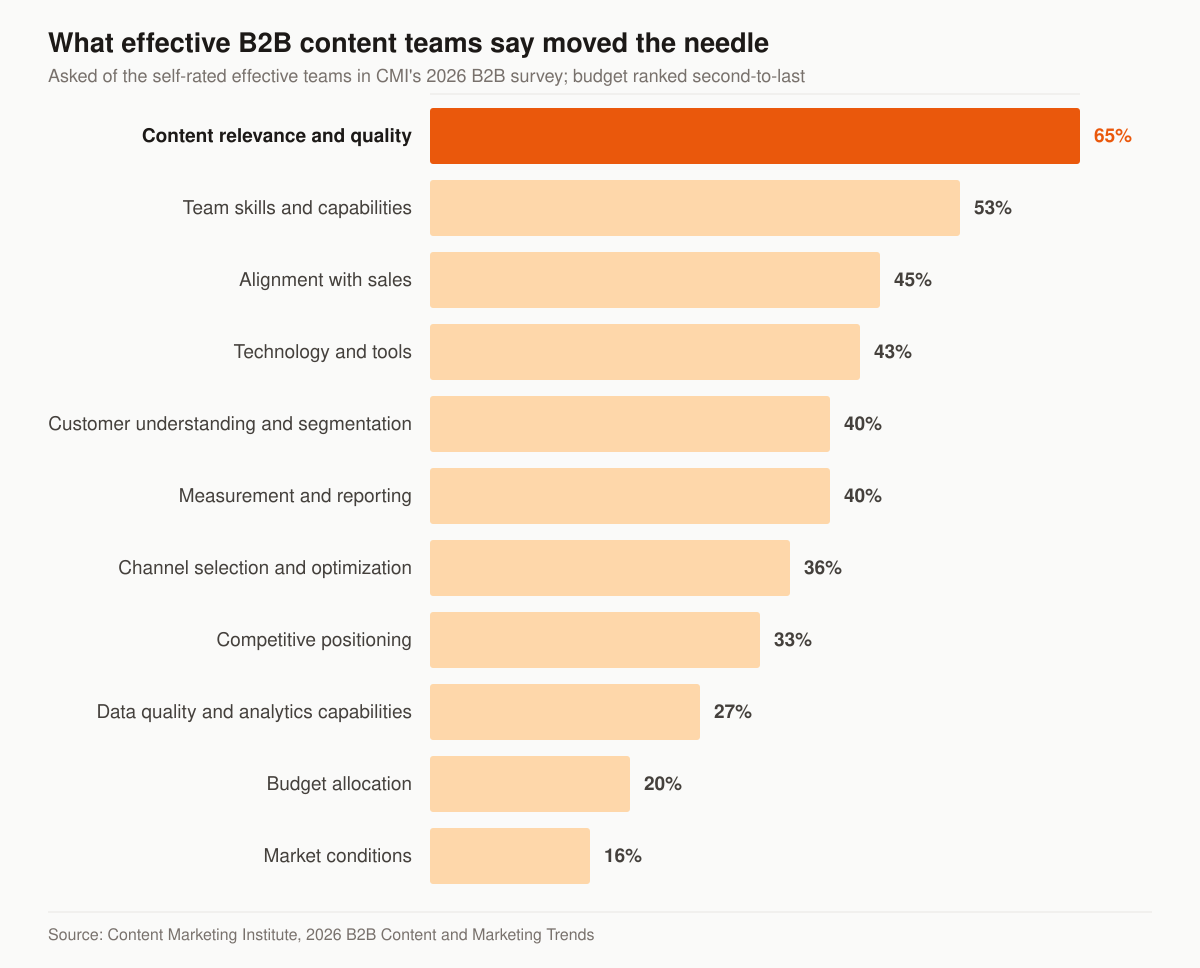
Source: Content Marketing Institute, 2026 B2B Content and Marketing Trends.
Among those effective teams, content relevance and quality tops the list at 65% and budget allocation sits near the bottom at 20%. Spending more does not fix a program that publishes the wrong topics.
The same research puts a different question to the whole B2B sample. Asked “to select their top three content marketing challenges,” they named “creating content that prompts a desired action — e.g., conversion” at 40%, “resource constraints — time, people, budget” at 39%, and “measuring content effectiveness” at 33%. Read the three together: the work stalls on content that does not convert, hours that run out, and results nobody can prove.
Each of those has an operational answer, not a motivational one. Conversion is a routing problem — every page carries an internal link to a capture point, so no article is a dead end. Resource constraints are a batching problem — one recording session and one brief cycle per month, not a daily scramble. Measurement is an instrumentation problem — the article is tagged, the form knows which page sent it, and the monthly report names the pages to prune. The rest of this page is those three answers in detail.
Our editorial process, stage by stage
Content quality is a process problem. Here is the pipeline every piece moves through — licensed review is the stage a generalist content shop cannot run at all, and it is where credibility comes from.
| Stage | Who owns it | Output |
|---|---|---|
| Brief | Strategist | Primary keyword, search intent, funnel target, entities to cover |
| Draft | Writer | Answer-first article with a comparison table and FAQ |
| Licensed review | You, the agent | Product and compliance accuracy sign-off |
| Edit + SEO pass | Editor | Title, meta description, internal links, schema |
| Publish + repurpose | Production | Live page, video clips, email segment |
| Report | Strategist | Leads and citations by article; prune-or-expand call |
Google’s own helpful-content guidance is blunt about why the review stage matters: “People-first content means content that’s created primarily for people, and not to manipulate search engine rankings” — and of the E-E-A-T factors it weighs, “trust is most important.” A licensed agent’s sign-off puts real product knowledge on the page, which is the one thing content farms cannot fake. The sentence-level mechanics — headlines, proof, calls to action — live in our insurance copywriting guide.
The review stage also has a shape. A licensed pass that takes an hour per article will not survive AEP, so we scope it to three questions: does this misstate a product, does this misstate a rule, does this misstate a carrier. Everything else — tone, structure, headline, link placement — is the editor’s problem, not yours. An agent who line-edits every draft becomes the bottleneck in their own calendar.
Content ideas for insurance agents, sorted by what they do
Good content does one of three jobs: it gets found in search, it builds trust on the second visit, or it gets repurposed cheaply. The best ideas do all three. Here is how the formats stack up.
| Content type | Primary job | Effort | Where it pays off |
|---|---|---|---|
| Pillar + cluster articles | Search + AI citation | High once | Compounding organic leads |
| FAQ / “answer” pages | AI extraction | Low | ChatGPT, Google AI Overviews |
| Talking-head video | Trust | Medium | YouTube, embeds, email |
| Short clips (repurposed) | Reach | Very low | Reels, Shorts, TikTok |
| Email newsletter | Re-engagement | Low | Aged-lead revival |
| Case study / numbers post | Proof | Medium | Closing skeptical prospects |
The pattern: invest once in a deep piece, then break it into a week of smaller assets. One recording or one long article should never produce one placement. The newsletter row is the cheapest to run and the easiest to abandon — our insurance agency newsletter service runs that re-engagement layer done-for-you. What makes the pattern survive a busy quarter is automating content distribution rather than remembering it: the new post fires to the right CRM segment on a trigger, the clip queue publishes on a schedule, and nothing depends on someone opening the calendar on a Friday.
If you want a broader idea bank than the formats above — referral plays, community angles, seasonal hooks — the standing list lives in marketing ideas for insurance agents. Pull from it, then run each idea through the same test: keyword, intent, funnel target.
Build topical authority, not a content pile
Search engines and AI tools reward depth on a subject, not volume across many. A tight cluster — one pillar page plus 8 to 15 supporting pages that fully cover final expense, Medicare, or life — outranks fifty scattered posts.
The mechanism is internal linking: the pillar links down to specifics, the specifics link back up, and the whole cluster reads as authoritative. This is the same discipline behind our insurance SEO service — content and rankings are one system, not two. For a worked example, our content ideas for final-expense agents post maps an entire cluster you can copy, and the term-level research behind a cluster is covered in insurance SEO keywords.
A cluster is finished when a buyer can answer their whole decision inside your site. For final expense that means cost by age, what disqualifies an applicant, how underwriting works, what the money actually pays for, how it differs from pre-need and from term, and what happens if a payment is missed. Publish five of those six and the sixth is the page a competitor uses to take the visit.
Why the free content library from your FMO will not rank
Most FMOs hand their agents a content library — pre-written articles, seasonal graphics, drop-in newsletters. Use it for print, for email, and for social, where duplication costs nothing. Do not use it for the pages you intend to rank, because a few hundred agents are publishing the identical article and search engines resolve that by choosing one winner.
Google’s documentation describes the mechanism plainly. Canonicalization is “the process of selecting the representative – canonical – URL of a piece of content,” and “a canonical URL is the URL of a page that Google chose as the most representative from a set of duplicate pages.” When Google “finds multiple pages that seem to be the same or the primary content very similar, it clusters them together,” then “chooses the page that, based on the factors (or signals) the indexing process collected, is objectively the most complete and useful for search users, and marks it as the canonical.” And the outcome for everyone else: “a Google Search result usually points to the canonical page, unless one of the duplicates is explicitly better suited for a search user.” Read the canonicalization documentation directly if you want the full mechanism.
Against a national FMO domain and the same article on a few hundred sibling sites, an independent agency site is not the page that gets picked. That is the whole argument for original content: not craft for its own sake, but the only version of the page that can win the cluster. The one place library material earns its keep on-site is as raw input — take the FMO explainer, add your state’s specifics, your carrier lineup, your answer to the question clients actually ask you on the phone, and it stops being a duplicate. Agencies running under an FMO’s brand should also see how the white-label marketing arrangement divides who owns which pages.
Video marketing for insurance agents
Senior-market buyers and agents both make a confusing decision more comfortably when a person explains it. You do not need a studio. Given the choice we would take a 5-minute screen-share or phone talking-head over a polished ad that says nothing.
The return is in repurposing. One recording becomes:
- A YouTube video targeting a long-tail search (“how does final expense underwriting work”).
- Three vertical short clips for Reels, Shorts, and TikTok.
- An embed inside the matching blog article, giving the page something a reader will stay for.
- A segment in your email newsletter.
- A reply asset you text to a lead who asked that exact question.
Five placements, one recording session. That is the math that makes video worth it.
Two production habits keep it sustainable, and both are how we choose to run it rather than measured rules. We record in batches rather than one answer at a time, because the expensive part of video is setup, not filming — the lighting, the microphone, and the mental gear-change cost the same whether you record one answer or several. And we script the opening only: the question, stated the way a buyer would type it. The answer stays unscripted, delivered the way you would deliver it across a kitchen table. Scripted middles are what make agent video unwatchable.
An idea swipe-list you can run this quarter
Insurance marketing ideas dry up because agents brainstorm topics instead of mining questions. Mine the questions. Here is a starting swipe-list of final expense insurance marketing ideas and adjacent angles:
- “How much does final expense cost at age 65, 70, 75?” — pure intent, links to a quote.
- “Final expense vs. pre-need: which actually pays the funeral home?” — comparison content (ranks and gets cited).
- “What disqualifies you from final expense coverage?” — fear-and-clarity question seniors search.
- “Medicare AEP: what changed this year” — seasonal, refreshed every fall under CMS marketing rules.
- “3 questions to ask before buying life insurance over the phone” — trust-builder for telesales.
- “What we charge to issue a policy” — radical-transparency post that pre-qualifies buyers.
Each line is a page, a video, and a string of clips. Map it to a keyword and a funnel target before you write a word.
A 12-month content calendar built around the insurance year
Insurance content has a calendar imposed on it from outside: enrollment windows, regulatory dates, and the seasons in which each line sells. An editorial plan that ignores those dates publishes Medicare plan comparisons in April and misses the eight weeks that matter.
The table below maps the year to what can be published when, with the dates that bind a Medicare-writing agency.
| Window | What to publish | The date that binds it |
|---|---|---|
| Jan–Mar | Evergreen final expense and life clusters; turning-65 education; tax-season life and annuity angles | Medicare Advantage Open Enrollment runs January 1 to March 31, and CMS prohibits knowingly targeting or sending unsolicited marketing materials to MA enrollees during it |
| Apr–Jun | Deep final expense cluster build; underwriting and disqualification answers; P&C rate-factor and claims explainers | No calendar-wide Medicare enrollment period falls in this window; note that the MA Open Enrollment Period also runs within a beneficiary’s first 3 months on Medicare, so it still binds age-ins year-round |
| Jul–Aug | Recruiting, retention, and referral content; refresh last year’s Medicare pages so they are ready, not published | Next-plan-year marketing is not yet permitted |
| Sep | Stage the Medicare cluster; publish education that does not market a specific plan | Marketing for the coming contract year is still gated |
| Oct 1 | Release next-year Medicare plan content | MA organizations “may begin marketing prospective plan year offerings on October 1 of each year for the following contract year,” and may market both years simultaneously “provided materials clearly indicate what year is being discussed” |
| Oct 15–Dec 7 | AEP push: plan-change explainers, comparison pages, appointment-driving answers | Medicare Open Enrollment runs October 15 to December 7 |
| Dec | Year-end life and annuity content; harvest AEP questions into next year’s briefs | AEP closes December 7 |
The Medicare dates come from Medicare.gov’s enrollment guidance and the October 1 marketing date from 42 CFR 422.2263. The tactical version of the fall push is in our Medicare AEP marketing strategies guide, and the January-to-March restrictions in Medicare OEP marketing rules. If Medicare is your primary line, the full channel plan sits on our Medicare marketing page.
Content types by line of business
What works in one line falls flat in another. Match the format to the buyer.
| Line | What ranks and converts | Watch-outs |
|---|---|---|
| Final expense | Cost-by-age pages, “what disqualifies you” answers, carrier comparisons | Senior readability — short sentences, plain words, no jargon |
| Medicare | Turning-65 guides, AEP/OEP explainers, plan-change updates | CMS marketing rules; seasonal pieces refreshed every fall |
| Life & IUL | “How it works” explainers, tax-angle education, telesales trust pieces | Illustration and income-claim compliance |
| P&C | Local bundling guides, claims explainers, rate-factor breakdowns | Overlaps local SEO — every page routes to the quote engine |
What compliance rules govern insurance agent content?
The first thing to get right is that not everything you publish is “marketing” in the regulatory sense, and the label decides which rules attach. Four rulebooks touch what a Medicare-writing agency publishes, and none of them stops good content — they change what a given page has to contain.
Marketing versus communications: the line that decides the rules. Under 42 CFR 422.2260, “Communications means activities and use of materials created or administered by the MA organization or any downstream entity to provide information to current and prospective enrollees,” and “Marketing is a subset of communications.” A piece only crosses into marketing when it meets both halves of a two-part test. It has to be intended to “Draw a beneficiary’s attention to a MA plan or plans,” to “Influence a beneficiary’s decision-making process when making a MA plan selection,” or to “Influence a beneficiary’s decision to stay enrolled in a plan (that is, retention-based marketing)” — and it has to “Include or address content regarding” “The plan’s benefits, benefits structure, premiums, or cost sharing,” “Measuring or ranking standards (for example, Star Ratings or plan comparisons),” or rewards and incentives as defined under § 422.134(a).
Intent is not yours to declare, either: “In evaluating the intent of an activity or material, CMS will consider objective information including, but not limited to, the audience of the activity or material, other information communicated by the activity or material, timing, and other context of the activity or material and is not limited to the MA organization’s stated intent.”
For a content program that distinction is the practical one. A turning-65 explainer that stays clear of benefits, premiums, cost sharing and plan ratings is a communication. A page comparing plan benefits or premiums is marketing, and the marketing rules land on it. When you are unsure which side a page falls on, write it to satisfy the marketing rules — that is the safe direction, and it costs you a disclaimer, not the page.
CMS rules on what a marketing page may say. The requirements in 42 CFR 422.2263 apply to “Marketing (as defined in § 422.2260),” and they are written as duties of the MA organization; they reach agents through the plan’s oversight of the people who market on its behalf. Marketing for the coming contract year cannot appear before October 1, and where a page covers both years the materials must “clearly indicate what year is being discussed.” In marketing, an MA organization may not “Compare their plan to other plans, unless the information is accurate, not misleading, and can be supported by the MA organization making the comparison.” It may not “Display the names or logos or both of provider co-branding partners on marketing materials, unless the materials clearly indicate via a disclaimer or in the body that ‘Other providers are available in the network.’” And it may not “Market any products or plans, benefits, or costs” unless the organization or HPMS-listed marketing name is identified in the material — and that name “must be in 12-point font in print and may not be in the form of a disclaimer or fine print,” and for “television, online, or social media” it “must be either read at the same pace as the phone number or must be displayed throughout the entire advertisement in a font size equivalent to the advertised phone number, contact information, or benefits.”
The TPMO disclaimer on your website. Under 42 CFR 422.2260, a third-party marketing organization means “organizations and individuals, including independent agents and brokers, who are compensated to perform lead generation, marketing, sales, and enrollment related functions as a part of the chain of enrollment” — a definition that expressly names independent agents and brokers. 42 CFR 422.2267(e)(41) then prescribes standardized disclaimer text, and it is two conditional statements, not one. Read the condition before you copy the words.
The first branch reads: “If a TPMO does not sell for all MA organizations in the service area the disclaimer consists of the statement: ‘We do not offer every plan available in your area. Currently we represent [insert number of organizations] organizations which offer [insert number of plans] products in your area. Please contact Medicare.gov or 1-800-MEDICARE to get information on all of your options.’” The second reads: “If the TPMO sells for all MA organizations in the service area the disclaimer consists of the statement: ‘Currently we represent [insert number of organizations] organizations which offer [insert number of plans] products in your area. You can always contact Medicare.gov or 1-800-MEDICARE for help with plan choices.’” An agency that does not represent every MA organization in its service area uses the first; an agency that does uses the second. The two are not interchangeable.
Here too the duty is written on the plan — “The MA organization must ensure that the disclaimer is as follows” — and it reaches any TPMO “that sells plans on behalf of more than one MA organization.” The regulation then says where the disclaimer has to appear: “Prominently displayed on TPMO websites,” “Included in any marketing materials, including print materials and television advertisements, developed, used or distributed by the TPMO,” and “Electronically conveyed when communicating with a beneficiary through email, online chat, or other electronic means of communication.” That last clause reaches your chat widget and your nurture email, not just the page. It is a site-wide element, not a footnote on one page.
What happens after the content captures a lead. These rules sit in the TPMO-oversight paragraph, 42 CFR 422.2274(g), and they reach you indirectly: the duty is written on the plan, which “when doing business with a TPMO, either directly or indirectly through a downstream entity,” must “implement the following as a part of their oversight of TPMOs.” Three of those provisions land on a content program, and only the first of the three is a contract term.
Call recording is the contract term. Agreements “between the TPMO and an MA plan, or between the TPMO and an MA plan’s FDR, must ensure the TPMO” satisfies four conditions, one of which is that “All marketing and sales calls, including the audio portion of calls conducted via web-based technology, must be recorded and retained in their entirety for a minimum period of 6 years. For the first 3 years of the retention period, records must be maintained in audio format.”
The lead-generation disclosure is a standard, not a contract clause. The plan must “Ensure that the TPMO, when conducting lead generating activities, either directly or indirectly for an MA organization,” will, “when applicable,” “Disclose to the beneficiary that his or her information will be provided to a licensed agent for future contact” — delivered “Electronically when communicating with a beneficiary through email, online chat, or other electronic messaging platform.” That clause is about your form and your chat window, not only your phone script.
Data sharing is capped outright: “Beginning October 1, 2024, personal beneficiary data collected by a TPMO for marketing or enrolling them into an MA plan may only be shared with another TPMO when prior express written consent is given by the beneficiary,” and that consent “must be obtained through a clear and conspicuous disclosure that lists each entity receiving the data and allows the beneficiary to consent or reject to the sharing of their data with each individual TPMO.” A content form that quietly hands one name to three carriers is the failure mode this language exists to stop. The appointment-side rules are covered in our scope of appointment and TPMO compliance guide, and the broader Medicare set in CMS Medicare marketing rules for agents.
FTC rules on client stories and reviews. The moment content quotes a happy client, the FTC’s Endorsement Guides apply. Where an endorser reports exceptional results, the FTC states that if “the advertiser doesn’t have proof that the endorser’s experience represents what people will generally achieve using the product as described in the ad,” then “an ad featuring that endorser must make clear to the audience what the generally expected results of following that same regimen are.” On disclosure, the test carries two halves and both matter: if “there’s a connection between an endorser and the marketer that a significant minority of consumers wouldn’t expect and it would affect how they evaluate the endorsement, that connection should be disclosed clearly and conspicuously.” And on negative feedback, the FTC is direct: “asking them to change or delete their initial negative reviews could mislead readers.” The plain-English version is in the FTC’s endorsement guidance; the operational version — how reviews get requested, answered, and published — belongs with reputation management.
State insurance advertising rules sit on top of all of this and vary by state. The cross-line summary is in our insurance marketing compliance guide. We build inside these lines by default, but we are a marketing provider, not compliance counsel — you remain the licensed party and your review is final.
Should you use AI to write insurance content?
AI is already in the drafting chair across B2B marketing. In the same CMI and MarketingProfs survey, 95% of respondents said their organizations use AI-powered applications, and of the tools those organizations reach for, “Content creation tools for generating or optimizing marketing copy/written content” leads at 89%. The results are less settled than the adoption: among the marketers using AI for content creation, 58% say content quality has improved, 21% say there has been no change, and 12% say it has decreased. So the question is not whether AI touches the draft. It is what happens between the draft and the published page.
Google has stated its position in writing, and it is narrower than either camp claims. “Appropriate use of AI or automation is not against our guidelines,” but “using automation—including AI—to generate content with the primary purpose of manipulating ranking in search results is a violation of our spam policies.” On the ranking question: “Using AI doesn’t give content any special gains. It’s just content. If it is useful, helpful, original, and satisfies aspects of E-E-A-T, it might do well in Search. If it doesn’t, it might not.” And on whether to use it at all: “If you see AI as an essential way to help you produce content that is helpful and original, it might be useful to consider. If you see AI as an inexpensive, easy way to game search engine rankings, then no.” Google’s guidance about AI-generated content carries all of it.
Two operational rules follow from that page. Google says “AI or automation disclosures are useful for content where someone might think ‘How was this created?’” and that “giving AI an author byline is probably not the best way” to make the process clear to readers. So: the licensed agent is the reviewer of record, never the model, and where a page would leave a reader wondering how it was made, it says so.
Our working line is the licensed review stage above. AI can compress research and produce a structured first draft. It cannot know that a specific carrier declines a specific medication, that your state requires a particular disclosure, or that the question your buyers actually ask is phrased differently than the keyword tool suggests. That knowledge is yours, and it is the part that makes the page worth citing.
Make it extractable for AI search
AI engines cite pages that answer cleanly: a clear question, a direct answer in the first two sentences, a table, consistent facts about your niche and service area. We structure every page that way and track who gets mentioned — the approach in our guide on getting your agency recommended by ChatGPT.
The mechanics are unglamorous and they are the same ones that make a page readable. One question per H2, phrased the way a person asks it. The answer in the first two sentences under that heading, before the context. A table wherever the answer has more than three variables. Facts about your agency — lines written, states licensed, service area — stated identically on every page, because an engine can only repeat a fact it finds stated the same way everywhere. The dedicated build for this is our generative engine optimization service.
How to measure an insurance content program
Measurement is the third of the three challenges the CMI research names, and it is the easiest one to postpone. The fix is deciding, before the first article publishes, what a win looks like at each stage — because content produces four different kinds of evidence and they arrive in order.
| What to track | Where it comes from | What it tells you |
|---|---|---|
| Impressions and average position, by query | Search Console | Whether the page is being seen for the intent you targeted |
| Clicks and click-through rate, by page | Search Console | Whether the title and description match what the searcher wanted |
| Form fills and calls, attributed to the landing page | Your form handler and call routing | Whether the page routes to a capture point that works |
| Citations and mentions in AI answers | Manual prompt checks and mention tracking | Whether the page is being used as a source |
Two rules make the report worth reading. First, judge a page on the query it targeted, not on total traffic — a page at position 12 for a buying question is worth more than a page at position 3 for a question nobody buys after. Second, prune. A cluster with four pages that pull and six that do not is not a ten-page cluster; it is a four-page cluster with dead weight that dilutes the internal links.
What nobody can promise you is a date. Google states it directly in its own guidance on hiring an SEO: “No one can guarantee a #1 ranking on Google,” and it advises treating any firm that does as a reason to walk. Content compounds, competitors move, and a domain with few external links climbs slower than one with many — the mechanics of that are in how to rank an insurance agency website on Google. We report what moved and what did not, monthly, without a projected date attached to it.
What we run in your insurance content marketing program
We handle strategy, writing, recording prompts, repurposing, and reporting — tied to leads, not vanity metrics. That strategy ownership stops at the edge of content; if you want one person owning the plan across channels while your team or vendors execute, that is a fractional CMO engagement rather than this one. It plugs into the rest of the stack: paid acquisition, email automation that works the leads content captures, and your final-expense marketing niche.
We do not provide licensed insurance advice — you are the licensed party. We build the marketing machine around your expertise.
Want to see which content gaps your competitors already own? Start with a free marketing audit and we will show you the cluster to build first. Compare tiers on pricing, or tell us your primary line and we will name the cluster we would build first.
Guides that go deeper
Frequently asked questions
What content actually generates insurance leads versus just filling a feed?
How many pieces of content do insurance agents need to rank?
What does content marketing cost for an insurance agency?
Is video marketing worth it for insurance agents?
Can I publish AI-written content on my insurance website?
Will content marketing get my agency cited by ChatGPT?
Who writes the content, and do I have to review it?
See exactly where your agency is leaking leads.
15 minutes. We screen-share our own live lead dashboard and tear down your funnel line by line — no pitch deck, just numbers.
- Site speed & conversion
- Local + AI-search visibility
- Ad efficiency
- Your cost per lead vs ours
No obligation · no pitch deck