How to Get Your Insurance Agency Recommended by ChatGPT
To get your insurance agency recommended by ChatGPT, you build entity-level trust the model can reuse: consistent NAP data, structured schema markup, an answer-first content layer, third-party citations in directories and reviews, and an llms.txt file. ChatGPT recommends agencies it can verify across many independent sources.
When a 64-year-old types “best Medicare agent near me” into ChatGPT, the model does not run an auction. It synthesizes what it has read about agencies across the web and hands back two or three names with a short reason for each. Your job is to be one of those names.
This guide spells out generative engine optimization (GEO) — the discipline of making your agency legible, verifiable, and quotable to large language models like ChatGPT, Perplexity, and Google’s AI Overviews. None of it is mystical. It is structured data, consistent facts, and content written so a machine can lift a clean answer.
Does ChatGPT recommend insurance agencies?
Yes. Ask ChatGPT for a Medicare agent in your city or a final expense agency for a parent, and it returns specific agency names with a one-line rationale for each — drawn from its training data and, when it browses, from live web results. It does not list every agency in town; it surfaces the few it can verify and describe confidently. That is the whole game. The recommendation goes to agencies whose facts are consistent everywhere, corroborated by third parties, and published in a form a model can quote. The rest of this guide is how to become one of them.
A note on honesty: we run our own lead book, so we test everything here on ourselves before recommending it. We are sharing mechanism, not magic.
How to get your insurance agency recommended by ChatGPT: the short version
ChatGPT recommends what it can verify. It trusts an agency when the same facts — name, location, specialty, credentials — appear consistently across many independent sources, and when your own pages answer questions cleanly. So the work splits into two halves:
- Be unambiguous about who you are (entities, schema, NAP, llms.txt).
- Be quotable and corroborated (answer-first content, reviews, directory citations).
Miss either half and you stay invisible. An agency with perfect schema but zero third-party mentions reads as unverified. An agency with great reviews but messy, contradictory location data reads as confusing. ChatGPT routes around both.
Who is actually asking ChatGPT
Before you fund a quarter of this work, it is worth knowing how large the surface is. Pew Research Center surveyed 5,119 U.S. adults from February 17 to 23, 2026 and asked which AI chatbots they ever use.
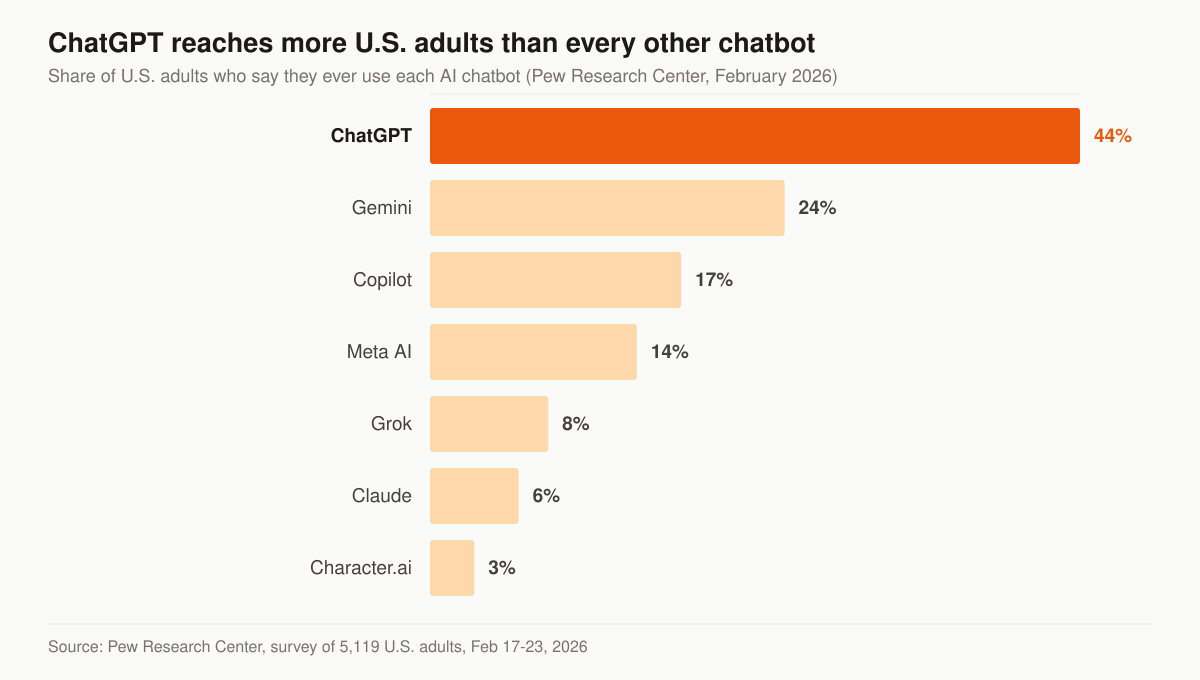
Source: Pew Research Center, survey of 5,119 U.S. adults conducted February 17-23, 2026.
Read the bars in order. ChatGPT reaches 44% of U.S. adults, Gemini 24%, Copilot 17%, Meta AI 14%, and Grok, Claude and Character.ai trail at 8%, 6% and 3%. Pew notes that ChatGPT is up from 34% the year before, and that adults under 50 are about twice as likely as those 50 and older to report using it, 57% against 28%.
Three numbers from the same survey set the expectations around that reach. About four-in-ten U.S. adults (42%) say they use chatbots to search for information, which is the top use Pew measured. Six-in-ten say they read the AI summaries at the top of a search engine result. And 71% predict that increased use of AI will make their personal information less secure — a useful corrective for anyone assuming a machine recommendation carries automatic goodwill.
For an insurance agency the age split is the line that matters. The 65-year-old buying a Medicare plan is not the likeliest person in that survey to open ChatGPT, but the 45-year-old adult child researching the plan on their behalf is. That is the reader you write the answer for. The vertical version of this argument, with the same sourcing, sits in AI search for annuity agents.
Where ChatGPT actually gets its answers
Two sources feed a recommendation:
- Training data — the corpus the model learned from, which updates on a lag.
- Live web retrieval — ChatGPT search, which OpenAI documents and controls with its own crawler.
The second one is where an agency has leverage, and it is worth being precise about it, because the widely repeated line that “ChatGPT runs on Bing” no longer matches what OpenAI publishes. OpenAI operates its own search crawler, OAI-SearchBot, and says sites opted out of it “will not be shown in ChatGPT search answers, though can still appear as navigational links” (OpenAI crawler documentation). Alongside that, OpenAI writes that ChatGPT search “sometimes partners with other search providers”, and its help centre points readers to the privacy statements of those providers, Microsoft’s among them (OpenAI Help Center). The 2024 launch post says the same thing in its own words: “ChatGPT search leverages third-party search providers, as well as content provided directly by our partners, to provide the information users are looking for.”
The practical translation is not “optimize for Bing.” It is: allow OpenAI’s own crawler, and keep the ordinary search hygiene that every third-party provider also depends on. Those are two jobs, not one, and the first is the one agencies skip because nothing in Google Search Console tells you it is broken.
None of it helps if the pages themselves are thin or unranked — retrieval can only surface what is already crawlable and indexed, which is why ranking an insurance agency website is the prerequisite, not the alternative. ChatGPT is only one engine; the live-retrieval engines reward slightly different tactics, which we cover in how to get cited by Perplexity and AI Overviews.
Which OpenAI crawlers decide whether ChatGPT can see you
OpenAI publishes its user agents and says what each one is for, which means the common “block the AI bots” line in a robots.txt file can quietly remove you from the surface you were trying to win. OpenAI is explicit that the controls are separable: “Each setting is independent of the others – for example, a webmaster can allow OAI-SearchBot in order to appear in search results while disallowing GPTBot to indicate that crawled content should not be used for training OpenAI’s generative AI foundation models.”
Table: the four OpenAI agents, described in OpenAI’s own words, and what each one decides for an agency site.
| Agent | What OpenAI says it does | What it controls for you |
|---|---|---|
OAI-SearchBot |
“is used to surface websites in search results in ChatGPT’s search features. Sites that are opted out of OAI-SearchBot will not be shown in ChatGPT search answers, though can still appear as navigational links.” | Whether you can be named and cited at all. OpenAI recommends “allowing OAI-SearchBot in your site’s robots.txt file and allowing requests from our published IP ranges” |
GPTBot |
“It is used to crawl content that may be used in training our generative AI foundation models. Disallowing GPTBot indicates a site’s content should not be used in training generative AI foundation models.” | Whether your pages can enter the training corpus — the slower, entity-level layer of trust |
ChatGPT-User |
“When users ask ChatGPT or a CustomGPT a question, it may visit a web page with a ChatGPT-User agent.” OpenAI adds that “Because these actions are initiated by a user, robots.txt rules may not apply” | The fetch that happens when a prospect pastes your URL into a chat. Assume this path is always open |
OAI-AdsBot |
“is used to validate the safety of web pages submitted as ads on ChatGPT… OAI-AdsBot only visits pages submitted as ads” | Only relevant if you run ChatGPT ads; it reviews the landing page you submitted |
Source: OpenAI crawler documentation.
Three operational details on that page save a wasted month. Timing first: OpenAI writes that “For search results, please note it can take ~24 hours from a site’s robots.txt update for our systems to adjust”, so a fix is not a same-hour test. Second, allowing the crawler is not sufficient on its own — the help centre adds that you must “confirm that the website host or content delivery network allows traffic from OpenAI’s published searchbot IP addresses.” A site can be perfectly permissive in robots.txt and still hand the crawler a challenge page at the edge. Third, ChatGPT-User is documented as user-initiated and outside robots.txt control, so write every public page assuming a buyer can always pull it up mid-conversation.
One more line is worth reading before anyone declares the door shut. OpenAI’s publisher FAQ says that if it obtains “the URL of a disallowed page from a third-party search provider or by crawling other pages” and has signals the page is relevant, “we may surface just the link and page title in ChatGPT Atlas”, and points to the noindex meta tag for publishers who want even that suppressed. Blocking the crawler removes the summary, not necessarily the mention.
The robots.txt file your CDN may be writing for you
This is the failure that is hardest to see from inside your own repository, and it is worth ten minutes before any content work. Your CDN can serve a robots.txt that is not the one in your codebase.
Cloudflare documents the feature plainly. “When you turn on the managed robots.txt setting, Cloudflare generates and maintains a robots.txt file that instructs known AI crawlers to stay away from your content” (Cloudflare Docs). It describes how that interacts with a file you already have: “Cloudflare detects whether your origin server already has a robots.txt file and adjusts accordingly — either merging with your existing file or creating one from scratch.” And where no file exists at all, “Cloudflare creates a new file with managed Disallow rules for known AI crawlers and serves it for you.” The setting is “available on all plans”, which is why a small agency site can inherit it without anyone having made a decision.
The same page documents Content Signals, machine-readable directives with three categories: “search (building a search index), ai-input (feeding content into AI models for real-time answers), and ai-train (training or fine-tuning AI models).” Cloudflare notes that turning the managed file on adds use=reference “in line with the existing default of search=yes,ai-train=no”, and that free-plan domains without their own robots.txt and without the managed feature “will display the Content Signals Policy” when a crawler requests the file.
So the audit step is blunt: open https://yourdomain.com/robots.txt in a browser and read what is actually served, rather than what is in your repository. If a managed block sits above your own rules, the toggle Cloudflare documents lives in the dashboard under Security Settings, filtered by Bot traffic, at “Set your preference to block training in robots.txt”. We treat that fetch as the first item in an AI-visibility check, because every hour spent on answer-first rewriting behind a disallowed crawler buys nothing.
Worth keeping in proportion, though. Cloudflare itself states that “robots.txt compliance is voluntary. The file expresses your preferences, but it does not prevent crawlers from accessing your content at a technical level.” The file decides whether compliant engines will cite you. It is a signal, not a lock.
Step 1: Lock your entity so the model can’t get confused
An “entity” is a thing the model recognizes — your agency as a distinct, real organization. Confusion kills recommendations. If your phone number differs across your website, Google Business Profile, and a directory, the model lowers confidence.
Fix the fundamentals first:
- NAP consistency — identical Name, Address, Phone everywhere. Same suite number, same formatting.
- One canonical “about” source — a strong About page that states what you do, who you serve, your licenses, and your service area in plain sentences.
- SameAs links — connect your site to your Google Business Profile, LinkedIn, Facebook, and listings via schema so the model knows they are the same organization.
Step 2: Ship schema markup that describes your agency
Schema (structured data in JSON-LD) is the most direct way to tell a machine literal facts. For an insurance agency, prioritize:
Table: the schema types that carry an agency’s identity, and where each one belongs.
| Schema type | What it tells the model | Where it goes |
|---|---|---|
InsuranceAgency / LocalBusiness |
Name, address, phone, hours, area served | Homepage, contact page |
FAQPage |
Question-and-answer pairs it can lift verbatim | Service and blog pages |
Article |
Author, publish date, topic of a guide | Blog posts |
Person (agent) |
Named licensed agent, credentials, role | About / agent bio pages |
Review / AggregateRating |
Social proof tied to your entity | Homepage, reviews page |
Schema does not rank you by itself, but it removes guesswork. When a model can read areaServed: Texas and knowsAbout: final expense insurance, it stops inferring and starts quoting. Our AI search and GEO service builds this layer for agencies that would rather not hand-write JSON-LD.
Step 3: Write answer-first content the model can quote
LLMs reward passages that state the answer in the first sentence, then support it. If your pages open with three paragraphs of brand throat-clearing before any substance, flip them.
A quotable passage looks like this:
“Final expense insurance is a small whole-life policy, typically $5,000 to $25,000, designed to cover funeral and end-of-life costs. It is available to most adults 50 to 85 without a medical exam.”
Clear. Self-contained. Liftable. Build pages around real questions your prospects ask and answer each one in 40–70 words up top, with detail below. Our deeper walkthrough on getting recommended across AI engines and the broader insurance content marketing playbook both lean on this structure.
Practical rules:
- Use clear
## H2questions a person would actually type. - Lead each section with a direct, standalone answer.
- Include at least one table and one list per substantive page — formats models extract cleanly.
- Cite well-known facts plainly (TCPA governs lead calls; CMS rules govern Medicare AEP marketing) and flag anything you can’t verify rather than inventing a statistic.
Step 4: Add an llms.txt file
llms.txt is an emerging convention: a plain-text file at your domain root that gives language models a curated map of your most important pages with short descriptions. Think of it as a robots.txt that says “read this” instead of “don’t.”
It is not a ranking switch, and adoption is early, but it is cheap to ship and removes ambiguity. A minimal version lists your core service pages, your About page, and your top guides, each with a one-line plain-English summary. Paired with schema, it gives the model a clean table of contents for your agency.
Step 5: Earn third-party citations and reviews
This is the half agents skip, and it is the half that decides trust. ChatGPT weighs what other sources say about you more heavily than what you say about yourself.
- Reviews — volume and recency on Google Business Profile and industry directories. The model reads sentiment and specialty signals from them.
- Directory listings — accurate, consistent entries on insurance and local directories reinforce your entity.
- Earned mentions — being referenced in roundups, association pages, and credible articles. These are the corroboration the model looks for.
You cannot fully control this, but you can seed it: claim every listing, ask satisfied clients for specific reviews, and publish content worth citing. The operational side of that is what reputation management covers, and the request mechanics are in how to get more Google reviews for insurance agents. For a worked example of the full stack in action, our Texas final-expense case study shows how entity, content, and reviews compound.
How ChatGPT handles a “near me” question
This is the mechanic that decides whether a local agency can be recommended at all, and OpenAI describes it in enough detail to plan against.
Start with location. OpenAI writes that “ChatGPT may use an approximate location based on your IP address to provide relevant local results”, and adds that “Device location sharing is optional and off by default.” So the default case is a coarse, IP-derived guess at a city or metro, not a rooftop coordinate. An agency whose pages describe a service area in city and county terms is legible to that; one whose only geographic signal is a street address in a footer image is not.
Then comes the step that changes how you plan pages. OpenAI says ChatGPT search “typically rewrites your query into one or more targeted queries” before sending them to a search provider, and gives its own local example: “if you type into ChatGPT ‘What are some good restaurants near me?’ and ChatGPT determines from your IP address that you are in the San Francisco area, ChatGPT may rewrite your prompt into the search query ‘top restaurants San Francisco.’” It also notes that after reviewing the initial results, ChatGPT search “may send additional, more specific queries to other search providers”.
Substitute the insurance version and the implication is immediate. “Who can help me with Medicare near me” becomes a rewritten query naming your metro and the line of business, and possibly a second and third query after that. You are not competing for the phrasing the prospect typed. You are competing for a machine-written query you never see, built from a city name plus a specialty noun. That argues for one substantial page per real service-and-place combination you actually serve, written with the city and the line of business in plain text — not a page per phrasing, which is thin-content spam under a new name.
Two smaller notes from the same page. OpenAI says that when memory is enabled, “ChatGPT may use relevant saved memories when rewriting a search query”, so a returning prospect’s rewritten query can carry context you never see. And OpenAI states plainly that “Search results and citations can be incomplete, outdated, or incorrect” — which is a fair warning that a single bad test result is not a diagnosis. This overlaps almost entirely with local SEO for insurance agents, because the entity a chatbot resolves for a city query is the same one the map pack resolves.
Can you pay to be recommended by ChatGPT?
Not the recommendation itself, and OpenAI is unusually direct about the separation. Its help centre states that ads “do not influence ChatGPT’s answers”, that they “run on separate systems from our chat model, and advertisers have no ability to shape, rank, or alter ChatGPT’s responses”, and that “seeing an ad doesn’t mean OpenAI endorses or recommends the advertiser or its products or services” (OpenAI Help Center).
Ads themselves are real, though, and an agency evaluating the channel should read the category rules before building a plan. OpenAI’s ad policies say that during the initial test period ads “are primarily limited to consumer verticals such as lifestyle and household goods, local services, travel and experiences, and digital products or education”, and then carve out the regulated ones: “We may approve ads from approved advertisers within the financial services, healthcare & medicine, and legal services categories. These categories are being rolled out gradually with approvals being reviewed manually on a case-by-case basis.”
Table: what OpenAI’s published ad policy says about the categories an insurance agency would actually buy.
| Question | What OpenAI’s ad policy says |
|---|---|
| Is insurance an eligible category? | “Ads for financial products and services are restricted. In the US, we may allow ads from approved financial advertisers on a case-by-case basis for:” a list that includes “Insurance” and “Financial planning” |
| Is health insurance treated separately? | Yes. Health services are restricted too, with a case-by-case US list that includes “Health insurance” |
| Do I need to prove I am licensed? | “Advertisers may be required to provide proof of licensure”, and advertisers needing “professional registrations, licenses, certifications, or similar authorizations must maintain those credentials” |
| Can I run these outside the US? | “Ads for financial services outside the US are generally prohibited”, and health services ads outside the US are “generally prohibited” as well |
| How is the ad reviewed? | Most review is automated, and OpenAI notes “Restricted categories (e.g. financial services) may require additional safeguards, including enhanced advertiser verification or manual review” |
| What does the buy look like? | CPM and CPC options; OpenAI writes that “For CPC campaigns, we recommend starting with a maximum bid of $3–$5 USD per click” and that it uses “a relevance-weighted, second-price auction to select among eligible ads” |
Sources: OpenAI ad policies and Ads in ChatGPT: The Basics.
Read the two halves together and the strategy writes itself. The paid surface is a labelled placement below the answer, gated behind case-by-case manual review, with proof of licensure a documented possibility, in a category OpenAI is rolling out gradually. The organic surface — being named inside the answer — is not for sale at any price. So the entity, schema and corroboration work in this guide is not the cheap alternative to advertising here; it is the only route to the part of the screen that carries the recommendation. If and when the ad category opens for your agency, it becomes another managed channel to run alongside the ones on our pricing page, not a replacement for the work above.
Make the page readable to an agent, not only to a crawler
There is a newer failure mode worth designing against, because it breaks the quote page rather than the blog post. OpenAI’s browser, ChatGPT Atlas, drives sites the way a person would, and OpenAI says how it reads them: “ChatGPT Atlas uses ARIA tags—the same labels and roles that support screen readers—to interpret page structure and interactive elements.” Its guidance for developers is to “follow WAI-ARIA best practices by adding descriptive roles, labels, and states to interactive elements like buttons, menus, and forms”, because that “helps ChatGPT recognize what each element does and interact with your site more accurately.”
For an insurance agency that lands on the quote form. A multi-step quote flow whose fields are unlabelled divs, whose “next” control is a styled span, and whose progress state exists only in CSS is opaque to an agent even when the marketing copy above it is immaculate. Real <label> elements, semantic buttons, and honest heading order are the fix, and they are the same fix accessibility asks for. That is the unusual case where the compliance-driven work and the visibility-driven work are literally the same tickets — which is how we treat it inside insurance web design.
How to measure whether ChatGPT is sending you anything
You have one first-party signal, and OpenAI publishes it. Its publisher FAQ states that “ChatGPT automatically includes the UTM parameter utm_source=chatgpt.com in referral URLs, enabling clear tracking and analysis of inbound traffic from ChatGPT search results”, and notes that publishers who allow OAI-SearchBot “can track referral traffic from ChatGPT using analytics platforms such as Google Analytics.”
That gives you a real number instead of a vibe. Build a segment on that source, watch which landing pages receive it, and check whether those sessions convert differently from organic search — a visitor who arrives after reading a synthesized answer has already had several of their questions answered, which changes what the page needs to do next.
What the parameter cannot tell you is how often you were named without being clicked, and there is no ChatGPT equivalent of Search Console for that. The honest method is manual and unglamorous: keep a fixed list of 20 to 30 questions a real prospect would ask — coverage questions, cost questions, “who sells this in my county” questions — run them monthly from a clean logged-out session, and log which agencies get named and what the named passage says. Track two things over time: whether you appear, and whether the sentence about you is the one you wrote. Pair that log with ordinary ranking data, since insurance SEO and citation share move together rather than independently.
ChatGPT, AI Overviews, and Perplexity: one playbook, three engines
The work above is not ChatGPT-specific. All three major answer engines reward the same underlying signals — an unambiguous entity, structured data, third-party corroboration, and passages that state the answer in the first sentence — because all three face the same problem: deciding which local business they can safely put their name behind. Build the entity-and-content layer once and it compounds across every engine at the same time.
Where the engines differ is retrieval: which index each one reads live, which crawler has to be allowed in your robots.txt, and how each selects the handful of sources it cites. Those mechanics deserve their own checklist, and we keep it in the Perplexity and AI Overviews citation playbook — read it as the companion to this guide, not a separate strategy. In practice the split is simple: do the foundation work here once, then verify coverage engine by engine.
A realistic 90-day priority order
Table: the order we work in, and the reason each phase sits where it does.
| Phase | Focus | Why it’s first |
|---|---|---|
| Weeks 1–3 | NAP cleanup, OAI-SearchBot access, CDN and IP check | Fixes confusion before adding anything |
| Weeks 4–6 | Schema + llms.txt | Makes facts machine-readable |
| Weeks 7–9 | Answer-first rewrites of top pages | Gives the model quotable passages |
| Weeks 10–12 | Reviews + directory citations | Builds the corroboration that earns the recommendation |
What this costs to run as a program
We publish rates rather than quoting per call. AI-search visibility sits inside the Growth tier at $3,500 per month, which also carries the ongoing SEO and content engine, reputation and reviews work, and monthly reporting. Foundation is $2,500 per month and covers the website and landing pages, local SEO and Google Business Profile, and on-page SEO. Full-Funnel is $5,500 per month and adds managed paid ads, landing-page CRO and marketing automation. A one-time website build runs $2,500 to $8,000, and ad spend is billed separately, straight to the platforms. The full breakdown is on the pricing page.
GEO sits at Growth rather than Foundation for a sequencing reason. Answer-first rewriting on a site that is crawl-blocked, thin or slow buys nothing, because retrieval never reaches the passage. Fix the crawler and the foundation first, then write the answers.
Where to start
GEO is not a one-time fix; it is hygiene plus content plus corroboration, maintained. If you want a read on where your agency stands today across schema, entity consistency, and AI visibility, request a free marketing audit and we will show you the gaps with numbers. To go deeper on the discipline, see our AI search and GEO service for insurance agencies — that is the page we built using every rule above.
ChatGPT will keep handing prospects a short list of agents. The mechanics that put you on it are knowable and largely within your control. Start with the fundamentals, ship the structure, and earn the citations.
- How to Get Cited by Perplexity and Google AI Overviews as a Local Business
How to get cited by Perplexity and Google AI Overviews as a local business: answer-first passages, structured data, consistent NAP, and third-party citations.
- Insurance SEO Cost, Timeline, and the DIY-vs-Hire Decision
What insurance SEO costs in 2026, how long it takes to pay back, and whether to run it yourself or hire it out — with the four layers ranked by payback.
- Google Business Profile Suspended: The Insurance Agency Recovery Guide
Why insurance agency Google Business Profiles get suspended and how to appeal using Google's own process — evidence checklist, steps, and prevention.
- How to Rank an Insurance Agency Website: The Insurance Agency SEO Guide
How to rank an insurance agency website on Google: a practitioner's SEO guide to technical setup, content, local signals, and the cadence that holds it.