Service
SEO for Insurance Agents, Priced and Run Line by Line
Your agency ranks for the searches that actually produce policies, and each organic lead's cost keeps falling as the pages compound — until it settles well below what you pay for paid leads.
- We run our own final-expense book
- No pitch deck — we screen-share real numbers
- TCPA-aware · CMS/AEP-compliant · Meta Special Ad Category
- Core Web Vitals < 2.0s LCP
SEO for insurance agents is the ongoing work of ranking your site for the searches that produce policies — technical health, YMYL content depth, local signals, and AI-search structure. The number that matters is not the retainer but cost per organic lead, which keeps falling as pages compound and rankings hold.
What you get
What your SEO for insurance agents program includes
- A 12-month keyword + content map for your line (final expense, Medicare, life, etc.), with every target term tied to search intent and a specific capture page
- A technical SEO fix punch-list — Core Web Vitals, crawl/index cleanup, valid schema, mobile-first — worked until each item is checked green
- Google Business Profile optimization plus location pages and citation cleanup built to win the '[city] insurance agent' map pack
- On-page rewrites of your money pages: titles, headers, internal links, and entity coverage aligned to the terms that convert
- Expert-reviewed YMYL content bylined to your own licensed producer — a pillar plus its supporting answer pages per niche, not spun filler
- AI-search / GEO structure — answer-first blocks, FAQ schema, and consistent facts so ChatGPT, Perplexity, and AI Overviews cite you
- A monthly report showing ranking movement and cost per organic lead measured against your paid blended CPL — not vanity traffic
How it works
How the SEO for insurance agents engagement runs
- 01
Baseline audit & winnable-terms quote
We pull your current rankings, map-pack gaps, the searches competitors are missing, and your existing lead spend, then quote a number tied to that market — not a generic package.
- 02
Technical + local foundation
Fix Core Web Vitals, crawl/index and schema issues, then optimize the Google Business Profile, clean up citations, and stand up location pages that can rank locally.
- 03
Lock the keyword + content map
Build the 12-month topical plan — pillar plus cluster per line — with each target term mapped to search intent and the capture page it funnels to.
- 04
Publish & build authority
Ship YMYL content bylined to your licensed producer, apply AI-search structure on a monthly cadence, earn reviews and citations, and strengthen internal links as pages start ranking.
- 05
Report & compound
Every month we report ranking movement and cost per organic lead against your paid CPL, then reallocate effort toward the pages actually producing policies.
A monthly SEO number means nothing until you can see what is inside it. We price the way we run our own book — line by line, tied to what each piece actually moves. This page breaks down insurance SEO cost, what drives it, and the ROI math that decides whether it beats buying leads.
Two choices sit inside that number and are worth naming before the price table. The first is how narrow you aim: broad insurance head terms are bid up by carriers and lead aggregators, so the favorable math usually lives one line down — final expense SEO for senior-market agents is the version we run most often, because no incumbent agency owns that niche and a focused site can rank on modest authority. The second is that ranking and being cited have become separate jobs: generative engine optimization for insurance agencies is the work of getting quoted inside a ChatGPT, Perplexity or AI Overview answer, and it is in scope at every tier below that includes SEO.
What insurance SEO actually costs
A serious insurance agency SEO program runs $2,500 to $5,500 per month on our published tiers. The spread is not arbitrary — it tracks scope. Here is how the work breaks down and what each line drives.
Table: the six work components inside an insurance SEO retainer, what each one does, and how much of the monthly cost it typically absorbs.
| Component | What it does | Typical share of cost |
|---|---|---|
| Local SEO + Google Business Profile | Wins the map pack for “[city] insurance agent” | High for single-location agents |
| Keyword + on-page work | Targets searches that produce policies, not vanity terms | Moderate, front-loaded |
| Content marketing | Builds topical depth Google rewards on YMYL topics | The ongoing line we budget most against |
| Technical SEO + Core Web Vitals | Keeps the site fast, crawlable, indexable | One-time, then maintenance |
| Reviews + E-E-A-T signals | Named authors, credentials, real proof | Low cost, high trust weight |
| AI-search / GEO structure | Citable answers for ChatGPT, Perplexity, AI Overviews | Growing share |
Below about $1,000/month, you are usually buying thin spun content or link schemes that put your domain at risk. The cheap option is the expensive one once Google catches it.
For context outside insurance: Ahrefs surveyed 439 SEO service providers and found SEO costs “usually range from $250 to $10,000 per month, with most businesses (63%) spending between $500 and $5,000,” with agencies charging an average of $3,209 a month (Ahrefs). Insurance lands in the upper half of that band — the next section explains why.
Our published tiers — no quote gate
Pricing here is not behind a sales call. It is published on the pricing page, and here it is again so you don’t have to click:
Table: our three published monthly program tiers, the agency size each fits, and the SEO scope included at each price.
| Program | Monthly | Built for | SEO scope |
|---|---|---|---|
| Foundation | $2,500 | Solo agents getting online right | Local SEO + Google Business Profile, on-page SEO, monthly reporting |
| Growth — most popular | $3,500 | Agents & small agencies scaling | Everything in Foundation, plus the ongoing SEO and content engine, AI-search visibility (GEO/AEO), and reputation & reviews |
| Full-Funnel | $5,500 | Agencies serious about volume | Everything in Growth, plus managed paid ads, landing-page CRO, and marketing automation |
This SEO program maps to the Growth tier. If your current site can’t carry the program, a one-time website build runs $2,500–$8,000. No long lock-ins, and ad spend (where it applies) is a pass-through billed straight to the platforms. AI-search/GEO structure is in scope at every tier that includes SEO — the dedicated version is our insurance AI search and GEO service.
That one-time band is worth checking against the market too, because project pricing is where quotes vary hardest. The same Ahrefs survey reports average per-project fees of $2,348.63 for freelancers, $8,685.53 for consultancies, and $9,507.84 for agencies, with 21.2% of respondents pricing projects in the $2,501–$5,000 band.
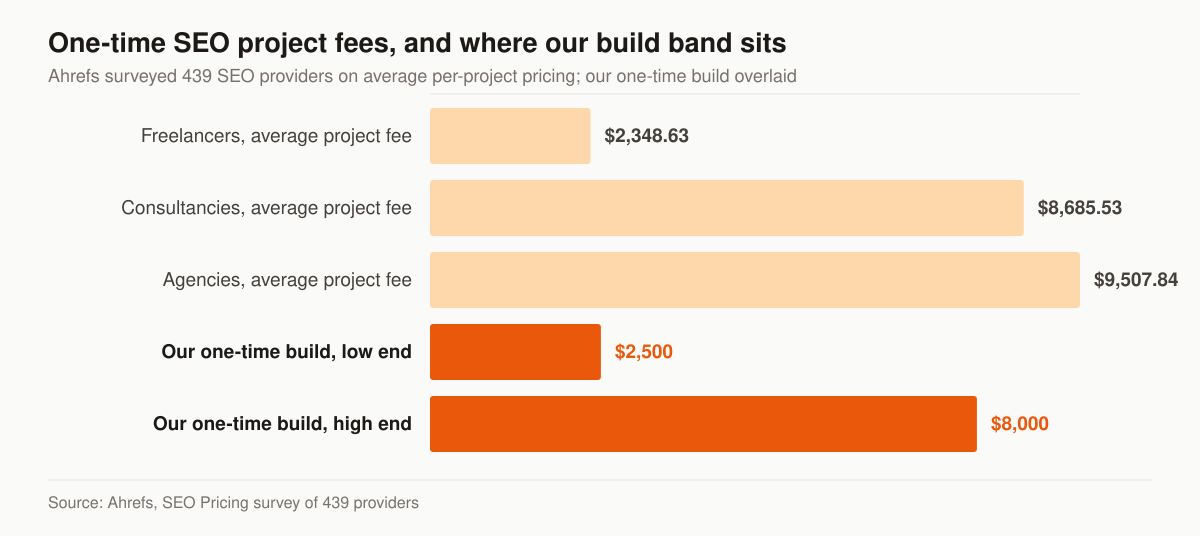
Chart: average one-time SEO project fees, from Ahrefs’ pricing survey of 439 SEO providers, with our published build band overlaid.
Why insurance SEO costs what it does
Three forces set the price:
- YMYL and E-E-A-T. Insurance is a Your-Money-Your-Life topic, so Google weights E-E-A-T heavily — author expertise, verifiable credentials, and genuine proof. Content written and reviewed to that bar costs more than a hobby blog — and it’s why generic agencies underperform here.
- Local competition. A single-county final-expense agent faces far less defended terms than a multi-line agency in a major metro. Scope drives the retainer.
- Commercial value of the term. Carriers and lead vendors out-spend small agencies on broad head terms. The favorable math lives in local and niche searches — which is exactly the gap our final-expense SEO program is built to win.
How Google ranks an insurance agency in local results
Google publishes its local ranking factors plainly, and there are three: relevance, distance, and prominence (Google Business Profile Help). Relevance is “how well a Business Profile matches what someone is searching for.” Distance is “how far each business is from the customer who’s searching.” Prominence is “how well-known a business is,” which Google says is “based on info like how many websites link to your business and how many reviews you have.”
Read that list as a spending guide rather than a checklist. One factor is fixed geography nobody can buy, one is a data-entry job that takes a week, and one is a slow expensive line that takes months of consistent work to move. Retainers get wasted when all three are worked as though they respond to the same effort.
Table: Google’s three named local ranking factors, what actually moves each one, and where the retainer goes.
| Factor | Google’s wording | What moves it | What it costs |
|---|---|---|---|
| Relevance | “how well a Business Profile matches what someone is searching for” | The correct primary category, the lines you actually write listed as services, profile and page copy using the buyer’s words | Days, not months — the cheapest win on the list |
| Distance | “how far each business is from the customer who’s searching” | Your physical address. Nothing else | Nothing, and nothing can be spent to change it |
| Prominence | “how well-known a business is … based on info like how many websites link to your business and how many reviews you have” | Review volume and recency, citations that agree with each other, and links from sites you don’t own | The slow, open-ended line — months of work, and it never finishes |
Distance decides how far the map pack is even worth chasing. An agent thirty miles from the metro core will not rank in that core’s map pack at any retainer, which is why the local SEO program targets the radius the profile can actually serve while organic pages carry the rest of the metro. Prominence is where reviews stop being a reputation nicety and become a ranking input — the standing engine for that lives in reputation management, and the tactics are written up in how to get more Google reviews.
The technical numbers we work to
Technical SEO is not a matter of opinion; it is pass or fail against thresholds Google publishes. The Core Web Vitals documentation sets three: Largest Contentful Paint should “occur within the first 2.5 seconds of the page starting to load,” Interaction to Next Paint should be “less than 200 milliseconds,” and Cumulative Layout Shift should be “less than 0.1” (Google Search Central).
Table: the three Core Web Vitals, Google’s published “good” threshold for each, and what usually breaks it on an insurance agency site.
| Metric | Google’s “good” threshold | What usually breaks it on an agency site |
|---|---|---|
| Largest Contentful Paint (LCP) | Within 2.5 seconds | An uncompressed hero photo, a carrier-logo slider above the fold, a theme loading four web fonts |
| Interaction to Next Paint (INP) | Under 200 ms | Quote-rater and chat widgets injected synchronously, a page running three tag managers at once |
| Cumulative Layout Shift (CLS) | Under 0.1 | Images with no width and height, a consent banner that pushes content down after paint, review sliders that load late |
Crawl and index health sits underneath all three, and it is where the punch-list spends most of its items: a stray noindex left on a template, a staging subdomain indexed alongside production, canonical tags all pointing at the homepage, a sitemap listing URLs that redirect, tag archives outnumbering real pages. None of it is glamorous and all of it is cheaper to fix than to out-publish. Where the fix list runs longer than a rebuild — a common outcome on a locked carrier-supplied template — a new website build is the cheaper path, which is why the audit prices both.
What the first 90 days look like
The first quarter follows a fixed sequence — foundation before content, content before authority — because publishing onto a broken site wastes the retainer. Here is what ships when:
Table: what ships in each 30-day phase of the first 90 days, and the signal you should be able to see by the end of it.
| Phase | What we deliver | What you should see |
|---|---|---|
| Days 0–30 | Baseline audit and winnable-terms quote; technical punch-list worked (Core Web Vitals, crawl/index, schema); Google Business Profile rebuilt; Search Console verified; money-page rewrites started | A fixed site and an honest map of what’s winnable in your market |
| Days 31–60 | Citations cleaned and location pages stood up; the 12-month keyword + content map locked; first named-author content cluster published; review cadence live | Impressions rising on target queries — the signal that arrives before clicks |
| Days 61–90 | Monthly content cadence at full speed; internal links tightened; AI-search/GEO structure applied to money pages; first full monthly report | Ranking movement and cost per organic lead measured against your paid CPL |
What the keyword map actually looks like
Deliverable one on every engagement is the 12-month keyword and content map. Rather than describe it, here is an excerpt of a real one — eight terms from our own research pull, each tied to search intent and the page type built to capture it:
Table: eight terms from our own DataForSEO pull, each with its monthly search volume, search intent, and the page type built to capture it.
| Keyword | Searches/mo | Intent | Page type it maps to |
|---|---|---|---|
| final expense leads | 1,300 | informational | pillar guide funneling to a lead-gen offer |
| seo for insurance agents | 720 | commercial | service page — the one you’re reading |
| best crm for insurance agents | 260 | commercial | comparison page |
| life insurance leads live transfer | 210 | transactional | offer / landing page |
| how to get life insurance leads | 170 | informational | blog guide → lead-gen service |
| turning 65 medicare leads | 140 | informational | Medicare niche spoke |
| final expense direct mail leads | 90 | transactional | niche offer page |
| medicare leads for agents | 70 | informational | Medicare niche guide |
Source: DataForSEO Labs, July 2026 — United States, English.
Notice what’s missing: “life insurance,” “medicare,” and every other head term carriers and lead vendors own. The map only carries terms an agency can actually win, and every row ends in a page whose job is capture, not traffic.
Why we don’t build a page for every city you’d like to rank in
Every agency SEO proposal eventually offers location pages, and a good number of them are describing a spam policy. Google defines doorway abuse as “sites or pages are created to rank for specific, similar search queries” that “lead users to intermediate pages that aren’t as useful as the final destination,” and lists among its examples multiple pages targeted at specific regions or cities that funnel users to one page (Google Search Central). The same document defines scaled content abuse as when “many pages are generated for the primary purpose of manipulating search rankings and not helping users,” and names generative AI output as its first example.
The distinction is not the number of pages, it is whether each one carries something true only about that place. A page for a county you hold appointments in, with the carriers you can actually write there and the producer who covers it, is a real page. Forty ZIP-code variants of one template are the thing the policy is named after.
Table: what separates a location page that earns its place from one that reads as a doorway.
| Signal | Earns its place | Reads as a doorway |
|---|---|---|
| Content | Carriers appointed in that state, the local filing facts, the office or producer who serves it | The same template with the city name swapped |
| Proof | Reviews, photos, or cases from that market | One testimonial block repeated everywhere |
| Destination | Converts on the page | Funnels every visitor to one central contact form |
| Volume | One page per market you can service | Forty pages for forty ZIPs in one county |
What replaces the ZIP-code sprawl is depth on the axis that genuinely differs: the line of business. A Medicare page and a final-expense page answer different questions, carry different compliance text, and target different buyers, which is why the Medicare agent website build and the final-expense program look nothing alike even inside the same retainer. The keyword-selection logic behind that split is worked through in our guide to insurance SEO keywords.
What insurance SEO content has to comply with
Insurance SEO differs from dentist SEO in one way that outweighs any ranking factor: some of the copy is regulated, and the regulator is not Google.
Medicare is the strictest case. The requirement attaches to any third-party marketing organization — TPMO, defined at 42 CFR 422.2260 — that sells plans on behalf of more than one Medicare Advantage organization, and CMS specifies the disclaimer word for word: “We do not offer every plan available in your area. Currently we represent [insert number of organizations] organizations which offer [insert number of plans] products in your area. Please contact Medicare.gov or 1-800-MEDICARE to get information on all of your options” (42 CFR 422.2267(e)(41), eCFR). That same paragraph requires the disclaimer be “prominently displayed on TPMO websites,” conveyed “electronically … when communicating with a beneficiary through email, online chat, or other electronic means of communication,” and read “verbally … during sales calls prior to the discussion of any benefits.” A separate wording applies if you do represent every organization in the service area.
That is a website requirement written as a marketing rule, and it lands on exactly the pages SEO is trying to rank: the Medicare landing page, the turning-65 guide, the chat widget, the form auto-reply. We build it into the template rather than bolt it onto pages one at a time, because a disclaimer that exists on four of nine pages is worse than a slow ranking.
Reviews carry a second rulebook. The FTC’s Rule on the Use of Consumer Reviews and Testimonials (16 CFR Part 465) took effect on 21 October 2024, and it reaches the tactics agency review programs reach for first.
Table: four provisions of the FTC consumer reviews rule and the common agency habit each one catches.
| Provision | What it forbids | The habit it catches |
|---|---|---|
| § 465.4 | Compensation “in exchange for, or conditioned expressly or by implication on, the writing or creation of consumer reviews expressing a particular sentiment” | The gift card offered for a five-star Google review |
| § 465.5 | An officer or manager writing a review without “a clear and conspicuous disclosure” of their material relationship to the business | The agency owner posting a five-star review of his own agency |
| § 465.7 | Misrepresenting that displayed reviews “represent most or all the reviews submitted” while suppressing them by rating or sentiment | The site widget set to render four- and five-star reviews only |
| § 465.1(c)(4) | A disclosure a reader must click or hover to see — it “must be unavoidable” | The relationship note hidden behind a “details” toggle |
We provide marketing services, not legal or compliance advice, and you remain the licensed and responsible party. But a review engine that trips 16 CFR 465 is a worse outcome than a slow one, and a Medicare page missing its disclaimer is a compliance problem before it is an SEO problem. Both are checked in the baseline audit alongside the technical punch-list.
What schema still earns, and what quietly stopped working
Structured data is still worth shipping on an insurance site, though rarely for the reason a proposal gives. Google announced on 8 August 2023 that FAQ rich results “will only be shown for well-known, authoritative government and health websites,” and that How-To rich results would be limited to desktop. An update appended to that same post five weeks later went further: “As of September 13, Google Search no longer shows How-to rich results on desktop, which means this result type is now deprecated” (Google Search Central). An independent agency is not a well-known authoritative government or health website. FAQPage markup sold as the way to win the expanding FAQ box in the results page is selling something that has not been available to ordinary businesses since 2023.
Table: the markup we ship on insurance money pages, what each type still does, and what it no longer does.
| Markup | What it still does | What it no longer does |
|---|---|---|
| FAQPage | Holds question-and-answer pairs in a machine-readable structure on the page | Produce the expandable FAQ result in Google for a normal business site |
| HowTo | Documents a process for readers | Appear as a rich result anywhere — dropped on mobile in August 2023 and on desktop from 13 September 2023, when Google called the type deprecated |
| Organization / LocalBusiness | States your name, address, licensing, and service area as facts an engine can reconcile against your directory listings | Nothing — this is the type still doing load-bearing work |
| BreadcrumbList | Renders the site hierarchy inside the result | — |
Google’s own guidance on the deprecated types is that “there’s no need to proactively remove it,” since “structured data that’s not being used does not cause problems for Search, but also has no visible effects in Google Search.” We keep FAQPage on money pages for a different job: it forces the answer-first passages an AI engine has to lift in order to quote you. No engine publishes a confirmation that the markup itself drives citations, so we do not claim it does — the mechanism we can defend is the writing underneath it, and the markup is cheap structure around that. The same honesty test runs through our notes on getting an agency recommended by ChatGPT.
Organic vs. paid: the real math
The honest comparison isn’t retainer vs. retainer. It’s three questions: what does the channel cost in month one, what does a lead cost by month twelve, and what do you still own if you switch it off?
Table: bought leads versus insurance SEO, compared on month-one cost, cost per lead by month twelve, and what the agency still owns after switching the channel off.
| Channel | Month-1 cost | Cost per lead by month 12 | What you own if you stop |
|---|---|---|---|
| Bought leads / PPC | Bills from day one, and produces from day one | Flat to rising — every new bidder in your ZIP pushes the click price up | Nothing. Leads stop the day the card does |
| Insurance SEO | Full retainer, little visible return — impressions arrive before clicks | Falling — ranked pages keep producing against the same retainer, so the marginal lead approaches zero | The rankings, the pages, and the traffic they keep earning |
Insurance keywords carry some of the highest costs-per-click of any vertical — see our PPC cost breakdown by line for what that first column actually bills. The trade is speed for ownership: paid buys leads today at a price that only goes up; SEO buys an asset whose cost per lead only goes down.
SEO is slower, but it’s an asset you own rather than rent. We recommend running both: paid for cash flow now, organic for margin later, with the monthly report showing which one is actually costing less per lead.
What we report every month, and the number that decides the renewal
Cost per organic lead is the figure the monthly report is built around: the month’s SEO retainer divided by the leads that arrived through organic sessions in that month. Not sessions, not keywords in the top 100, not a vendor’s “visibility score.” Four other lines sit above it in the report, and the order they move in matters as much as the numbers themselves.
Table: the five lines in the monthly SEO report, what each one tells you, and the order they move in.
| Line in the report | What it tells you | When it moves |
|---|---|---|
| Impressions on target queries | Google is now showing the page for the terms on the map | First, often inside the opening quarter |
| Average position on those queries | Whether the page is climbing toward the range where clicks exist | Second, and it can climb forty places while earning nothing |
| Clicks and click-through rate | The page has reached positions searchers can actually see | Third, and only once position has moved |
| Leads from organic sessions | The page converts, rather than only attracting | Fourth |
| Cost per organic lead | Retainer ÷ organic leads for the month | Last, and the only one that settles against your paid blended CPL |
That order is why month four is where SEO engagements get cancelled. A page can gain thirty positions in a quarter and produce nothing, because almost everything below the top ten is invisible to a searcher — movement from 82 to 45 is real progress that pays exactly zero. Publishing more words does not shorten the lag either; word count is not a ranking purchase, and any agency implying it is has told you what their program is. We report the leading indicators precisely so the middle of a program is legible instead of a black box, and so you can tell a program working slowly apart from one not working at all.
Attribution gets the same treatment. Organic leads are counted from tracked form submissions and calls that carry organic attribution, and where attribution is genuinely uncertain we say so rather than round it into the win column.
What a real program includes
A complete build isn’t “ten blog posts.” It covers:
- Technical foundation — fast load, clean crawl, valid schema, mobile-first.
- Local signals — the map-pack side of the work (Google Business Profile ranking, citations, location pages) is its own discipline, covered in our local SEO for insurance agents service; the reviews that back it live in reputation management, and all three rank together.
- Topical content — the questions seniors and adult children actually search, answered with depth.
- AI-search visibility — structured, citable content so you surface in AI answers, covered on our AI search and GEO service.
- Reviews and authorship — the trust signals Google weights on YMYL pages.
SEO rarely works alone. We usually pair it with conversion-ready insurance landing pages so the traffic it earns turns into consented leads instead of bounces, and we map it against your existing lead spend during onboarding.
See what’s winnable in your market
Pricing only means something against your competition and your terms. We’ll pull your current rankings, your local map-pack gaps, and the searches your competitors are missing, then quote a number tied to that — not a generic package.
Start with a free SEO and marketing audit, browse the full services lineup, or read how we grow an agency’s organic footprint from the same playbook we run on our own pages.
Guides that go deeper
Frequently asked questions
How much does insurance SEO cost per month?
Is insurance SEO cheaper than buying leads?
What makes insurance SEO cost more than other industries?
How much should I expect to pay for SEO?
Do you guarantee first-page rankings?
Does my agency website need a rebuild before SEO starts?
Do Medicare agents need extra disclaimers on their website?
Can I offer clients a gift card for a Google review?
See exactly where your agency is leaking leads.
15 minutes. We screen-share our own live lead dashboard and tear down your funnel line by line — no pitch deck, just numbers.
- Site speed & conversion
- Local + AI-search visibility
- Ad efficiency
- Your cost per lead vs ours
No obligation · no pitch deck