Insurance SEO Keywords: Real Data by Line and Intent
Insurance keyword research starts by separating the buyer: a consumer seeking coverage, an agent buying leads, or an agency buying marketing. This page retains a dated July 2026 vendor dataset of 79 agent-facing terms, then shows how to map the relevant task to an existing page without treating missing difficulty scores as easy rankings.
A useful insurance SEO keyword list starts with who is buying what. A policy shopper, an agent purchasing leads and an agency hiring a marketing provider can use similar insurance words while needing entirely different pages.
The tables below retain a July 2026 DataForSEO Labs snapshot of 79 US English agent- and agency-facing terms. These are dated vendor estimates and classifications, not a complete list of insurance searches, current Google measurements or proof that a page will rank. The original numeric rows remain visible so you can audit the interpretation rather than mistake new advice for newly collected data.
First separate policy shoppers, lead buyers and marketing buyers
| Searcher | Illustrative query | What they want | Appropriate destination |
|---|---|---|---|
| Consumer considering coverage | term life insurance agent in [city] | A relevant licensed provider or help comparing coverage | The agency’s actual consumer service or useful local page |
| Agent buying prospect records | exclusive life insurance leads | A lead supplier, product terms and buying process | A lead-vendor product or comparison; not a consumer insurance sales page |
| Agency buying a marketing service | seo for insurance agents | A provider’s scope, evidence and engagement process | A B2B marketing service page |
| Agent researching how to acquire customers | how to get life insurance leads | A practical acquisition method or channel comparison | An educational guide with an appropriate next step |
| Existing policyholder | change address on [carrier] policy | Customer service or account access | The relevant service/support route; keep separate from new-business enquiries |
The examples are task illustrations, not additional measured keyword rows. Our site sells marketing services to agencies; your agency may sell policies to consumers. Copying our B2B target list onto a consumer website would target the wrong buyer. Likewise, a provider-intent phrase labelled navigational by a tool is not automatically a brand query or a reason to discard it. Inspect the actual results and buyer task.
How to read this data
Four things to know before you use the tables:
- Volume is average monthly US searches. Insurance volumes look tiny next to other industries; the commissions behind each search are why the clicks still cost what they do.
- CPC is the vendor’s dated cost-per-click estimate, not an actual bill or a conversion forecast. A “—” means this snapshot did not return a value; the reason is not established here. For paid-channel context by product line, see our breakdown of insurance PPC cost per click.
- Difficulty (KD) is DataForSEO’s 0–100 competitiveness score. “n/a — not measurable” records that this snapshot returned no score. It does not establish weak competitors or a difficulty of zero.
- Intent is DataForSEO’s classification: informational, commercial, transactional, or navigational.
Only 19 of the 79 sampled terms returned a difficulty score, and 8 returned zero reported volume. That describes this selected dataset, not the proportion or difficulty of all insurance demand.
What are the highest-volume insurance keywords?
The highest-volume agent-facing insurance keywords are lead terms: “insurance leads” and “life insurance leads” tie at 1,900 monthly searches, with “insurance leads for agents” and “final expense leads” at 1,300 each (DataForSEO Labs, July 2026). These phrases concern buying leads. They may fit a lead vendor but do not by themselves target a consumer seeking insurance. Their vendor-assigned labels are retained in the tables; business fit requires a separate judgment.
For a marketing provider, agency-service terms may be relevant; for a policy-selling agency, consumer coverage and genuine local-service tasks need a separate research set. The commercial column is a vendor classification, not verified sales attribution.
Agency and marketing keywords
What agents and agency principals type when they’re looking for marketing help — the buying-intent core of this dataset.
| Keyword | Volume/mo | CPC | Difficulty | Intent |
|---|---|---|---|---|
| seo for insurance agents | 720 | $58.37 | n/a — not measurable | commercial |
| insurance seo company | 390 | — | n/a — not measurable | commercial |
| recruiting for insurance agents | 210 | $43.11 | n/a — not measurable | informational |
| insurance agency marketing services | 210 | $17.19 | 17 | commercial |
| digital marketing for insurance agents | 140 | $26.17 | n/a — not measurable | commercial |
| marketing to insurance agents | 140 | $15.82 | n/a — not measurable | commercial |
| insurance marketing agency | 110 | $42.65 | 4 | commercial |
| insurance marketing ideas | 110 | $9.12 | 3 | commercial |
| local seo for insurance agents | 110 | — | n/a — not measurable | commercial |
| social media marketing for insurance agents | 110 | $20.69 | n/a — not measurable | informational |
| marketing strategies for insurance agents | 90 | $40.45 | n/a — not measurable | informational |
| insurance agent marketing ideas | 90 | $31.43 | n/a — not measurable | commercial |
| insurance agency marketing strategy | 90 | $40.45 | n/a — not measurable | commercial |
| telemarketing for insurance agents | 90 | $36.69 | n/a — not measurable | commercial |
| marketing consultant insurance | 70 | $220.01 | n/a — not measurable | commercial |
| facebook ads for insurance agents | 70 | $20.30 | n/a — not measurable | informational |
| email marketing for insurance agents | 50 | $50.70 | n/a — not measurable | commercial |
| google ads for insurance agents | 30 | $21.11 | n/a — not measurable | commercial |
| content marketing for insurance agents | 20 | — | n/a — not measurable | commercial |
| digital marketing agency for insurance | 10 | $52.10 | n/a — not measurable | commercial |
Source: DataForSEO Labs, July 2026 (US, English).
Two things stand out. “Marketing consultant insurance” is the most expensive click in the entire pull at $220.01 — seventy monthly searches, each one a business owner ready to write a retainer check. The reported KD values of 4 and 3 on two terms are vendor scores in a dated snapshot. They do not establish easy rankings, actual customer value or fit; ambiguous phrases also need a brand-versus-service check.
If you landed here looking for marketing help rather than for the keyword data, our insurance marketing agency page describes the service itself.
Lead generation keywords
The volume center of insurance search. Note how much of it is navigational — people looking for a lead vendor by category, not an agent.
| Keyword | Volume/mo | CPC | Difficulty | Intent |
|---|---|---|---|---|
| insurance leads | 1,900 | $25.72 | n/a — not measurable | navigational |
| insurance leads for agents | 1,300 | $37.28 | n/a — not measurable | informational |
| insurance leads generation | 720 | $29.55 | n/a — not measurable | navigational |
| telemarketing insurance leads | 590 | — | n/a — not measurable | commercial |
| insurance telemarketing leads | 590 | — | n/a — not measurable | commercial |
| leads for insurance agents | 390 | $32.70 | 14 | informational |
| exclusive insurance leads | 390 | $17.18 | n/a — not measurable | navigational |
| health insurance leads | 320 | $30.22 | n/a — not measurable | informational |
| insurance leads companies | 260 | $38.35 | n/a — not measurable | informational |
| insurance lead generation companies | 260 | $38.35 | 1 | informational |
| insurance leads providers | 170 | $47.50 | n/a — not measurable | navigational |
| buy insurance leads | 140 | $36.14 | 3 | transactional |
| how to generate insurance leads | 110 | $20.18 | n/a — not measurable | informational |
| how to get insurance clients | 30 | $24.71 | n/a — not measurable | informational |
Source: DataForSEO Labs, July 2026 (US, English).
The snapshot reports “insurance lead generation companies” at 260 monthly searches, a $38.35 CPC estimate, KD 1 and a +177% trend. That makes it a candidate for a lead-vendor comparison, not a validated opportunity for every insurance business. The low score does not replace inspecting actual ranking pages and their link evidence.
Life insurance keywords
| Keyword | Volume/mo | CPC | Difficulty | Intent |
|---|---|---|---|---|
| life insurance leads | 1,900 | $18.18 | n/a — not measurable | navigational |
| life insurance leads live transfer | 210 | $15.10 | n/a — not measurable | transactional |
| life insurance leads for agents | 210 | $26.33 | n/a — not measurable | informational |
| how to get life insurance leads | 170 | $23.45 | n/a — not measurable | informational |
Source: DataForSEO Labs, July 2026 (US, English).
“Life insurance leads for agents” carries a +88% 12-month trend in this pull — one of the few core terms growing rather than shrinking. Live-transfer is the one measured transactional term in the line.
Medicare keywords
Medicare search is seasonal — AEP compresses a year of demand into ten weeks — and most of its long tail sits below the measurement floor.
| Keyword | Volume/mo | CPC | Difficulty | Intent |
|---|---|---|---|---|
| turning 65 medicare leads | 140 | $31.74 | n/a — not measurable | informational |
| medicare leads for agents | 70 | $41.60 | n/a — not measurable | informational |
| medicare supplement marketing | 10 | $24.30 | n/a — not measurable | informational |
| medicare supplement leads for agents | 10 | — | 17 | informational |
| medicare aep marketing | 10 | — | n/a — not measurable | informational |
Source: DataForSEO Labs, July 2026 (US, English).
Final expense keywords
| Keyword | Volume/mo | CPC | Difficulty | Intent |
|---|---|---|---|---|
| final expense leads | 1,300 | $14.28 | n/a — not measurable | informational |
| final expense direct mail leads | 90 | $27.11 | n/a — not measurable | transactional |
| aged final expense leads | 70 | $10.78 | n/a — not measurable | informational |
| final expense facebook ads | 70 | $12.29 | n/a — not measurable | commercial |
| exclusive final expense leads | 40 | $15.94 | n/a — not measurable | navigational |
| final expense telemarketing leads | 10 | $15.56 | n/a — not measurable | informational |
| how to sell final expense over the phone | 10 | — | 21 | informational |
Source: DataForSEO Labs, July 2026 (US, English).
Final expense is the rare line with rising channel terms: “final expense direct mail leads” trends +57% and “final expense facebook ads” +29% over 12 months in this pull, while most of the industry’s keywords decline.
P&C, auto, and home keywords
Tiny measured volumes — but this is the segment where difficulty scores actually exist, which tells you real sites are competing for real money.
| Keyword | Volume/mo | CPC | Difficulty | Intent |
|---|---|---|---|---|
| cross selling in insurance | 110 | — | n/a — not measurable | informational |
| property and casualty insurance leads | 10 | $72.30 | 13 | navigational |
| property and casualty insurance marketing | 10 | — | 21 | commercial |
| home insurance leads for agents | 10 | $32.13 | 12 | informational |
| auto insurance marketing ideas | 10 | — | 45 | commercial |
| account rounding insurance | 10 | — | n/a — not measurable | informational |
Source: DataForSEO Labs, July 2026 (US, English).
A $72.30 CPC on ten monthly searches (“property and casualty insurance leads”) is this vertical in one row: almost nobody searches it, and the few who do are worth fighting over. “Home insurance leads for agents” also posts a +100% 12-month trend.
Annuity, IUL, and mortgage protection keywords
| Keyword | Volume/mo | CPC | Difficulty | Intent |
|---|---|---|---|---|
| annuity leads for agents | 50 | $32.45 | n/a — not measurable | informational |
| exclusive annuity leads | 20 | $26.75 | n/a — not measurable | navigational |
| annuity marketing ideas | 10 | — | n/a — not measurable | informational |
| how to market annuities | 10 | — | n/a — not measurable | informational |
| exclusive mortgage protection leads | 10 | $18.03 | 24 | informational |
Source: DataForSEO Labs, July 2026 (US, English).
The trend split is stark: “annuity leads for agents” is down 94% over 12 months in this pull — the steepest decline in the dataset — while “exclusive mortgage protection leads” is up 100%. This selected vendor trend does not explain the cause. Seasonality, sampling, wording shifts and changes in demand or search behavior remain alternatives; it cannot establish a move to AI assistants or referrals.
Website, CRM, and software keywords
The biggest cluster of untapped commercial volume in the dataset — agents shopping for tools, not marketing.
| Keyword | Volume/mo | CPC | Difficulty | Intent |
|---|---|---|---|---|
| crm for insurance agents | 590 | $59.58 | 11 | commercial |
| software for insurance agents | 480 | $31.99 | n/a — not measurable | commercial |
| best crm for insurance agents | 260 | $41.90 | 14 | commercial |
| insurance agent website | 210 | $22.02 | 56 | navigational |
| website design for insurance agents | 170 | $45.14 | 23 | commercial |
| insurance agent crm software | 170 | $63.25 | 32 | commercial |
| crm software for insurance agents | 170 | $63.25 | 12 | commercial |
| salesforce for insurance agents | 110 | $28.48 | n/a — not measurable | informational |
| zoho crm for insurance agents | 90 | $20.87 | n/a — not measurable | navigational |
| clickfunnels for insurance agents | 10 | — | n/a — not measurable | commercial |
Source: DataForSEO Labs, July 2026 (US, English).
Closely related CRM phrases can overlap in the tool’s estimation and audience. Do not add their volumes as unique buyers or assume their scores apply to a different page. We published a full CRM comparison for insurance agents. Note the one hard term in the set: “insurance agent website” at KD 56, defended by national website vendors.
What about local insurance keywords?
Local patterns — “[city] insurance agent,” “medicare broker near me,” “[line] agent near me” — fragment across thousands of city and line combinations, so each variant is measured on its own and lands below the tools’ floor. This pull shows where that floor sits: 8 of the 79 keywords returned no volume at all, including national channel terms like “ppc for insurance agents.” Whether those fragments produce useful demand must be checked in the actual service area and enquiry records; no closing-rate comparison is established by this dataset.
The terms that returned zero measurable volume in this pull:
| Keyword | Volume/mo | CPC | Difficulty | Intent |
|---|---|---|---|---|
| ppc for insurance agents | 0 (below floor) | — | n/a — not measurable | navigational |
| medicare seminar marketing | 0 (below floor) | — | n/a — not measurable | informational |
| marketing for independent insurance agencies | 0 (below floor) | — | n/a — not measurable | commercial |
| landing pages for insurance agents | 0 (below floor) | — | n/a — not measurable | informational |
| how to get annuity leads | 0 (below floor) | — | n/a — not measurable | informational |
| how much do final expense leads cost | 0 (below floor) | — | n/a — not measurable | informational |
| final expense agent website | 0 (below floor) | — | n/a — not measurable | navigational |
| exclusive iul leads | 0 (below floor) | — | n/a — not measurable | navigational |
Source: DataForSEO Labs, July 2026 (US, English).
A tool-reported zero alone cannot decide whether to create a local page. Validate the task, actual service coverage and existing inventory first — the map pack, reviews, and location pages that win these searches are their own discipline, covered by our local SEO service for insurance agents.
How do you map insurance keywords to page types?
Start with the existing inventory, then assign a useful page owner to each task. The vendor intent labels in the historical tables are inputs; they are not an instruction to create a page or ignore a query.
| Candidate cluster | Buyer and intended outcome | Page decision before drafting |
|---|---|---|
| SEO for insurance agents and close service variants | Agency choosing managed SEO | Improve the existing service owner; keep vendor comparison and cost research distinct |
| Life-insurance lead suppliers and exclusive records | Agent procuring a lead product | A real supplier or useful supplier comparison; do not target this on a policy-sales page |
| Local coverage help | Consumer seeking an agency serving their area | An existing genuine local/service owner with coverage, contact route and appropriate product information |
| Coverage cost or eligibility questions | Consumer researching a decision | Improve an existing relevant answer first; a separate guide needs a distinct useful task and qualified product review |
| Existing-customer support | Policyholder needing service | A support route, measured separately from new-business demand |
A worked keyword-to-page review
For each cluster, keep a row with query, buyer, task, market, existing owner, relevant ranking URLs, missing answer, proposed change and validation. Add reported volume and difficulty only with provider and observation date. Record missing values as unknown.
- Read the current owner completely. A short extraction or low traffic is not evidence that a section is missing. Check the actual page, relevant templates, index eligibility and current internal links.
- Compare exact competing pages in the target market. Record their task, format, useful answers, evidence, source date and relevant page/domain link context. A company can compete on one query and be irrelevant on another. Separate ordinary results from AI answers, ads and local results.
- Expand around a real unanswered decision. Use disclosed Search Console queries, actual recurring questions and relevant competitor coverage as candidates. A word-order variant or more entity mentions alone does not earn another URL.
- Resolve overlap with evidence. Two pages receiving impressions for similar words is not proof of cannibalization. Compare the same query, market, device and dates; preserve distinct service, comparison, cost and support tasks. Do not merge useful pages just to make the map neat.
- Write a specific brief. Name what the reader cannot currently decide, the evidence needed to answer, the existing sections to keep, the contextual links and the truthful next step. Use natural terminology; there is no fixed keyword-density or entity-count target.
- Verify and observe. Check the released page, intended links and metadata; record when Google has seen it. Review comparable finalized search cohorts and qualified outcomes later. A successful build or a new article is not a measured ranking gain.
The content marketing service explains how this becomes an editorial cluster. Our insurance SEO service remains the distinct procurement owner.
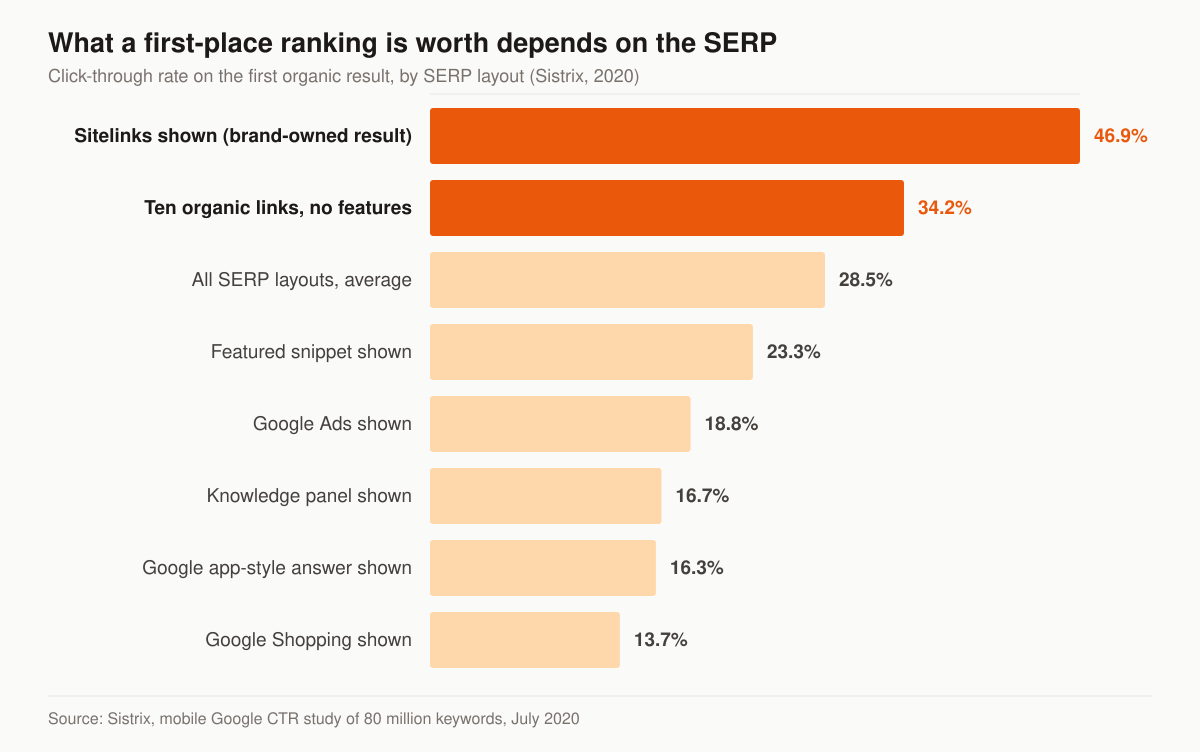
Intent sets the SERP layout, and the layout sets how many clicks first place can collect: 13.7% to 46.9% for the identical ranking. Source: Sistrix, mobile CTR study of 80 million keywords, July 2020.
Which layer of SEO deserves your budget first is a strategy question — that’s covered in our complete guide to SEO for insurance agents. The build sequence once you’ve picked targets is in how to rank an insurance agency website on Google.
Which insurance keywords are rising, and which are dying?
The 12-month trends in this pull tell one coherent story: generic “hire a marketer” searches are collapsing while lead-source and channel-specific searches grow.
Steepest declines (12-month trend, same July 2026 pull):
- annuity leads for agents: −94%
- crm software for insurance agents: −82%
- digital marketing for insurance agents: −77%
- marketing consultant insurance: −76%
- website design for insurance agents: −72%
- seo for insurance agents: −45%
Biggest risers:
- insurance lead generation companies: +177%
- home insurance leads for agents: +100%
- exclusive mortgage protection leads: +100%
- life insurance leads for agents: +88%
- final expense direct mail leads: +57%
The trend series does not identify why searches changed. It cannot separate seasonality, changed wording, sampling, business demand and adoption of AI tools. Treat migration to AI answers as a hypothesis requiring separate evidence. We cover that discipline in how to get cited by Perplexity and AI Overviews.
How to use this list
- Choose the buyer and real offer first. Separate consumer coverage, agency marketing, lead procurement and support.
- Map the existing owners. Keep distinct useful service, cost, comparison and informational tasks; reuse a suitable page before creating another.
- Validate the opportunity. Use the current market results, competitor evidence, actual coverage and realistic acquisition economics. A high CPC or low KD is not an investment case.
- Prepare one justified change. Specify the missing decision, evidence, exact page and useful contextual paths.
- Measure at the right stage. Release validation, Google exposure, relevant search performance and qualified outcomes are different milestones.
If you’d rather have operators run this data for you — targets picked for your line, pages built, rankings tracked against leads instead of vanity terms — that’s our insurance SEO program. Or start with a free marketing audit and we’ll map these keywords against what your site already ranks for.
- Insurance SEO Cost, Timeline, and the DIY-vs-Hire Decision
What insurance SEO costs in 2026, how long it takes to pay back, and whether to run it yourself or hire it out — with the four layers ranked by payback.
- How to Get More Google Reviews for Insurance Agents (Without Gaming It)
How to get more Google reviews for insurance agents: when to ask, the direct-link method, texting requests, responding to reviews, and staying compliant.
- How to Rank an Insurance Agency Website: The Insurance Agency SEO Guide
How to rank an insurance agency website on Google: a practitioner's SEO guide to technical setup, content, local signals, and the cadence that holds it.
- How to Get Cited by Perplexity and Google AI Overviews as a Local Business
How to get cited by Perplexity and Google AI Overviews as a local business: answer-first passages, structured data, consistent NAP, and third-party citations.