Who we serve
Veteran Insurance Marketing for Agents Serving Military Families
Veteran insurance marketing is how agents reach veterans and military families about final expense, life, and coverage that fills gaps left by SGLI, VGLI, and VA burial benefits. It leans on earned trust, plain-spoken creative, and channels that respect strict rules on solicitation and any implied government affiliation — a fit and tone generalist marketers rarely get right.
Free · 15-minute teardown · no pitch deck
- We run our own final-expense book
- No pitch deck — we screen-share real numbers
- TCPA-aware · CMS/AEP-compliant · Meta Special Ad Category
- Core Web Vitals < 2.0s LCP
Veterans get marketed to constantly. Plenty of it arrives wrapped in flags and slogans, and there is a quick test for whether the sender did any homework: check whether a single benefit claim in the piece is traceable to a VA page. Veteran insurance marketing done right is quieter than that: it educates, it respects a hard set of rules, and it earns trust from an audience that grants it slowly and revokes it instantly.
A boundary first, because we keep it clean: this side builds marketing systems you own. If you want to buy veteran or military-family leads as a finished product — exclusive, live-transfer, or aged — that runs through our sister brand, getinsureleads. Everything here is about the engine you keep.
Three things separate a veteran program that works from one that reads as decoration, and all three are checkable rather than stylistic. The benefit numbers are published by VA and can be quoted exactly. The solicitation rules are published by DoD and by the states, and they say what you may and may not put in front of someone in uniform. And the audience splits into cohorts whose ages differ by fifty years, which means one creative cannot address them. Each of those is below, with the primary source attached.
The audience: veterans, transitioning members, and their families
“Veteran market” is really three overlapping audiences, each at a different moment:
- Transitioning servicemembers leaving active duty, facing the SGLI-to-VGLI decision and a benefits landscape that just changed under them.
- Established veterans years past service, often thinking about final expense, legacy, and filling the gap the modest VA burial allowance leaves.
- Military families — spouses and adult children who frequently research, fill out the form, and sit in on the decision, exactly as they do in the broader senior market.
They share a temperament: skeptical of outsiders, loyal to people who have earned it, and unusually alert to anyone overstating a connection to service or to the government.
How big the veteran market is, and how it splits by era
The Census Bureau publishes the denominator every year, which is where a media plan should start rather than end. Its Veterans Day 2025 release reports 15.7 million military veterans in the United States in 2024, “representing 5.9% of the total civilian population age 18 and over.” It also counts 1.7 million female veterans, “representing 11.1% of the total veteran population” — a segment that shows up in almost no veteran-market creative.
Age is the number that should govern the plan. The same release records that 29.1% of veterans were 75 and older in 2024, and that 8.4% were under age 35. That is a market whose two ends are half a century apart, sold through the same three words in a headline.
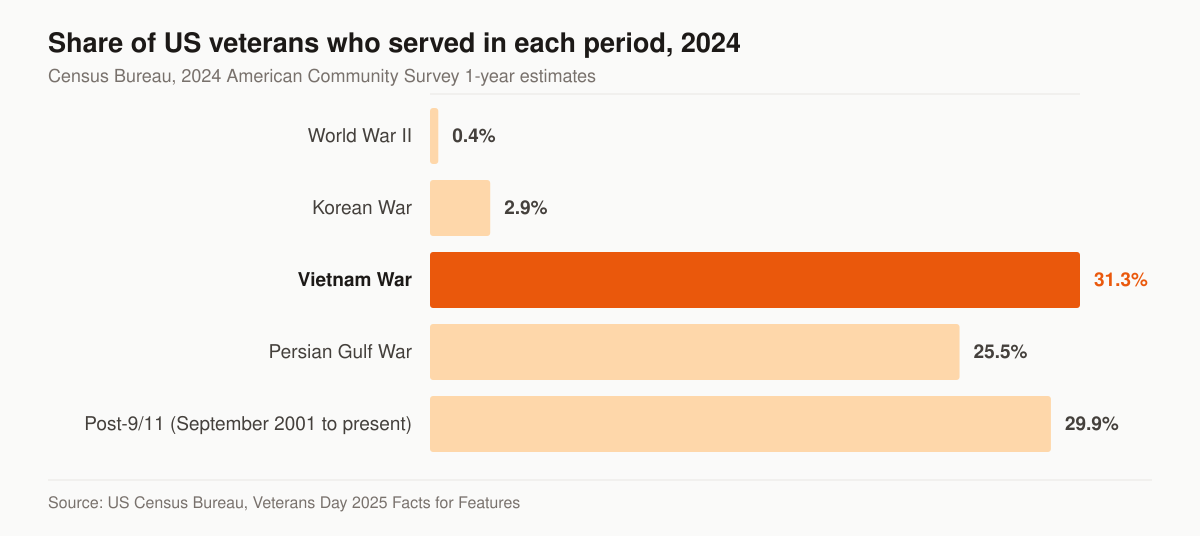
Source: US Census Bureau, Veterans Day 2025: November 11, reporting that 0.4% of veterans in 2024 served during World War II, “2.9% of veterans served during the Korean War; 31.3% during the Vietnam War; 25.5% during the Persian Gulf War; and 29.9% during the Post-9/11 period (September 2001 to present).” Shares are reported separately by period and are not presented here as mutually exclusive.
Read those bars as separate campaigns. The Vietnam-era cohort is the largest of the five shares Census lists, and it sits squarely in final-expense and senior-market territory, where the buying trigger is a funeral bill and an adult child on the call. The Post-9/11 cohort is close behind in share and nowhere near it in need: mortgages, young children, term face amounts in the hundreds of thousands, and a VGLI decision made in the last few years. Between them, the Persian Gulf cohort is mid-career, often carrying both a mortgage and ageing parents.
One creative set cannot carry that spread, and no targeting parameter fixes it either. What fixes it is running parallel messages and letting each reader self-select — the same discipline the final-expense marketing pillar applies to the senior end and mortgage protection agent marketing applies to the young-family end.
The SGLI/VGLI transition is the natural entry point
We treat the SGLI-to-VGLI decision as the entry point for a veteran program, because it is a moment where a real decision, a published deadline, and a legitimate advisory conversation coincide. While serving, members carry Servicemembers’ Group Life Insurance (SGLI). On separation, they can convert to Veterans’ Group Life Insurance (VGLI) within a limited window, and VGLI premiums climb steeply with age.
That creates a real advisory conversation: does VGLI still make sense, or does privately owned term or whole life serve the family better? Marketing that teaches the transition — the window, the trade-offs, the alternatives — rather than pitching a product wins the appointment.
Here is the clock, in VA’s own published terms, so your creative can quote it instead of paraphrasing it.
| What | What VA states | Where |
|---|---|---|
| SGLI maximum | “Coverage up to the top limit of $500,000—in $50,000 increments” | VA, SGLI |
| SGLI premium | “5 cents per $1,000 of insurance coverage,” plus “an additional $1 per month” for TSGLI | VA, SGLI |
| Free coverage after separation | “120 days of free coverage from the date you leave the military” | VA, SGLI |
| Convert SGLI to an individual policy | “within 120 days from your date of discharge without proof of good health,” and the policy “must be a permanent policy, such as a whole life policy” | VA, SGLI and VGLI |
| VGLI application deadline | “You’ll need to apply for VGLI within 1 year and 120 days of leaving the military.” | VA, VGLI |
| VGLI without health evidence | “If you sign up within 240 days of leaving the military, you won’t need to prove you’re in good health.” | VA, VGLI |
| VGLI coverage band | “You can get between $10,000 and $500,000 in term life insurance benefits,” capped at the SGLI amount held on separation | VA, VGLI |
| Increasing VGLI later | “increase your coverage by $25,000 1 year after getting VGLI and then every 5 years after that … up to a total of $500,000 until you’re 60 years old” | VA, VGLI |
Sources: VA, Servicemembers’ Group Life Insurance (SGLI) and VA, Veterans’ Group Life Insurance (VGLI).
Two of those rows are worth a second read, because they describe two different doors and collapse easily into one line of copy. The 120-day conversion route and the 240-day health-evidence-free VGLI route are different doors with different deadlines, and the conversion door leads only to a permanent policy — VA states plainly that you “can’t convert to other types of policies, like term, variable life, or universal life insurance.” A landing page that blurs those two windows into one “you have a year” line is not simplifying; it is wrong.
What VGLI costs at each age, and why the comparison is legitimate
The claim that “VGLI gets expensive” is true, and it is also the kind of claim a prospect discounts unless you show the ladder. VA publishes the whole rate table. Here is one column of it — the monthly premium for $400,000 of coverage — across the age bands.
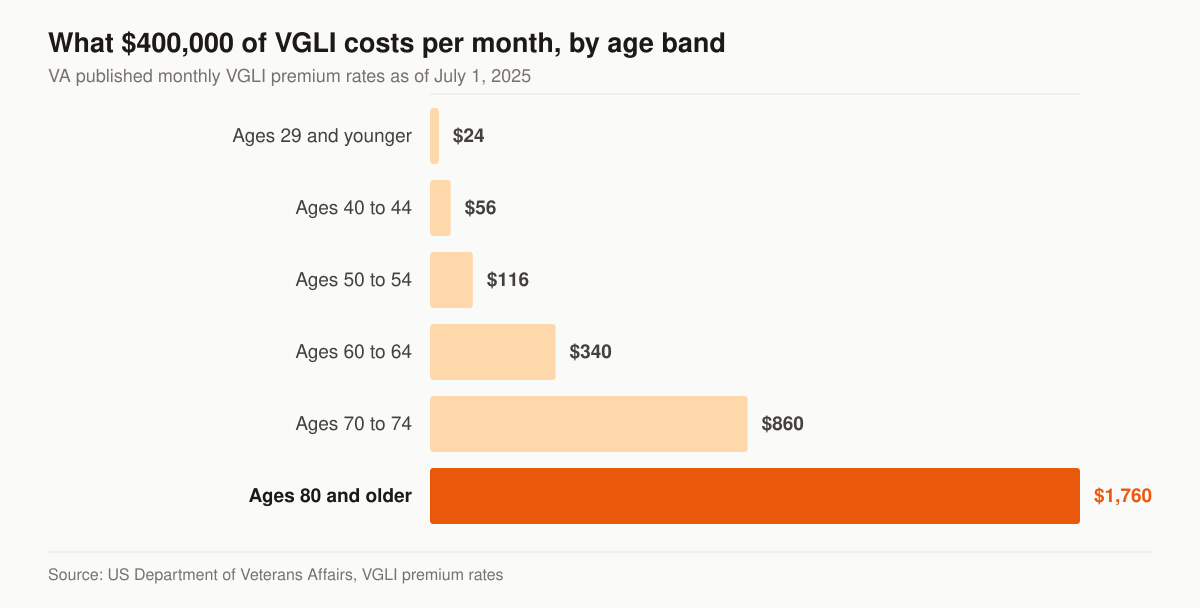
Source: VA, Veterans’ Group Life Insurance (VGLI), monthly premium rates “as of July 1, 2025.”
That is the entire advisory case, printed by the government, free to quote. A healthy member separating in their early thirties is looking at $32 a month for $400,000 of VGLI, and is not in a hurry. The same person at 60 is looking at $340 a month for the same face amount, and at that point a privately underwritten policy is worth quoting against it. Nothing about that comparison requires you to disparage VGLI, and a page that presents both honestly gives a reader a reason to keep reading that a sales page does not.
Two guardrails on how you say it. First, a comparison must be accurate about the program, not merely favourable to you: the NAIC model regulation discussed below declares it false, misleading, deceptive or unfair to make “any representation regarding the availability, suitability, amount, cost, exclusions or limitations to coverage provided to a service member or dependents by SGLI or VGLI, which is false, misleading or deceptive.” Second, timing. That same regulation names another practice: “Suggesting, recommending or encouraging a service member to cancel or terminate his or her SGLI policy or issuing a life insurance policy which replaces an existing SGLI policy unless the replacement shall take effect upon or after the service member’s separation from the United States Armed Forces.” Read the exception in that sentence rather than the prohibition: a replacement timed to take effect on or after separation is contemplated by the rule. A pitch to drop SGLI while still serving is not.
VALife changed the conversation for rated veterans
Anyone writing veteran final expense should know what VA now offers, because a rated veteran may already have it or qualify for it, and a pitch that ignores it looks uninformed the moment the prospect searches.
Veterans Affairs Life Insurance (VALife) provides, in VA’s words, “Up to $40,000 in whole life insurance coverage (in $10,000 increments),” plus “Cash value that starts to add up 2 years after we approve your application.” VA describes it as “guaranteed acceptance whole life insurance,” meaning that if you meet the eligibility requirements, “we’ll automatically approve your application. You won’t need to prove you’re in good health.” Eligibility for a veteran age 80 or younger is stated simply: “You’re eligible for VALife if you have a VA service-connected disability rating—even if your rating is 0%,” with no time limit to apply after getting the rating.
The catches are as published as the benefits, and they are the substance of an honest comparison. Full coverage “starts 2 years after you apply,” and premiums must be paid during that wait; a death inside the waiting period pays beneficiaries “the total amount you paid in premiums, plus interest,” at a rate VA lists as 4.23% for a death in 2026. VALife “doesn’t offer loans,” and it “doesn’t offer premium waivers.” Premium rates are fixed at issue age and, per VA, “will never increase as long as you keep your VALife policy.”
Set the two side by side rather than arguing against one of them.
| Question a rated veteran will ask | What VA publishes about VALife |
|---|---|
| How much can I get? | Up to $40,000, in $10,000 increments |
| Will I be turned down for health? | No — guaranteed acceptance if eligible; no proof of good health |
| When does the death benefit start? | Two years after you apply; premiums are payable during the wait |
| What if I die inside those two years? | Premiums paid, plus interest (4.23% for a death in 2026) |
| Can I borrow against it? | No; VALife does not offer loans |
| Can premiums be waived if I am disabled? | No; VALife does not offer premium waivers |
| Will my premium rise with age? | No; the rate is set at the age you apply |
Source: VA, Veterans Affairs Life Insurance (VALife).
The marketing implication is specific. A $40,000 ceiling, a two-year wait, no loans and no waiver is a real product with real edges, and a household that needs more face amount, immediate coverage, or living benefits has a gap that private final expense fills. Say that plainly and cite VA for every VALife detail you assert. Do not build creative that implies VALife does not exist, and do not build creative that implies you administer it — the affiliation rules below make that a live exposure, not a style note. Agents who write both simplified and guaranteed-issue product should read this alongside marketing simplified issue life insurance.
What the VA burial allowance actually pays
“The VA burial allowance is modest” is the load-bearing sentence in most veteran final-expense copy, and it is the one worth replacing with the number. VA publishes current amounts by date of death.
These are the published maximums, not estimates, and they are what a family will find when they check you.
| Situation | Maximum VA pays |
|---|---|
| Service-connected death, on or after September 11, 2001 | $2,000 |
| Non-service-connected death, on or after October 1, 2025 | “$1,002 burial allowance and $1,002 for a plot” |
| Non-service-connected death, October 1, 2024 to September 30, 2025 | “$978 burial allowance and $978 for a plot” |
| Headstone or marker allowance, death on or after October 1, 2025 | $441 |
Source: VA, Veterans burial allowance and transportation benefits.
Three details belong in the copy alongside the number. The allowance is a reimbursement to whoever paid, not a pre-funded benefit, and VA lists the eligible payers as the surviving spouse, surviving partner from a legal union, surviving child, parent, executor, a family member or friend, or a funeral-home representative. For a non-service-connected death there is a filing deadline — a claim must generally be filed “within 2 years after the Veteran’s burial,” subject to stated exceptions. And VA states that it does not provide burial allowances where the individual died on active duty, while serving as a member of Congress, or while serving a federal prison sentence.
Put those four rows on the page and you have done something a competitor’s flag-and-slogan mailer has not: given the family a number they can act on. That is the same info-gain logic we apply across insurance content marketing — the page that answers the arithmetic gets the citation, the link, and the call.
Compliance is the moat: affiliation and solicitation
Two rules define what you can and cannot do, and treating them as a discipline is what separates agencies veterans trust from the ones they report.
Read the right column as build instructions for the campaign, not as a legal footnote to it.
| Constraint | What it means for marketing |
|---|---|
| No implied government affiliation | No VA/DoD seals, insignia, or language implying a government program or endorsement. Coverage sold here is private, and creative must say so plainly. |
| Installation solicitation rules | DoD rules tightly restrict commercial solicitation on military installations; on-base pitching is fenced in by permission, appointment and location rules, and off-base outreach has guardrails. |
| TCPA consent | Every call and text needs clear, provable, stored consent captured at the point of lead — same discipline as any senior-market program. |
| No “stolen valor” overreach | Claiming or implying service, endorsements, or affiliations you do not have destroys credibility and invites complaints. |
What DoD Instruction 1344.07 prohibits on an installation
The installation rules are not folklore. They are written down in DoD Instruction 1344.07, Personal Commercial Solicitation on DoD Installations, dated March 30, 2006 and listed on the Department’s issuances index with no change memo against it. Read the scope first: the instruction governs conduct on DoD installations, so it is not a general advertising code, and it does not reach a page on your own website read by a veteran in their kitchen. Inside that scope it is specific.
The permission structure comes first. The instruction states that personal commercial solicitation “may be permitted only if” the solicitor is duly licensed and has complied with installation regulations, and “A specific appointment has been made for each meeting with the individual concerned.” For insurance in particular, “The conduct of all insurance business on DoD installations shall be by specific appointment,” and “When establishing the appointment, insurance agents shall identify themselves to the prospective purchaser as an agent for a specific insurer.”
Then comes the prohibited-practices list. These are the ones that touch marketing rather than the sales call itself.
| Paragraph | What is prohibited on DoD installations |
|---|---|
| 6.4.1 | “Solicitation of recruits, trainees, and transient personnel in a group setting or ‘mass’ audience and solicitation of any DoD personnel in a ‘captive’ audience where attendance is not voluntary.” |
| 6.4.2 | “Making appointments with or soliciting military or DoD civilian personnel during their normally scheduled duty hours.” |
| 6.4.5 | “Procuring, attempting to procure, supplying, or attempting to supply non-public listings of DoD personnel for purposes of commercial solicitation,” except for releases made under the referenced DoD directive |
| 6.4.9 | “Using oral or written representations to suggest or give the appearance that the Department of Defense sponsors or endorses any particular company, its agents, or the goods, services, and commodities it sells.” |
| 6.4.13 | “Soliciting door to door or without an appointment.” |
| 6.4.15 | “Contacting DoD personnel by calling a government telephone, faxing to a government fax machine, or by sending e-mail to a government computer, unless a pre-existing relationship (i.e., the DoD member is a current client or requested to be contacted) exists between the parties and the DoD member has not asked for contact to be terminated.” |
Source: DoD Instruction 1344.07, Personal Commercial Solicitation on DoD Installations.
Paragraph 6.4.5 is the one that should change how you buy data. A list of names sourced from inside an installation is not a data problem to be negotiated with a vendor; procuring it is named conduct. Paragraph 6.4.15 is the one that should change how you build a CRM: a work email address ending in .mil is not a marketable field, and the exception is written narrowly around a pre-existing relationship that has not been terminated.
The instruction also bars titles that imply endorsement — it names “Battalion Insurance Counselor,” “Unit Insurance Advisor,” “Servicemen’s Group Life Insurance Conversion Consultant” as examples — and it prohibits using “an installation ‘daily bulletin,’ marquee, newsletter, webpage, or other official notice to announce the presence of an agent and/or his or her availability.” Any title, badge or bio line on your site that borrows a unit or a program is squarely in that family of problems.
The rules that bind a sale to an active-duty service member
The state-level counterpart is the NAIC Military Sales Practices Model Regulation (#568), adopted July 2007. Its stated purpose is “to set forth standards to protect active duty service members of the United States Armed Forces from dishonest and predatory insurance sales practices by declaring certain identified practices to be false, misleading, deceptive or unfair.”
Scope is the whole ball game here, and it is stated in one sentence: “This regulation shall apply only to the solicitation or sale of any life insurance or annuity product by an insurer or insurance producer to an active duty service member of the United States Armed Forces.” A separated veteran is not an active duty service member. So a final-expense campaign aimed at a 72-year-old Vietnam-era veteran is outside the model’s scope, while a transition campaign aimed at someone still in uniform is inside it. It is also a model regulation, which binds only where a state has adopted it — Missouri adopted it as 20 CSR 400-5.310, filed November 9, 2007 and effective June 30, 2008.
Two more definitions carry weight and are routinely dropped in summaries. “Active Duty” as defined excludes reserve-component members performing duty “under military calls or orders specifying periods of less than 31 calendar days.” And the knowledge standard is not actual knowledge alone: “Known” or “Knowingly” means the producer or insurer “had actual awareness, or in the exercise of ordinary care should have known,” that the person solicited is a service member, or a service member at pay grade E-4 or below. A campaign built to target service members cannot later argue it did not know who answered.
The provisions that reach marketing rather than the closing conversation are the affiliation ones. Section 7.B(1) declares it false, misleading, deceptive or unfair to make “any representation, or using any device, title, descriptive name or identifier that has the tendency or capacity to confuse or mislead a service member into believing that the insurer, insurance producer or product offered is affiliated, connected or associated with, endorsed, sponsored, sanctioned or recommended by the U.S. Government, the United States Armed Forces, or any state or federal agency or government entity.” Its list of prohibited titles adds one the DoD instruction does not: “Veteran’s Benefits Counselor.”
Section 7.B(2) extends the same logic to partnerships, prohibiting solicitation “through the use of or in conjunction with any third party organization that promotes the welfare of or assists members of the United States Armed Forces in a manner that has the tendency or capacity to confuse or mislead a service member” into believing there is government or Armed Forces endorsement. Veteran service organization co-marketing is a genuine channel and this does not close it — but the piece has to make clear who is selling and who is not endorsing.
Source: NAIC, Military Sales Practices Model Regulation (#568) and Missouri 20 CSR 400-5.310, Deceptive or Unfair Military Sales Practices.
What a lead piece aimed at service members has to say on its face
The disclosure rules are where the regulation and the creative brief touch directly. Missouri’s adopted version of the model regulation lists, among the omissions that constitute a deceptive sales practice, this one: “Deploying, using or contracting for any lead generating materials designed exclusively for use with service members that do not clearly and conspicuously disclose that the recipient will be contacted by an insurance producer, if that is the case, for the purpose of soliciting the purchase of life insurance.”
Read the conditional in the middle of that sentence — “if that is the case” — and read “designed exclusively for use with service members.” Both are scope limiters. A general-audience lead magnet is not the target; a piece built solely for service members that quietly harvests a phone number is. The same subsection also names “Failing to disclose that a solicitation for the sale of life insurance will be made when establishing a specific appointment for an in-person, face-to-face meeting with a prospective purchaser,” and, separately — “Excluding individually issued annuities” — “failing to clearly and conspicuously disclose the fact that the product being sold is life insurance.”
That converts into four build items we hand a designer, none of which cost conversion when done well:
- A disclosure line above the fold of the form, in the same type size as the field labels, stating that a licensed insurance agent will contact the person and that the subject is life insurance.
- A booking confirmation that repeats it — the appointment-setting step is its own named disclosure moment, not a repeat of the first.
- No borrowed authority anywhere in the asset: no seals, no unit names, no title that reads as an official role, no implication that a VSO partner endorses the product.
- A consent record you can produce later, with the language, timestamp and source page stored against the lead, which is the same standard our insurance landing pages and email automation builds hold for every line of business.
Our wider treatment of consent capture, disclosures and record-keeping is in insurance marketing compliance for agents. Have your own compliance counsel sign off on the exact wording; nothing on this page is legal advice.
Products that fit real gaps
The strongest veteran creative frames each product against a gap the family can already see:
- Final expense — fills the space the modest VA burial allowance leaves. Our final-expense marketing pillar is the deepest playbook on the site.
- Life insurance — privately owned term or whole life that stays with the family regardless of future benefit changes, and a natural comparison against aging VGLI premiums. See life insurance marketing.
- Mortgage protection — for younger veteran households with a new home and a family to shield, covered in mortgage protection agent marketing.
Route each prospect to the product they actually qualify for and need. Steering a veteran into the wrong policy to close is both a trust problem and a compliance one.
Veterans, VA health care and Medicare
If you also write Medicare, the veteran file you already own is a second line of business, and the reason is a rule that is easy to hear backwards. VA’s own guidance answers the question directly. Asked whether a veteran with VA health care should still sign up for Medicare at 65, VA answers: “Yes. We encourage you to sign up for Medicare as soon as you can.”
The reasons VA gives are the substance of a genuinely useful piece of content. Having Medicare “means you’re covered if you need to go to a non-VA hospital or doctor—so you have more options to choose from.” On the penalty: “If you delay signing up for Medicare Part B (coverage for doctors and outpatient services) and then need to sign up later because you lose your VA health care benefits or need more choice in care options, you’ll pay a penalty. This penalty gets bigger each year you delay signing up—and you’ll pay it every year for the rest of your life.” On drugs, VA states there is “no penalty for delaying Medicare Part D as long as you enroll when you’re first eligible or within 63 days of when you no longer have VA health care or other creditable prescription drug coverage.”
Two more lines from the same page shape the family conversation. VA notes that “We don’t normally provide care for Veterans’ family members,” which is why a spouse’s coverage is a separate question from the veteran’s. And on eligibility anxiety: “Whether or not you have health insurance coverage doesn’t affect the VA health care benefits you can get.”
Source: VA, VA health care and other insurance.
Written as an article, that is a page a 64-year-old veteran and their adult child will read to the end, and it hands you an enrollment conversation without a single pushy line. It also has to run under the annual enrollment marketing rules that govern all Medicare communications, which is a separate and heavier rulebook — see the Medicare marketing pillar before you write a word of it.
Trust and messaging: earned, not decorated
The military community can spot a marketer hiding behind patriotic decoration in seconds. What builds trust is the opposite of a slogan: plain language, transparency about what is private coverage versus a government benefit, real credentials, and content an adult child can vet quickly. A veteran-owned or genuinely veteran-serving voice carries weight that no stock photo of a flag ever will. This is also where authority signals matter for search and AI answers — real explanations that an engine will cite over a competitor’s thin page.
There is a practical test for this that costs nothing. Take any sentence in your creative that mentions VA, SGLI, VGLI or a burial benefit, and ask whether you can point to the VA page it came from. If you can, the sentence stays and the citation goes next to it. If you cannot, it comes out. That single rule strips out the material that gets veteran-market advertisers into trouble, and it happens to be the same rule that makes a page quotable by an AI assistant.
Channels that respect the audience
Owned search and AI visibility do the compounding work: when a veteran or their family searches or asks an AI assistant about VGLI alternatives or final expense, our insurance SEO and AI-search / GEO work makes you the answer. On top of that, permission-based response — compliant social campaigns and conversion-focused landing pages with consent capture built in — turns intent into appointments. Community presence through veteran service organizations and off-base events builds the referral trust that paid channels cannot manufacture.
Two channel notes specific to this audience. First, geography: if you have an office and a service radius, local search reaches the households nearest it at a cost a national competitor cannot match — which is what local SEO for insurance agents is built to capture. Second, reviews: an audience this alert to authenticity reads them closely, and a thin or stale review profile undercuts an otherwise careful page, which is why we treat reputation management as part of the trust build rather than an add-on.
How we sequence a veteran-market program
Order matters here more than in a general campaign, because the compliance work gates the creative work rather than following it.
- Weeks 1–2: the source file. Every benefit claim you intend to make, written down next to the VA page it comes from. This becomes the fact base every future page and ad draws on, and it is the artifact that makes the rest fast.
- Weeks 2–4: the compliance envelope. Your counsel’s read on which state rules apply, which audiences you will and will not target, and the exact disclosure wording for forms and appointment confirmations.
- Weeks 3–6: the pages that answer the questions. VGLI versus private coverage, what the burial allowance pays, VALife alongside private final expense, Medicare at 65 with VA health care. Each with the number, the source, and one clear next step.
- Weeks 5–8: the response system. Landing pages, consent capture, routing and the follow-up cadence — the sequence itself is documented in our insurance lead follow-up cadence playbook.
- Weeks 8–12: demand. Search and AI visibility first because they compound, then paid response once the pages convert, run through insurance lead generation.
We do not invert this order. Buying traffic before the pages and the disclosures exist means paying to send readers to a page you are about to rewrite.
What a veteran-market marketing program costs
We publish our rates rather than quoting per prospect, and the veteran niche runs on the same three tiers as every other line.
Pick the tier at your weakest link, not at your ambition.
| Tier | Monthly | Built for |
|---|---|---|
| Foundation | $2,500 | Solo agents getting online right — site or landing pages, local SEO and Google Business Profile, on-page SEO, monthly reporting |
| Growth | $3,500 | Agents and small agencies scaling — everything in Foundation, plus an ongoing SEO and content engine, AI-search visibility, reputation and reviews |
| Full-Funnel | $5,500 | Agencies serious about volume — everything in Growth, plus managed Google and Meta ads, landing-page CRO, and marketing automation |
A one-time website or landing-page build runs $2,500–$8,000, and it is the entry point we recommend when the site itself has to be rebuilt before anything can rank. Ad spend is a pass-through paid straight to the platforms and is never marked up by us. The full breakdown, including what is not included and what happens to your assets if you cancel, is on the pricing page.
For a veteran program specifically, the content work in Growth is what carries it: the fact base, the benefit-comparison pages, and the AI-search visibility that puts you in front of a family researching VGLI at 11pm. Foundation is the right start only if you do not yet have a site worth ranking. How to think about the whole number as a share of revenue is worked through in our insurance agency marketing budget breakdown.
The differentiator no generalist can copy
Marketing to veterans well is a senior-market skill with an extra compliance envelope and a much higher trust bar. We run a live senior-market lead operation every day, so the consent discipline, speed-to-lead systems, and trust-first creative we install are tested rather than theorized — and we know where the affiliation and solicitation lines are. For the bigger picture, see the senior market marketing pillar and the lead generation service that powers demand across every line.
Want your veteran-market program mapped against how we actually run ours? Start with a free marketing audit — we will look at your channels, your compliance posture, and where your book leaks — or get in touch to model the economics together.
The services behind it