Who we serve
Final Expense Marketing for Agents Who Want a Real Engine
Final-expense marketing for agents is the full system that turns senior prospects into issued burial-insurance policies: a fast website, compliant Facebook and Google campaigns, exclusive and live-transfer leads, local and AI-search visibility, and tracked speed-to-lead follow-up. It differs from generic insurance marketing in its senior audience, lead economics, and compliance constraints.
Free · 15-minute teardown · no pitch deck
- We run our own final-expense book
- No pitch deck — we screen-share real numbers
- TCPA-aware · CMS/AEP-compliant · Meta Special Ad Category
- Core Web Vitals < 2.0s LCP
Updated July 2026 — refreshed with current NFDA funeral-cost data, the 2026 channel mix, and four free mailer templates.
Final expense is a relationship-and-speed business. The prospect is a senior researching a small whole-life policy to cover burial costs; the agent who reaches them first, with the right message, on a compliant path, usually writes the policy. Marketing is what makes that introduction happen at scale — and most of it is done badly.
The demand is documented, not assumed: LIMRA’s April 2026 commentary on the 2026 Insurance Barometer Study notes that “a majority of people look to life insurance to cover burial and final expenses” — the exact job this product exists for — and reports US life insurers set sales records in four of the past five years.
We run a live final-expense lead operation. This program packages that operation for your agency. Final expense is also the anchor of our broader senior-market insurance marketing practice — the same audience, compliance posture, and speed-to-lead discipline carry across burial, Medicare, and life.
What is final expense marketing?
Final expense marketing for agents is the system that turns senior prospects into issued burial-insurance policies: a conversion-built website, compliant Facebook and Google campaigns, exclusive or live-transfer leads, local and AI-search visibility, and a tracked speed-to-lead follow-up cadence. What makes it its own discipline is the senior audience, the lead economics, and the TCPA constraints.
The product underneath is small-face whole life, sized to a bill the family will actually receive. The National Funeral Directors Association puts the national median cost of a funeral with viewing and burial at $8,300 in 2023, and a funeral with cremation at $6,280 — with the cremation rate projected at 63.4% for 2025. Those two numbers are the message. Final-expense marketing converts when the offer is framed as covering a specific, documented expense the family would otherwise absorb, not as an investment or a “government benefit.” Everything below — channels, mailers, dialer workflow, consent — is downstream of getting that framing right.
What final expense leads cost, and which number to judge them on
Lead price is the first question every agent asks and the least useful one. A shared lead and a live transfer can carry the same cost per issued policy at wildly different sticker prices, so the unit that decides your budget is cost per sale, not cost per lead.
Illustrative worked example — not agency results. Your prices and close rates will differ:
| Lead type | Cost per lead | Close rate | Cost per sale |
|---|---|---|---|
| Aged FE lead | $1.50 | 1-in-25 | $37.50 |
| Shared FE lead | $9 | 1-in-10 | $90 |
| Exclusive FE lead | $28 | one-in-six | $168 |
| Live transfer | $45 | 1-in-4 | $180 |
Read down the last column, not the second. The cheapest lead has the lowest cost per sale on paper and the highest demand on your dialer; the most expensive lead buys conversations instead of dials. Which row fits you is a function of how many calls you can actually make in a week. The insurance agency marketing budget works the same math against commission, month by month, and exclusive final expense leads covers how exclusivity changes the close rate in column three.
The four parts of a working final-expense engine
- The asset — a fast, conversion-built final-expense agent website and landing pages that rank and convert.
- The demand — compliant final-expense Facebook ads and Google campaigns, plus exclusive and live-transfer leads. When you want that paid layer run for you, our final-expense PPC management handles the ad accounts end to end.
- The visibility — final-expense SEO and AI-search presence, structured with schema markup so answer engines can quote you when seniors and their families search.
- The follow-through — a tracked follow-up cadence so no lead dies in a spreadsheet.
What separates winners from churn
| Lever | Losing approach | Winning approach |
|---|---|---|
| Leads | Shared lists, raced by 10 agents | Exclusive / live-transfer, owned by you |
| Speed-to-lead | Called hours later | Contacted in minutes |
| Reporting | Impressions and clicks | Cost per issued policy |
| Assets | Rented funnel | Owned site, pixel, and CRM |
| Compliance | Hope | Consent captured and recorded |
10 final expense marketing ideas that still work in 2026
Final expense marketing ideas age badly — the list below is the set that still produces issued policies now, ordered roughly from fastest-to-start to slowest-to-compound:
- Filtered direct mail with a reply card. Age- and income-filtered list, plain benefit copy, a card that captures phone number and consent.
- Live transfers. A call center qualifies the senior and warm-transfers a prospect who is already expecting to talk.
- Facebook lead-form ads with senior-appropriate creative. Large type, plain language, a family-first offer — called back in minutes, not hours.
- SEO pages that answer buyer questions. Cost, qualifying with health conditions, how the payout reaches the beneficiary.
- Google Business Profile plus a review habit. The map pack is where “burial insurance near me” lands, and reviews are the tiebreak.
- Educational webinars. A 20-minute “what burial insurance actually covers” session, recorded once and re-run monthly.
- Senior expos and community events. Table at the local health fair, library, or church event where the audience is already the age band.
- Funeral-home and estate-planner partnerships. Referral relationships with the people already having the conversation.
- A systematic referral and review request after every issued policy. The cheapest lead you will ever write.
- Cross-selling final expense into an existing Medicare or Med Supp book. Same client, same age band, coverage nobody asked them about.
Need creative for the top of that list rather than channels? The 40-idea final expense content swipe file covers what to post, film, and mail.
Final expense marketing strategy: the five channels that write policies
A final expense marketing strategy is a channel-mix decision before it is a creative decision. Nearly every issued FE policy traces back to one of five channels, each buying something different. Pick the mix your dial capacity can actually work.
Direct mail
The legacy workhorse: an age- and income-filtered list, a plain benefit-style piece, a reply card back. Slow and paid per piece, but respondents skew older and higher-intent. The mailer-template anatomy below shows what a compliant piece includes.
Telemarketing and live transfers
Most final expense is now sold by phone. Either your team dials fresh leads on a script, or a call center qualifies prospects and warm-transfers them to you. The dialer workflow section below covers the mechanics; our telesales script and lead breakdown covers what to say once someone picks up.
Facebook and digital ads
Volume and speed at a lower cost per raw lead, with softer intent that dies in hours if nobody calls. Whether paid search belongs in that mix at all is its own math — see is final-expense PPC worth it — and the digital marketing playbook for FE agents covers the full stack.
SEO, local search, and AI answers
The compounding channel: ranking pages, a maintained Google Business Profile, and structured content that answer engines can quote. It starts slow and gets cheaper every month. Local SEO for agents and AI-search visibility are the two halves.
Referrals and partnerships
The cheapest policies you will ever write come from past clients, funeral homes, senior centers, and estate planners. A simple review-request habit after every issued policy plus two or three local partnerships beats most ad budgets per dollar — reputation management systematizes the review half.
Cross-selling, seminars, and senior expos
Cross-selling is the referral channel’s quiet cousin, and it is a lead source you may already own. An existing Medicare or Med Supp book is the same age band, already trusts you, and may never have been asked about burial coverage — so the “lead” costs a phone call. Keep the lines cleanly separated: a Medicare appointment stays inside its scope of appointment, and the final-expense conversation is booked as its own call.
Seminars and webinars do the same job for strangers. A 20-minute session on what burial insurance actually covers pre-sells the product to a room (or a Zoom) instead of one prospect at a time, and the recording keeps working. Senior expos, health fairs, library talks, and church events put you in front of the age band without buying a list.
Funeral-home partnerships are the most under-worked of the three: the NFDA counts 15,401 funeral homes operating in the United States, roughly 75% of them family- or privately owned — local businesses that talk to your exact buyer, every week, and are not selling insurance themselves.
Whatever the mix, every channel feeds the same funnel:
- Attention — the mailer, ad, ranking page, or referral puts the offer in front of a senior or their adult child.
- Capture and consent — a form or reply card records contact information and provable permission to call.
- Speed-to-lead — first dial within minutes, not hours.
- Cadence — a written call-and-text schedule works everyone who didn’t answer.
- Application — taken live on the call or at the table.
- Reporting — every channel judged on cost per issued policy.
The final-expense sales funnel guide walks that path stage by stage.
Direct mail vs. Facebook: two different senior-lead economies
Final-expense demand comes from two very different machines, and picking the wrong one for your operation is an expensive mistake.
Direct mail is the legacy channel. You mail a plain, benefit-style piece to an age- and income-filtered list, and the senior mails back a reply card or calls in. Respondents tend to be older, higher-intent, and comfortable on the phone — but each piece costs money whether or not it converts, volume is slow to scale, and you are buying access to a list other agents can also rent. Mail rewards patience and a disciplined dialer.
Facebook and other digital/social flip the economics. Creative puts a simple offer — “cover your funeral so your family doesn’t have to” — in front of seniors in-feed, and the interested ones fill out a form. You get more volume, faster, and usually a lower cost per raw lead. But intent is softer, the same person may have tapped three agents’ ads, and a lead that isn’t called within minutes goes cold. Digital rewards speed and follow-up, not patience.
Neither channel is simply “better.” Direct mail buys intent; Facebook buys volume. The right answer is almost always a blend sized to how fast you actually dial — which is the whole point of the lead-mix section below. The digital half keeps getting easier to buy through, and that shift is industry-wide: “the industry efforts to make the buying process easier and accessibility through technology has definitely had a positive impact,” as Steve Wood, research director at LIMRA Markets Research, put it in April 2026.
Final expense mailer templates: what a compliant mailer includes
Most “final expense mailer templates” traded in agent groups are just headlines. If you want ready-to-edit pieces rather than theory, download our four free final expense mailer templates — editable HTML and print-ready PDFs. A piece that survives carrier compliance review and still pulls replies has four working parts:
The headline. The patterns that pull are plain benefit statements aimed at the reader’s family, not the product: “Help cover your final expenses so your family doesn’t have to,” or “New burial-benefit information for [County] residents age 50–80.” The patterns that get mailers rejected are the ones that imply a government program, an existing benefit waiting to be claimed, or official urgency. If a headline needs an eagle seal to work, it doesn’t work.
The body. Short. Name the age band, frame the product honestly as small whole-life coverage for burial costs, and give one reason to reply now. No premium quotes on paper — rates depend on age and health, and a printed number you can’t honor burns the lead.
The reply card. This is the lead itself, so every field earns its place: name, mailing address, date of birth or age band, phone number, and a signature or checkbox that clearly consents to contact by phone. A card that comes back without a phone number or consent line produces a lead you can barely work legally.
The disclaimers. A compliant piece identifies itself as an insurance solicitation, names the agent or agency behind it, and avoids any implication of affiliation with a government agency or benefit program. Exact required wording varies by state and carrier, so the template gets carrier and compliance-counsel sign-off before it prints — the same posture as the TCPA section below. We provide marketing, not legal advice.
Guaranteed issue vs. simplified issue: know what you’re actually selling
Final expense is small-face whole life, but the underwriting path changes both the pitch and the marketing.
- Simplified issue asks a short list of health questions and checks prescription and MIB data, with no medical exam. A reasonably healthy senior qualifies for a lower rate and, commonly, a first-day (immediate) death benefit. This is the bulk of the market and the easiest to convert, because the applicant is fully covered right away.
- Guaranteed issue (GI) asks no health questions and accepts everyone in the age band. In exchange it carries a graded death benefit — typically a two-to-three-year waiting period during which a non-accidental death returns premiums paid plus interest rather than the full face amount — and a higher price. GI exists for the applicant who can’t pass simplified-issue questions.
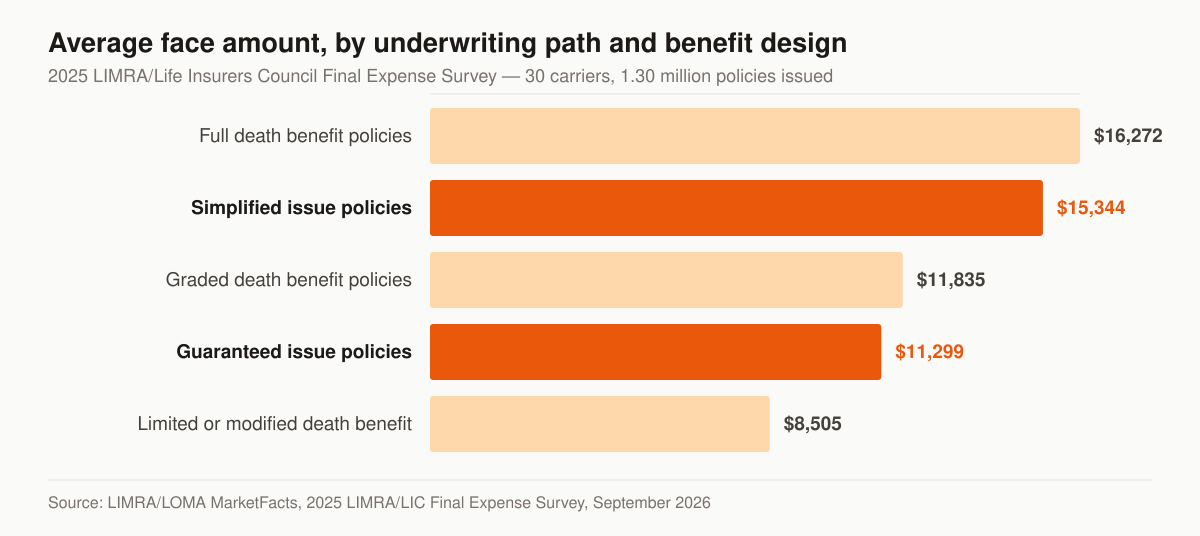
The 30 carriers in the 2025 LIMRA/Life Insurers Council Final Expense Survey reported an average face amount of $15,344 on simplified-issue policies against $11,299 on guaranteed-issue business, and $8,505 where the design was a limited or modified death benefit — a face amount that lands near the $8,300 median casketed funeral cited above.
Your marketing has to route each prospect to the right product honestly. Steering a healthy 62-year-old into a GI plan overcharges them; promising a first-day benefit to someone who only qualifies for GI is a compliance and trust problem. Our burial-insurance marketing page goes deeper on positioning GI and simplified-issue offers without overpromising.
The live-transfer and telesales dialer workflow
Most final expense today is sold over the phone, not at the kitchen table, which makes the dialer workflow the engine room.
A live transfer is a lead a call center has already contacted, qualified, and warm-transferred to you, so you pick up a prospect who is expecting to talk. It costs the most per contact and the least per sale for closers who can work a live conversation. A telesales flow, by contrast, has you or your team dialing fresh form-fill and mail-reply leads directly, controlling the script and the pace.
Either way the mechanics rhyme: a dialer or CRM stages the day’s leads, the agent works a script that qualifies age, health, and beneficiary in the first minutes, quotes a monthly premium tied to a specific product, and either takes the application on the call or books a firm callback. The system’s job is to keep the agent talking to consented prospects and out of the spreadsheet.
TCPA and consent when the prospect is a senior
Every dial and text in final expense lives under the TCPA, and the senior audience raises the stakes because regulators watch this demographic closely. The rule of practice is simple: capture and store clear, provable consent to be contacted at the point of lead capture — on the form, in the reply path, on the transfer — and honor do-not-call and revocation requests. The FCC’s one-to-one consent rule was vacated in January 2025, but TCPA exposure itself is unchanged, so we build consent capture into every form and landing page and keep the records. We provide marketing services, not legal advice — your compliance counsel signs off on your scripts and disclosures.
Speed-to-lead and a fixed follow-up cadence
Two levers decide whether a lead becomes a policy, and both are about time.
Speed-to-lead is how fast you make first contact. A Facebook lead answered in minutes converts far better than the same lead answered hours later; the interest is perishable. The fix is routing that puts a new lead on a phone immediately, not at the end of the day.
A fixed follow-up cadence is what catches everyone you don’t reach on the first attempt — which is most of them. Instead of dialing twice and quitting, you run a written, repeatable schedule of calls and texts across the first days and weeks, varying the time of day, until the prospect answers, buys, or opts out. Our follow-up cadence guide lays out a workable rhythm. The agents who lose money almost always have leads, not a cadence.
A final-expense agent’s day
The engine only pays if the daily workflow is boring and repeatable. A productive day tends to look like this: block dialing hours when seniors actually answer (mid-morning and early evening work well), hit fresh leads first for speed-to-lead, then layer the follow-up cadence onto older leads, take applications live wherever possible, and log every outcome so tomorrow’s list starts clean. Money leaks when an agent free-styles — dialing sporadically, skipping the cadence, or letting yesterday’s un-worked leads pile up until they’ve gone cold.
What are the best final expense leads for agents?
The best final expense leads for agents are the ones your dial capacity can actually work. Direct mail buys intent, Facebook buys volume, live transfers buy conversations, and aged leads buy cheap filler. Match the source to your hours, budget, and closing style — then judge every one of them on cost per issued policy.
That makes lead selection an operations decision, not a shopping decision:
- Tight follow-up, limited hours — lean on exclusive and direct-mail leads you can work thoroughly, rather than high volume you’ll let rot.
- A closer who wants to talk, not dial — weight toward live transfers so every contact is a live conversation.
- A team with dialer capacity and budget — blend higher-volume Facebook leads with a disciplined cadence to keep the room busy.
- Filler between fresh drops — aged leads at low cost, worked lightly.
The honest test for any mix is cost per issued policy, not cost per lead — a cheap lead that never closes is the expensive one.
Final-expense lead channels at a glance
Each channel buys a different thing. Reading them side by side shows why we build a blend rather than bet on one source.
| Channel | What you’re actually buying | Intent | Cost profile | Speed-to-contact needed | Best fit |
|---|---|---|---|---|---|
| Direct mail | Older, higher-intent respondents who reply by card or call-in | High — they raised a hand on paper | Pay per piece regardless of response; slow to scale | Same day; the reply already committed | Patient agents with a disciplined dialer |
| Facebook / social | Volume of form-fill leads with softer, perishable intent | Low to moderate — curiosity, not commitment | Lower cost per raw lead; dies fast if not called in minutes | Minutes | Fast-dialing teams with tight speed-to-lead |
| Live transfers | A pre-qualified prospect warm-transferred, expecting your call | Highest — they are on the line now | Highest per contact, lowest per sale for real closers | Immediate, by definition | Closers who want conversations, not dialing |
| Aged leads | Previously-worked leads at low cost and low contact rate | Low and unknown; already worked by others | Low per-lead cost; worked lightly as filler | None — speed is no longer the lever | Filling gaps between fresh drops |
| Telemarketed / vendor | Call-center-generated, consent-captured qualified leads | Moderate; varies with the qualifying script | Mid-range; quality varies by vendor | Hours, while the call is remembered | Scaling volume without building your own room |
None of these is “the best lead.” Direct mail buys intent, Facebook buys volume, live transfers buy conversations — and the right mix is the one your dial capacity can actually work, tested against cost per issued policy.
How much does final expense marketing cost?
Final expense marketing cost has no flat number, because the honest unit is cost per issued policy, not cost per lead. Three inputs set the budget: your channel mix, your dial capacity, and your target acquisition cost — the most you can pay for a policy and still keep the commission math working.
Anyone quoting a single figure is selling something. A cheap lead that never closes is the most expensive thing you can buy, which is why the three inputs are set in this order:
- Channel mix. Direct mail costs more per response and less per wasted dial; Facebook is the reverse; live transfers cost the most per contact and often the least per sale for a real closer.
- Dial capacity. Budget that outruns your ability to call leads within minutes just buys leads that rot in a spreadsheet.
- Target acquisition cost. Work backward from commission per issued policy to what you can afford to pay to acquire one, then fund channels only while the math holds.
The marketing budget by percent of revenue walks that math line by line.
What running your final-expense marketing includes
When we run the engine rather than hand you tactics, a working program covers the whole path from stranger to issued policy:
- A conversion-built asset — a fast final-expense agent website and landing pages built to capture, not just to look nice.
- Compliant demand — Facebook and Google campaigns with senior-appropriate creative, plus sourced exclusive and live-transfer leads.
- Routing and speed-to-lead — new leads pushed to a phone in minutes through your dialer or CRM, not queued for end of day.
- Visibility that compounds — final-expense SEO and AI-search presence with schema so answer engines can quote you.
- A written follow-up cadence — a repeatable call-and-text schedule so no lead dies in a spreadsheet.
- Consent and tracking — provable TCPA consent captured on every form and reporting tied to cost per issued policy.
How we read a final-expense campaign
We run our own final-expense book, so we read these campaigns the way an operator does, not a vendor. That means we judge a program on four things, in this order:
- Cost per issued policy, not cost per lead — a cheap lead that never issues is the most expensive line on the sheet.
- Contact rate inside the first few minutes — on senior-market leads, the dial that happens while the form is still on screen is a different lead than the one dialed tomorrow.
- The share of leads that reach a second conversation — one-call closes are the exception; the follow-up cadence is where the book is actually written.
- Whether the consent record would survive a complaint — provable TCPA consent on every form, because one unprovable lead can cost more than a month of them.
A vendor optimizes the first number you see. An operator optimizes the last one that pays.
Want your own campaign read the same way? Take the free marketing audit, or start with the lead generation service that powers this program.
Deeper guides
Go deeper on Final Expense
Exclusive Final-Expense Leads, Priced on Cost Per Sale
Exclusive final expense leads for agents — how exclusive vs shared, live transfers, aged, direct mail vs internet, and CPL vs cost-per-sale really compare.
Final Expense PPC Management That Runs on Our Own Numbers
Managed final expense PPC: Google + Facebook ads run by people who generate their own FE leads. See the math, then book an audit.
Final Expense Facebook Ads, Built for a Panel That Lost Age Targeting
Final expense Facebook ads now run in Meta's Financial products and services category, which removes age and ZIP targeting. Here is how the creative replaces it.
Marketing for Burial Insurance Agents
Marketing for burial insurance agents from operators who run a real final-expense lead book. Guaranteed-issue angle, funnels, and follow-up that convert.
Final-Expense SEO That Ranks for the Searches That Convert
Final-expense SEO services that rank agent sites for senior-market searches: local SEO, content, schema, and AI-search visibility that wins the niche.
Final Expense Agent Website Design That Turns Visitors Into Booked Appointments
Final expense agent website design built to convert seniors and families: speed, trust signals, and lead capture that books calls. Free site teardown.
The services behind it
Guides that go deeper
- How to Evaluate the Best Final Expense Carriers for Agents
- Digital Marketing for Final Expense Agents: The Channels That Actually Produce
- Final Expense Commission Levels for Agents: What Your Contract Actually Pays
- Final Expense Mailer Templates: Four Free, Editable Downloads
- Final Expense Sales Tips That Actually Move Placed Policies
- The Final Expense Telesales Script That Holds Up Call After Call