Who we serve
Exclusive Final-Expense Leads, Priced on Cost Per Sale
Exclusive final expense leads for agents are inquiries sold to one agent only, so you aren't racing nine other dials on the same senior. They cost more per lead than shared lists but usually win on cost per issued policy. Live transfers, aged leads, direct mail, and internet leads each fit a different dialing capacity and budget.
Free · 15-minute teardown · no pitch deck
- We run our own final-expense book
- No pitch deck — we screen-share real numbers
- TCPA-aware · CMS/AEP-compliant · Meta Special Ad Category
- Core Web Vitals < 2.0s LCP
Every final-expense lead conversation eventually comes down to one number, and it isn’t the price on the invoice. It’s cost per issued policy. A cheap lead that never closes is the most expensive lead you’ll ever buy.
This page sits inside our final-expense marketing program and explains how the lead types actually behave when an agent dials them. The mechanics behind sourcing them live in our insurance lead generation service.
Exclusive final expense leads for agents vs shared lists
The core split is ownership. An exclusive lead is sold to you and no one else. A shared lead is resold to several agents at once, so the senior fields a barrage of calls and talks to whoever dials first.
Shared leads look cheap on the line item and expensive on the close rate. Exclusive leads invert that. We go deeper on the tradeoff in exclusive vs shared final-expense leads, but the short version is below.
Table: how the five final-expense lead types line up on price, contact rate, and the agent they suit.
| Lead type | Typical CPL | Contact rate | Best for |
|---|---|---|---|
| Exclusive internet | Higher | High | Agents who follow up fast |
| Shared internet | Low | Low | High-volume dialers, thin budget |
| Live transfer | Highest | Highest | Phone closers, minimal dialing |
| Aged | Lowest | Lowest | Patient dialers at scale |
| Direct mail | Mid–high | Mid | Older demographic, mail-responsive |
What does exclusive actually mean on an order form?
Exclusivity is a contract term, not a property of the data. The same word covers at least four different products, and the difference only shows up after you have paid.
Sold once, ever, is the version agents assume they are buying. Sold once in first position is a different thing: the vendor gives you the first call and resells the same record later as aged inventory, so the senior you spoke to this week can be dialed by other agents months later off the same record. Generated inside your own ad account is a third version, and the one where exclusivity is a property of the data rather than a promise in a contract, because the record never exists anywhere but your CRM. And then there is the version where the word is doing marketing work rather than describing anything. Aged Lead Store, writing about a competitor’s fresh leads on its own provider comparison, puts the risk plainly: “Even ‘exclusive’ fresh leads may be sold to 2-3 agents. And the prospect is still getting flooded by other vendors’ leads.”
Table: four things a vendor can mean by exclusive, and the question that tells them apart.
| What the word can mean | What you actually receive | The question that settles it |
|---|---|---|
| Sold once, ever | One agent, one record, no resale | “Will this record ever be resold, at any age?” |
| Exclusive in first position | First call, then resale as aged | “How long is my exclusivity window in days?” |
| Exclusive to a territory | One agent per ZIP or county | “Who else in my state holds this filter?” |
| Generated in your own ad account | A record that never leaves your CRM | “Whose pixel and whose consent form captured this?” |
Only the last row survives a change of vendor, which is the whole argument for owning the campaign rather than renting the output. That is the build we run on the Meta side of a final expense account and on final expense PPC management.
How the lead types behave on the phone
- Exclusive internet leads — One agent, one lead. Win or lose on speed-to-lead; called in minutes they convert, called in hours they go cold.
- Final expense live transfer leads — The prospect is already on the line and pre-screened. Highest cost per unit, highest contact rate, no dialing waste.
- Aged final expense leads — Older inquiries sold cheap because they’ve been worked. Lower close rate, but volume and low cost can still pencil out.
- Direct mail leads — A senior physically returned a card. Slower and pricier to generate, but the responder skews older and more mail-trusting.
- Internet vs direct mail — Internet is faster and cheaper to scale; direct mail reaches seniors who never fill out a form. Most stable books run both.
What does a final expense lead cost in 2026?
Published prices exist, and they run from $12 at the bottom of the social-media band to $120 at the top of the live-transfer band. The Insurance Leads Guide maintains a 2026 final expense pricing table that is worth reading before any vendor call, because it gives you a band to negotiate against instead of a number a salesperson supplies.
Table: published 2026 price ranges for each final expense lead type.
| Lead type | Published range | What the price is buying |
|---|---|---|
| Social media leads | $12–$25+ | Interrupt-generated volume, softest intent |
| Shared leads | $15–$35 | The same record, several agents |
| Direct mail leads | $20–$40 | A senior who physically returned a card |
| Telemarketed leads | $25–$60+ | A human already spoke to the prospect |
| Exclusive web leads | $30–$80+ | Sole possession of a self-submitted inquiry |
| Live call transfers | $40–$120+ | The prospect on the phone, pre-screened |
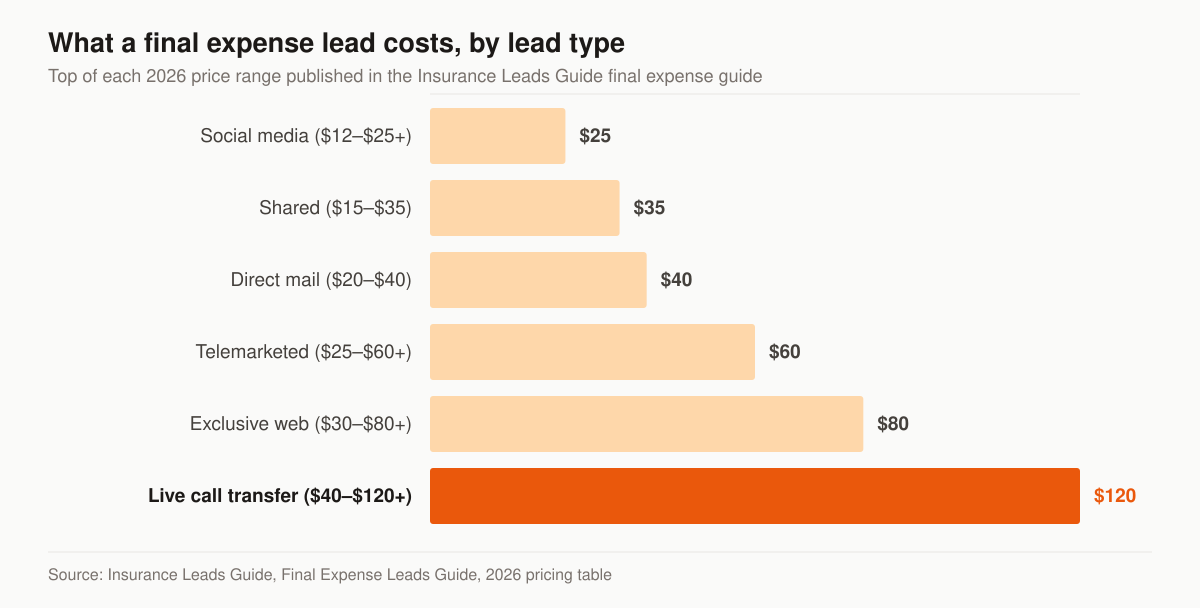
The chart plots the top of each band, from the Insurance Leads Guide 2026 final expense pricing table.
Two things in that table are easy to miss. The bands overlap heavily — a badly negotiated exclusive web lead at $80 and a well-negotiated live transfer at $40 sit on opposite sides of the price you would expect. And four of the six ranges end in a plus sign, which is the publisher telling you the top is not a ceiling. The same guide reports that direct mail achieves “1-2% response rates when properly targeted,” which is the number that actually sets a mailer’s cost per lead once you know your piece cost.
Price is also not the same as spend. A $120 transfer that reaches a decision-maker on the first call and a $15 shared lead that takes a long dial sequence to reach the same conversation cost the same in money and nothing like the same in hours. We work that comparison out in cost per lead versus true cost per sale.
How lead age changes the price and the work
Age is the second price axis, and it moves further than exclusivity does. Aged Lead Store publishes its final expense price ladder openly, which makes it a useful public reference point for what old inventory is worth.
Table: one vendor’s published final expense prices by lead age.
| Lead age | Published price per lead | Vendor’s stated fit |
|---|---|---|
| 15–45 days | $1.50–$1.88 | The freshest aged inventory |
| 46–85 days | $0.62–$1.25 | Balance of cost and contact rate |
| 86–180 days | $0.40–$0.75 | Budget-conscious, high-volume dialers |
| 181–365 days | $0.25–$0.50 | Call centers, maximum volume |
| 365+ days | $0.15–$0.30 | Deep inventory for experienced teams |
Set that against the same vendor’s description of fresh inventory: “Fresh final expense leads cost $20-$45 each and get called by 5-20 agents within the first hour.” The gap between a $40 fresh lead and a $0.40 lead from the 86-180 day tier is not a quality gap of a hundred times. It is a timing gap, and it transfers work from your budget to your dialer. Aged Lead Store’s own published comparison puts contact rates at 50-65% for fresh and 25-35% for aged, and close rates at 5-8% versus 1-3% — vendor figures, published by a vendor selling the aged side, so read them as a claim rather than a measurement.
The practical consequence for a fresh-lead buyer is a question, not a discount: ask whether the record you are buying at $40 today re-enters that ladder at $1.88 in six weeks. Many vendors run both businesses. We cover how to work the old end of the ladder in aged final expense leads.
CPL is a vanity metric; cost per sale is the real one
Two agents buy the same month of leads. One brags about an $8 cost per lead. The other pays $35 and closes more policies for less total spend. Here’s why:
Table: three worked scenarios, using stated assumptions rather than measured results, showing how a cheap lead can cost more per issued policy.
| Scenario | CPL | Close rate | Leads per sale | Cost per sale |
|---|---|---|---|---|
| Shared, slow follow-up | $8 | 1 in 20 | 20 | $160 |
| Exclusive, fast follow-up | $35 | 1 in 5 | 5 | $175 |
| Live transfer | $60 | 1 in 4 | 4 | $240 |
The cheap column also hides labor: 20 dials versus 5 for nearly the same outcome. Cost per sale survives that comparison and cost per lead does not, which is why cost per sale is what we report back on every campaign we run.
How big does a test order need to be before it means anything?
Bigger than a typical first order, and the reason is arithmetic rather than opinion. If a source genuinely closes one lead in twenty, then each lead fails to close with probability 0.95, and twenty independent leads all fail with probability 0.95 multiplied by itself twenty times — which comes to about 0.36. So a source performing exactly as advertised hands you zero sales in a twenty-lead test about a third of the time. Cancel on that evidence and you have cancelled a working source on a coin flip.
Aged Lead Store reaches the same conclusion from the other side, recommending a 500-lead starting order because “[s]maller samples produce unreliable results due to variance.” That figure suits sub-dollar aged data. At live-transfer prices the same statistical honesty means something different: you cannot buy statistical confidence at $120 a unit on a small budget, so you judge transfers on call recordings and appointment quality first, and on cost per issued policy only after several months of flow.
Table: what a $500 test buys at each published band, rounded down.
| Lead type | Published range | Leads at the top of the band | Leads at the bottom |
|---|---|---|---|
| Social media | $12–$25+ | 20 | 41 |
| Shared | $15–$35 | 14 | 33 |
| Direct mail | $20–$40 | 12 | 25 |
| Telemarketed | $25–$60+ | 8 | 20 |
| Exclusive web | $30–$80+ | 6 | 16 |
| Live call transfer | $40–$120+ | 4 | 12 |
Read the bottom two rows honestly. Four to sixteen leads is a conversation, not an experiment. That does not make transfers a bad buy — it makes a $500 transfer test the wrong instrument for the question you are asking. Either raise the test budget until the count is readable, or change the question to one a small sample can answer: did the transfers arrive pre-screened, in your licensed states, at the hours you dial?
Whatever the size, run one variable at a time and score every batch on issued policies rather than applications. A disciplined follow-up cadence is part of the test, because a source scored through a broken cadence is a test of your cadence.
What to ask a final-expense lead vendor before you buy
Vendor quality varies more than vendor price, and almost none of it is visible on the order page. Nine questions separate a source you can scale from one you will quietly stop using in six weeks:
- Where was this lead generated? A specific answer — Facebook lead form, search landing page, mailer reply, call-center transfer — or you are buying a mystery.
- How many agents receive it? “Exclusive” means one. Ask them to say the number out loud.
- How old is it when it hits my CRM? Minutes and hours are different products. Anything measured in days is an aged lead being sold as fresh.
- Can you show me the consent capture? The form, the disclosure text, the timestamp. A vendor who cannot produce this is selling you their liability along with the lead.
- What is the return policy on bad data? Disconnected numbers and wrong-party contacts are a cost of doing business; a vendor with no credit policy has priced that risk onto you.
- Do you resell aged versions of the same lead later? Many do. It changes the economics of every lead you bought fresh.
- What is the geographic fill rate? A vendor with volume in three states and none in yours will starve your dialer while still charging a setup fee.
- Can I start small and scale? Any source that requires a large minimum before you have measured a cost per sale is asking you to fund their risk.
- What does your best-performing agent do differently? A vendor who actually watches their book has an answer. One who does not is a list broker.
Run the answers against a small test order before you commit a monthly spend, and score the test on cost per issued policy — never on how the leads looked in the spreadsheet.
Who is actually writing final expense business
Knowing who competes for the same senior changes how you read a lead price. LIMRA and the Life Insurers Council survey final expense carriers each year, and the 2024 report is one of the few public datasets on who sells this product. Its scope is stated plainly by LIMRA itself: the survey “is not a comprehensive view of the U.S. final expense market, but offers a snapshot of sales trends for participating companies.” Twenty-eight carriers took part.
Those 28 carriers reported US final expense new annualized premium of $1.05 billion in 2024, up 16% year over year, across 1.06 million policies, up 10%. Independent distribution sold 86% of those policies. Affiliated distribution sold 10%, and direct-to-consumer channels 4%.
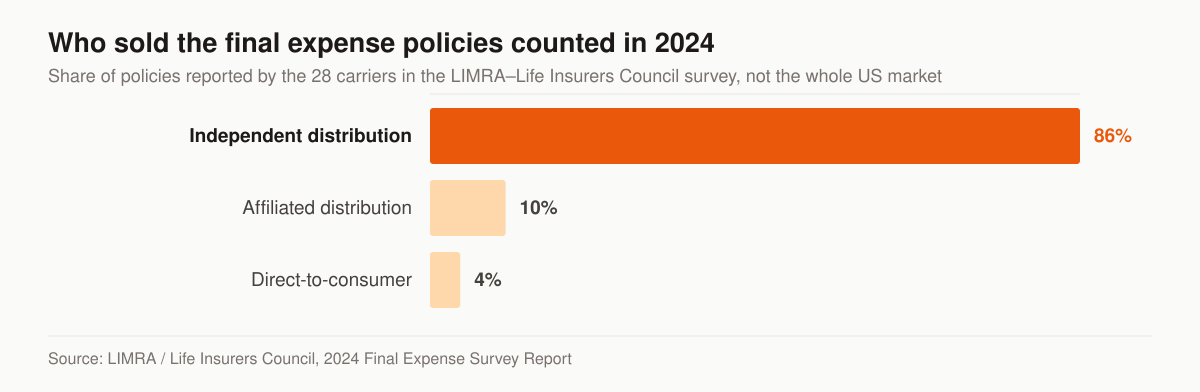
Share of policies by distribution channel, from the LIMRA / Life Insurers Council 2024 Final Expense Survey Report.
That 86% is the number to sit with. The agent racing you to the phone on a shared lead is not a carrier’s captive salaried rep — it is another independent buying from the same handful of vendors you are. We read that concentration as the market structure behind the price of exclusivity in this line.
Table: what the 2024 LIC survey reported about the policies themselves.
| Underwriting type | Share of policies reported | Average face amount |
|---|---|---|
| Simplified issue | 85% | $14,535 |
| Guaranteed issue | 15% | $9,786 |
Those face amounts are the sanity check on any lead price. A live transfer at the top of its published band costs $120 against an average simplified-issue policy of $14,535 in face value — a ratio that looks comfortable until you multiply it by the leads that do not close, which is exactly why the cost-per-sale table above matters more than the price list. Which carriers pay what on those policies is a separate question, covered in final expense carriers for agents.
Buying leads versus building your own flow
Buying leads and generating them are different purchases with different payback curves, and most stable books do both.
Table: the two purchases side by side, on the five dimensions that actually differ.
| Buying leads | Building your own flow | |
|---|---|---|
| Time to first contact | Same week | Weeks to months |
| Cost per lead over time | Flat or rising with competition | Falls as the funnel and content mature |
| Exclusivity | Whatever you paid for | Total, by definition |
| What you own at the end | The policies you wrote | The policies plus the asset that produced them |
| Main failure mode | Vendor quality drift | Impatience — pulling spend before it compounds |
Buying fills the calendar while the owned asset is still being built. The mistake is treating either one as the whole plan. If you want leads as a finished product, our sister brand sells them direct; on this site we build the final-expense marketing engine that eventually reduces how many you need to buy.
Compliance is part of the lead, not an afterthought
TCPA still governs how you contact these prospects. The FCC’s one-to-one consent rule was vacated in January 2025, but the underlying consent and Do-Not-Call requirements did not disappear — a documented, traceable consent trail still protects you. Treat any vendor that can’t show where consent was captured as a liability, not a bargain. For the full picture, see our guide to TCPA compliance when buying insurance leads.
What the TCPA still requires after the one-to-one rule was vacated
The vacatur is real and it is narrower than the headlines suggested. In Insurance Marketing Coalition Ltd. v. FCC, No. 24-10277, decided January 24, 2025, the Eleventh Circuit granted the petition and vacated Part III.D of the FCC’s 2023 Order — the part that would have required consent to one seller at a time and confined consented calls to subject matter “logically and topically associated with the interaction that prompted the consent.” The court’s own footnote marks the limit of the ruling: “The 2012 Order is not at issue in this case.” Everything the 2012 rule put in place therefore stands.
Table: what the January 2025 vacatur changed, and what it left exactly where it was.
| Requirement | Status after the ruling | Where it lives |
|---|---|---|
| Consent to one identified seller at a time | Vacated | Part III.D, 2023 FCC Order |
| Calls must be logically and topically associated | Vacated | Part III.D, 2023 FCC Order |
| Written consent for autodialed or prerecorded telemarketing | Unchanged | 47 CFR 64.1200(f)(9) |
| National Do Not Call registry scrub | Unchanged | 47 CFR 64.1200(c)(2) |
| Honor revocation within ten business days | Unchanged | 47 CFR 64.1200(a)(10) |
Read the third row with its scope attached, because that is where agents get hurt. Section 64.1200(f)(9) defines prior express written consent as “an agreement, in writing, bearing the signature of the person called that clearly authorizes the seller to deliver or cause to be delivered to the person called advertisements or telemarketing messages using an automatic telephone dialing system or an artificial or prerecorded voice, and the telephone number to which the signatory authorizes such advertisements or telemarketing messages to be delivered.” The trigger is the dialing method, not the sale. The written agreement must also carry a clear and conspicuous disclosure that “The person is not required to sign the agreement (directly or indirectly), or agree to enter into such an agreement as a condition of purchasing any property, goods, or services.”
Two more rules apply whether or not you touch an autodialer. Under 64.1200(c)(2), Do Not Call registrations “must be honored indefinitely, or until the registration is cancelled by the consumer or the telephone number is removed by the database administrator,” and the safe harbor attached to that paragraph is conditional, not automatic: a caller must “demonstrate that the violation is the result of error” and that its routine business practice meets every listed standard, including written procedures, trained personnel, a company do-not-call list, and a registry version “obtained from the administrator of the registry no more than 31 days prior to the date any call is made.” A separately signed written agreement with the seller naming the number is the alternative route out of that paragraph.
Under 64.1200(a)(10), “All requests to revoke prior express consent or prior express written consent made in any reasonable manner must be honored within a reasonable time not to exceed ten business days from receipt of such request,” and the words “stop,” “quit,” “end,” “revoke,” “opt out,” “cancel,” or “unsubscribe” in a reply text count on their own. None of that is legal advice and none of it is a substitute for your own counsel reading your own consent language — but a vendor who cannot show you the form, the disclosure and the timestamp is selling you exposure with the record attached. Our longer treatment sits in TCPA compliance when buying insurance leads.
Does the reassigned numbers database matter when you buy a list?
It matters more the older the data gets, because the risk it addresses is a number changing hands. The FCC’s Reassigned Numbers Database went live for paid subscribers on November 1, 2021, and providers must now “wait a minimum of 45 days before reassigning a disconnected number to a new user.” The database had grown to over 305.9 million geographic and toll-free numbers as of February 17, 2023.
The reason it belongs on a lead-buying page is the shape of its safe harbor. The FCC states it in three parts: “To be shielded from liability under the TCPA, a caller must prove that: (1) it obtained consent from the intended call recipient; (2) it or its duly authorized agent checked the database prior to calling the number to verify that the number had not been permanently disconnected, or reassigned, after the date the caller obtained consent; and (3) the database returned a query response of ‘no’ that was incorrect.”
Every one of those three parts depends on something the vendor holds. You cannot query the database without supplying the consent date, and you cannot prove part one without the consent record itself. A vendor who will not export a consent timestamp with the lead has not just given you a weaker file — they have removed your access to the safe harbor. The FCC also notes callers “may be liable for violating the TCPA if… they check the database, and then knowingly call a reassigned number without consent,” so the knowledge element matters: the point of querying is to act on the answer.
Queries return one of three responses. “Yes” means the number was disconnected and possibly reassigned after your consent date, and you should not call it without separate consent from whoever holds it now. “No” means you may place the call if you have the consent the TCPA requires. “No Data” means the number is not in the database and your query date predates the record-keeping requirement — an answer, not a clearance. Use of the database requires a paid subscription, and callers may query up to 50 numbers individually or up to 250,000 in a group.
Match the lead to your capacity
Pick by how you actually sell, not by sticker price:
- Limited time, want pre-qualified calls → live transfers.
- Disciplined fast follow-up, want best per-policy economics → exclusive internet leads.
- High dialing capacity, tight budget → aged leads as a supplement.
- Selling to the oldest, mail-trusting cohort → direct mail.
Most healthy books blend two or three sources and route everything through a tracked follow-up cadence so nothing dies in a spreadsheet.
Want your current lead spend re-scored by cost per sale instead of CPL? Take the free marketing audit and we’ll show you where the leak is. If you would rather know the commercial shape first, our retainers are published — Foundation at $2,500 a month, Growth at $3,500, Full-Funnel at $5,500, with a one-time website build of $2,500 to $8,000 and ad spend billed at cost, straight to the platforms. We build the engine rather than sell the leads, so what you buy from a vendor stays your own line item; tell us what you are buying now and we will score it against the bands above.
Guides that go deeper
- Aged Final Expense Leads: What They Are and When the Math Works
- Final Expense Lead Generation Companies for Agents: A Buyer's Map
- Exclusive vs Shared Final Expense Leads: A Cost-Per-Sale Breakdown
- Final Expense Leads Cost: Why Cost Per Sale Is the Only Number That Matters
- How to Get Final Expense Leads Without Cold Calling
- Building a Final Expense Lead Generation System You Own