Exclusive vs Shared Final Expense Leads: A Cost-Per-Sale Breakdown
Exclusive vs shared final expense leads comes down to cost per sale, not cost per lead. Exclusive leads cost more upfront but you are the only agent calling, so contact and close rates run higher. Shared leads are cheaper but split 3-8 ways, dragging real economics down.
The sticker price is the first number an agent sees on a final expense lead, and it is the wrong one to decide on. A shared lead at $9 next to an exclusive lead at $28 reads like a 3x markup worth avoiding. That framing is backwards. The price you pay per lead tells you almost nothing about what a sale actually costs you. The number that matters is cost per issued policy, and exclusivity moves it more than almost any other lever.
We run our own final-expense and senior-market lead operation, so these playbooks come from live campaigns, not theory. The whole comparison below turns on one structural fact: the moment a lead gets sold five times, every assumption underneath the close rate breaks.
Exclusive vs shared final expense leads: what each one actually is
An exclusive lead is sold to one agent. You are the only person calling that prospect about final expense coverage. A shared lead (sometimes called a “shared,” “non-exclusive,” or “competitive” lead) is sold to multiple agents at once, typically three to eight, sometimes more through aggregators.
Vendors describe the split the same way you would. ActiveProspect — the company behind the TrustedForm consent-certificate product — defines shared web leads as leads that “are sold to multiple agents. They cost less but come with more competition,” and exclusive web leads as leads “sold to a single buyer” that “cost roughly 2 to 3 times more than shared leads, but often convert better.” Read that second sentence twice. The price multiple is stated flatly. The conversion advantage is stated as a tendency, which is the honest way to put it, and it is why the rest of this page is arithmetic rather than assertion.
The label “exclusive” is also abused. Some vendors call a lead exclusive because it was sold once, then resell it as an aged lead 30 days later. Others call it exclusive but resell within the same hour to a different downline. Get the exclusivity window and resale policy in writing before you spend a dollar.
What each type costs right now
Final expense is written inside the life line, so the published life bands are the closest thing to a price list this market has. Four published bands describe the line, and the top two overlap.
| Lead type | Published band | What the money actually buys |
|---|---|---|
| Aged life record | $5–$15 | A record resold after the intent behind it went cold |
| Shared life web lead | $20–$45 | One form fill, delivered to several agents at the same moment |
| Exclusive life lead | $75–$150 | The same form fill, delivered to you alone by that one vendor |
| Real-time exclusive or live transfer | $80–$200+ | A connected call, not a record you still have to dial |
Source: ActiveProspect, Insurance leads cost, life insurance section, page last updated 28 August 2026.
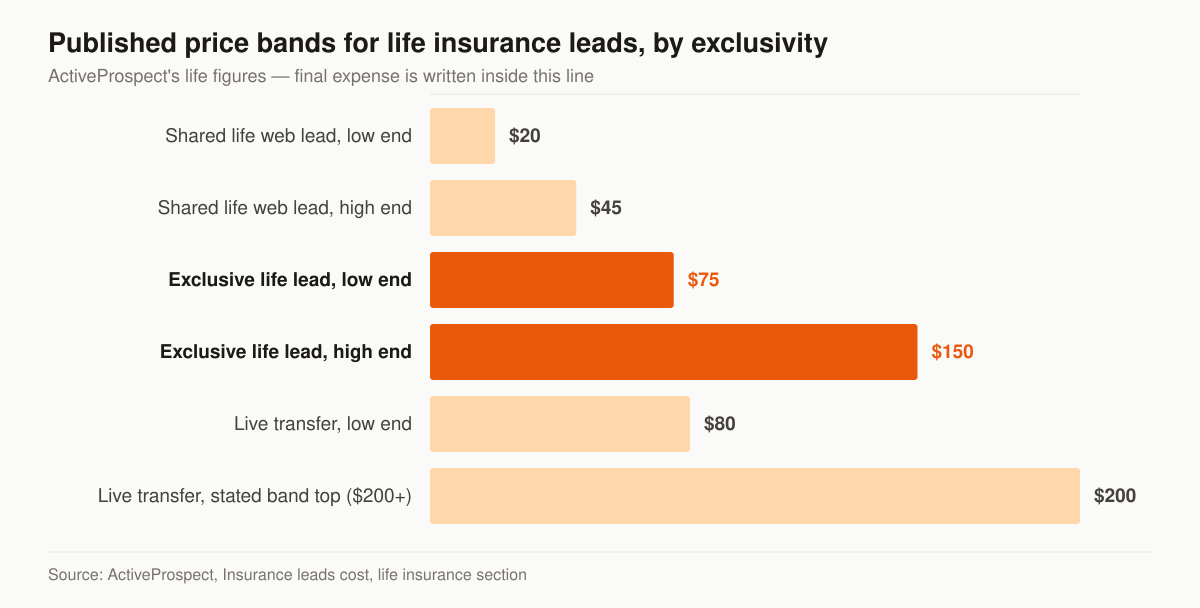
Published price bands for life leads by exclusivity. Source: ActiveProspect, Insurance leads cost.
Two things in that table change how you should read every price quote you get. First, the bottom of the exclusive band ($75) sits below the bottom of the live-transfer band ($80), which means at the cheap end of “exclusive” you are choosing between one more form fill and a connected call for roughly the same money. Second, the same ActiveProspect guide warns that “Niche products like final expense or business insurance may carry premiums if targeting and compliance are more complex.” Treat the life bands as a floor for final expense, not a ceiling — and treat any final expense quote far below them as a question about share count rather than a bargain.
Published gaps are not the only gaps. EverQuote’s agent-facing post on shared versus exclusive leads — written around its auto product but defining both types generally — tells agents they “can typically expect to pay $4-5 dollars less per lead” when buying shared instead of exclusive. How wide the gap runs on your own quote depends less on the word “exclusive” than on whether the vendor generated the traffic itself or bought the record from someone who did.
The cost-per-lead vs cost-per-sale math
Here is the only comparison that pays your bills. Watch what happens to the bottom row even when the shared lead looks cheaper per unit.
| Metric | Exclusive lead | Shared lead (sold 5x) |
|---|---|---|
| Cost per lead | $28 | $9 |
| Contact rate | 65% | 35% |
| Quote rate (of contacted) | 55% | 40% |
| Close rate (of quoted) | 30% | 22% |
| Net close rate (lead → sale) | ~10.7% | ~3.1% |
| Leads needed per sale | ~9.3 | ~32.5 |
| Cost per issued policy | ~$262 | ~$293 |
The shared lead is 68% cheaper per lead and still costs more per sale. That is the trap. The per-lead discount gets erased by lower contact rates (you are calling someone three other agents already reached), lower quote rates (they are price-shopped and fatigued), and a thinner close rate (someone else may have already bound coverage).
These exact percentages are illustrative, not a promise. The point is the structure: a small drop in contact and close rate, multiplied across the funnel, swamps a large drop in lead price. Plug your own numbers in. If you do not know your contact and close rates by lead source, that is the first problem to fix, and a structured audit will surface it fast. Our free marketing audit reverse-engineers cost per sale from whatever data you already have.
Exclusivity is a property of the channel, not a checkbox on the invoice
Final expense records come from four channels, and the exclusivity question means something different in each one. Buying “exclusive” without knowing which channel produced the record is how agents end up paying premium prices for a distribution promise they did not need.
Direct mail response cards are exclusive by construction. A senior fills in a reply card and it goes back to whoever paid for the mail drop; there is no second buyer unless the mailer chooses to create one. That structural exclusivity is most of why the format costs what it costs, and it is also why the ageing rules are different — a card that sat on a desk for six weeks is still yours alone. What to ask here is not “is it exclusive” but “what was the drop date and who else is mailing that carrier route.”
Telemarketed leads cut either way. If a call centre dialed on your behalf, into your filters, the record is yours. If the room dialed on its own account and then sold the transcript, the same conversation can arrive on several desks. The tell is who owns the calling list and who is named in the disclosure the caller read.
Internet form fills are shared by default, because the economics of the form push that way: a submission that can be sold once earns once, and a submission that can be sold four times earns four times. Exclusivity here is a choice the vendor prices, which is exactly why it costs two to three times more.
Live transfers are exclusive for the duration of the call and worth nothing afterwards if nobody picked up. You are buying a connection, not a record, and the exclusivity you paid for evaporates the moment the call rolls to voicemail. Before you buy transfers at all, answer two questions: can somebody take the call every time one lands, and can you run a quote while the person is still on the line? If either answer is no, you are paying transfer prices for form-fill outcomes. Our appointment-setting service page covers the staffing side of that decision.
There is a fifth origin that never appears in these comparisons because nobody sells it: a form on your own site, filled in by someone who came looking for you. That record is exclusive by construction, the consent language on it is yours, and its marginal cost is whatever the traffic cost. It is a different budget line, not a different lead tier.
The share count is the number to make them put in writing
“Shared” is not one product. At one end, EverQuote states in the same agent-facing post that “EverQuote shared leads are distributed with a maximum of three insurance agencies—on average, EverQuote sends one consumer lead to 1.9 agents”. At the other end, the same post describes lead aggregators as vendors whose leads “are shared among multiple, sometimes dozens, of other agents”. Both of those arrive on your invoice under the identical word.
That range is the whole decision. A record capped at three buyers, delivered the second the form is submitted, is a different economic object from a record resold to twenty desks over a fortnight — and no per-lead price comparison between two vendors means anything until you know where each one sits. So ask for two figures in the agreement, not on the phone: the contractual maximum number of buyers, and the trailing average over the last three months in your states.
Ask the same three-month question about exclusive volume. EverQuote’s post notes that “Exclusive leads are often available with limited volume and vendors charge a premium for them,” which is the polite version of a real operating problem: an exclusive tier you can only half-fill is a scheduling problem wearing a lead-quality costume. If a vendor cannot tell you how many final expense leads your age band, state and benefit-amount filters actually produced last month, you are buying a hope rather than a flow.
Where shared leads still win
Shared is not a scam. There are three honest cases for it:
- You are new and protecting capital. Shared leads keep your upfront spend low while you build phone skills. The cost-per-sale penalty is real, but so is the lower risk of torching $3,000 in week one.
- You dial fast and at volume. Speed to lead is the entire game with shared leads. If you hit them in under five minutes, you are often the first agent through, which collapses the contact-rate gap. An agent who calls a shared lead 40 minutes late is buying garbage.
- You have a tight, repeatable script. Price-shopped prospects need a fast, confident framework. Weak scripts get destroyed on shared leads. If yours is not written down yet, start from our final expense telesales script.
If those three are not true, shared leads usually punish you.
Where exclusive leads earn the premium
- Contact rate. No one else is dialing. You set the pace, you choose the callback windows, you are not racing four downlines.
- Conversation quality. The prospect has not been quoted three times this morning. They are warmer, less defensive, and easier to qualify.
- Room in the schedule. EverQuote puts the operational version of this plainly: “Exclusive leads put less pressure on the sales team to immediately call out to the consumer. Because you are the only agency reaching out to the consumer, you don’t have to race to be the first to reach out to them (though you should certainly still try to quickly contact them.)” For a solo agent who is also servicing existing policyholders, a callback at hour two being a delay rather than a loss is worth real money.
- Cleaner attribution. With one agent per lead, your source data is honest. You can actually trust your cost per sale, which makes scaling decisions defensible instead of guesswork.
- Compliance posture. Exclusive, first-party generated leads with documented consent are far easier to defend than aggregator traffic resold across vendors. The FCC’s one-to-one consent rule was vacated in January 2025, but TCPA exposure did not disappear, and shared aggregator leads carry murkier consent trails.
Speed to lead changes the answer
Exclusivity and speed interact. A shared lead you dial immediately can outperform an exclusive lead called the next morning, because you become the de facto first contact. This is why a disciplined follow-up cadence matters more than the lead label. We treat slow, inconsistent dialing as the first thing to fix, ahead of the exclusive-versus-shared choice itself, because a lead type cannot rescue a callback that never happens.
A quick decision frame:
- Fast dialer, strong script, want clean economics → exclusive.
- New, capital-constrained, can dial instantly → shared, with strict tracking.
- Slow or inconsistent on the phone → fix that first; no lead type rescues a 40-minute callback.
Worth separating the two purchases here. If the answer to this comparison is “exclusive, and I want them delivered”, that is a lead-purchasing transaction — buy leads direct from getinsureleads, our sister brand built for exactly that. We don’t sell leads on this site; we build the systems that generate them, which is the other path out of the shared-lead race.
The consent trail is different on a shared lead, and the burden is yours
Exclusivity is a distribution term. It tells you how many agents received the record. It says nothing about whether you may lawfully dial the number, and in final expense the two get conflated constantly, because the person on the other end is a residential consumer and the rules below are written for exactly that call.
Start with the size of the problem. The FTC’s National Do Not Call Registry Data Book for fiscal year 2025 reports that “As of September 30, 2025, there were 259 million active registrations.” The same page states the operating rule in one line: “Telemarketers and sellers must remove numbers added to the Registry from their call lists at least every 31 days.”
Now the rule itself. The FTC Telemarketing Sales Rule at 16 CFR 310.4(b)(1)(iii)(B) makes it an abusive telemarketing act to initiate an outbound call to a person whose number “is on the ‘do-not-call’ registry, maintained by the Commission, of persons who do not wish to receive outbound telephone calls to induce the purchase of goods or services unless the seller or telemarketer” can demonstrate one of two things. The first is that the seller “has obtained the express agreement, in writing, of such person to place calls to that person. Such written agreement shall clearly evidence such person’s authorization that calls made by or on behalf of a specific party may be placed to that person, and shall include the telephone number to which the calls may be placed and the signature of that person”. The second is that the seller “has an established business relationship with such person, and that person has not stated that he or she does not wish to receive outbound telephone calls” under the entity-specific do-not-call provision.
The load-bearing phrase is “by or on behalf of a specific party”. Written consent under this provision runs to a named party, and the burden of demonstrating it sits with the seller. That is where shared and exclusive records genuinely diverge, and not in the direction the marketing implies: when you buy a record of either type, the consumer agreed to whatever the form named, and you inherit that document rather than a general permission to dial. On an aggregator record the chain is longer and the originating page is often unnamed, which is a paperwork problem before it is a conversion problem.
Three more mechanics apply to a final expense dialing operation regardless of which lead type funds it. The Rule’s safe harbor at § 310.4(b)(3)(iv) requires “employing a version of the ‘do-not-call’ registry obtained from the Commission no more than thirty-one (31) days prior to the date any call is made, and maintains records documenting this process”. Calling hours are fixed by § 310.4(c): “Without the prior consent of a person, it is an abusive telemarketing act or practice and a violation of this part for a telemarketer to engage in outbound telephone calls to a person’s residence at any time other than between 8:00 a.m. and 9:00 p.m. local time at the called person’s location.” And if volume pushes you toward a predictive dialer, § 310.4(b)(1)(iv) defines an abandoned call as one where “a person answers it and the telemarketer does not connect the call to a sales representative within two (2) seconds of the person’s completed greeting”, with the safe harbor at § 310.4(b)(4)(i) conditioned on technology “that ensures abandonment of no more than three (3) percent of all calls answered by a person, measured over the duration of a single calling campaign, if less than 30 days, or separately over each successive 30-day period or portion thereof that the campaign continues.”
One exemption matters enough to final expense to read in full rather than in summary. Under § 310.6(b)(3), the Rule exempts “Telephone calls in which the sale of goods or services or charitable solicitation is not completed, and payment or authorization of payment is not required, until after a face-to-face sales or donation presentation by the seller or charitable organization” — which describes the classic in-home final expense appointment set over the phone. Read the rest of the sentence before you rely on it: the exemption applies “provided, however, that this exemption does not apply to the requirements of § 310.4(a)(1), (a)(8), (b), and (c)”. Paragraph (b) is the one that contains the do-not-call registry provision and the abandonment limits, and paragraph (c) is the calling-hours rule. So the face-to-face route does not lift the registry obligation, the dialer discipline, or the 8:00 a.m. to 9:00 p.m. window. The neighbouring exemptions at § 310.6(b)(5) and (b)(6) turn on calls initiated by the customer, which is a different event from you dialing a returned mail card.
None of that makes shared leads unlawful or exclusive leads safe. It makes the paperwork part of the price, and it makes high-volume dialing of cheap records more expensive than the invoice suggests. The Rule’s definitions sit in § 310.2 and the full exemption list in § 310.6, and both can change which provisions reach a given call, which is a reason to read them rather than a substitute for doing so. Our fuller treatment of TCPA compliance when you buy insurance leads covers the consent standard and the records to demand from a vendor, and the broader compliance checklist for agents covers the advertising side.
What to get in writing before you buy either type
Vendors answer these questions differently on a sales call than they do in a contract, which is the reason to ask for the contract. Eight terms decide what you actually bought, and none of them is the per-lead price.
| Ask the vendor | Why it changes your economics | What a clean answer sounds like |
|---|---|---|
| Maximum share count, and the trailing average | Your position in the queue drives contact rate more than lead quality does | A contractual cap plus a three-month average, both in the agreement |
| Exclusivity window, and resale after it expires | An “exclusive” lead resold as aged next month is a shared lead on a delay | A named number of days, plus whether resale ever happens and to whom |
| Generation channel | Direct mail, telemarketed and web records behave nothing alike on the phone | The channel named, and for mail the drop date and geography |
| Delivery latency | A real-time post and a nightly batch are different products at the same price | Posted to your CRM at submission, with a timestamp you can audit |
| Consent record per lead | The document you may need is the one captured at the form, not a summary | A retrievable consent certificate or session record, per lead |
| Return and credit policy | Decides whether wrong numbers and wrong ages are a cost or a rounding error | Written criteria, a filing window, and cash-or-credit stated plainly |
| Filters available | Age band, state and benefit amount are what make a final expense lead workable | Age 50–85 banding, state and ZIP radius, plus health-question filters if offered |
| Volume commitment and exit terms | Exclusive tiers throttle; a commitment you cannot fill is a monthly write-off | Trailing volume by state for three months, and a stated notice period |
Two of these carry extra weight in final expense specifically. The consent record, because the registry your prospect may sit on held 259 million active registrations as of 30 September 2025, and the burden of demonstrating an exception sits with the seller. And the return policy, because age-banded products generate a steady trickle of records that are simply uninsurable at any price, and whether you eat that or credit it decides your real cost per lead.
How to actually compare your two options
- Pull 90 days of leads by source.
- Tag each lead exclusive or shared.
- Calculate contact rate, quote rate, and close rate for each.
- Divide total spend by issued policies for each source. That is your real cost per sale.
- Multiply cost per sale against your average commission to get a return multiple, not just a cost.
If your commission per final expense sale is, say, $600 and your exclusive cost per sale is $262, you are roughly 2.3x. If shared is $293, you are 2.0x at lower volume and lower predictability. Now the decision is numerate, not emotional.
If you are building a durable pipeline, exclusive leads and first-party generated leads are where we would put the budget once phone discipline is in place. For the full picture on sourcing, pricing tiers, and what predictable lead flow looks like, see our breakdown of final expense lead generation that holds up under the math, and the deeper comparison of lead cost versus true cost per sale. Agents weighing vendors should also review how the major final expense lead companies actually price exclusivity, and agents tempted by the cheap end should read what aged final expense leads really cost to work.
How to run a 60-day split test instead of arguing about it
Everything above is a model. Your market is the measurement, and 60 days of disciplined buying is the window we use to get one.
- Fix every variable you are not testing. Same producers, same dialing hours, same script, same carriers, same follow-up cadence. If the exclusive leads go to your best closer, you have tested your closer.
- Size both buys to one week of dialing capacity, not one month of budget. Buy only what you can first-dial inside your target window. A test that outruns your phones measures your phones.
- Timestamp at the record level. Lead received, first dial, first contact, application taken, application submitted, policy issued, first premium drafted. Cost per issued policy is a division problem and both numbers have to come out of the same system.
- Let the cohort finish, including underwriting. Final expense has a gap between submitted and issued that shared and exclusive sources do not necessarily share. Cutting the window at 30 days flatters whichever source produces faster, thinner business.
- Score three numbers, not one. Cost per issued policy, average annual premium per issued policy, and the share still on the books after the chargeback window. A source that wins on cost and loses on persistency has not won.
- Write the decision rule before you look at the results. “We keep whichever source has the lower cost per issued policy at equal average premium” is a rule. Reading the numbers and then deciding which one mattered is not.
Run it twice a year. Vendors change their share caps, mail costs move, and a conclusion from two seasons ago is a hypothesis today. A CRM that timestamps first contact by source makes this a report rather than a project.
When buying leads stops being the answer
Both columns of this comparison share a ceiling. You are renting access to a prospect somebody else acquired, at whatever the auction clears, and every improvement you make to your close rate raises the price that vendor can charge the next buyer. That is not an argument against buying leads. It is an argument against buying leads being the whole plan.
The alternative is owning the acquisition: a page that ranks for what a retiree actually types, a form whose consent language you wrote, and a record that is exclusive because nobody else generated it. The mechanics of that sit under insurance lead generation, and the market-specific version runs through our final expense marketing hub. It is slower than a lead order and it compounds instead of resetting each month.
Where that lands in our own pricing is deliberately public. Managed programs run $2,500 per month at Foundation, which covers the site and landing pages, local SEO and Google Business Profile, on-page SEO and monthly reporting; $3,500 at Growth, which adds the ongoing SEO and content engine, AI-search visibility and reputation work; and $5,500 at Full-Funnel, which is the tier that adds managed Google and Meta ads, landing-page CRO and marketing automation. A one-time website or landing-page build is $2,500–$8,000, and ad spend is billed at cost, straight to the platforms. Full detail sits on the pricing page. The same argument in its P&C form is on our exclusive versus shared auto insurance leads breakdown, and the phone-side skills that decide whether any of this pays are in how to sell final expense over the phone.
The takeaway
Stop comparing exclusive vs shared final expense leads by price per lead. That number is a distraction. Compare them by cost per issued policy and return on commission, get the share count and the consent record in writing, and let a 60-day test settle it. When you do, the cheaper-looking shared lead frequently turns out to be the more expensive sale, and the agents who win are the ones who actually measured it.
- Aged Final Expense Leads: What They Are and When the Math Works
Aged final expense leads cost a fraction of fresh leads. Here's what they are, the ROI math that decides if they work, and when to skip them.
- How to Get Final Expense Leads: Sources, Costs, and Contact Rates
How to get final expense leads: five sources compared on cost, exclusivity, and contact rate, plus a 30-day plan to prove your first channel pays.
- Telemarketing Insurance Leads: What Still Works in 2026
An honest guide to telemarketing insurance leads: telemarketed vs direct-mail vs live-transfer, DNC and TCPA compliance, and whether to buy or generate them.
- Final Expense Lead Generation Companies for Agents: A Buyer's Map
A practitioner's breakdown of final expense lead generation companies: the vendor types, real cost-per-sale math, and when building your own wins.