Who we serve
IUL Marketing That Books Appointments, Not Just Leads
Indexed universal life (IUL) marketing for agents builds the offer around a clear consumer outcome, tax-advantaged accumulation and protection, and keeps messaging factual instead of leaning on 'guaranteed returns' hype that draws compliance risk. The channels that move IUL are educational paid social, search and AI-search, and a disciplined appointment-setting layer.
Free · 15-minute teardown · no pitch deck
- We run our own final-expense book
- No pitch deck — we screen-share real numbers
- TCPA-aware · CMS/AEP-compliant · Meta Special Ad Category
- Core Web Vitals < 2.0s LCP
Most IUL marketing fails for one of two reasons: it sounds like a pitch (“tax-free retirement, guaranteed!”) that buyers and compliance reviewers both distrust, or it never gets past clicks because there’s no system to turn interest into a booked call. Indexed universal life (IUL) marketing for agents is a conversion problem, not a creative one. Below is what we run, how we keep the message clean, and the numbers that tell you it’s working.
What IUL marketing actually has to do
IUL is a considered purchase. The buyer is usually 30–55, employed, and already searching terms like “cash value life insurance” or “tax-advantaged retirement.” Your marketing has three jobs in order:
- Reach the right buyer with an educational angle, not a hard pitch.
- Earn the click with a specific outcome (supplemental income, tax treatment, protection) — never a return promise.
- Book the call. A lead that never gets on your calendar is a sunk ad cost.
Skip job three and your cost per lead is irrelevant, because cost per issued case is what pays you.
Who is actually buying IUL right now
The market question comes before the channel question, and for IUL it has a published answer rather than a guess. LIMRA’s individual life insurance industry sales survey put industry-wide new annualized premium above $17.5 billion in 2025, up 10% year over year, with the number of policies sold rising 7% for the year. IUL set quarterly and annual sales records inside that total. For the year, IUL new premium reached a record-high $4.5 billion, 17% higher than 2024 results, and policy sales increased 8% over 2024 levels. In the fourth quarter alone, IUL new annualized premium was $1.3 billion, up 12% year over year, with IUL policy count up 13%.
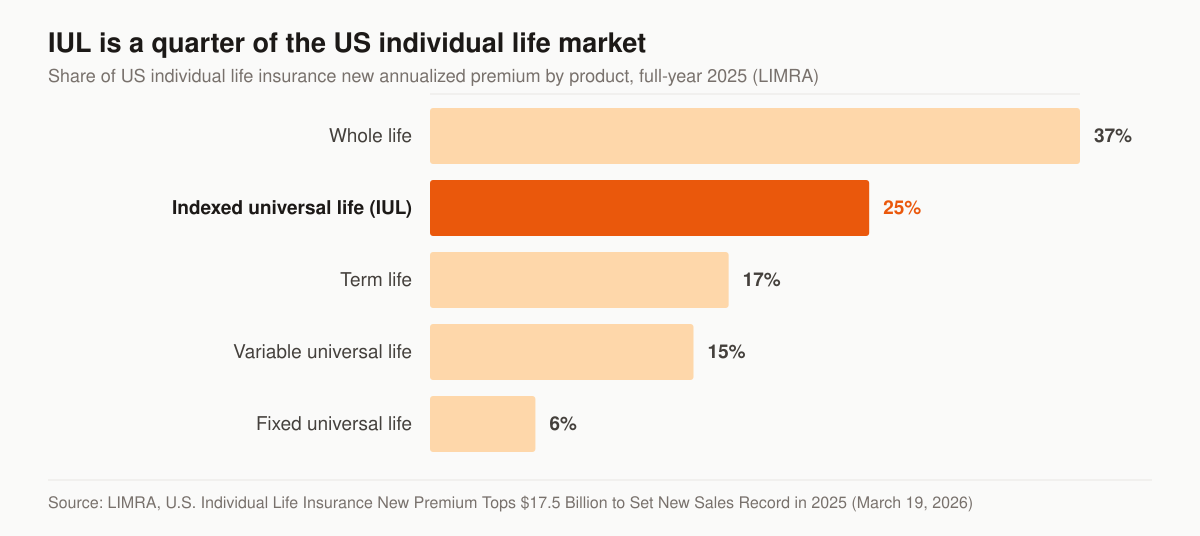
Source: LIMRA, U.S. Individual Life Insurance New Premium Tops $17.5 Billion to Set New Sales Record in 2025, published March 19, 2026.
IUL new premium represented 25% of the total U.S. life insurance market in 2025 — the largest share after whole life at 37%. Term life took 17% of total sales, variable universal life held 15%, and fixed universal life 6%.
Two comments in that release matter more to a marketer than the totals do. Karen Terry, corporate vice president and head of LIMRA Insurance Research, credited the run to supply as much as to demand: “Broader distribution, enhanced products and a strong equity market all contributed to the IUL growth in the fourth quarter and in 2025.” She added that “Despite a weaker economy, LIMRA is forecasting double-digit IUL sales growth in 2026, supported by the increased distribution reach as additional products become available.”
Read that as a competitive warning as much as a tailwind. Broader distribution means more licensed producers with an IUL to place, bidding into the same feed and researching the same query set you are. In a category where supply of sellers is growing alongside demand, the differentiator stops being access to the product and becomes whether you are findable and credible at the moment someone researches it. That is the job IUL SEO and AI-search optimization are built to do.
The channels that move IUL
No single channel wins. The mix does. Here’s how we weight them and what each is good for.
| Channel | Best for | Watch-out |
|---|---|---|
| Paid social (Facebook/Instagram) | Cheap top-of-funnel reach, educational creative | Hype/return claims get ads rejected and erode trust — see our IUL Facebook ad approach |
| Search SEO | High-intent buyers researching cash value & tax-free retirement | Slow to compound; needs real content — covered in IUL SEO |
| AI search / GEO | Capturing buyers who ask ChatGPT/Perplexity before they ever Google | We treat this as an early-mover surface, built through AI-search optimization |
| Website + landing pages | Converting traffic into booked calls | Generic agency sites leak leads — fix with conversion-focused IUL web design |
Start with one or two channels you can actually fund and measure. Prove your cost per appointment, then add the next. Spreading a small budget across five channels just produces five sets of inconclusive data.
Compliant messaging is a conversion tool, not a tax
The temptation with IUL is to lead with upside. Don’t. “Guaranteed returns,” “get rich,” or any framing that shows market gains without the caps, floors, and cost-of-insurance drag invites both compliance review and the kind of skepticism that kills close rates. Be factual:
- Show illustrations as illustrations, never as promises.
- Frame IUL around real jobs — tax-advantaged accumulation, supplemental retirement income, a death benefit.
- Let the licensed agent own suitability. We provide marketing services; you’re the licensed party.
In practice, clean messaging outperforms hype because the buyer who books a call already trusts you. That’s the whole point of our compliant IUL marketing playbook and the way we market tax-free retirement without the hype.
The illustration is the document your marketing is really selling
An IUL prospect does not decide from your landing page. They decide from a ledger the carrier prints, and that ledger has its own rulebook. The NAIC’s Life Insurance Illustrations Model Regulation (#582) exists, in its own words, to “provide rules for life insurance policy illustrations that will protect consumers and foster consumer education,” with the stated goals of ensuring “that illustrations do not mislead purchasers of life insurance and to make illustrations more understandable” (NAIC Model #582).
Check scope first, because agents often assume this is a variable-product rule. Section 3 applies the regulation to all group and individual life insurance policies and certificates except variable life insurance, individual and group annuity contracts, credit life insurance, and “Life insurance policies with no illustrated death benefits on any individual exceeding $10,000.” An IUL is none of those exclusions. The rule is on.
Section 6B is the part a creative team has to read. It lists what an insurer or its producers and other authorized representatives shall not do when using an illustration in the sale of a life insurance policy, and several of those prohibitions describe marketing copy rather than a sales conversation.
This table pairs the Model #582 prohibitions with the IUL advertising convention each one rules out.
| When using an illustration, Model #582 §6B says you shall not | The IUL marketing convention it rules out |
|---|---|
| “Represent the policy as anything other than a life insurance policy” | Copy that sells a retirement account, a savings plan or a “401(k) alternative” with the life insurance mentioned nowhere |
| “Use or describe non-guaranteed elements in a manner that is misleading or has the capacity or tendency to mislead” | The screenshot of an accumulation column with the guaranteed column cropped out of frame |
| “State or imply that the payment or amount of non-guaranteed elements is guaranteed” | “Locked-in gains,” “guaranteed growth,” a fixed percentage in the headline |
| “Represent in any way that premium payments will not be required for each year of the policy in order to maintain the illustrated death benefits, unless that is the fact” | “Fund it for ten years and you’re done” |
| Use the term “vanish” or “vanishing premium,” or a similar term that implies the policy becomes paid up, to describe a plan for using non-guaranteed elements to pay a portion of future premiums | The whole vanishing-premium genre, under any new name |
| “Provide an applicant with an incomplete illustration” | The one-page ledger extract repackaged as a downloadable lead magnet |
Two more provisions belong above a copywriter’s desk. Every basic illustration carries a narrative-summary statement reading, in substance: “This illustration assumes that the currently illustrated nonguaranteed elements will continue unchanged for all years shown. This is not likely to occur, and actual results may be more or less favorable than those shown.” And the applicant signs a line reading: “I have received a copy of this illustration and understand that any non-guaranteed elements illustrated are subject to change and could be either higher or lower. The agent has told me they are not guaranteed.”
That is the document sitting at the end of your funnel. An ad that promises certainty hands the prospect a paper that formally withdraws it in the first meeting, which is a conversion problem before it is ever a compliance one. Marketing that pre-frames the guaranteed and the non-guaranteed columns arrives at that same document with the expectation already set, and the appointment starts from an informed prospect instead of a corrected one.
The index layer adds a second guideline on top of the model regulation. The NAIC adopted Actuarial Guideline XLIX in 2015 “to bring uniformity to the illustrations of policies tied to an external index or indices,” and for policies sold in 2020 and later AG 49 was superseded by AG 49-A. The NAIC’s topic page, last updated January 8, 2026, records that “Revisions to AG 49-A became effective in 2023 to tighten illustration limits and in 2026 to enhance consumer-protection disclosures” (NAIC, Life Insurance Illustrations).
The operational consequence is unglamorous and easy to skip: an illustrated figure has a shelf life set by regulation, not by taste. A number that was legitimately illustrable in 2019 may not be illustrable now. Any page, PDF or ad graphic on your site carrying an illustrated value needs a review date and a named owner, or your evergreen content quietly goes stale while it keeps ranking.
What a state advertising rule says about “be your own bank” copy
The signature IUL pitches — be your own bank, tax-free retirement account, your money grows like savings with a floor under it — all point at the same policy feature, and that feature has rules written specifically about it. Georgia’s advertising regulation for life insurance and annuity contracts is used here because it is public, specific, and easy for you to open and check (Ga. Comp. R. & Regs. Subject 120-2-11). Your own state’s rule is the one that binds you, and you have to read it rather than assume it matches Georgia’s. We provide marketing services, not legal advice; your compliance counsel and your carriers approve creative before it runs.
The rule reaches your reel, not just the carrier brochure
Georgia defines an advertisement as material “designed to create or has the effect of creating public interest in life insurance, annuities or in an insurer, agent or counselor, or induces or tends to induce the public to purchase, increase, modify, reinstate, surrender or retain a policy,” then lists the formats it covers: “printed and/or published material, audiovisual material, mailing envelopes, descriptive literature used by an insurer in direct mail, newspapers, magazines, radio and television scripts, billboards or similar displays,” plus “descriptive literature and sales aids of all kinds,” expressly “including the use of pamphlets, brochures, books or portions thereof, authored by third parties,” and “prepared or extemporaneous sales talks, presentations, and material for use or used by sales personnel, agents or counselors” (120-2-11-.03(4)).
Your webinar deck is an advertisement. So is the reel script, the lead-magnet ebook, and the envelope a mailer arrives in. Responsibility does not stop with whoever wrote it either: “Every insurer shall establish and at all times maintain a system of control over the content, form and method of dissemination of all advertisements of its policies. All such advertisements, regardless of by whom written, created, designed, or presented, shall be the responsibility of the insurer” (120-2-11-.04(2)). That clause is why carriers insist on advertising approval, and why an agency that ships IUL creative without routing it through carrier review is creating a problem with your name attached. Insurers must also keep a specimen copy of every printed, published or prepared advertisement on file for “a period of either four years or until the filing of the next regular report on the examination of the insurer, whichever is the longer period of time” (120-2-11-.11(1)). Build your own creative archive to that standard, because someone will ask for it.
The clauses that govern cash-value copy
Georgia’s misleading-statements rule carries a cluster of provisions aimed squarely at how cash value gets marketed.
This table pairs each stock IUL framing with the clause it runs into and the version that survives review.
| The framing | What the rule says | What we ship instead |
|---|---|---|
| Cash value is “your savings” | “No person or advertisement shall state or imply in a misleading manner that the policy cash value is the policyowner’s ‘savings’ or that the policyowner owns the cash value. The use of savings ‘passbooks’ and such similar misleading techniques is prohibited.” (120-2-11-.10(2)(g)) | Name the mechanism: a policy value inside a life insurance contract, reachable by loan or withdrawal on stated terms |
| “It works just like a savings account” | Analogies between cash value and savings accounts, and between premium payments and contributions to savings accounts, are “prohibited unless such analogy completely and clearly explains both the similarities and the difference between the items so compared”, and unless it is made clear the comparison is an analogy only (120-2-11-.10(2)(h)) | Keep the analogy and carry the differences with it — surrender charges, cost of insurance, loan interest, no deposit insurance |
| IUL beside a 401(k), an index fund or a CD | “Life insurance policies shall not be compared to savings accounts, stocks, bonds, or any other financial instrument or investment in such a way as to mislead a person as to the true nature of life insurance or life insurance surrender values or other policy benefits.” (120-2-11-.10(2)(k)) | The comparison is not banned; the two-column version carrying only the upside is. Show cost, access, tax treatment, and what is guaranteed by whom |
| “Deposit” your premium, “invest” in an IUL | The use of words such as “deposit,” “deposit premium,” “investment,” or other such misleading or confusing terminology to refer to an amount which is a premium as defined in Section 33-24-1 of the Georgia Insurance Code is prohibited (120-2-11-.10(2)(n)) | Call a premium a premium |
| “Your family gets the death benefit and the cash value” | “No person or advertisement shall state or imply that on the death of the insured, the beneficiary will receive, or should have received, the cash value of a policy in addition to the face amount.” (120-2-11-.10(2)(e)) | Describe the death benefit option the policy actually provides |
The terminology restriction reaches past the cash-value clauses. Georgia’s form-and-content rule bars an advertisement from using “investment,” “investment plan,” “founder’s plan,” “charter plan,” “expansion plan,” “profit,” “profits,” “profit sharing,” “deposit,” “interest plan,” “savings,” “savings plan,” “or other similar terms in connection with a policy” — but read the condition attached to it, because the condition is the rule. The bar applies where those terms appear “in a context or under such circumstances or conditions as to have the capacity or tendency to mislead a purchaser or prospective purchaser of such policy or a policyholder to believe that he will receive, or that it is possible that he will receive, something other than a policy or some benefit not available to other persons of the same class and equal expectation of life, when such is not the fact” (120-2-11-.05(2)). It is a misleading-context test, not a banned-word list, and that distinction is what lets an honest explanation of index crediting exist at all.
Tax framing has an omission rule with your name on it
“Tax-free retirement” is the hook this niche runs on, and the disclosure rule names tax consequences directly. No advertisement may “omit material information or use words, phrases, statements, references, or illustrations” where the omission or use “has the capacity, tendency, or effect of misleading or deceiving purchasers or prospective purchasers as to the nature of their relationship with the insurer or as to the nature or extent of any policy benefit, loss covered, premiums payable at specified ages over the life of the contract unless premiums remain level, or state or federal tax consequences” (120-2-11-.06(2)). Two items on that list are IUL’s two hardest explanations: premiums that are not level across the life of the contract, and tax treatment. The same subsection adds that making the policy available for inspection, or offering to refund the premium, “does not remedy misleading statements.”
Turn that around and it is a content brief. An IUL page that explains policy loans, the cost-of-insurance drag, and what happens if a policy lapses with a loan outstanding is doing exactly what the clause asks — and it is also the page an answer engine can quote, because it contains the qualification the hype version leaves out. The copy version of this argument is in how we market tax-free retirement to clients.
Program names, dollar figures, and titles you do not hold
Three smaller clauses catch things IUL marketers do constantly.
- Your program name needs the product in it. “An advertisement shall not use as the name or title of a policy any phrase which does not include the words ‘life insurance’ or ‘annuity’ unless accompanied by other language clearly indicating it is life insurance or an annuity” (120-2-11-.06(4)). A branded system whose name never says life insurance needs that qualifier attached wherever the name appears.
- Every figure needs its nature and source attached. The rule bars using “a dollar amount or any other figure in printed material to be shown to prospective policyholders unless accompanied by language in such material indicating the nature and source of the figure” (120-2-11-.10(1)(l)). The big number on your ad graphic is that figure. Separately, no advertisement may “contain statistical information relating to any insurer or any policy unless it accurately reflects recent and relevant facts,” and “The source of any such statistics used in any advertisement shall be identified therein” (120-2-11-.06(12)) — which is the standard this page holds itself to, and the same standard that earns citations from AI answer engines.
- Do not borrow a title you do not hold. The rule restricts terms “such as financial planner, investment advisor, financial consultant, or financial counseling in such a way as to imply that the person who is engaged in the business of insurance is generally engaged in an advisory business in which compensation is unrelated to sales unless such is actually the case” (120-2-11-.10(1)(o)). A bio and a LinkedIn headline are advertising copy too.
Testimonials and the paid-endorsement line
Social proof on an IUL funnel has a specific standard. Testimonials “must be genuine; represent the current opinion of the author; be applicable to the policy advertised, if any; and be accurately reproduced,” and in using one “the insurer, agent or counselor makes as its own all of the statements contained therein” (120-2-11-.06(11)(a)). Where the person giving a testimonial receives “any benefit directly or indirectly other than required union scale wages,” the advertisement must carry disclosure “by language identical to, or substantially similar to, the following: ‘THIS IS A PAID ENDORSEMENT.’” And no testimonial that constitutes a solicitation may be made unless the endorser is currently licensed in that state as an agent to solicit insurance. Manufactured social proof is not a gray area on an insurance page — it is a rule violation with your license attached to it.
The IUL illustration rulebook is being rewritten right now
This is not settled ground, and a marketing program built on the assumption that it is will be rebuilding creative on someone else’s schedule. The NAIC states that it “and its Life Insurance and Annuities Illustrations (A) Working Group continue to review life insurance illustration requirements; additional updates may be considered to further enhance consumer disclosure and comparability.”
Its published call materials show what that means in practice. The working group’s May 27, 2026 meeting put a single question out for comment: “What should be the starting point of a short-term solution: Model 245 language or something else (such as AG 49-A, other guidance, or starting anew)?”, with a follow-up asking which sections need modification “to address current regulatory concerns regarding illustrated rates and transparency.” Comment letters were posted from the American Academy of Actuaries, the ACLI, the IRI, CANNEX and consumer representatives, and the group continued the discussion on June 2, 2026.
IUL sales practice is on the agenda separately. The Life Insurance and Annuities (A) Committee met on June 15, 2026 to hear NAIC Consumer Representative Dick Weber, of the Life Insurance Consumer Advocacy Center, present “IUL and Premium Financing: It’s Not Free Life Insurance.” The published description says the intention “is to advise regulators attending the meeting on the unique issues raised by the plans and life insurance components, and to review two of the most egregious IUL sales examples we have seen” (NAIC, Life Insurance Illustrations).
You do not need a view on where any of that lands. You need two operating habits. Date every illustrated figure you publish, and keep the creative archive Georgia’s rule already requires, so that when a guideline moves you can find every asset that has to move with it. There is an upside in it as well: regulatory change is a content opportunity, and the page that explains a change accurately while competitors recycle copy written under the old guideline is the page that picks up the research traffic.
Meta put IUL ads in a Special Ad Category
Facebook and Instagram are where IUL prospecting happens at volume, and the account rules changed underneath that habit. In October 2024 Meta introduced a Special Ad Category called “Financial products and services,” replacing the previous Credit ads category, and its documentation names what falls inside: “Examples of financial products and services ads include those promoting insurance, bank accounts, investment services and payment services” (Meta Business Help Center). Since January 21, 2025 the designation has been required “for advertisers based in the United States or reaching audiences in the United States running financial products and services campaigns,” and Meta warns that “Ads may be rejected if the advertiser does not choose an appropriate Special Ad Category.”
Selecting it withdraws tools. In Meta’s words: “Certain audience options are limited or unavailable for these ads for advertisers based in or reaching the US and advertisers reaching Canada and certain countries in Europe: age, gender, ZIP code or postal code, exclusion targeting, lookalike audiences and saved audiences.” Meta adds that “Some interests will also be unavailable when you create your audience” and that “Audiences based on city or pin drop locations will include an expanded radius” (Meta Business Help Center).
That list bites this niche in a particular way. The IUL buyer is defined by situation rather than by a birthday — a business owner with taxable income and no pension, a high earner who has already maxed a qualified plan — and the usual way to reach a situation on Meta was age band plus interest plus a lookalike built from your own buyer list. All three of those levers are now limited or unavailable, and Meta’s own guidance is “We encourage you to broaden—not restrict—your audience.”
This table maps each withdrawn lever to the thing that has to do its job in an IUL account.
| Lever the category limits or removes | What carries the job instead |
|---|---|
| Age | A first line that names the life stage and the decision, so the wrong reader scrolls past |
| Gender | Self-selection in the message rather than exclusion in the audience |
| ZIP or postal code | City or pin-drop targeting, with the expanded radius Meta applies |
| Exclusion targeting | Suppression after the click, in your CRM and in site logic |
| Lookalike audiences | Broad delivery plus a clean conversion signal, with the offer doing the filtering |
| Saved audiences | Audiences rebuilt inside each campaign |
The practical consequence is that the offer became the targeting. Creative mechanics for this niche live in IUL Facebook ads; ongoing management is insurance Facebook ads; the page that has to catch the broader click is covered in conversion-focused IUL web design and at the service level in insurance landing pages.
The IUL questions your content has to answer
Prospects research IUL before they call anybody, and they research it sceptically, because the product has a loud marketing reputation. The pages that get found and quoted are the ones that answer the question as it was asked, including the uncomfortable ones. This is the editorial spine we build for an IUL agent, and each line is a page rather than a paragraph.
- How does indexed universal life actually work? Index crediting, caps, participation rates, the floor, and the cost of insurance that comes out regardless of index performance.
- What are the charges and where do they show up? Cost of insurance, policy charges, surrender charges, and how they move as the insured ages.
- How do policy loans work, and what happens if the policy lapses with a loan outstanding? The question the “tax-free income” pitch skips, and the one a careful buyer raises on the call anyway.
- IUL versus buying term and investing the difference. Georgia’s comparison clause tells you how to write this page, not to avoid it.
- IUL versus whole life. Whole life took 37% of 2025 new annualized premium against IUL’s 25%, so this is a live decision across a large part of the market rather than a straw man.
- What does the illustration mean, column by column? Guaranteed, non-guaranteed, and the narrative-summary sentence the carrier prints on it.
- Who is a poor fit for an IUL? The page that costs you a few leads and wins the ones worth having.
- What does it cost to start, and what happens if I stop funding it? Flexible premium is a feature and a risk, and the honest version of that answer builds more trust than the brochure version.
Publishing that corpus is what IUL SEO is for, and the same body of answers is what gets an agency cited by an answer engine — the mechanics are in how to get your insurance agency recommended by ChatGPT, and the production side is insurance content marketing.
Appointment setting is where the economics live
A lead is not a sale. The gap between the two is appointment setting — speed-to-lead, multi-touch follow-up, and a calendar that actually fills. This is the single highest-leverage fix for the IUL agents we audit. A dedicated IUL appointment-setting system is the change that most reliably lifts booked calls off the same lead volume, which means your real cost per appointment drops even if cost per lead stays flat.
How to measure IUL marketing when the case takes months
IUL underwriting and funding decisions run a long way past the click, which breaks the reporting habit imported from final expense. Judge an IUL campaign on cost per lead in month one and you will switch off the channel that was working while keeping the one producing cheap, unplaceable form fills.
This table is the reporting stack we build for an IUL program, ordered by when each number becomes trustworthy.
| Metric | What it tells you | When it becomes reliable |
|---|---|---|
| Cost per lead | Channel efficiency, and nothing else | Week one — and it is the number we weight lowest |
| Contact rate | Whether speed-to-lead and consent capture are working | Week one to two |
| Cost per booked appointment | Whether the offer and the follow-up match | Month one |
| Kept-appointment rate | Whether the ad set an expectation the call could meet | Month one to two |
| Applications submitted per appointment | Whether the buyer you attracted is placeable | Month two to three |
| Cost per issued and funded case | The number that pays you | Month three onward |
Two build requirements make that table possible, and both are marketing work rather than sales work. The lead record has to carry its source, campaign and creative all the way into the CRM, and the case outcome has to be written back against it. Without the write-back you are measuring cost per lead forever, because nothing downstream ever reaches the number. That instrumentation is part of IUL appointment setting and, at the service level, insurance appointment setting.
What IUL marketing costs
Our rates are published rather than quoted, and they do not change by niche. Managed programs run $2,500 per month at the Foundation tier, $3,500 at Growth and $5,500 at Full-Funnel, with a one-time website build of $2,500–$8,000. Ad spend is billed at cost, paid straight to Google or Meta, and never marked up by us. Programs run month to month.
We place IUL programs at Growth by default. The two things this niche needs first are a content engine that can answer the question list above and AI-search visibility on those answers, and both sit at that tier alongside the Foundation website, local SEO and on-page work. Full-Funnel is the step you take once the answers are published and you want managed paid ads, landing-page CRO and marketing automation running on top of them. The tier-by-tier breakdown, including what is not in the monthly fee, is on the pricing page, and the month-by-month arithmetic against commission rather than clicks is in our insurance agency marketing budget guide.
Generate IUL leads or buy them?
Both are valid. Generating your own pipeline builds owned, exclusive assets and lowers long-run acquisition cost, but it compounds slowly. Buying gives you volume on day one. If your question is specifically about buying IUL leads, live transfers, or appointments as a product, that’s not what we sell here — you can buy leads direct from getinsureleads, our sister brand. This site builds the marketing engine. For a deeper breakdown of the tradeoff, see how to generate IUL leads with marketing.
How the IUL spokes connect
This page is the hub. Four spokes carry the parts of the program that need their own depth, and they are built to be read in this order:
- IUL agent website design and funnels — the page that has to hold a research-stage reader long enough to book.
- IUL SEO — the question corpus above, published and interlinked so it compounds.
- Facebook ads for IUL agents — paid reach under Special Ad Category limits.
- IUL appointment setting — the layer that turns interest into a kept calendar slot.
Two neighbouring niches share machinery with this one. Life insurance agent marketing covers the wider line and the consumer research behind it, and final expense marketing is the senior-market operation whose conversion systems this program borrows.
The first 90 days, in order
Sequence matters more than budget here, because each step makes the next one measurable.
- Weeks 1 to 2 — audit and instrument. Analytics, call tracking, CRM fields and write-back go in before any spend, because a campaign you cannot measure is a campaign you cannot defend or renew. Start with a free marketing audit.
- Weeks 2 to 4 — fix the destination. One IUL landing page that names the buyer, explains the mechanism honestly, and has a single booking action. Everything you spend later lands here.
- Weeks 3 to 6 — publish the answer corpus. Work down the question list above, carrier-approved and cited, starting with the questions your own appointments keep raising.
- Weeks 5 to 8 — turn on one paid channel. One channel, funded properly, measured to cost per booked appointment. Not five channels on a fifth of a budget each.
- Weeks 6 to 10 — build the follow-up. Speed-to-lead, a multi-touch cadence, and a reminder sequence that protects the appointment you paid for.
- Weeks 8 to 12 — read the funnel, not the clicks. By now the middle of that measurement table is populated. Cut or scale on cost per booked appointment, and hold the channel decision open until issued cases start reporting.
If you would rather have someone run that sequence, get in touch and we will scope it against your current numbers.
Why an operator-run team reads IUL funnels differently
Our authority comes from a lead operation we actually run — not a pitch deck. In the final-expense and senior market we run our own live campaigns, so this comes from real operating experience, not theory. IUL is a different, higher-intent buyer, so we don’t claim final-expense lineage on the product itself — instead we apply the same conversion systems and ad discipline that work for our senior-market lead operation. Built by people who actually generate insurance leads.
Want the math on your own funnel before you spend? Get a free marketing audit and we’ll show you where the cost per appointment is leaking.
Deeper guides
Go deeper on IUL
IUL Appointment Setting for Agents
Done-for-you IUL appointment setting for agents. We run the ad, the funnel, and the follow-up so you walk into preset appointments. Free funnel audit.
Facebook Ads for IUL Agents That Book Real Appointments
Facebook ads for IUL agents that stay compliant and produce qualified appointments: creative rules, targeting, funnel math. Get a free ad audit.
IUL Agency SEO for Agents Who Want Compounding Pipeline
IUL agency SEO for agents who want to rank for indexed universal life searches: what to target and how it compounds. Get a free SEO audit.
IUL Agent Website Design and Funnels That Book Appointments
IUL agent website design and funnels built by people who generate insurance leads. See the page structure, funnel steps, and capture math. Free teardown.
The services behind it
Guides that go deeper