Who we serve
IUL Agency SEO for Agents Who Want Compounding Pipeline
IUL agency SEO for agents ranks your site for the searches a prospect types before buying indexed universal life, from 'is an IUL worth it' to 'IUL vs Roth IRA' and 'tax-free retirement insurance', so you capture demand you are not paying per click for. It is slower than ads but compounds long after publishing.
Free · 15-minute teardown · no pitch deck
- We run our own final-expense book
- No pitch deck — we screen-share real numbers
- TCPA-aware · CMS/AEP-compliant · Meta Special Ad Category
- Core Web Vitals < 2.0s LCP
Most IUL producers buy clicks. A click on “indexed universal life” can run well past a final-expense lead — and the moment you stop paying, the traffic stops. SEO is the other side of that ledger: you do the work once, the page ranks, and it keeps pulling prospects who were going to search for IUL anyway. The math only looks slow if you measure it in weeks instead of in the 24-plus months a ranking page actually produces.
We are not final-expense purists pretending every vertical is the same. IUL sits well outside our senior-market book. But the discipline transfers cleanly — the same conversion systems and ad-and-content discipline that hold our senior clients’ campaigns together are what we point at indexed universal life search. The one channel that lowers blended cost over time is organic.
What IUL agency SEO for agents actually targets
The mistake is chasing the head term. “IUL” and “indexed universal life” are brutally competitive and full of carriers, not buyers. The money is in intent — the questions a prospect types while they are still deciding.
This table sorts the IUL keyword clusters by the buyer stage each one catches, so you can see why the head term is the last thing to chase and not the first.
| Keyword cluster | Buyer intent | Difficulty | Why it wins |
|---|---|---|---|
| “IUL vs Roth IRA” | Comparison / deciding | Medium | Catches the buyer mid-decision |
| “is an IUL worth it” | Skeptical research | Medium | You get to answer the objection first |
| “tax-free retirement insurance” | Outcome-driven | Medium-high | High-intent, high-premium |
| “indexed universal life pros and cons” | Due diligence | Low-medium | |
| “IUL agent [city]” | Ready to talk | Low | Converts fastest, claim it early |
Lead with the comparison and “worth it” clusters. They are lower competition than the head term and they intercept the buyer at the exact moment a producer can shape the decision. The producer who answers “is an IUL a good investment” honestly — guaranteed and non-guaranteed columns, plainly — earns the click and the trust.
How long IUL SEO takes, in published numbers rather than promises
The timeline question deserves a published answer rather than a range. Here is one. Ahrefs took 1 million random URLs its crawler saw in September 2023 and checked which of them reached Google’s top 10 within a year: 1.74% did, down from 5.7% when it ran the same study in 2017. Filtering differently — 2 million URLs created in October 2023, non-empty English content only — 6.11% made the top 10 within a year, which Ahrefs calls “a more fair number to use.” Of the pages that did reach the top 10, 40.82% got there within one month.
Read those three figures together and the shape of the work changes. A page tends to find traction early or not at all, which makes the revision cycle more important than the publishing cycle. Ahrefs’ own guidance is blunt: “After ~6 months, you may want to look at updating your content if you’re still not in the top 10. Your chances are pretty low after that unless you make some changes.” That is the cadence we build into an IUL editorial calendar — publish, let a quarter pass, read Search Console, then rework the pages that collected impressions without positions instead of stacking new pages on top of them.
The other half of that study explains why the head term stays out of reach for a while.
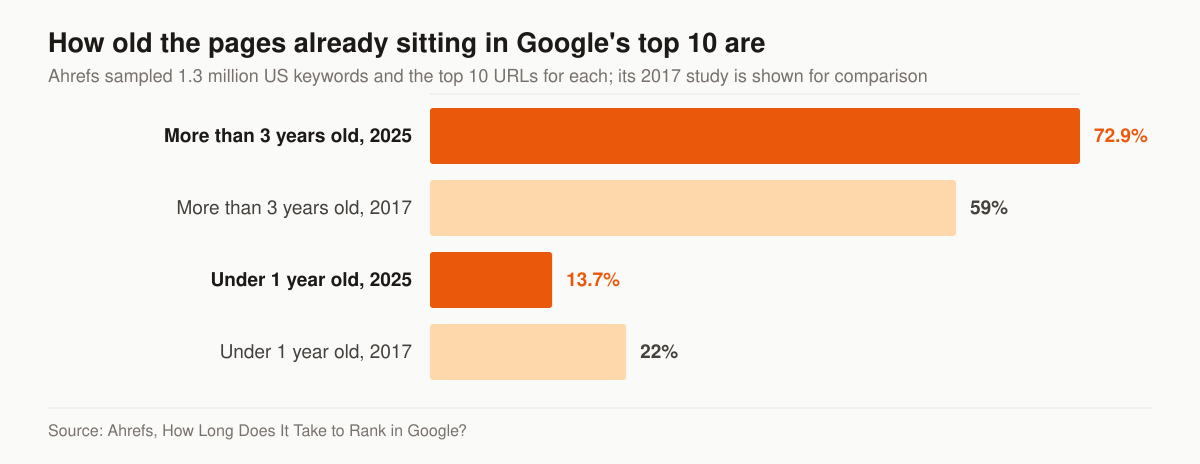
Source: Ahrefs, How Long Does It Take to Rank in Google? And How Old Are Top Ranking Pages?, published May 15, 2025.
Ahrefs sampled 1.3 million US keywords and the top 10 URLs behind each. 72.9% of those pages are more than three years old, up from 59% in its 2017 study, while 13.7% were under a year old, down from 22%. On average, it reports, the #1 ranking page in Google is 5 years old, against 2 years in 2017. The page holding position one for “indexed universal life” has had years of links, revisions and click history poured into it, and no quarterly retainer displaces that. What is available to a page published this month is the long tail — the specific, situational, sceptical questions the incumbents wrote around rather than answered.
IUL is a Your Money or Your Life topic, and Google puts that in writing
This is the part that separates insurance SEO from plumber SEO, and it is written down rather than inferred. Google’s Search Quality Rater Guidelines define the category directly: “Some topics have a high risk of harm because content about these topics could significantly impact the health, financial stability, or safety of people, or the welfare or well-being of society. We call these topics ‘Your Money or Your Life’ or YMYL.” The guidelines then break YMYL into types of harm, one of which is “YMYL Financial Security: Topics that could damage a person’s ability to support themselves and their families.”
An indexed universal life policy is a multi-decade premium commitment with surrender charges, policy loans and a lapse risk. It lands inside that definition without argument. Two consequences follow for the way an IUL page has to be built.
The first is that trust outranks polish. The guidelines state: “Trust is the most important member of the E-E-A-T family because untrustworthy pages have low E-E-A-T no matter how Experienced, Expert, or Authoritative they may seem. For example, a financial scam is untrustworthy, even if the content creator is a highly experienced and expert scammer who is considered the go-to on running scams!” Google’s own public documentation on helpful content puts the same idea in one line: “Of these aspects, trust is most important.”
The second is that anonymity is penalised by name. The guidelines instruct raters that “Pages on YMYL topics and other pages that require a high level of user trust should receive a Low rating if there is an unsatisfying amount of information about who is responsible for the website or who created the content.” That sentence is the reason a nameless IUL blog with a stock-photo author box struggles no matter how well the keywords are placed.
This table maps each quality-rater criterion onto the page element that satisfies it on an IUL site.
| What the rater guidelines look for | What that means on an IUL page |
|---|---|
| Who is responsible for the website | A named agency or agency owner, a real business address, and a contact route that reaches a person |
| Who created the content | A byline for the licensed producer, with state licence detail and the lines they actually place |
| Adequate experience for the topic | Explanations that could only be written by someone who has walked a client through an illustration |
| Adequate expertise | Correct handling of caps, participation rates, the floor, cost of insurance and loan mechanics |
| A trustworthy source for the topic of the page | IUL content on an insurance marketing site, not bolted onto an unrelated domain |
| Contact and customer-service information | A phone number and a form that resolve, not a bare email capture |
The practical read is encouraging rather than discouraging. Every one of those rows is something an actual licensed producer already has and a content farm does not. The producer’s own explanations are the asset; our job is to get them published in a structure search engines and answer engines can lift.
The page structure that ranks (and gets cited by AI)
Ranking IUL content is not about word count. It is about being the most extractable answer on the page. Four rules:
- Lead each section with a direct 40–60 word answer, then expand. Search engines and AI engines both lift that opening passage.
- Use one comparison table per page. IUL buyers compare obsessively; tables match that intent and get pulled into AI Overviews.
- Ship 5–10 real questions with real answers. Write them as the prospect asks them, in their words, and answer in the first sentence. The question-and-answer block earns its place as a passage an engine can quote, not as markup — see the next section for why that distinction now matters.
- Keep it factual. Hype gets filtered; plain, numerate explanation gets ranked and cited.
That last rule is also the compliance rule. IUL marketing has to stay factual — no “get rich,” no guaranteed-return framing, honest illustration of non-guaranteed values. We cover the line-by-line version in our guide to marketing IUL compliantly, and the messaging angle in how to talk about tax-free retirement. We build the pages; the agent is the licensed party.
The FAQ rich result you were told to chase no longer exists
If your current SEO vendor is still quoting FAQ schema as a deliverable, the deliverable has been discontinued. Google’s Search Central changelog entry of May 8, 2026 reads: “This feature will no longer appear in Google Search starting May 7, 2026.” On June 15, 2026 Google removed the supporting documentation with the note: “The FAQ rich result feature is no longer shown in Google Search results, as announced in the changelog entry in May 2026.”
That kills a tactic, not a format. Question-and-answer sections still do three things worth paying for on an IUL page. They force the writer to answer the objection in one sentence instead of three paragraphs. They give an answer engine a clean passage to quote, which is how a firm gets named in a response rather than merely linked. And they surface the questions a producer keeps fielding on calls, which is an editorial calendar the producer already has and does not have to research.
What changes is the reporting conversation. A vendor who was showing you FAQ rich-result impressions has lost the metric, and if the response is to add another schema type nothing improves. The honest replacement is Search Console query data: which IUL questions your pages now collect impressions for, at what average position, and which of those questions deserve a page of their own. That is the loop, and it runs the same whether or not any rich result is attached to it.
What Google says actually gets a page into AI Overviews and AI Mode
Before you buy an AI-search product, read what Google publishes about how these features choose pages. Its guide for site owners states: “There are no additional requirements to appear in AI Overviews or AI Mode, nor other special optimizations necessary.” On the technical bar: “To be eligible to be shown as a supporting link in AI Overviews or AI Mode, a page must be indexed and eligible to be shown in Google Search with a snippet, fulfilling the Search technical requirements. There are no additional technical requirements.” And on the files and markup being sold around this: “You don’t need to create new machine readable files, AI text files, or markup to appear in these features. There’s also no special schema.org structured data that you need to add.”
Google also describes the mechanism, which is the part with a real implication for an IUL content plan: “Both AI Overviews and AI Mode may use a ‘query fan-out’ technique — issuing multiple related searches across subtopics and data sources — to develop a response.” A fan-out rewards a site that has a separate, thorough page for each subtopic — how index crediting works, what a policy loan costs, what happens at lapse — over one long page that mentions all of them. That is the argument for building a cluster rather than a monolith, and it is the same argument insurance content marketing makes for every other line.
Ranking and citation also turn out to be closely tied. Ahrefs analysed 1.9 million citations across 1 million AI Overviews and found that 76.10% of AI Overview-cited pages rank in the top 10, 9.50% rank between positions 11 and 100, and 14.40% do not rank in the SERPs (Ahrefs, 76% of AI Overview Citations Pull From the Top 10). Read that as permission to stop buying two separate programs. Classic ranking work is the majority route into the AI answer. Where the surfaces genuinely diverge — prompt-shaped queries, brand mentions off your own domain — is the ground our AI search and GEO service covers, and the tactical version for agents is in how to get your insurance agency recommended by ChatGPT.
Publishing 200 AI-written IUL pages is a named spam policy
The tempting shortcut in a long-tail niche is volume: generate a page for every phrasing and let the tail do the work. Google names that behaviour explicitly. Its spam policies define scaled content abuse as “when many pages are generated for the primary purpose of manipulating search rankings and not helping users,” adding that “This abusive practice is typically focused on creating large amounts of unoriginal content that provides little to no value to users, no matter how it’s created.” The listed examples include “Using generative AI tools or other similar tools to generate many pages without adding value for users,” “Stitching or combining content from different web pages without adding value,” and “Creating multiple sites with the intent of hiding the scaled nature of the content.”
Note the clause that does the work: no matter how it’s created. The policy is not anti-AI, it is anti-unoriginal-at-scale. A drafting tool used to get a producer’s own explanation onto the page faster is outside it. Hundreds of near-identical city pages about indexed universal life are inside it.
The IUL-specific version of the risk is worse than a ranking loss. A page that generalises about caps, loan interest or tax treatment because nobody with a licence read it is a compliance exposure with the producer’s name on it, not the vendor’s. Our position on this is a rule rather than a preference: a page ships when a licensed producer has read it and the carrier-approved language is in place. That constraint is also why we cap output per month rather than selling article counts — the throughput number some agencies lead with is the number that creates this problem.
What to do when the keyword tool returns no volume
Run an IUL keyword set through a research tool and a lot of it comes back at zero or “not enough data.” It is easy to read that as proof the niche has no search demand and go back to buying clicks. The reading is wrong in a specific way that is worth understanding, because it is where a small agency’s advantage lives.
Volume estimates are modelled from a sample, and the sample thins out fast at the tail. A phrase reported as zero can still be typed by real people every month — it just cannot be measured reliably at that resolution. Meanwhile the commercial value per visitor in this niche runs the other way from volume. An IUL case is a target-premium sale, not a small monthly term premium, so a page that brings in a handful of the right readers a month can still pay for itself — and it does so without the per-click cost that makes the same term expensive to buy.
This table shows the four inputs we weigh in place of the volume column when we scope an IUL content cluster.
| Input | What we look at | Why it beats raw volume |
|---|---|---|
| Question reality | Does a producer actually get asked this on calls? | Proves demand the tool cannot sample |
| Buyer stage | Research, comparison, objection, or ready-to-talk | Decides whether the page’s job is trust or booking |
| Case size | Target premium the question implies | A low-volume page can still carry the month |
| SERP occupancy | Whether carriers and comparison sites already own it | Tells you if a page has room to land |
Once the pages are live, the volume question answers itself properly. Search Console reports the queries your pages actually collected impressions for, in your market, at your position — a first-party sample that no third-party estimate can match. That report is where the second wave of pages comes from. The broader method is in insurance SEO keywords, and the local slice of it, for agents who want “IUL agent [city]” as well as the national questions, is handled through local SEO for insurance agents.
What to measure, and when each number becomes readable
SEO reporting fails IUL programs in a predictable way: the agency reports traffic, the producer wants cases, and nobody agrees on what month three should look like. Fix that by agreeing up front which number is legible when.
This table sets the reporting sequence for an IUL SEO program, ordered by the point at which each figure starts telling the truth.
| Metric | What it tells you | When it becomes reliable |
|---|---|---|
| Pages indexed | Whether the work is even eligible to rank | Week two to four |
| Impressions by query | Which IUL questions Google is matching you to | Month one to two |
| Average position on tracked queries | Whether the pages are climbing or stuck | Month two to four |
| Organic clicks to money pages | Whether titles and answers earn the click | Month three to six |
| Booked appointments from organic | Whether the traffic is the buyer you wanted | Month four onward |
| Issued cases attributed to organic | The number that pays you | Month six onward |
Two build requirements make that sequence possible, and both are marketing work. Organic has to be separated from paid and referral in the CRM at the point of lead capture, and the case outcome has to be written back against the source. Without the write-back, an IUL program gets judged on clicks forever, because nothing further down the funnel ever reaches the report. The same instrumentation feeds IUL appointment setting.
Where SEO fits next to your other IUL marketing
SEO is one spoke. It works best wired to the rest of the system:
- Paid for speed, SEO for durability. Run IUL Facebook ads to fill the calendar this quarter while organic pages mature.
- Capture the demand once it converts. A ranking page is worthless if the IUL agent website it points to does not convert.
- Turn inbound interest into booked time with appointment setting so SEO traffic does not leak.
- Feed the engine with a steady content marketing cadence — the cluster, not the single page, is what Google rewards.
The full playbook lives on our IUL marketing pillar, and the mechanics of organic generation are detailed in how to generate IUL leads with marketing. For the technical and AI-search side of search — schema, passage structure, crawlability — see our global insurance SEO service and our work on AI search and GEO.
What IUL SEO costs, and which tier the work sits in
Our rates are published rather than quoted, and they do not move by niche. Managed programs run $2,500 per month at Foundation, $3,500 at Growth and $5,500 at Full-Funnel, with a one-time website build of $2,500–$8,000. Ad spend is billed at cost, straight to Google or Meta, and never marked up. Programs run month to month.
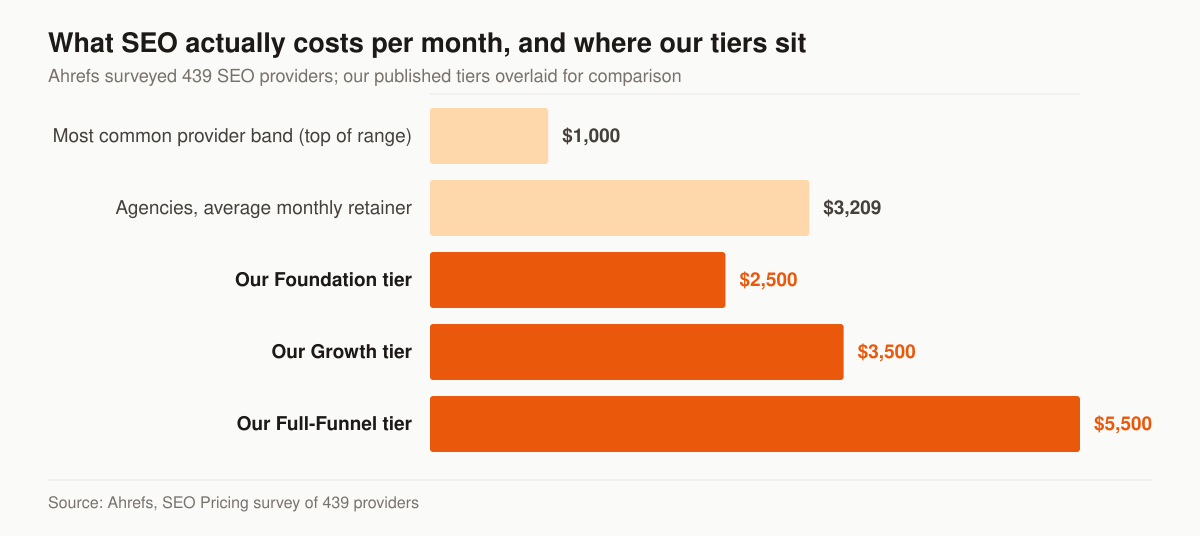
Source: Ahrefs, SEO Pricing: How Much Does SEO Cost?, a poll of 439 people, with our published tiers overlaid. Ahrefs reports $3,209 per month as the agency average and $501–$1,000 as the “most popular monthly retainer rate”, charged by 20.4% of respondents.
This table shows where the IUL search work described on this page actually sits across the three published tiers.
| Tier | Monthly | What it carries for an IUL search program |
|---|---|---|
| Foundation | $2,500 | Optimized website and landing pages, local SEO and Google Business Profile, on-page SEO, monthly reporting |
| Growth | $3,500 | Everything in Foundation, plus the ongoing SEO and content engine, AI-search visibility, and reputation and reviews |
| Full-Funnel | $5,500 | Everything in Growth, plus managed paid ads, landing-page CRO, marketing automation and CRM, full-funnel reporting |
An IUL search program that has to publish the question corpus and be visible in AI answers is a Growth engagement, because the content engine and the GEO work both sit at that tier. Foundation is the right start when the site itself is the constraint and there is nothing worth ranking yet. Full-Funnel is the step you take once the answers are published and you want paid ads and CRO running on top of them. The tier-by-tier detail, including what the monthly fee does not include, is on the pricing page, and the arithmetic against commission rather than clicks is in our insurance agency marketing budget guide. The general cost picture across insurance verticals is in SEO for insurance agents.
Where IUL SEO programs stall
Four things go wrong often enough in IUL search programs to be worth checking before anything technical.
The corpus is one page. A single 4,000-word IUL guide tries to serve research, comparison, objection and local intent at once, and the fan-out described above has nothing separate to match. Split it by question.
Nobody’s name is on it. The pages are competent and anonymous, on a YMYL topic where the rater guidelines call for a Low rating when there is an unsatisfying amount of information about who is responsible. The fix costs nothing but a producer byline and a real contact route.
The site is publishing but never revising. New pages go up monthly while the pages from six months ago sit at position 14 collecting impressions nobody reads. Given the ranking curve above, Ahrefs’ six-month review point argues for reworking those pages before writing the next one.
The traffic lands somewhere that cannot book. Ranking is the cheap half. If the destination page buries the calendar link under three scroll-lengths of product explanation, the program produces readers rather than appointments — which is the argument for treating IUL web design as part of the SEO budget rather than a separate project. If you want that read on your own site before committing to anything, get in touch.
SEO vs. buying leads: pick the right tool
These are not competitors; they solve different timing problems. SEO builds an asset that compounds. Buying leads fills the calendar now. If you need volume this week while your pages mature, you can buy leads direct from getinsureleads and taper purchased volume as rankings come up. We do not sell leads on this site — we build the marketing systems that make organic the cheaper channel over time, the same approach that holds our senior-market book at a low blended cost.
Want to see what IUL terms you could realistically rank for, and how far behind your competitors’ organic footprint is? Start with a free marketing audit and we will show you the gap in numbers, not adjectives.