Who we serve
IUL Agent Website Design and Funnels That Book Appointments
IUL agent website design and funnels are judged on one thing: qualified appointments booked per hundred visitors, not looks. A pretty brochure loses to a plain three-page funnel, because the funnel asks for one action. We build IUL sites as conversion systems, a focused offer, a lead magnet, a booking step, and follow-up automation.
Free · 15-minute teardown · no pitch deck
- We run our own final-expense book
- No pitch deck — we screen-share real numbers
- TCPA-aware · CMS/AEP-compliant · Meta Special Ad Category
- Core Web Vitals < 2.0s LCP
It is easy to pay for a website that looks like a business card and converts like one. The problem is not the design taste — it is that the site was never built as a funnel. A funnel has a job: take a visitor, make one offer, capture the lead, and book the call. Everything else is decoration.
We build IUL agent website design and funnels the way we build landing pages for our own senior-market lead operation — measured by appointments per 100 visitors, not by how the homepage feels. We run our own live lead campaigns, so the method comes from operating a book, not theorizing about one. The same conversion systems and ad discipline carry over directly to indexed universal life.
There is a second thing an IUL site is, before it is a design at all: it is an advertisement for a life insurance policy, and the state code has an opinion about what it may say. That constraint shapes the page structure more than any layout trend does, so this guide covers both halves — the funnel mechanics that produce booked appointments, and the rules the words on the page have to survive.
What an IUL funnel actually is
A funnel is four moving parts working in sequence. Skip one and the math breaks.
- A focused landing page — one offer, one audience, one call to action. No menu of nine services competing for attention.
- A lead magnet — a tax-advantaged-retirement guide, a “is IUL right for you” quiz, or a short illustration request. Something worth an email.
- A booking step — a calendar the prospect can self-schedule on, so a warm lead never cools waiting for a callback.
- Follow-up automation — email and SMS sequences that reach the people who read, leave, and never book on the first visit.
Your broader brand site can live behind this. But the booked appointment comes from the funnel, and the funnel is what we design first.
The reason the sequence matters is that each step has a different failure mode, and they are not interchangeable. A landing page fails by being about you. A lead magnet fails by being worth less than an email address. A booking step fails by adding a human handoff where a calendar would do. Follow-up fails by never being written. Fixing the wrong one is how a rebuild produces a prettier site with the same appointment count.
Brochure site vs. conversion funnel
This table sets the two builds side by side on the six decisions that actually separate them, so you can tell which one you are currently paying for.
| Element | Typical brochure site | IUL conversion funnel |
|---|---|---|
| Primary goal | “Look professional” | Book a qualified appointment |
| Calls to action | “Contact us” (vague) | Get the guide → book the call |
| Lead capture | One contact form, buried | Lead magnet + calendar, above fold |
| Follow-up | None | Automated email/SMS sequence |
| Measurement | Page views | Visitors → leads → booked calls |
| Iteration | Rebuilt every few years | Headline, offer, and form tested monthly |
The difference is not budget. It is intent. A site built to book appointments is structured completely differently from one built to exist.
Where IUL needs special handling
Indexed universal life invites hype, and hype invites compliance and reputational risk. We keep the marketing factual: no “guaranteed returns,” no “get rich,” no implied market upside without the caps, costs, and surrender mechanics that come with the product. The copy explains the mechanism — tax-deferred cash value growth with downside protection and a cap — and lets the agent make the licensed recommendation. We provide the marketing services; you are the licensed party.
For deeper compliance framing, our team writes about marketing IUL without tripping suitability rules and how to position tax-free retirement honestly.
Your state’s advertising rule reaches the website, not just the mailer
It is tempting to picture the advertising rule as something that governs a direct-mail piece. Read the definition and the web page is inside it. Missouri’s rule on advertisements of life insurance and annuities, 20 CSR 400-5.100, defines an advertisement as material designed to create public interest in life insurance or annuities or to induce the public to purchase a policy, and lists the media it covers as material “used in direct mail, newspapers, magazines, radio and television scripts, telemarketing scripts, billboards and similar displays, and the Internet or any other mass communication media”. Its applicability clause is short: “This rule shall apply to any life insurance or annuity advertisement intended for dissemination in this state.”
This is Missouri’s rule, not a national one. The version that binds you is your own state’s, and the states differ in detail. Missouri is used here because its text is published in full and because it names, in one sentence, the party who carries the exposure. Section (2)(B) reads: “All advertisements, regardless of by whom written, created, designed, or presented, shall be the responsibility of the insurer, as well as the producer who created or presented the advertisement.”
That sentence is the reason we do not treat the copy on an IUL page as a design decision. Your web designer is not named in it. You are.
This table maps the clauses of Missouri’s rule that most directly constrain what an IUL landing page is allowed to say, so the copy can be written against them rather than edited after a complaint.
| Clause | What it restricts | What that means on the page |
|---|---|---|
| (3)(A) | Advertisements “shall be truthful and not misleading in fact or by implication” | The director judges it from the overall impression on a person of average education or intelligence within the audience the page is directed at, not whether a disclaimer sits somewhere on it |
| (3)(B) | Named terms including “investment,” “savings,” “savings plan,” “private pension plan,” “retirement plan” | Headlines built on those nouns need to be re-read against the rule’s condition clause, not deleted reflexively |
| (4)(D) | Policy names that omit the words “life insurance” | A policy name used anywhere on the page has to make clear it is life insurance |
| (4)(E) | “An advertisement shall prominently describe the type of policy advertised” | The page says indexed universal life, in the body, not only in the footer |
| (4)(I)6 | The term “vanish,” “vanishing premium,” or similar | Copy implying premiums stop is out, however it is phrased |
| (4)(J) | Analogies between cash value and savings accounts or other investments | Comparison sections have to be “complete and accurate”, and may not tip the reader into thinking the policy is something other than life insurance |
| (4)(O)3 | Illustrations or statements based on nonguaranteed elements | Guaranteed columns get “equal prominence”, not a smaller font below the fold |
| (4)(O)6 | Any reference to a nonguaranteed element | The page has to indicate the insurer reserves the right to change it “at any time and for any reason”, unless it has agreed to limit that right, which the page may then say |
| (4)(Q) | Testimonials, appraisals, analysis, endorsements | They must be genuine, current, applicable to the policy, and accurately reproduced; financial interest gets disclosed |
| (4)(R) | Statistics about an insurer or policy | “The source of any such statistics used in an advertisement shall be identified” |
Two of those rows deserve a longer look because they are where IUL marketing copy usually goes wrong.
The first is the prohibited-terms clause. Section (3)(B) does not ban the word “retirement plan” outright — it bans using it, and a list of similar terms, “in connection with a policy in a context or under such circumstances or conditions as to have the capacity or tendency to mislead a purchaser or prospective purchaser of such policy to believe that s/he will receive, or that it is possible that s/he will receive, something other than a policy or some benefit not available to other persons of the same class and equal expectation of life”. The condition is doing the work. A page that explains the policy correctly and then uses the phrase descriptively is a different document from a page whose headline sells a retirement plan and mentions life insurance in a footnote. Reading the clause without its condition produces both bad copy and bad compliance advice.
The second is nonguaranteed elements, which is the whole marketing problem of indexed universal life compressed into one subsection. Missouri’s (4)(O)2 states that an advertisement “shall not state or imply that the payment or amount of nonguaranteed elements is guaranteed.” Its (4)(O)3 requires, unless otherwise specified in the state’s illustration statutes, that an advertisement based on nonguaranteed elements “shall set forth, with equal prominence comparable illustrations or statements containing or based upon the guaranteed elements.” Equal prominence is a layout instruction. It is the reason a credible IUL page shows two columns rather than one, and the reason a designer who has never read the rule will build the wrong hero section.
There is also a naming trap worth flagging before you write an about page. Section (4)(N) restricts an insurance producer from using terms such as “financial planner,” “investment adviser,” “financial consultant,” or “financial counseling” in a way that implies the producer is generally engaged in an advisory business in which compensation is unrelated to sales, unless that is the case — with carve-outs for holders of a recognized financial planning or consultant designation and for members of trade associations whose names contain such terms. Bio copy is where that clause gets tripped, not sales copy.
What the consent line under the form has to say
The funnel captures a phone number, and then something calls or texts it. That is where federal rules enter the build. The FCC’s telephone-solicitation rules at 47 CFR 64.1200 are the ones a lead form has to be designed against, and the operative definition is in paragraph (f)(9): prior express written consent means “an agreement, in writing, bearing the signature of the person called that clearly authorizes the seller to deliver or cause to be delivered to the person called advertisements or telemarketing messages using an automatic telephone dialing system or an artificial or prerecorded voice, and the telephone number to which the signatory authorizes such advertisements or telemarketing messages to be delivered.”
Two disclosures ride along with it. Paragraph (f)(9)(i)(A) requires the written agreement to include a clear and conspicuous disclosure that by executing it the person authorizes the seller to deliver telemarketing calls “using an automatic telephone dialing system or an artificial or prerecorded voice”. Paragraph (f)(9)(i)(B) requires disclosure that the person “is not required to sign the agreement (directly or indirectly), or agree to enter into such an agreement as a condition of purchasing any property, goods, or services.” Paragraph (f)(9)(ii) settles the signature question: an electronic or digital form of signature counts, “to the extent that such form of signature is recognized as a valid signature under applicable federal law or state contract law”.
Note what the rules actually attach to. Paragraph (a)(2) prohibits initiating a call “that includes or introduces an advertisement or constitutes telemarketing, using an automatic telephone dialing system or an artificial or prerecorded voice” to the lines listed in (a)(1)(i) through (iii) — which include “any telephone number assigned to a paging service, cellular telephone service, specialized mobile radio service, or other radio common carrier service” — other than a call made with prior express written consent, with narrow exceptions the rule names for tax-exempt nonprofits and certain HIPAA-covered health care messages. Separately, paragraph (c)(1) bars telephone solicitations to a residential subscriber “before the hour of 8 a.m. or after 9 p.m. (local time at the called party’s location),” and (c)(2) covers numbers on the national do-not-call registry.
This table turns those clauses into the four build decisions they imply, because each one is a thing the form has to do rather than a thing the copy has to say.
| What the rule turns on | The build decision it forces |
|---|---|
| Consent is an agreement in writing bearing a signature | The submit event is the signature; the form has to store what was agreed to, not just the checkbox state |
| Consent names the telephone number | The number field and the consent record are stored together, on the same submission |
| Disclosures must be clear and conspicuous | The consent text sits next to the button at readable size, not behind a link |
| Consent may not be a condition of purchase | The consent checkbox cannot be the same control as the form’s required fields |
Two honest limits on this section. The rules quoted here are the FCC’s, written in the language of telephone calls; how they reach a text sequence, and what your carriers and your state add on top, is a question for your counsel rather than your web developer. And a consent record is only worth what your storage can prove later, which is why the CRM write-back matters more than the wording. Our broader treatment of the same problem on the buying side is in TCPA compliance for insurance agents buying leads. We build to these rules and flag what we see; the licensed party signs off.
The capture step, and what a badly labelled field costs
Once the legal text is settled, the form itself is an engineering problem, and the crawl data says the baseline is low. The HTTP Archive’s 2024 Web Almanac crawl found that 61% of mobile sites have inputs with no label, that 57% of mobile sites use placeholders alone in place of a label, and that only 15% of mobile sites use the <label> element, down from 19% in 2022. On required fields, 65% of mobile sites use the HTML required attribute, 40% use aria-required, and 19% still rely only on an asterisk.
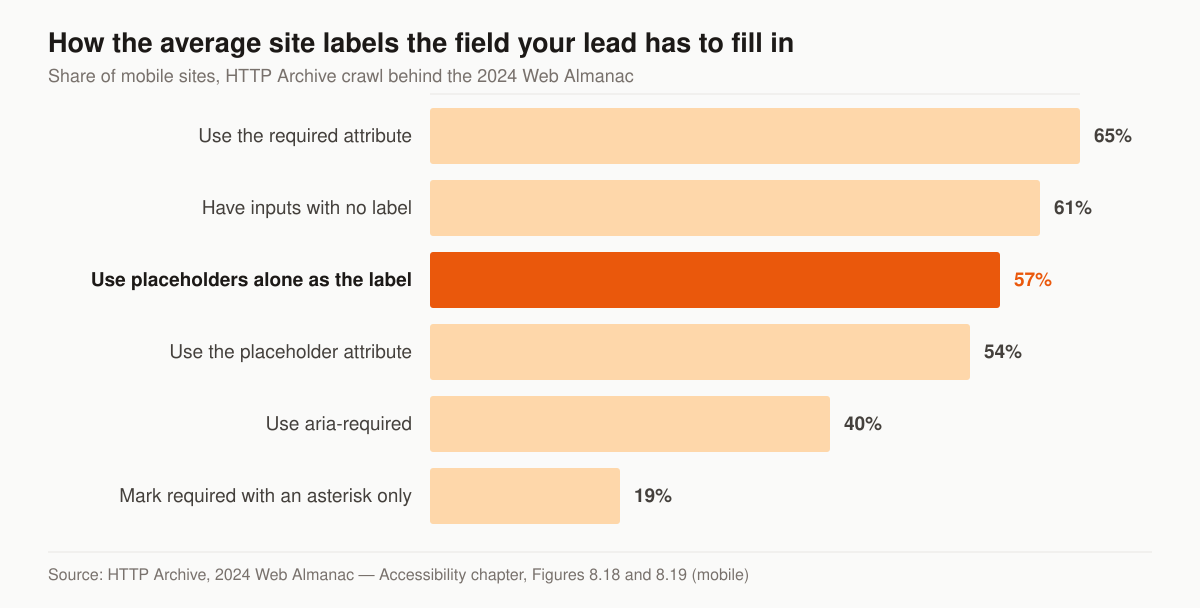
Source: HTTP Archive, 2024 Web Almanac — Accessibility chapter, Figures 8.18 and 8.19, mobile column.
The placeholder finding is the one with money attached, and the Almanac states the mechanism plainly: “When placeholders are the only way of providing a visible label, that reference point disappears when the user starts typing.” Picture the IUL prospect it happens to. They are on a phone, they have typed a first name into a field whose only label has now vanished, and the next field is grey and empty. Every second of that is a chance to close the tab. The fix is not a redesign; it is a visible <label> above each input, which costs nothing and survives every future template change.
The same discipline applies to how many fields exist at all. An IUL funnel form is not an application. It captures what the follow-up needs to run and what a producer needs to decide whether the call is worth taking, and it moves everything else to the conversation. Every field past that is one more thing to abandon on a phone.
What conversion rate to measure an IUL funnel against
The honest answer to “what should this convert at” is a published benchmark plus your own numbers, in that order. Unbounce’s conversion benchmark report for its finance and insurance category puts the median landing-page conversion rate at 8.3%, with the insurance subcategory inside it at 18.2% and the investing subcategory at 3.9%. The same report gives a median of 11.5% on mobile against 9.0% on desktop, and names 195 to 715 words as its recommended page length range.
Read those with care, because the mismatch to an agent site is instructive. Those are landing pages built for a single campaign, not agency homepages, and the wide spread between subcategories says the offer, not the layout, is what moves the number. We plan an IUL page against the investing end of that spread rather than the insurance end, because the buyer is researching a decision rather than replacing an expiring policy — so we design the first conversion as a request for information, not a request for a quote.
That is also why we build the reading level down rather than up. The same Unbounce report breaks conversion out by reading level, and finance and insurance pages written at a fifth-to-seventh-grade level record the highest median in the set at 18.1%, against 7.1% for college-level pages.
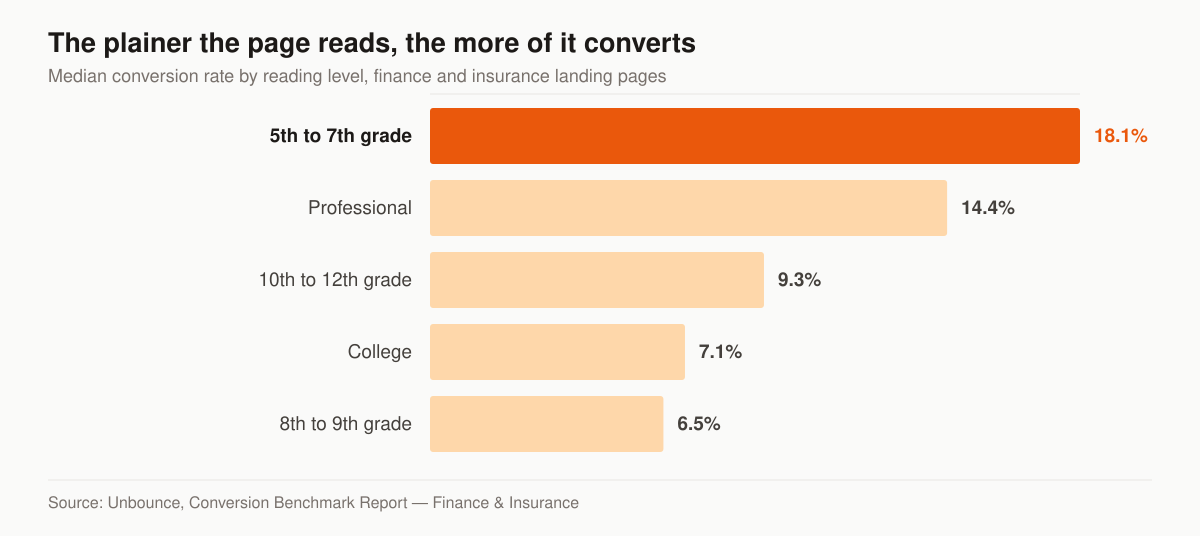
Source: Unbounce, Conversion Benchmark Report — Finance & Insurance.
Plain language is not dumbing the product down. Caps, participation rates, the floor, cost of insurance and loan mechanics can all be explained in short sentences, and the version that reads plainly is also the version that survives the “misleading by implication” test in the advertising rule. The compliance constraint and the conversion constraint point the same direction, which is rare and worth using.
How fast the page has to be before any of this matters
Speed is a floor, not a lever. Google’s guidance on Largest Contentful Paint is that “sites should strive to have Largest Contentful Paint of 2.5 seconds or less”, assessed at “the 75th percentile of page loads, segmented across mobile and desktop devices.” LCP itself “reports the render time of the largest image, text block, or video visible in the viewport, relative to when the user first navigated to the page” — on an IUL landing page that is usually the hero headline or the hero image, which is exactly the element a design brief tends to make heavy.
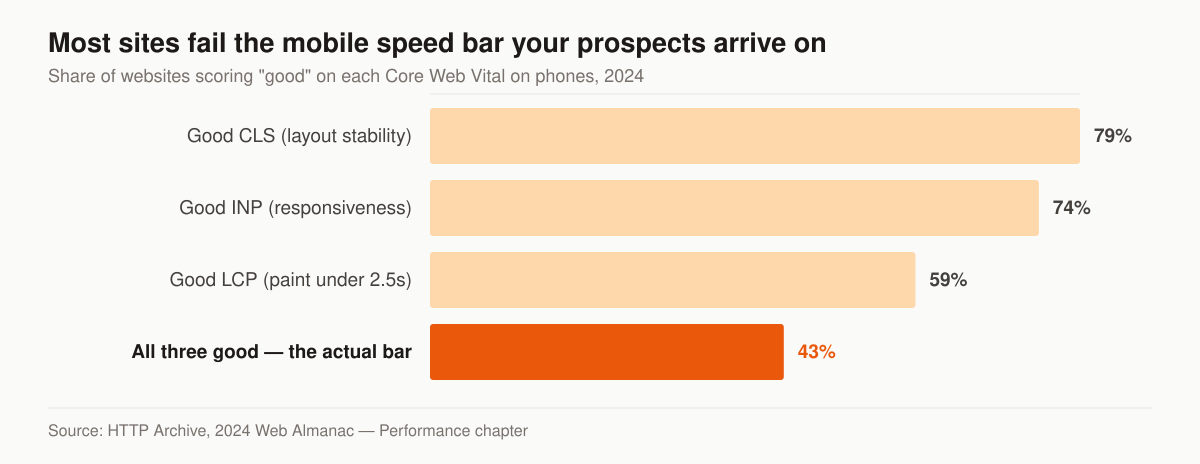
Source: HTTP Archive, 2024 Web Almanac — Performance chapter: 79% of mobile sites scored good on CLS, 74% on INP and 59% on LCP, with 43% of websites achieving a good Core Web Vitals experience overall on mobile.
Treat that 43% as the bar the funnel has to clear, not as a target to celebrate clearing. A fast page that asks for nothing still books nothing. The order of work is: make the offer right, then make the page fast enough that the offer gets read. The technical side of that sits inside our insurance web design service, and the search consequences are covered in how to rank an insurance agency website on Google.
The booking step, and where it leaks
The calendar is where we look first when a funnel produces leads and no appointments. Four leaks are worth checking before anything else, and none of them are design problems.
The calendar is a link, not a step. A thank-you page that says “we’ll be in touch” hands the scheduling job back to you, and the lead cools while it waits. The booking widget belongs on the page the form submits to, already loaded, with the prospect’s name and email pre-filled from what they just typed.
Availability is too thin. A calendar showing two slots next Thursday reads as an unavailable business. The remedy is more open time in the next 48 hours, not a redesign of the booking page.
The confirmation does no work. A confirmation email that repeats the time and nothing else wastes the one message a prospect reliably opens. It should restate what the call will cover, what the prospect should have to hand, and what happens if they need to move it.
Nothing happens to the ones who do not book. A lead who downloaded the guide and skipped the calendar is not a dead lead; they are the reason the follow-up sequence exists. That sequence is a separate build with its own copy, and it is worth confirming it exists rather than assuming a quote covered it.
The human half of that — who calls, when, and what they say — runs through IUL appointment setting, and the sequence itself through insurance email automation.
Rebuild, or repair what you have
Not every underperforming IUL site needs replacing, and a rebuild is the more expensive way to be wrong.
This table gives the four diagnoses we work through before recommending a build, in the order we check them.
| Symptom | Likely cause | Rebuild or repair |
|---|---|---|
| Traffic arrives, nobody submits | The offer, or a form nobody can read on a phone | Repair — new offer and a labelled form |
| Leads submit, nobody books | No booking step, or a booking step behind an email | Repair — put the calendar on the thank-you page |
| Bookings happen, nobody shows | Confirmation and reminder sequence missing | Repair — build the sequence |
| No traffic at all to measure | There is no funnel yet, only a brochure | Rebuild — there is nothing to optimize |
The order matters because each row invalidates the ones below it. Diagnosing a show-rate problem on a page nobody submits to produces a report, not a fix.
How the pieces connect
Website design is one spoke. It works best wired to the rest of the IUL system:
- Start at the IUL agent marketing pillar to see the full strategy.
- Pair the site with IUL appointment setting so booked calls don’t sit unworked, and with IUL Facebook ad campaigns to feed traffic into the funnel.
- Give the funnel something to rank for over time with IUL agency SEO, so ads are not the sole route in.
- The build itself runs through our insurance web design service, which standardizes the funnel structure across verticals, with the page-level work in insurance landing pages and the sequence design in insurance sales funnels.
If your goal is buying IUL or final-expense leads as a product rather than generating your own, that is a different channel — you can buy leads direct from getinsureleads instead of asking your marketing site to do work it isn’t built for.
What we instrument
You should never guess whether the site works. Every funnel ships with tracking on three numbers: visitors, leads captured, and appointments booked. That lets us see the real conversion rate and fix the weakest step — usually the offer or the booking friction, rarely the colors.
Three numbers is the minimum, not the ambition. The reporting gets useful when the case outcome is written back against the source, so an IUL program can be judged on issued premium rather than on form fills. That write-back is a build requirement, not a reporting preference: if the CRM does not separate organic from paid from referral at the point of capture, no later report can reconstruct it.
This table sets out what each funnel number tells you and the step it indicts when it is the one that is low.
| Number | What it measures | What a low reading points at |
|---|---|---|
| Visitors to the landing page | Whether the traffic side is working at all | Ad targeting, budget, or search visibility |
| Lead capture rate | Whether the offer is worth an email | The lead magnet and the form, in that order |
| Booking rate from leads | Whether the calendar step exists and works | Thank-you page, availability, pre-fill |
| Show rate on booked calls | Whether confirmations do their job | Reminder sequence and call framing |
| Issued cases per hundred visitors | The number that pays for the funnel | Qualification, not the website |
Benchmarks are the starting point; your own numbers should replace them as soon as you have enough of them. Compare the first three rows against the published landing-page medians above, and the last two against your own history — we have no published IUL show-rate benchmark to point you at.
What an IUL funnel build costs, and which tier it sits in
Our rates are published rather than quoted, and they do not move by niche. Managed programs run $2,500 per month at Foundation, $3,500 at Growth and $5,500 at Full-Funnel, with a one-time website build of $2,500–$8,000. Ad spend is billed at cost, straight to Google or Meta, and never marked up. Programs run month to month.
This table shows where the IUL funnel work described on this page sits across the three published tiers.
| Tier | Monthly | What it carries for an IUL funnel |
|---|---|---|
| Foundation | $2,500 | Optimized insurance website and landing pages, local SEO and Google Business Profile, on-page SEO, monthly reporting |
| Growth | $3,500 | Everything in Foundation, plus the ongoing SEO and content engine, AI-search visibility, and reputation and reviews |
| Full-Funnel | $5,500 | Everything in Growth, plus managed paid ads, landing-page CRO, marketing automation and CRM, full-funnel reporting |
We scope IUL funnel work as the one-time build followed by Full-Funnel, because landing-page CRO and marketing automation — the two line items that make a funnel iterate rather than just exist — both sit at that tier. Foundation is the right start when there is no credible site to send traffic to yet. Growth is the step for a producer who wants the funnel fed by organic questions rather than only by ad spend.
Four things sit outside the monthly fee: ad spend, third-party costs you authorize, buying leads outright, and legal and compliance sign-off. The last one is the relevant one for this page — we build to state insurance advertising rules and the TCPA and flag what we see, but your counsel approves the disclosures. Full tier detail is on the pricing page, and the arithmetic against commission is in our insurance agency marketing budget guide.
Where IUL funnel builds stall
Four failures are worth ruling out in an IUL website project before anyone opens a design tool.
The site is a rebrand of the carrier’s microsite. It describes the product accurately and asks for nothing. Product explanation is the middle of the funnel, not the top; the top is a question the prospect already has.
The guaranteed column is missing. The page shows an attractive non-guaranteed projection with no comparable guaranteed figure, which fails the equal-prominence requirement quoted above and, separately, fails the reader who was going to ask about it on the call anyway.
The form asks like an application. Date of birth, health questions and coverage amount on a first-touch form belong on a call, not on a landing page reached from an ad.
The follow-up was scoped and never written. The automation exists as an empty sequence in the CRM. It is quick to put right and easy to overlook, because the dashboard shows the automation as active.
Examples of what the finished article looks like in a neighbouring line are collected in insurance agent website examples, and the lead-generation mechanics behind the funnel are in how to generate IUL leads with marketing. If you want a read on your own site before committing to a build, get in touch.
Start with the math, not the mockup
If you want a plain read on what your current site is leaving on the table — visitor-to-appointment rate, where leads leak, what one fixed step would add — request a free marketing audit. We’ll show you the funnel math the way an operator shows the books: numbers first, opinions second. You can also see how this thinking plays out across our agent niches and on the final-expense operation that proves the system.