Tax-Free Retirement Marketing: A Compliant Playbook for IUL Agents
Tax-free retirement marketing works when you sell the question, not the product: lead with 'how the tax code treats this account at withdrawal,' not 'guaranteed tax-free riches.' The agents who win this niche run educational offers — a 7702 explainer, a tax-bracket worksheet — instead of hype, qualify hard for income and time horizon, and keep every claim factual.
Most “tax-free retirement” ads fail for the same reason: they sell a fantasy (“retire tax-free, guaranteed”) instead of a question the prospect is already asking (“how much of my retirement income is the IRS going to take?”). The first gets your ad account flagged and your prospects skeptical. The second fills a calendar. This is a playbook for tax-free retirement marketing that stays compliant, qualifies hard, and actually books appointments.
We don’t sell IUL. We build the marketing systems that put qualified prospects in front of agents who do. And we know what converts because we run a live senior-market lead operation — real campaigns, not stock claims.
One structural note before the tactics. We treat the statute itself as the primary marketing asset in this niche, because the tax code text behind “TFRA” is public, short enough to quote, and free to use. Everything below leans on that: the sections, the tests, the dollar thresholds, and the places where the honest version of a claim is more persuasive than the hyped one.
What “TFRA” and Section 7702 actually mean for your marketing
Before you write a single ad, get the terms straight, because the wrong framing is what gets accounts shut down.
- TFRA (“tax-free retirement account”) is a marketing label, not an IRS product. It almost always means cash value life insurance — usually an IUL — used for retirement income via policy loans and withdrawals.
- Section 7702 is the part of the tax code that defines what qualifies as life insurance. It’s why properly structured cash value can grow tax-deferred and be accessed tax-advantaged. It is also why section 7702 marketing must stay factual — the benefit depends on the policy being structured and maintained correctly.
- A policy funded too aggressively becomes a Modified Endowment Contract (MEC) and loses the favorable loan treatment. That nuance is exactly why “guaranteed tax-free” copy is both inaccurate and a compliance liability.
| Term | What it is | How to use it in marketing |
|---|---|---|
| TFRA | Marketing label for cash-value life insurance | Frame as a strategy, disclose it’s life insurance |
| Section 7702 | Tax code defining life insurance | Use for educational, factual content |
| IUL | The product most TFRA funnels sell | Tie messaging to mechanism, never to hype |
| Roth IRA | The comparison prospects already know | Use as the on-ramp, not a false equivalence |
The honest, higher-converting angle: position the strategy alongside a Roth, not as a magic alternative to it. Prospects trust the agent who says “here’s where this fits and where it doesn’t” over the one promising the moon.
What Section 7702 actually requires, in the statute’s own words
Agents cite “7702” constantly and describe it rarely. Read the operative sentence once and you will never write a lazy version of it again. 26 U.S.C. §7702(a) says “the term ‘life insurance contract’ means any contract which is a life insurance contract under the applicable law, but only if such contract—(1) meets the cash value accumulation test of subsection (b), or (2)(A) meets the guideline premium requirements of subsection (c), and (B) falls within the cash value corridor of subsection (d).”
Two routes, and a policy takes one of them. That is the whole architecture, and it is a better opening slide than any accumulation curve.
The table below is the section every “what is a 7702 plan” search is actually asking about, with the statutory sentence that defines each route.
| Route | The test | The statute’s wording | What it constrains |
|---|---|---|---|
| Cash value accumulation test | §7702(b)(1) | The cash surrender value “may not at any time exceed the net single premium which would have to be paid at such time to fund future benefits under the contract” | Caps cash value relative to the benefit it is funding |
| Guideline premium requirements | §7702(c)(1) | Met only if “the sum of the premiums paid under such contract does not at any time exceed the guideline premium limitation as of such time” | Caps what can be paid in |
| Cash value corridor | §7702(d)(1) | The contract qualifies if “the death benefit under the contract at any time is not less than the applicable percentage of the cash surrender value” | Forces a minimum death benefit above the cash value |
| Failure | §7702(g)(1)(A) | If the contract does not meet §7702(a), “the income on the contract for any taxable year of the policyholder shall be treated as ordinary income received or accrued by the policyholder during such year” | The penalty for meeting neither route |
The corridor is the one with the most useful marketing consequence, because it is a hard number that changes with age. §7702(d)(2) sets the applicable percentage on a scale keyed to “an insured with an attained age as of the beginning of the contract year,” and it steps down from 250% to 100% across life.
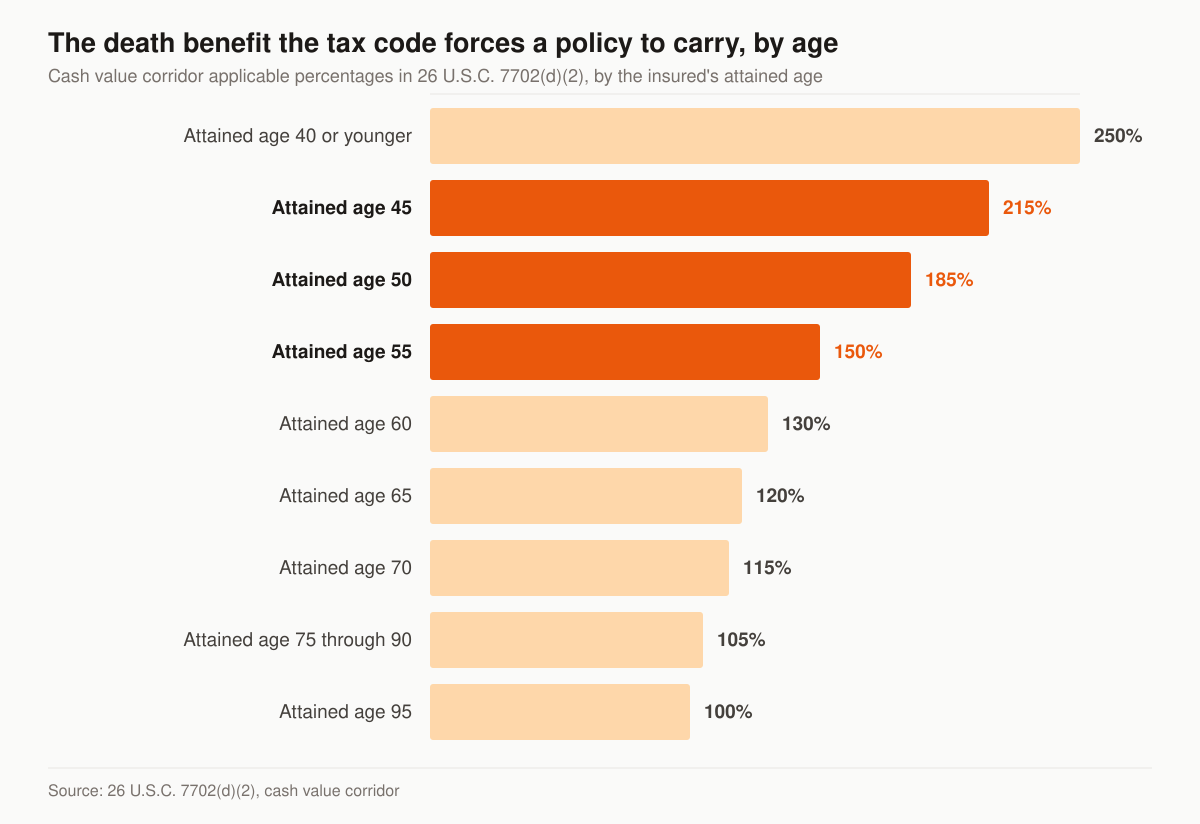
Every percentage is written into the statute. Source: 26 U.S.C. §7702(d)(2), cash value corridor; the applicable percentage decreases by a ratable portion for each full year inside each age band.
Read that chart as a sales conversation rather than a compliance chore. A 40-year-old’s contract has to carry a death benefit of at least two and a half times its cash surrender value; a 70-year-old’s has to carry 115%. That gap is the reason a younger buyer’s policy costs more insurance per dollar of accumulation, and it is a far better answer to “why is my cash value low in year one” than anything a producer can improvise. It is also the cleanest rebuttal to the framing the advertising rules explicitly prohibit — a policy that the tax code forces to carry a death benefit is not a bank account, and the corridor is the receipt.
What changed in 2021, and why it belongs in your copy
Here is a change that is recent, dated and fully sourceable: the interest-rate assumptions inside the definition of life insurance were rewritten at the end of 2020.
The Consolidated Appropriations Act, 2021 — Pub. L. 116–260, div. EE, title II, §205, Dec. 27, 2020 — amended §7702 through four provisions, §205(a) through (d). The codification notes on the section record the substitutions: §205(a)(1) “substituted ‘the applicable accumulation test minimum rate’ for ‘an annual effective rate of 4 percent’”, and §205(b)(1) “substituted ‘the applicable guideline premium minimum rate’ for ‘an annual effective rate of 6 percent’”. Those flat 4% and 6% assumptions had sat in the statute since the 1980s.
What replaced them floats. §7702(b)(3) now defines the applicable accumulation test minimum rate as the lesser of “an annual effective rate of 4 percent” or the insurance interest rate in effect when the contract is issued, and §7702(c)(3)(E) defines the applicable guideline premium minimum rate as that same rate “plus 2 percentage points.” §7702(f)(11)(A) then defines the insurance interest rate as the lesser of the section 7702 valuation interest rate or the section 7702 applicable Federal interest rate for the calendar year — the first tied to “the prescribed U.S. valuation interest rate for life insurance with guaranteed durations of more than 20 years (as defined in the National Association of Insurance Commissioners’ Standard Valuation Law),” the second to a rounded average of applicable Federal mid-term rates over a 60-month lookback period that the same paragraph defines. A transition rule at §7702(f)(11)(E) fixed the insurance interest rate at “2 percent in the case of any contract which is issued during the period that” begins on January 1, 2021 and “ends immediately before the beginning of the first adjustment year that beings” — the statute’s own typo for “begins” — “after December 31, 2021.” That is a bounded window rather than a standing rate: the subparagraph opens “Notwithstanding subparagraph (A),” so contracts issued outside the window take the rate the subparagraph (A) formula produces.
Why this belongs in a marketing playbook rather than an actuarial memo: it is a genuine, dated, sourceable change in the rules that govern the product you sell, and it answers a question your prospect has no other way to research. A short explainer titled “what changed in the tax code behind these policies in 2021” is a better lead magnet than a generic tax-free retirement PDF, because it demonstrates that you read the statute. That is the entire E-E-A-T argument for this niche compressed into one asset, and it is the kind of page that gets pulled into AI answers — the mechanics of which we cover in getting cited by AI search engines.
The compliance guardrail is the same one that applies everywhere else here: describe what the statute changed, not what it will do for the client’s balance.
Why “no contribution limits” is the wrong sentence, and what to say instead
The standard TFRA pitch runs: no contribution limits, no income phase-out, no required minimum distributions. Two of those three are defensible with a source. The first is not, and it is the one that gets repeated hardest.
The tax code does limit funding. It just does it with a design constraint instead of a published annual number. §7702(c)(1) conditions the guideline premium route on premiums never exceeding “the guideline premium limitation,” and §7702A’s 7-pay test converts an over-funded contract into a modified endowment contract, which is precisely the outcome a well-designed accumulation policy is engineered to avoid. Telling a prospect there is no limit and then designing to a limit is a credibility problem waiting for the second appointment.
The other two claims survive contact with the source, and are stronger when you attach it. The IRS states that the RMD rules “apply to all employer sponsored retirement plans, including profit-sharing plans, 401(k) plans, 403(b) plans, and 457(b) plans,” and to traditional IRAs, that you “generally must start taking withdrawals from your traditional IRA, SEP IRA, SIMPLE IRA, and retirement plan accounts when you reach age 73,” and that the rules “do not apply to Roth IRAs or Designated Roth accounts while the owner is alive.”
These are the 2026 numbers a prospect can verify in under a minute, which is exactly why you should be the one who gives them.
| Vehicle | 2026 annual funding limit | Income phase-out | Distributions required in the owner’s lifetime |
|---|---|---|---|
| Traditional or Roth IRA | $7,500, or $8,600 at age 50 and older (IRS) | Roth: $153,000–$168,000 single or head of household; $242,000–$252,000 married filing jointly (IRS) | Traditional IRA yes, generally from age 73; Roth IRA no |
| 401(k), 403(b), governmental 457 | $24,500 elective deferral; $8,000 catch-up at 50 and older; $11,250 at ages 60 through 63 (IRS) | None on the deferral itself | Yes for the traditional account; not for a designated Roth account while the owner is alive |
| Cash value life insurance under §7702 | No published dollar cap; funding constrained by the guideline premium limitation and the 7-pay test | None stated in §7702 | None in §7702 |
Sources: IRS, IR-2025-111 (November 13, 2025), IRS IRA contribution limits and IRS required minimum distributions FAQs. Note the third row carefully: “no published dollar cap” is a different sentence from “no limit,” and the difference is your credibility.
That Roth phase-out band is also the sharpest targeting instrument in the niche. A single filer above $168,000 of modified AGI, or a couple above $252,000, is a person for whom the direct-Roth door is closed by a number the IRS publishes. That is a qualification criterion you can put on a form without asking anybody to disclose a net worth.
The offers that convert tax-free retirement leads
Lead-gen in this niche lives or dies on the offer. “Get a free quote” is a weak ask for a complex product. Educational offers qualify intent and keep you compliant.
- The 7702 explainer. A 2-page PDF or short video: “How the tax code treats this account at withdrawal.” It pre-frames the conversation and filters out tire-kickers.
- The taxable-income worksheet. “How much of your retirement income is actually taxable?” People who complete it are self-identifying as planners.
- The 15-minute strategy call. Gated by income and time-horizon questions so your calendar isn’t full of 22-year-olds with no surplus to fund a policy.
- The threshold sheet. One page listing the published dollar lines that change a retiree’s tax bill — the Social Security and Medicare figures in the next section — with the year and the agency next to each. It is the cheapest asset on this list and the easiest one to keep accurate.
Whatever the offer, your form should ask the qualifying questions up front — age band, investable surplus, retirement timeline. That’s the difference between a busy calendar and a productive one. The mechanics of building these funnels — the landing page, the ad creative, the follow-up — are what our IUL and tax-free retirement marketing service is built around, and the page these offers land on is a build in its own right, which is why we treat landing pages as a separate discipline from ads.
The tax question your prospect is already carrying
The worksheet offer above only works if the worksheet contains something. It should contain the thresholds, because the thresholds are where a retiree’s tax bill actually turns — and because they are public, dated and easy to cite.
Start with Social Security. Under 26 U.S.C. §86(c), the base amount is “$25,000” for a single filer and “$32,000 in the case of a joint return,” and the adjusted base amount at which a larger share of benefits becomes includible is “$34,000” and “$44,000 in the case of a joint return.” The Social Security Administration puts the same test in plain language: “You will pay federal income taxes on your benefits if your combined income (50% of your benefit amount plus any other earned income) exceeds $25,000/year filing individually or $32,000/year filing jointly.”
Two details make this a content asset rather than a footnote. First, the figures appear in the statute as flat dollar amounts with no inflation-adjustment provision attached to them, so unlike the IRA limits above they do not move each year. Second, §86(b)(2) defines the modified adjusted gross income in that test as adjusted gross income “increased by the amount of interest received or accrued by the taxpayer during the taxable year which is exempt from tax” — so tax-exempt interest is added back when the threshold is measured, which is a clause worth walking a prospect through line by line.
Then Medicare. CMS set the 2026 standard Part B premium at $202.90 a month with an annual deductible of $283, and the premium climbs in steps above a modified-AGI line. SSA describes the mechanism directly: higher-income beneficiaries “pay monthly Part B premiums equal to 35%, 50%, 65%, 80%, or 85% of the total cost,” using a MAGI that SSA defines as “your total adjusted gross income and tax-exempt interest income,” drawn from a return two years back — “Generally, this information is from a tax return filed in 2025 for tax year 2024.”
Print this table on the worksheet and the appointment sets itself, because the steps are cliffs rather than slopes.
| 2026 modified AGI, individual return | 2026 modified AGI, joint return | Part B monthly premium | Add-on for prescription drug coverage |
|---|---|---|---|
| $109,000 or less | $218,000 or less | $202.90 | None |
| Above $109,000 up to $137,000 | Above $218,000 up to $274,000 | $202.90 + $81.20 | Plan premium + $14.50 |
| Above $137,000 up to $171,000 | Above $274,000 up to $342,000 | $202.90 + $202.90 | Plan premium + $37.50 |
| Above $171,000 up to $205,000 | Above $342,000 up to $410,000 | $202.90 + $324.60 | Plan premium + $60.40 |
| Above $205,000 and under $500,000 | Above $410,000 and under $750,000 | $202.90 + $446.30 | Plan premium + $83.30 |
| $500,000 or more | $750,000 or more | $202.90 + $487.00 | Plan premium + $91.00 |
Sources: CMS, 2026 Medicare Parts A & B Premiums and Deductibles for the standard premium and deductible; SSA, Premiums: Rules for Higher-Income Beneficiaries for the 2026 bands and adjustment amounts.
Here is the discipline that keeps this compliant. Publishing the thresholds is education. Telling a prospect which side of a threshold a particular funding strategy will put them on is tax advice, and it belongs to their CPA. The statute that governs the Medicare surcharge, 42 U.S.C. §1395r(i)(4), defines its MAGI as adjusted gross income increased by “the amount of interest received or accrued during the taxable year which is exempt from tax under such Code,” and applies it to income “determined for the individual’s last taxable year beginning in the second calendar year preceding the year involved.” Show the client the definition and the two-year lag; let their tax professional apply it to their return. Your marketing job is to be the person who showed them the question existed.
Who is actually a prospect, and the three questions that find them
One reliable way to waste a tax-free retirement budget is to run a broad interest audience against an offer that only pays off for someone with surplus income and fifteen years of runway. The published thresholds above give you a way to qualify without interrogating anyone.
Three questions, in this order, on the form:
- Age band. Not a birth date — a band. It sets the corridor percentage, the funding horizon and whether the conversation is accumulation or distribution.
- Whether they are already maxing an employer plan or an IRA. This is the single cleanest proxy for surplus, and it is a yes/no rather than an income disclosure. Someone who is not yet contributing $24,500 to a 401(k) has an obvious, cheaper next step, and telling them so buys you the referral later.
- Whether a direct Roth contribution is available to them. The 2026 phase-out is published; the answer segments your list into people the strategy is designed for and people it is not.
Anyone who clears all three is worth a calendar slot. Anyone who does not is worth a nurture sequence and an honest email. Both are better outcomes than a booked appointment that ends in “I’ll think about it,” and the routing logic for it lives in the intake form, not in the agent’s judgment on call three. We build that routing as part of appointment setting for IUL agents.
Keeping it compliant (this is a trust signal, not a footnote)
Compliance in tax-free retirement marketing isn’t a legal disclaimer you bolt on at the end — it’s a conversion advantage. Skeptical, higher-net-worth prospects reward factual messaging.
- Avoid “guaranteed return” and “get rich” framing. Index-linked growth has caps, floors, and costs. Say so.
- Disclose it’s life insurance. “TFRA” without context invites confusion and carrier pushback.
- Don’t promise outcomes that depend on the policy staying in force or on index performance you can’t control.
- Agents are the licensed parties. We provide marketing services; suitability and tax advice stay with the licensed agent and the client’s tax professional.
- Cite the year and the agency on every number. A threshold with “IRS, 2026” next to it is a credential. The same threshold with no attribution is a claim a reviewer has to verify for you, and reviewers who have to verify things say no.
There is a second-order benefit to sourcing everything, and it is commercial rather than legal. A page built out of quoted statute and dated agency figures is a page a compliance desk can approve line by line, which means it survives review intact instead of coming back with its best paragraph removed.
For a deeper treatment of the rules and creative guardrails, we wrote a companion piece on marketing IUL compliantly that pairs directly with this one. If you’re building the broader pipeline, the IUL lead-generation guide walks through channel mix and follow-up, and the sentence-level version of this discipline is in our notes on insurance copywriting.
Where this audience actually looks for answers
Two channels carry most of the discovery in this niche, and they reward opposite things.
The first is social. LIMRA and Life Happens reported in a June 25, 2025 release on their 2025 Insurance Barometer Study that “Sixty-two percent of all adults—and 80% of those under 45—use social media to seek information on financial or insurance products, which is up from 29% when this question was first asked in 2019.” The same release put life insurance ownership at “51% of Americans between 18 – 75 years old.” Read those two figures together and the implication for a tax-free retirement funnel is concrete: the research happens on a feed, in public, before anyone fills in a form — which is why the compliance rules on organic posts matter as much as the ones on paid creative.
The second is search, including the AI-answer surfaces that now sit on top of it. Questions like “is a TFRA real,” “what is a 7702 plan,” and “do you pay taxes on life insurance cash value” are answerable in a paragraph, which makes them exactly the kind of query an AI summary will try to handle without sending a click. The counter is to be the source the summary quotes: short, sourced, attributable passages with the statute named. Our SEO work for IUL agents is built around that, and the parallel play in the annuity vertical is documented in AI search for annuity agents.
Neither channel rewards the hyped version. On social, the exaggerated claim is what a platform classifier is trained to catch. In an AI answer, an unsourced claim is what a model has no reason to repeat.
The follow-up a 7702 lead needs
A tax-free retirement lead is not a final expense lead and should not be worked like one. The buying window is long, the objection is complexity rather than price, and the prospect frequently wants to run the idea past a spouse or a CPA before committing to anything.
Three adjustments that follow from that:
- Send the source, not the summary. The follow-up email that contains a link to the IRS page or the statute outperforms the one that contains an adjective, because the prospect is in verification mode and you have just made verification easy.
- Expect a third party. Write one asset addressed to the CPA or the spouse. It is the document that gets forwarded, and forwarded documents are the only part of your funnel that travels without you.
- Sequence over weeks, not hours. Speed-to-lead still matters for the first contact, and after that the cadence should assume a decision cycle measured in months. The general shape is in our lead follow-up cadence guide.
Build your own pipeline, or buy leads — know the difference
There are two ways to fill a tax-free retirement calendar, and they’re not the same business.
- Generate your own. Educational funnels produce exclusive, intent-qualified prospects and a content asset that compounds over time. This is what we build — websites, ads, SEO/GEO, and the conversion plumbing behind them.
- Buy leads. If you need volume fast or want to fill gaps between campaigns, you can buy leads direct from getinsureleads, our sister brand for lead purchasing. We don’t sell tax-free retirement leads on this site — that’s a separate operation, kept clean on purpose.
Agents who scale tend to run both: a self-generated funnel for margin and exclusivity, purchased volume to smooth the curve. The two are not interchangeable, though, and the failure mode is treating them as one budget. A purchased lead is a cost that resets every month; a ranked explainer page is an asset that keeps answering the same question after the invoice stops.
Why our conversion playbook transfers to this niche
IUL and final expense are different products, but the marketing discipline is identical: tight ad-account hygiene, qualified forms, fast follow-up, and copy that earns trust instead of buying clicks. We refine that discipline daily on our own senior-market book — live campaigns, not theory. Industry IUL CPLs vary widely by audience and offer, which is exactly why the systems matter more than the product.
What does not transfer is the pace. A senior-market lead is worked in hours; a tax-free retirement lead is worked in weeks, against a prospect who is comparing your explanation to a Roth conversion and a brokerage account. The systems are the same. The patience is not, and a funnel built on final-expense timing will report failure on a campaign that was working.
What it costs to build this
Publishing the price is part of the same argument as publishing the sources: it removes a reason to leave the page. Our productized retainers are Foundation at $2,500/mo (optimized website and landing pages, local SEO and Google Business Profile, on-page SEO, monthly reporting), Growth at $3,500/mo (everything in Foundation plus an ongoing SEO and content engine, AI-search visibility, reputation and reviews), and Full-Funnel at $5,500/mo (everything in Growth plus managed Google and Meta ads, landing-page CRO, marketing automation and CRM, full-funnel reporting). A one-time website build runs $2,500–$8,000. Ad spend is billed at cost, straight to the platforms. The full breakdown, and the tier-selection logic, is on the pricing page.
For a 7702 or TFRA funnel specifically, the content engine is the part that compounds, because the assets described above — the statute explainer, the threshold sheet, the worksheet — are the same assets that rank and the same assets that get cited. If you want to talk through carriers, states and what already exists before picking a tier, get in touch.
Quick-start checklist
- Replace every “no contribution limits” line with the guideline premium limitation and the 7-pay test.
- Put the year and the agency next to every dollar figure you publish, and diarize a re-read when the next inflation adjustment lands.
- Build the 7702 explainer around §7702(a)’s two routes and the corridor table, not around an illustration.
- Add the 2021 rate change to your content calendar as a standalone asset — it is recent, sourceable, and rarely explained well.
- Put age band, employer-plan status and Roth eligibility on the intake form before anything else.
- Write one asset addressed to the prospect’s CPA or spouse, because that is the one that gets forwarded.
- Keep threshold publishing on your side of the line and threshold application on the client’s tax professional’s side.
If you want a concrete next step, take the free marketing audit — we’ll look at your current funnel (or lack of one) and tell you where the compliant, high-intent leads are hiding. Want the full vertical picture first? Start with the IUL agent marketing hub and work down to the specific play you need. A closely related retirement-income play is how to get annuity clients with marketing.
Tax-free retirement marketing isn’t about a louder promise. It’s about a sharper question, a compliant answer, and a funnel disciplined enough to turn curiosity into a booked call.
This article is general marketing guidance, not legal, tax or compliance advice. The statutory and agency figures cited here were checked against the linked sources on the date this page was updated; verify current amounts and your own obligations with counsel, your carriers’ advertising desks, and the client’s tax professional.
- IUL Marketing Compliance: What to Say, What to Avoid
IUL marketing compliance for agents: what to say, what to avoid, and how to advertise indexed universal life without carrier or reputational blowback.
- AI Search for Annuity Agents: The GEO Playbook to Get Cited, Not Skipped
AI search for annuity agents: a GEO playbook for getting cited by ChatGPT, Perplexity, and Google AI Overviews, with structure, schema, and proof tactics.
- How to Generate IUL Leads With Marketing
How to generate IUL leads with your own marketing versus buying them. Published lead prices, the consent rules on a bought lead, and the channel plan.
- How to Get Annuity Clients With Marketing (Without Buying a Single Lead)
How to get annuity clients without buying leads: a numerate, repeatable system for annuity client acquisition you can run week after week.