AI Search for Annuity Agents: The GEO Playbook to Get Cited, Not Skipped
AI search for annuity agents means structuring your site so ChatGPT, Perplexity, and Google's AI Overviews quote you when a near-retiree asks 'is a fixed annuity safe?' You earn citations by answering specific questions in extractable blocks — H2 questions, short answers, tables, FAQs — and publishing factual, non-hype content.
Your future annuity clients are 58 to 70, sitting on a rollover decision, and they no longer start at Google. They open ChatGPT and type “is a fixed indexed annuity a good idea for retirement income?” The model answers in one paragraph. If your site is not part of the source set behind that paragraph, you do not exist in that conversation — and that conversation is replacing the top of your funnel.
This is a marketing problem, not a tech problem, and it is solvable with the same discipline that runs our lead operation. We are operators: we run our own senior-market lead operation, so this comes from live campaigns, not theory. The same conversion systems and ad discipline that work for our senior-market clients are what shape this GEO playbook for annuity agents.
What AI search for annuity agents actually means
AI search for annuity agents is the practice of getting generative engines — ChatGPT, Perplexity, Google AI Overviews, Gemini — to cite or summarize your content when a near-retiree asks an annuity question. These tools do not rank ten links; they read a handful of trusted pages, extract the cleanest answer, and present it as the answer. Your job is to be the page they extract from.
Mechanically it works like retrieval: the engine finds candidate passages, scores them for relevance and trust, and stitches a response. Google names the technique in its own documentation as retrieval-augmented generation, which it describes as a way “to improve the quality, accuracy, and freshness of AI responses by relying on our core Search ranking systems to retrieve relevant, up-to-date web pages from our Search index” (Google Search Central). The same document names a second mechanic, query fan-out: “A set of concurrent, related queries generated by the model to request more information and fetch additional relevant search results to address the user’s query.” One annuity question therefore becomes several, and your page can be retrieved for a question the buyer never typed.
Three things decide whether you make the cut:
- Extractability — can a model lift one clean passage that fully answers the question without surrounding noise?
- Authority — do other sources, reviews, and your own track record signal you know annuities?
- Crawlability — can the AI crawlers reach and parse the page at all (fast load, clean HTML, no JS-only content)?
Miss any one and you are invisible to the summary, no matter how good your advice is.
Which annuity questions actually trigger an AI answer
Not every search produces an AI answer, and the difference is measurable. Pew Research Center collected the browsing data of 900 U.S. adults and examined 68,879 unique Google searches from March 1-31, 2025. Of those, 12,593 produced an AI summary — 18% of all searches in the study. But the rate swung hard with the shape of the query.
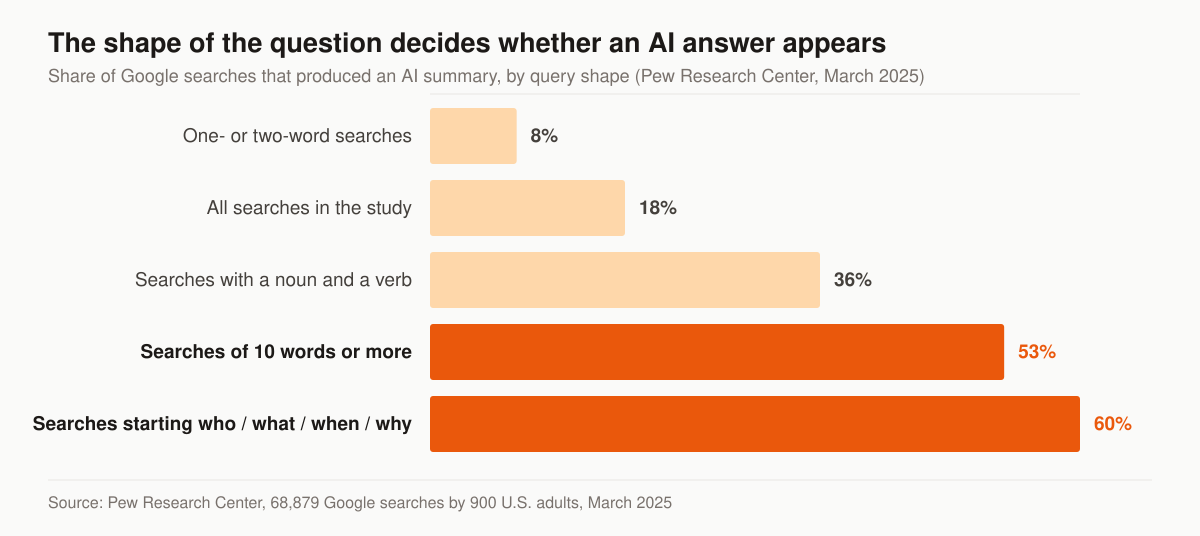
Source: Pew Research Center, July 2025, analysing searches collected March 2025.
Read those bars against how annuity buyers actually search. “Annuity” is a two-word-class query; 8% of one- or two-word searches produced a summary. “Should I roll my 401k into an annuity at 62” is a ten-plus-word question starting with a question word; that band ran 53% and 60% respectively. Annuity research is long-form, anxious and conversational, which puts it squarely in the query shapes that generate AI answers.
That has a direct consequence for what you publish. Head terms like “annuities” will keep behaving like classic SERPs for a while. The long, worried, full-sentence questions — the ones your phone appointments actually open with — are the ones being answered above the links. Build pages for the sentences, not the nouns.
Two more figures from the same study set the size of the prize. The vast majority of AI summaries, 88%, cited three or more sources, and only 1% cited a single source. So the answer block is rarely a winner-take-all slot; there is usually room for more than one name in it. And the typical summary was short: the median ran 67 words, the shortest 7 and the longest 369. Your quotable passage has to survive being compressed to roughly the length of this paragraph.
Where annuity buyers use ChatGPT, and what they ask
Annuity questions are unusually well-suited to AI search because they are research-heavy, anxiety-driven, and full of jargon buyers want translated. The annuity agents whose content ChatGPT pulls from are the ones who answer these literally:
Table: the five buyer intents behind annuity queries, the phrasing they arrive in, and the block your page needs in order to be the passage that gets lifted.
| Buyer intent | What they type into ChatGPT | What your page must contain |
|---|---|---|
| Safety check | “Are annuities safe in 2026?” | Plain explanation of guarantees, insurer ratings, state guaranty backing |
| Income math | “How much income will $500k buy at 65?” | A worked example with a clear “depends on” framing |
| Product compare | “Fixed vs fixed indexed annuity” | A side-by-side table of caps, participation, downside |
| Timing | “Should I roll my 401k into an annuity?” | Scenario-based answer, not a pitch |
| Fees | “What are annuity surrender charges?” | Direct definition plus a sample schedule |
Each row is a page or a section. Each gets a question-shaped H2 and a two-to-three sentence direct answer before any nuance. That ordering — answer first, nuance second — is what lets a model quote you cleanly.
Adoption skews by age in a way that matters for annuity marketing. Pew’s survey of 5,123 U.S. adults, fielded February 24 to March 2, 2025, found 34% of U.S. adults had ever used ChatGPT, including 25% of adults aged 50 to 64 and 10% of adults 65 and older (Pew Research Center). The 58-to-64 slice of your prospect list therefore sits inside the 25% band, while a 68-year-old prospect sits in the 10% band. The same survey put adults aged 30 to 49 at 41% — the adult children who research the rollover before the parent signs anything.
What Google itself tells you to do, and what it tells you to ignore
Google published an official guide to optimizing for generative AI features in Search. It is the closest thing to a rulebook that exists, and it contradicts a fair amount of what gets sold as GEO. Its opening position is that nothing was replaced: “The best practices for SEO continue to be relevant because our generative AI features on Google Search are rooted in our core Search ranking and quality systems.”
Table: what Google’s generative AI guidance asks for, set against the tactics the same document tells you to skip.
| Google says do this | Google says you can ignore this |
|---|---|
| Be indexed and snippet-eligible: “a page must be indexed and eligible to be shown in Google Search with a snippet” | Special files: “You don’t need to create new machine readable files, AI text files, markup, or Markdown to appear in Google Search” |
| Provide a unique point of view rather than recycled copy | “Chunking” content: “There’s no requirement to break your content into tiny pieces for AI to better understand it” |
| Write for people: “make pages for your audience, not just for generative AI search” | Rewriting for machines: “You don’t need to write in a specific way just for generative AI search” |
| Keep content crawlable, because the models “use publicly accessible, crawlable content” | Chasing mentions Google calls inauthentic across the web |
| Support text with relevant images and video | Treating structured data as a requirement for AI answers |
Two lines in that guide are worth an annuity agent’s full attention. The first is the warning against spinning up a page for every phrasing: creating separate content for every possible variation “primarily to manipulate rankings or generative AI responses in Google Search violates Google’s scaled content abuse spam policy.” If your plan was a page for every city crossed with every product, that is the policy it runs into.
The second is the definition of content worth citing. Google contrasts commodity content, “based on common knowledge, which could originate from anyone,” with non-commodity content that “provides unique expert or experienced takes that go beyond common knowledge and the ordinary.” For a licensed annuity producer that distinction is a gift: nobody else can write the paragraph about what a surrender-charge conversation sounds like at a kitchen table in year three of a seven-year contract. Everybody can write “what is an annuity.”
Does FAQ schema still earn an annuity page anything?
Short answer: it earns you organization, not a rich result. On August 8, 2023, Google announced that “FAQ (from FAQPage structured data) rich results will only be shown for well-known, authoritative government and health websites”. The same post continued: “For all other sites, this rich result will no longer be shown regularly.” An independent annuity agency is neither a government nor a health site, so the expanding accordion in the search result is not coming back.
Google’s generative AI guide is equally direct about the AI side: “Structured data isn’t required for generative AI search, and there’s no special schema.org markup you need to add.” It then adds the qualifier that vendors selling schema packages tend to drop: “However, it’s a good idea to continue using it as part of your overall SEO strategy, as it helps with being eligible for rich results on Google Search.”
So keep the markup, and stop paying for it as a citation lever. Google’s own note on the 2023 change was that “While you can drop this structured data from your site, there’s no need to proactively remove it.” The value that survives is the discipline the markup forces: writing a real question, giving it a self-contained answer, and not letting the answer wander. That discipline is what makes the passage extractable, with or without the JSON-LD around it. We hold the same position on the wider engine set in how to get cited by Perplexity and AI Overviews.
The GEO checklist for annuity pages
GEO for annuity agents is mostly disciplined formatting layered on genuine expertise. Run every important page through this:
- Lead with the answer. First 1–2 sentences under each H2 must stand alone as a complete reply. Pew’s median AI summary was 67 words, so write the block you want lifted at roughly that length.
- Use question H2s. “How does a fixed indexed annuity work?” beats “Product Overview.”
- Keep an FAQ section, and keep the FAQPage markup. It will not produce a rich result for an agency site, but it forces a clean question-to-answer mapping and stays useful to your overall SEO.
- Include at least one table and one list per page. We treat structured blocks as the first thing to build on a money page, because a table survives compression into a short answer better than a paragraph does.
- Write factually, never hype. Avoid “guaranteed riches” or “get rich” framing; explain caps, participation rates, and surrender periods plainly. State that you are a licensed agent. Clean, compliant copy reads as trustworthy to buyers and to ranking systems alike.
- Keep it fast and crawlable. Server-rendered HTML, quick load, no answer hidden behind a script.
The web foundation underneath this matters. A page that loads slowly or hides its content behind JavaScript will not get parsed, which is why we pair GEO work with a properly built annuity agent website and a broader generative engine optimization service rather than treating AI search as a bolt-on.
Which AI crawlers have to reach your annuity pages
Crawlability stops being an abstraction once you name the robots. Each major engine publishes its user-agent tokens, and each token does a different job — which means a single blanket disallow can quietly remove you from one surface while leaving another intact.
Table: the documented AI crawler tokens, described in each operator’s own words, with the consequence each operator publishes for disallowing it.
| robots.txt token | Operator | What the operator says it does | What the operator says disabling it does |
|---|---|---|---|
OAI-SearchBot |
OpenAI | “is used to surface websites in search results in ChatGPT’s search features” | “Sites that are opted out of OAI-SearchBot will not be shown in ChatGPT search answers, though can still appear as navigational links.” |
GPTBot |
OpenAI | “is used to make our generative AI foundation models more useful and safe” | “Disallowing GPTBot indicates a site’s content should not be used in training generative AI foundation models.” |
ChatGPT-User |
OpenAI | “for certain user actions in ChatGPT and Custom GPTs” | “Because these actions are initiated by a user, robots.txt rules may not apply.” |
OAI-AdsBot |
OpenAI | “is used to validate the safety of web pages submitted as ads on ChatGPT” | It “only visits pages submitted as ads” |
PerplexityBot |
Perplexity | “is designed to surface and link websites in search results on Perplexity. It is not used to crawl content for AI foundation models.” | You lose the surface it feeds — its search results |
Perplexity-User |
Perplexity | “supports user actions within Perplexity” | “Since a user requested the fetch, this fetcher generally ignores robots.txt rules.” |
ClaudeBot |
Anthropic | “helps enhance the utility and safety of our generative AI models by collecting web content that could potentially contribute to their training” | “it signals that the site’s future materials should be excluded from our AI model training datasets” |
Claude-SearchBot |
Anthropic | “navigates the web to improve search result quality for users” | “prevents our system from indexing your content for search optimization, which may reduce your site’s visibility and accuracy in user search results” |
Sources: OpenAI, Perplexity, Anthropic.
The split worth understanding is training versus retrieval. GPTBot and ClaudeBot feed model training; OAI-SearchBot, PerplexityBot and Claude-SearchBot feed the live answer with a link next to it. An agency that wants citations but not training can allow the search bots and disallow the training bots. An agency whose developer pasted a broad AI-blocking snippet into robots.txt has probably disallowed both, and then wondered why the citations never came. Check the file before you buy a strategy. The same audit sits inside our insurance SEO work, because a crawl-blocked page fails classic search for the same reason.
Note the third category in that table, because it changes what robots.txt can promise you. The user-initiated fetchers behave differently from the crawlers: OpenAI writes of ChatGPT-User that “Because these actions are initiated by a user, robots.txt rules may not apply,” and Perplexity writes of Perplexity-User that “Since a user requested the fetch, this fetcher generally ignores robots.txt rules.” Anthropic states the opposite policy for its own bots, saying they respect do-not-crawl signals by honoring industry standard directives in robots.txt. So a robots.txt edit reliably controls the automatic crawl, and does not reliably control what happens when a prospect pastes your URL into a chat window. Plan the page assuming a buyer can always fetch it.
Does publishing annuity content count as a recommendation?
This is the question that stops annuity agents from publishing, and it has a documented answer. The NAIC Suitability in Annuity Transactions Model Regulation (#275) defines a recommendation as “advice provided by a producer to an individual consumer that was intended to result or does result in a purchase, an exchange or a replacement of an annuity in accordance with that advice.” The very next paragraph draws the line you need:
Recommendation does not include general communication to the public, generalized customer services assistance or administrative support, general educational information and tools, prospectuses, or other product and sales material.
A blog post explaining how a surrender charge works, written for everyone who lands on it, sits inside that exclusion as the model is drafted. A one-to-one message telling a named 63-year-old to move her 401(k) into a specific contract does not. The model’s scope section is broad — “This regulation shall apply to any sale or recommendation of an annuity” — so the exclusion in the definition is doing real work.
Two caveats you must carry. First, #275 is a model; it binds only in the version your state adopted. The NAIC’s Center for Insurance Policy and Research, on a page last updated November 1, 2023, states that “To date, 40 states have adopted the model revisions” (NAIC CIPR). Read your state’s adopted text, because the wording can differ. Second, the model says of the best-interest subsection’s requirements that they “do not create a fiduciary obligation or relationship and only create a regulatory obligation as established in this regulation” — which is a reason not to call yourself a fiduciary on a page merely because the word sounds authoritative.
There is a licensing boundary in the same section that shapes what you can safely write. #275 does not force a producer to hold a securities license to meet its duties, “provided the producer does not give advice or provide services that are otherwise subject to securities laws or engage in any other activity requiring other professional licenses.” An insurance-only producer writing a comparison page that steers a reader toward or away from a variable annuity or a registered index-linked annuity is walking toward that line. Write the definitional content on those products; leave the recommendation to someone who holds the license. Our broader treatment of this sits in insurance marketing compliance for agents.
What the best-interest rule makes you disclose, and why it doubles as content
Here is the part that turns compliance paperwork into GEO fuel. Before a recommendation, #275 requires the producer to disclose, on a form substantially similar to its Appendix A, a specific set of facts about themselves. Those facts are exactly the entity signals an AI engine needs in order to describe you accurately — and you are already required to produce them.
Table: each Appendix A disclosure item from Model #275, and the page on your site where the same fact belongs.
| What #275 makes you disclose | Where the same fact earns you citations |
|---|---|
| The scope and terms of your relationship with the consumer, and your role in the transaction | An “how we work” section that states plainly what you do and do not do |
| Whether you are licensed and authorized to sell fixed annuities, fixed indexed annuities, variable annuities, life insurance, mutual funds, stocks and bonds, and certificates of deposit | A licensing block on your about page, product by product |
| Whether you sell “From one insurer”, “From two or more insurers”, or “From two or more insurers although primarily contracted with one insurer” | The carrier-relationship line buyers and models both look for |
| The sources and types of cash and non-cash compensation you receive | A plain-English “how we get paid” page |
| The consumer’s right to request an estimate of your cash compensation | One sentence inviting the question, in the same place |
A site that buries or omits those rows leaves an engine trying to decide whether to name you with nothing to work with. An engine reading a page that answers all five has an unusually complete entity record — and buyers reading the same page get the disclosure they were going to receive anyway, earlier and without a form.
The regulation also hands you a content outline. Before or at the time of a recommendation, the producer must have a reasonable basis to believe the consumer has been informed of features including “the potential surrender period and surrender charge, potential tax penalty if the consumer sells, exchanges, surrenders or annuitizes the annuity, mortality and expense fees, investment advisory fees, any annual fees, potential charges for and features of riders or other options of the annuity, limitations on interest returns, potential changes in non-guaranteed elements of the annuity, insurance and investment components and market risk.”
Read that list again as a content outline rather than as paperwork. Every item on it is a question a near-retiree types into ChatGPT, and every item is something you have to be able to explain out loud anyway. The model even defines the hard one for you: non-guaranteed elements are “the premiums, credited interest rates (including any bonus), benefits, values, dividends, non-interest based credits, charges or elements of formulas used to determine any of these, that are subject to company discretion and are not guaranteed at issue.” Write that definition in your own words, plainly, and you have a passage engines can lift on a question competitors dodge.
Which annuity products your pages should cover
Write toward where the money actually moves. LIMRA’s final full-year figures put total U.S. retail annuity sales at $464.1 billion in 2025, up 7% year over year, with fixed-rate deferred at $165.3 billion (up 6%), fixed indexed at $127.9 billion (up 1%), registered index-linked at $79.5 billion (up 20%), traditional variable at $63.1 billion (up 8%), single premium immediate at $14.4 billion (up 6%) and deferred income at $4.8 billion (down 3%).
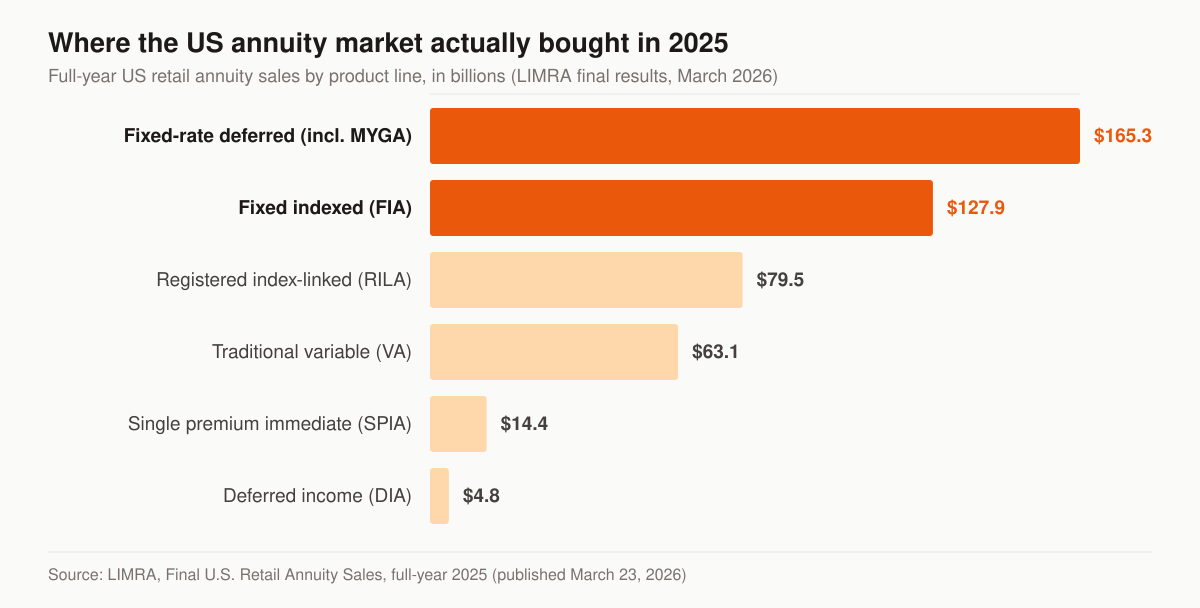
Source: LIMRA, Final U.S. Retail Annuity Sales, full-year 2025.
The two lines an insurance-only licensed producer can write, fixed-rate deferred at $165.3 billion and fixed indexed at $127.9 billion, are the two tallest bars on that chart. That is where your depth belongs: MYGA rate mechanics, index crediting methods, caps and participation rates, surrender schedules, free-withdrawal provisions. RILA’s 20% gain is the strongest percentage move among the six lines above, which tells you buyers are asking about it — and the licensing boundary in the previous section tells you how to handle those questions: explain the product, do not recommend it unless you are licensed for it.
The practical build is one deep page per product line, each answering the #275 feature topics for that specific product, cross-linked to the others. That structure gives query fan-out somewhere to land: a buyer asking about surrender charges on a MYGA generates related queries about free withdrawals and tax penalties, and your cluster has a passage for each. The lead mechanics that sit under those pages are covered in annuity lead generation.
Authority: why “built by people who run campaigns” wins
AI engines weigh trust signals heavily, and annuity is a YMYL (your-money-or-your-life) topic where they are extra cautious. Generic, scraped-sounding content gets skipped. Three moves build the authority that gets you cited:
- Show real experience. Author bios with license details, years in market, and the specific carriers you write.
- Earn third-party mentions. Directory listings, reviews, and references from other sites tell the model you are real.
- Be consistent across the network. A site that answers annuity questions deeply, links sensibly, and matches what review sites say about you reads as a coherent, trustworthy entity.
One caution on the second move, straight from Google: its generative AI guide lists seeking inauthentic mentions across the web as a tactic that “isn’t as helpful as it might seem”. It notes that its ranking systems focus on high-quality content while other systems block spam. Paid mention farms and syndicated press blasts are the version of “third-party mentions” that guidance is aimed at. A real listing on a real directory, a real review from a real client, and a real quote in a real trade publication are not.
There is a source-mix finding worth planning around. In Pew’s study, Wikipedia, YouTube and Reddit collectively accounted for 15% of the sources listed in the AI summaries examined, and a similar 17% of the sources in standard search results. Government sites took 6% of AI-summary sources versus 2% of standard-result sources. So a meaningful share of citation slots goes to a handful of mega-domains and to .gov pages before any independent agency is considered — which is an argument for aligning your explanations with the government and regulator sources on the same topic rather than contradicting them, and for having a real presence on the platforms in that first group.
This is the transferable proof in action: we cannot claim final-expense lineage for an annuity reader, but the same systems we run on a hard senior-market vertical are what we apply to make your annuity content extractable and trusted.
How to tell whether any of this worked
You now have one first-party measurement surface for AI search, and it covers Google only. Search Console’s generative AI performance report “shows data about how your site performs in generative AI features on Google Search”. It covers impressions from AI Overviews and AI Mode, with a note that “As of August 31, 2026, we’ve rolled out these insights to all websites worldwide” (Search Console Help). You can group the data by pages, countries, dates and devices. Data from Search Labs experiments is excluded, and the usual 1,000-row limit applies.
What it will not tell you is anything about ChatGPT, Perplexity or Claude. For those, the honest method is manual and repeatable: keep a fixed list of your 20 to 30 core annuity questions, run them monthly in each engine, and log who gets cited. It is unglamorous and it is the only reporting on those surfaces that is not guesswork.
Set expectations on what a citation is worth before you start. In the same Pew study, users who encountered an AI summary clicked a traditional search result on 8% of visits, against 15% for visits without one, and clicked a link inside the summary on just 1% of visits. Browsing sessions ended on 26% of pages with an AI summary versus 16% of pages without. A citation is a brand impression far more often than it is a session. That is exactly why the answer block has to carry your name and your positioning, not only your URL — and why the content marketing engine behind it has to keep producing pages rather than betting on one.
Don’t confuse marketing with buying leads
One clean boundary keeps your strategy honest. GEO and AI search are about generating your own inbound — getting cited so retirees find and contact you. That is different from purchasing leads, live transfers, or appointments as a product. If buying volume is what you actually need this quarter, do that through a dedicated source and buy leads direct from getinsureleads, and keep your owned site focused on the long-term asset: being the answer ChatGPT gives.
The two work together. Bought leads fill the calendar now; GEO compounds so that in twelve months a meaningful share of your pipeline comes from people who asked an AI a question and got pointed to you.
What running this as a program costs
We publish our prices rather than quoting per call. AI-search visibility sits inside the Growth tier at $3,500 per month, which also carries the ongoing SEO and content engine, reputation and reviews work, and monthly reporting. Foundation is $2,500 per month and covers the website, local SEO and on-page work that GEO stands on. Full-Funnel is $5,500 per month and adds managed paid ads, landing-page CRO and marketing automation on top. A one-time website build runs $2,500 to $8,000. Ad spend is billed separately, straight to the platforms. The full breakdown is on the pricing page.
The reason GEO sits at Growth rather than Foundation is sequencing, not upsell. Answer-first rewriting on a site that is slow, thin or crawl-blocked buys nothing, because the retrieval step never reaches the passage. Fix the foundation, then write the answers.
Your first three moves
If you do nothing else this month, do these in order:
- Pick your five highest-intent annuity questions (use the table above) and rewrite each as an answer-first page or section.
- Read your robots.txt and confirm
OAI-SearchBot,PerplexityBotandClaude-SearchBotare not disallowed — then decide deliberately about the training bots. - Audit whether AI crawlers can even reach your content — speed, rendering, and structure — and open the Search Console generative AI report to set a baseline.
Then do the slower one: write the five disclosure facts from the Appendix A table onto your about page, in plain sentences, and give the #275 feature topics their own H2s somewhere in your product cluster. That is a quarter of work, and it produces the disclosure depth a model can quote you on.
That sequence — extractable answers, crawl access, structured disclosure — is what turns an invisible annuity site into a cited one. To see how the full system fits together for retirement-income producers, start with our annuity agent marketing approach, and if you want us to map your current AI-search gaps line by line, grab a free marketing audit. We will show you, with numbers, where the citations are leaking — the same way we show our senior-market clients on the homepage proof. For the broader client-acquisition system these AI citations feed, see how to get annuity clients with marketing, and for the entity-level work behind being named at all, how to get your insurance agency recommended by ChatGPT.
- How to Get Annuity Clients With Marketing (Without Buying a Single Lead)
How to get annuity clients without buying leads: a numerate, repeatable system for annuity client acquisition you can run week after week.
- How to Generate IUL Leads With Marketing
How to generate IUL leads with your own marketing versus buying them. Published lead prices, the consent rules on a bought lead, and the channel plan.
- How to Sell Life Insurance: The Needs-Based Process
How to sell life insurance with a needs-based process: discovery scripts, an objection-handling table, licensing basics, and an honest look at the odds.
- Key Person Insurance Marketing Ideas That Actually Reach Business Owners
Key person insurance marketing ideas for agents who sell to business owners: targeting, offers, buy-sell agreement marketing, and a lead system that runs.