How to Sell Life Insurance: The Needs-Based Process
To sell life insurance, run a needs-based process: prospect, discover the client's actual financial exposure, design one recommendation that fits their budget, present it in plain language, resolve objections by finding the root cause, and close on a specific next step. The product is simple; the discipline of the process is what places policies.
Selling life insurance is a process problem, not a personality contest. Agents who place policies consistently run the same needs-based sequence on every prospect: discover the real financial exposure, design one recommendation that fits the budget, and close on a specific next step. Agents who wing it get “let me think about it” and an empty calendar.
The field is bigger and more ordinary than the recruiting pitches suggest. The U.S. Bureau of Labor Statistics counted 572,600 insurance sales agent jobs at a median wage of $62,280 a year as of May 2025, projects 3% employment growth from 2025 to 2035, and expects about 43,100 openings a year over that decade — a steady, unglamorous occupation with constant turnover at the entry point. We treat the gap between the agents who build a book and the agents who quit as a pipeline and process problem, not a product-knowledge problem. This guide covers the process; the prospecting section covers the pipeline.
The 7-stage needs-based life insurance sales process
Every stage has one job. Do them in order — most blown sales trace back to a skipped stage, usually discovery.
- Prospect. Fill the calendar before you worry about anything else. Leads, referrals, and marketing (covered below) — an empty pipeline makes every other stage desperate, and prospects can smell desperate.
- Discovery. Before you quote anything, quantify the exposure: who depends on the income, what debts survive them, what the mortgage payoff looks like, what they can actually budget monthly. This stage does the selling.
- Design. Build ONE recommendation from the discovery answers — face amount, term versus permanent, rider or no rider — sized to the budget they named. A menu of three quotes feels safe to you and paralyzing to them.
- Present. Plain language, tied back to their own words: “You said the mortgage was the thing that scared you — this pays it off.” Explain what the policy does, not how the industry categorizes it.
- Handle objections. Objections are unanswered questions wearing a costume. Find the root cause (table below), answer it, and return to the close. Never argue.
- Close. Ask for a decision on a detail, not a verdict: the draft date, the beneficiary spelling, the exam scheduling. “Whether” is a hard question; “which” is an easy one.
- Deliver and ask for referrals. Policy delivery is the highest-trust moment in the relationship. Review the coverage, confirm the beneficiary, and ask for two introductions while you’re the person who just took care of their family.
New agents compress stages 2 and 4 into a pitch. Resist it. A prospect who has just told you, out loud, what happens to their family without coverage has mostly sold themselves — your quote is the answer to a question they asked.
Discovery questions that do the selling
Discovery is a conversation, not an interrogation — but you should walk in knowing exactly which questions you need answered. Ask, then be quiet and let them finish.
- “Walk me through who depends on your income right now.”
- “If your paycheck stopped tomorrow, how long could your family keep the house?”
- “What would you want to happen with the mortgage — paid off, or covered for a few years while everyone regroups?”
- “Do you have any coverage now — through work or on your own? Do you know what it actually pays?”
- “Have you looked into this before? What stopped you last time?”
- “If we find something that genuinely fits, what monthly amount is comfortable — not a stretch, comfortable?”
Two of those carry the whole call. The paycheck question converts an abstract product into a concrete, personal scenario. The budget question, asked before you quote, means your recommendation lands inside their reality — which pre-empts the price objection instead of triggering it.
How much coverage does the prospect actually need?
Discovery either produces a number or it produced nothing. The face amount is not a preference to be negotiated toward the middle; it is the sum of what a household would still owe and still need if the paycheck stopped on a Tuesday. Work the exposure in four buckets, out loud, with the prospect doing as much of the arithmetic as they will.
This table is the worksheet the discovery call runs on — four buckets, each attached to a question the prospect can answer without looking anything up.
| Bucket | What you are sizing | The question that gets the number |
|---|---|---|
| Debt | Everything that survives the insured: car notes, credit cards, private student loans, medical balances | “Besides the house, what’s still on autopay every month?” |
| Income | The years of the household’s share of income the survivors would need to keep the same life | “If the paycheck stopped, how many years do they need before the household is standing on its own?” |
| Mortgage | The payoff, kept separate from other debt because it is the obligation people can picture | “Would you want the house paid off outright, or covered for a stretch while everyone regroups?” |
| Education | What the survivors have already been promised about school, in today’s dollars | “What did you plan to put toward school, and for how many of them?” |
Add the four, then subtract what already exists: group coverage at work, any individual policy in force, and the savings the family would genuinely spend on this rather than the savings that exist on paper. The remainder is the honest face amount. Only then look back at the budget figure from discovery and design to whichever number is smaller, saying the difference out loud: “The full exposure is $X. At the $Y a month you told me was comfortable, here’s what goes in force today, and here’s what we add when the raise lands.” Naming the gap is what separates a needs-based recommendation from a quote sized to whatever the client happened to say first.
Two findings make this stage worth slowing down for. The first is that the survivors’ timeline is shorter than the client assumes. In the 2026 Insurance Barometer Study, around half of people said they would feel the financial impact of the “loss” of the primary wage earner due to disability (51%) or death (46%) within six months. Asked as a discovery question rather than recited as a statistic, that is the moment an abstraction turns into a calendar.
The second is that the money lands clean, which clients rarely know going in. The IRS puts it plainly: “life insurance proceeds you receive as a beneficiary due to the death of the insured person, aren’t includable in gross income and you don’t have to report them.” Interest paid on top of the benefit is taxable and reported as interest received, and a policy transferred for cash or other valuable consideration gets a narrower exclusion (IRS, Life insurance & disability insurance proceeds). A client mentally comparing a death benefit to a savings balance is comparing after-tax to pre-tax. Correcting that is arithmetic, not a closing technique — and it is a tax question, so send them to their own adviser for their own facts.
Term or permanent: matching the product to the need
Product selection is a consequence of the discovery number, not a preference you carried into the room. A 34-year-old with 26 years left on a mortgage and two kids under ten has a need with an end date. A business owner funding a buy-sell agreement, or a client who wants a benefit that cannot expire before they do, does not.
The NAIC’s own consumer-facing definitions are the cleanest framing to borrow, because no carrier’s marketing department wrote them. Term life “offers coverage for a set period of time,” with policies “commonly issued for 1, 5, 10, or 20 years, or until a specific age (such as 65),” and it “is generally more affordable than permanent insurance, particularly in the early policy durations.” Whole life “offers a fixed amount of coverage that lasts for the insured’s entire life” and is “designed to build cash value over time, which grows without being taxed” (NAIC, Life Insurance).
This table maps the need you found in discovery to the structure that answers it, using the NAIC’s product descriptions rather than a brochure’s.
| Structure | What the NAIC says it does | The need it answers |
|---|---|---|
| Level term | “Provides a fixed death benefit and premium amount throughout the term, typically 10, 20, or 30 years” | A dated obligation: mortgage, working years, kids at home |
| Decreasing term | “Offers a death benefit that decreases over time,” often used for debts that reduce over time, such as a mortgage | A single amortizing debt, priced to match it |
| Renewable term | “Allows the policy to be renewed at the end of the term without proof of insurability, as long as premiums continue to be paid” | A client whose health may not survive the term |
| Convertible term | “Gives the option to convert the term policy into a permanent policy that builds cash value” | Budget today, a permanent need they can already see |
| Return of premium | A feature that “refunds part or all of the premiums paid if the policyholder outlives the term and no death benefit is paid” | The buyer whose real objection is “I get nothing back” |
| Whole life | Fixed coverage for the insured’s whole life, building cash value that “grows without being taxed,” with state-required nonforfeiture values | Final expenses, estate liquidity, a benefit with no end date |
| Universal life | Permanent coverage that “combines term insurance with a cash account that earns interest without being taxed” and stays in force “as long as the cash value is enough to cover insurance costs” | Premium flexibility, and the funding discipline that flexibility demands |
| Indexed universal life | Interest “tied to external investment indexes, such as bonds or the S&P 500,” with “a guaranteed minimum interest rate” | A client who wants index participation and understands the floor |
Two guardrails belong in every presentation. Term and permanent are not opponents: a permanent base for the need that never ends, layered with term across the years of greatest exposure, is a legitimate design and often the affordable one. And an illustration is a projection, not a promise — walk the guaranteed column first, name the non-guaranteed column as non-guaranteed, and never let a hypothetical rate of return do the closing for you. If your book leans toward index products, our note on marketing IUL compliantly covers what the ad and the illustration are each allowed to say.
What underwriting decides before you quote
Underwriting is the branch point between the quote you would like to give and the quote a carrier will honour. Run it before you name a price, so you never have to walk a number back.
This table is the field-underwriting map: four paths, four different conversations.
| Path | What the client goes through | What it costs them | When it fits |
|---|---|---|---|
| Fully underwritten | Application, paramedical exam, fluids, medical records, sometimes an attending physician’s statement | The lowest rates a healthy applicant can get | Large face amounts, clean health, a client willing to wait |
| Accelerated underwriting | Application plus carrier data checks, no exam for applicants who fit the carrier’s box | Close to fully underwritten rates for those who qualify | Younger, healthy applicants who will not sit for an exam |
| Simplified issue | Application and knockout health questions, no exam | Higher rates across a narrower band of face amounts | Moderate health, or speed matters more than price |
| Guaranteed issue | No health questions; acceptance inside the carrier’s age band | The highest rates, with a graded benefit period at the start | Health that fails every other path |
Two habits protect the case. Ask the health questions the way the application asks them, not the way you hope the client will answer — an answer rewritten at underwriting costs you the policy and the commission. And set the expectation before you submit: what happens next, how the carrier communicates, and what a rating or a counter-offer would mean in dollars. A client who hears “approved other than applied for” with no warning reads it as a bait and switch and walks.
The no-exam lane is where a lot of the market has moved, and it changes the marketing message as well as the sale — we cover that separately in marketing no-exam life to younger buyers and marketing simplified issue life insurance. At the far end, the mechanics and the honest positioning of guaranteed issue final expense have their own page.
One line belongs in every delivery conversation, because it removes a fear clients rarely voice: “After a policy is issued, the insurance company cannot cancel it due to changes in the policyholder’s health” (NAIC).
What actually stops the sale
Before rehearsing a rebuttal, look at what people say when they are asked why they have no coverage. The 2026 Insurance Barometer Study — run annually by LIMRA and Life Happens, based on a survey of more than 5,200 US adults ages 18 to 75 who share responsibility for household financial decisions — reports the same four answers it has reported for years: “perceived cost (45%), other financial priorities (35%), confusion over what kind or how to buy (23%) and procrastination (23%).”
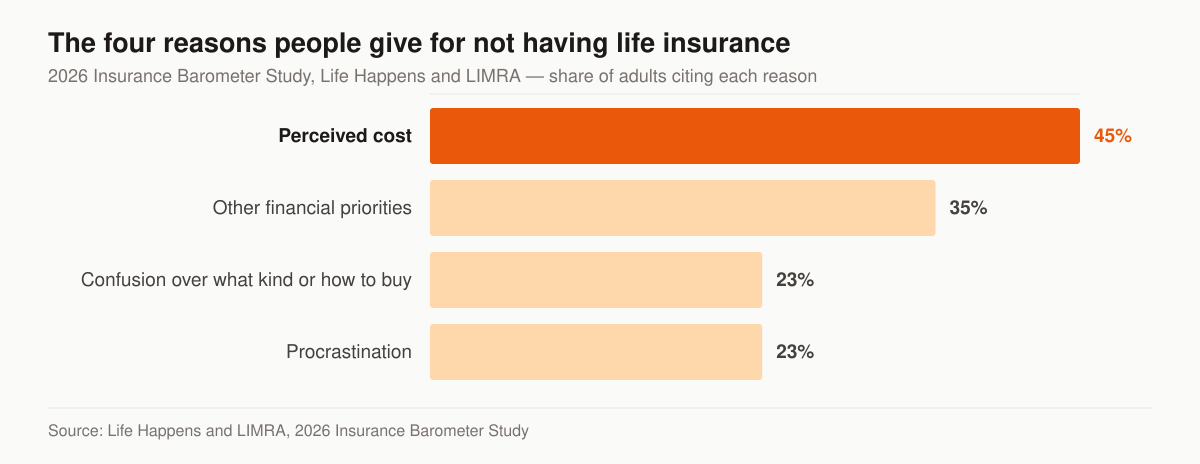
The four reasons people give for not having life insurance. Source: Life Happens and LIMRA, 2026 Insurance Barometer Study.
Read the shape of that list, not just the order. Only one of the four is a considered decision. Cost is a belief, and it is a measurably wrong one: in the same study, 4% of consumers 30 and younger correctly priced a basic life insurance policy, and LIMRA’s write-up of the 2026 findings sizes the error — “healthy adults under age 30 overestimate the cost of a typical term life insurance policy by 5 to 6 times” (LIMRA/LOMA MarketFacts). Confusion and procrastination are friction. Only “other financial priorities” is a genuine competing claim on the money.
That changes what a rebuttal is for. If the price objection is usually a wrong estimate rather than a refusal, the fix is a real premium on a real face amount, quoted early in plain dollars — not a persuasion script. Life Happens reached the same conclusion from the earlier 2025 study: “about three-quarters of adults overestimate the true cost of life insurance” (Life Happens).
The demand side is also friendlier than the recruiting-deck version of this job suggests. The 2026 study reports that 45% say they already work with a professional and 26% say they are currently looking for one to work with, and that the top preferred contact method across generations was “in person” at 31%, rising to 53% once telephone and video chat are counted alongside it. People are not avoiding agents. They are stalled in front of a product they cannot price.
How to handle life insurance objections
This table pairs the six objections you will hear most often with the root cause underneath each one and the move that answers it. Memorize the logic, then say it like a person.
| Objection | Root cause | Response approach |
|---|---|---|
| “It’s too expensive.” | Coverage was designed past the budget, or budget was never anchored | Re-anchor to the monthly number they named; redesign the face amount to fit it |
| “I need to think about it.” | An unvoiced question — price, trust, or need | Name the likely candidates, ask which one, answer it live |
| “I have coverage through work.” | Believes group coverage is sufficient and portable | Ask what happens to it when they leave the job; compare it to the need from discovery |
| “I want to shop around.” | Sees policies as identical commodities | Agree, then reposition on fit: design and underwriting match matter more than a few dollars |
| “I’m young and healthy — later.” | The cost of waiting is invisible | Reframe what they’re buying now: today’s insurability at today’s health class |
| “My spouse handles this.” | Joint decision, and you only have half the room | Stop pitching; book the joint conversation instead |
Three of these deserve a scripted response you’ve rehearsed out loud.
“I need to think about it.” “That’s fair — this matters, and I’d rather you be sure. In my experience, ‘think about it’ is usually one of three things: the monthly amount, the company, or whether you really need it. Which one is it for you?” Then answer that one thing and ask for the decision again. If you let this objection end the call, you’ll lose the majority of them to silence, not to a competitor.
“I have coverage through work.” “Good — that’s a real head start, and I’d never tell you to drop it. Quick question, though: if you left that job next year, what happens to the policy? Most group coverage stays with the employer, and it’s usually a fixed multiple of salary — you told me earlier your family would need enough to clear the mortgage. Want to see what it costs to lock in the gap while your health class is this good?”
“It’s too expensive.” “Understood — and that’s on me, not you. You said earlier that around [their number] a month was comfortable. Let me redesign this so the premium sits inside that number, and I’ll show you exactly what coverage that buys. It’s better to have the right amount you’ll actually keep than a bigger policy that lapses in a year.”
How life insurance agents get paid, and why year one is a cash-flow problem
Compensation structure shapes a first year more than closing skill does, and it is the part recruiters describe last. The BLS states the arrangements without euphemism: “Independent agents may be paid by commission only,” while employees of an agency or a carrier “may be paid in one of three ways: salary only, salary plus commission, or salary plus bonus.” On the size of the cheque it is equally direct — “The amount of the commission depends on the type and amount of insurance sold and on whether the transaction is a new policy or a renewal” (BLS).
Four consequences follow, and none of them are about technique.
An advance is a loan against a policy that has not persisted yet. Carriers commonly advance a block of first-year commission at issue. If the policy lapses inside the advance period, the unearned portion comes back as a chargeback against your next statement. An agent who spends every advance and writes business that does not stay on the books can work an entire quarter into a negative balance and still be busy.
Persistency is a compensation problem before it is a service problem. The draft date, the affordability of the premium, and whether the client understood what they bought all decide whether month four gets paid. Designing to the budget the client named — rather than to whatever face amount they will sign for — is a persistency fix that costs nothing to apply on the call.
Renewals are the part that compounds. First-year commission pays for this month; renewal commission is what turns a book into an asset that pays while you are prospecting. That is also why the contract you sign matters as much as the carrier you write.
Rates vary by product, carrier and contract level, so compare them before you sign anything. Published grids in an adjacent line make the spread visible: our breakdown of final expense commission levels shows how far the same starting contract moves between organizations.
The wage picture is worth holding alongside the recruiting math. The BLS reports a median annual wage of $62,280 for insurance sales agents in May 2025, with the lowest 10% earning less than $37,330 and the highest 10% earning more than $138,140 — a spread wide enough that “what do agents make” has no useful single answer, and narrow enough at the bottom to explain the turnover.
Captive, independent, or through an FMO
Where you sell from decides your product shelf, your lead flow and your contract level. The BLS draws the line cleanly: captive agents “work exclusively for one company. They sell policies provided only by the company that employs them,” while independent agents “may sell the policies of several companies to match their clients’ needs with the company that offers the best rate and coverage.” Brokers, it adds, “represent their clients, rather than insurers.”
The practical trade is training and leads against ownership and margin. A captive contract usually comes with a desk, a script, a manager and some form of lead subsidy, paid for out of a lower contract level. An independent contract through a field marketing organization gives you carrier choice and a higher level, and hands you the lead problem in return. Neither is the correct answer in the abstract; the correct answer depends on whether you can fill a calendar unaided this year. If you are weighing an upline, our guide to choosing an FMO sets out the questions that actually change your income — release policy, contract level, lead program terms and what happens to your book if you leave.
Is it easy to sell life insurance?
No. The product knowledge is the easy part — term versus whole life is a week of reading. What’s hard is the pipeline: finding enough people to talk to, week after week, usually on commission-based pay. Agents who fail rarely fail at closing; they fail at prospecting. If you can keep a full calendar, the selling itself is a learnable, repeatable process.
The honest picture: entry is deliberately easy — a high school diploma or equivalent is the typical education for the role, per the BLS occupational profile — and that low barrier is exactly why turnover is brutal. Commission-heavy pay means slow months early on, rejection is a daily line item, and nobody hands you prospects. Treat prospecting as the job and selling as the skill, and the business is durable. Treat selling as the job and hope for prospects, and you become a statistic in someone’s recruiting deck.
If your market is seniors specifically, the mechanics shift — simpler product, phone-first, faster closes. We wrote a separate, step-by-step guide to selling final expense over the phone for that lane.
Licensing and compliance basics
You cannot legally sell anything until your state licenses you. As the NAIC’s producer licensing overview puts it: “An insurance producer is an individual who sells, solicits, or negotiates insurance.” The same NAIC overview counts more than 2 million licensed individuals and more than 236,000 licensed business entities in the United States — licensing is the floor of this business, not a differentiator.
The path, in order:
- Complete your state’s pre-licensing requirements. Required study hours and course formats vary by state — your state’s department of insurance publishes the exact rules.
- Pass the state life exam to earn the life line of authority in your resident state.
- Apply for the license, including fingerprinting and a background check where the state requires them.
- Get appointed by carriers. A license lets you sell; an appointment gives you products to sell.
- Add non-resident licenses through NIPR if you sell across state lines — the BLS profile is blunt about the rule: “Agents must be licensed in the states where they work.”
- Keep continuing education current. CE requirements are state-set and non-negotiable at renewal.
Step 3 is where new agents lose weeks they did not budget for, because they treat the application as the finish line. It is not. NIPR, the registry that carries these filings between producers and state regulators, publishes the required inputs and the review window on its own application page: you need your license number or National Producer Number if you have been licensed before, an SSN for first-time applicants or an FEIN for entities, date of birth, your applicant and residency type, and an electronic payment method — and “States typically take 7 to 10 days to review applications” (NIPR). NIPR also notes that “Each state has unique requirements and fees for obtaining and renewing a license, including transaction and state license fees,” so treat every state you add as its own line item with its own clock.
This table separates the four credentials people collapse into the word “licensed” — each one gates something different, and the order they arrive in is not negotiable.
| Credential | What it actually authorizes | Who issues it | What it does not do |
|---|---|---|---|
| Resident producer license, life line of authority | Selling, soliciting or negotiating life insurance in your home state | Your state department of insurance, after pre-licensing and the state exam | Gives you nothing to sell — products come with appointments |
| Carrier appointment | Representing a specific carrier’s products | Each carrier, on its own timeline, after contracting | Does not extend to that carrier’s other lines automatically |
| Non-resident license | The same authority in another state | That state, filed through NIPR | Does not survive a lapse in your resident license |
| Continuing education credits | Keeping the license you already hold at renewal | State-approved CE providers | Does not substitute for an appointment or a state filing |
One compliance note from the marketing side, since it’s where we live: how you generate the prospect is regulated too. Calls and texts to leads sit under TCPA, and product claims in ads have carrier and state rules attached. We’re a marketing agency, not licensed insurance advisors — the producer is always the licensed, responsible party — but our overview of insurance marketing compliance for agents maps the terrain.
Selling life insurance remotely
The remote version of this job is the same seven stages with the visual channel removed and the licensing footprint widened. Two constraints define it. The first is legal: you need a resident license at home and a non-resident license in every state you solicit into, which means the state you cannot write in is a state whose leads you should not buy. Sequence the licenses and appointments before you turn on lead flow, not after.
The second is that remote does not mean impersonal, and the data says clients still want a person. In the 2026 Insurance Barometer Study, “in person” was the top preferred contact method at 31%, and 53% preferred speaking to a financial professional once telephone and video chat were counted alongside it (Life Happens). A scheduled video call with a screen-shared illustration is much closer to that preference than an emailed quote and a follow-up text. Book the conversation; don’t email the answer.
The operational kit is short: a dialer or scheduler that records the consent trail, a CRM that holds the next action rather than a list of names, e-application access for every carrier you write, and a quiet room. If you are still picking the CRM half of that, our comparison of the CRMs insurance agents actually run covers call logging, disposition codes and the queue that tells you who to dial next. If the constraint is getting the conversation booked at all, that is what an appointment-setting program exists to solve. And if your market is seniors on the phone specifically, the final expense telesales page breaks the call down dial by dial.
Cross-selling life insurance into a book you already have
If you already write auto, home, health or Medicare, you are sitting on the least expensive life prospects available to you: people who have already bought from you, already answered your questions, and already pick up the phone. The trigger events are in your renewal data — a new mortgage on a homeowners policy, a young driver added to an auto policy, a birth or a marriage on a health application, a term policy nearing the end of its level period.
The mechanics are unglamorous. Run a coverage-gap report against your book, flag the accounts with no life policy attached, and attach one life conversation to every renewal review rather than running a separate campaign. Ask the same discovery questions from the top of this page — the client’s answers are what size the recommendation, not the fact that they already own something. Property and casualty agencies have a longer version of this play in our note on cross-selling and account rounding.
Where the prospects come from
Every stage of the process above assumes there’s a person on the other side of the table, and that assumption is where most careers quietly die. You have three ways to keep the calendar full: buy leads, generate your own through marketing, or build a referral engine off your existing book — and mature agents run all three.
Marketing is the lever that compounds. A working system — targeted ads, a site that books appointments, follow-up that doesn’t leak — brings the prospects; the process on this page converts them. If you’re deciding where to start, we scored 17 life insurance marketing ideas by cost, speed, and effort, and our insurance lead generation service covers what it takes to own your lead flow instead of renting it. Whatever the source, the follow-up cadence you run on each lead decides whether the money you spent turns into discovery calls or into a spreadsheet of unreturned dials.
For the full picture — channel mix, budgets, niche selection, and the referral loop — start with our life insurance marketing playbook for the senior market. It’s the demand side of the same machine this page describes, and if you want the cost of it before you talk to anybody, our program pricing is published rather than quoted on request.
And if you already have lead flow but the calendar still isn’t converting, the leak is usually visible in the numbers within an hour. Request a free marketing audit and we’ll walk your funnel — lead source, follow-up, booking rate — and show you where it’s bleeding.
- Simplified Issue Life Insurance Marketing: How SI vs GI Changes Your Funnel
A practitioner's guide to simplified issue life insurance marketing: how SI vs GI changes your messaging, your lead quality, and your close rate.
- No Exam Life Insurance Marketing: A Playbook for Reaching Younger Buyers
No exam life insurance marketing for younger buyers: the offer math, the ad disclosure rules, and the funnel that turns a no-exam hook into bound policies.
- AI Search for Annuity Agents: The GEO Playbook to Get Cited, Not Skipped
AI search for annuity agents: a GEO playbook for getting cited by ChatGPT, Perplexity, and Google AI Overviews, with structure, schema, and proof tactics.
- How to Generate IUL Leads With Marketing
How to generate IUL leads with your own marketing versus buying them. Published lead prices, the consent rules on a bought lead, and the channel plan.