Life Insurance Marketing Ideas That Move Policies, Not Just Impressions
The life insurance marketing ideas that produce booked appointments are paid social with one tight offer, an SEO-backed local site, a referral system, and email nurture for slow deciders — in that order of speed to first lead. Which pair you run first depends on how fast your product's buyer decides.
The channel list is not the hard part. What agents lack is a way to decide which idea to run first, what it costs, and how fast it returns. So instead of a generic list, here are life insurance marketing ideas scored on the three variables that actually drive your decision: upfront cost, speed to first lead, and ongoing effort. We run our own senior-market lead operation, and the same ad discipline and conversion systems that work there transfer cleanly to a life book.
The 17 life insurance marketing ideas, scored
The table below is the whole strategy in one screen. Read it top to bottom as a rough priority order for an agent who needs leads this quarter, not someday.
| # | Marketing idea | Upfront cost | Speed to first lead | Ongoing effort | Fits |
|---|---|---|---|---|---|
| 1 | Paid social (Meta) with a single offer | Medium | Days | Medium | Term, mortgage protection, families |
| 2 | Google Search ads on intent keywords | Medium–High | Days | Medium | High-intent quote seekers |
| 3 | Local SEO + Google Business Profile | Low | 1–3 months | Low | Established local agents |
| 4 | Dedicated landing pages per offer | Low–Medium | Days | Low | Every paid channel |
| 5 | Referral system with a scripted ask | Low | Weeks | Low | Agents with a book already |
| 6 | Email nurture for slow deciders | Low | Weeks | Low | Whole life, IUL, cash value |
| 7 | Retargeting site/ad visitors | Low | Days | Low | Recovering abandoned quotes |
| 8 | Educational blog / content marketing | Low | 3–6 months | High | Long-term organic moat |
| 9 | Short-form video (Reels, Shorts) | Low | Weeks | High | Younger term buyers |
| 10 | Webinars / live Q&A | Low | Weeks | Medium | Higher-ticket products |
| 11 | Review generation (social proof) | Low | Weeks | Low | Conversion-rate lift everywhere |
| 12 | Lead magnets (calculators, guides) | Low–Medium | Weeks | Low | Email list building |
| 13 | Partner/COI referrals (CPAs, realtors) | Low | Weeks | Medium | Whole life, business owners |
| 14 | Direct mail to filtered lists | High | Weeks | Low | Final-expense and senior buyers |
| 15 | GEO / AI-search optimization | Low–Medium | 1–3 months | Medium | Future-proofing discovery |
| 16 | SMS follow-up on opt-in leads | Low | Days | Low | Speed-to-lead on any source |
| 17 | Buying leads / live transfers | Medium | Same day | Low | Filling a slow pipeline fast |
What the demand data says before you pick an idea
Demand for life insurance is not the constraint on a life book, and the published research says so plainly. The 2026 Insurance Barometer Study, conducted annually by LIMRA and Life Happens and fielded among more than 5,200 US adults aged 18 to 75 who share responsibility for household financial decisions, reports that life insurance ownership stands at 52% of American adults while 48% still do not own it, and that 38% — roughly 92 million adults — say they need coverage or need more than they have. Within that gap, 29% of consumers do not own life insurance but say they need it, and a further 22 million own coverage they believe is insufficient.
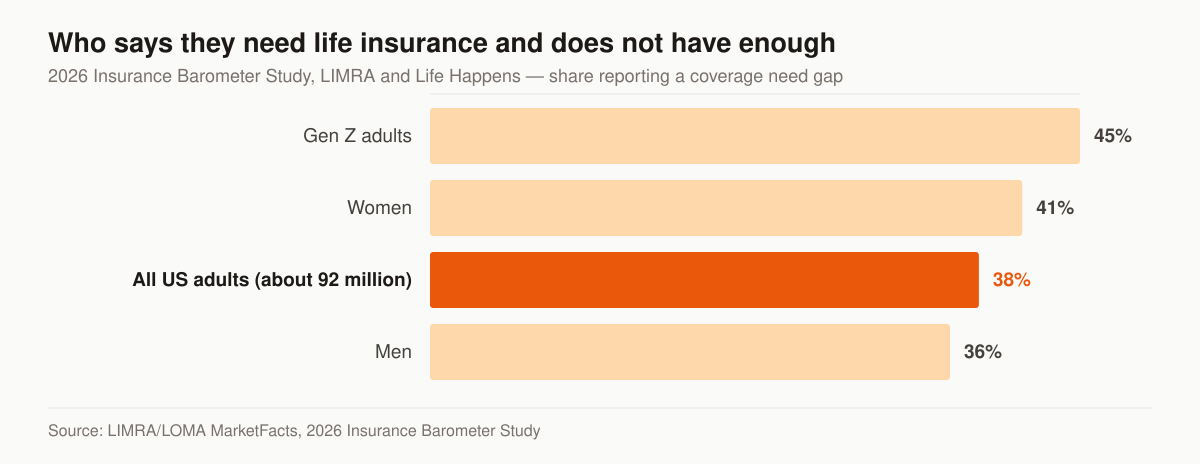
Share of each group reporting a life insurance need gap. Source: LIMRA and Life Happens, 2026 Insurance Barometer Study, reported in LIMRA/LOMA MarketFacts.
The barriers the study names are the ones your creative has to argue with. Among those with a coverage gap, one-third say they aren’t sure how much life insurance they need or what type of policy to buy, and another third say they simply haven’t gotten around to it. On price, the report is blunt: “The most cited reason for going without coverage is the belief that it costs too much,” and it quantifies the error — healthy adults under age 30 overestimate the cost of a typical term life insurance policy by 5 to 6 times. Women report a need for life insurance at 41% against 36% for men, and Gen Z adults report a 45% need gap while 44% of them already own coverage.
Read the table below as a translation layer: each published finding on the left changes one specific thing on the asset you are about to build.
| What the 2026 Barometer reports | The figure | What it changes in your marketing |
|---|---|---|
| Adults who say they need coverage or more of it | 38%, about 92 million | The audience is not narrow; targeting is not your problem |
| Reason cited most often for going without | Belief that it costs too much | Put a real premium example on the ad and the landing page |
| Cost overestimate, healthy adults under 30 | 5 to 6 times | Lead with a real premium figure rather than a responsibility appeal here |
| Unsure how much or what type to buy | One-third of those with a gap | Build a needs calculator and a type-comparison page, not another quote form |
| Haven’t gotten around to it | Another third of those with a gap | The follow-up sequence is the campaign, not an afterthought |
| Women reporting a need versus men | 41% versus 36% | Creative and casting aimed at women is an underserved segment, not a niche |
Where life insurance buyers actually look for answers
Discovery has moved, and the same research programme measured where. The second report from the 2025 Insurance Barometer Study, published by Life Happens and LIMRA, found that 62% of Americans use social media when looking for financial and insurance information, up from 29% in 2019, with usage strongest among younger adults at 84% of Gen Z and 78% of Millennials. The 2026 study puts platform detail on that: among Americans who use social media, 66% use YouTube to learn about financial products and services and 62% use Facebook for financial education, while 46% say it is important for financial professionals to connect with them on social media.
Artificial intelligence now sits inside the same journey. The 2025 report records that over half of respondents used AI tools for research (51%) and shopping (55%), and that one in four consumers would complete a life insurance purchase entirely online — which leaves three in four still wanting professional help somewhere in the process. That is the number that should decide how your content ends.
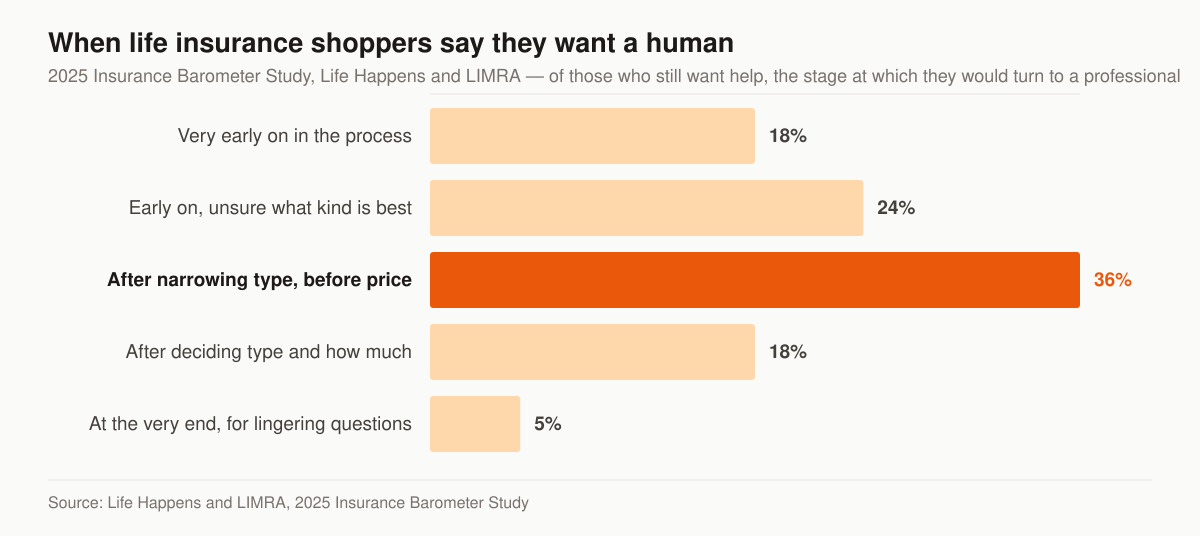
Of consumers who still want human help, the stage at which they would turn to a professional. Source: Life Happens and LIMRA, 2025 Insurance Barometer Study.
The single largest group, 36%, turns to a professional after narrowing the product type but before deciding amount and price. That is a specific instruction for content marketing: a page that compares term against whole life earns the handoff, and a page that opens with a quote form asks for the decision before the reader has made the one that comes first. Trust is not the obstacle either — 78% of adults say they trust financial professionals, 43% currently work with one, and 94% of those say they are somewhat or very likely to trust them. The traits consumers say they want in a financial professional are instructive for positioning: experience (81%), specialized focus (62%), recommendations from friends and family (54%) and empathy or kindness (43%). A specialized focus is a marketing asset with a measured number attached to it, which is the argument for a page that says what you write rather than a page that says you write everything.
One more line from the same body of work keeps agents from over-rotating to digital. LIMRA reports that 31% of Americans prefer in-person, face-to-face conversations when interacting with a financial professional or life insurance agent, and that 29% of Generation Z say the same. The channel that produces the appointment and the channel that closes it are allowed to be different.
Start with one fast channel and one slow channel
A thin budget spread across six ideas is the failure mode we plan against, because no single channel then collects enough data to optimize. Pick one fast channel for cash flow now and one slow channel that compounds.
A clean starter pair looks like this:
- Fast: Paid social to a dedicated landing page, with SMS and call follow-up inside five minutes. Speed to first contact is the lever we reach for first.
- Slow: Local SEO and a real content layer so that in 90 days you are earning leads you do not pay per click for.
Run the fast channel to keep the lights on while the slow channel lowers your blended cost per acquisition. Our senior-market book only reached its efficient cost per sale after the slow assets matured underneath the paid spend.
Match the channel to how the buyer decides
Not every life product wants the same idea. Term life is a fast, price-driven decision, so it rewards Facebook and Meta ad strategies that lead with a clear protection-and-price hook. Whole life and cash-value products are slower, trust-heavy decisions, so they reward education, a whole life marketing approach built on nurture and proof, and referral credibility over a cold pitch.
A simple rule: the longer the buyer takes to decide, the more you weight email nurture, content, and referrals over raw paid traffic. Spending more on cold clicks for a slow product just inflates your cost per lead without lifting your close.
Two product-level variants deserve their own creative rather than a stretched version of your term campaign. Simplified-issue and no-exam products sell on removed friction, and the offer math and disclosure duties differ enough that we treat them separately in marketing no-exam life to younger buyers and simplified issue life insurance marketing. Indexed universal life sits at the other end — a long, illustration-heavy sale where the marketing job is qualification, not volume, which is why generating IUL leads reads nothing like a term campaign.
The ideas that quietly lift every other channel
Three of the 17 are not standalone campaigns — they are multipliers that make everything else convert better:
- Landing pages. Sending paid traffic to a homepage instead of a focused page is a money leak we look for first. One offer, one form, no menu. The build standards we hold those to are on our insurance landing pages service.
- Reviews and social proof. A page with recent, specific reviews converts the same traffic at a higher rate, and the Barometer’s finding that 54% of consumers name recommendations from friends and family among the traits they want in a financial professional is the demand-side reason. This is free lift. See how to get more Google reviews for the mechanics.
- Retargeting. Treat a first visit without a conversion as the default case and budget for the second touch. A small retargeting budget recovers buyers you already paid to reach.
If your paid numbers look weak, fix these three before you blame the channel.
Life events and cross-sell: the ideas with no media cost
The cheapest life insurance marketing ideas are the ones that use a moment you already know about. Gen Z consumers told the 2026 Barometer exactly which moments those are: 44% would consider purchasing life insurance when opening a checking or savings account, a third would be interested after the birth of a child (34%), and 32% each would consider it through a credit card membership or through a gym or wellness program. None of those are traditional insurance channels. All of them are events a partner, a CRM field or an existing client conversation can surface for free.
The same study explains why the conversation is easier when you frame the product around a living risk rather than a death benefit. Fifty-one percent of Americans say they would feel the financial impact of a primary wage earner becoming too sick or injured to work within six months. One-fifth (20%) of life insurance owners say they own life insurance to supplement retirement income, and 47% of Gen Z and Millennials say that “providing income in retirement” is attractive when shown a set of potential policy components. Reasons for owning, in the study’s own ranking, run 57% to help pay final expenses, 39% to leave an inheritance or transfer wealth, and 27% to replace lost income if a wage earner dies.
The table below pairs each published trigger with the asset that catches it, so a life event turns into a booked call rather than a mental note.
| Trigger | What the study reports | The asset that catches it |
|---|---|---|
| Opening a bank account | 44% of Gen Z would consider buying then | A partner placement or co-branded page, not a cold ad |
| Birth of a child | 34% of Gen Z would consider buying after it | A nurture email to your existing book plus a needs calculator |
| Credit card membership | 32% of Gen Z would consider buying there | An affinity or association offer with its own landing page |
| Gym or wellness program | 32% of Gen Z would consider buying there | Local partnership content, run as education rather than an offer |
| Wage earner unable to work | 51% would feel the impact within six months | A living-benefits explainer that reframes the product |
| Retirement income interest | 47% of Gen Z and Millennials find it attractive | A cash-value comparison page that hands off to a booking |
Cross-selling inside a book you already own carries no media cost at all, which is why we sequence it before new paid spend for any agent who writes more than one line. The mechanics transfer from the property and casualty side almost unchanged — see cross-selling and account rounding for the review-call structure and the timing rules.
What a referral or review program may legally offer
Review generation and referral rewards both involve giving something in exchange for something, which is why we check them against two separate bodies of law before either one launches.
The FTC’s Rule on the Use of Consumer Reviews and Testimonials, 16 CFR Part 465, published at 89 FR 68077 and in force since 21 October 2024, is the federal half. Section 465.4 states that “It is an unfair or deceptive act or practice and a violation of this part for a business to provide compensation or other incentives in exchange for, or conditioned expressly or by implication on, the writing or creation of consumer reviews expressing a particular sentiment, whether positive or negative, regarding the product, service, or business that is the subject of the review.” The rule’s definitions leave little room to design around it: to “purchase a consumer review” means “to provide something of value, such as money, gift certificates, products, services, discounts, coupons, contest entries, or another review, in exchange for a consumer review.” A drawing entry for five-star reviews is inside that definition.
What the rule preserves is the ask itself. Section 465.2(d) states that paragraphs (b) and (c) of that section do not apply to “Reviews or testimonials that resulted from a business making generalized solicitations to purchasers to post reviews or testimonials about their experiences with the product, service, or business,” which is precisely the scripted, sentiment-neutral request you should be making after every issued policy. Two adjacent provisions catch the shortcuts: section 465.5(a) requires a clear and conspicuous disclosure of an officer’s or manager’s material relationship when they write a review of their own business, and section 465.7(b) reaches a business that misrepresents that the reviews it displays “represent most or all the reviews submitted to the website or platform when reviews are being suppressed” on the basis of rating or negative sentiment. If your website widget filters out three-star reviews, that provision is about you.
State insurance law is the second half, and it is the one agents forget. Anti-rebating statutes cap what may be given as an inducement to buy. New York’s is representative and specific: Insurance Law § 4224(c) bars a life insurer, its agents, solicitors and representatives and licensed brokers from giving, directly or indirectly, “as an inducement to any person to insure,” any “valuable consideration or inducement whatever not specified in such policy or contract other than any valuable consideration, including but not limited to merchandise or periodical subscriptions, not exceeding twenty-five dollars in value.” Ceilings and definitions vary by state, so the working rule is to price any referral thank-you against your own state’s code before the campaign prints.
Use this table as the pre-launch check on any referral, review or testimonial idea.
| The tactic | The rule that reaches it | The version that survives it |
|---|---|---|
| “$25 gift card for a five-star review” | 16 CFR 465.4 and 465.1(m) | A generalized ask with no reward and no sentiment condition |
| Staff posting reviews of their own agency | 16 CFR 465.5(a) | A clear and conspicuous disclosure of the relationship, or no post |
| Hiding sub-four-star reviews on your site | 16 CFR 465.7(b) | Publish all reviews, or apply criteria equally without regard to sentiment |
| A disclosure behind a “more” link on social | 16 CFR 465.1(c)(4) | An unavoidable disclosure that needs no click or hover to see |
| A gift for referring a prospect who buys | State anti-rebating law, e.g. NY Ins. Law § 4224(c) | A thank-you priced under your state’s ceiling, or a non-cash acknowledgement |
| A client testimonial reworded for the ad | 16 CFR 465.2(a)(3) | The client’s own words, unaltered, with the experience represented accurately |
The contact rules that decide whether an idea is runnable
Speed to first contact is the lever we reach for first, and federal law puts boundaries around it that a five-minute call rule has to respect. Under 47 CFR 64.1200(c)(1), no person or entity shall initiate any telephone solicitation to a residential telephone subscriber “before the hour of 8 a.m. or after 9 p.m. (local time at the called party’s location).” A lead that arrives at 10:40 p.m. in the prospect’s time zone waits until morning, whatever your dialer is set to do.
The national do-not-call registry sits in 64.1200(c)(2), and its registrations “must be honored indefinitely, or until the registration is cancelled by the consumer or the telephone number is removed by the database administrator.” The safe harbour that protects you from an error is conditional on routine business practice: written procedures, trained personnel, a recorded internal list of numbers not to contact, and a process that uses “a version of the national do-not-call registry obtained from the administrator of the registry no more than 31 days prior to the date any call is made.” Internal do-not-call requests carry their own clock under 64.1200(d) — honored for five years from the time the request is made. Paragraph (e) extends the (c) and (d) rules to “any person or entity making telephone solicitations or telemarketing calls or text messages to wireless telephone numbers to the extent described in the Commission’s Report and Order, CG Docket No. 02-278, FCC 03-153,” which is why the SMS idea in row 16 lives under the same regime as the call.
Consent has a definition, not a vibe. 47 CFR 64.1200(f)(9) defines prior express written consent as “an agreement, in writing, bearing the signature of the person called that clearly authorizes the seller to deliver or cause to be delivered to the person called advertisements or telemarketing messages using an automatic telephone dialing system or an artificial or prerecorded voice, and the telephone number to which the signatory authorizes such advertisements or telemarketing messages to be delivered.” The same paragraph requires the agreement to disclose that “The person is not required to sign the agreement (directly or indirectly), or agree to enter into such an agreement as a condition of purchasing any property, goods, or services.” A lead form whose consent checkbox is required to submit is not collecting that.
Email nurture answers to the CAN-SPAM Rule at 16 CFR Part 316. Section 316.5 prohibits a sender from requiring “that any recipient pay any fee, provide any information other than the recipient’s electronic mail address and opt-out preferences, or take any other steps except sending a reply electronic mail message or visiting a single Internet Web page” to unsubscribe — a login wall on the preference centre fails that test. Section 316.2(p) defines the valid physical postal address a commercial message must carry as “the sender’s current street address, a Post Office box the sender has accurately registered with the United States Postal Service, or a private mailbox the sender has accurately registered with a commercial mail receiving agency that is established pursuant to United States Postal Service regulations.” Section 316.3(c) is the useful one for sequence design: it lists the transactional or relationship content that keeps a message out of the commercial category, including messages sent “To facilitate, complete, or confirm a commercial transaction that the recipient has previously agreed to enter into with the sender.” Policy-service mail and marketing mail are different objects, and your sequence should treat them that way.
The table below is the compliance floor for the four contact-dependent ideas in the list above.
| Idea | Rule | The operational constraint |
|---|---|---|
| Five-minute call on a new lead | 47 CFR 64.1200(c)(1) | Calls only between 8 a.m. and 9 p.m. local time at the called party’s location |
| Dialing purchased or aged lists | 47 CFR 64.1200(c)(2) | Registry scrub no older than 31 days, plus written procedures and training |
| SMS follow-up on opt-in leads | 47 CFR 64.1200(e) and (f)(9) | Signed written consent naming the number, never a condition of purchase |
| Email nurture sequences | 16 CFR 316.5 and 316.2(p) | One-click or one-reply opt-out and a valid physical postal address on the message |
None of this is legal advice, and state insurance advertising codes add requirements on top of the federal floor. The broader sitewide view is in insurance marketing compliance for agents.
A note on buying versus building leads
Generating your own leads through ads and SEO gives you exclusive, brand-aligned prospects and assets that compound. But if your pipeline is empty today, building from scratch is the wrong first move. When the goal is simply to buy leads or live transfers as a product to dial tomorrow, do that through a dedicated vendor — you can buy leads direct from getinsureleads and keep your owned marketing focused on long-term, lower-cost acquisition. Mixing the two is fine; just be honest about which problem you are solving.
What running these ideas costs
The build and the retainer are separate decisions, and we publish both. A one-time website build runs $2,500 to $8,000 depending on scope. Ongoing programs run in three flat tiers: Foundation at $2,500 per month, covering the optimized website and landing pages, local SEO and Google Business Profile, on-page SEO and monthly reporting; Growth at $3,500 per month, which adds the ongoing SEO and content engine, AI-search visibility, and reputation and reviews; and Full-Funnel at $5,500 per month, which adds managed paid ads across Google and Meta, landing-page CRO, and marketing automation and CRM. Media budget is a pass-through paid directly to Google and Meta — our fee covers strategy, build and management, never a markup on your ad spend.
Map that against the 17 ideas and the tier picks itself. Ideas 3, 4 and 8 sit inside Foundation and Growth; ideas 1, 2, 7 and 16 need the paid and automation layer that arrives at Full-Funnel; ideas 5, 10 and 13 are labour you supply and we script. The full breakdown and the comparison table are on the pricing page, and if you would rather talk it through against your own book, start a conversation. For a wider view of how a life book should split its money across channels before any of this, read the insurance agency marketing budget breakdown.
The four numbers that decide which idea survives
Every idea in the table ties to a number you can watch. Four of them, tracked weekly, tell you whether to keep spending, fix the asset, or cut the channel — and they fail in a specific order, which is what makes them diagnostic rather than decorative.
Read the table below as a decision tree: find the first row that is failing and fix that one before touching anything downstream.
| Metric | What it tells you | Act when |
|---|---|---|
| Cost per lead | Whether the offer and the audience match | It climbs while lead quality is flat — change the offer before the budget |
| Contact rate | Whether your follow-up speed and calling window are real | It falls below your own baseline after a source or dialer change |
| Appointment rate | Whether the lead understood what they opted into | Leads answer but will not book — the ad promised something the call does not |
| Close rate | Whether the product, the price and the audience agree | Appointments hold but nothing binds — the segment or the product fit is wrong |
Cost per bound policy is the number those four roll up into, and it is the one to compare against first-year commission value before a campaign gets a second month. If you cannot see all four, you are not marketing — you are spending. And when the pipeline fills, the bottleneck moves to the appointment itself: how to sell life insurance is the conversion half of the same system, and insurance lead follow-up cadence governs the hours between the click and the call.
Ideas we would not run first
An honest list has to say which ideas are wrong for the moment you are in, not only which are right. These are the sequencing calls we make and the reasoning behind each.
- Direct mail before a landing page exists. Row 14 carries the highest upfront cost in the table and the least room to iterate. A mailer that drives a call to an untracked number teaches you nothing about which list segment worked.
- Short-form video before a booking path. Video earns attention that expires. Without a link that ends in a calendar, the 46% who say it matters that professionals show up on social have nowhere to go once you have their attention.
- AI-search optimization before the site answers a product question. Generative engines cite pages that resolve a question cleanly. Until you have the term-versus-whole-life comparison the 36% handoff group is looking for, there is nothing to cite. Sequence it after the content layer — the approach is set out in getting cited by Perplexity and AI Overviews and delivered through AI-search and GEO services.
- A newsletter with no list. Row 6 needs an audience before it needs a template. Build the lead magnet and the opt-in first; the email automation service assumes a list already exists.
- Review campaigns with an incentive attached. Covered above — 16 CFR 465.4 removes the shortcut, and a sentiment-neutral ask still works. Our reputation management service runs the compliant version.
How to actually sequence this
Here is the order we would run for a typical life agent with a modest budget:
- Stand up one dedicated landing page and a five-minute follow-up process, inside the 8 a.m. to 9 p.m. window the rules allow.
- Launch one paid social campaign; spend to 50–100 leads before judging it.
- Turn on retargeting and start collecting reviews with a generalized, sentiment-neutral ask.
- Build the SEO and content layer in parallel for the 90-day payoff, leading with a product-type comparison rather than a quote form.
- Add email nurture for slow-deciding whole life and IUL prospects, with a compliant opt-out and postal address on every send.
- Layer referrals and partner relationships once the book grows, priced against your state’s anti-rebating ceiling.
If you want a second set of eyes on which two ideas to run first for your book, our team will walk your funnel and numbers in a free marketing audit. For the full playbook on positioning, channels, and creative built specifically for this market, start with our life insurance marketing services overview, and if organic is your long game, see how we approach SEO for life insurance agents. For what this looks like applied to a book rather than a list, read the life insurance agent case file and the wider set of documented client case files. The same conversion systems and ad discipline that work for our senior-market clients are what make these ideas produce — not luck, and not hype. Selling to business owners? Two B2B-specific reads: marketing group life and employee benefits and key person and buy-sell insurance marketing.
- How to Generate IUL Leads With Marketing
How to generate IUL leads with your own marketing versus buying them. Published lead prices, the consent rules on a bought lead, and the channel plan.
- No Exam Life Insurance Marketing: A Playbook for Reaching Younger Buyers
No exam life insurance marketing for younger buyers: the offer math, the ad disclosure rules, and the funnel that turns a no-exam hook into bound policies.
- Simplified Issue Life Insurance Marketing: How SI vs GI Changes Your Funnel
A practitioner's guide to simplified issue life insurance marketing: how SI vs GI changes your messaging, your lead quality, and your close rate.
- How to Get Annuity Clients With Marketing (Without Buying a Single Lead)
How to get annuity clients without buying leads: a numerate, repeatable system for annuity client acquisition you can run week after week.