Who we serve
Cash Value Life Insurance Marketing, Run as a Funnel
Whole life insurance marketing for agents matches the funnel to the buyer's pace: whole life is a permanent, cash-value decision people research before signing, so the job is to earn trust at every step, not push a quick close. It runs on ads, landing pages, and content that explain guarantees plainly and book informed appointments.
Free · 15-minute teardown · no pitch deck
- We run our own final-expense book
- No pitch deck — we screen-share real numbers
- TCPA-aware · CMS/AEP-compliant · Meta Special Ad Category
- Core Web Vitals < 2.0s LCP
Whole life insurance marketing for agents fails in one predictable way: agents run it like term. Term is a price quote and a fast yes. Whole life is a permanent, cash-value decision a buyer turns over in their head for days or weeks before they sign anything. Market it for speed and you burn good prospects. Market it for trust and you book people who already understand what they’re buying.
We say this as operators, not theorists. The lead operation that anchors this agency is final expense — and final expense is whole life, just small-face. We sell guaranteed, permanent, cash-value coverage for a living, through our own live campaigns, and the same conversion discipline carries up-market to fully-underwritten whole life.
How much whole life is actually being sold
Agents budget marketing as if term were the center of the individual life market. The sales data says otherwise. LIMRA’s individual life insurance sales survey, whose preliminary 2025 results were published in March 2026, put total new annualized premium at $17.5 billion for the year, up 10% over 2024, with the number of policies sold up 7%.
Inside that total, whole life carried the largest single share.
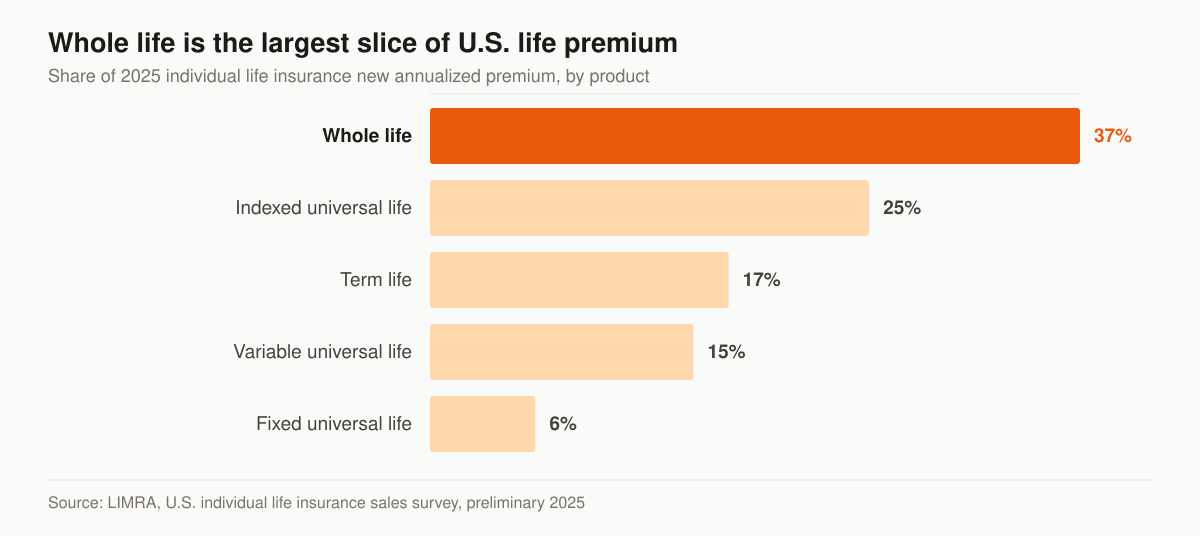
Source: LIMRA, U.S. individual life insurance sales survey, preliminary 2025 results, read September 2026. LIMRA states the survey “represents 85% of the U.S. life insurance market.”
The dollar figures behind those shares are worth writing down, because they set the size of the prize for a whole life practice.
| Product | 2025 new annualized premium | Change vs 2024 | Share of 2025 market |
|---|---|---|---|
| Whole life | $6.4 billion | Up 7% | 37% |
| Indexed universal life | $4.5 billion | Up 17% | 25% |
| Term life | $3.1 billion | Up 3% | 17% |
| Variable universal life | $2.6 billion | Up 17% | 15% |
| Fixed universal life | $985 million | Down 4% | 6% |
Every figure in that table comes from the same LIMRA release. Two things follow for a marketing plan. First, whole life premium set a record in 2025 — LIMRA calls it “a new sales record for whole life insurance products” — so an agent building a whole life funnel is not fighting a shrinking category. Second, LIMRA is forecasting overall new annualized premium growth of 2% to 6% in 2026 against a stated historical average of 3.1%, which means 2026 will not repeat the double-digit tailwind. Campaigns launched this year have to earn their appointments rather than ride the market.
Who is buying whole life right now
The composition of that growth changes who your ads should talk to. LIMRA’s release attributes the quarterly pattern directly: “Driven by final expense product sales, total whole life (WL) premium and policy count posted positive growth for the fifth consecutive quarter.”
The policy and premium numbers move at different speeds, and the gap is the story. In 2025 whole life premium grew 7% while whole life policy count grew 12%. More policies growing faster than premium points to smaller average cases, which is what final expense and small-face permanent coverage look like in a sales report. Karen Terry, head of LIMRA Insurance Research, described the supply side of that in the same release: “A number of companies have expanded their final expense and smaller-face amount business to attract more middle-market consumers”.
For an agent, that means the whole life audience is not one audience. It is at least two, and they need separate campaigns:
- The small-face permanent buyer, usually shopping burial or final expense coverage, deciding on affordability and simplicity. Our final expense marketing work is built entirely around this buyer, and the systems there are the ones we run for ourselves.
- The fully-underwritten cash-value buyer, weighing guarantees, dividends and long-horizon funding against alternatives. This buyer reads before they book, compares whole life against indexed universal life, and expects the agent to have an opinion in writing.
Running one ad set and one landing page at both produces the worst version of each. We split them at the ad account level, not at the follow-up stage.
Why whole life marketing needs its own funnel
A whole life buyer is weighing guarantees, dividends, and cash value — not just a monthly premium. Your marketing has to do the explaining the policy illustration can’t, in plain language, before the appointment. That changes every layer of the funnel.
Set the two products side by side and the differences are not tone, they are structure.
| Funnel layer | Term life approach | Whole life approach |
|---|---|---|
| Ad angle | Price and speed | Guarantees, cash value, “forever” coverage |
| Landing page | Quote form | Education plus a booked call |
| Follow-up | Hours | A weeks-long nurture sequence |
| Lead intent | Transactional | Considered, relationship-driven |
| Best metric | Cost per quote | Cost per qualified appointment |
Judge a whole life campaign on booked, qualified appointments — never raw clicks. A cheap click that doesn’t understand cash value wastes your seat time.
What a whole life advertisement is not allowed to say
Whole life is a product line where marketing copy runs close to a regulator’s line, because the cash-value feature invites language borrowed from investing. The NAIC publishes a model regulation named Advertisements of Life Insurance and Annuities, and states adopt their own versions of it, so the wording and the citation differ by state. Arkansas adopted the terminology provision at 23 CAR § 130-104:
No advertisement shall use the terms “investment”, “investment plan”, “founder’s plan”, “charter plan”, “deposit”, “expansion plan”, “profit”, “profits”, “profit sharing”, “interest plan”, “savings”, “savings plan”, “private pension plan”, “retirement plan”, or other similar terms in connection with a policy in a context or under such circumstances or conditions as to have the capacity or tendency to mislead a purchaser or prospective purchaser of such policy to believe that he or she will receive, or that it is possible that he or she will receive, something other than a policy or some benefit not available to other persons of the same class and equal expectation of life.
Read the back half of that sentence as carefully as the word list. The rule is not a ban on the word “savings” in every sentence an agent ever writes; it bars those terms used “in a context or under such circumstances or conditions as to have the capacity or tendency to mislead”. Whether a given ad crosses that line is not the agency’s call: the same Arkansas rule says it “shall be determined by the Insurance Commissioner from the overall impression that the advertisement may be reasonably expected to create upon a person of average education or intelligence within the segment of the public to which it is directed.”
That standard — overall impression on the ordinary reader in your target segment — is the practical test we apply to every whole life headline before it goes live.
Here is that standard applied to four whole life headlines, with the rewrite we would ship in each case.
| Headline shape that trips the rule | Why it is a problem | What we write instead |
|---|---|---|
| “A tax-free savings plan that never loses value” | Uses “savings plan” in a context inviting a non-insurance reading | “Permanent coverage with a guaranteed cash value schedule in the contract” |
| “Deposit $500 a month and watch it grow” | Uses “deposit” for a premium | “Premiums of $500 a month, with the guaranteed values shown in your illustration” |
| “Earn 6.60% on your money” | Presents a dividend interest rate as a return to the buyer | “Dividends are declared each year by the carrier’s board and are not guaranteed” |
| “Your policy pays for itself after year ten” | Implies premiums stop, which the illustration rule addresses head-on | “Here is what the guaranteed column shows at year ten, and what the non-guaranteed column shows” |
Nothing in that right-hand column is weaker copy. It is more specific copy, and specificity is what a permanent-product buyer is actually shopping for. This is the same discipline our insurance advertising service applies across every regulated line we run.
Dividends: the number you may quote and the number you may not
Participating whole life pays dividends, and dividend language is where the terminology rule and the illustration rule meet. The carriers publish the figures and the caveats on the same page, which makes the honest version of this copy easy to write.
New York Life announced on November 20, 2025 that it would pay an estimated $2.78 billion in dividends to eligible participating policy owners in 2026, “the largest dividend payout in New York Life’s 180-year history and its 172nd consecutive annual dividend.” MassMutual announced an estimated $2.9 billion for 2026, “its 158th consecutive year paying a dividend”, with a dividend interest rate increasing to 6.60%.
Those are real, published, checkable numbers, and an agent may cite them. What the same pages also say is the part that keeps ad copy clean:
- New York Life’s own footnote states plainly: “Dividends are not guaranteed.” The mechanism is a board vote, not a rate: “Each year the board of directors votes on the amount and allocation of the divisible surplus.”
- MassMutual’s footnote is explicit that the dividend interest rate is not a policy return: “The dividend and dividend interest rate (DIR) are determined annually, subject to change and are not guaranteed.” It continues: “It is not the rate of return on the policy and should not be the sole basis for comparing insurers or policy performance.”
An ad that prints 6.60% next to a dollar sign has taken a carrier’s own disclosed input to a dividend formula and re-presented it to a consumer as a yield. The carrier says in writing that it is not one. We treat the dividend interest rate as unusable in a headline and usable in a body paragraph that carries the carrier’s caveat with it.
Illustrations are sales collateral, and they have their own rulebook
Marketing does not stop at the ad. The illustration your prospect sees in the appointment is regulated separately, and the prohibitions in it shape what the marketing before it is allowed to promise. Ohio adopted the NAIC illustrations model at Ohio Administrative Code rule 3901-6-04, effective November 17, 2022. When an illustration is used in the sale of a life insurance policy, that rule states an insurer or its agents or other authorized representatives shall not:
(a) Represent the policy as anything other than a life insurance policy;
(b) Use or describe non-guaranteed elements in a manner that is misleading or has the capacity or tendency to mislead;
(c) State or imply that the payment or amount of non-guaranteed elements is guaranteed;
(g) Represent in any way that premium payments will not be required for each year of the policy in order to maintain the illustrated death benefits, unless that is the fact;
(h) Use the term “vanish” of “vanishing premium,” or a similar term that implies the policy becomes paid up, to describe a plan for using non-guaranteed elements to pay a portion of future premiums;
That reproduces the Ohio text as published, including the typo in paragraph (h). Paragraph (a) is the one that reaches marketing copy furthest from the illustration itself: a campaign whose whole premise is that the product is a savings vehicle or a private bank has represented the policy as something other than a life insurance policy before the prospect ever sees a numbers page.
Check your own state’s rule rather than assuming Ohio’s wording travels. States adopted the model at different dates and with their own edits, and we are a marketing firm, not your compliance counsel — your carrier’s advertising review and your own counsel sign the copy off.
Infinite banking, “be your own bank,” and the terminology trap
Search demand exists for infinite banking, and agents want to capture it. The concept describes funding a participating whole life policy heavily and borrowing against the cash value. The mechanics are real; the marketing language around them is where practices get into trouble, because “be your own bank” is exactly the kind of framing the terminology rule quoted above was written for, and “the policy funds itself” is the framing the illustration rule addresses in paragraph (g).
There is a way to serve that search intent without adopting the pitch. We build the content that answers the question — how policy loans work, what the guaranteed column actually shows, what happens if dividends are reduced, why the strategy needs a decades-long horizon — and we let the honest answer do the qualifying. A prospect who reads a straight explanation and still books is a prospect who can be closed and kept. We treat a prospect who books off a returns promise as a lapse risk, not a win.
Our insurance content marketing service builds those explainers as ranking assets, which also happens to be the format an AI assistant can quote when someone asks it whether infinite banking is legitimate. Structured, sourced, cautious answers get cited. Hype does not.
What we build for whole life agents
We run the same machine that powers our senior-market clients, tuned for a permanent-product buyer:
- Ad systems that lead with guarantees and cash value, not hype — no “get rich,” no guaranteed-return framing around infinite-banking or dividend concepts. Factual claims protect your book and your appointment quality.
- Landing pages that teach first and book second, so the people who reach your calendar already grasp what whole life does. The mechanics of that page — the offer, the form length, the proof block — are covered in our insurance landing page service.
- Content — the long game that earns trust before the call and feeds AI search. Our insurance content marketing service builds the dividend-explainer, term-vs-whole-life, and cash-value articles that get an agent cited when a prospect asks an AI assistant which permanent policy fits.
- Follow-up automation sized for a weeks-long decision, so no considered buyer goes cold while they think.
- Appointment setting where the calendar, not the inbox, is the conversion event — see insurance appointment setting for how we structure the booking step and the reminder sequence around it.
The whole life funnel, stage by stage
This is the build order we use, and the question each asset has to answer before the next one earns any budget.
| Stage | Asset we build | Question it answers for the buyer | What we watch |
|---|---|---|---|
| Demand | Paid search and paid social by product, split small-face from fully-underwritten | “Is permanent coverage even right for me?” | Cost per landing-page visit, by audience |
| Education | Long-form guides on guarantees, dividends, cash value, policy loans | “What am I actually buying, in plain words?” | Scroll depth and assisted bookings |
| Capture | A landing page whose primary action is a booked call, not a raw quote form | “What happens if I raise my hand?” | Booked appointments per 100 visits |
| Qualification | Pre-call questions on budget, horizon and existing coverage | “Will this agent waste my time?” | Show rate and appointment quality |
| Nurture | Multi-week email and SMS sequence sized to a permanent decision | “Can I think about it without being chased?” | Bookings from touch three onward |
| Attribution | Every booked appointment traced back to campaign and creative | Nothing — this one is for you | Cost per qualified appointment |
The last row is the one that ends arguments. We treat cost per lead as a flattering number for an education-led funnel, because a guide download is cheap to buy and tells you nothing about whether the person will sit for an appointment. Cost per qualified appointment is the figure we manage a permanent-product practice on, and it is what our insurance lead generation reporting is built to produce. If you are running paid search alongside this, the bidding side of it sits in our insurance PPC management.
How whole life fits the rest of your life book
Whole life rarely sells alone. The same prospect often weighs term, and your marketing should route both cleanly. Our life insurance marketing pillar is the hub for the full book; the term life marketing page covers the fast, price-led side, and life insurance SEO covers the organic engine that compounds while your ads run.
The 2025 sales mix argues for keeping all of it under one roof rather than specializing too early. Whole life took 37% of new premium, indexed universal life 25% and term 17%, so a practice that markets one of the three leaves the other two shares to whoever else ranks. The site architecture should mirror that: one page per product line with its own ranking surface, all of them linking back to a hub, which is also how our life insurance lead generation and life insurance website design pages are wired.
If you’d rather buy whole life or final-expense leads as a finished product instead of generating your own, that’s a different operation — you can buy leads direct from getinsureleads. This page is about building the funnel that produces your appointments; we don’t sell leads here. Keeping that line clean is deliberate.
Compliance is an appointment-quality signal
Factual whole life marketing isn’t only a legal posture — it’s a filter. Ads that explain real guarantees and real dividend behavior attract buyers who can be closed honestly. Ads that overpromise cash value attract refunds, complaints, and reputational drag. Agents are the licensed parties; we provide the marketing and hold the line on claims so your appointments stay clean.
There is a second-order effect worth naming. The claims a regulator would strike are also the claims a prospect has heard from other agents already. A whole life landing page that says what the guaranteed column shows, names the carrier, and states that dividends are declared annually and are not guaranteed is doing something a hype page cannot: it is proving the agent reads the contract. That is the whole sale, in a category where the buyer’s real fear is being talked into something they do not understand.
What whole life marketing costs here
We publish prices rather than quoting on discovery calls, so you can size this before you talk to anyone.
Each tier is a monthly retainer; ad spend is separate and goes straight to Google or Meta at cost.
| Tier | Monthly | Built for | What a whole life practice gets |
|---|---|---|---|
| Foundation | $2,500 | Solo agents getting online right | Optimized website and landing pages, local SEO and Google Business Profile, on-page SEO, monthly reporting |
| Growth | $3,500 | Agents and small agencies scaling | Everything in Foundation, plus the ongoing SEO and content engine, AI-search visibility, and reputation and reviews |
| Full-Funnel | $5,500 | Agencies serious about volume | Everything in Growth, plus managed paid ads on Google and Meta, landing-page CRO, marketing automation and CRM, full-funnel reporting |
A one-time website or landing-page build runs $2,500–$8,000 and is the usual starting point for an agent who wants the asset before the retainer. Programs run month to month with no long lock-ins. Full detail, including what is deliberately excluded from the monthly fee and what happens to your site and ad accounts if you leave, is on the pricing page.
For a whole life practice specifically, the education layer is the part that does the work, which is why Growth is the tier we point permanent-product agents at first. Full-Funnel is the tier that makes sense once the content is ranking and you want to buy volume on top of it.
Start with the numbers
We’d rather show you the math than pitch you. A free marketing audit maps your current whole life cost-per-appointment, where the funnel leaks, and what a permanent-product nurture sequence should look like for your market. If the numbers don’t justify the spend, we’ll tell you — that’s the operator’s job.
See how the same systems performed for adjacent books in our case studies, compare scope and engagement levels on pricing, or just get in touch with the two or three questions you actually need answered before you spend anything.