Who we serve
Exclusive Life Insurance Leads, Priced on Cost Per Sale
Life insurance lead generation for agents is the work of producing prospects who want coverage and will answer the phone — through paid ads, search, and direct response. The variables that decide profit are lead type, exclusivity, intent, and speed-to-contact, not headline price per lead.
Free · 15-minute teardown · no pitch deck
- We run our own final-expense book
- No pitch deck — we screen-share real numbers
- TCPA-aware · CMS/AEP-compliant · Meta Special Ad Category
- Core Web Vitals < 2.0s LCP
Ask an agent what they pay for life insurance leads and one number comes back: price per lead. That number is the least useful thing on the invoice. What decides whether a campaign makes you money is the type of lead, who else got it, how warm the intent is, and how fast you call. This page breaks down those variables so you can buy leads that book, not leads that pad a vendor’s volume report.
We run paid generation across the senior market every day. Our own book is a live operation, and what makes it work is controlling the four variables below — not buying the cheapest data we could find.
The four lead variables that decide profit
Before comparing vendors or building your own funnel, get clear on what you are actually buying:
- Lead type — real-time form fill, click-to-call, direct-mail response, or aged data. Each has a different contact rate and a different price.
- Exclusivity — exclusive (sold to one agent) versus shared (sold to several). We weight this variable the most heavily when we score a source, because it changes how many other voices reach the prospect before you do.
- Intent — did the prospect ask for a quote, or just click a quiz? High-intent leads cost more and waste less of your dial time.
- Speed-to-lead — how fast you call after opt-in. Calling within minutes beats calling within hours, every time.
Lead types compared
The table below is the shape of the market, not a price list — costs come in the next section.
| Lead type | Typical intent | Exclusivity | Best for | Trade-off |
|---|---|---|---|---|
| Real-time exclusive | High | One agent | Closers with fast follow-up | Highest cost per lead |
| Real-time shared | Medium | 3–5 agents | High-volume dialers | You race other agents |
| Aged (30–90+ days) | Lower | Often resold | Cheap volume, scripted dials | Low contact rate |
| Direct-mail response | High | Usually exclusive | Senior/final expense | Slower, higher unit cost |
There is no “best” row. There is a row that fits your dial discipline and your budget. A disciplined agent on shared leads can out-earn a lazy one on exclusives. For a deeper breakdown of the trade-off, see our guide on exclusive versus shared final expense leads, which applies directly to life lines too.
One row that is not in the table is the phone-sourced list, because it is bought on different terms: telemarketing leads for life agents are priced per record rather than per opt-in, which means the Do Not Call scrub and the consent or established-business-relationship check are yours to run before the first dial, not the vendor’s.
What a life insurance lead actually costs
Lead pricing in this line is published, but it is published in bands, and the bands are wide. ActiveProspect — the company behind the TrustedForm consent-certificate product — puts four bands on its live pricing explainer for life specifically: shared life insurance web leads at roughly $20 to $45 per lead, exclusive life insurance leads at $75 to $150, real-time exclusive or live transfer life leads at $80 to $200 or more per transfer, and aged life insurance leads at $5 to $15.
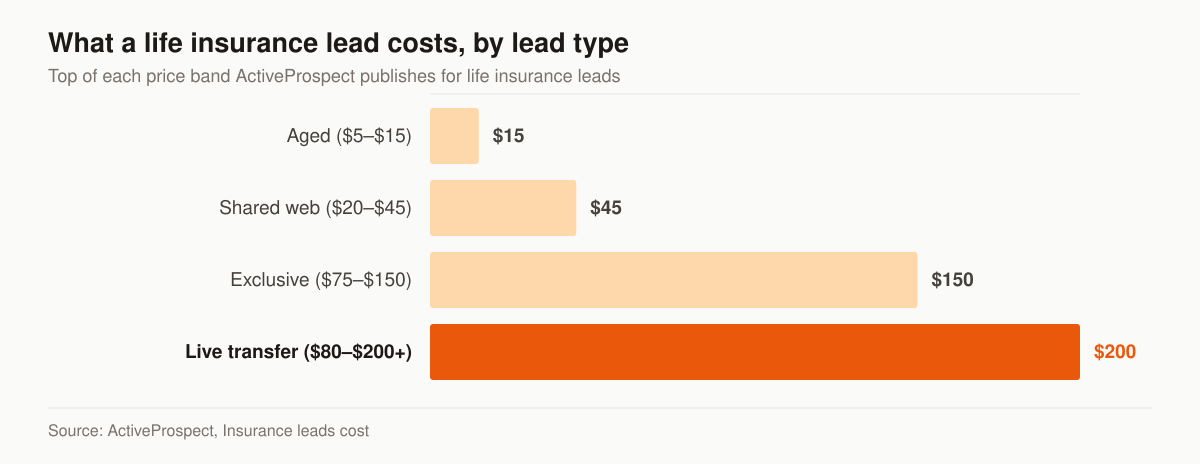
Source: ActiveProspect, “Insurance leads cost: How much does it cost to buy leads?”, read September 2026. Bars show the top of each band the page publishes for life insurance.
The same page reports what happens after the invoice. ActiveProspect writes that life close rates on purchased leads are “often in the 2 to 3 percent range” and that, once follow-up time is counted, “the total acquisition cost per life client can easily reach $2,000 to $3,000”. Whether your book runs at that level or well under it is exactly the thing you are trying to find out — but it is the right denominator, and it is why the sticker price on a single record tells you so little.
Why two vendors quote the same lead at three different prices
Compare the published numbers side by side and the disagreement is the finding.
| What is being priced | Published figure | Source |
|---|---|---|
| Real-time exclusive life lead | $20–$50 per lead | Aged Lead Store |
| Exclusive life lead | $75–$150 per lead | ActiveProspect |
| Shared life web lead | $20–$45 per lead | ActiveProspect |
| Aged life lead, 15–45 days | $2.00 per lead (1–249 leads) | Aged Lead Store |
| Aged life lead | $5–$15 per lead | ActiveProspect |
Read the top two rows again. Aged Lead Store describes the real-time exclusive market as $20 to $50; ActiveProspect puts exclusive life leads at $75 to $150. One source’s exclusive ceiling sits below the other’s exclusive floor, and ActiveProspect’s shared band overlaps Aged Lead Store’s exclusive band almost exactly. A price quote on its own does not identify how many agents receive the record, how old it is when it lands, or whether the consent behind it will survive a look.
Three things move a life lead between those bands:
- How many buyers the record is sold to. “Exclusive” is a number, not an adjective. QuoteWizard states the terms plainly on its life page: “Exclusive Life products mean the lead is delivered to just 1 agent.” Ask any vendor to say the number out loud and put it in the order confirmation.
- How old the record is when it reaches your CRM. Minutes, hours and days are three different products sold under one word. Aged Lead Store sells its life inventory in explicit age brackets — 15 to 85 days old, and 86 to 365 days old — which is at least honest labeling.
- How much filtering you applied. Every filter shrinks the pool and raises the unit price. Coverage amount, state, tobacco status and phone type all cost something.
Aged life insurance leads and the price ladder
Aged data is a genuinely different purchase, and its price collapses on a schedule. Aged Lead Store publishes the ladder for its life inventory: $2.00 per lead at 15 to 45 days old for orders of 1 to 249 leads, dropping to $1.50 each at 250 to 999; $1.50 per lead at 45 to 86 days old for 1 to 999 leads, dropping to $1.25 at 250 to 999; $0.40 per lead at 86 to 365 days for 1 to 999 leads; and $0.25 per lead at 366 to 2,000 days for 1 to 999 leads.
That is $2.00 down to $0.25 inside one vendor’s own catalog, moved by nothing but the calendar. The same page argues the case for buying late rather than early: once a real-time lead is generated, “multiple agents will call or email the lead, overwhelming them to the point where they shut down or stop answering calls”, and the record has had time to cool by the time an aged buyer reaches it.
Aged inventory earns its place when three conditions hold at once:
- You have dialing capacity you are not currently filling with fresh flow.
- You have a script written for a cold record — one that reopens the conversation instead of assuming the prospect remembers filling in a form.
- You run a Do Not Call scrub and check the consent record before the first dial, because the passage of time does not improve either.
Our companion guide on aged final expense leads works the same economics for the senior line, where the buyer profile overlaps heavily with aged life data.
What is actually inside a life insurance lead record
Agents compare vendors on price because price is the only field on the order page. The field list is more predictive. QuoteWizard publishes a sample life lead on its agent page, and it carries three layers: contact details, coverage detail (requested coverage type, requested coverage amount, requested term length, current coverage, household income, marital status), and disclosure fields (nicotine, DUI, felony, hazardous activities, plus a long medical checklist). Aged Lead Store lists a comparable capture set for its life inventory — full contact information, gender and birthdate, desired coverage amount, height and weight, tobacco usage, and financial goals.
Three of those fields change how you open the call:
- Requested coverage amount and term length. QuoteWizard’s published sample record asks for $1,200,000 of term over 30 years; a final expense shopper is asking for a fraction of that. Same field, different product, different objections and different script. Our pages on term life marketing and whole life marketing split the messaging accordingly.
- Tobacco and disclosed conditions. A record with a disclosed condition is not a worse lead; it is a lead you route to a simplified-issue or guaranteed-issue carrier before you quote.
- Date of the inquiry. This one is not about the prospect at all. It tells you which cadence the record belongs in.
Order settings that decide what shows up in your dialer
The order form is where quality is really bought, and it is the part agents skip. Five settings matter more than the price line:
- Daily and weekly caps. QuoteWizard advertises “Customizable daily and weekly caps setting to funnel the perfect lead volume for your team.” A cap that exceeds what you can dial in a day converts a lead budget into a pile of aging records.
- Geography. Set it to the states you are actually appointed in. A vendor with thin volume in your footprint will underfill the order and still bill the setup.
- Coverage amount floor. If your carriers and commissions do not support small face amounts, filter them out rather than dialing them.
- Phone type. Wireless numbers carry different consent requirements than landlines under 47 CFR 64.1200(a)(1)(iii), which covers calls made with an autodialer or a prerecorded voice to “any telephone number assigned to a paging service, cellular telephone service, specialized mobile radio service, or other radio common carrier service, or any service for which the called party is charged for the call.”
- Return and credit policy. Aged Lead Store publishes one: “We offer a 100% satisfaction guarantee to replace or refund any leads with wrong numbers, disconnects, or leads that don’t match the filters you selected.” Get your vendor’s version in writing before the first order, because disconnected numbers are a cost of doing business and the question is only who absorbs them.
The senior-market angle
Senior-market buyers — final expense and simplified-issue whole life for people roughly 50 and up — are where we concentrate paid life lead generation. These prospects answer the phone, buy smaller face amounts, and convert on emotion plus affordability rather than long underwriting.
Two rules shape how you can target them:
- Meta’s Special Ad Category. In October 2024 Meta introduced a Special Ad Category called “Financial products and services”, replacing the previous Credit ads category, and its documentation names what is in scope: “Examples of financial products and services ads include those promoting insurance, bank accounts, investment services and payment services.” Meta adds that “Starting January 21, 2025, using the Special Ad Category designation is required for advertisers based in the United States or reaching audiences in the United States running financial products and services campaigns.” Selecting it strips tools: “Certain audience options are limited or unavailable for these ads for advertisers based in or reaching the US and advertisers reaching Canada and certain countries in Europe: age, gender, ZIP code or postal code, exclusion targeting, lookalike audiences and saved audiences.” You win on creative and offer, not micro-targeting. Our Facebook ads playbook for insurance agents covers the workarounds, and our Facebook ads service runs them.
- TCPA consent. Buying or generating leads means you are dialing. TCPA still governs how and when. Read TCPA compliance for agents buying leads before you scale any dial list.
Sources: Meta Business Help Center, “Special Ad Categories have expanded and now include financial products and services” and “How to choose a Special Ad Category”.
If your book skews senior, the broader life insurance marketing strategy and our final expense lead approach overlap heavily — same buyers, same channels. Agents working mortgage-balance term will find the same mechanics in our mortgage protection lead generation guide.
The consent trail is part of what you are buying
A purchased lead is a permission to call, and the permission is the part that can be defective. The federal rules sit in 47 CFR 64.1200, and the paragraphs that shape a life agent’s dial plan are short enough to read directly. Note that each one carries its own scope — paragraph (c) governs telephone solicitations, paragraph (d) governs telemarketing calls to residential subscribers, and paragraph (a) governs autodialed and prerecorded calls.
These are the artifacts a lead vendor should be able to produce, and the rule behind each one.
| What to ask for | Why, in the rule’s own words | Citation |
|---|---|---|
| The signed consent form and the number it names | Prior express written consent means “an agreement, in writing, bearing the signature of the person called that clearly authorizes the seller to deliver or cause to be delivered to the person called advertisements or telemarketing messages using an automatic telephone dialing system or an artificial or prerecorded voice, and the telephone number to which the signatory authorizes such advertisements or telemarketing messages to be delivered.” | 47 CFR 64.1200(f)(9) |
| The disclosure text shown above the button | The agreement must disclose that “The person is not required to sign the agreement (directly or indirectly), or agree to enter into such an agreement as a condition of purchasing any property, goods, or services.” | 47 CFR 64.1200(f)(9)(i)(B) |
| Their revocation handling, in writing | Requests “made in any reasonable manner must be honored within a reasonable time not to exceed ten business days from receipt of such request”, and a caller “may not designate an exclusive means to request revocation of consent.” | 47 CFR 64.1200(a)(10) |
| Their registry scrub cadence | One of five standards in the error-based safe harbor: the caller “uses a process to prevent telephone solicitations to any telephone number on any list established pursuant to the do-not-call rules, employing a version of the national do-not-call registry obtained from the administrator of the registry no more than 31 days prior to the date any call is made, and maintains records documenting this process.” | 47 CFR 64.1200(c)(2)(i)(D) |
| Their internal do-not-call retention | “A do-not-call request must be honored for 5 years from the time the request is made.” | 47 CFR 64.1200(d)(6) |
Two more paragraphs govern the dial itself rather than the record. Under paragraph (c), no person or entity shall initiate a telephone solicitation to “Any residential telephone subscriber before the hour of 8 a.m. or after 9 p.m. (local time at the called party’s location)”, or to a residential subscriber on the national registry, and those registrations “must be honored indefinitely, or until the registration is cancelled by the consumer or the telephone number is removed by the database administrator.”
The revocation rule is the one that catches resold data. Under paragraph (a)(10), a reply of “stop,” “quit,” “end,” “revoke,” “opt out,” “cancel,” or “unsubscribe” to a text is a per-se reasonable revocation, and other wording still counts “if a reasonable person would understand those words to have conveyed a request to revoke consent.” If a record has already been worked by three other buyers, a revocation may have been made to one of them. Your vendor’s suppression process, not your good intentions, is what keeps that record out of your dialer.
The exposure is statutory rather than speculative. Under 47 U.S.C. 227(b)(3)(B) a plaintiff may bring “an action to recover for actual monetary loss from such a violation, or to receive $500 in damages for each such violation, whichever is greater”, and the court “may, in its discretion” treble that award where it finds the defendant “willfully or knowingly violated this subsection or the regulations prescribed under this subsection”. The do-not-call private right of action in 227(c)(5) is narrower — it requires “more than one telephone call within any 12-month period by or on behalf of the same entity” — and it carries an affirmative defense for a caller who “has established and implemented, with due care, reasonable practices and procedures to effectively prevent telephone solicitations in violation of the regulations prescribed under this subsection.” Those written procedures are worth having on file before you need them. We provide marketing services, not legal advice; your compliance counsel is the person who signs off on your dial plan.
Ten questions to ask a life insurance lead vendor
Vendor quality varies more than vendor price, and almost none of it is visible on the order page. Ask these before the first order:
- How many agents receive this record? Ask for the number, and ask for it in the order confirmation.
- What is the median age of the record when it hits my CRM? Not the bracket — the median.
- Where was it generated? A named surface: search landing page, Facebook lead form, comparison site, mail reply, call-center transfer.
- Can you show me the consent capture for a specific record? The form, the disclosure text, the timestamp, the page URL, and the IP if they have it.
- Do you supply an independent consent certificate? TrustedForm issues a certificate that, in ActiveProspect’s description, “independently records the consumer’s session”; a vendor that supplies one has removed an argument you would otherwise have to win alone.
- How often do you scrub against the national registry, and how do you propagate revocations to prior buyers? Compare their answer to the 31-day safe-harbor standard above.
- Do you resell this record as aged inventory later? Many do. It changes the value of every fresh lead you bought.
- What is the credit policy on disconnects, wrong-party contacts and filter mismatches?
- What is your fill rate in my states, at my filters, for the last 30 days? A vendor with real volume can answer this.
- Can I start under 100 leads? Any minimum that requires a commitment before you have measured a cost per acquired policy is asking you to fund their risk.
How to run a vendor test order that means something
A test order that is too small tells you nothing, and one run without a control tells you nothing either. Design it before you spend:
- Fix the variable you are testing. Change the vendor, not the vendor plus the script plus the hours you dial. One variable per test.
- Buy enough records to see a close. If a source needs 30 to 40 dials to produce a sale in your book, a 25-lead test measures noise. Size the order against your own leads-per-sale, not against a budget round number.
- Route every record the same way. Same dialer, same first-touch window, same cadence, same disposition codes. Our insurance lead follow-up cadence guide is the version we hand clients.
- Score on issued policies, not on submitted applications. Placement and persistency are where life economics actually live.
- Give the source a written verdict. Cost per issued policy, contact rate, and one sentence on why. Without a written scorecard, the next order gets placed on memory and vendor charm.
Speed-to-contact and the cadence that works the lead
We treat time-to-first-dial as the first thing to fix on any underperforming paid-lead program, because it changes nothing but routing and costs nothing to try. A form fill that sits unread in an inbox for four hours is, on a shared record, four hours the other buyers have already had to work it.
The mechanics are unglamorous and they are all in your CRM:
- Post leads by API, not by email. An emailed CSV is a delay dressed as a delivery. Our roundup of the best CRM for insurance agents covers which platforms accept real-time posts.
- Fire the first attempt automatically. A dial task that depends on someone noticing a notification is a dial task that happens late.
- Write the cadence down. Multiple attempts across the first 10 to 14 days, mixing call, text and email, with the text sent only where the consent record supports it.
- Instrument the handoff. If you cannot see time-to-first-dial per record in a report, you cannot manage it. This is one of the things our marketing automation work puts in place.
Live transfers exist precisely to delete this problem: the prospect is already on the line. QuoteWizard markets its WizardCalls transfers as leads that “have reported to close at over 30% based on customer feedback” — a vendor claim they footnote themselves, not an independent measurement, and worth treating as a starting hypothesis for your own test rather than a benchmark.
Buy leads or build a funnel?
Two paths, and plenty of agencies run both:
- Buy leads. Fast to start, predictable volume, but you compete on speed and you never own the source. Good for filling a calendar this week.
- Build owned generation. Slower to spin up, but the cost per lead drops over time and the pipeline is yours. This is what our insurance lead generation service builds — campaigns you keep, not data you rent.
The honest answer for an agent who needs appointments this month: buy to keep the phone busy now, build to lower cost per sale over the next two quarters.
Owned generation is a different asset with a different payback curve, and the comparison is worth making on paper.
| Buying leads | Building owned flow | |
|---|---|---|
| Time to first conversation | Same week | Weeks to months |
| Unit cost over time | Set by the vendor’s market | Falls as the funnel and content compound |
| Exclusivity | Whatever the contract says | Total, by definition |
| Consent trail | The vendor’s, and you inherit it | Yours, captured on your own form |
| What you hold at the end | The policies written | The policies plus the asset that produced them |
| Main failure mode | Vendor quality drift | Pulling spend before it compounds |
The owned side is not only ads. It is a site that converts the traffic you already get, which is why insurance landing pages and a life insurance agent website built for lead capture sit underneath every paid channel we run. For agents who want the pipeline without the dial list at all, we wrote a separate guide on insurance leads without cold calling.
Stop measuring the wrong number
Cost per lead is a vanity metric. Cost per acquired policy is the one that pays your bills. A $25 exclusive lead that closes at 1-in-5 beats a $6 shared lead that closes at 1-in-30 — by a wide margin. Run the math on your own numbers before you switch vendors.
The rows below are arithmetic on illustrative inputs, not measured results — replace every number with your own before you decide anything.
| Scenario | Cost per lead | Close rate | Leads per sale | Cost per sale | Dials to get there |
|---|---|---|---|---|---|
| Shared, slow follow-up | $6 | 1 in 30 | 30 | $180 | Highest |
| Shared, fast follow-up | $6 | 1 in 15 | 15 | $90 | High |
| Exclusive, fast follow-up | $25 | 1 in 5 | 5 | $125 | Low |
| Live transfer | $120 | 1 in 4 | 4 | $480 | Lowest |
Two things fall out of that grid. First, the cheap column hides labor: thirty dials and five dials are not the same working day, and the difference is your capacity, not your budget. Second, the same lead price produces two different cost-per-sale figures depending only on how fast you call — which is the change that costs nothing.
Where life lead programs leak money
These leaks are process, not price, and each has a fix that does not involve changing vendors.
| Leak | What it looks like | The fix |
|---|---|---|
| Leads arriving by email | Records sit unread for hours | Real-time API post into the CRM |
| No written cadence | Two attempts, then silence | A documented 10–14 day multi-touch sequence |
| Untracked source codes | Every lead looks the same in the CRM | A vendor and campaign field on every record, mandatory |
| Scoring on cost per lead | The cheapest source keeps winning the budget | Score on cost per issued policy |
| Caps set above dial capacity | A growing pile of aging records | Cap to what the team can actually work in a day |
| No consent record on file | A defensible call you cannot prove was defensible | Store the consent artifact with the lead, not with the vendor |
| Filters left at default | Out-of-state and out-of-band records | Set geography, coverage floor and phone type on the order |
What it costs to build the flow instead
Buying leads is an operating expense that resets every month. Building the flow is a project with a finish line, and our prices for it are published rather than quoted: Foundation at $2,500 per month, Growth at $3,500, Full-Funnel at $5,500, plus a one-time website build of $2,500–$8,000. Ad spend is not inside the retainer — your media budget is a pass-through billed at cost, straight to Google and Meta. Full detail, including what is excluded, is on the pricing page.
Which tier fits depends on where the flow is broken. If there is no site worth sending traffic to, that is Foundation. If the site is fine but nothing finds it, that is Growth. If visibility is handled and the constraint is volume, Full-Funnel adds managed paid ads, landing-page CRO and the automation that makes speed-to-contact automatic rather than aspirational.
If you want a second set of eyes on your current lead economics — what you pay, what closes, and where the money leaks — request a free marketing audit or get in touch. We will show you our working, the same way we would for our own book.