Service
Done-for-You Newsletter for Insurance Agencies That Keeps You Top of Mind
A recurring, professionally written newsletter that goes out under your brand on a fixed cadence — keeping current clients, aged leads, and referral sources warm so renewals and introductions stop leaking during the quiet months between sales.
- We run our own final-expense book
- No pitch deck — we screen-share real numbers
- TCPA-aware · CMS/AEP-compliant · Meta Special Ad Category
- Core Web Vitals < 2.0s LCP
A done-for-you newsletter for insurance agencies is a recurring, ghost-written email — usually monthly — that keeps your agency top-of-mind between the sale and the next renewal. Unlike triggered automation, it is a relationship publication: seasonal reminders, plan-year updates, and referral prompts sent to your whole list on a steady cadence you never have to write.
What you get
What your done-for-you newsletter for insurance agencies program includes
- A monthly (or twice-monthly) email newsletter written, designed, and scheduled end to end under your agency's name and branding
- A rolling 3-month content calendar mapped to the insurance year — AEP, open enrollment, tax-season life reviews, storm-season P&C checkups — that you approve in advance
- Each issue built around one educational explainer plus a single soft call to action (review request, referral ask, or annual-review booking) rather than a hard pitch
- List segmentation so current clients, aged leads, and referral partners get the right version instead of one generic blast
- Deliverability upkeep: authenticated sending domain, one-click unsubscribe, and bounce/complaint monitoring so issues land in the inbox
- A slot in every issue for your own personal note, local event, or community photo to keep it human
- Compliance-aware copy for senior-market lists that stays inside CMS Medicare marketing rules and CAN-SPAM
- A monthly report on opens, clicks, replies, and — where tracked — renewals and referrals attributed to the send
How it works
How the done-for-you newsletter for insurance agencies engagement runs
- 01
List and calendar setup
We pull your client and aged-lead lists, confirm consent and segmentation, and build a rolling content calendar mapped to the insurance year so every issue has a reason to exist before we write a word.
- 02
Template and brand build
We design a clean, mobile-first template under your agency's name — logo, colors, headshot, contact block — and authenticate the sending domain so the newsletter looks like you and lands in the inbox.
- 03
Write, approve, schedule
We draft each issue around one educational explainer and one soft call to action, send it to you for a quick approval, then schedule it. You can drop in a personal note or local event any time.
- 04
Send, measure, tune
We monitor opens, clicks, replies, and unsubscribes, watch deliverability, and adjust subject lines and topics off what your list actually engages with — reporting on renewals and referrals, not vanity opens alone.
An agency can go a whole policy year talking to a client twice: the day they buy and the day something goes wrong. In between — the eleven or twenty-three months where renewals, referrals, and cross-sells actually live — there is silence. A newsletter fills that silence with a reason to stay in touch that isn’t a sales call.
This is a different tool than a triggered sequence. It is a standing publication: same list, steady cadence, written to be read rather than to close. Its job is to make sure that when your client’s neighbor asks “who’s your insurance person?”, your name is the one that surfaces.
What a done-for-you newsletter for insurance agencies includes
The phrase “done-for-you” is doing real work here. The writing is the visible part, but the reason agencies stop sending after issue three is rarely that they cannot write — it is that nobody owns the calendar, the list hygiene, the approval loop, and the send. A done-for-you newsletter for insurance agencies moves all four of those off your desk and leaves you one recurring decision: approve the quarter, then approve each draft.
The table below splits the monthly job between our desk and yours, because the part agencies underestimate is not the writing — it is the standing decisions that have to happen before anything can be written.
| Job | Who does it | What it takes from you |
|---|---|---|
| Content calendar for the next quarter | We draft, you approve | One review, once a quarter |
| Writing, design, and proofing of each issue | We do it | Nothing |
| Personal note, local event, or office photo | You supply, we place it | A sentence and a photo, optional |
| Compliance sign-off on senior-market copy | Your compliance path | Whatever your upline or carrier requires |
| List, consent records, and the archive | Yours, held in your platform | Access for our team |
| Sending-domain authentication | We configure, you approve the DNS change | One DNS change at setup |
| Send, monitoring, and the monthly report | We do it | Reading the report |
Two lines in that table are the ones agencies push back on, and both are deliberate. The list stays in your platform because a subscriber relationship you cannot export is not an asset you own. And compliance sign-off stays with your compliance path because we provide marketing services, not licensed insurance advice — you are the licensed party, and on senior-market copy that distinction is not a formality.
Newsletter vs. email automation: two different jobs
Agents conflate these two, then wonder why “email doesn’t work.” They do opposite things. Automation reacts to an individual’s behavior; the newsletter maintains a relationship with the whole book regardless of behavior.
This table sets the two side by side on the five dimensions that actually differ, so you can tell which gap your agency has.
| Newsletter (this page) | Email automation | |
|---|---|---|
| Trigger | Fixed cadence (e.g. monthly) | A behavior (opt-in, quote, missed call) |
| Audience | Your whole list at once | The individual lead in a sequence |
| Goal | Top-of-mind, retention, referrals | Convert or reactivate a specific lead |
| Content | Educational, seasonal, human | Timed, direct, next-step focused |
| Ends? | Never — it’s ongoing | Yes — when the lead converts or exits |
If you want the behavioral side — speed-to-lead, quote follow-up, cross-sell triggers — that lives in our insurance email automation service. The two share one list and one consent record, so they reinforce each other instead of double-messaging the same contact.
What a working insurance newsletter contains
A newsletter that gets deleted is all pitch. One that gets read follows a simple recipe, repeated with fresh seasonal angles:
- A seasonal hook — AEP is open, it’s storm season, it’s tax-time life-insurance-review season.
- One plain-language explainer — a single coverage question answered clearly (“what a final expense waiting period actually means”).
- A human note — a client win, a community event, a photo from your office.
- One soft call to action — a review request, a referral ask, or an invitation to book an annual review. One, not four.
Repeating that structure is what makes it sustainable to send for years — and consistency, not any single clever issue, is what keeps you top-of-mind. For the triggered sends that live outside the newsletter — quote follow-ups, renewal reminders, win-backs — see our insurance email marketing examples with subject lines and timing. The explainer slot is also where an existing content library pays for itself; a blog post you already published becomes the issue’s middle section, which is one reason the newsletter and the content marketing engine are cheaper to run together than apart.
Insurance newsletter examples: what to send each month
The insurance year hands you a hook for every issue, which is why a newsletter never has to feel like filler. Here is a working 12-month calendar for a mixed book — we tune it to your lines and segment it so senior-market clients and P&C clients each get the version that fits them:
| Month | Seasonal hook | Explainer topic | Soft CTA |
|---|---|---|---|
| January | New year, fresh paperwork | What to check when your renewal arrives | Book an annual review |
| February | Protecting the people you love | Term vs. whole life in plain language | Referral ask |
| March | Tax-season document gathering | Which insurance documents matter at tax time | Book a coverage check |
| April | Spring-clean your coverage | The beneficiary check most people skip | Update beneficiary info |
| May | Storm-season prep | What a homeowners policy actually covers | Schedule a P&C checkup |
| June | Graduations and life changes | Why life events reset your insurance needs | Referral ask for new grads and parents |
| July | Mid-year check-in | The coverage gaps that show up mid-year | Book a mid-year review |
| August | Back to school | Teen drivers and your auto policy | Quote request for added drivers |
| September | Planning season for seniors | How Medicare enrollment windows work | Invite AEP-eligible clients to book early |
| October | AEP is open (senior lists) | Common Medicare enrollment mistakes | Book an AEP appointment |
| November | Gratitude and year-end | Year-end deadlines worth knowing | Review request |
| December | Year in review | What to gather for January’s review | Referral ask + holiday note |
The calendar is a spine, not a script — a local storm, a rate change, or a client milestone can bump any month’s topic. What never changes is the recipe: one hook, one explainer, one human note, one ask. On a property and casualty book the same spine leans harder on account rounding, which we cover in the P&C marketing strategy guide and in cross-selling and account rounding for P&C agencies.
How often should an insurance agency send a newsletter?
Monthly is our default, and the reason is arithmetic rather than taste: twelve issues cover every seasonal hook in the insurance calendar without asking a client to read you fifty-two times a year. Weekly is a genuinely different product with a different price tag and a different content problem — you run out of insurance topics and start filling with generic business tips, which is the point at which people unsubscribe.
This table lays out what each cadence actually demands and where it fits, so the decision is made on capacity rather than ambition.
| Cadence | Issues per year | What it demands | Where it fits |
|---|---|---|---|
| Weekly | 52 | A real editorial operation and a steady source feed | Commercial-lines books with market news to report |
| Twice monthly | 24 | Two hooks a month, or one hook split across two issues | Larger books with distinct client and prospect tracks |
| Monthly | 12 | One seasonal hook, one explainer, one ask | Our default for a mixed personal-lines or senior-market book |
| Quarterly | 4 | Very little — and it drifts toward a company update | Agencies testing the channel before committing |
Weekly is a real market: NewsletterAsAService publishes $399 per month for a weekly done-for-you edition aimed at independent insurance agencies, with the firm reviewing each draft. That is a fair benchmark for what a standalone weekly subscription costs, and it is a useful contrast with the managed-program pricing further down this page.
Whichever number you pick, holding it steady matters more than the number itself, and not only for the reader. Google’s email sender guidelines tell senders that increase volume to “Send email at a consistent rate. Avoid sending email in bursts,” and to “Avoid introducing sudden volume spikes if you do not have a history of sending large volumes. For example, immediately doubling previously sent volumes suddenly could result in rate limiting or reputation drops.” A quarter of silence followed by a catch-up blast to the full book is exactly the shape that guidance warns about.
Who gets which version: segmenting an agency list
Sending one undifferentiated newsletter to the whole list saves a step at setup and costs you readers, because a Medicare-eligible client reading about teen drivers concludes the message was not written for them. Segmentation is not personalization theatre — it is deciding which of four or five real audiences each issue is addressed to, and swapping the explainer and the call to action accordingly.
The table below shows the segments we build first, what changes between them, and the reason each one earns a separate version rather than a merge field.
| Segment | What changes in their issue | Why it is separated |
|---|---|---|
| Current clients, personal lines | Coverage explainers, annual-review invitations | The renewal and cross-sell audience |
| Current clients, senior market | Enrollment-window education, no plan specifics | CMS content rules apply to this list, not the others |
| Aged and no-answer leads | A lower-commitment ask, no assumption of a policy | They never bought; a client-voice issue reads wrong |
| Referral partners and centers of influence | What you write and who you help, not coverage tips | They refer people; they do not buy from you |
| Commercial clients, where you write them | Risk and renewal-cycle content | A different buyer with a different calendar |
The fields that make this possible are unglamorous: line of business, policy anniversary, age band or Medicare eligibility, lead source, and consent per channel. If your CRM does not carry them, the segmentation work is a data project before it is an editorial one, and we would rather tell you that during the audit than after the first send. Our insurance client retention program is where the rest of that book-level work sits.
Is your newsletter a commercial email? The CAN-SPAM primary-purpose test
Agents often assume an educational newsletter is exempt from CAN-SPAM because it is not selling anything. That is not how the rule is written. The FTC’s CAN-SPAM compliance guide states plainly that the Act “doesn’t apply just to bulk email” and “covers all commercial messages,” and that “The law makes no exception for business-to-business email.”
What decides the question is the primary-purpose test at 16 CFR 316.3. The rule sets out a narrow list of “transactional or relationship content” — content to “facilitate, complete, or confirm a commercial transaction that the recipient has previously agreed to enter into with the sender,” warranty or safety information, notification of a change in the terms, features or the recipient’s standing in an ongoing relationship, periodic account statements, employment-related information, or delivery of goods or services the recipient is already entitled to. A seasonal coverage explainer with a referral ask is none of those things.
The rule then covers the mixed case, which is what a newsletter actually is. Where a message contains both commercial content and transactional or relationship content, its primary purpose is commercial if “A recipient reasonably interpreting the subject line of the electronic mail message would likely conclude that the message contains the commercial advertisement or promotion of a commercial product or service” or if the transactional content “does not appear, in whole or in substantial part, at the beginning of the body of the message.” And where the mix is commercial content plus other content, the same subject-line test applies alongside a body test whose stated factors include “the placement of content that is the commercial advertisement or promotion of a commercial product or service, in whole or in substantial part, at the beginning of the body of the message; the proportion of the message dedicated to such content; and how color, graphics, type size, and style are used to highlight commercial content.”
The FTC guide closes the last loophole an agency might reach for. Subscribers and members “still have the right to opt out of marketing messages from you,” and the guide warns you “shouldn’t assume that any message you send to recipients who have an ongoing commercial relationship with you” is a transactional or relationship message, naming subscribers and membership-programme participants as the examples people get wrong.
So we build every issue as a commercial message and stop arguing about it. That means accurate header and sender information, a subject line that reflects the content, a clear disclosure that the message is an advertisement, a valid physical postal address, and a conspicuous opt-out. The guide sets the clocks: the opt-out mechanism “must be able to process opt-out requests for at least 30 days after you send your message,” and “You must honor a recipient’s opt-out request within 10 business days.” Each separate violating email carries a penalty of up to $53,088. And hiring us does not move the exposure — in the FTC’s words, “even if you hire another company to handle your email marketing, you can’t contract away your legal responsibility to comply with the law.” That is precisely why unsubscribe handling is wired into the system rather than trusted to whatever the template shipped with. The wider set of rules an agency’s marketing touches is in our insurance marketing compliance guide.
Compliance and deliverability, built in
A newsletter that lands in spam does nothing, and a senior-market newsletter that names specific plan benefits invites a compliance problem. We handle both. On compliance, senior-market issues stay educational and general, inside CMS Medicare marketing rules — the same discipline we describe in our CMS Medicare marketing guide. You are the licensed party; we provide marketing services, not licensed insurance advice.
On deliverability, the work is unglamorous and non-negotiable — inbox providers now expect bulk senders to prove who they are and to make leaving easy. What we maintain on every list:
- An authenticated sending domain — SPF, DKIM, and DMARC records set up so mailbox providers can verify the newsletter genuinely comes from your agency, not a spoofer.
- One-click unsubscribe, honored promptly — required under CAN-SPAM, and a far cheaper outcome than an annoyed contact clicking “spam” instead, which damages your sender reputation in a way an unsubscribe does not.
- List hygiene — hard bounces and long-dormant addresses pruned before they drag deliverability down for everyone else on the list.
- Cadence discipline — a steady monthly rhythm, for the reason Google’s sender guidance gives above.
- Per-send monitoring — bounce and complaint rates watched on every issue, with subject lines and content adjusted before a problem compounds into throttling.
Two smaller points from the same Google guidance shape how the template itself is built. The display-name rules ask that sender display names “reflect a consistent, clear, and accurate statement of the sender’s identity, name and/or organization” and warn against names that include subject or message content, so the newsletter goes out under your agency’s name rather than a rotating “Last chance” style label. And the sending-practices section says “Don’t mix different types of content in the same message,” which is one more argument for keeping policy-service email on a separate address from the newsletter. The full bulk-sender requirement set, including the Yahoo standards and the 5,000-messages-a-day threshold, is laid out on our email automation page.
None of this is visible in the newsletter itself, which is the point: deliverability is the plumbing that decides whether the writing ever gets read.
Referral asks, gift cards, and state anti-rebating law
The referral ask is a standing fixture in the newsletter’s call-to-action slot, and it is also where an agency can walk into a state insurance-code problem without noticing. The moment “introduce us to a friend” becomes “introduce us to a friend and we’ll send you a $50 gift card,” you are offering consideration in connection with insurance, and state rebating statutes have an opinion about that. The ceilings are written in dollars, and they differ.
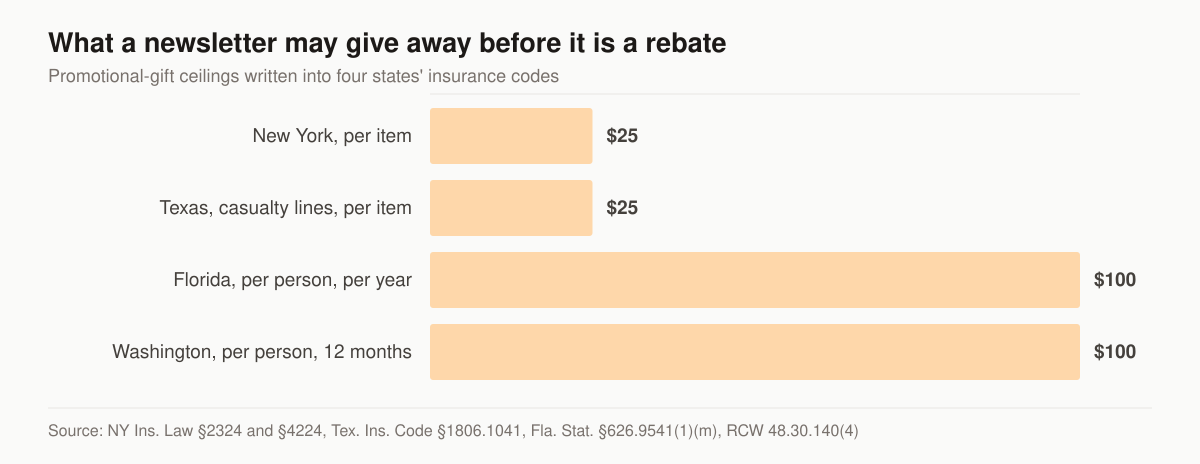
Sources: NY Ins. Law §2324 and §4224, Tex. Ins. Code §1806.1041, Fla. Stat. §626.9541(1)(m), and RCW 48.30.140(4), each read September 2026.
The wording behind those four bars matters more than the numbers, because each carries its own conditions.
New York’s §2324 bars a licensed agent or broker from giving “any valuable consideration or inducement of any kind, directly or indirectly, which is not specified in such policy or contract, other than any valuable consideration, including but not limited to merchandise or periodical subscriptions, not exceeding twenty-five dollars in value.” Its subsection (e) then removes from that section any contract or policy of “life insurance, accident insurance or health insurance which is subject to the provisions of section four thousand two hundred twenty-four of this chapter” — so those lines run under §4224, which repeats the same “not exceeding twenty-five dollars in value” allowance at subsection (c). So a final expense or Medicare-supplement agent in New York reads §4224, not §2324, and lands on the same ceiling by a different route.
Texas splits its rule by line of business across one chapter. For casualty lines, §1806.1041 permits “an item that is a promotional advertising item, educational item, or traditional courtesy commonly extended to consumers and that is valued at $25 or less,” and §1806.059 and §1806.1541 carry the same $25 item language for automobile and for fire and allied lines.
Florida’s §626.9541(1)(m)1.a. is more generous and more precisely bounded: a licensed insurer or its agent may give “any article of merchandise, goods, wares, store gift cards, gift certificates, event tickets, anti-fraud or loss mitigation services, or other items having a total value of $100 or less per insured or prospective insured in any calendar year.” Title agents get their own $25 rule at subparagraph 2 and are expressly excluded from the $100 one.
Washington’s RCW 48.30.140(4) allows “prizes, goods, wares, gift cards, gift certificates, or merchandise, not exceeding one hundred dollars in value per person in the aggregate in any twelve-month period” — but only where they “are given to all insureds or prospective insureds under similar qualifying circumstances,” which is hard to square with a one-off reward for whoever refers the most people. Title insurers and title agents are excluded there too.
There is a federal wrinkle on top of the state ones, and it is specific to the forward-to-a-friend mechanic newsletters love. The FTC’s CAN-SPAM guide notes that if a seller “offers money, coupons, discounts, awards, additional entries in a sweepstakes, or the like in exchange for forwarding a message, the seller may be responsible for compliance,” and that “if a seller pays or gives a benefit to someone in exchange for generating traffic to a website or for any form of referral, the seller is likely to have compliance obligations under the CAN-SPAM Act.” Paying for the forward turns your reader into your sender.
Our default is therefore to write the referral CTA as a request for an introduction rather than a purchase of one — it sidesteps the whole analysis and, in a newsletter whose credibility rests on not selling, it reads better. Where an agency does want an incentive, the amount and the state rule get checked before the copy is written, and the same care applies to review requests; the ground rules there are in how to get more Google reviews for insurance agents. None of this is legal advice — your compliance officer or E&O carrier makes the call for your agency.
When a Medicare newsletter becomes marketing under CMS rules
Senior-market lists are where a newsletter stops being a general marketing question. CMS draws its line in the definitions at 42 CFR 422.2260, the Medicare Advantage subpart. Standalone Part D prescription drug plans sit under Part 423 rather than Part 422, so a drug-plan book reads the parallel subpart there. Two definitions decide everything.
“Communications” is the broad category: “activities and use of materials created or administered by the MA organization or any downstream entity to provide information to current and prospective enrollees.” Then comes the sentence agents skip: “Marketing is a subset of communications.”
“Marketing” is the narrower category, and it is defined as materials and activities “that meet both the following standards for intent and content.” The intent standard covers material intended to “Draw a beneficiary’s attention to a MA plan or plans,” to “Influence a beneficiary’s decision-making process when making a MA plan selection,” or to “Influence a beneficiary’s decision to stay enrolled in a plan (that is, retention-based marketing).” A retention newsletter to existing Medicare clients sits squarely inside that third clause. The content standard is the other half, and it is a closed list: content regarding “The plan’s benefits, benefits structure, premiums, or cost sharing,” “Measuring or ranking standards (for example, Star Ratings or plan comparisons),” or “Rewards and incentives as defined under § 422.134(a).”
Both standards have to be met. That is the editorial rule the whole senior-market track is built on: an issue that explains how an enrollment window works, what a scope-of-appointment form is for, or which documents to bring to a review does not address any of the three content categories, and so it does not become marketing merely because it keeps you top-of-mind. Add a benefit comparison or a Star Rating and it does.
Two more provisions shape how carefully that line is walked. First, intent is not self-certified: the same definition says that “In evaluating the intent of an activity or material, CMS will consider objective information including, but not limited to, the audience of the activity or material, other information communicated by the activity or material, timing, and other context of the activity or material and is not limited to the MA organization’s stated intent.” Timing is named explicitly, which is why an October issue to an AEP-eligible list gets read more strictly than a June one — the seasonal side of that is in our Medicare AEP marketing guide.
Second, the review pipeline. 42 CFR 422.2261 provides that “MA organizations must submit all marketing materials, all election forms, and certain designated communications materials for CMS review,” through the HPMS Marketing Module, and that submission by a third-party marketing organization applies “where materials have been developed by a Third Party Marketing Organization for multiple MA organizations or plans.” For everything below the marketing line, paragraph (c) says “CMS does not require submission, or submission and approval, of communications materials prior to use,” subject to two named exceptions. Note who the obligation names: the duty in that section runs to MA organizations, and independent agents and brokers fall inside the “third-party marketing organization” definition at §422.2260 when they are “compensated to perform lead generation, marketing, sales, and enrollment related functions as a part of the chain of enrollment.” What your upline or carrier requires of you on top of the regulation is their call, not ours.
Email itself is the permitted channel here. 42 CFR 422.2264 paragraph (a)(1) provides that organizations “may make unsolicited direct contact by conventional mail and other print media (for example, advertisements and direct mail) or email (provided every email contains an opt-out option).” The parenthetical is a condition, not a courtesy — the opt-out has to be in every issue, which happens to be what CAN-SPAM already required. The appointment-side obligations are covered in scope of appointment and TPMO compliance, and the turning-65 pipeline in our turning 65 marketing system. Nothing on this page is legal advice; your compliance officer decides what your specific setup permits.
Reviving aged leads without paying for them twice
The aged-lead segment is the part of the list agencies forget they own. These are people who once asked for information, never bought, and have been sitting in a CRM ever since — already paid for, already consented, and costing nothing to email. A newsletter is a low-cost standing place for them, because it needs no new offer and no new spend to keep the name in front of them until their circumstances change.
Two things make it work rather than annoy. The consent record has to travel with the contact into the sending platform instead of being dropped at import, and the version they receive has to drop the assumption that they are a client — their explainer is the same, but the ask is a lower-commitment one, closer to “reply with a question” than “book your annual review.” Where that segment is large enough to justify its own worked cadence rather than a newsletter slot, that is a job for email automation and the timing patterns in our lead follow-up cadence guide. The economics of the underlying files, and why the aged ones are worth reworking at all, are in aged final expense leads.
What to measure on a newsletter, and what to ignore
A newsletter is a retention instrument, so the numbers that matter are conversations and kept policies, not sends. The published benchmarks below are context for the deliverability-side numbers only; the performance targets come from your own pre-launch baseline, because a newsletter’s job is defined by your book rather than by an industry average.
This table lists what goes on the monthly report, what each figure actually measures, and the published reference point where one exists.
| Metric | What it measures | Reference point |
|---|---|---|
| Replies per issue | Real conversations started by the send | Your own baseline before launch |
| Referrals named in a reply | Introductions the newsletter directly prompted | Your own baseline before launch |
| Annual reviews booked | Appointments attributable to the issue’s CTA | Your own baseline before launch |
| Unsubscribe rate | Opt-outs per delivered message | Mailchimp: 0.22% all users, 0.15% business and finance |
| Click rate | Clicks per delivered message | Mailchimp: 2.62% all users, 2.78% business and finance |
| Spam complaint rate | Complaints per delivered message | Google: below 0.10%, never 0.30% or higher |
| Open rate | Pixel loads, reported as a trend only | Directional; distorted by privacy proxies |
Those benchmark figures come from Mailchimp’s email marketing benchmark table, built from campaigns sent to at least 1,000 subscribers and last updated December 2023. Business and finance is the closest listed category to an insurance agency, at 31.35% open, 2.78% click and 0.15% unsubscribe, against all-user figures of 35.63%, 2.62% and 0.22%. Mailchimp publishes no insurance row on that table, so an “average insurance newsletter open rate” quoted without a source behind it was invented by whoever wrote the page.
Open rate stays at the bottom of the table on purpose. Mailchimp’s own disclaimer says “The accuracy of email open rates may be impacted by Apple’s privacy changes and their Mail Privacy Protection (MPP) feature, and this should be considered as you interpret open rate data.” Google is blunter still in its sender guidelines: “Google doesn’t track open rates,” “Google can’t verify the accuracy of open rates reported by third parties,” and “Low open rates aren’t necessarily an accurate indicator of deliverability or spam classification issues.” We report it as a trend line and grade the program on replies, referrals and retained policies.
What a done-for-you newsletter for insurance agencies costs
The newsletter is not sold here as a standalone subscription; it runs inside a monthly tier. The published tiers are Foundation $2,500/mo, Growth $3,500/mo, and Full-Funnel $5,500/mo, and this program maps to Growth, which is where the ongoing content engine sits — deliberately, because the explainer slot in each issue is fed by the same editorial pipeline that produces your site content. A one-time site or funnel build, where the opt-in forms and archive page need building first, runs $2,500–$8,000. The full breakdown is on the pricing page.
Your email platform is billed separately by that vendor and is the smallest number in the stack. It is worth comparing the two shapes honestly: a standalone weekly newsletter subscription like the $399-per-month offer cited above buys you drafts to review, and the list, the segmentation, the consent records, the sending-domain setup and the reporting remain your job. A managed program is priced higher because those are the parts it takes off your desk. Which of the two you need depends on whether the writing or the operating is what has been stopping you.
What a newsletter will not fix
Four problems look like communication problems and are not, and it is cheaper to say so before the engagement than after.
A list with no consent record is a legal problem before it is a marketing one, and no cadence fixes it — the fix is to rebuild consent at the point of capture, which is a form and landing-page job. A book you cannot segment is a data problem: if the CRM carries no line-of-business field and no policy anniversary, every issue goes out generic, and generic is what gets unsubscribed. Nobody to answer the replies is a staffing problem, and it is worse than sending nothing, because a client who replies to your newsletter and hears nothing back learns something about your agency; appointment setting exists for exactly that gap. And an agency with a visible reputation problem gets no relief from a warm monthly email, because the prospect who was referred still checks the reviews before they call — that work sits in reputation management.
There is a copy failure mode too, and it is the common one: an issue that reads like a brochure. If the writing sounds like a carrier wrote it, the seasonal hook does not save it, and the patterns that keep insurance copy readable are in our insurance copywriting guide.
How we run your insurance newsletter each month
We write, design, schedule, and report on every issue under your brand, working from your CRM or email platform so the list and the archive stay your asset. It pairs naturally with the rest of the stack: the content marketing engine that supplies the explainers, the client retention program it feeds, the lead generation that keeps new names arriving on the list, and your final-expense marketing or Medicare marketing niche work.
Want to see how much of your book is quietly going cold between renewals? Start with a free marketing audit, check the tiers and what each includes, or reach the team here to talk cadence and topics.
Guides that go deeper
Frequently asked questions
How is a newsletter different from your email automation service?
What actually goes in an insurance agency newsletter?
Is a Medicare newsletter compliant under CMS rules?
Do I need a big list for a newsletter to be worth it?
Who writes it, and whose brand is on it?
How often should an insurance agency send its newsletter?
Can we offer a gift card in the newsletter for a referral?
How much does a done-for-you newsletter for insurance agencies cost?
See exactly where your agency is leaking leads.
15 minutes. We screen-share our own live lead dashboard and tear down your funnel line by line — no pitch deck, just numbers.
- Site speed & conversion
- Local + AI-search visibility
- Ad efficiency
- Your cost per lead vs ours
No obligation · no pitch deck