Who we serve
Bilingual Insurance Marketing for Spanish-Speaking Markets
Bilingual insurance marketing is how agents reach Spanish-speaking prospects about final expense and Medicare using in-language creative, transcreated landing pages, and Spanish-fluent follow-up. Done right it is cultural, not only translated: it respects family-centered decisions, uses Spanish written by native speakers, and follows the CMS translation standard at 42 CFR 422.2267(a)(2) for Medicare materials.
Free · 15-minute teardown · no pitch deck
- We run our own final-expense book
- No pitch deck — we screen-share real numbers
- TCPA-aware · CMS/AEP-compliant · Meta Special Ad Category
- Core Web Vitals < 2.0s LCP
The Spanish-speaking market is one of the largest underserved opportunities in senior insurance, and the standard approach to it is the laziest possible one: run the English ad through a translation tool and wonder why the leads never call back. Bilingual insurance marketing that works is not a translation project. It is a cultural one — the same final expense and Medicare discipline we run every day, rebuilt so that a Spanish-speaking family recognizes it as meant for them.
A boundary first, because we keep it clean: this side builds marketing systems you own. If you want to buy Spanish-language final expense or Medicare leads as a finished product — exclusive, live-transfer, or aged — that runs through our sister brand, getinsureleads. Everything here is about the engine you keep.
How big the Spanish-speaking market actually is
Sizing comes before spending, and the language question has a published answer. The Census Bureau’s 2023 American Community Survey one-year estimates put the United States population age 5 and over at 316,581,199, of whom 245,472,067 speak only English at home and 43,369,734 speak Spanish at home (Table B16001). No other non-English language is close.
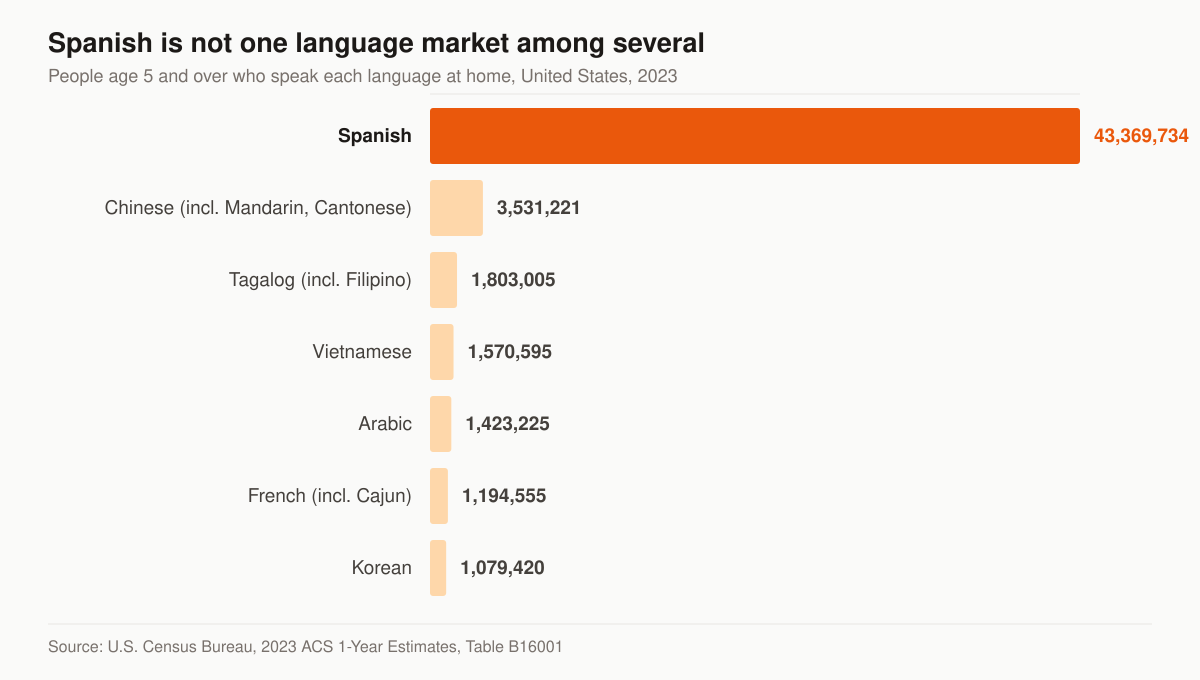
Source: U.S. Census Bureau, 2023 ACS 1-Year Estimates, Table B16001.
Chinese, the next language on the list, is spoken at home by 3,531,221 people. Set 43,369,734 against 3,531,221 and the question of whether a second language is worth building for answers itself. A bilingual program in Spanish is not a diversity gesture bolted onto the plan; on the Census Bureau’s own count, Spanish is the language other than English spoken at home by more people than any other in the country, and those people sit in the same senior lines the rest of this site is built around.
The Census Bureau’s June 2025 release on detailed languages adds the national frame: more than 1 in 5 people age 5 and older spoke a language other than English at home over the 2017 to 2021 period, approximately 61% of them spoke Spanish, and 62% of those who spoke a language other than English at home also spoke English “very well” (press release CB25-TPS.40). Hold on to that last figure. It changes what your funnel should look like.
Bilingual is the market; Spanish-only is a segment inside it
Two mistakes cost agents money here, and they are opposites. One is ignoring Spanish. The other is building a Spanish-only funnel and assuming everyone in the household lives inside it.
The table below splits the Spanish-at-home population by how well the same people report speaking English.
| Group, United States, 2023 | People age 5 and over | What it means for the funnel |
|---|---|---|
| Speak Spanish at home | 43,369,734 | The total in-language audience |
| Spanish at home, speak English “very well” | 25,773,177 | Reachable in either language; will judge you on the one they prefer |
| Spanish at home, speak English less than “very well” | 17,596,557 | The group an English-only funnel simply cannot serve |
| Speak only English at home | 245,472,067 | Your existing market, unchanged |
All four figures are from the same ACS Table B16001. Read the middle two rows together. The 17,596,557 people who speak English less than “very well” are effectively locked out of an English-only quote path, which is the case for building the Spanish side at all. The 25,773,177 who speak Spanish at home and report speaking English very well are the case against tearing out the English side or hiding it behind a language gate.
Pew Research Center’s September 2023 report on Latinos and the Spanish language, based on a survey of 3,029 U.S. Latino adults fielded August 1 to 14, 2022, puts numbers on the generational drift. Pew found that 75% of Latinos say they are able to carry on a conversation in Spanish pretty well or very well, while 24% of all Latino adults say they can only carry on a conversation in Spanish a little or not at all. Among U.S.-born Latinos the share who converse pretty well or very well falls to 57%. Among third- or higher-generation Latinos it falls to 34%, with only 14% saying they can do so very well, and close to two-thirds — 65% — saying they cannot carry on a conversation well in Spanish. Pew also found that 63% report speaking Spanglish, a combination of Spanish and English, at least sometimes (Latinos’ Views of and Experiences With the Spanish Language).
Now put that next to how senior insurance actually gets bought. A Spanish-dominant 68-year-old is frequently researched for by an adult child, and on Pew’s numbers that adult child is materially less likely to be comfortable in Spanish than the parent is. So the search that starts the sale may well be typed in English, about a Spanish-speaking parent, by someone who then needs to hand the phone to an agent who can speak Spanish. A funnel that exists only in Spanish misses the searcher. A funnel that exists only in English misses the buyer. You need both doors into the same room — which is the same adult-children dynamic that drives the senior market generally, sharpened by language.
Where the opportunity concentrates
The Spanish-speaking audience overlaps almost perfectly with the site’s core: the senior market. Two lines carry most of the demand.
- Final expense in Spanish — the family-centered, trust-driven buying style fits this line especially well, and in-language competition is thin. See the final-expense marketing pillar.
- Medicare in Spanish — demand concentrates around the same CMS-governed enrollment calendar as the English market, with an added translation-compliance layer. See Medicare marketing.
Life insurance and mortgage protection round out households, but final expense and Medicare are where a bilingual program earns its keep first.
The ownership data supports that ordering. LIMRA’s 2025 Insurance Barometer Study found that life insurance coverage among Hispanics dropped eleven percentage points from 51% in 2021 to just 40% today, lower than any other ethnicity, and that half of Hispanic Americans — approximately 20 million adults — say they don’t have enough life insurance to protect their loved ones or meet their financial goals (LIMRA, Hispanic Americans and Life Insurance). LIMRA also reports that 40% of Hispanic Americans are concerned about leaving financial dependents in a difficult situation should they pass away, against 26% of Asian Americans, 31% of Black Americans and 22% of White Americans, and that 29% of Hispanics say their families would face financial hardship within one month should the primary wage earner die unexpectedly.
The table below pairs the demand signals with the objections your Spanish creative has to answer in the same breath.
| Signal | Figure | Source | What the creative has to do |
|---|---|---|---|
| Life insurance ownership among Hispanics | 40%, down from 51% in 2021 | LIMRA 2025 Barometer | Lead with need, not with product features |
| Say they don’t have enough coverage | Approximately 20 million adults | LIMRA 2025 Barometer | Offer a review, not only a new-policy pitch |
| Concerned about leaving dependents in difficulty | 40% | LIMRA 2025 Barometer | Name the family outcome explicitly |
| Believe life insurance is too expensive | 41% | LIMRA 2025 Barometer | Show a real premium range early |
| Consider themselves very knowledgeable about it | 27% | LIMRA 2025 Barometer | Teach before you quote |
| Own it mainly to cover burial and final expenses | 69% | Life Happens / LIMRA, 2022 supplement | Final expense is the entry product |
The last row is from the Life Happens and LIMRA supplemental report to the 2022 Insurance Barometer Study, which found that 7 in 10 Hispanic Americans cite burial and final expenses as the major reason they own life insurance (69%), with replacing lost wages (41%) and leaving an inheritance (39%) next, and that cost (38%) and competing financial priorities (38%) are the top stated reasons for not having coverage (The Life Insurance “Need Gap” for Hispanic Americans). That 2022 report also found 27% of Hispanic Americans looking for a financial advisor against 20% of the general population, and 66% using social media for financial information against 53% — which is why compliant social campaigns tend to carry more of the load in a bilingual build than in an English one.
Transcreation, not translation
The core mistake is treating Spanish creative as an output of an English original. It has to be written in Spanish, by a native speaker, to carry tone and trust.
The table below is the difference your prospect actually perceives, in the order agencies usually try these.
| Approach | What the prospect experiences |
|---|---|
| Machine translation | Technically Spanish, subtly wrong — reads as foreign, machine-made, not for them. High compliance risk on Medicare. |
| Literal human translation | Accurate words, English rhythm and idiom — better, but still feels imported. |
| Transcreation | A native speaker rewrites the message to land naturally — the version that actually converts. |
Transcreation applies to everything the prospect touches: the ad, the in-language landing page, the form fields, the confirmation, and the call. One weak link — an English form under a Spanish ad — leaks the trust the creative just built.
Search has an opinion about the shortcut, too. Google’s spam policies define scaled content abuse as “when many pages are generated for the primary purpose of manipulating search rankings and not helping users,” and list among its examples “Scraping feeds, search results, or other content to generate many pages (including through automated transformations like synonymizing, translating, or other obfuscation techniques), where little value is provided to users” (Spam policies for Google web search). Running your English site through a translation plugin to conjure a hundred Spanish URLs is the exact pattern that policy describes. We would rather ship a dozen genuinely written Spanish pages than a hundred machine-made ones, and that choice keeps the English side of the site out of the policy’s line of fire.
Regulators have written down a version of the same standard. Under HHS’s Section 1557 rule at 45 CFR 92.201(c)(3), if a covered entity “uses machine translation when the underlying text is critical to the rights, benefits, or meaningful access of an individual with limited English proficiency, when accuracy is essential, or when the source documents or materials contain complex, non-literal or technical language, the translation must be reviewed by a qualified human translator.” Section 1557 binds covered entities — health programs and activities receiving federal financial assistance — rather than every independent agent. But it is the benchmark your carrier partners work to, and it is a defensible one to hold your own Spanish materials against.
What CMS actually requires to be translated, and who it binds
This is where the summaries you find elsewhere go vague, so here is the rule itself. 42 CFR 422.2267(a)(2), which governs Medicare Advantage, requires that required materials and content, “For markets with a significant non-English speaking population, be in the language of these individuals. Specifically, MA organizations must translate required materials into any non-English language that is the primary language of at least 5 percent of the individuals in a plan benefit package (PBP) service area.” The Part D rulebook is separate and says the same thing about sponsors: 42 CFR 423.2267(a)(2) requires that Part D sponsors “translate required materials into any non-English language that is the primary language of at least 5 percent of the individuals in a plan benefit package (PBP) service area.”
Read who that binds. The translation duty is written on the MA organization and the Part D sponsor, not on you. It reaches an agent or a third-party marketing organization through the plan’s contract: 42 CFR 422.2274(g)(2) requires that contracts, written arrangements, and agreements between the TPMO and an MA plan ensure the TPMO “Uses the TPMO disclaimer as required under § 422.2267(e)(41).” So the practical question is never “does the rule apply to me” in the abstract — it is what your carrier and FMO contracts say, and which of their approved Spanish materials you are cleared to use.
The disclaimer itself is standardized content, and the Spanish call is where agents forget it. Under 42 CFR 422.2267(e)(41), where a TPMO does not sell for all MA organizations in the service area, the disclaimer is: “We do not offer every plan available in your area. Currently we represent [insert number of organizations] organizations which offer [insert number of plans] products in your area. Please contact Medicare.gov or 1-800-MEDICARE to get information on all of your options.” The same paragraph requires that the disclaimer be verbally conveyed during sales calls prior to the discussion of any benefits, electronically conveyed when communicating by email, online chat, or other electronic means, prominently displayed on TPMO websites, and included in any marketing materials, including print materials and television advertisements, developed, used or distributed by the TPMO.
On a Spanish-language call, “verbally conveyed” means verbally conveyed in Spanish, before benefits — which means your bilingual script needs the carrier’s approved Spanish version of that text, not an improvised rendering by whoever is on the phone. The lead-generation disclosures at 42 CFR 422.2274(g)(3) travel the same way: a TPMO conducting lead-generating activities must disclose to the beneficiary that his or her information will be provided to a licensed agent for future contact, verbally by telephone, in writing on paper, and electronically through email or chat, and must disclose that he or she is being transferred to a licensed agent who can enroll him or her into a new plan.
Compliance: CMS translation and TCPA, in two languages
Spanish-language marketing does not relax the rules; it adds a translation layer on top of them.
- CMS rules on translated materials. Medicare communications must be accurately translated, and qualifying service areas require translated versions under the 5 percent standard above. Machine translation is genuinely risky here, because an error is both a trust failure and a compliance one. Use a qualified human translator.
- TCPA consent, every dial and text. The same provable, stored consent discipline applies to Spanish outreach as to English — captured on the Spanish form, the reply card, the transfer. Consent language a prospect could not read is a weak record; capture it in the language the form was completed in.
- Honest product routing. Language should open the door, never be used to push a prospect toward a product they do not qualify for.
Interpreters, family members, and the qualified-translator standard
Agents working the Hispanic senior market improvise language support constantly, usually by leaning on whoever in the family speaks the most English. The federal standard for health programs is stricter than that instinct, and it is worth knowing even where it does not bind you directly.
45 CFR 92.201 requires a covered entity to take reasonable steps to provide meaningful access to each individual with limited English proficiency, and that the language assistance services “be provided free of charge, be accurate and timely, and protect the privacy and the independent decision-making ability of the individual with limited English proficiency.” Paragraph (e) then restricts who may interpret: a covered entity must not require an individual with limited English proficiency to provide their own interpreter or pay for one, must not rely on an unqualified adult to interpret except in the narrow circumstances the rule spells out, must not “Rely on a minor child to interpret or facilitate communication” except as a temporary emergency measure, and must not “Rely on staff other than qualified interpreters, qualified translators, or qualified bilingual/multilingual staff to communicate with individuals with limited English proficiency.”
Again: Section 1557 covers health programs and activities that receive federal financial assistance, and a licensed independent agent is generally not a covered entity. Treat the rule as the practice benchmark rather than as your own compliance obligation. The marketing consequence is straightforward either way. If your funnel’s plan is “the grandson will translate,” you do not have a bilingual program — you have an English program with a hopeful step in the middle, and the record of what was explained to the buyer is only as good as a teenager’s paraphrase.
Does the federal three-day cooling-off rule cover a kitchen-table sale in Spanish?
This one catches people out, so it is worth stating precisely. The FTC’s Cooling-Off Rule at 16 CFR 429.1(a) does carry a language requirement: in a door-to-door sale, the seller must furnish the buyer a receipt or contract “which is in the same language, e.g., Spanish, as that principally used in the oral sales presentation,” and paragraph (b) requires the notice of cancellation in the same language as the contract. Read that alone and you would conclude every in-home Spanish presentation triggers it.
It does not, because of the definition. 16 CFR 429.0(a)(6) excludes from “door-to-door sale” any transaction “Pertaining to the sale or rental of real property, to the sale of insurance, or to the sale of securities or commodities by a broker-dealer registered with the Securities and Exchange Commission.” Insurance is carved out of the federal rule. What governs a kitchen-table final expense sale conducted in Spanish is your state’s insurance code and any state door-to-door or translated-contract statute, not 16 CFR 429.
That is not a licence to be careless. It is the opposite: the federal fallback you might have assumed protects the buyer is not there, so the burden of leaving a Spanish-speaking household with an accurate written record of what they bought sits entirely with you and the carrier’s approved materials.
Culture changes the message, not just the words
Spanish-speaking households — especially older ones — often decide as a family. The familismo dynamic means adult children and extended family weigh in more, phone and in-person contact are frequently preferred over a purely digital funnel, and trust flows through community familiarity and referrals. Creative that honors those patterns — the family’s peace of mind, a real person to call, patience over pressure — outperforms a hard English pitch dropped into Spanish. It is the same adult-children insight that drives the broader senior market, sharpened by culture.
LIMRA’s qualitative work points the same direction and is worth reading before you write a single headline: it reports that respondents described financially providing for the family, including extended family, as a personal responsibility passed down from generation to generation, and recommends that insurers demonstrate how life insurance contributes to securing a family’s financial future and legacy building. LIMRA’s own stated fix for the ownership gap is to make resources available in Spanish and provide access to bilingual advisors. That is the whole thesis of this page, written by the industry’s own research arm.
Two practical translations of that into creative. First, we build the offer so the family is invited in rather than designed out — an appointment a daughter can sit in on, not one framed as a private decision. Second, we lead the proof with community-shaped signals: local presence, a real name, a real number, longevity.
Regional Spanish matters too. Vocabulary and formality differ across Mexican, Caribbean, and Central and South American communities; you do not need a campaign per country, but you do need copy from a native speaker who knows your market’s dominant communities. Pew’s finding that 63% of Latinos speak Spanglish at least sometimes is a caution against the opposite error as well — copy so formal it sounds like a translated government notice reads as distant, not respectful.
Bilingual telesales closes what the creative opens
We treat one failure as the first thing to design out of a bilingual program: a Spanish ad answered by an English-only phone bank. The follow-up has to match the creative — genuinely fluent agents, attuned to the prospect’s regional Spanish, calling fast. A Spanish-language final-expense lead goes cold just as quickly as an English one, so speed-to-lead in-language is non-negotiable. This is where our appointment-setting and telesales support and compliant social campaigns have to run as one system, not two.
Three details decide whether the handoff holds. The inbound number on Spanish creative should route to a Spanish-capable queue, not to the general line with a language menu in front of it. The CRM needs a language field set at capture, so the second and third touch do not arrive in the wrong language. And the SMS and email sequences behind the form have to exist in Spanish before the campaign goes live, because that is where an English-only stack silently reverts.
Where the Spanish pages live on your site
The structural question comes up on every bilingual build, and Google has published its answer. Google Search Central states that “Google recommends using different URLs for each language version of a page rather than using cookies or browser settings to adjust the content language on the page,” and that where you dynamically change content or reroute users by language settings, “be aware that Google might not find and crawl all your variations,” because Googlebot usually crawls from the USA and sends HTTP requests without setting Accept-Language (Managing multi-regional and multilingual sites).
Three more lines from the same document decide the build. On language detection: “Google uses the visible content of your page to determine its language. We don’t use any code-level language information such as lang attributes, or the URL.” On mixing: “You can help Google determine the language correctly by using a single language for content and navigation on each page, and by avoiding side-by-side translations.” And on the redirect that half of bilingual sites ship with: “Avoid automatically redirecting users from one language version of a site to a different language version of a site,” with the recommendation to “Consider adding hyperlinks to other language versions of a page” instead.
The table below is Google’s own comparison of URL structures, applied to an agency site that is adding Spanish.
| Structure | Google’s stated pros | Google’s stated cons | Fit for an agent site |
|---|---|---|---|
Country-specific domain (example.de) |
Clear geotargeting; server location irrelevant; easy separation of sites | Expensive; requires more infrastructure; strict ccTLD requirements; can only target a single country | Wrong tool — you are targeting a language inside one country |
Subdomain (de.example.com) |
Easy to set up; allows different server locations; easy separation of sites | Users might not recognize geotargeting from the URL alone | Workable, but splits the site you have already built |
Subdirectory (example.com/de/) |
Easy to set up; low maintenance (same host) | Users might not recognize geotargeting from the URL alone; single server location; separation of sites harder | The default choice for /es/ on your existing domain |
URL parameters (site.com?loc=de) |
Not recommended | URL-based segmentation difficult; users might not recognize geotargeting from the URL alone | Avoid |
Pros and cons are quoted from Google’s URL structure table in the same document. Pair the subdirectory with hreflang annotations, keep each page in one language end to end including the navigation, and put a visible language link in the header rather than a redirect. The same rules apply to your insurance website build and to local SEO, where a Spanish service page and an English one can both rank in the same city without competing, because they answer different queries.
Running Spanish paid campaigns after Google’s September 2026 change
Language targeting in Google Ads is changing this month, and a bilingual program is exactly the kind of account that feels it. Google’s help documentation states that starting in September 2026, “The campaign-level language targeting setting will be removed. Search ads will automatically match based on the language of your ads,” and that for Performance Max, “The campaign-level language setting will no longer apply to ads shown on the Google Search Network,” while language settings continue to apply to YouTube, Display, Discover and Gmail. Google adds that “No action is required by advertisers for this change” (About language targeting).
Read that as a shift in where your control lives: from a checkbox in campaign settings to the actual words in the ad and on the landing page. Google describes the mechanism plainly — “Google Ads uses search term language, the user’s language settings, and preferences to understand which language the user knows, and attempts to serve the best ad available in a language the user understands” — and its own worked example is a bilingual user: “Pat understands both English and Spanish. While her mobile browser is set to a Spanish interface, her other activity on Google strongly suggests she understands English too… Therefore, she may be shown ads that are either English or Spanish, when the keywords match. Pat may also enter a query in Spanish and be served an ad in English.”
For a bilingual insurance account, that argues for keeping Spanish ads and Spanish landing pages in their own ad groups with Spanish keywords, so the creative itself carries the signal, and for never pointing a Spanish ad at an English page. It also means your reporting has to be structured by language from the start, because the setting that used to segment it for you is going away. Our paid search work and Facebook and Meta campaigns get built that way for bilingual clients by default.
Search and AI visibility in Spanish
When a Spanish-speaking senior or their adult child searches or asks an AI assistant about seguro de gastos finales or Medicare, the agents who show up are the ones who publish credible in-language content. Our insurance SEO and AI-search / GEO work extends to Spanish so you compound organic visibility in both languages, not just one.
Two things make Spanish organic worth the effort. Pull the Spanish SERP for your own terms before assuming it mirrors the English one — where the in-language corpus is thin, a small number of well-made pages goes further than the same effort spent in English. And AI assistants answering a Spanish query need a Spanish source to quote; a page that only exists in English is not a candidate. The content programme that produces those pages should start from questions Spanish-speaking buyers actually ask, not from translated English titles — the keyword set is not a mirror image.
How to measure a bilingual program separately
If Spanish and English traffic sit in one undifferentiated bucket, the Spanish side will look like noise for the first two quarters and get cut. Separate it at the point of capture, not in the report.
- Give Spanish pages their own URL path, so Search Console and analytics can be filtered by folder without any custom tagging.
- Set a language field on every form and every CRM record at creation, sourced from the page, not guessed by the rep afterwards.
- Track calls to the Spanish number as a distinct conversion, and tag the recording language so cost per appointment can be compared honestly.
- Compare cost per booked appointment by language rather than cost per lead — the gap between the two languages usually opens at the follow-up stage, and a lead-level metric hides it.
- Give the Spanish side the same review window you would give a new product line, not a shorter one because it is unfamiliar.
The lead-generation systems we install carry these fields as standard, because a bilingual program that cannot prove its own economics gets defunded regardless of how well it is performing.
What a bilingual marketing engagement costs
Our retainers are flat and published: Foundation at $2,500 per month, Growth at $3,500 per month, and Full-Funnel at $5,500 per month, plus a one-time website build of $2,500 to $8,000. Media budget is separate and paid directly to Google or Meta. See pricing for what each tier includes.
Bilingual work does not sit in a separate price list. It changes what goes into the tier: a native-speaker writer instead of a translation pass, a second set of landing pages and sequences, and a campaign structure split by language. The honest constraint is on your side rather than ours: we will not launch a Spanish funnel for a client who has nobody Spanish-fluent to answer it, so the staffing decision comes before the marketing spend.
The differentiator no generalist can copy
Bilingual marketing is senior-market marketing with a cultural and translation layer that a generalist agency is not set up to execute credibly. We run a live senior-market lead operation, so the speed-to-lead systems, consent discipline, and trust-first creative we install are tested — and we build them to work in Spanish rather than bolting translation on at the end. See the senior market marketing pillar and the life insurance marketing hub that sits behind the household products a bilingual program cross-sells into.
Want your bilingual program mapped against how we actually run ours? Start with a free marketing audit — we will look at your creative, your follow-up, and your compliance posture — or get in touch to model the economics together.
The services behind it