Service
Fractional CMO for Insurance Agencies and Agency Owners
Senior marketing leadership on a fractional retainer — a single person accountable for your strategy, budget, channel mix, and the numbers — so your agency stops running disconnected campaigns and starts running a marketing plan that adds up to a book.
- We run our own final-expense book
- No pitch deck — we screen-share real numbers
- TCPA-aware · CMS/AEP-compliant · Meta Special Ad Category
- Core Web Vitals < 2.0s LCP
A fractional CMO for insurance agencies is a senior marketing leader who sets strategy, owns the numbers, and directs your channels part-time — for agencies too big to fly blind but too lean to justify a full-time executive. Unlike a marketing consultant, who advises and hands the plan back, a fractional CMO stays to own the budget and the vendors.
What you get
What your fractional cmo for insurance agencies program includes
- A written marketing strategy and 12-month roadmap tied to your growth target, lines, and lead economics
- A budget allocation across channels with a stated cost-per-acquisition and return target for each — not spend for spend's sake
- A defined KPI dashboard (cost per lead, contact rate, close rate, marketing-sourced policies, lifetime value) reviewed on a fixed cadence
- Vendor and staff coordination — briefing and holding your existing lead, web, and content providers accountable to one shared plan
- A monthly leadership review where the numbers, not the activity, drive the next decisions
- Channel-priority sequencing so you build in the right order instead of spreading a thin budget across everything at once
- A build-vs-buy recommendation for each gap, with honest guidance even when the answer is not one of our services
- Quarterly strategy resets that reallocate budget toward what is actually producing policies
How it works
How the fractional cmo for insurance agencies engagement runs
- 01
Diagnose the marketing P&L
We map every dollar you currently spend on marketing against what it produces — cost per lead, close rate, policies sourced — to find where the budget leaks and which channels are actually carrying the book.
- 02
Set strategy, budget, and KPIs
We write the 12-month plan: the growth target, the channel mix and sequence, the budget per channel with a return target, and the exact KPIs the whole system will be judged against.
- 03
Align vendors and execution
We brief your existing vendors and staff — or ours — against the shared plan, so the lead vendor, the web person, and the content team pull in one direction instead of six.
- 04
Review, reallocate, repeat
On a fixed cadence we review the numbers with you and move budget toward what produces policies and away from what does not — the same accountability we apply to our own book.
Most agency owners are their own marketing director by accident. You buy leads from one vendor, a website from another, hire a cousin to run social, and try to hold the whole thing together between appointments. Nobody owns the number. Campaigns run, money moves, and at year-end it is genuinely unclear which spend built the book and which just felt productive.
A fractional CMO fixes the missing layer: someone senior who owns the strategy, the budget, and the accountability — part-time, at a fraction of a full-time executive’s cost. Not another channel to buy. The person who decides which channels are worth buying at all.
Execution vs. strategy: what this role adds
Every other service on this site executes a channel. This one sits above them and decides. That distinction is the entire value.
| Channel services | Fractional CMO | |
|---|---|---|
| Question answered | “How do we run good ads / SEO / email?” | “Which channels deserve budget, in what order, to what target?” |
| Scope | One channel, executed well | The whole marketing system |
| Accountable to | Channel metrics (CPL, opens) | Business metrics (CPA, policies, ROI) |
| Output | Campaigns and assets | A plan, a budget, and decisions |
| Fails when | Nobody set the strategy | Nobody executes the strategy |
You can buy execution without strategy and get busy, disconnected campaigns. You can buy strategy without execution and get a nice document nobody runs. The fractional CMO owns the first and coordinates the second — including lead generation, content, and paid search — toward one plan.
What the fractional CMO role owns
A fractional CMO engagement is defined by ownership, not hours. Across the retainer, this person owns:
- The strategy — the 12-month plan tied to your growth target and lines.
- The budget — allocation across channels, each with a stated return target.
- The numbers — a KPI dashboard reviewed on a fixed cadence, judging the whole system.
- The vendors — coordinating whoever executes, in-house or outside, against the shared plan.
- The decisions — reallocating spend each quarter toward what actually produces policies.
How the engagement model works
Fractional means a defined slice of senior attention on a standing retainer — not a full-time seat in your office, and not a one-off project that ends with a slide deck. In practice the engagement is a monthly rhythm: a fixed leadership review where the KPI dashboard drives the decisions, working sessions with whoever executes (your staff, your vendors, or our team), and a quarterly reset where budget moves toward what is producing policies. Scope is set at the start — which lines, which channels, which numbers the role answers for — so you are buying accountability for outcomes, not a bucket of hours. The retainer flexes with the agency: heavier in the build phase, lighter once the system is running and the reviews become about tuning rather than triage.
What the monthly leadership review actually reports
The review is where the retainer either earns its fee or gets ended, so it is worth knowing what lands on the table before you buy one. It is not a campaign update. It is a short set of numbers that answer whether marketing is producing policies at a price the agency can pay, each one traceable to a system you already own rather than to a vendor’s dashboard.
Ask any provider to name the source system for each line before the first review, because a metric nobody can trace is a metric nobody can argue with:
| What gets reported | The question it answers | Where the number comes from |
|---|---|---|
| Cost per lead by channel | What each source charges for a name | Ad platform spend and vendor invoices against lead counts |
| Contact rate | Whether those names are reachable at all | Dialer or CRM disposition records |
| Appointment or quote rate | Whether contact turns into a real conversation | CRM stage movement |
| Close rate by source | Which channels send buyers rather than browsers | CRM outcomes matched back to source |
| Marketing-sourced policies | The count the agency is actually paid on | Carrier or AMS policy records tagged to source |
| Cost per acquisition | The full price of one issued policy from that channel | Channel spend divided by policies from that channel |
| Return on marketing spend | Whether the program pays for itself over the term | Commission on sourced policies against total spend |
| Retention and cross-sell | Whether the book renews once it is written | Persistency and policies-per-household reporting |
Two of those rows are the ones we check for first, because they are the two that matter to a book: policies tagged to source, and anything past the first year. An agency that measures only cost per lead is measuring the front of the funnel and inferring the rest of it. Repairing that tagging is scoped into the first thirty days for exactly that reason, which is why the marketing automation and CRM layer gets touched early even in engagements bought for strategy.
How a fractional CMO sets the marketing budget
Budget is the first decision the role makes, and the one where owners ask for a benchmark. The benchmark that circulates is Gartner’s: in the 2026 CMO Spend Survey, marketing budgets rose only slightly to 7.8% of company revenue in 2026 from 7.7% in 2025.
Read the sample before you apply the number. Gartner surveyed 401 CMOs and other marketing leaders across North America, the UK and Europe between January and March 2026, and says the vast majority reported annual revenue over $1 billion. That is not a room full of insurance agencies. What the figure is genuinely good for is arguing with a percentage someone quoted at you: if a vendor tells you that agencies “should” spend a fixed share of revenue, ask which population produced the share.
The same survey reports the tension the role exists to resolve — 56% of those CMOs said their marketing organization lacks the budget required to deliver their 2026 strategy, and 54% reported insufficient resources. Senior marketing leadership is mostly the discipline of choosing what not to fund. At agency scale we set the number bottom-up instead: the growth target in policies, the close rate the floor actually runs, the contact rate the lead type actually returns, and the allowable cost per acquisition the commission on that line will carry. Multiply those back and the budget falls out as a consequence rather than a percentage. Our insurance agency marketing budget guide walks the arithmetic, and the marketing plan guide covers the document it feeds.
The fractional CMO’s first 90 days
A fractional CMO engagement front-loads diagnosis so that budget decisions rest on your numbers, not templates:
- Days 1–30 — map the marketing P&L. Every current dollar of spend traced to what it produces: cost per lead by channel, contact and close rates, policies sourced, and where tracking is too broken to know. The output is a list rather than an opinion — which channels can be evaluated on your own data today, which cannot, and what it would take to make the second group countable.
- Days 31–60 — write the plan. The 12-month strategy: growth target, channel mix and sequence, budget per channel with a return target, and the KPI dashboard the whole system will be judged against.
- Days 61–90 — align execution and make the first cuts. Vendors and staff briefed against the shared plan, the weakest spend reallocated, and the monthly review cadence running — so by day 90 there is one owner of the number and a system that reports to it.
How much does a fractional CMO cost for an insurance agency?
Published rate guides put a fractional CMO at $5,000–$25,000 per month on retainer, or $200–$500 per hour for advisory work; RankedCMO’s 2026 benchmark and Revenue Nomad’s rate guide both land in that band. Insurance agencies typically sit at the lower end, where scope is one book, a few channels, and one growth target.
Nobody publishes an insurance-specific rate card, so the honest starting point is the general market. These are third-party published ranges — not our quote, and not a promise that any given operator charges this:
| Engagement model | Published market range | Typical commitment | Source |
|---|---|---|---|
| Monthly retainer | $5,000–$25,000 / month | 10–20 hours per week | RankedCMO, 2026 |
| Monthly retainer | $5,000–$15,000+ / month | Ongoing strategic leadership | Revenue Nomad, 2026 |
| Hourly advisory | $200–$500 / hour | 5–15 hours per month | RankedCMO, 2026 |
| Project fee | $10,000–$50,000+ | 1–3 months, one defined deliverable | RankedCMO and Revenue Nomad |
| Day rate | $1,500–$3,500 / day | 1–5 days, workshops or a paid audit | RankedCMO, 2026 |
| Full-time marketing manager (for comparison) | $166,790 median annual wage, May 2025 | A permanent seat, plus benefits and payroll tax | U.S. Bureau of Labor Statistics |
The day rate is worth knowing about even if you never buy a retainer. RankedCMO describes paid scoping or audit engagements as a normal step before signing a longer term, and if an operator will not sell you a bounded first piece of work, that tells you something about how they scope.
One distinction before you benchmark: a fractional CMO has no salary. The role is a contractor paid a retainer or an hourly rate, so figures published under “fractional CMO salary” are annualized earnings across several clients — not what one agency pays. The salary number that matters to you is the full-time alternative: median pay for U.S. marketing managers was $166,790 per year as of May 2025, per the Bureau of Labor Statistics, before benefits, payroll taxes, and recruiting — and an executive-level CMO typically commands more than a manager.
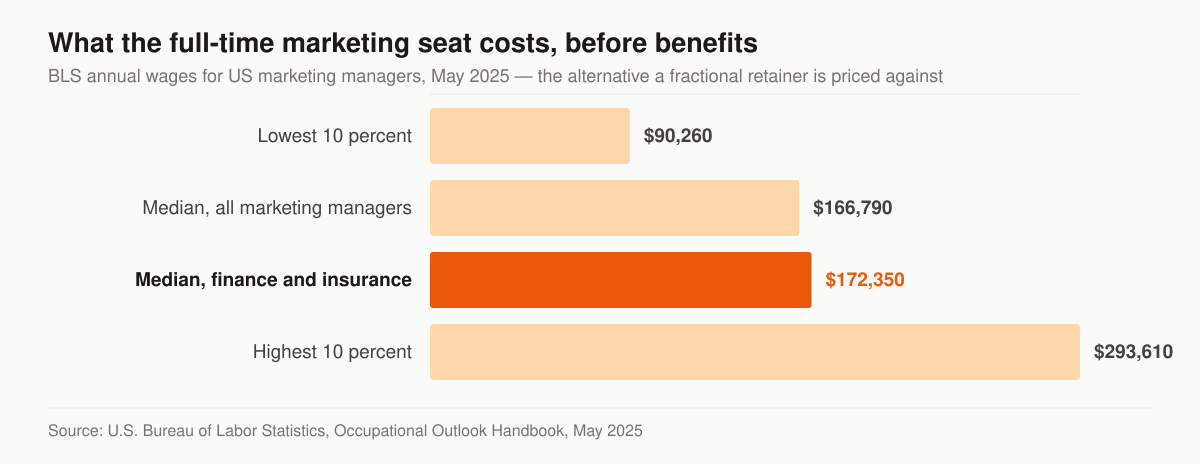
Source: U.S. Bureau of Labor Statistics, Occupational Outlook Handbook: Advertising, Promotions, and Marketing Managers, May 2025 wage data.
Two details in that chart change how an agency owner should read it. The first is the spread: BLS puts the lowest 10 percent of marketing managers under $90,260 and the highest 10 percent over $293,610, so “hire a marketing manager” is not one price — it is a decision about where between those two figures you are buying, made before you know whether the person can run your channels. The second is the industry line. BLS reports a May 2025 median of $172,350 for marketing managers working in finance and insurance, above the $166,790 all-industry median, and 10 percent of marketing managers worked in finance and insurance in 2025. Marketing talent that already understands regulated financial products is not cheaper in your industry; it costs slightly more than average, which is exactly why renting a slice of it is the structure that fits a single book.
The honest comparison is not price alone but scope, commitment, and risk:
| Fractional CMO | Full-time marketing hire | |
|---|---|---|
| Commitment | Monthly retainer, adjustable scope | Salary, benefits, payroll overhead |
| Cost structure | A defined slice of an executive’s attention | The whole seat, whether or not you need it daily |
| Ramp | Productive in weeks — arrives with a playbook | Months of recruiting, then onboarding |
| Risk if it fails | End the retainer | Severance, re-recruiting, and lost quarters |
| Scope | Strategy, budget, vendor direction | Strategy plus daily management presence |
| Fits when | Multi-channel spend with no owner of the number | Marketing large enough to need daily senior leadership |
The full-time seat also carries turnover risk you inherit. Spencer Stuart’s CMO Tenure 2026 study puts average CMO tenure in the S&P 500 at 4.1 years, against 5.0 years for all C-suite roles at those companies, and finds 31% of S&P 500 companies have no enterprise CMO at all. Senior marketing leadership turns over faster than the rest of the executive bench even at companies built to absorb it. An agency carrying one book cannot absorb a failed executive hire the same way, which is the practical argument for renting the layer before you buy the seat.
The retainer is justified the same way every other line item should be: against cost per acquisition and marketing-sourced policies. If senior direction does not measurably improve those numbers, the role has not earned its fee — that is the standard we set in the first review.
How many hours per month does a fractional CMO work?
Fractional CMO hours are set by scope, not by a timesheet. Published guides put full retainer engagements at 10–20 hours per week per client, with advisory-only arrangements running 5–15 hours per month (RankedCMO, 2026). Most operators cap client load at two to four accounts so the hours are real.
At agency scale the honest framing is what the hours have to cover: a standing monthly leadership review, the working sessions with whoever executes, the reporting build, and the quarterly reallocation. An agency with three channels and two lead vendors needs less senior time than a multi-state operation running AEP campaigns across four carriers — which is why hours follow the scope you set at the start rather than a package. Ask any provider, including us, to state the commitment in writing and to say what happens when the work exceeds it.
What a fractional CMO does not do
The role is defined as much by what sits outside it, and this is where engagements go wrong: an owner buys strategy, then quietly expects the strategist to build the landing page. RankedCMO’s 2026 rate guide lists what is usually excluded from a fractional CMO retainer, and the list is worth reading before you sign one — hands-on campaign execution, daily content writing and graphic design, paid media buying and ad account management, direct sales calls and prospecting, email infrastructure and CRM setup, and website development.
Read against an insurance agency, that exclusion list translates cleanly. The fractional CMO decides that Medicare needs a search presence before AEP and sets the target; somebody else does the insurance SEO work. The fractional CMO decides the agency is invisible in its own county and budgets for it; somebody else does the local SEO build. The fractional CMO decides the follow-up sequence is where policies are leaking and specifies what has to change; somebody else configures it. That somebody can be your staff, your existing vendors, or our team — the point is that the decision layer and the labor layer are separately priced, and paying an executive rate for labor is an expensive way to get labor.
Two more exclusions belong on the list for regulated lines specifically. A fractional CMO is not your compliance officer and not your legal counsel; the licensed agency remains the responsible party for what its advertising says. And a fractional CMO does not replace a sales manager. Nothing in a marketing plan fixes a floor that does not call its leads back, which is why the diagnosis in the first thirty days looks at contact rate before it looks at creative.
What belongs in the fractional CMO agreement
Because the role is not a channel with a deliverable you can point at, the contract is doing more work than usual. Seven clauses decide whether the engagement is accountable or just expensive, and each one has a version that protects you and a version that reads well and means nothing.
Take this to any provider you are considering, including us, and ask them to fill the right-hand column in writing:
| Clause | What a straight version says |
|---|---|
| Term and notice | An initial term long enough for strategy to show up in the numbers, then a stated notice period that runs both ways |
| Commitment | The hours, or the named standing meetings and reports, that the retainer buys per month |
| Scope | Which lines, which channels, and which numbers the role answers for — and what falls outside |
| Overage | What happens when the work exceeds the commitment: more hours, re-scoped priorities, or a higher retainer |
| Access | The systems the role must be able to read — CRM, ad accounts, call tracking, policy records — because the plan runs on your data |
| Ownership | That the plan, the ad accounts, the tracking, the creative, and the reporting stay yours when the engagement ends |
| Conflicts | Whether the operator works with competing agencies in your lines and territory, and what they will not do while engaged |
One market detail affects the first row. RankedCMO’s 2026 guide notes that annual commitments often carry a 10–20% discount against month-to-month engagements. That trade is fine when the scope is settled and the operator is known; it is a poor trade in month one, before you have seen a single leadership review. Get the shorter term at the higher rate first, and buy the discount later once you have numbers to judge it against.
The ownership row is easy to skip and expensive to have skipped. Ad accounts opened under a vendor’s business manager, call-tracking numbers registered to the vendor, and a plan that exists only as slides in someone else’s deck are three ways to end an engagement and keep nothing. The same principle applies whichever provider runs your channels — see the evaluation criteria in our guide to the best insurance marketing agencies.
How to vet a fractional CMO before you sign
The market has no license, no exam, and no shared definition of the title, so vetting is on you. Six questions separate an operator from a consultant with a new business card, and what matters is less the answer than whether they answer at all:
- What will you own, and what will you refuse to own? A clear no is a good sign. An operator who agrees to everything has not read your situation.
- Which numbers will you report against, and where does each come from? They should name systems, not adjectives. If the answer is a dashboard screenshot, ask what feeds it.
- How many clients do you carry? Published guides put full retainer engagements at 10–20 hours per week per client, with most operators serving two to four accounts. Do the arithmetic against their answer and see whether the hours exist.
- What have you decided to stop spending on, and what happened? Someone who has held the seat can describe a cut they made and how it went, including one that turned out wrong.
- What do you need from us to work? Access, decision authority within scope, and a single internal owner. If they need none of those, they are planning to write a document and leave.
- How does this end? Notice period, handover, and what stays with the agency. If the exit has clearly never been thought about, it has probably never been run.
Two things you cannot verify by asking are worth checking directly: whether they have run marketing in a regulated line, and whether they will tell you when the answer is not to buy their services. The build-versus-buy recommendation is the part of the role that only works if the person giving it is willing to lose revenue on it — which is the same reason we say so on this page rather than in the second meeting.
Fractional CMO vs. insurance marketing consultant vs. marketing agency: which do you need?
Three different products get sold as “marketing help.” An insurance marketing consultant sells a diagnosis, an agency sells execution, and a fractional CMO sells ownership of the plan and the numbers between them. Choose by what is actually missing in your agency: judgment, hands, or accountability.
| Fractional CMO | Marketing consultant | Marketing agency | |
|---|---|---|---|
| What you buy | Ownership of strategy, budget, and KPIs | A diagnosis and a recommended plan | Execution of one or more channels |
| Who executes | Your staff, your vendors, or an agency they direct | Nobody — you or someone else executes | The agency’s own team |
| Accountable for | Cost per acquisition and policies sourced | The quality of the advice | Channel metrics (leads, clicks, opens) |
| How it is paid | Monthly retainer | Project or advisory fee | Retainer or per-channel fee |
| Ends when | You end the retainer | The deliverable ships | The contract term ends |
| Right when | Multi-channel spend with nobody owning the number | You need an outside read, then you run it | You have the strategy and need hands |
The combinations matter more than the labels. Many agencies buy execution three times over and still have nobody deciding what the spend is for; some buy a consultant’s plan that no one has time to run. If you want to see how the execution layer prices out on its own, our pricing page lays out the tiers, and the best insurance marketing agencies buyer’s guide covers how to evaluate providers before you commit to any of the three.
Who a fractional CMO is not for
Honest scoping saves both sides a bad quarter. This role is a poor fit if:
- You are a newer agent without steady marketing spend. You need a producing channel first, not a strategy layer over an empty budget — start with lead generation and grow into oversight.
- You want a doer, not a decider. If the real need is someone to run ads or write content, hire the channel service directly; a CMO retainer spent on execution is overpriced labor. If you go that route, compare the best insurance marketing agencies before you commit a retainer.
- You will not share the numbers. The role runs on your book’s data — spend, close rates, policy counts. Without access, accountability is theater.
- You already have a strong marketing leader. Then the gap is execution capacity, not strategy, and adding a second decision-maker creates friction instead of focus.
Built for the senior-market agency owner
This role earns its keep for agencies that have outgrown do-it-yourself marketing but have not reached full-time-CMO scale — typically multi-producer final expense, Medicare, and life agencies running several channels at once. The senior market has its own economics, and a fractional CMO plan has to price them in:
- Producer capacity. Lead volume gets planned against how many producers can actually work it. We treat leads bought beyond what the floor can call as the first budget leak to close, because an unworked lead costs the same as a worked one.
- AEP seasonality. Spend, hiring, and content ship on the Medicare calendar. A budget spread evenly across twelve months is already wrong before it starts.
- Carrier compliance. Creative that has to survive carrier review and CMS marketing rules constrains the channel mix from the beginning, not at the end of it.
- Lead vendors. Vendors get held to cost per issued policy, not cost per lead — and get cut or resized when the contact rate says so.
- Retention and cross-sell. A book of business that renews for years makes retention and cross-sell — Medicare into final expense, for one — cheaper growth than the next lead order.
A generic marketing director does not know that landscape. We do — it is the same book we run — so the strategy is written for how senior-market policies are actually sold, not a template borrowed from e-commerce. For the broader picture, see our senior-market insurance marketing approach.
Who owns compliance when the marketing leader is fractional
You do. The licensed agency and its agents remain the responsible parties for what the agency’s advertising says, and no retainer transfers that. What changes is where compliance enters the process. Run without a marketing owner and the rules get discovered at the end, when creative is already built and a carrier or a plan sends it back. Run with one and the rules are inputs to the channel plan, which is cheaper and faster.
For Medicare Advantage that is concrete, because CMS wrote lead generation into the oversight rules directly. Under 42 CFR 422.2274(g), MA plans doing business with a third-party marketing organization must ensure that the TPMO, “when conducting lead generating activities, either directly or indirectly for an MA organization, must, when applicable,” disclose to the beneficiary “that his or her information will be provided to a licensed agent for future contact” — verbally on the phone, in writing on paper, and electronically over email, online chat, or other electronic messaging. A second disclosure applies when the beneficiary is transferred: that “he or she is being transferred to a licensed agent who can enroll him or her into a new plan.” Those are design constraints on a landing page and a call script, not paperwork to add afterwards.
The provision that most changes a channel plan is 42 CFR 422.2274(g)(4). Beginning October 1, 2024, personal beneficiary data collected by a TPMO for marketing or enrolling into an MA plan may only be shared with another TPMO where the beneficiary has given prior express written consent, and that consent must be obtained “through a clear and conspicuous disclosure that lists each entity receiving the data and allows the beneficiary to consent or reject to the sharing of their data with each individual TPMO.” A marketing plan that assumed cheap shared Medicare Advantage leads needs rewriting around that, and it is a budget decision before it is a legal one.
Two scope notes, because these get over-applied. Part 422 governs Medicare Advantage; the parallel Part D requirements sit in 42 CFR Part 423, at 423.2274. Neither reaches a final expense, life, or property and casualty campaign, so an agency running several lines needs the Medicare pieces walled off rather than imposed on everything. Separately, telephone and text outreach is governed by its own body of law regardless of line. Our guides to CMS Medicare marketing rules and TCPA compliance when buying leads go through both in detail. None of this is legal advice; it is the set of constraints the plan gets written around, and your compliance counsel or carrier remains the authority on your specific campaign.
How we run the fractional CMO retainer
The engagement is a retainer, not a project: a standing strategy-and-accountability layer over your marketing, with a monthly leadership review and quarterly resets. Where a gap needs execution we can fill it, but the honest recommendation sometimes points elsewhere — the role’s value depends on that independence.
Want to see what your marketing spend is actually producing before committing to a plan? Start with a free marketing audit — we map your current channels and numbers — or talk to the team about scope and cadence.
Guides that go deeper
Frequently asked questions
What does a fractional CMO for an insurance agency actually do?
How much does a fractional CMO cost?
What is a fractional CMO salary?
How long is a fractional CMO engagement?
How is this different from just hiring your other services?
When does an agency need a fractional CMO versus a full-time hire?
Will a fractional CMO work with my existing vendors and staff?
How do you measure whether the fractional CMO is working?
What should be in a fractional CMO agreement?
What does a fractional CMO not do?
Who is responsible for Medicare marketing compliance if the CMO is fractional?
Is a fractional CMO the same as an insurance marketing consultant?
See exactly where your agency is leaking leads.
15 minutes. We screen-share our own live lead dashboard and tear down your funnel line by line — no pitch deck, just numbers.
- Site speed & conversion
- Local + AI-search visibility
- Ad efficiency
- Your cost per lead vs ours
No obligation · no pitch deck