The Insurance Agency Marketing Plan That Fits on One Page
An insurance agency marketing plan is a one-page working document that fixes five decisions: who you serve, which lines and niches you push, which channels get budget each quarter, what a lead and an issued policy are allowed to cost, and how you stay compliant. Build it in seven steps, review it quarterly, and cut whatever misses its number.
Plenty of agents don’t have a marketing problem — they have a “whatever this month” problem. A lead vendor one month, a Facebook boost the next, a dead website all year. The fix isn’t another tactic; it’s a one-page plan that decides, in advance, where the money goes and what number it has to hit.
This guide walks through the seven decisions, gives you a quarterly example, and includes the template as a free download — no email gate.
Get the template: Download the editable HTML · Download the print-ready PDF — one US Letter page: positioning, targets, quarterly channel plan, budget worksheet, KPI tracker, compliance checklist. Fill the highlighted fields, print it, review it quarterly.
Why agencies end up running without a plan
The competition is thinner than it looks. There are roughly 39,000 independent P&C agencies in the U.S. as of 2024, down from 40,000 in 2022, per the Big “I” Agency Universe Study — and the same study found that “marketing their agency effectively on the internet” ranks as agents’ second-biggest technology problem, right behind carrier interfaces. Meanwhile 56% of agencies call social media a top marketing activity — down from 62% in 2022, which tells you plenty of shops are posting without a plan and quietly giving up.
For budget context: Gartner’s 2025 CMO Spend Survey of roughly 400 marketing executives put marketing budgets at 7.7% of company revenue (reported May 2025). That’s a cross-industry corporate benchmark, not an agency rule — use it as a sanity check, then budget from policy economics as in step 4 below.
“The 2024 Agency Universe Study once again shows the independent agency channel’s capability to adapt and overcome challenges, as agents across the U.S. continue to improve operations and client communications during the hard market, even with the difficult headwinds they have confronted,” says Charles Symington, Big “I” president & CEO. Adapting is the channel’s strength — the plan is what points the adapting somewhere.
What goes in an insurance agency marketing plan?
Six sections, in this order — the same six as the template, with the decision each one forces:
| Section | The decision it forces | Time to fill |
|---|---|---|
| Positioning | Who you serve, and why you over the alternative | 30 min (the hard one) |
| Target lines & niches | Max 3 rows: line, ideal client, where they look | 20 min |
| Quarterly channel plan | Two channels per quarter, with a budget and a goal | 30 min |
| Budget worksheet | Monthly spend per channel, tied to cost per policy | 20 min |
| KPI tracker | Baseline → target → quarterly actuals | 15 min |
| Compliance checklist | TCPA, CMS, carrier approval — before launch, not after | 15 min |
If your plan is longer than two pages, it’s a document nobody reads. The one-pager wins because it gets pinned up and argued with.
How big is the market your plan is aimed at?
A plan needs a denominator. Two public counts give you one without commissioning research, as long as you keep straight that they count different things — one counts people who sell, the other counts firms that sell.
Here is the field, as the two standing federal and industry counts describe it:
| What it counts | Figure | Prior reading | Source |
|---|---|---|---|
| Insurance sales agent jobs, U.S. | 572,600 (2025) | — | BLS Occupational Outlook Handbook |
| Projected change, 2025–35 | 3% growth, +18,800 jobs | — | BLS Occupational Outlook Handbook |
| Median pay, insurance sales agents | $62,280/yr ($29.94/hr) | — | BLS Occupational Outlook Handbook |
| Independent P&C agencies, U.S. | 39,000 (2024) | 40,000 (2022) | Big “I” Agency Universe Study |
| Agencies expecting an ownership change within five years | 1 in 3 | — | Big “I” Agency Universe Study |
Figures from the Bureau of Labor Statistics Occupational Outlook Handbook for insurance sales agents and the 2024 Agency Universe Study findings. The BLS count covers agent jobs across carriers, brokerages and agencies; the Big “I” count is independent P&C agency firms only. They are not the same population and should never be divided into each other.
Two planning consequences fall out of that table. First, read each count only against itself. BLS projects insurance sales agent employment to grow 3 percent from 2025 to 2035; the Big “I” study puts independent P&C agents and brokers at 39,000 in 2024, a decrease from 40,000 in 2022. Neither source reports how many producers work inside an agency, so nothing about agency size follows from setting the two numbers side by side — the firm count is the one that describes the field of local competitors your plan is written against, and the jobs count is not a proxy for it. Second, one in three agencies expects an ownership change inside five years, which is shorter than the horizon of the plan you are writing. The competitor names you write down this quarter have a shelf life. We rewrite the competitor list at the annual rewrite rather than carrying it forward, and we treat a competitor’s sale as a trigger to re-check the positioning line, because an acquired agency’s marketing usually changes with its owner.
How to build your marketing plan in 7 steps
- Write the positioning line. “We help [who] get [what] without [pain]. Unlike [the alternative], we [difference].” If you can’t fill those brackets, no channel below will save you — every ad and page inherits the vagueness.
- Pick your target lines and niches — three rows max. A named niche (final expense, Medicare, life and IUL) beats “anyone who needs insurance” because the message, the channel, and the compliance rules all follow from it.
- Choose two channels per quarter, not six. Match channel to line — paid social for senior-market lines, search and local for P&C. The channel-by-channel playbook covers which to run first and why; the plan just makes you commit in writing.
- Budget from policy economics, not a flat percentage. What’s a bound policy worth in lifetime commission? What will you pay to acquire one and keep margin? Fill the worksheet backward from that number — the marketing budget and cost-per-lead breakdown shows the math worked through.
- Put dates on it. A strategy without quarters is a wish. Assign each channel a quarter, a dollar figure, a lead goal, and a policy goal — see the example table below.
- Define KPIs and a review cadence. Leads, contact rate, appointments, policies issued, cost per issued policy, retention. Baseline first (last year’s real numbers — “unknown” is itself a finding), then quarterly targets. Track it in a CRM, not memory.
- Build compliance in, not after. TCPA consent before calls and texts, current CMS rules for Medicare, no implied government affiliation in senior-directed ads, carrier approval where required. The compliance guide for agents covers the traps; the checklist in the template makes it a launch gate.
Do you need a SWOT analysis, or is that planning theatre?
A SWOT grid is easy to fill in and easy to strand: four boxes get answers, nothing downstream changes, and the document goes in a drawer. We keep the exercise and cut it to four sentences, on one condition — each answer has to land in a specific row of the template or it does not get written.
Four questions, and where each answer is required to go:
| Quadrant | The question we make it answer | Where the answer lands |
|---|---|---|
| Strength | What do we win on, on the deals we win? | The positioning line, step 1 |
| Weakness | Which step of our funnel leaks — leads, contact, appointment or close? | The KPI tracker, plus this quarter’s fix |
| Opportunity | Which niche within driving distance is underserved? | Target lines and niches, three rows max |
| Threat | Which competitor or channel shift would hurt us in twelve months? | The annual rewrite, not the quarter |
The competitor half of the same exercise is worth an hour, no more. Name three to five agencies you actually lose business to, search the terms your buyers use and note who appears, then read their recent Google reviews for the complaint that repeats. That gives you two usable inputs: the search terms nobody local has covered, which becomes an SEO row, and a service failure you can honestly promise not to repeat, which becomes a line of copy. Our guide to ranking an insurance agency website on Google covers how to check who currently holds those terms before you commit a quarter to chasing them.
How do you write the target-client row?
Persona sheets with a stock headshot and a name like “Contractor Chris” are enjoyable to build and hard to act on. The plan needs the version a media buyer can target and a writer can address, which is five fields per row and nothing else:
- Line — the product, not the category. “Homeowners for coastal properties,” not “P&C.”
- Situation, not demographic — the circumstance that creates the need. Turning 65, closing on a house, hiring a first employee, losing a group plan.
- Trigger — the event that makes them search this month, which is what your ad and page have to name back to them.
- Where they look — the specific surface. A Google search, a Facebook feed, a mail piece, a referral partner’s desk.
- What disqualifies them — the field that stops you paying for leads you cannot write.
Field four is where agencies conflate two different jobs. In the 2024 Agency Universe Study, agencies that use social media said they use it primarily to build the agency’s brand (87%) and to attract prospects (79%), and the platforms named were Facebook, LinkedIn and Instagram. Brand-building and prospecting are separate rows with separate numbers; a plan that funds one and measures the other will always look broken. Keep the surface in the target-client row and the job in the channel row.
A quarterly marketing plan example
Here’s the shape of a sane first year for an agency starting from scratch — a sequencing example to adapt, not a promise of results:
| Quarter | Focus | Primary channel | Secondary channel | Success gate before next quarter |
|---|---|---|---|---|
| Q1 | Foundation | Website with booking path | Google Business Profile + reviews | Site converts; every call/form tracked |
| Q2 | Acquisition | Paid leads (Meta or Google, by line) | Email/SMS follow-up cadence | Cost per lead known; contact rate measured |
| Q3 | Scale what worked | Double down on the Q2 winner | SEO / content starts compounding | Cost per issued policy clears margin |
| Q4 | Season + retention | AEP/OEP push or annual-review campaign | Referral and cross-sell drive | Retention baseline set for next year’s plan |
The pattern to steal: foundation before acquisition, acquisition before scale, and a gate between quarters so a channel that missed its number doesn’t get re-funded out of habit.
What does the marketing calendar owe to the regulator?
For two lines the calendar is not yours to choose, and a plan that ignores that fact schedules its heaviest quarter into a window that has already closed.
Medicare Advantage runs on a fixed annual window. 42 CFR 422.62(a)(2)(iii) states: “Beginning in 2011, the annual coordinated election period for the following calendar year is October 15 through December 7.” That date pair sets when a Medicare-heavy plan spends, and — because materials need carrier or FMO clearance first — when the creative has to be finished, which is earlier than agents expect. Our AEP marketing walkthrough covers the sequencing inside the window itself.
The Marketplace window is moving, and this is the change most likely to break a plan carried over from last year. 45 CFR 155.410(e)(4)(i) provides that for benefit years beginning on January 1, 2022, through January 1, 2026, and “[s]ubject to paragraphs (e)(4)(ii) and (iii) of this section, the annual open enrollment period begins on November 1 of the calendar year preceding the benefit year and extends through January 15 of the benefit year.” Those cross-references matter if you write in a state-based marketplace: (e)(4)(ii) lets State Exchanges adopt a later end date for benefit years beginning on or after January 1, 2025, so your state’s window may already differ from the federal one. Paragraph (e)(5) then resets it. For benefit years beginning on or after January 1, 2027, (e)(5)(i) requires that “[t]he annual open enrollment period for all Exchanges must begin no later than November 1 and must end no later than December 31 of the calendar year preceding the benefit year,” and (e)(5)(ii) adds that it “must not exceed 9 weeks in duration.”
Write the fixed dates into the calendar before anything else goes on it:
| Window | What the rule says | Citation |
|---|---|---|
| Medicare annual coordinated election period | October 15 through December 7 | 42 CFR 422.62(a)(2)(iii) |
| Marketplace open enrollment, benefit years 2022 through 2026 | November 1 through January 15 of the benefit year, subject to the State Exchange later-end-date option | 45 CFR 155.410(e)(4)(i)–(ii) |
| Marketplace open enrollment, benefit years from 2027 | For all Exchanges: begins no later than November 1, ends no later than December 31 of the preceding year, and must not exceed 9 weeks | 45 CFR 155.410(e)(5)(i)–(ii) |
For an ACA book, that is a January half of the campaign that has to move forward or come off the plan. Pages, ad creative, tracking and the follow-up cadence all need to be live before November 1 rather than being finished in December, and the post-deadline cleanup week that used to sit in January now sits inside the window. If Marketplace business is a real share of your book, read the OEP pipeline playbook alongside this and re-date every task in it.
Lines with no federal window — final expense, life, most P&C — have the opposite problem. Nothing forces the calendar, so nothing gets scheduled, and the quarterly table is what stands between a plan and twelve months of improvisation. Those lines are also where the off-season belongs: run the experiments in the months the regulated lines are quiet, so a failed test costs you a test rather than a selling season.
What KPI baseline is honest when the whole market moved?
Step 6 says to baseline before you set targets. The trap is baselining in dollars during a hard market, because premiums rose for reasons that had nothing to do with your marketing, and commission revenue rose with them.
The scale of that is measurable. In the 2024 Agency Universe Study, 75% of agencies reported revenue gains, up from 62% in the 2022 study; personal lines revenue rose for 72% of agencies against 60% two years earlier, and commercial lines for 68% against 57%. The study also found 12% of agencies saw revenue decreases, with an average decrease of 24%.
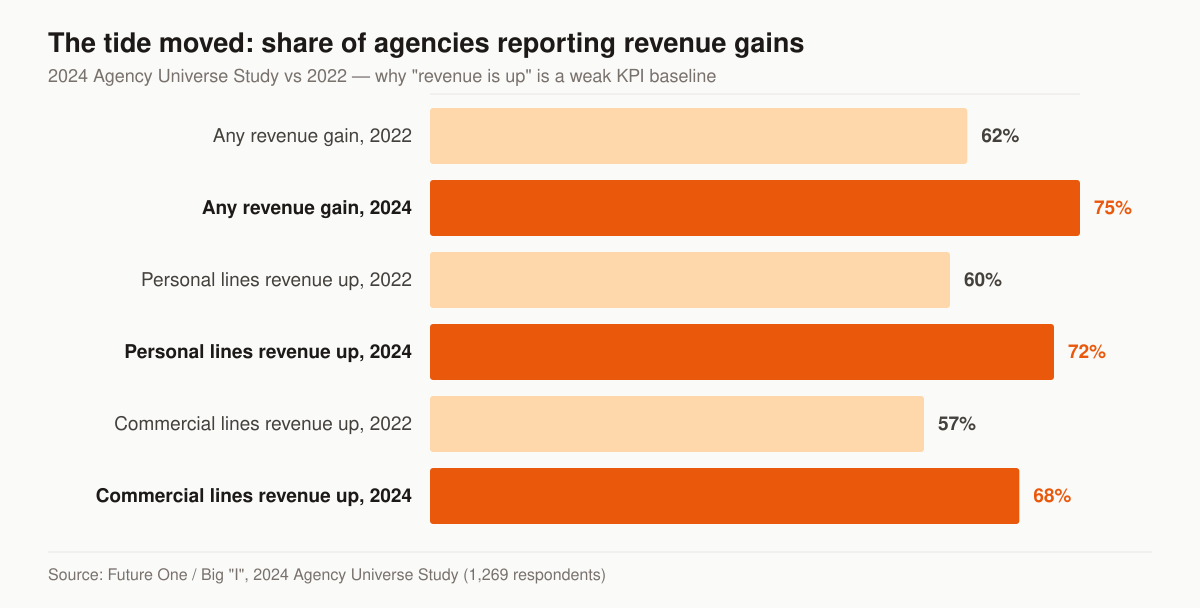
Share of agencies reporting revenue gains, 2022 vs 2024. Source: Future One / Big “I” 2024 Agency Universe Study, 1,269 respondents, reported by IA Magazine.
Three agencies in four rode that tide. If your plan’s success measure is “revenue is up,” it will report a win in a year when you did nothing, and it will report a loss in a soft year when your marketing was working. So we baseline the tracker on units — counts of people and policies — and keep dollars to exactly one row, the one that ties spend to output.
The six rows we put in the tracker, and where each one is actually read:
| KPI | Where it is measured | Why it holds up in a hard market |
|---|---|---|
| Leads by source | CRM, one row per source, never blended | Counts people, so premium inflation cannot flatter it |
| Contact rate | Dialer or CRM call logs | Isolates follow-up from lead quality |
| Appointments set | Calendar or CRM, booked not attempted | The first step that requires the prospect to agree to something |
| Policies issued | Agency management system or carrier statements | The unit the whole plan is buying |
| Cost per issued policy | Total spend ÷ policies issued | The one dollar figure; ties spend to output rather than to rate |
| Retention or policies in force | Agency management system | Separates real growth from replacing churn |
Baseline each from last year’s actuals before you set a single target. Where the baseline is genuinely unknown, write “unknown” in the cell — that is a finding, and it tells you which piece of tracking to fix in Q1. The marketing budget and cost-per-sale math shows how the cost-per-issued-policy row becomes the ceiling every other row answers to, and marketing automation is what stops the tracker depending on someone remembering to update a spreadsheet.
What belongs on the compliance checklist, line by line?
Step 7 makes compliance a launch gate. Here is the part of that gate that comes straight from the text, for the outbound calling and texting that sits behind most insurance lead follow-up.
Calling hours are fixed by 47 CFR 64.1200(c)(1), which bars initiating any telephone solicitation to “Any residential telephone subscriber before the hour of 8 a.m. or after 9 p.m. (local time at the called party’s location)”. Read the scope, not just the hours: the paragraph governs telephone solicitations, it is written about residential subscribers, and the clock is the called party’s local time rather than yours — so a dialer set to your own office hours is already non-compliant for any state to your east.
Paragraph (c)(2) covers the national registry, reaching “[a] residential telephone subscriber who has registered his or her telephone number on the national do-not-call registry of persons who do not wish to receive telephone solicitations that is maintained by the Federal Government.” Those registrations, the same paragraph says, “must be honored indefinitely, or until the registration is cancelled by the consumer or the telephone number is removed by the database administrator.”
The rule then supplies a safe harbor, and every condition attached to it is load-bearing. A caller “will not be liable for violating this requirement” only if it “can demonstrate that the violation is the result of error and that as part of its routine business practice, it meets the following standards” — written procedures, trained personnel, a recorded list of numbers the seller may not contact, and, under (c)(2)(i)(D), a process employing “a version of the national do-not-call registry obtained from the administrator of the registry no more than 31 days prior to the date any call is made, and maintains records documenting this process”. The error condition is part of the test, so the safe harbor does nothing for a call you meant to place.
Your own suppression list runs on a separate clock. Paragraph (d)(6) — the internal do-not-call rule, which reaches any call for telemarketing purposes and artificial or prerecorded-voice calls made “pursuant to an exemption under paragraphs (a)(3)(ii) through (v)” — provides that “[a] do-not-call request must be honored for 5 years from the time the request is made.” Paragraph (e) then extends the reach of both (c) and (d), which “are applicable to any person or entity making telephone solicitations or telemarketing calls or text messages to wireless telephone numbers to the extent described in the Commission’s Report and Order, CG Docket No. 02-278, FCC 03-153”.
Turn each of those into a line the plan can tick before a campaign launches:
| Checklist line | The rule behind it | Evidence to keep |
|---|---|---|
| Dial only 8 a.m.–9 p.m. at the called party’s local time | 47 CFR 64.1200(c)(1) | Dialer time-zone configuration and call logs |
| Scrub against a registry version obtained within the last 31 days | 47 CFR 64.1200(c)(2)(i)(D) | Dated scrub records for every list |
| Written do-not-call procedures, and personnel trained on them | 47 CFR 64.1200(c)(2)(i)(A)–(B) | The written policy, available on demand, plus training records |
| Internal do-not-call requests honored for five years | 47 CFR 64.1200(d)(6) | Suppression list carrying the request date |
| Apply the same rules to texts and mobile numbers | 47 CFR 64.1200(e) | SMS platform suppression settings |
| Medicare campaigns cleared and scheduled for October 15 – December 7 | 42 CFR 422.62(a)(2)(iii) | Carrier or FMO approval dates on file |
This is a federal telemarketing floor, not the whole checklist. States add their own calling and disclosure rules, individual lines add theirs, and carrier or FMO approval is a separate gate again — the checklist in the template has room for all three, and a lawyer, not a marketing page, signs it off. If you buy leads, the consent question sits upstream of everything above: our breakdown of TCPA compliance when buying insurance leads covers what the seller has to hand you along with the record.
Insurance agent vs. insurance agency marketing plan: what changes?
The document is identical; the scope shrinks. A solo agent’s plan has one niche instead of three, one acquisition channel plus follow-up instead of a stack, and a monthly ten-minute KPI review instead of a team meeting. What doesn’t shrink: positioning (a one-person shop needs a “why you” more, not less) and compliance (TCPA doesn’t care how big you are). Captive agents have one extra constraint — carrier rules on what you may advertise — so the compliance checklist does double duty as a carrier-approval tracker.
Which insurance agency marketing strategies belong in the plan?
Strategies are the rows in your quarterly table. The honest menu, by job:
- Convert: a fast website with a booking path — the foundation every other row points at.
- Acquire: paid social or Google/PPC, matched to line; purchased leads if the follow-up system exists first.
- Retain and revive: email/SMS nurture, annual reviews, cross-sell.
- Compound: SEO, local search, and AI-search visibility — slower, but they lower cost per policy every quarter they hold.
You can run these yourself, or hand rows to a specialist — our insurance marketing services map one-to-one onto the template’s channel rows, and pricing is public, so you can put real numbers in the budget worksheet either way. If handing rows off is on the table, the criteria for choosing an insurance marketing agency are worth settling before anyone sends you a proposal.
Insurance agency marketing ideas to fill the plan, by line
Ideas are cheap; the plan is what makes them accountable. When a quarterly row needs filling:
- Cross-line, ranked by effort-to-impact: 45 marketing ideas for insurance agents
- Final expense and senior market: content ideas for final expense agents
- Life, IUL, and family-facing lines: marketing ideas for life insurance agents
- ACA and health, around enrollment windows: open enrollment marketing ideas
Every idea you adopt should land in a specific quarter with a budget and a number attached — otherwise it’s content for content’s sake.
What do you do when a quarter misses its number?
A gate between quarters only works if the miss triggers something. Triage it in the order the funnel runs, and stop at the first step that failed — fixing a later step while an earlier one is broken is how agencies spend a second quarter on the same problem.
- Not enough leads. A volume problem: the channel, the budget or the targeting. Change one of the three, not all three, or the next quarter tells you nothing.
- Leads, but no contact. A follow-up problem, and the one on this list that costs no media budget to fix. We check speed to first attempt and number of attempts before we question the lead source — the lead follow-up cadence is the specific fix.
- Contact, but no appointments. An offer problem. What you are asking for is too big for the stage, or the target-client row named a situation your script does not speak to.
- Policies, but the cost per issued policy is over the ceiling. An economics problem. The channel works and does not scale at this price; either the ceiling was wrong or the channel is a supplement rather than an engine.
Two rules we apply to the gate itself. A channel gets one corrected quarter — the diagnosis above, one change, one more quarter — and then it is either funded properly or cut, because a channel kept alive on hope is how a plan turns back into a “whatever this month” habit. And the miss gets written on the plan, in the quarter it happened, with the reason. That record is what makes the annual rewrite a decision rather than a memory test, and it is the difference between a document that improves each year and one that starts from scratch every January. Q4 is where the retention rows earn their place: an annual-review campaign and a cross-sell and account-rounding pass are the rows we price against acquisition before funding a new channel, because the relationship already exists and the consent question is already answered.
Who owns the plan after it is written?
Every row in the quarterly table needs a name next to it, and there are only three honest answers for who that name belongs to.
The principal owns it. No extra cost and full context, and it is the first thing dropped in a hard week. Workable if the quarterly review is a calendar entry with the same status as a carrier meeting.
A producer or office manager owns it. This works when the KPI review is a standing meeting on their calendar and they have authority to cut a channel, and it fails when the role is “also do the marketing” bolted onto a full book.
An outside team owns it. Our own published rates make the trade explicit: Foundation is $2,500 a month and covers an optimized website and landing pages, local SEO and Google Business Profile, on-page SEO and monthly reporting. Growth is $3,500 and adds an ongoing SEO and content engine, AI-search visibility, and reputation and reviews. Full-Funnel is $5,500 and adds managed Google and Meta ads, landing-page CRO, marketing automation and CRM, and full-funnel reporting. A one-time website build runs $2,500 to $8,000, and ad spend is billed at cost straight to the platforms rather than marked up. The full breakdown, including what is not included, is on the pricing page.
If what you need is someone to own the plan itself rather than a single channel — the positioning call, the quarterly gate, the decision to cut a channel that missed — that is a fractional CMO who owns the plan, and it is a different job from running ads. The retention rows have their own home too, in client retention work. Whichever way you split it, the plan names one owner per row: rows owned by everyone are owned by nobody, and they are the rows still blank at the next review.
Fill it in, then pressure-test it
Download the template (editable HTML · print-ready PDF), fill the highlighted fields, and put the first quarterly review on your calendar today. If auto and home are your book, the 90-day P&C marketing plan is this same skeleton already filled in for one line — a worked example you can copy row by row.
Want a second set of eyes before you commit budget? Get a no-pitch audit of your current plan — we’ll flag the leaks and the wins we would go after first for your line, whether or not you ever hire us. Prefer to talk the plan through before filling anything in? Send us the two lines you are stuck on.
- Digital Marketing for Insurance Agents: The Channel-by-Channel Playbook
Digital marketing for insurance agents, channel by channel: which of SEO, PPC, social, email, and AI search to run first — by line and budget. Free audit.
- 40 Content Ideas for Final Expense Agents You Can Steal This Week
40 content ideas for final expense agents: cost and qualifying answers, video hooks, offline angles, and the capture step that turns views into leads.
- 45 Marketing Ideas for Insurance Agents, Ranked by Effort and Impact
45 marketing ideas for insurance agents, ranked into four tiers by effort and impact. Every idea notes the line it fits, from final expense to P&C.
- Insurance Agency Marketing Budget: What It Costs, and the Cost-Per-Sale Math Underneath
Insurance agency marketing budget and costs: 7-12% of gross revenue steady, 15-20% growing, with the monthly figure by tier and agency retainer bands.