Medicare AEP Marketing Strategy for Agents: The 2026 Playbook
Medicare AEP marketing runs on two dates: CMS lets you market next year's plans from October 1, and enrollment runs October 15 to December 7. Build in summer and clear creative through your carrier by September. Then judge spend against CY2027 commission, $725 national for a first-year Medicare Advantage enrollment, not against cost per lead.
Medicare AEP marketing strategies for agents fail for one predictable reason: agents start in October. By then the Annual Enrollment Period is already live, every competitor is bidding on the same beneficiaries, and there’s no time left to build, test, or get materials approved. AEP is a calendar problem before it’s a marketing problem. Win the calendar and the economics follow.
The Annual Enrollment Period runs October 15 to December 7 every year. AEP 2026 (October 15 – December 7, 2026) enrolls beneficiaries into plan year 2027. That’s 54 days when the highest-intent Medicare audience of the year is actively shopping. The work that decides your AEP happens in the four months before that window.
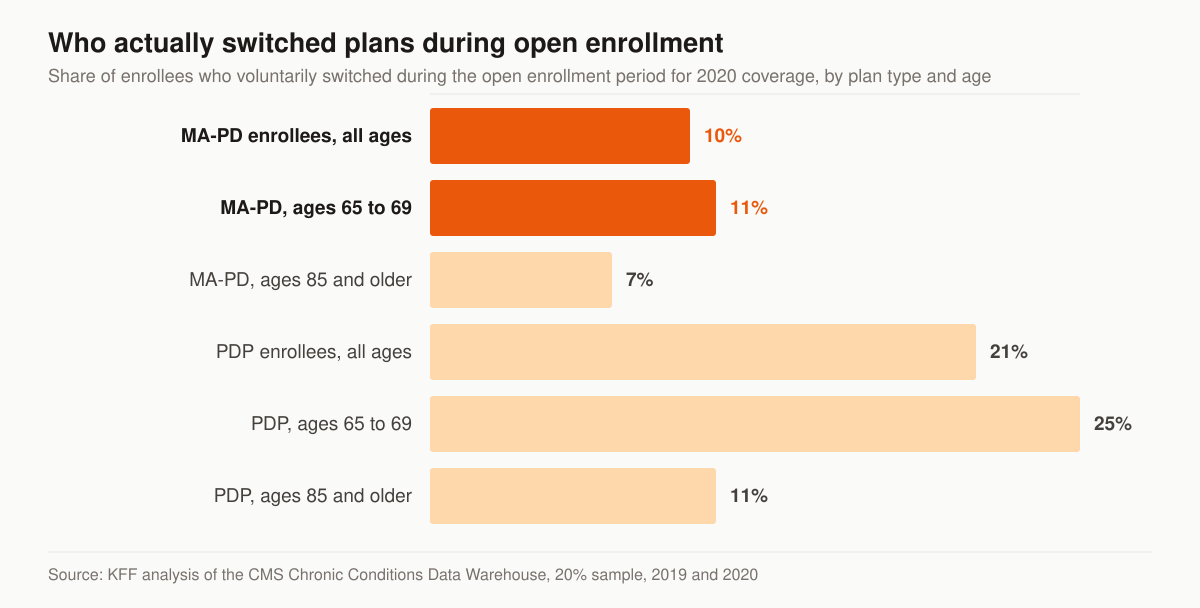
Movement inside the window is a slice, and it skews young: of 11.3 million Medicare Advantage drug plan enrollees, 10% voluntarily switched during the open enrollment period for 2020. The 21% PDP figure that year was lifted by premium changes at one large stand-alone drug plan; across the 13 enrollment periods for 2008 through 2020, MA-PD switching ran 6–12% and PDP switching 10–13%. Source: KFF, Medicare Beneficiaries Rarely Change Their Coverage During Open Enrollment.
When can agents start marketing for AEP?
CMS lets Medicare Advantage organizations begin marketing next year’s plan offerings on October 1 (42 CFR 422.2263(a)) — two weeks before AEP enrollment opens. AEP 2026 runs October 15 to December 7, 2026, for coverage that starts January 1, 2027. Materials must clearly state which plan year they describe.
October 1 is the most under-used date in Medicare AEP marketing. The regulation is explicit: “MA organizations may begin marketing prospective plan year offerings on October 1 of each year for the following contract year,” and they “may market the current and prospective year simultaneously provided materials clearly indicate what year is being discussed” (42 CFR 422.2263(a)). Part D carries a parallel rule at 42 CFR 423.2263.
Two weeks matters. An agent whose landing pages are indexed, ad account is warmed, and phone room is staffed on October 1 is already collecting next-year intent while competitors are still waiting for October 15. The catch is upstream: agent marketing materials are submitted to CMS through HPMS by the plan before use (42 CFR 422.2274(c)(7)), and plans must have next-year compensation structures in place by October 1. That approval queue is why the real deadline for creative is September, not October.
AEP vs OEP vs SEP: what each window allows
AEP is the October 15 – December 7 window when any beneficiary can change plans and agents may market actively; OEP is the January 1 – March 31 window open only to people already in a Medicare Advantage plan, and it may not be marketed to at all. Medicare has three enrollment windows and each one permits a different kind of marketing — confusing them is how agents draw compliance letters. Note the naming trap: Medicare.gov calls the October 15 – December 7 window the “Open Enrollment Period,” while the industry calls it AEP and reserves “OEP” for the Medicare Advantage Open Enrollment Period in Q1.
| Window | Dates | What the beneficiary can do | What agents may market |
|---|---|---|---|
| AEP (Medicare.gov: “Open Enrollment Period”) | Oct 15 – Dec 7 | Join, drop, or switch a Medicare Advantage plan; add or drop drug coverage; move between Original Medicare and MA; switch Part D plans | Full plan marketing. Next-year plans marketable from Oct 1 |
| MA OEP | Jan 1 – Mar 31 (only if already in an MA plan) | Switch to another MA plan, or drop MA and return to Original Medicare plus a standalone drug plan | No OEP-targeted marketing: no unsolicited materials referencing OEP, no buying lists of AEP switchers, no calls to former enrollees who picked a new plan during AEP |
| SEP | Varies by qualifying event (move, loss of coverage, Medicaid, Extra Help) | Join or switch depending on the event | Marketing tied to the qualifying event — age-ins, 5-star plans, dual-eligible/LIS — is permitted, including during Q1 |
Sources: Medicare.gov enrollment periods and 42 CFR 422.2263(b)(7). The Q1 rules are their own discipline — we break them down in Medicare OEP marketing rules for agents.
What does an AEP marketing calendar look like?
An AEP marketing calendar is a build schedule, not a launch date. Foundation work runs June–July, creative and compliance review land in August, pre-launch warm-up happens in early September, and paid spend plus daily contact runs October 15 to December 7 — with a December wind-down that converts the backlog and preps Q1. Here’s the timing table we run against.
| Phase | Window | What you do |
|---|---|---|
| Foundation | June – July | Audit last AEP’s numbers, fix the website, rebuild landing pages, set up CRM and consent capture |
| Creative + compliance | August | Produce ad creative and scripts; submit any CMS-required materials for review through your upline/carrier |
| Pre-launch | Early–mid September | Warm up ad accounts, build audiences, finalize follow-up cadence, brief your dialers |
| Marketing opens | October 1 | Publish and promote plan-year 2027 creative; label the plan year on every asset |
| AEP live | Oct 15 – Dec 7, 2026 | Spend daily, contact leads in minutes, run Scope of Appointment correctly |
| Wind-down + capture | Dec 7 – Dec 31 | Convert backlog, document what worked, prep for OEP (Jan 1 – Mar 31) |
The single biggest miss is the August compliance step. CMS rules govern how agents market Medicare Advantage and Part D, and material review takes time. If your creative isn’t approved by mid-September, you lose the first weeks of the only season that matters. We cover the specifics in our breakdown of CMS Medicare marketing rules for agents — read it before you write a single ad.
Five strategies that move enrolled-beneficiary cost
AEP traffic is expensive because everyone wants it at once. These are the levers that lower your cost per enrolled beneficiary — the number that decides whether you scale. For a broader grab-bag of campaign angles to layer on top, our roundup of open enrollment marketing ideas pairs with this calendar.
- Build for intent, not awareness. During AEP, search intent is sky-high. Google Search captures people typing “Medicare plans 2026” and “compare Medicare Advantage.” Pair it with Meta for reach. Don’t run brand-awareness fluff in October — you’re paying premium CPMs for clicks that should convert today.
- Respect speed-to-lead. A beneficiary who requested a quote at 2pm and gets a call at 2:05 enrolls at a far higher rate than one called the next morning. New AEP leads should hit a licensed agent or live transfer in minutes, not hours.
- Run compliant paid acquisition. Medicare ads on Meta fall under the Special Ad Category, which strips most targeting — so the offer and creative carry the load. Bake consent capture into every form. TCPA exposure is real even after the FCC’s one-to-one consent rule was vacated in January 2025; document consent on every lead.
- Follow up like the policy depends on it — because it does. Most enrollments land after multiple touches, and AEP’s 54-day clock makes cadence non-negotiable.
- Measure the full chain. Cost per lead → contact rate → Scope of Appointment → enrollment → cost per enrolled beneficiary. A $40 exclusive lead that enrolls beats a $9 shared lead nobody reaches.
How fast should you follow up with AEP leads?
An AEP lead should reach a licensed agent within five minutes, get a same-day second touch, then four to six more attempts across the first week before dropping to a weekly cadence through December 7. A fixed cadence in a CRM is the difference between a flat AEP and a record one — the window closes hard.
| Touch | Timing | Channel |
|---|---|---|
| 1 | Within 5 minutes | Call |
| 2 | Same day | Call + text |
| 3–6 | Days 1–7 | Call / text / compliant voicemail |
| 7+ | Weekly through Dec 7 | Call + email |
For the mechanics behind this — and why follow-up stalls two touches too early — see our piece on insurance lead follow-up cadence. The same discipline that lifts a final-expense book’s close rate applies to Medicare leads worked correctly.
Do CMS TPMO rules apply to independent agents?
Yes — in most cases. CMS defines a third-party marketing organization as “organizations and individuals, including independent agents and brokers, who are compensated to perform lead generation, marketing, sales, and enrollment related functions as a part of the chain of enrollment” (42 CFR 422.2260). During AEP that means four operational duties.
- The TPMO disclaimer. Standardized CMS wording naming how many organizations and plans you represent, pointing beneficiaries to Medicare.gov or 1-800-MEDICARE. It must be conveyed verbally on sales calls before any benefits are discussed, sent electronically in email/chat, prominently displayed on TPMO websites, and included in marketing materials (42 CFR 422.2267(e)(41)).
- Call recording. All marketing and sales calls — including the audio portion of web-based meetings — must be recorded and retained in their entirety for at least six years, with the first three years kept in audio format (42 CFR 422.2274(g)(2)(ii)). Budget the storage before October, not after.
- Lead-generation disclosure. When you run lead gen, you must tell the beneficiary their information will be provided to a licensed agent for future contact — verbally on calls, in writing on paper, electronically in email or chat — and tell them when they’re being transferred to a licensed agent who can enroll them (42 CFR 422.2274(g)(3)).
- Scope of Appointment. The current rule requires the SOA to be agreed and recorded prior to the personal marketing appointment, in writing for in-person appointments (42 CFR 422.2264(c)(3)(i)).
That last point is where most AEP checklists are now wrong. CMS’s contract-year 2027 final rule (91 FR 17384, published April 6, 2026, effective June 1, 2026) removed the 48-hour advance-SOA requirement that governed the 2024 through 2026 seasons; the rule is now simply “prior to the appointment.” If your team is still turning away same-day appointments to satisfy a 48-hour clock, you are leaving AEP enrollments on the table. Verify the current text yourself before you rebuild your process — and see our Scope of Appointment and TPMO compliance guide for the mechanics.
What are agents not allowed to do during AEP?
During AEP, CMS bars agents from cold-calling or door-knocking beneficiaries who haven’t asked for contact, offering gifts worth more than $15 per item, providing meals at a sales pitch, selling non-health products in a Medicare appointment, and marketing plans at an educational event. Print, email with an opt-out, and inbound response stay open.
| AEP marketing move | Allowed? | The rule |
|---|---|---|
| Market next plan year’s MA/PD plans from October 1 | Yes | 422.2263(a) — materials must state which plan year they describe |
| Unsolicited direct mail, print ads, email with an opt-out | Yes | 422.2264(a)(1) |
| Cold calls, robocalls, texts, voicemail drops to beneficiaries who haven’t consented | No | 422.2264(a)(2)(iv) — explicitly includes calls based on referrals |
| Door-to-door solicitation; approaching people in parking lots, hallways, lobbies | No | 422.2264(a)(2)(i)–(ii) |
| Direct messages from social media platforms | No | 422.2264(a)(2)(iii) |
| Returning a call or contacting someone who completed a reply card | Yes — not “unsolicited” | 422.2264(a)(3) |
| Gifts to prospects | Only at nominal value: no more than $15 per item / $75 per person per year, never cash | 422.2263(b)(2) + HHS OIG nominal-value policy |
| Meals at a sales event | No — regardless of value | 422.2263(b)(3) |
| Sales presentations or plan applications at an educational event | No | 422.2264(c)(1)(iii) |
| Making SOA forms available at an educational event | Yes — since June 1, 2026 | 422.2264(c)(1)(ii)(D) |
| A marketing event immediately following an educational event | Yes, if attendees are told the educational event is ending and given a real chance to leave | 422.2264(c)(2)(i) |
| Cross-selling annuities or life insurance inside a Medicare appointment | No | 422.2264(c)(3)(iii)(C) |
Gift limits come from the HHS OIG policy statement on gifts of nominal value, which sets nominal value at “no more than $15 per item or $75 in the aggregate per patient on an annual basis” and bars cash or cash equivalents; 42 CFR 422.2263(b)(2) points to that OIG guidance. Two rows in this table changed on June 1, 2026, when the CY2027 final rule took effect: SOA forms may now be made available at educational events, and the old 12-hour delay between an educational event and a marketing event in the same location has been replaced by a notify-and-let-them-leave requirement. Any AEP checklist written before June 2026 gets both wrong. Full walkthrough: CMS Medicare marketing rules for agents.
Medicare AEP marketing examples that stay compliant
Compliant AEP marketing is not weaker marketing — it’s marketing that survives an audit. Four channel examples that fit inside the rules above:
- Direct mail. Unsolicited mail is expressly permitted (422.2264(a)(1)). The piece must identify the MA organization or marketing name in at least 12-point font — not as fine print (422.2263(b)(9)(i)) — carry the TPMO disclaimer, and drive to a call or a form. It may not promise a gift above nominal value, and it can never be followed by an unrequested door-knock.
- Paid social. Ads that name plans, benefits, or costs must identify the organizations offering them — displayed throughout the ad, or read at the same pace as the phone number (422.2263(b)(9)(ii)). Because platform targeting is restricted for this audience, the offer and the creative carry the load. You may run ads; you may not slide into beneficiaries’ DMs (422.2264(a)(2)(iii)).
- Educational seminar. Advertise it as educational, keep it to general Medicare information, and don’t pitch specific plans or take applications. You may hand out business cards, answer beneficiary-initiated questions, and — new for 2026 — make SOA forms available. If a sales event follows, announce the handoff and let people leave.
- Google Business Profile and organic search. A beneficiary who calls you or fills out your form is not an unsolicited contact (422.2264(a)(3)). That is precisely why owned search assets are the cheapest compliant AEP channel: the beneficiary starts the conversation, and the compliance burden drops to disclaimer, recording, and SOA.
How much do Medicare agents make per AEP enrollment?
A first-year Medicare Advantage enrollment pays a maximum of $725 nationally for CY2027, and a renewal pays $363. Those ceilings are what your entire AEP budget has to work against, so they are the right place to start a spend plan.
CMS set the CY2027 maximums in its June 1, 2026 HPMS memo, Contract Year 2027 Agent and Broker Compensation Rates, Referral/Finder’s Fees, Submissions, and Training and Testing Requirements; the plan-by-plan amounts carriers actually pay are published separately on CMS’s Agent Broker Compensation page. For CY2027:
| Plan | Region | Initial (first year) | Renewal |
|---|---|---|---|
| Medicare Advantage | National | $725 | $363 |
| Medicare Advantage | Connecticut, Pennsylvania, DC | $816 | $408 |
| Medicare Advantage | California, New Jersey | $902 | $451 |
| Medicare Advantage | Puerto Rico, US Virgin Islands | $495 | $248 |
| Prescription Drug Plan | National | $130 | $65 |
Referral fees are capped separately at $100 for Medicare Advantage and $25 for a PDP (42 CFR 422.2274(f)). These are maximum fair market value, not guaranteed pay — a carrier may pay all of it, some of it, or none of it, and your contract governs. Check your own schedule before budgeting against these numbers.
What that lets you pay per enrolled beneficiary
Commission ceilings convert directly into an acquisition ceiling. If you are willing to spend half of first-year commission to acquire an enrollment, the national number gives you $362 of room; a third gives you $242.
| Share of first-year commission spent on acquisition | National MA ($725) | California / New Jersey ($902) | PDP ($130) |
|---|---|---|---|
| 50% | $362 | $451 | $65 |
| 33% | $242 | $301 | $43 |
| 25% | $181 | $226 | $33 |
Two things fall out of that table. First, a PDP enrollment cannot carry meaningful paid acquisition on its own — at a third of commission you have $43, which will not buy a Medicare lead in October. PDP volume has to ride along with MA, not be targeted separately. Second, the same campaign is worth 24% more in California and New Jersey than nationally, because $902 is 24% above $725. If you are licensed in a high-commission state, that is where the incremental ad dollar should go first.
What a managed program has to return
The same arithmetic sizes an agency retainer. At the national $725 first-year rate:
| Monthly investment | Enrollments per month to break even (national $725 first-year) |
|---|---|
| $2,500 | 3.4 |
| $3,500 | 4.8 |
| $5,500 | 7.6 |
| $8,000 one-time website build | 11.0 (one-off, not monthly) |
Those are our own published bands, set out in full on our pricing page. Judge any proposal — ours or anyone else’s — against this table rather than against a monthly fee in isolation. A program is worth its price when the enrollments it adds clear the row it sits on, and renewals in years two and beyond are upside on top.
The other half of the equation is what you own when the season ends. Owning the assets — site, pixel, CRM, consent records — rather than renting a vendor funnel means the cost of the next AEP starts lower. An agent who rebuilds before AEP starts the season with a faster site, a warmed ad account, and a follow-up machine already running. An agent who waits until October buys the same leads at peak price with none of the infrastructure.
Lead sourcing for AEP: pick by your capacity
There’s no universally “best” AEP lead. There’s the one that matches your dial capacity and licensed headcount.
- Exclusive leads — highest cost per lead, usually lowest cost per enrolled beneficiary. Best for small teams that can work each lead hard.
- Live transfers — a beneficiary already on the phone. Strong for closers who’d rather talk than dial.
- Shared leads — cheap per lead, raced by many agents. Profitable only at high dial volume.
- Aged leads — cheapest, lower intent. A volume play for centers, not solo agents.
If you’re deciding where AEP budget should go, our guide on how to get Medicare clients as an agent maps each source to a realistic operating model, and our Medicare leads page shows how we generate them.
Refresh this before every AEP
AEP is seasonal, and so is this playbook. Carrier plans change, CMS guidance updates, and ad-platform rules shift year to year. Before each October 15, re-audit last season’s cost per enrolled beneficiary, refresh creative against the current plan year, and re-confirm every compliance step. What worked last AEP is a starting point, not a guarantee.
Want this built and run for you instead of cobbled together in September? Hiring a Medicare Advantage AEP marketing partner is the done-for-you version of everything above — operated by a team that runs its own book. If you’d rather find the leaks in your current setup first, start with a free marketing audit and we’ll show you where AEP dollars are slipping before the season opens. AEP is only one window — the rules flip in the Open Enrollment Period, covered in Medicare OEP marketing rules for agents. See the approach applied to a real book in our Medicare agency case study.
- How to Get Medicare Clients: 9 Channels Ranked by Cost and Risk
How to get Medicare clients as an agent: 9 channels ranked by cost, speed, and CMS risk — plus what CMS caps agent commissions at, and the rules.
- Medicare OEP Marketing Rules: What Agents Can and Can't Do (Jan 1–Mar 31, 2027)
Medicare OEP marketing rules for 2027: the 5 things CMS bans Jan 1-Mar 31 under 42 CFR 422.2263, and 7 compliant plays that still win share.
- 15 Open Enrollment Marketing Ideas for Agents (ACA, Medicare, Group)
15 open enrollment marketing ideas for agents, segmented for ACA OE, Medicare AEP, and employer group windows — with verified 2026 dates and deadlines.
- The T65 Marketing Calendar: A Month-by-Month Campaign System
A month-by-month T65 marketing calendar for Medicare agents: when to mail, when to call, and which touch belongs in each month before the IEP opens.