How to Get Medicare Clients: 9 Channels Ranked by Cost and Risk
To get Medicare clients as an agent, run a few of the nine channels well rather than all badly: paid search and Meta lead forms for volume, an SEO-backed website and Google Business Profile for cheap compounding leads, direct mail and events for turning-65 reach, referrals for trust. Track cost per enrollment and stay inside CMS rules.
Agents asking how to get Medicare clients are really asking two questions at once: which channels actually produce enrollments, and which ones won’t get a letter from a carrier’s compliance team. This post answers both, channel by channel, with the trade-offs laid out plainly.
The market isn’t the constraint — CMS’s Medicare Monthly Enrollment data puts total Medicare enrollment at 70.2 million as of March 2026, with 51.2% in Medicare Advantage and other private plans. The pipeline behind it is just as good: the Alliance for Lifetime Income’s Retirement Income Institute counts more than 4.1 million Americans turning 65 every year through 2027 — over 11,200 a day, the “Peak 65” surge. The constraint is acquiring your slice of it at a cost your commissions clear.
For context on how we think about this market, we run our own final-expense and senior-market lead operation, so the advice below comes from live campaigns, not theory: we favor channels we can measure to a cost per enrollment, not channels that just look busy.
The metric we judge every channel on: cost per enrollment
Lead count is a vanity number. A Medicare agent who pays $9 per lead but closes 1 in 20 is spending more per client than one paying $22 per lead closing one in six. Before you pick a channel, decide how you’ll track the chain from spend to enrollment.
Here is the math that should drive every channel decision:
| Metric | Formula | Why it matters |
|---|---|---|
| Cost per lead (CPL) | Spend ÷ leads | Entry cost, easy to game |
| Contact rate | Reached ÷ leads | Aged and shared leads tank here |
| Close rate | Enrollments ÷ contacted | Where lead quality shows up |
| Cost per enrollment | Spend ÷ enrollments | The number that decides profit |
A channel with a high CPL can still win on cost per enrollment if the leads are exclusive and intent is high. Judge every option below on the last row, not the first.
The 9 Medicare client acquisition channels, ranked by trade-off
There is no single best channel. There’s a portfolio. Most healthy Medicare books run three to five of these at once, weighted toward the agent’s strengths and AEP calendar. Ranked by how fast they produce a first client against what they cost and what CMS exposure they carry:
- Google Ads (search) — buy in-market intent; the fastest paid path to someone already shopping plans.
- Meta lead forms — cheap volume under Special Ad Category limits; speed to first dial decides everything.
- SEO and your own website — slow to start, lowest cost per client once it ranks.
- Google Business Profile and local search — free map-pack visibility for “Medicare agent near me.”
- Direct mail — the one channel CMS still lets you send unsolicited, which is why T65 lists work.
- Referrals and your existing book — near-zero cost, highest close rate, hardest to scale.
- Provider and professional partnerships — doctors, pharmacists, CPAs, financial planners.
- Community and turning-65 events — trust at scale, inside strict CMS event rules.
- Purchased vendor leads — instant volume, inherited compliance exposure.
| Channel | Speed to first client | Relative cost per client | CMS / compliance risk | Best for |
|---|---|---|---|---|
| Google Ads (search) | Fast | Medium–high | Medium | High-intent T65 and plan-shoppers |
| Meta lead forms | Fast | Medium | Medium–high | Volume, turning-65 audiences |
| SEO + agent website | Slow (3–9 mo) | Low over time | Low | Compounding, cheap leads |
| Google Business Profile | Medium | Very low | Low | Local “near me” and review-driven trust |
| Direct mail (T65, AEP, SEP) | Medium | Medium | Low–medium | Reaching age-ins before they shop |
| Referrals & client base | Medium | Very low | Low–medium | Retention-driven growth |
| Provider & professional partnerships | Slow | Low | Medium | Steady, pre-trusted flow |
| Community / T65 events | Medium | Low–medium | Medium | Local trust, face-to-face |
| Purchased vendor leads | Fast | Varies widely | Medium–high | Filling pipeline gaps |
Paid search: buy intent, not impressions
When someone types “Medicare Advantage plans near me,” they are shopping now. That intent is why search converts. The catch is that Medicare is a regulated, expensive auction, and unmanaged accounts bleed budget on broad terms that never enroll. Tight match types, T65-focused keywords, and call tracking are non-negotiable. If you want a deeper breakdown of what clicks cost by line and how to keep the account profitable, our guide to Google Ads for insurance agents covers structure and budget pacing, and the cost-per-click benchmarks by line show where Medicare sits versus final expense and life.
Meta lead forms: cheap volume under a Special Ad Category ceiling
Facebook and Instagram lead forms produce volume fast and cheap, which is why so many turning-65 campaigns live there. Two constraints matter. First, insurance ads fall under Meta’s Special Ad Category, so you lose detailed demographic and ZIP-radius targeting and must lean on broad audiences and creative. Second, a form fill is a soft signal, not a hot prospect, so your follow-up cadence determines whether those leads ever become enrollments. Speed of the first dial is the lever we tune before anything else. For the full T65 pipeline — audiences, offers, and the follow-up ladder — see our turning-65 marketing system.
SEO and your own website: the asset that lowers cost every month
Paid channels stop the moment you stop paying. An optimized agent website keeps producing leads after the spend ends, which is why cost per client falls over time. The work is slower, usually three to nine months to rank, so it pairs best with paid channels that carry you in the meantime. Our Medicare marketing services are built around this combination: paid flow now, organic compounding later. If your site is the weak link, the Medicare agent website page covers what a page needs to convert turning-65 visitors, and you can pull dedicated Medicare leads through the same funnel.
Google Business Profile: the free channel worth finishing
A Google Business Profile is the cheapest Medicare lead source on this list, and it only pays once it’s finished. Claim and verify the listing, set the category to insurance agency, define the service area you’re actually licensed and appointed in, and keep hours accurate — “Medicare agent near me” searches resolve in the map pack before anyone scrolls to the organic results. Reviews are the ranking and conversion lever together, so build a habit of asking every enrolled client, and answer each one; our guide to getting more Google reviews covers the ask that actually gets responses. Two cautions: profile posts that name plan-specific benefits or premiums count as marketing under CMS’s definition and need the same review as any other material, and insurance profiles get flagged easily — if yours goes dark, the Google Business Profile suspension playbook is the way back.
Direct mail: the only unsolicited channel CMS still allows
Direct mail is the strange survivor of Medicare marketing, and the reason is regulatory, not nostalgic. CMS explicitly permits unsolicited contact by conventional mail and print — and explicitly prohibits unsolicited cold calls, robocalls, texts, voicemails, social-media direct messages, and door-to-door drops (42 CFR §422.2264(a)). Mail is how you reach an age-in before the carriers’ call centers do. Four drops carry most books: a turning-65 birthday sequence timed to the Initial Enrollment Period, an AEP announcement that can’t reference next year’s plans before October 1, a Special Enrollment Period piece for movers and retirees losing group coverage, and a D-SNP piece in dual-heavy ZIP codes. Mail carries a business reply card, because a returned card is documented permission to call. The T65 marketing system covers list sourcing and drop timing.
Referrals and your existing book: the lowest cost per client you’ll ever get
Every satisfied client knows other people turning 65. Cost per client here is close to zero, and these prospects arrive pre-trusted, so close rates run well above any cold channel. One rule agents get wrong: a name handed to you is not permission to dial. CMS lists calls based on referrals as prohibited unsolicited contact, so the referred person has to reach out or consent first. The agents who grow fastest don’t treat referrals as luck — the step-by-step system is a section below.
Provider and professional partnerships
Provider partnerships are the slowest channel here and the stickiest. Primary-care offices, pharmacies, senior-living communities, CPAs, and financial planners all sit in front of your buyer months before you do, and none of them want to answer Medicare questions. Give them a referral path instead. Three constraints define what’s compliant: marketing inside a health care setting is limited to common areas, never where patients receive care; a payment for a referral is capped at $100 for an MA or MA-PD enrollment and $25 for a Part D enrollment (42 CFR §422.2274(f)); and the exchange only runs one way, because you cannot market non-health products like annuities inside a Medicare marketing appointment. Send your Medicare clients’ retirement questions to the planner, take their turning-65 clients back, and document the boundary.
Community and turning-65 events
Community events still work, especially in markets where trust beats price: library workshops, senior-center sessions, and partnerships with local pharmacies. CMS draws a hard line between educational events and marketing or sales events, and the two carry completely different rules — the table further down spells out what you can do at each. Confuse them and you create real exposure. Done right, events feed both enrollments and referrals; our Medicare seminar marketing page covers filling the room.
Purchased vendor leads: fast volume, inherited risk
Vendor leads exist to fill pipeline gaps when your own generation can’t keep pace, and that’s the right way to use them — as a supplement, not the strategy. Shared leads are cheap and worked by several agents at once; exclusive leads cost more and convert better. Either way, you inherit the vendor’s compliance posture the moment you dial, so verify the consent trail first — our guide to TCPA compliance when buying insurance leads covers exactly what to check.
How much do Medicare agents make per client?
Medicare commission is capped, not negotiated. CMS limits what a Medicare Advantage plan may pay an independent agent for a first-year enrollment to a fair market value (FMV) cap, and every renewal year pays exactly 50% of that cap. CMS resets the cap annually, and a few states carry higher ones.
| Payment type | What CMS allows | Rule |
|---|---|---|
| Initial-year MA / MA-PD enrollment | At or below the FMV cap for that state | §422.2274(d)(2) |
| Renewal year (same or “like” plan) | Exactly 50% of FMV | §422.2274(d)(3) |
| Referral / finder’s fee | ≤ $100 per MA or MA-PD referral; ≤ $25 per PDP referral | §422.2274(f) |
| Rapid disenrollment (member switches within 3 months) | Entire compensation recovered from the agent | §422.2274(d)(5) |
| Admin payments (training, mileage, venue costs) | Folded into the compensation cap since CY2025 | §422.2274(a), (e)(2) |
The FMV baseline is national, with separate higher caps for Connecticut, Pennsylvania and DC, and for California and New Jersey. You don’t have to guess what any given plan pays: CMS publishes the actual first-year amount every plan pays independent agents, by state and county, in its Agent Broker Compensation data file. Pull it before you decide which contracts to carry — and note that the renewal stream, not the first-year check, is what makes a Medicare book worth owning.
Can you get Medicare clients under 65?
Yes. People under 65 get Medicare automatically after 24 months of Social Security disability benefits, immediately in the month ALS benefits start, or through End-Stage Renal Disease — permanent kidney failure requiring dialysis or a transplant (Medicare.gov). These prospects enroll year-round, and almost no agent markets to them.
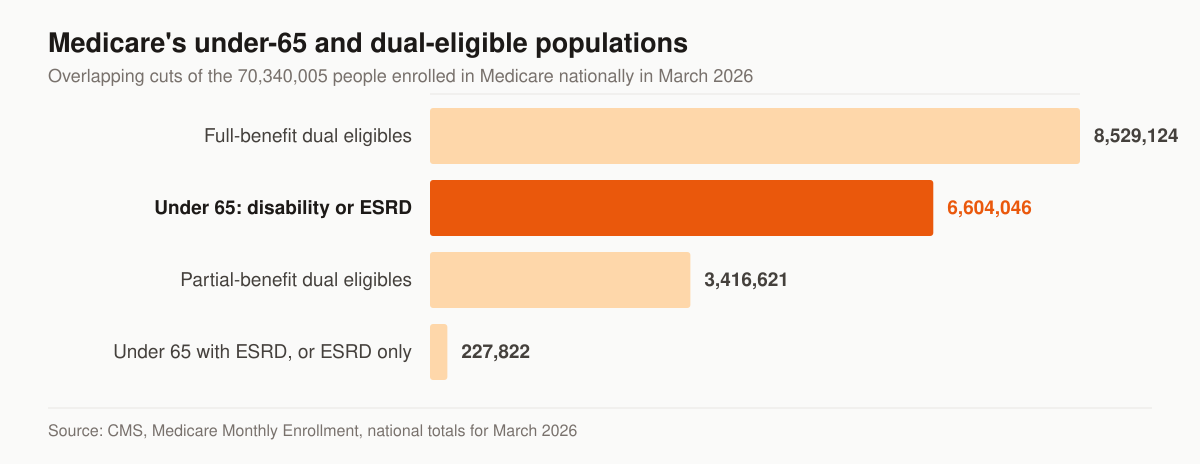
Medicare enrollment by original reason for entitlement and by dual status, national totals for March 2026. The cuts overlap: someone under 65 can also be a full-benefit dual eligible. Source: CMS, Medicare Monthly Enrollment.
Three prospecting angles follow from that:
- Disability age-ins. The 24-month clock is predictable, which makes it list-able the same way a 65th birthday is. CMS even requires plans to show they allocate marketing resources to the disabled Medicare population, not just to people aging in at 65.
- Dual eligibles and D-SNPs. Full-benefit dual eligibles can use the Integrated Care SEP to move into an aligned D-SNP in any month, and dual/LIS enrollees have a monthly Part D SEP — so this book doesn’t live or die on AEP. Marketing a plan as a D-SNP when it isn’t, or implying a Medicaid relationship you don’t have, is a fast way to lose your contracts.
- ESRD and chronic-condition prospects. C-SNPs and ESRD-eligible enrollees are a referral conversation with dialysis centers and nephrology practices, not an ad campaign.
How do Medicare agents get referrals?
Medicare agents get referrals by building a repeatable ask into the service calendar instead of waiting on goodwill. Two service touchpoints a year, a specific question rather than a vague one, and a documented path for the referred person to contact you first are the whole system. It costs nothing and closes better than any paid channel:
- Schedule service touchpoints. An annual review plus a check-in before AEP — October 15 to December 7, 2026 this year, with coverage starting January 1, 2027 per Medicare.gov — gives you at least two natural referral moments per client.
- Make the ask specific. “Who do you know turning 65 this year?” outperforms “keep me in mind” because it gives the client a concrete face to picture.
- Capture the household first. The spouse on the policy paperwork is the easiest referral you’ll ever get, and the one that gets skipped.
- Make referring effortless — and inbound. A forwardable text or one-line email the client can send beats a formal program nobody uses, and it solves the compliance problem: the referred person contacts you, so you’re never cold-calling a name off a list.
- Close the loop, carefully. Tell the referrer what happened — thanked referrers refer again. If you thank them with a gift, keep it nominal: CMS caps gifts to beneficiaries at nominal value under 42 CFR §422.2263(b)(2), and cash is off the table entirely.
Between those touchpoints, a monthly client newsletter keeps your name in the household, so the referral ask never lands cold.
What is the difference between an educational event and a sales event?
An educational event is advertised as educational and informs people about Medicare generally; a marketing or sales event presents specific plans. At an educational event you may not discuss plan benefits or take an application. At a sales event you can do both. Everything else — sign-in sheets, screenings, meals — is restricted at either (42 CFR §422.2264(c)).
| What you want to do | Educational event | Marketing / sales event |
|---|---|---|
| Present plan-specific benefits, premiums, or Star Ratings | No | Yes |
| Distribute or accept enrollment applications | No | Yes |
| Answer plan questions the beneficiary asks first | Yes | Yes |
| Hand out business cards and general Medicare materials | Yes | Yes |
| Collect Scope of Appointment forms | Yes | Yes (for later appointments) |
| Require a sign-in sheet, pre-registration, or contact info to attend | No | No |
| Run health screenings or surveys that segment attendees | No | No |
Two details that catch agents out. Meals are prohibited at marketing and sales events regardless of value — light snacks only — and any gift must be nominal and offered to everyone who shows up, whether or not they enroll (§422.2263(b)(2)–(3)). And if a sales presentation follows an educational event in the same room, you must announce that the educational portion has ended and give people a genuine chance to leave before you start selling.
Compliance is a trust signal, not a tax
Agents get burned by generic marketing agencies that don’t know CMS rules and hand them campaigns that can’t run. A few fixed guardrails for Medicare client acquisition:
- No cold calling — and no texts, DMs, or door knocks. CMS prohibits unsolicited telephone solicitation, robocalls, texts, voicemails, social-media direct messages, door-to-door contact, and approaching people in parking lots, hallways, and lobbies. It expressly includes calls based on referrals and calls to confirm someone got your mailer. Unsolicited conventional mail and email with an opt-out are allowed.
- You are almost certainly a TPMO. CMS defines a Third-Party Marketing Organization to include independent agents and brokers compensated for lead generation, marketing, sales, or enrollment. That means every marketing, sales, and enrollment call — including the audio of web-based calls — must be recorded in full and retained for six years, and the TPMO disclaimer stating how many organizations and plans you represent has to appear in your materials. The Scope of Appointment and TPMO rules post breaks the wording down.
- Scope of Appointment, before the appointment. An SOA must be agreed and recorded before any personal marketing appointment, in writing for in-person meetings, and it covers only the product lines the beneficiary agreed to discuss. It applies even when the beneficiary calls you — walk-ins, unscheduled calls, and web chats included. CMS’s current rules removed the old 48-hour waiting period, but the SOA still comes first.
- Permission to contact travels with the lead. Since October 1, 2024, a TPMO may share a beneficiary’s data with another TPMO only with prior express written consent that names each receiving entity. If a vendor can’t show you that disclosure, their leads are your problem the moment you dial.
- TCPA still applies. The FCC’s one-to-one consent rule was vacated in January 2025, but TCPA consent obligations remain — verify any purchased lead’s consent trail before dialing.
- AEP and the October 1 line. Demand peaks during the Annual Enrollment Period, October 15 to December 7, 2026, but you cannot market next year’s plans before October 1 — so build content and SEO in the summer and turn on the plan-specific spend on schedule. See the AEP marketing playbook for the calendar.
- MA OEP is not a second AEP. From January 1 to March 31, current Medicare Advantage enrollees may make one change. Agents may not knowingly target them: no unsolicited materials referencing OEP, no buying lists of people who switched at AEP, no calling former clients who left you. You may still market to age-ins and respond to anyone who contacts you. The Medicare OEP marketing rules post covers the compliant Q1 plays.
We provide the marketing; the licensed agent owns plan recommendations. Keeping that boundary clean is part of what makes a campaign survivable.
A simple 90-day sequence
If you’re starting close to scratch, sequence it like this:
- Weeks 1–2: Stand up or fix the website and a single compliant landing page. Wire call tracking and a lead form.
- Weeks 2–4: Launch one paid channel — usually Google Ads for intent — with tight keywords and a fast follow-up cadence.
- Weeks 4–8: Add Meta lead forms for volume; start publishing SEO content targeting T65 questions.
- Weeks 8–12: Layer a referral ask into every service call and measure cost per enrollment by channel. Cut what doesn’t pay.
Before any of it goes live, run the creative past the CMS Medicare marketing rules for agents — the rewrite is cheap in July and expensive in October.
The agents who win don’t chase every channel. They pick three, measure cost per enrollment ruthlessly, and stay compliant enough to keep their contracts. If you’d like an operator to look at your current numbers and tell you where the money is leaking, request a free marketing audit and we’ll map the channels to your market. To see these channels compound on a real book, read our Medicare agency case study or the full set of documented client case files. Two audiences inside this market are worth their own creative rather than a translated version of the same ad: veterans aging in with VA coverage they still have to coordinate around, covered in marketing to veteran and military families, and Spanish-dominant households, covered in bilingual insurance agent marketing.
- Medicare AEP Marketing Strategy for Agents: The 2026 Playbook
Medicare AEP marketing strategy: the Oct 1 start date, the Oct 15-Dec 7 calendar, CMS rules, and what CY2027 commission lets you pay per enrolled beneficiary.
- The T65 Marketing Calendar: A Month-by-Month Campaign System
A month-by-month T65 marketing calendar for Medicare agents: when to mail, when to call, and which touch belongs in each month before the IEP opens.
- Medicare OEP Marketing Rules: What Agents Can and Can't Do (Jan 1–Mar 31, 2027)
Medicare OEP marketing rules for 2027: the 5 things CMS bans Jan 1-Mar 31 under 42 CFR 422.2263, and 7 compliant plays that still win share.
- 15 Open Enrollment Marketing Ideas for Agents (ACA, Medicare, Group)
15 open enrollment marketing ideas for agents, segmented for ACA OE, Medicare AEP, and employer group windows — with verified 2026 dates and deadlines.