Who we serve
The Turning-65 System That Owns the IEP Window
T65 marketing for Medicare agents reaches prospects in the months before they age into Medicare at 65 and captures them during their Initial Enrollment Period (IEP) before a competitor does. You identify the turning-65 cohort, reach them four to six months early with helpful content, capture the contact, and nurture until their IEP opens.
Free · 15-minute teardown · no pitch deck
- We run our own final-expense book
- No pitch deck — we screen-share real numbers
- TCPA-aware · CMS/AEP-compliant · Meta Special Ad Category
- Core Web Vitals < 2.0s LCP
T65 marketing for Medicare agents runs on a clock rather than a hunch. The pool refreshes every month, the buying trigger is a calendar date, and the prospect is making a first-time coverage decision with no Medicare plan already in place to displace. This page lays out the turning-65 system we build: who to reach, when, and how to do it without tripping a CMS rule.
We run this on the back of a real senior-market lead operation. Our final-expense book runs on live campaigns, not theory. T65 sits next door to that book, so the same ad discipline and conversion plumbing carry straight over.
One structural note before the tactics. The moment a T65 campaign markets a Medicare Advantage plan it answers to 42 CFR part 422, subpart V, and a Part D campaign answers to the mirrored text at part 423, subpart V. A Medicare Supplement conversation with the same prospect does not sit under either part — it is state-regulated insurance — but the FCC’s telephone rules at 47 CFR 64.1200 govern the call whichever product is on the table. Where this page quotes a regulation, it quotes the current published text.
Why the turning-65 window runs on a clock
The Initial Enrollment Period (IEP) opens three months before the month someone turns 65 and runs three months after. That is a seven-month window with a start date you can calculate a year ahead. An AEP prospect is shopping against an existing plan; an aged lead carries no date at all. A turning-65 prospect is deciding for the first time, and the date the decision becomes urgent is already on your calendar.
This table sets the two lead types side by side on the four attributes that change how you campaign to them.
| Signal | Aged Medicare lead | T65 / turning-65 lead |
|---|---|---|
| Buying trigger | Unknown | Fixed date (65th birthday) |
| Incumbent plan | Often in place | None yet — a first Medicare enrollment |
| Intent at contact | Cold to warm | Actively deciding |
| Pool refresh | One-time | Every month, forever |
The enrollment clock your campaign is timed against
Before you set a cadence, read what has already happened on the government’s side of the calendar, because your first touch is not landing in an empty mailbox.
Medicare.gov puts the Initial Enrollment Period at seven months: “It lasts for 7 months, starting 3 months before you turn 65, and ending 3 months after the month you turn 65.” When coverage begins depends on where inside that window the person acts. Sign up before the month you turn 65 and coverage begins “the month you turn 65”; sign up the month you turn 65 or during the three months after, and coverage starts “the next month”. Part A on its own starts the month the person turns 65, and if the birthday falls on the first of the month, coverage starts the month before.
Plan enrolment runs on its own clock alongside it. For joining a Medicare Advantage or Medicare drug plan, Medicare.gov describes an Initial Enrollment Period that “Starts 3 months before you get Medicare (Part A and/or Part B) and ends 3 months after you get Medicare.” It also sets the eligibility gate that decides which product you can even discuss: “You need both Part A (Hospital Insurance) and Part B (Medical Insurance) to join a Medicare Advantage Plan”, while “You need either Part A or Part B to join a Medicare drug plan.” Request the plan before Part A or Part B starts and coverage begins the same day the Medicare coverage does; request it afterwards and it “starts the first of the month after the plan gets your request.”
Two different people sit inside every turning-65 cohort, and they need different first touches. CMS’s Enrolling in Medicare Part A and Part B booklet says of people already drawing Social Security or Railroad Retirement Board benefits: “If you’re getting these benefits, in most cases, you’ll automatically get Part A and Part B starting the first day of the month you turn 65.” Those people get the “Welcome to Medicare” package, and the booklet is specific about the timing — “This package is mailed about 3 months before your 65th birthday.” The other group has nothing coming: “Important: If you’re not getting Social Security benefits, Medicare won’t mail you any enrollment information. You’ll need to call Social Security at 1-800-772-1213 at least 3 months before you turn 65 to avoid any penalties.” For someone still working, the booklet is direct: “If you aren’t getting Social Security or RRB benefits (for example, because you’re still working) and you want Part A or Part B, you’ll need to sign up (even if you’re eligible to get free Part A).”
This table pairs each stretch of the countdown with what has already reached the prospect, which is what decides whether your touch is early or late.
| Months to the 65th birthday | What has reached the prospect | What a T65 program should be doing |
|---|---|---|
| 6 to 4 | Nothing from the government yet | First educational touch, opt-in captured, permission recorded |
| 3 | “Welcome to Medicare” package mailed to those already on Social Security; IEP opens | Nurture already running; you are a familiar name rather than a new envelope |
| 2 to 1 | Card in hand for the auto-enrolled; self-enrollers still have to act | Appointment booked; Scope of Appointment captured before any plan talk |
| Birthday month | Part A coverage starts | Enrolment conversation, or a dated follow-up for anyone deferring |
| +1 to +3 | IEP still open, but coverage now starts the month after signing up | Last window before the penalty clock and the General Enrollment Period |
The penalty is what makes the deadline real for the prospect, and it is worth stating plainly rather than dramatising. Medicare.gov’s rule on Part B is that “You’ll pay an extra 10% for each year you could have signed up for Part B, but didn’t.” That is the sentence an educational T65 asset can carry without touching a plan benefit, which matters for a reason the compliance section below makes concrete.
The turning-65 system, step by step
The whole thing is a timed sequence built around the IEP clock:
- Identify the cohort. Target the audience aging into Medicare in your service area 4-6 months out, by age and geography.
- Lead with help, not a pitch. A plain “what happens when you turn 65” guide or checklist earns the opt-in. No fear, no hype.
- Capture and get permission. Collect the contact and a documented permission-to-contact before any outbound call. This is a compliance step and a conversion step at once.
- Nurture to the IEP date. Email and SMS spaced to the prospect’s birthday month so your call lands the week they are ready.
- Convert on a Scope of Appointment. Only discuss specific Medicare Advantage or Part D plans after the SOA is on file.
For the engine behind steps 1-2, see our approach to building Medicare lead-generation systems and the broader Medicare marketing playbook this page sits under. The tactical walkthrough of this sequence, cadence included, lives in our full turning-65 marketing system guide.
What a T65 lead is, and what a turning-65 list is not
The two words get used interchangeably and they are not the same asset. A turning-65 list is a set of names with birthdates attached. A T65 lead is a person who has produced a record of consent. The difference decides which channels you may use on them, so it decides what the data is worth.
A list is a legitimate mail audience. 42 CFR 422.2264(a)(1) permits MA organizations to “make unsolicited direct contact by conventional mail and other print media (for example, advertisements and direct mail) or email (provided every email contains an opt-out option).” So the birthdate file you bought can carry an invitation into a mailbox or an inbox.
A list is not a call file. Two separate rulebooks close that door, and each has its own scope. Under 42 CFR 422.2264(a), which applies “when materials or activities are given or supplied to a beneficiary or their caregiver without prior request”, MA organizations may not “Use telephone solicitation (that is, cold calling), robocalls, text messages, or voicemail messages”, with calls based on referrals and “Calls to prospective enrollees to confirm receipt of mailed information” named among the examples. Separately, 47 CFR 64.1200(c) says “No person or entity shall initiate any telephone solicitation to” a residential telephone subscriber “who has registered his or her telephone number on the national do-not-call registry of persons who do not wish to receive telephone solicitations that is maintained by the Federal Government.” The registry exception that matters commercially is the one in (c)(2)(ii): the caller “has obtained the subscriber’s prior express invitation or permission. Such permission must be evidenced by a signed, written agreement between the consumer and seller which states that the consumer agrees to be contacted by this seller and includes the telephone number to which the calls may be placed”.
Read those together and the whole design of a T65 funnel falls out of them. The list buys you a mailer. The mailer buys you an opt-in. The opt-in — a completed reply card, a form submission carrying an express consent statement, a booked appointment — buys you the phone. That is why we build the consent capture into the landing page rather than bolting it on: the artifact is the asset, and the difference between a name and a lead is a timestamped record you can produce later.
How to reach a turning-65 cohort, channel by channel
There is no single T65 channel. Each one reaches a different slice of the same birthday cohort, and each fails differently, so the mix is what makes the pipeline steady instead of lumpy.
This table sets out what each channel reaches, where it breaks, and the job it is best given inside a T65 program.
| Channel | What it reaches | Where it breaks | Best used for |
|---|---|---|---|
| Direct mail | The 63-to-64 cohort that still opens mail and responds to a deadline | Slow feedback loop; you cannot iterate weekly | Building the top of the list 4-6 months ahead of IEP |
| Facebook / Meta | Adult children and the younger, online end of the cohort | Special Ad Category strips exact-age targeting, so creative has to self-select | Volume opt-ins into the nurture sequence |
| Search and local SEO | People already typing “when do I sign up for Medicare” | Compounds slowly; needs real content and a Business Profile | Durable flow that compounds instead of resetting each month — see insurance SEO |
| Educational seminars | The cohort that wants to be taught in person before deciding | CMS draws a hard line between educational and sales events | High-trust conversion — see Medicare seminar marketing |
| Referrals from existing book | Spouses, siblings, and neighbours of members you already serve | Only scales as fast as your book does; a referred name may not be called | Volume that costs no media spend |
The order matters more than the list. Start with the one channel you can fund and measure for a full IEP cycle, prove cost per enrolled member on it, then add the next. A budget spread across five channels in the same quarter produces five sets of inconclusive data and one missed enrollment window.
Which rulebook applies to the conversation
The same prospect can sit under two regimes in the same week. What decides which one applies is the product on the table and, for CMS purposes, whether the material meets the definition of marketing at all.
CMS defines a third-party marketing organization broadly enough to catch an independent agency doing its own lead generation. Under 42 CFR 422.2260, a TPMO means “organizations and individuals, including independent agents and brokers, who are compensated to perform lead generation, marketing, sales, and enrollment related functions as a part of the chain of enrollment (the steps taken by a beneficiary from becoming aware of an MA plan or plans to making an enrollment decision).” If you are being paid anywhere along that chain, you are inside the definition.
Whether a given asset is marketing is a separate, two-prong test. The same section defines marketing as materials and activities meeting both an intent standard and a content standard. The intent prong covers material intended to “Draw a beneficiary’s attention to a MA plan or plans”, influence a plan selection, or influence a decision to stay enrolled. The content prong is met where the material includes or addresses “The plan’s benefits, benefits structure, premiums, or cost sharing”, measuring or ranking standards such as Star Ratings or plan comparisons, or rewards and incentives. Both prongs have to be met. A “what happens when you turn 65” guide that explains Part A, Part B and the IEP clock and names no plan, benefit, premium, cost share or Star Rating is a communication rather than marketing — which is exactly why the educational offer is the right top of a T65 funnel and not a compromise.
This table maps the artifacts in a typical T65 funnel to the rulebook that governs each one.
| Funnel artifact | Governing rulebook | Why |
|---|---|---|
| “Turning 65” guide with no plan, benefit or Star Rating | Communications rules, not the marketing subset | Fails the content prong of the marketing definition at § 422.2260 |
| Landing page naming an MA plan or its benefits | 42 CFR part 422, subpart V | Meets both prongs; TPMO disclaimer attaches under § 422.2267(e)(41) |
| Part D drug-plan page or script | 42 CFR part 423, subpart V | Part D has its own mirrored subpart V |
| Medicare Supplement quote page | State insurance law and the carrier’s filing rules | Medigap sits outside parts 422 and 423 |
| Any outbound phone call | 47 CFR 64.1200, plus § 422.2264(a) where MA or Part D is marketed | The FCC rules follow the call, not the product |
| Recorded sales call for an MA plan | § 422.2274(g)(2)(ii) | Recording and 6-year retention are contract requirements on the TPMO |
For the full walkthrough of the marketing-versus-communications line, our guide to CMS Medicare marketing rules for agents works through it clause by clause.
What the TPMO disclaimer says, and where it has to appear
The disclaimer is standardized content, which means the wording is not yours to improve. 42 CFR 422.2267(e)(41) gives two versions. For a TPMO that does not sell for all MA organizations in the service area, the disclaimer consists of the statement: “We do not offer every plan available in your area. Currently we represent [insert number of organizations] organizations which offer [insert number of plans] products in your area. Please contact Medicare.gov or 1-800-MEDICARE to get information on all of your options.” For a TPMO that does sell for all MA organizations in the service area, it consists of: “Currently we represent [insert number of organizations] organizations which offer [insert number of plans] products in your area. You can always contact Medicare.gov or 1-800-MEDICARE for help with plan choices.”
The placement list is where T65 funnels leak, because a funnel has more surfaces than a mailer does. The paragraph requires the disclaimer to be used by any TPMO that sells plans on behalf of more than one MA organization, “Verbally conveyed during sales calls prior to the discussion of any benefits”, “Electronically conveyed when communicating with a beneficiary through email, online chat, or other electronic means of communication”, “Prominently displayed on TPMO websites”, and “Included in any marketing materials, including print materials and television advertisements, developed, used or distributed by the TPMO.” Read the call trigger literally: it is the point before benefits come up, not a stopwatch reading.
Lead generation carries two further disclosures under § 422.2274(g)(3). A TPMO conducting lead-generating activities must “Disclose to the beneficiary that his or her information will be provided to a licensed agent for future contact” — verbally on the phone, in writing on paper, electronically in email, online chat or other electronic messaging — and must “Disclose to the beneficiary that he or she is being transferred to a licensed agent who can enroll him or her into a new plan.” And since October 1, 2024, personal beneficiary data collected by a TPMO for marketing or enrolment “may only be shared with another TPMO when prior express written consent is given by the beneficiary”, obtained “through a clear and conspicuous disclosure that lists each entity receiving the data and allows the beneficiary to consent or reject to the sharing of their data with each individual TPMO.” That paragraph is the reason a T65 form cannot quietly fan a lead out to a panel of agents.
Staying CMS-compliant on T65
The moment you advertise Medicare Advantage or Part D, you are a third-party marketing organization under CMS rules. Turning-65 prospects get no exemption. Build these into the funnel and you stay clean:
- The required TPMO disclaimer on advertising that mentions plan benefits or carrier names, in all five places the paragraph lists.
- A documented permission-to-contact before any outbound call, recorded with timestamp.
- A Scope of Appointment captured before discussing specific plans. Under § 422.2264(c)(3)(i), “Prior to the personal marketing appointment, the MA plan (or agent or broker, as applicable) must agree upon and record the Scope of Appointment with the beneficiary(ies)”, and “The Scope of Appointment must be in writing for in-person personal marketing appointments.”
- Call recording handled as a system rather than a habit: § 422.2274(g)(2)(ii) requires that all marketing and sales calls, “including the audio portion of calls conducted via web-based technology, must be recorded and retained in their entirety for a minimum period of 6 years”, with the first three years in audio format and years four to six in audio or “complete and accurate transcript recordings.”
- No misleading benefit claims, no implied government affiliation, no “limited time” pressure that the regulation doesn’t support.
One trap is specific to the turning-65 cohort. § 422.2264(c)(3)(iii)(C) says an agent in a personal marketing appointment may not “Market non-health related products, such as annuities”, and § 422.2263(b)(4) generalises it: an MA organization may not “Market non-health care related products to prospective enrollees during any MA sales activity or presentation. This is considered cross-selling and is prohibited.” A newly retired 65-year-old is an obvious annuity or final-expense conversation, and it is a separate appointment on a separate record. The scope agreed in a Scope of Appointment is also valid “for 12 months following the date of beneficiary’s signature date or the date of the beneficiary’s initial request for information”, and a second health-related line of plan business needs its own SOA.
We provide the marketing services; the agent is the licensed party making the recommendation. Our job is to make sure the disclaimers, opt-ins, and SOA capture are baked into the pages and sequences so compliance isn’t a thing you remember, it’s a thing the funnel does. The same discipline runs through our Medicare Facebook ad system, and the step-by-step version lives in our Scope of Appointment and TPMO compliance guide.
Marketing to age-ins between January and March
Q1 reads like a closed season and is not one, which is one reason to run T65 as a year-round program rather than an AEP annex. 42 CFR 422.2263(b)(7) prohibits an MA organization from knowingly targeting or sending unsolicited marketing materials to any MA enrollee during the Open Enrollment Period. Paragraph (b)(7)(i)(A) then carves out the audience you want: during the OEP an MA organization may “Conduct marketing activities that focus on other enrollment opportunities, including but not limited to marketing to age-ins (who have not yet made an enrollment decision), marketing by 5-star plans regarding their continuous enrollment special election period (SEP), and marketing to dual-eligible and LIS beneficiaries who, in general, may make changes once per calendar quarter during the first 9 months of the year.”
The four prohibitions in (b)(7)(ii) are the guardrails on that lane. During the OEP an MA organization may not send “unsolicited materials advertising the ability or opportunity to make an additional enrollment change or referencing the OEP”, may not target beneficiaries who are in the OEP because of an AEP choice “by purchase of mailing lists or other means of identification”, may not “Engage in or promote agent or broker activities that intend to target the OEP as an opportunity to make further sales”, and may not “Call or otherwise contact former enrollees who have selected a new plan during the AEP.”
For a T65 program that means January to March is open for business as long as the creative is written for someone who has not yet enrolled. A February mailer explaining the IEP to a June birthday is inside the carve-out. The same mailer sent to last quarter’s enrollees is not. The rule-by-rule version is in our Medicare OEP marketing rules guide.
When next year’s plans may enter a T65 conversation
A T65 prospect with an October or November birthday raises a timing question the calendar answers. 42 CFR 422.2263(a) states that “MA organizations may begin marketing prospective plan year offerings on October 1 of each year for the following contract year”, and that the current and prospective year may be marketed simultaneously “provided materials clearly indicate what year is being discussed.” Before October 1, a Q4 birthday cohort gets enrollment mechanics, deadlines and Part A and Part B basics — none of which are plan-year dependent. After it, the nurture can name next year’s lineup as long as the material says which year it means. Where that collides with the AEP scramble is covered in our Medicare AEP marketing strategies.
What a turning-65 enrollment is worth, and what that lets you spend
A media budget needs a ceiling, and for Medicare Advantage the regulation supplies one: the most an enrollment is allowed to pay the agent. 42 CFR 422.2274(a) defines fair market value as “the amount that CMS determines could reasonably be expected to be paid for an enrollment or continued enrollment into an MA plan”, then fixes the numbers: “Beginning January 1, 2021, the national FMV is $539, the FMV for Connecticut, Pennsylvania, and the District of Columbia is $607, the FMV for California and New Jersey is $672, and the FMV for Puerto Rico and the U.S. Virgin Islands is $370.”
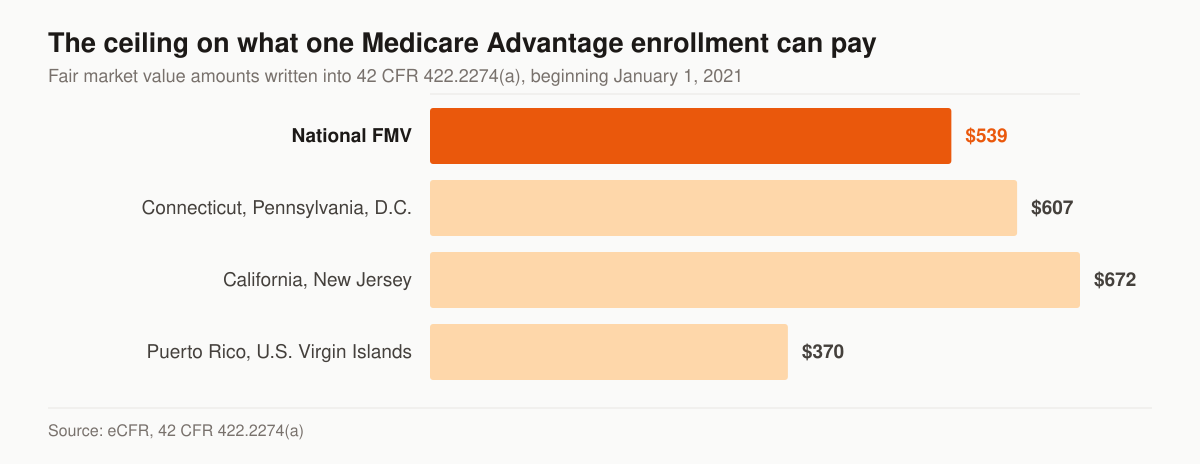
Fair market value amounts as written in the regulation, before later adjustments. Source: eCFR, 42 CFR 422.2274(a).
Two adjustments sit on top of those figures and the chart deliberately does not fold them in, because the regulation states them separately. “For contract year 2025, there will be a one-time increase of $100 to the FMV to account for administrative payments included under the compensation rate.” And for subsequent years, FMV is calculated by adding the current year FMV to the product of the current year FMV and the MA growth percentage for aged and disabled beneficiaries, “which is published for each year in the rate announcement issued under § 422.312.” Your upline can tell you the current-year number; the structure above is what produces it.
The same paragraph widened what counts as compensation in a way that changes T65 budgeting. Beginning with contract year 2025, compensation includes “payment of fees to comply with state appointment laws, training, certification, and testing costs”, “reimbursement for mileage to, and from, appointments with beneficiaries”, and “reimbursement for actual costs associated with beneficiary sales appointments such as venue rent, snacks, and materials.” A carrier or FMO covering your seminar room is paying you compensation, and compensation is capped.
Two things follow for a marketing plan. First, the cost you can defend per enrolled member has to clear under the commission the enrollment produces, and the top of that commission is set by regulation rather than by negotiation. Second, renewal compensation exists — the section provides for compensation in a renewal year — so a T65 enrollment written at 65 is a multi-year asset, which is the argument for spending more on the first-time cohort than on a switcher. Medigap commission is not governed by this section at all, so a Medigap-led T65 program runs different math and you should get that number from the carrier before you set a budget against it.
What to measure across an IEP cycle
A T65 program cannot be judged inside a month, because the gap between first touch and enrollment is deliberately four to six months long. Judge it on the ladder instead, and report every rung — the two ends alone hide which step is actually costing you.
This table lists the rungs we report on a T65 program and the question each one answers.
| Metric | The question it answers |
|---|---|
| Cohort reached | Is the addressable turning-65 audience in this area big enough to fund a channel? |
| Cost per opt-in | Is the educational offer earning attention at a price the enrollment can carry? |
| Permission-artifact rate | What share of opt-ins produced a record that lets you legally call? |
| Scope of Appointment rate | How many permissions became a documented plan conversation? |
| Appointment-to-application rate | Is the problem the funnel or the sales conversation? |
| Cost per effectuated enrollment | The number the whole cycle is judged on |
| Rapid-disenrollment rate | Whether the enrollments are the kind the carrier claws back |
That reporting layer is the same one behind our insurance appointment setting service, and the nurture that carries a month-six opt-in to a month-one appointment is insurance email automation doing the work.
What a done-for-you T65 program includes
This is the commercial side of the page — what we actually build and run when an agency hands the turning-65 window to us:
- A cohort-timed landing page with the TPMO disclaimer, permission-to-contact capture, and a booking step, not a contact form. The build discipline is our insurance landing pages service.
- The educational offer — a “what happens when you turn 65” guide or checklist that earns the opt-in without touching plan benefits, and therefore without meeting the content prong of the marketing definition.
- The IEP-timed nurture sequence — email and SMS spaced against each prospect’s birthday month rather than against your send calendar, split so the auto-enrolled and the still-working get different first touches.
- Ad accounts run under the correct category with creative written to self-select the cohort, since exact-age targeting is not available.
- SOA and consent capture wired into the funnel, timestamped, so compliance is a thing the system does rather than a thing you remember.
- Reporting down the whole ladder, ending at cost per enrolled member rather than cost per lead, because a cost-per-lead figure cannot be judged until the cycle closes.
If you want to compare the turning-65 window against the other ways into this market first, our Medicare leads page sets the channels side by side, Medicare supplement leads covers the Medigap-led version of the same cohort, and how to get Medicare clients as an agent is the wider version of the question.
What a T65 program costs to run
Our side of it is priced the same way as everything else we run, with no seasonal T65 surcharge: Foundation at $2,500 per month, Growth at $3,500, and Full-Funnel at $5,500, plus a one-time website or landing-page build of $2,500 to $8,000. Mail, print and ad spend are billed at cost to the vendors and platforms rather than marked up, which matters on a channel like direct mail, where the media is billed separately from the retainer. The tier breakdown is on the pricing page, and the page a T65 funnel starts from is covered under Medicare agent website design.
Build your own pipeline vs. buying turning-65 leads
A marketing system builds an asset you own: a stream of turning-65 opt-ins that gets cheaper per lead as the funnel matures. That is what we do here. If you instead want to buy turning-65 leads or live transfers as a finished product to fill a gap fast, that’s a separate purchase, and you can buy leads direct from getinsureleads rather than route it through a services engagement. We keep those two clean: we build the machine, the sister brand sells the inventory.
If you do buy, buy against the consent question rather than the price. Ask what artifact came with each record, whether the disclosure required by § 422.2274(g)(3)(i) was made at capture, and whether the record was shared with other TPMOs under the express written consent that paragraph (g)(4) requires. A cheap record you cannot lawfully call is not a lead.
Map your T65 cohort before you spend
Want to see what a turning-65 system would cost and return in your market before you commit? Grab a free marketing audit and we’ll map the cohort size in your area, model the CPL, and show you the IEP-timed sequence. If you would rather talk it through first, contact us. The clock is the whole advantage here: every month a cohort ages in on a date you already know, and the only question is whether you reached them before the envelope did.
Guides that go deeper