Who we serve
Medicare Seminar Marketing for Agents: CMS-Compliant Educational Events
Medicare seminar marketing for agents fills CMS-compliant educational events — and, when advertised as such, marketing events — with the right seniors, then converts them without crossing a compliance line. It hinges on the educational-versus-marketing distinction in 42 CFR 422.2264, venue and registration funnels, the Scope of Appointment boundary, and a post-event follow-up cadence.
Free · 15-minute teardown · no pitch deck
- We run our own final-expense book
- No pitch deck — we screen-share real numbers
- TCPA-aware · CMS/AEP-compliant · Meta Special Ad Category
- Core Web Vitals < 2.0s LCP
A Medicare seminar is one of the highest-trust ways to meet seniors — a room of local prospects who chose to show up. It is also a place where a compliance error is easy to make, because the line between an educational event and a marketing event is drawn in regulation, enforced, and often blurred by well-meaning agents. Seminar marketing done right fills the right seats, keeps the room on the compliant side of that line, and converts through disciplined follow-up rather than floor pressure.
This page covers what decides whether a seminar program pays: the educational-versus-marketing distinction as § 422.2264 actually writes it, how you promote and capture registrations, what the invitation itself has to carry, where you may hold the event, the Scope of Appointment boundary inside the room, who may lawfully call an attendee afterwards, and the cadence that turns a room into booked appointments.
One structural note before the rules. Medicare Advantage events run under 42 CFR part 422, subpart V. Part D events run under the parallel text at part 423, subpart V, and § 423.2264 repeats the event paragraphs in the same words — so an agent running a combined MA-PD seminar answers to two mirrored sections rather than one. Both were amended on April 6, 2026 — 91 FR 17583 for part 422, 91 FR 17592 for part 423 — and the current text differs from the version that was in force as recently as May 2026. Where this page quotes the regulation, it quotes the text as published today.
Educational vs sales events: the line that governs everything
Before you write a single invitation, you have to know which event you are running, because the rules differ sharply and the advertising has to match. Educational events “must be advertised as such and be designed to generally inform beneficiaries about Medicare, including Medicare Advantage, Prescription Drug programs, or any other Medicare program”, and at one an agent “may not market specific MA plans or benefits”. Marketing or sales events, by contrast, “are group events that fall within the definition of marketing at § 422.2260” — which is the two-prong intent-and-content test we walk through in our guide to CMS Medicare marketing rules for agents.
This table sets the two event types side by side using the permitted and prohibited activities listed in § 422.2264(c).
| Element | Educational event | Marketing or sales event |
|---|---|---|
| How it must be advertised | As educational, and designed to generally inform about Medicare | As a marketing or sales event |
| Plan-specific benefits | May not market specific MA plans or benefits | Permitted — the event is marketing by definition |
| Sales or marketing presentation | May not conduct one | May conduct marketing presentations |
| Plan applications | May not distribute or accept | May distribute and accept |
| Marketing materials | May distribute communications materials | May provide marketing materials |
| Scope of Appointment forms | May make available and receive | May collect for future personal marketing appointments |
| Business cards | May distribute | Permitted |
| Beneficiary-initiated plan questions | May be answered | Permitted |
| Best window | Year-round | Concentrated from October 1 through AEP |
The failure mode is advertising an educational event and then selling in the room. Decide the event type first; every promotion and script flows from it — and because the marketing-event window is concentrated in Q4, the educational vs sales event rules for AEP are where those two columns get tested hardest.
What the regulation actually lets you do at an educational event
It is worth reading the permitted list rather than working from a checklist, because the paragraph changed in April 2026 and a stale copy of it costs a seminar program real conversion. The current § 422.2264(c)(1)(ii) lists four things an MA organization or agent holding or participating in an educational event may do:
- Distribute communications materials. Communications is the wider category; marketing is the subset that triggers Subpart V’s heavier obligations. A “what Medicare covers” handout with no plan, benefit, premium or Star Rating in it is a communication.
- Answer beneficiary-initiated questions pertaining to MA plans. The initiation matters. A question from the floor may be answered; a slide that raises the topic is a presentation.
- Distribute business cards.
- Make available and receive beneficiary contact information, including Business Reply Cards and Scope of Appointment forms.
That fourth item is the one worth re-reading, because it is the item the April 2026 amendment moved. The regulation permits making available and receiving Scope of Appointment forms at an educational event. It does not permit a plan conversation to follow on the spot: paragraph (c)(1)(iii) still says the event “may not conduct sales or marketing presentations or distribute or accept plan applications”, and (c)(1)(i) still bars marketing specific MA plans or benefits. The practical shape is a room that teaches, a card or form the attendee fills in of their own accord, and a plan discussion that happens later under a documented Scope of Appointment.
Because this paragraph moved recently, treat the carrier’s compliance team as the authority on your specific room script rather than a page like this one. We build the capture flow; the licensed agent and the carrier own the sign-off.
Can a marketing event follow an educational event on the same day?
Under the current text, yes, with a handoff. § 422.2264(c)(2)(i) provides that if a marketing event directly follows an educational event, “the beneficiary must be notified that the educational event is ending and a marketing event will begin shortly and be given a sufficient opportunity to leave the educational event prior to the start of the marketing event.”
That is a different rule from the one in force four months ago. The version of § 422.2264 in effect on May 1, 2026 read: “Marketing events are prohibited from taking place within 12 hours of an educational event, in the same location. The same location is defined as the entire building or adjacent buildings.” The same amendment removed the Scope of Appointment waiting period — the earlier text required the SOA to be agreed and recorded “At least 48 hours prior to the scheduled personal marketing”, subject to two exceptions for the last four days of a valid election period and for beneficiary-initiated walk-ins.
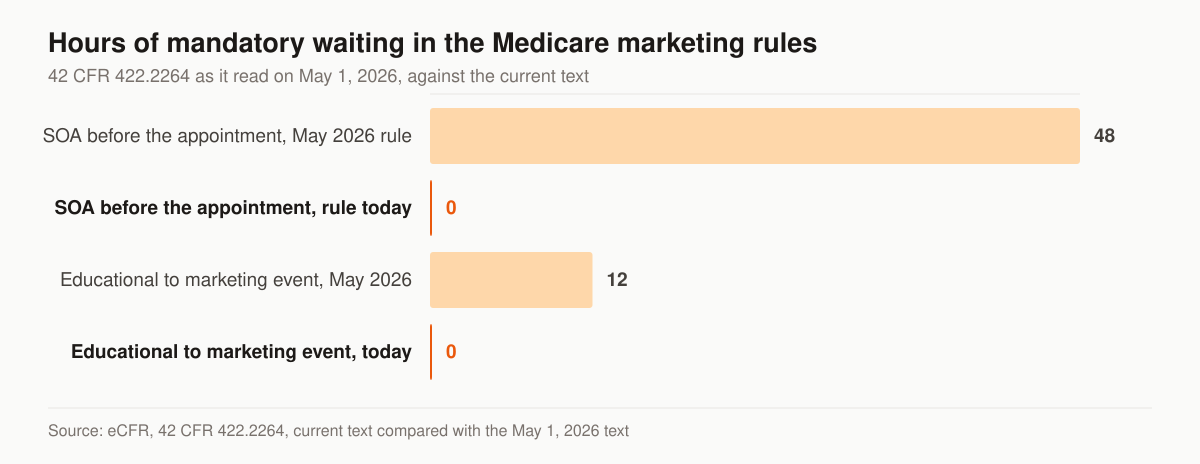
Two waiting periods that no longer appear in the rule. Source: eCFR, 42 CFR 422.2264, current text compared with the May 1, 2026 text.
For a seminar program the operational consequence is real: a single evening can now carry an educational segment and a marketing segment back to back, provided the break is announced and people can genuinely leave. Do not read the removal of an hour count as the removal of a boundary. The two segments are still two different events with two different rule sets, and the notification is a requirement rather than a courtesy.
Why an education-first room still converts
The commercial case for a teaching event rests on something measurable: comparison is the service, and comparison is the thing beneficiaries skip. KFF’s analysis of the 2022 Medicare Current Beneficiary Survey found that 69% of Medicare beneficiaries did not compare their plan with other Medicare coverage options available during the open enrollment period for 2022 coverage, against 31% who did. The share was 73% among traditional Medicare enrollees and 65% among Medicare Advantage enrollees, across a population of 55.7 million beneficiaries.
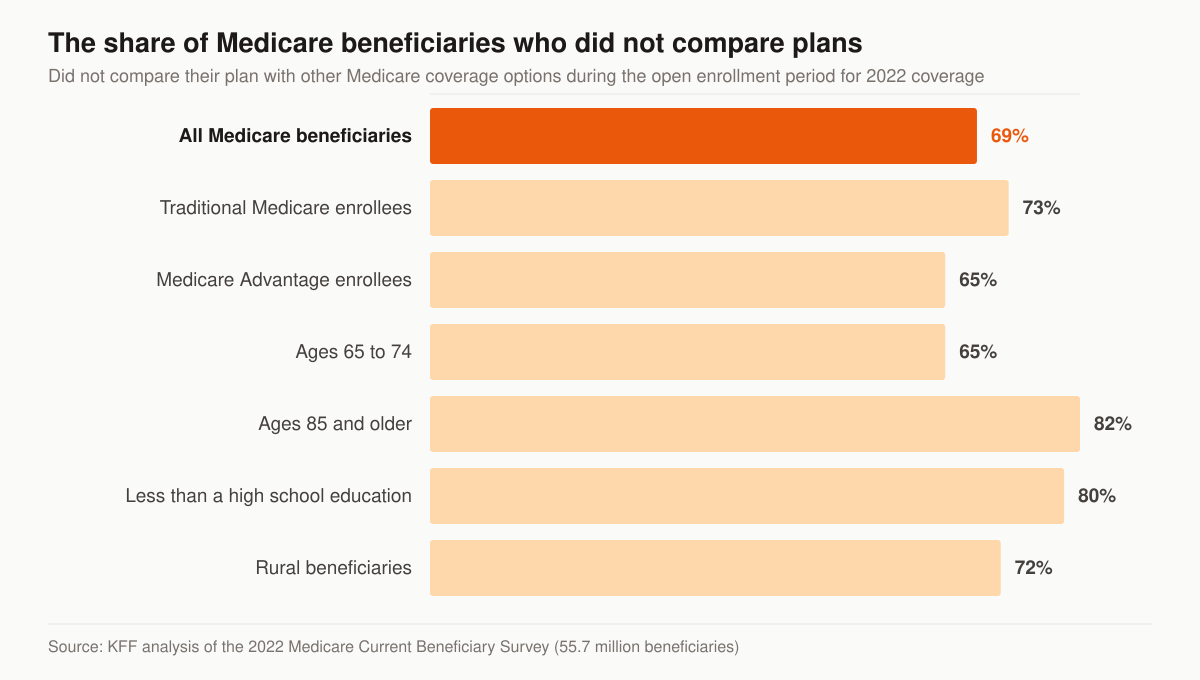
Share of Medicare beneficiaries who did not compare coverage options during open enrollment. Source: KFF analysis of the 2022 Medicare Current Beneficiary Survey.
The same analysis reports that 43% of Medicare Advantage enrollees did not review their own current plan to see whether monthly premiums, deductibles, co-payments or other out-of-pocket expenses would change for 2022, and 44% did not review it for changes to the treatments, drugs and services covered. A seminar is one of the few formats that fixes that in a single sitting, and it is why we treat the educational event as a demand-creation channel rather than a compliance chore. Note the subgroup spread in the chart, too: 82% of beneficiaries aged 85 and older and 80% of those with less than a high school education did not compare. Those are the attendees for whom the room is worth the most and the follow-up pace has to be gentlest.
Filling seats: direct mail plus Facebook, funneled to one page
Two channels carry most seminar attendance, and the contact rules explain why. § 422.2264(a)(1) permits unsolicited direct contact by conventional mail and other print media — the regulation gives “advertisements and direct mail” as its examples — and by email provided every email contains an opt-out option. Paragraph (a)(2) then removes the shortcuts: no door-to-door solicitation, no approaching enrollees “in common areas such as parking lots, hallways, and lobbies”, no direct messages from social media platforms, and no telephone solicitation, robocalls, text messages or voicemail. A room cannot be filled by cold call.
- Direct mail. The channel the rule explicitly permits, and the one that still reaches the 65-plus audience with a local, date-specific invitation. Target by age and geography around your venue and enrollment window.
- Facebook event promotion. Low-cost incremental reach with built-in RSVP capture. Meta’s developer documentation says age options under the Financial products and services Special Ad Category are “generally fixed to include ages 18 through 65+” and lists
zipsamong the location categories that are not supported, so the creative has to self-select the audience the panel no longer will — the mechanics live on our Medicare Facebook ads page. - A single registration landing page. Route every mailer and ad to one tracked page so you can confirm RSVPs, send reminders, and measure cost per attendee. The build discipline is our insurance landing pages service.
- Your own local search footprint. People searching “Medicare help near me” in the weeks before AEP have already raised their hand, and a Business Profile that lists an upcoming event reaches them without a mail drop. That is insurance local SEO doing seminar work.
The goal is a room of qualified, local attendees near your enrollment window — not a full room of people who will never buy.
What the invitation itself has to carry
The mailer and the ad are regulated materials, not just creative. Several requirements attach to the invitation before anyone walks in.
This table lists the disclosure requirements that attach to an event invitation, with the paragraph each one comes from.
| Requirement | What the regulation asks for | Citation |
|---|---|---|
| Advertised as educational | An educational event “must be advertised as such” | § 422.2264(c)(1) |
| Accommodations disclaimer | Convey that accommodations for persons with special needs are available, provide a telephone number and TTY number, and include the model content in disclaimer form or in the body of the material on any advertisement or invitation to all events described under § 422.2264(c) | § 422.2267(e)(35) |
| TPMO disclaimer | “We do not offer every plan available in your area. Currently we represent [insert number of organizations] organizations which offer [insert number of plans] products in your area. Please contact Medicare.gov or 1-800-MEDICARE to get information on all of your options.” — for a TPMO that does not sell for all MA organizations in the service area | § 422.2267(e)(41) |
| Plan or marketing name | Marketing may not reference products, plans, benefits or costs unless the MA organization or its HPMS marketing name is identified; names “must be in 12-point font in print and may not be in the form of a disclaimer or fine print” | § 422.2263(b)(9) |
| Promotional give-away disclaimer | A statement making clear there is no obligation to enroll, included when offering a promotional give-away such as a drawing, prizes, or a free gift | § 422.2267(e)(37) |
| Service-area limit | May not advertise benefits unavailable in the service areas where the marketing appears, unless it runs in local media serving those areas and spillover is unavoidable | § 422.2263(b)(8) |
| Carrier filing | MA organizations must “Submit agent or broker marketing materials to CMS through HPMS prior to use” | § 422.2274(c)(7) |
The filing line is the one that changes your production calendar. An agent-built invitation that meets the marketing definition routes through the carrier to HPMS before it runs, which means a mail drop timed to land in early October has to be drafted in August, not late September. An educational invitation that names no plan, benefit, premium or Star Rating is a communication rather than marketing, which is a lighter path — but the accommodations disclaimer still attaches to it, because § 422.2267(e)(35) is written against all events described under § 422.2264(c).
Where you may hold it, and where you may not
Venue is a compliance decision as much as a logistics one, and it has its own section. § 422.2266 governs activities in the health care setting. Marketing activities and materials “are not permitted in areas where care is being administered”, and the regulation names exam rooms, hospital patient rooms, treatment areas where patients interact with a provider and clinical team including such areas in dialysis treatment facilities, and pharmacy counter areas. Marketing is permitted in common areas within the health care setting, and the list there is a useful venue shortlist: common entryways, vestibules, waiting rooms, hospital or nursing home cafeterias, and community, recreational, or conference rooms.
So a hospital’s community room is a permitted venue and its infusion suite is not. Outside health care settings the practical shortlist is the same one seniors already visit: library meeting rooms, senior and community centres, and private rooms in restaurants — with the food rule in the next section applied before you book the caterer.
Long-term care carries its own paragraph. Under § 422.2264(c)(1)(iv), an MA organization “may schedule appointments with residents of long-term care facilities (for example, nursing homes, assisted living facilities, board and care homes) upon a resident’s request”, and where a resident did not request the appointment “any visit by an agent or broker is prohibited as unsolicited door-to-door marketing”. An in-facility event is not a way around that.
Food, gifts and drawings in the room
The free-lunch seminar is a fixture of the Medicare marketing advice currently ranking for this query, and § 422.2263(b) has closed it. In marketing, MA organizations may not “Provide meals to potential enrollees regardless of value.” There is no nominal-value carve-out on meals the way there is on gifts, and “regardless of value” is doing the work in that sentence.
The neighbouring paragraphs draw the rest of the line. Cash or other monetary rebates as an inducement for enrollment or otherwise are prohibited outright under (b)(1). Gifts are permitted under (b)(2) only where they are of nominal value “as governed by guidance published by the HHS OIG”, are offered to similarly situated beneficiaries without regard to whether or not the beneficiary enrolls, and are not in the form of cash or other monetary rebates. The OIG’s policy statement on gifts of nominal value sets that ceiling, and notes that it would periodically review these limits and adjust them according to inflation, if appropriate: “Thus, as of the date above, we are interpreting ‘nominal value’ as having a retail value of no more than $15 per item or $75 in the aggregate per patient on an annual basis.” Offer a drawing, prizes or a free gift and the promotional give-away disclaimer at § 422.2267(e)(37) attaches, making clear there is no obligation to enroll.
Two more room-level prohibitions sit in § 422.2264(c)(2)(iii). An event may not conduct “health screenings, health surveys, or other activities that are used for or could be viewed as being used to target a subset of members (that is, ‘cherry-picking’)” — which rules out the blood-pressure table some agents still run alongside the sign-in desk. And information collected for a raffle or drawing may not be used “for any purpose other than raffles or drawings”, so the fishbowl of business cards is not a lead list.
Sign-in sheets, business reply cards and the data you keep
The capture mechanics of a seminar are regulated separately from the presentation, and getting them wrong is how a well-run event produces an unusable list.
§ 422.2264(c)(2)(iii)(A) states that a marketing event may not “Require sign-in sheets or require attendees to provide contact information as a prerequisite for attending an event.” The word doing the work is require. An optional sign-in sheet, clearly marked optional, is a different artifact from a clipboard at the door that people believe they must fill in to be admitted, and the room’s design has to make that visible rather than merely technically true.
What replaces the mandatory clipboard is the voluntary one. Paragraph (a)(3) is explicit that “Calls are not considered unsolicited if the beneficiary provides consent or initiates contact with the plan. For example, returning phone calls or calling an individual who has completed a business reply card requesting contact is not considered unsolicited.” That single sentence is the conversion engine of a compliant seminar: the business reply card an attendee chooses to complete is what converts a name in a room into a person you may lawfully phone on Monday. Design the card as a request for contact, keep the completed original, and timestamp it in the CRM alongside the event.
The same discipline runs through the Medicare lead-generation systems we build, and it is the difference between a seminar list and a seminar liability.
The Scope of Appointment boundary inside the room
The moment your event becomes a one-to-one plan conversation, the Scope of Appointment governs it — and location does not save you. § 422.2264(c)(3) defines personal marketing appointments as “those appointments that are tailored to an individual or small group (for example, a married couple) for purposes of discussing marketing topics”, then adds that they “are not defined by the location.” A quiet corner of the seminar room after the presentation is a personal marketing appointment.
Under (c)(3)(i), “Prior to the personal marketing appointment, the MA plan (or agent or broker, as applicable) must agree upon and record the Scope of Appointment with the beneficiary(ies)”, and “The Scope of Appointment must be in writing for in-person personal marketing appointments.” § 422.2274(b)(3) puts the same duty on the agent directly: agents and brokers must “Secure and document a Scope of Appointment prior to a personal marketing appointment.” An SOA is valid for 12 months following the beneficiary’s signature date or the date of their initial request for information, and a second line of health-related plan business needs its own separate SOA identifying it.
Two limits inside that appointment catch cross-sellers. § 422.2264(c)(3)(iii)(C) says an agent may not market non-health related products, “such as annuities”, during a personal marketing appointment, and § 422.2263(b)(4) generalizes it: in marketing, an MA organization may not “Market non-health care related products to prospective enrollees during any MA sales activity or presentation. This is considered cross-selling and is prohibited.” The step-by-step version of all of this is our Scope of Appointment and TPMO compliance guide.
We build the registration and capture flow so the compliant path is the easy path, but the licensed agent owns the final call on what happens in the room. We provide the marketing services; you are the licensed party making recommendations.
Virtual seminars and webinars
§ 422.2264(c) opens by allowing MA organizations and their agents or brokers to hold educational events, marketing or sales events, and personal marketing appointments “either face-to-face or virtually”. A webinar therefore inherits the rule set of whichever event type it is: an educational webinar may not market specific plans or benefits or accept applications, and a marketing webinar may.
Three practical carry-overs. The accommodations disclaimer attaches to any advertisement or invitation to events described under § 422.2264(c), so the registration page for a webinar carries it exactly as a mailer would. The prohibition on requiring contact information as a prerequisite for attending applies to a registration form as much as to a clipboard, which is a real design constraint on a webinar platform that wants a mandatory email field. And the recording requirement at § 422.2274(g)(2)(ii) is written about marketing and sales calls “including the audio portion of calls conducted via web-based technology”, retained in their entirety for a minimum period of 6 years with the first 3 years in audio format — whether a group webinar sits inside that definition is a question for the carrier’s compliance team, and it is worth resolving before you record rather than after.
The upside of the virtual format is that it removes the venue cost and the geography, which makes an educational webinar a sensible first event for an agent who has never filled a room. The downside is that it removes the trust the room was creating in the first place, which is why we treat webinars as a supplement to a live schedule rather than a replacement for one.
Who may contact an attendee afterwards
Follow-up is where a seminar program meets a rule set it did not read, because the contact rules in § 422.2264(a) do not care that the person was in your room an hour ago.
This table maps the post-event channels an agent reaches for against what § 422.2264(a) permits.
| After the event, you want to | Permitted? | Citation |
|---|---|---|
| Mail a recap or invitation to the next session | Yes — unsolicited direct contact by conventional mail and other print media is permitted | § 422.2264(a)(1) |
| Email a recap | Yes, provided every email contains an opt-out option | § 422.2264(a)(1) |
| Call an attendee of a sales event | Only where the beneficiary gave express permission to be contacted | § 422.2264(a)(2)(iv)(C) |
| Call someone who completed a business reply card requesting contact | Yes — that call is not unsolicited | § 422.2264(a)(3) |
| Text or leave a voicemail to chase a no-show | No — text messages and voicemail messages are listed under prohibited telephone solicitation | § 422.2264(a)(2)(iv) |
| Send a direct message on social media | No | § 422.2264(a)(2)(iii) |
| Call a name an attendee referred | No — calls based on referrals are named in the prohibition | § 422.2264(a)(2)(iv)(A) |
| Drop by the home of an attendee who did not book | No, unless an appointment at that home was previously scheduled | § 422.2264(a)(2)(i) |
Read as a follow-up plan, that leaves mail and opt-out email as the open channels, and the phone as the channel you have to earn in the room. Every dollar of seminar spend therefore rides on the permission artifact — the completed business reply card, the recorded consent, the booked appointment — rather than on the attendance count. An agent who leaves with forty names and no permissions has bought a mailing list at seminar prices.
Follow-up is where seminars are won or lost
Seminar ROI leaks after everyone goes home. Attendees cool within days, so the cadence matters more than the pitch:
- Same-week, multi-touch. A thank-you, a helpful recap, and — where the permission exists — a booked one-on-one beat a single call placed days later.
- A separate no-show sequence. A registrant who missed the event is still a warm hand-raise. Give them their own follow-up rather than dropping them, and run it on the channels the rules leave open unless they gave permission to call.
- Every RSVP tracked against its permission. No attendee or registrant should fall through the gap between the event and the appointment, and no record should sit in the CRM without the artifact that says how you may reach them.
That structured, timely outreach is exactly what our insurance appointment setting service is built to run, so the agent walks out of the room and into booked calls instead of a stack of business cards. The recap-and-reminder layer around it is insurance email automation, which is also what keeps an educational attendee warm through a nine-month gap between the session and their enrollment window.
Run the seminar calendar off the CMS calendar
Seminar scheduling is election-period scheduling. The dates are fixed in regulation, and the event type you may run changes with them.
This table pairs each window with the event type it supports and the paragraph that sets it.
| Window | Dates | What a seminar can be | Citation |
|---|---|---|---|
| Prospective plan-year marketing opens | October 1 | Marketing events for next contract year may begin; current and prospective year may be marketed simultaneously if materials clearly indicate what year is being discussed | § 422.2263(a) |
| Annual coordinated election period | October 15 to December 7 | Peak marketing-event volume; plan comparison and enrollment | § 422.62(a)(2)(iii) |
| MA Open Enrollment Period | January 1 to March 31 | Educational events and age-in marketing; unsolicited marketing to MA enrollees is prohibited | § 422.2263(b)(7) |
| Year-round | Any | Educational events, and marketing to the newly eligible and to special enrollment period audiences | § 422.2264(c)(1) |
Q1 is the window that reads more permissive than it is. § 422.2263(b)(7) permits marketing activities that focus on other enrollment opportunities, “including but not limited to marketing to age-ins (who have not yet made an enrollment decision)”, marketing by 5-star plans regarding their continuous enrollment special election period, and marketing to dual-eligible and LIS beneficiaries who may generally make changes once per calendar quarter during the first 9 months of the year. It prohibits sending unsolicited materials advertising the ability to make an additional enrollment change or referencing the OEP, and prohibits calling or otherwise contacting former enrollees who selected a new plan during AEP. A January educational seminar aimed at people turning 65 is squarely inside the permitted lane; a January mailer inviting last quarter’s enrollees to “review your new plan” is not. The rule-by-rule version is in our Medicare OEP marketing rules guide, and the aging-in audience that carries a Q1 room is the subject of our turning-65 marketing system.
What a seminar program costs, and who pays for the room
Event economics changed in a way that catches agencies expecting the carrier to cover the venue. § 422.2274(a) defines compensation to include, “Beginning with contract year 2025, reimbursement for actual costs associated with beneficiary sales appointments such as venue rent, snacks, and materials.” Room hire and refreshments reimbursed by a carrier or FMO are therefore compensation, and compensation is capped: the regulation sets a national fair market value of $539 beginning January 1, 2021, with $607 for Connecticut, Pennsylvania and the District of Columbia, $672 for California and New Jersey, and $370 for Puerto Rico and the U.S. Virgin Islands, plus “a one-time increase of $100 to the FMV to account for administrative payments included under the compensation rate” for contract year 2025 and annual indexing thereafter. Ask your upline how seminar reimbursement is being booked against that cap before you plan a season of rooms around it.
On our side, seminar promotion is marketing work rather than event reimbursement, and it is priced with everything else: Foundation at $2,500 per month, Growth at $3,500, and Full-Funnel at $5,500, with a one-time website or landing-page build of $2,500 to $8,000. Mail, print and ad spend are billed at cost to the vendors and platforms rather than marked up. The full breakdown is on the pricing page.
What a done-for-you seminar program includes
This is the commercial side of the page — what we build and run when an agency hands its event calendar over:
- A single registration landing page per event series, carrying the accommodations disclaimer and the TPMO disclaimer, with a contact field that is genuinely optional where the rules require it to be.
- The invitation set — mailer, ad creative and confirmation email — drafted against the § 422.2267 disclosure list and routed to the carrier for HPMS filing on a calendar that lands before October 1 rather than after it.
- A reminder sequence to registrants, since the gap between RSVP and attendance is where a mailed seat is lost.
- Permission capture built into the room, so the business reply card and the Scope of Appointment are artifacts the CRM holds with a timestamp rather than paper in a folder.
- A no-show sequence on the permitted channels, separate from the attendee sequence.
- Reporting down the whole ladder — invitations mailed, registrations, attendance, permission artifacts captured, personal marketing appointments booked, applications, effectuated enrollments. Reporting only the first and last of those hides which step is actually costing you.
If you would rather compare event marketing against the other ways into this market first, our Medicare leads page sets the channels side by side, and how to get Medicare clients as an agent is the wider version of the same question.
Nothing here is legal advice, and we are not the licensed party: we provide the marketing services, the agent makes the recommendation, and the carrier’s compliance team owns the sign-off on what happens in the room.
Start with the math
Seminars only pay when cost per attendee, show rate, permission-capture rate and post-event conversion are measured together. Grab a free marketing audit and we will model a seminar program for your market — venue mix, mail and social spend, and the follow-up cadence — against your enrollment calendar. For where this fits in the wider plan, see our Medicare marketing overview, or contact us if you would rather talk it through. The agents who win seminars are not the best presenters. They are the ones who filled the right seats, captured the permission to follow up, and used it before the room went cold.