Who we serve
Home Insurance Agent Marketing Built on Real Lead Economics
Home insurance agent marketing ties every dollar to a tracked cost per lead and a known close rate instead of vanity reach. It combines local SEO, paid search, and conversion-focused websites so homeowners shopping after a purchase, a renewal hike, or a bad claim find you and request a quote.
Free · 15-minute teardown · no pitch deck
- We run our own final-expense book
- No pitch deck — we screen-share real numbers
- TCPA-aware · CMS/AEP-compliant · Meta Special Ad Category
- Core Web Vitals < 2.0s LCP
From our own book
- Pricing
- Transparent, audit-first
Illustrative
Most home insurance agent marketing fails for a boring reason: nobody tracks what a lead actually costs or whether it closes. Agencies buy “exposure,” post on social, maybe run a few ads, and then guess. We do not guess. We are an operator-led shop that runs paid lead systems every day, and we bring that same numerate discipline to homeowners insurance agents who want a pipeline they control instead of one they rent.
The timing favors agents who run this well. Almost half (47%) of U.S. homeowners insurance customers experienced a premium increase in the past year — the highest rate of insurer-initiated increases in more than a decade, per the J.D. Power 2025 U.S. Home Insurance Study — and every one of those increases is a homeowner primed to shop.
A quick boundary first: this page is about building marketing systems you own. If your goal is to buy homeowners leads, live transfers, or aged data as a finished product, that is a separate business — you can buy leads direct from getinsureleads, our sister brand, and we will keep this side focused on assets that compound.
What “home insurance agent marketing” actually means
For a property-and-casualty agent, marketing is not one channel. It is a system with four jobs:
- Get found when a homeowner shops — after a home purchase, a renewal hike, or a bad claim experience.
- Convert the click into a quote request with a fast, trustworthy website.
- Track the cost of every lead so you know your real cost per lead, not a vendor’s headline number.
- Compound the asset so your blended cost drops over time instead of climbing with ad inflation.
We are honest about where our proof comes from. Our authority is built on a senior-market lead operation we run ourselves. Home insurance is a different buyer, so we do not claim final-expense lineage here. What carries over is the mechanism: the same conversion systems and ad-spend discipline that keep those campaigns profitable.
What actually puts a homeowner in the market
A homeowners policy renews quietly for years and then, on one particular week, becomes something the household is willing to spend an evening on. Marketing that ignores which week that is spends its budget on people who are not shopping. Four events reliably start the search, and each one has a different asset attached to it.
The renewal increase. This is the trigger with the most published evidence behind it. Alongside the 47% headline, J.D. Power reports that among homeowners insurance customers who experienced a premium increase and say they are unlikely to renew, 43% cite the recent price hike as the reason for switching. The pressure is heaviest at the top of the book: 49% of high lifetime-value customers have experienced an insurer-initiated rate increase, and among customers who are unlikely to renew, 45% of high-value customers say they will not renew due to multiple price increases over time, against 30% of low lifetime-value customers who are unlikely to renew. J.D. Power defines high lifetime-value customers as those with higher annual premiums and a higher proportion of product and service needs purchased with one insurance carrier — which is to say, the households an independent agent most wants to write.
The purchase. Every financed home purchase requires a bound policy before closing, which is the mechanic behind the referral section below. The buyer is not comparing carriers on philosophy; they are trying to hit a funding date.
The claim. Homeowners claims are infrequent enough that most households have no habit of dealing with their carrier. Triple-I calculates, from ISO data, that about one in 18 insured homes has a claim each year, and that 5.5% of insured homes experienced a claim in 2022 compared with 6.5% in 2020, per its homeowners fact file. A claim is the rare moment a homeowner forms an opinion about service, and a bad one moves them.
The servicer letter. The fourth trigger gets its own section further down, because it is the one that arrives with a statutory deadline printed on it.
The practical consequence is that the content calendar should be organised by trigger rather than by topic. A page titled “why did my home insurance go up” answers the renewal shopper. A page on binding coverage before closing answers the buyer. Both are worth more than a generic “get a home insurance quote” page that assumes the visitor arrived without a reason.
How do home insurance agents get leads?
Home insurance agents get leads from five repeatable sources: local search (SEO plus a complete Google Business Profile), paid search on active quote intent, referral partners who touch home purchases — realtors, mortgage brokers, escrow and title officers — a website that converts visits into quote requests, and bundling offers into an existing auto book. The mix that wins depends on your market; the economics of each are below.
“In a year marked by inflation, severe weather and tightening reinsurance markets, home insurance premiums have risen sharply in many parts of the country. While these increases often reflect real cost pressures, they’re also eroding trust and driving customers to shop for alternatives,” said Craig Martin, executive director, global insurance intelligence at J.D. Power, in the 2025 U.S. Home Insurance Study release.
That shopping wave is measurable: among homeowners who took a premium increase and say they are unlikely to renew, 43% cite the price hike as their reason for switching, per the same study. The table below sets those five sources side by side on the three things that decide which one you fund first — who it suits, how quickly it produces, and what it actually costs you.
| Channel | Best for | Speed | What it costs you |
|---|---|---|---|
| Local SEO + Google Business Profile | Agents in a defined service area | Slow build, compounding | Time + content, low ongoing CPL |
| Reviews & reputation | Map-pack rank and trust at the comparison moment | Steady habit | Process time, near-zero spend |
| Paid search (PPC) | Capturing active “home insurance quote” intent | Fast | Per-click, stops when spend stops |
| Referral partners (realtors, lenders, escrow) | New-purchase policies that must bind before closing | Slow build, recurring | Relationship time, not ad spend |
| Conversion website | Turning every visitor into a quote request | Foundational | One build, lifts every other channel |
| Bundling campaigns | Lifting close rate and lifetime value | Medium | Copy + landing pages |
A few practitioner notes on this mix:
- SEO is your margin play. It lowers blended CPL over time. Start with our approach to home insurance SEO for local agents, and lean on the broader insurance SEO service for the technical foundation.
- Your website is the multiplier. A slow or generic site wastes every ad dollar. See how we structure a high-converting home insurance agent website.
- Bundling is the cheapest lift available. Home-plus-auto messaging routinely raises quote-request rates and the value of each lead, so we build it into copy and forms by default. Home is one line in a wider property-and-casualty book; the P&C insurance agency marketing pillar covers cross-sell, account rounding, and local visibility across every line you write.
For the step-by-step version of this mix — sequencing, budgets, and what to build first — the home insurance agent marketing playbook walks the full build.
Who already holds the homeowners book you are quoting against
Before a budget conversation, look at the field. Homeowners is a concentrated line. State Farm’s share of U.S. homeowners direct premiums written was 17.8% in 2023, ahead of Allstate at 8.9%, Liberty Mutual at 6.9% and USAA at 6.8%, per NAIC data published in Triple-I’s homeowners fact file.
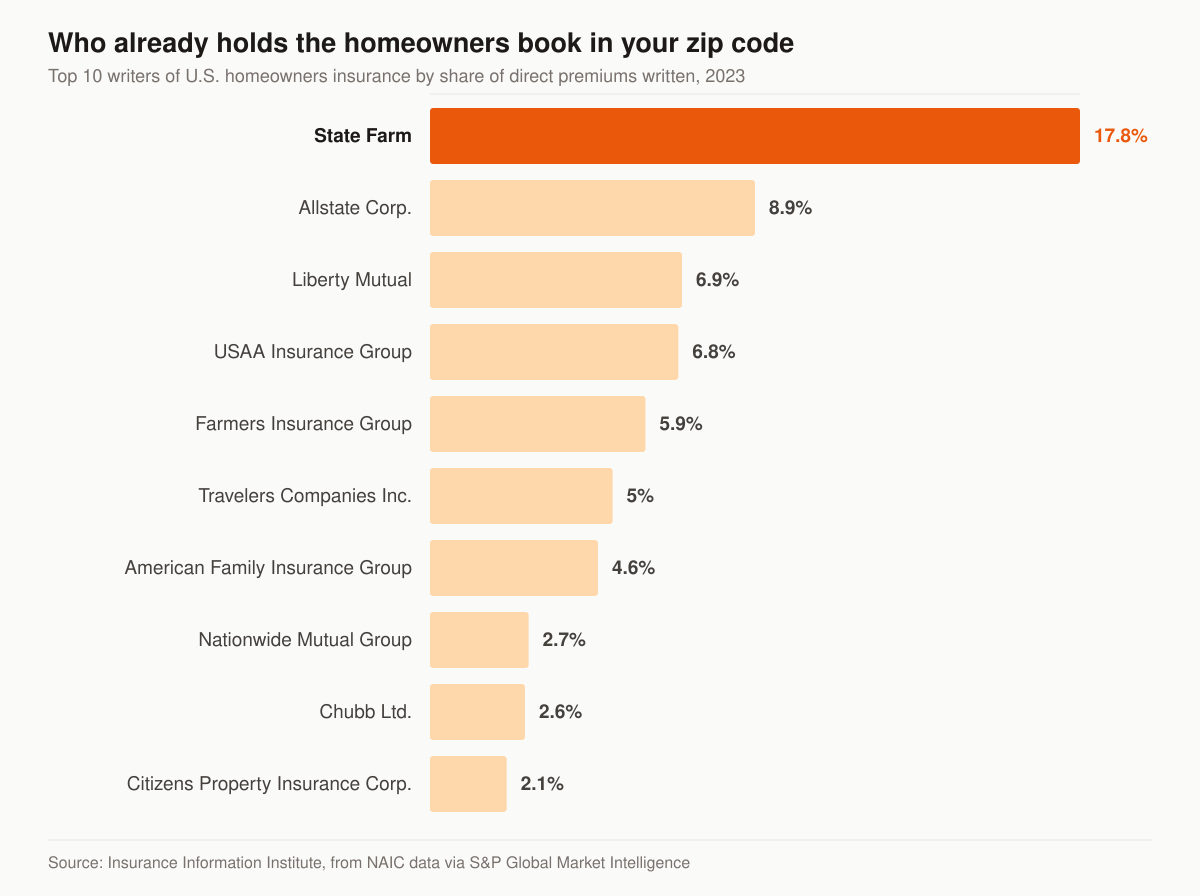
Top 10 writers of U.S. homeowners insurance by share of direct premiums written, 2023. Source: Insurance Information Institute, from NAIC data via S&P Global Market Intelligence.
Two things in that chart change how an independent agent should spend. The first is the obvious one: those brands are already in your prospect’s head before they open a search box, and buying awareness against them is a losing trade. The second is subtler and more useful. Tenth place on that national list belongs to Citizens Property Insurance Corp. at 2.1% — one of the two state-run insurers Triple-I names, in Florida and Louisiana. A line where a state-run insurer of last resort places inside the national top ten is a line where availability, not brand preference, is deciding coverage in whole regions, and availability is something a local agent with the right appointments can genuinely market.
So the fight worth picking is not brand-versus-brand. It is the set of surfaces where national scale stops helping: the map pack, where the competitor is usually another local office; queries with a city, a peril, a roof age or a carrier constraint attached; and the referral relationships that never go to auction. That is the same logic we apply on the P&C agency pillar, and the query-level version of it is worked through in our guide to insurance SEO keywords.
To be clear about what content depth does and does not buy: substance is what makes a page worth citing and a profile worth clicking, and it is the precondition for competing at all. It is not a promise of a position. How long it takes depends on how contested your zip codes are and what shape your site and profile are in today, which is what an audit measures before anyone quotes you.
What your state’s premium level does to the marketing math
Home insurance economics are not national. The average U.S. homeowners premium was $1,411 in 2021, the latest NAIC figure published by Triple-I, and the spread behind that average is wide enough to change what a lead is worth to you.
The table below pairs the ten most expensive states for homeowners premiums with the ten least expensive, using 2021 NAIC average premiums for the HO-3 policy — the same policy, priced three times apart depending on where you write it.
| Rank | Most expensive state | Average premium | Least expensive state | Average premium |
|---|---|---|---|---|
| 1 | Florida | $2,437 | Wisconsin | $780 |
| 2 | Louisiana | $2,259 | Oregon | $793 |
| 3 | Oklahoma | $2,155 | Utah | $831 |
| 4 | Texas | $2,146 | Nevada | $863 |
| 5 | Rhode Island | $1,900 | Idaho | $884 |
| 6 | Colorado | $1,802 | Arizona | $917 |
| 7 | Mississippi | $1,766 | Ohio | $920 |
| 8 | Massachusetts | $1,712 | Delaware | $988 |
| 9 | Nebraska | $1,684 | Michigan | $993 |
| 10 | Connecticut | $1,651 | Maine | $996 |
2021 average premiums for the HO-3 homeowner package policy, including state funds, residual markets and some wind pools. Source: NAIC data published by the Insurance Information Institute. Texas data were obtained from the Texas Department of Insurance; California data were provided by the California Department of Insurance.
Read that table as a cost-per-lead ceiling rather than as trivia. A Wisconsin agent and a Florida agent writing the same HO-3 are not earning the same commission on it, so they cannot rationally pay the same for a click. The industry-level commission anchor is published too: net commissions and brokerage expenses incurred came to 11.8% of net premiums written for the homeowners line in 2023, inside an expense ratio of 26.1%, per the same fact file. Your own schedule will differ by carrier and by whether the policy is new or renewing, so we build the model with your numbers rather than the industry’s — but the shape is fixed. Premium level sets commission, commission sets what a bound policy is worth, and what a bound policy is worth sets the bid.
The other number in that underwriting table belongs in a marketing plan too. The homeowners line ran a combined ratio after dividends of 110.9% in 2023, on a loss and loss-adjustment-expense ratio of 84.5%. A line running that far above break-even is a line where carriers tighten roof-age rules, restrict binding authority in exposed counties, and stop paying for growth. When your appetite narrows, the honest marketing move is to narrow the targeting with it rather than to buy clicks you cannot place.
Referral partners: realtors, mortgage brokers, and escrow officers
Every financed home purchase requires a bound policy before closing. That single mechanic makes the people who run closings a recurring, warm source of new-purchase business — and each partner type needs a slightly different pitch:
- Realtors are first to know a buyer needs coverage. Give them a co-branded handoff — a simple landing page or one-pager — and same-day quote turnaround, because their reputation rides on your speed.
- Mortgage brokers and loan officers hold the deadline: the loan cannot fund without proof of insurance. For them, you are risk removal — the agent who never delays a closing.
- Escrow and title officers are the most underused of the three. They see every closing late in the process, exactly when a missing binder becomes an emergency you can solve in hours.
Run it as a channel, not a hope: a named list of local partners, one handoff asset each, and a light monthly touch. The mechanics are the same across P&C — the referral partnerships section of our strategy guide covers the operating cadence in detail.
The force-placed insurance letter is a shopping trigger with a deadline on it
When a mortgage servicer cannot verify that a borrower is carrying hazard insurance, it buys a policy on the owner’s behalf and bills them for it. That is force-placed insurance, and federal law wraps it in a notice schedule that hands a home insurance agent a dated, named list of people who need coverage right now.
The rule is 12 CFR 1024.37, part of the CFPB’s Regulation X. Four mechanics in it matter to marketing:
- The servicer needs a basis. Under §1024.37(b), a servicer “may not assess on a borrower a premium charge or fee related to force-placed insurance unless the servicer has a reasonable basis to believe that the borrower has failed to comply with the mortgage loan contract’s requirement to maintain hazard insurance.” In practice the trigger is often a lapsed or unverifiable policy rather than an uninsured house.
- Forty-five days of warning. Before assessing any force-placed charge, the servicer must deliver or mail a written notice “at least 45 days before” the charge, per §1024.37(c)(1)(i). That notice has to identify the property, state that hazard insurance is required, and say that the servicer has purchased or will purchase it at the borrower’s expense.
- A second notice, then the charge. A reminder notice must go out at least 15 days before the charge and may not be mailed until at least 30 days after the first, per §1024.37(d)(1). The reminder carries the cost of the force-placed policy stated as an annual premium.
- Proof reverses it. Under §1024.37(g), within 15 days of receiving evidence that the borrower has had complying coverage in place, the servicer must cancel the force-placed policy and refund all force-placed premium charges and related fees paid “for any period of overlapping insurance coverage.”
The notice itself does the selling. It must tell the borrower, in bold, that the insurance the servicer purchases “May cost significantly more than hazard insurance purchased by the borrower” and may “Not provide as much coverage as hazard insurance purchased by the borrower.” A homeowner reading that has been told by their own lender that they can do better, and has a countdown to do it in.
We treat this as a first campaign to build rather than an afterthought, for one reason: it is a high-intent, time-boxed audience that generic “home insurance quote” advertising does not address by name. The assets are cheap — one landing page written for someone holding the letter, one talk track for the phone, and one referral line to the loan officers who see the lapse notices go out. Note the boundary: flood insurance required by the Flood Disaster Protection Act of 1973 is expressly not “force-placed insurance” under §1024.37(a)(2)(i), so lender-placed flood runs on its own track. That page belongs on a site built to convert — the structure we use is on our insurance web design service.
Flood is the gap the homeowners policy leaves open
The cross-sell we build into every homeowners quote is flood, and FEMA states the reason in one line on its flood insurance page: “Most homeowners insurance does not cover flood damage.” It is a separate policy, bought separately, and a homeowner who has never been flooded rarely knows that.
The scale and the mechanics both argue for putting it in the funnel:
- The National Flood Insurance Program has 4.7 million policyholders nationwide and provides nearly $1.3 trillion in coverage, making it, in FEMA’s words, “the nation’s largest single-line insurance program.”
- Coverage is available to anyone living in one of the 22,600 participating NFIP communities, and more than 47 private insurers sell and service NFIP policies through the Write-Your-Own program.
- Homes in high-risk flood areas with mortgages from government-backed lenders are required to have flood insurance — another lender-driven deadline, like the binder before closing.
- FEMA notes that there is typically a 30-day waiting period for an NFIP policy to go into effect, unless the coverage is mandated as required by a government-backed lender or is related to a community flood map change.
That waiting period is the whole marketing lesson. A coverage that takes a month to start cannot be sold in the week a buyer is closing or the week a storm is named. It has to be raised at the homeowners quote, months earlier, which makes it a question in the quote form and a paragraph in the follow-up sequence rather than a separate campaign. Agents who ask it routinely also generate a second policy per household without paying for a second lead — the account-rounding logic worked through in cross-selling and account rounding for P&C agencies.
Marketing in a market where carriers stopped writing
In parts of the country the constraint on a home insurance agency is not demand. It is appetite. When admitted carriers pull back, coverage shifts into the residual market — FAIR plans, beach and windstorm plans, and the state-run insurers in Florida and Louisiana — and the shape of that shift is published.
The table below tracks total FAIR plan policies in force nationally across six fiscal years, which is the clearest public proxy for how much of the country the standard market has stopped writing.
| Fiscal year | Habitational policies | Commercial policies | Total policies |
|---|---|---|---|
| 2018 | 1,339,004 | 24,484 | 1,363,488 |
| 2019 | 1,370,999 | 25,776 | 1,396,775 |
| 2020 | 1,474,616 | 22,645 | 1,497,261 |
| 2021 | 1,729,208 | 24,352 | 1,753,560 |
| 2022 | 2,244,317 | 35,059 | 2,279,376 |
| 2023 | 2,657,457 | 47,593 | 2,705,050 |
Insurance provided by FAIR plans, fiscal years 2018–2023, including the Texas FAIR Plan, Florida’s Citizens Property Insurance Corporation, the Louisiana Citizens Property Insurance Corporation and North Carolina. Source: Property Insurance Plans Service Office (PIPSO), published by the Insurance Information Institute.
The concentration is regional. In fiscal 2023, Florida’s Citizens held 1,542,316 policies, California’s FAIR Plan 320,592, North Carolina 227,798, Massachusetts 194,571 and Louisiana Citizens 184,169, per the same PIPSO data.
For an agent in one of those states, three things follow. Search demand rises exactly as placement gets harder, so traffic is not the bottleneck and content promising cheap coverage will burn trust fast. The queries that convert are availability queries — coverage after a non-renewal, a wildfire or wind-exposed property, a roof past a carrier’s age cut-off — and answering them honestly, including where the answer is a residual-market placement plus a wind or flood policy, is the differentiator. And your targeting has to follow your appointments county by county, which is a paid-search discipline before it is a content one; that is the job our PPC management for insurance agencies does.
What a home insurance agent marketing program includes
The channels above are the strategy. This is what actually gets built and run when an agency hands the work over:
- A quote-first site — a homeowner-focused landing structure where the primary action is a quote request, not a contact form, sized to load fast on the phone a homeowner is holding while comparing four agents.
- The local search surface — a fully built Google Business Profile, service-area and city pages, and a review cadence, because home insurance is bought from whoever appears local and credible. The mechanics live in our local SEO service.
- Paid coverage on the shopping trigger — search campaigns aimed at renewal-shopping and new-purchase queries rather than broad “home insurance” terms, budgeted against cost per bound policy.
- A referral-partner kit — the co-branded handoff assets the realtor, loan officer, and escrow contacts above need in order to send you business without thinking about it.
- Cross-line capture — every home quote is an auto and umbrella conversation; the funnel is built to ask, which is what makes the same lead worth more. Our auto insurance agent marketing page covers the other half of that bundle, and the P&C agency program covers running both lines as one book.
- Reporting to bound policies — not clicks, not form fills. The number that decides next quarter’s budget is what a bound policy cost you this quarter.
The two sub-pages under this pillar go deeper on the first two items: home insurance agent website design and home insurance agency SEO.
The rate-increase conversation is a marketing channel, not a chore
The J.D. Power study contains a finding that reads like a retention memo and should be read as an acquisition one. Among customers who experience a rate increase but fully understand the reason and are offered options to lower their premium, overall satisfaction averages 721 on a 1,000-point scale. That is 184 points higher than the average among customers who do not understand the reason and are not presented with options — and 33 points higher than the average among those who experience no premium increase at all. The study is based on responses from 14,511 homeowners and renters, collected via online interviews from July 2024 through May 2025.
A rate increase explained well, with options attached, scored higher than no rate increase at all. That inverts the usual assumption that an increase is a loss to be absorbed quietly, and it has two consequences for a marketing program.
Inside your own book, the pre-increase call stops being a defensive chore and becomes the touchpoint that produces referrals and cross-sold policies. It has to fire off the renewal date in your management system rather than off a monthly newsletter, which is what our email and marketing automation work and the client retention program are built to run.
Outside it, the same content wins the households whose current carrier did the opposite. A page that explains, without spin, why homeowners premiums moved in your state — reinsurance cost, severe weather, replacement-cost inflation — and what a homeowner can actually change about their own premium is a page written for the 43% who are already leaving over price. That is also the format AI assistants quote from when someone asks why their home insurance went up, which is the point of our AI search and GEO service.
Asking for reviews without tripping the FTC rule
Homeowners comparing four agencies read reviews before they call, so review volume is a ranking input and a conversion input at once. It is also the place where a well-meant agency habit turns into a federal problem.
The FTC’s Rule on the Use of Consumer Reviews and Testimonials took effect on 21 October 2024. Section 16 CFR 465.4 states that it is “an unfair or deceptive act or practice and a violation of this part for a business to provide compensation or other incentives in exchange for, or conditioned expressly or by implication on, the writing or creation of consumer reviews expressing a particular sentiment, whether positive or negative, regarding the product, service, or business that is the subject of the review.” A gift card for a five-star review is the conduct the section names. The condition to read closely is “expressing a particular sentiment” — the problem is buying the sentiment, not asking for the review.
So the compliant habit is the one that also works: ask every household at bind, ask without an incentive attached, ask for their honest experience, and make the link one tap on a phone. Run it as a step in the bind process rather than a quarterly push. The full section-by-section treatment, including the disclosure requirements that apply when employees or relatives review the business, is on our reputation management service, and the recovery path when a profile gets suspended is in what to do when a Google Business Profile is suspended.
How to measure a home insurance marketing program
A program that reports traffic is a program nobody can cancel intelligently. The table below is the measurement stack we hold ourselves to, from the click at the top to the figure our budget decisions actually run on at the bottom.
| Metric | What it answers | Where it comes from | What a bad reading means |
|---|---|---|---|
| Quote-request rate | Is the site converting the traffic it already has? | Analytics, form events | Fix the page before buying more clicks |
| Cost per quote request | What does one hand-raise cost by channel? | Ad platform spend ÷ tracked requests | Reallocate budget between channels |
| Contact rate | Are you reaching the people who raised a hand? | CRM, call tracking | Speed-to-lead problem, not a lead problem |
| Quote-to-bind rate | Are the leads placeable with your appointments? | Agency management system | Targeting is off appetite, or price is off market |
| Cost per bound policy | What did a policy on the books actually cost? | Spend ÷ bound policies by source | The figure we hold a program to |
| Policies per household | Is each acquired household being rounded? | Management system | Cross-sell is an intention, not a system |
Two notes on running it. Track by source from the first touch, or the report collapses into an average that hides which channel is carrying the program. And judge channels on cost per bound policy rather than cost per lead, because a cheaper lead in a county where you cannot place the risk costs more than an expensive one you can bind. We build reporting to that last row from day one — the reasoning behind it is on our pricing page, where the tiers are published rather than quoted on request.
What it costs, and what you get at each tier
We publish prices. Foundation is $2,500/mo and covers the optimized website or landing pages, local SEO and Google Business Profile, on-page SEO, and monthly reporting — the right starting point for a solo agent whose problem is that nothing exists yet. Growth is $3,500/mo and adds the ongoing SEO and content engine, AI-search visibility, and reputation and reviews, which is where an agency with a decent site nobody can find should start. Full-Funnel is $5,500/mo and adds managed paid ads on Google and Meta, landing-page CRO, and marketing automation, for agencies ready to buy volume on top of visibility. A one-time website or landing-page build runs $2,500–$8,000.
Two things are deliberately not in those numbers. Ad spend is a pass-through paid straight to the platforms and never marked up by us, so a rate hike at Google is not a rate hike from us. And there are no long lock-ins; the reporting in the table above is what earns the next month. The full breakdown, including what a comparable in-house hire costs, is on the pricing page.
Why operators, not “brand” agencies
Home insurance is shopped on price and proof, which means the agencies winning home insurance clients are the ones who treat search intent and tracking as the whole game. A pretty logo does not close a homeowner comparing four quotes at midnight.
We price and plan around the math first. Before we touch a campaign, we model your target CPL against your close rate and your average commission, so you know what “good” looks like for your book — not ours. You can see how that thinking applies across insurance niches we serve and how we frame marketing investment and pricing openly.
The first 90 days, in order
Sequencing matters more than channel selection, because each stage makes the next one cheaper. The table below is the order we build in, and what has to be true before the next stage is worth funding.
| Days | What we build | Why it comes here | Gate before moving on |
|---|---|---|---|
| 1–15 | Audit and tracking: sources, forms, call tracking, current CPL | You cannot improve a number nobody records | Every lead source is attributed |
| 15–30 | Quote path: speed, form length, click-to-call, trigger pages | Fixing conversion multiplies every later channel | Quote-request rate measured and moving |
| 30–60 | Local surface: Google Business Profile, service-area and city pages, review cadence | Compounding asset with no media cost | Profile complete, reviews arriving weekly |
| 45–75 | Trigger content: renewal increase, closing binder, force-placed letter, flood gap | Captures shoppers with a reason and a deadline | One page live per trigger, internally linked |
| 60–90 | Paid layer on shopping-trigger queries, geo-scoped to appointments | Fills the pipe while organic matures | Cost per bound policy tracked by campaign |
| Ongoing | Referral kit, renewal calendar, cross-sell to the existing book | Cheapest policies you will write are to households you already have | Policies per household rising |
If you would rather see the reasoning behind the organic half of this schedule before committing to it, SEO for insurance agents covers the ranking mechanics in full.
Find out where your quote funnel leaks first
The direct way to know whether home insurance agent marketing is worth it for you is to look at your current numbers. We will pull apart where your leads come from, what they cost, and which channel is leaking money.
- Book a free marketing audit — we map your channels and current cost per lead.
- Want leads as a product instead? Route to getinsureleads and skip the build.
- Ready to build the system you own? Get in touch and we will model the economics with you.
Marketing for home insurance agents is not magic. It is tracked CPL, a website that converts, and search visibility that compounds — built by people who run lead systems for a living and show the books while they do it.
Deeper guides
Go deeper on Home Insurance Agent Marketing
Home Insurance Agency SEO Services That Win the Local Map Pack
Home insurance agency SEO built on local-SEO mechanics: Google Business Profile, location pages, and review velocity. Get a free SEO audit.
Home Insurance Agent Website Design Built to Generate Quote Requests
Home insurance agent website design built to turn traffic into quote requests, with ad discipline from a team running live campaigns. Free teardown.
The services behind it
Guides that go deeper