Service
Social Media Marketing for Insurance Agents, Organic and Paid
A social media system matched to how insurance actually sells: a sustainable organic presence on the platforms your buyers use, plus paid Meta lead campaigns when volume is the goal — built inside the compliance rules (Special Ad Category, TCPA, CMS) that generalist social managers miss.
- We run our own final-expense book
- No pitch deck — we screen-share real numbers
- TCPA-aware · CMS/AEP-compliant · Meta Special Ad Category
- Core Web Vitals < 2.0s LCP
Social media marketing for insurance agents spans two different jobs: organic content on Facebook, Instagram, and LinkedIn that builds local trust and referrals over time, and paid campaigns that generate leads on demand. The practical setup for an agent is a simple organic presence plus paid lead generation — weighted by line, budget, and how fast they need clients.
What you get
What your social media marketing for insurance agents program includes
- A platform strategy matched to your lines — Facebook for the senior market, LinkedIn for commercial and benefits, Instagram for personal lines and life
- A monthly organic content calendar built on repeatable pillars (plain-language explainers, local presence, client stories with consent, the human behind the license)
- Profile and page optimization across Facebook, Instagram, and LinkedIn so your agency looks credible before a prospect ever calls
- Short-form video scripting and repurposing — one explainer filmed once, cut for Reels, Facebook, and LinkedIn
- Paid Meta lead campaigns built under Special Ad Category rules when lead volume is the goal, with creative testing and retargeting
- TCPA-aligned consent capture on every lead form, wired to how you actually call and text the lead
- Compliance-aware copy for senior-market content that stays inside CMS Medicare marketing rules, organic and paid alike
- Monthly reporting tied to inquiries, quotes, and cost per lead — not follower counts or reach
How it works
How the social media marketing for insurance agents engagement runs
- 01
Audit and platform strategy
We audit your current profiles and any past ad accounts, map where your buyers actually spend time by line, and set the split — what organic needs to do, whether paid belongs in the plan, and on which platforms.
- 02
Build the organic engine
We optimize your profiles, build the pillar-based content calendar, and set up a sustainable production rhythm — including video scripting and repurposing — so the presence runs weekly without eating your selling hours.
- 03
Layer paid when volume is the goal
Where the plan calls for lead flow, we build Meta campaigns under Special Ad Category rules: senior-tuned creative, compliant lead forms with consent capture, retargeting audiences, and routing into your dialer or CRM.
- 04
Measure, tune, repeat
We report monthly on what matters — inquiries, quotes, and cost per lead where paid runs — cut what underperforms, refresh creative and topics, and keep the cadence going through the seasons of your lines.
Most advice on social media marketing for insurance agents is either fluff (“post consistently, be authentic!”) or secretly just a Facebook-ads pitch wearing a broader costume. The honest version is that social is two distinct jobs — building trust with an audience over time, and buying leads on demand — and they get planned, executed, and measured completely differently. This page covers both and tells you plainly which one your situation calls for.
Key takeaways:
- Organic social builds recognition and referrals over months; paid Meta campaigns buy leads on a schedule. Run a lean version of both unless time or budget forces a choice.
- Platform follows your book of business: Pew Research Center’s 2025 survey of U.S. adults found 57% of adults 65 and older use Facebook and 64% use YouTube, against 19% on Instagram and 12% on TikTok.
- Insurance ads run under Meta’s Special Ad Category, which removes ZIP-code targeting, limits age and gender selection, and cuts lookalike audiences — so creative, offer, and follow-up speed decide cost per lead.
- One to three posts a week you can hold for a year beats a heroic month followed by silence; per-platform cadence is in the table below.
- Four rulebooks bind an agent on social: Meta’s ad policies, the TCPA on every lead you call or text, CMS rules on anything Medicare, and the FTC’s testimonial rule on every client story and bought follower.
- LinkedIn is a referral and commercial channel, not a consumer lead channel — it earns its hour a week from CPAs, attorneys, HR managers, and business owners rather than from buyers.
Should insurance agents run paid ads or organic social?
Run paid social when you need leads on a schedule; build organic when you want local trust, referrals, and a name people recognize — and in most books, run a lean version of both. Paid is a faucet: predictable, measurable, and off the instant you stop spending. Organic is a garden: slow to start, but it compounds and keeps working between posts.
The table below sets the two jobs side by side on the six dimensions that decide where your next dollar belongs: speed, cost, measurability, compounding, compliance load, and fit.
| Paid social (Meta lead ads) | Organic social | |
|---|---|---|
| Speed to first lead | Days | Months |
| Cost | Ad spend plus management | Time — yours or a hire’s |
| Measurability | Cost per lead, tracked to the dollar | Indirect — inquiries, referrals, recognition |
| Compounding | Stops when spend stops | Content and audience accumulate |
| Compliance surface | High — Special Ad Category, TCPA consent | Lower, but CMS rules still bind Medicare content |
| Best for | Lead volume, senior-market lines | Local trust, referrals, recruiting |
The trap is funding one and expecting the other’s results: judging organic by this week’s lead count, or expecting an ad campaign to make people trust you. Match the tool to the job and both earn their keep.
Organic social that earns trust, not just likes
The goal of organic isn’t virality — it’s being the name that surfaces when someone in your town needs an agent. Four content pillars cover that job, and they repeat indefinitely with fresh material:
- Plain-language explainers — one coverage question answered simply, the same answer-first style that works everywhere else in your marketing.
- Local presence — the community you actually serve: sponsorships, events, the businesses and schools your clients know.
- Proof and stories — client outcomes and reviews, always shared with consent.
- The human behind the license — the agent, the office, the milestones. People refer people, not logos.
A sustainable one-to-three-posts-a-week rhythm on these pillars beats any burst of effort. Where the calendar and writing become the bottleneck, our content marketing engine supplies the explainers that social repurposes.
How often should insurance agents post on social media?
Insurance agents should post one to three times per week per primary platform — a cadence sustainable for a full year, seasons and AEP included. Recognition compounds with consistency, not volume: a steady weekly explainer, a local post, and a client story beat a burst of daily content followed by three silent months.
The table below gives the cadence that survives a full year on each platform, the format that carries it, and the honest weekly hour cost — enough to staff two platforms properly instead of six badly.
| Platform | Cadence that holds | Format that carries | Realistic weekly effort |
|---|---|---|---|
| 2–3 posts/week + daily comment replies | Short video, community photos, plain-language explainers | 1–2 hours | |
| 2–3 Reels or carousels/week, stories most days | Vertical video, face-to-camera | 1–2 hours | |
| 1–2 posts/week + deliberate connection outreach | Written posts, case notes, partner engagement | 45–60 minutes | |
| YouTube | 1 explainer/week, or 2/month filmed in one batched session | 3–6 minute answer videos, evergreen and searchable | 1–2 hours, batched |
The cadence is the easy half; the topics are what stall agents by week three. Pull from a standing bank — our insurance social media post ideas list is built line by line so a week’s posts take minutes to choose, not an afternoon to invent.
Which social platform fits which line of insurance?
Platform choice follows your lines of business, not the platform’s press. Pew Research Center’s 2025 survey found 57% of U.S. adults 65 and older use Facebook and 64% use YouTube, against 19% on Instagram and 12% on TikTok — which is why Medicare and final expense live on Facebook while personal lines and life travel further on Instagram.
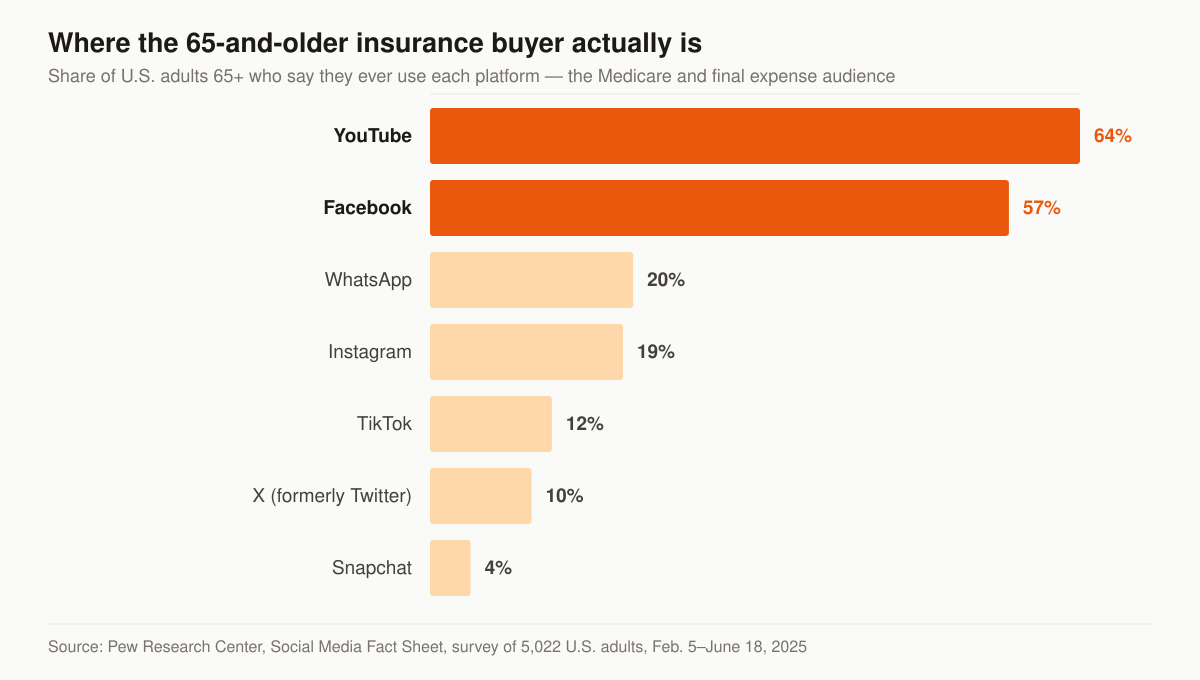
Platform use among U.S. adults 65 and older — the Medicare, final expense, and annuity audience. Source: Pew Research Center, Social Media Fact Sheet, survey of 5,022 U.S. adults conducted Feb. 5 to June 18, 2025.
Read the chart as a staffing decision rather than a trivia slide. Two platforms hold a majority of the senior market and five do not, so a senior-market agent who spends equal effort across all seven feeds has spent five-sevenths of it on the 4 to 20 percent tail. The same logic runs the other direction for a personal-lines agency writing renters and auto for people in their twenties and thirties, where Instagram reaches 80% of adults 18 to 29 and TikTok 63%.
The table below maps each platform to the lines it actually serves and the format that works there, so the platform choice follows the book you are trying to grow.
| Platform | Best for | What works |
|---|---|---|
| Final expense, Medicare, local community | Video, community posts, paid lead ads | |
| Personal lines, life, younger buyers | Reels, stories, behind-the-scenes | |
| Commercial, group benefits, referral partners | Written posts, case notes, relationship-building | |
| YouTube | Medicare, annuities, any line with a long question list | Search-style explainers (“Does Medicare cover dental?”) — evergreen and indexable, unlike a feed post |
| TikTok | Life and personal lines under 40 | Fast explainers; treat it as organic-only — the audience skews far younger than the insurance buyer |
| Google Business Profile | Every local agency | Posts, photos, and review replies that feed the map pack rather than a feed |
Instagram rewards short video and personality — a different muscle than Facebook’s community feel — and we’ve written the full playbook in Instagram for insurance agents. LinkedIn is less about volume and more about who sees you: CPAs, attorneys, HR managers, and business owners who send commercial and benefits referrals. One thoughtful post a week plus deliberate connection-building outperforms daily noise there. Google Business Profile is not social media in the feed sense, but it is where a local search turns into a call — that work belongs to local SEO, not the content calendar. Final expense has its own platform math, covered in social media for final expense agents.
How should insurance agents use LinkedIn?
LinkedIn produces commercial, group benefits, and referral-partner business — not consumer policies — and it rewards behaviour that looks nothing like Facebook: fewer posts, more deliberate outreach, and a profile written for a buyer instead of a recruiter. Personal-lines and final expense agents can skip it without losing anything. Commercial and benefits producers cannot.
Name the audience mismatch first, because it saves a year of wasted posting. Pew’s most recently published LinkedIn reading, from its June 2024 wave, put LinkedIn use at 32% of U.S. adults, and LinkedIn does not appear in the 2025 age breakdown at all — while Facebook holds 57% of adults 65 and older. A Medicare agent posting to LinkedIn is talking to referral sources, FMOs, and other agents. That is a legitimate goal. It is not lead generation, and it should not be measured as if it were.
The table below breaks LinkedIn into the five moves that actually produce commercial and benefits pipeline, with the weekly effort each one costs and what it returns.
| Move | What it looks like weekly | What it produces |
|---|---|---|
| Profile rewritten for the buyer | Headline naming the lines and market you write, not “Insurance Professional”; an about section that reads as a specialist | Accepted connection requests, and a searched name that looks like the right call |
| One written post a week | A claim you handled, a coverage gap you found, a renewal that went wrong — plain text, no graphics | Recognition among the local people who can send you work |
| Deliberate connection outreach | 10 to 15 targeted requests to CPAs, attorneys, HR managers, bookkeepers, commercial lenders, payroll reps | The referral bench, which is the entire point of the channel |
| Commenting on partner posts | 10 minutes a day on the feeds of the people above | Visibility without publishing anything yourself |
| Company page kept current | Filled out, lines listed, employees linked to it | The page a prospect opens after your email lands |
Referral partners are the asset here, and the arithmetic is small enough to hold in your head: one CPA who sends two commercial submissions a year does more for the book than any follower count. Group benefits producers should read marketing group life and employee benefits alongside this, and commercial agents will find the line-specific version in P&C insurance agent marketing.
Paid LinkedIn is a separate decision with a published floor. LinkedIn’s own documentation puts the minimum daily budget at $10 for any ad format, and the minimum lifetime budget for a new, inactive campaign at $100. The same page describes the budgets Campaign Manager pre-fills rather than a recommended spend: “When creating a new campaign, we suggest $25 for new advertisers and $50-100 for existing advertisers who are using USD currency, and equivalent of $25 for all new campaigns in other currencies.” Those are entry numbers rather than working numbers. For an agency of any normal size, the return on LinkedIn comes from the unpaid relationship column above, and the ad account is worth opening only once a specific group-benefits or commercial audience is worth paying to reach twice.
7 social media best practices for insurance agents
These seven practices separate an insurance social presence that produces inquiries from one that produces likes. None requires a bigger budget — they require picking a lane and holding it.
- Run two platforms, not six. One where your buyers are (Facebook for senior market, Instagram for personal lines, LinkedIn for commercial) and one where you can be found later (YouTube).
- Build on four repeatable pillars — explainers, local presence, proof with consent, the human behind the license — so nobody has to invent a post from scratch.
- Fix the profile before the feed. Licensed name, service area, lines written, a real phone number, and a link that lands on a page built to convert.
- Film once, cut three ways. One explainer becomes a Reel, a Facebook video, and a LinkedIn post — the production cost is paid once.
- Answer questions instead of broadcasting offers. “What does Medicare Part B actually cover?” earns more saved posts and more calls than any quote-request graphic.
- Reply to every comment and review, good or bad. Reviews are trust infrastructure; the response is public and permanent — see our reputation management approach.
- Measure inquiries, quotes, and cost per lead — never followers. A page of engaged local people out-earns a bigger page of strangers.
Paid social: the Facebook lead engine, in brief
Paid Meta campaigns are where social produces leads you can count. Insurance runs under Meta’s Special Ad Category for financial products and services, which limits age and gender selection, removes ZIP-code targeting, and cuts detailed targeting options — so creative, offer, and follow-up speed carry the cost per lead. Lead forms need TCPA-aligned consent language built correctly, and Medicare creative has to respect CMS marketing rules on claims and enrollment periods. That discipline is a page of its own: the complete breakdown lives in our guide to Facebook ads for insurance agents, and the built-and-run version is the core of our lead generation service. The service page for the channel itself is insurance Facebook ads.
How do you measure social media for an insurance agency?
Measure social on inquiries, quoted households, and cost per lead where paid runs. Followers, reach, and impressions are diagnostics at best — they tell you whether anyone saw the post, never whether the post earned a policy. The reporting problem is that organic and paid answer to different instruments, and reporting them in one number hides which half is working.
Paid is the easy half: Meta reports the lead, the campaign, and the spend, so cost per lead is arithmetic. Organic resists that, because the referral it produced arrives as a phone call from someone who never clicked anything. Three mechanics close most of that gap, and none of them needs new software. Put a UTM-tagged link in every profile and every post that points at your site, so social traffic separates cleanly from search traffic in analytics. Send social traffic to a page built for it rather than the homepage — that is what insurance landing pages exist for. And keep a required “how did you hear about us” field on the form and a source field in the CRM, filled at intake rather than reconstructed at month end; the right CRM for an insurance agency makes that a dropdown instead of a habit.
The table below lists the five numbers worth reporting monthly, where each one comes from, and what each number cannot tell you.
| Number | Where it comes from | What it tells you | What it does not tell you |
|---|---|---|---|
| Inquiries from social | CRM source field plus tagged link clicks | Whether the presence is producing conversations | Which specific post did it |
| Quoted households | CRM, filtered to social-sourced contacts | Whether the conversations are the right people | Anything about close rate yet |
| Cost per lead (paid only) | Meta Ads Manager, spend divided by lead-form submissions | Whether the campaign is affordable at current creative | Lead quality, which only the dialer knows |
| Speed to first contact | Timestamp on the lead versus the first call logged | Whether follow-up is actually happening in minutes rather than hours | Whether the lead was reachable at all |
| Cadence held | Your own calendar — posts published versus posts planned | Whether organic is being run or merely intended | Whether the content is any good |
Speed to first contact deserves the emphasis it gets there. A Meta lead form takes seconds to submit and the person keeps scrolling, so the campaign’s economics are decided in the follow-up window rather than in the ad account — the sequence that actually works is laid out in our insurance lead follow-up cadence, and the outsourced version is appointment setting. Tightening that window costs no ad spend and no new creative, which is why we work on it before touching the campaign.
Report monthly, not weekly. Organic moves too slowly for a weekly read to mean anything, and paid needs a full learning cycle before its numbers stop moving. Look at a rolling 90 days when deciding whether to keep a platform, and at the month when deciding whether to change creative.
What compliance rules apply to insurance ads on social media?
Three of the four rulebooks govern the campaign itself: Meta’s ad policies control how you target, the TCPA controls how you call and text the leads you capture, and CMS rules control what Medicare content can say. None of them stops a campaign from working — but each one quietly kills campaigns built by people who don’t know they exist.
Meta’s “financial products and services” Special Ad Category. Since January 21, 2025, Meta requires campaigns for financial products and services — a category that in the US explicitly includes insurance products — to declare a Special Ad Category, and ads may be rejected if the category isn’t chosen. Declaring it changes the machine. On Meta’s Special Ad Category page, the options “limited or unavailable” for housing, employment and financial products and services ads are “age, gender, ZIP code or postal code, exclusion targeting, lookalike audiences and saved audiences,” plus some interests. The audience documentation spells the rest out: audiences must include all genders, ZIP-code targeting and location exclusion are unavailable (a US city target expands to a 15-mile radius), some detailed-targeting options and all targeting exclusions are off, and Advantage+ lookalike is unavailable. Read the age rule with its scope attached rather than as a flat “18 to 65+ and that’s that”: the options are “generally fixed to include ages 18 through 65+ for housing, employment and credit ads,” and the category page notes that “The Credit Special Ad Category has been replaced by the financial products and services category.” What’s left is creative, offer, and follow-up speed — which is exactly why those now decide cost per lead.
TCPA on the leads you capture. Retargeting someone with ads doesn’t trigger the TCPA — calls and texts do. The moment a lead form collects a phone number, the consent question is yours: the form needs clear consent language, the opt-in record and timestamp get kept, and a revocation is honored fast. The FCC fixed the outer bound in 47 CFR 64.1200(a)(10): a request to revoke consent made in any reasonable manner “must be honored within a reasonable time not to exceed ten business days from receipt of such request.” The same paragraph makes the words stop, quit, end, revoke, opt out, cancel and unsubscribe in a reply text reasonable per se, requires a caller to treat other wording as valid revocation where a reasonable person would read it that way, and bars a caller from designating “an exclusive means to request revocation of consent” — so an agency cannot insist that an opt-out arrive through its own preferred form. The full paper trail lives in our TCPA compliance guide for agents.
CMS when the product is Medicare. A Medicare post is regulated content whether it’s organic or a paid ad — CMS rules govern claims, disclaimers, and how you contact beneficiaries, and marketing aimed at the January-to-March switching window is prohibited outright. Before any senior-market social calendar ships, read the CMS Medicare marketing rules for agents and the Medicare OEP marketing rules.
Organic doesn’t get a pass on any of this: client stories need documented consent, and anything that collects a phone number inherits TCPA obligations. The working checklist an agent can hold in their head:
- Declare the Special Ad Category on every insurance campaign, before the first dollar runs.
- Build TCPA consent language into the lead form and keep the opt-in record and timestamp; honor a STOP immediately.
- Get written consent before a client story or photo goes up — organic proof is still a use of someone’s information.
- Route co-branded creative through carrier or FMO review. If a carrier’s logo or a plan name appears in the post, the carrier’s advertising-review process applies, not your judgment.
- Hold every Medicare post to CMS rules, organic and paid alike — including no campaign aimed at the January-to-March switching window.
We build inside those lines by default — but we are a marketing provider, not compliance counsel; you remain the licensed party and your compliance review is final.
What are the FTC rules for client testimonials and follower counts?
A fourth rulebook reaches the two things agents most want on a feed — a happy client saying something nice, and a follower number that looks established. The FTC’s Rule on the Use of Consumer Reviews and Testimonials, 16 CFR part 465, took effect October 21, 2024, and four of its provisions land on the social calendar specifically rather than on your Google profile.
A testimonial from anyone inside the agency needs a disclosure. 16 CFR 465.5(b)(1) makes it an unfair or deceptive act for a business to disseminate a consumer testimonial about itself “by one of its officers, managers, employees, or agents, which fails to have a clear and conspicuous disclosure of the testimonialist’s material relationship to the business, when the relationship is not otherwise clear to the audience and the business knew or should have known the testimonialist’s relationship to the business.” Both conditions carry weight: the duty attaches when the relationship is not already obvious to the reader and the agency knew or should have known about it. A downline agent’s glowing quote or a staffer’s testimonial reposted to the page is squarely inside that list, and needs the relationship stated on the face of the post.
Relatives sit under a different provision with different elements. A producer’s spouse is not an officer, manager, employee, or agent, so 465.5(b)(1) does not reach them. 16 CFR 465.5(c)(1) does the work instead: it reaches an officer or manager who solicits or demands a consumer review from “any of their immediate relatives or from any employee or agent of the business,” or who asks employees or agents to seek reviews from their relatives — but only where the solicitation actually produces an undisclosed review and the officer or manager encouraged non-disclosure, failed to instruct that reviewers disclose their relationship clearly and conspicuously, or knew or should have known the review went up without a disclosure and took no remedial step. 465.1(i) defines an immediate relative as “a spouse, parent, child, or sibling.” The practical reading for an agency owner: asking your spouse or your staff for a review is not the violation — asking without instructing them to disclose the relationship is.
“Clear and conspicuous” has a definition written for social media. 16 CFR 465.1(c)(4) says that in an interactive electronic medium “such as social media or the internet, the disclosure must be unavoidable. A disclosure is not clear and conspicuous if a consumer must take any action, such as clicking on a hyperlink or hovering over an icon, to see it.” That rules out the three easy placements: burying the disclosure below the “…more” fold, parking it in the first comment, and putting it in a bio the reader has to go looking for. It goes in the visible caption or burned into the video.
Buying followers, likes, or views is a violation on its own. 16 CFR 465.8(b) reaches anyone who buys or procures fake indicators of social media influence “that they knew or should have known to be fake and that materially misrepresent their influence or importance for a commercial purpose.” 16 CFR 465.1(j) defines those indicators broadly — “followers, friends, connections, subscribers, views, plays, likes, saves, shares, reposts, and comments” — and 465.1(h) sweeps in indicators generated by bots, accounts not associated with a real individual, accounts created with a real individual’s personal information without their consent, and hijacked accounts. The cheap follower package sold to new agents sits inside both sentences.
Two more habits are worth naming even though they belong to the review platforms rather than the feed: paying for a positive review and hiding the negative ones. Both are covered under the same part, and both are handled in our insurance agency reputation management approach. And part 465 sits on top of your other obligations, not instead of them — a co-branded post still goes through carrier advertising review, and a state insurance department’s advertising rules still apply to how you describe a product.
What does social media marketing cost for insurance agents?
Social media marketing for insurance agents has three separate cost lines: your time if you run organic yourself, a monthly fee if someone else runs it, and ad spend if you want leads on a schedule. Organic can cost zero dollars and several hours a week; paid cannot — the budget has to buy enough leads to teach the algorithm.
The table below separates the three cost lines so they stop being quoted as one number, and names the variable that actually moves each one.
| Cost line | What you actually pay | What decides the number |
|---|---|---|
| DIY organic | Time — a few hours a week, indefinitely | Whether you can hold the cadence for a year without a nudge |
| Managed organic | A monthly retainer covering calendar, production, posting, and reporting | Platforms covered, video volume, and whether paid is bundled in |
| Paid Meta lead campaigns | Ad spend, plus management if you don’t run it yourself | Your market’s lead cost and the weekly volume needed to exit Meta’s learning phase |
The paid floor is set by the algorithm, not by an agency’s minimum. Meta’s own documentation says an ad set exits the learning phase as soon as it can deliver stably, which “usually occurs after about 50 results in the week after the ad set’s last significant edit” — and an ad set that never gets there sits in “learning limited,” where cost per lead stays unstable. Practically: a budget too thin to buy roughly 50 leads a week never lets the campaign stabilize, which is why underfunded insurance campaigns look like the channel failed when the channel was never given a chance to learn.
Nobody publishes an honest rate card for insurance cost per lead, and we won’t invent one — it moves by line, state, offer, and how fast you call. What we do publish is our own structure: see pricing for the tier this service sits in.
What does the first 90 days of a social media program look like?
A social program that starts with posting is the one that stalls. The first three weeks are setup, the next six are cadence, and only the last four are judgement — and the agency that skips setup spends the whole quarter posting into a profile that gives a prospect no reason to call.
The table below lays out the three phases, what actually ships in each, and the single question that decides whether the phase worked.
| Phase | Weeks | What ships | How you know it worked |
|---|---|---|---|
| Setup | 1 to 3 | Profile and page rewritten across two platforms, licensed name and service area correct, link tagged and pointed at a real landing page, CRM source field added, four content pillars agreed, first four weeks of posts drafted | A stranger can tell in ten seconds what you write and where, and every profile link is tracked |
| Cadence | 4 to 9 | Posts published on schedule, one batched video session producing four to six cuts, comments and messages answered inside a business day, paid campaign built and launched if the plan includes one | Six straight weeks published with no gap, and inbound messages arriving that did not exist in week one |
| Judgement | 10 to 13 | First real report — inquiries, quoted households, cost per lead if paid ran, cadence held; underperforming platform cut; creative refreshed | You can say which platform to keep and which to drop, with a number behind it |
Setup is where the compliance work belongs too, because it is cheaper to build consent language and disclosure habits into a template than to retrofit them across forty posts. Batch the video in phase two rather than filming weekly: one two-hour session yields a month of Reels, Facebook video, and LinkedIn clips, which is the difference between a program that survives a busy AEP and one that goes quiet in October.
What the 90 days will not do is produce a ranking, a viral post, or a full pipeline. Paid campaigns produce leads inside that window; organic produces the beginnings of recognition. Any provider promising more than that from a first quarter of social is describing an outcome nobody in this channel can guarantee — including us.
Not sure whether your next dollar belongs in organic, paid, or neither? Start with a free marketing audit — we’ll look at your profiles, your past ad spend, and your lines, and tell you which half of social is worth your money first. Compare packages on pricing or reach out with specifics.
Guides that go deeper
Frequently asked questions
Which social media platform is best for insurance agents?
What is the best social media platform for Medicare and health insurance agents?
Does organic social media actually generate insurance leads?
How often should an insurance agent post on social media?
Can insurance agents do social media marketing for free?
Do Facebook ads still work for insurance agents?
How do insurance agents stay compliant on social media?
Can insurance agents buy followers, likes, or views to look established?
How long before social media produces leads for an insurance agency?
Should I hire an agency or run social media myself?
See exactly where your agency is leaking leads.
15 minutes. We screen-share our own live lead dashboard and tear down your funnel line by line — no pitch deck, just numbers.
- Site speed & conversion
- Local + AI-search visibility
- Ad efficiency
- Your cost per lead vs ours
No obligation · no pitch deck