Instagram for Insurance Agents: The Organic Playbook That Actually Moves Pipeline
Instagram for insurance agents works best as an organic trust engine, not a lead firehose. Post 3–5 times weekly across four content pillars—education, proof, behind-the-scenes, and offer—lean on Reels for reach, and keep every claim compliant. Treat it as warm-up, not the close.
It is easy to treat Instagram like a slot machine: post a selfie, wait for DMs, quit in six weeks when nothing happens. That’s the wrong mental model. Instagram for insurance agents is a trust warm-up channel, not a lead firehose. Done right, it makes the leads you already buy close easier and turns referrals into inbound DMs. Done wrong, it’s a time sink that pays nothing.
For context, we run our own final-expense and senior-market lead operation, so this comes from live campaigns, not theory. Organic Instagram doesn’t replace that paid engine—it lowers the friction on it. Prospects who’ve watched your Reels for a month pick up the phone differently.
What Instagram actually does for an insurance agent
Be honest about the job. Instagram is bad at cold demand capture and good at three things:
- Trust before the call — a prospect who’s seen your face explaining final expense rates is warmer than a cold list.
- Referral amplification — when a client refers you, the friend checks your profile before they DM. A dead grid kills the referral.
- Recruiting and credibility — agency owners use it to attract downline agents who see a real operator, not a stock-photo brand.
What it is not: a substitute for a real lead system. If you need predictable volume this quarter, organic social is the wrong lever—start with our insurance lead generation service and treat Instagram as the compounding side bet.
Before you post: is your buyer even on Instagram?
Start here, because this question decides whether the next twelve months of filming are worth doing. Pew Research Center’s Social Media Fact Sheet, built on a survey of 5,022 U.S. adults conducted February 5 to June 18, 2025, puts Instagram use at 50% of U.S. adults. That headline number hides the part that matters to an insurance producer: the age split.
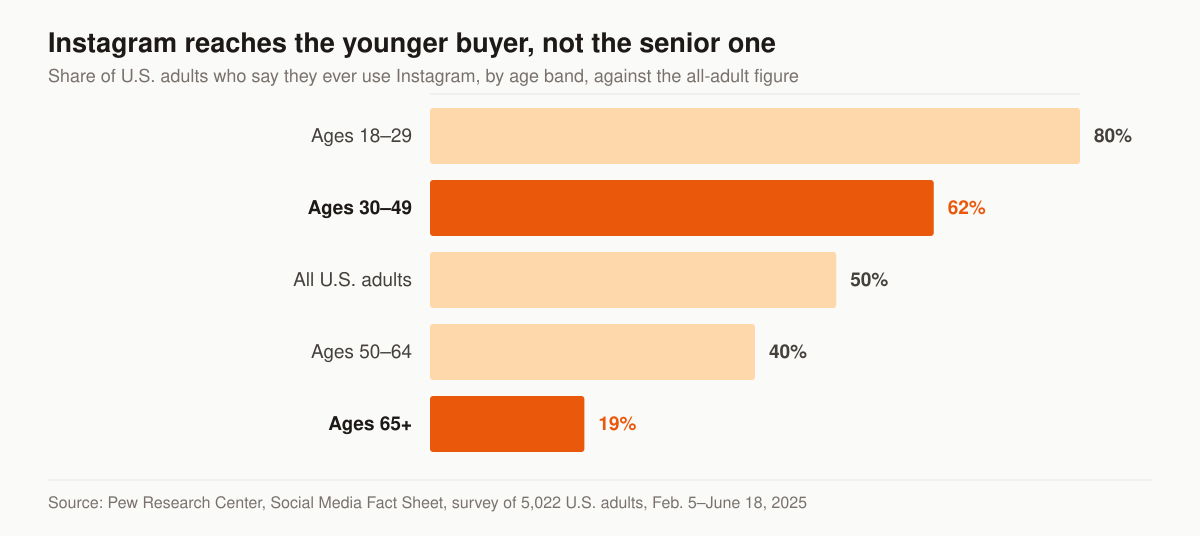
Share of U.S. adults who say they ever use Instagram, by age. Source: Pew Research Center, Social Media Fact Sheet, survey of 5,022 U.S. adults, Feb. 5–June 18, 2025.
Nineteen percent of adults 65 and older say they ever use Instagram. In the same survey, 57% of that age group say they use Facebook and 64% say they use YouTube. So if you write final expense or Medicare Advantage, Instagram reaches 19% of the age group you are licensed to help, and Facebook reaches 57% of it.
That is not an argument for abandoning the channel. It is an argument for knowing what you are buying with your hours. On Instagram, the senior-market agent is mostly reaching the adult daughter who will sit in on the appointment, not the person who signs. That audience is real and worth having; it is just a referral audience, not a buyer audience, and it should change what you film.
Instagram against Facebook, by age band, with how we treat each one. Both columns come from the same Pew survey; the third column is our own routing rule, not a finding.
| Age band | Ever use Instagram | Ever use Facebook | How we treat the band |
|---|---|---|---|
| 18–29 | 80% | 68% | Recruiting and referral reach, rarely a policy buyer |
| 30–49 | 62% | 80% | Where Instagram earns its hours: mortgage protection, term life, IUL, auto and home |
| 50–64 | 40% | 74% | Split. Worth posting to, but Facebook carries the same person more reliably |
| 65+ | 19% | 57% | Reach the family, not the buyer. Put paid budget on the platforms they actually open |
The practical read: an agent writing mortgage protection to young families is fishing where the fish are. An agent writing final expense is fishing next to the pond. Both can win; only one should treat Instagram as a primary channel. If you are in the second group, our social media playbook for final expense agents walks the paid-and-organic split that suits the senior market better.
Set it up as a professional account, and export your numbers
Instagram gates its analytics behind account type and account privacy, and it forgets faster than the posting habit it is meant to measure. Three mechanics from Instagram’s own help center are worth knowing before your first post rather than after your first quarter.
One: the account has to be public. Instagram’s help article on account and content insights states, “You need to have a public (personal or professional) account on Instagram to view insights”, and warns that “If you switch back to a private account, you’ll lose access to insights. However, you can regain access to past insights data if you switch back to a public account within 90 days.” A private account is not a marketing account.
Two: your data has a 90-day memory. The same article says you can view insights “for any time period within the past 90 days”, through preset 7, 14, 30 and 90-day windows or a custom range inside that window. There is no year-over-year comparison waiting for you in the app. If you want to know in December whether the February pivot worked, you have to have written February down. A monthly export or a monthly screenshot set is the whole discipline.
Three: audience demographics need an audience. To see who is watching, Instagram says you need to “use preset timeframes, and reach or engage over 100 viewers”, and suggests a longer preset such as Last 30 days or Last 90 days if a 7-day window shows nothing. A new agent account looking at a blank demographics panel is usually looking at a threshold problem, not a broken app.
That 90-day window has a second consequence agents in the Medicare space should sit with. Your compliance obligations run in years, not days — the recording retention rule for marketing and sales calls at 42 CFR 422.2274(g)(2)(ii) runs six — while your own performance record evaporates in three months unless you save it. Build the export habit for both reasons.
What belongs in the bio, the name field and the link
The profile is the page every referral lands on, and it does more work than any single Reel. We treat it as three separate jobs.
- The name field states who you help and where. A licensed producer’s bio is a credential surface, not a slogan surface. Lines of business plus the states you are appointed in tell a stranger in one second whether to keep reading.
- The bio states the next step, once. One instruction beats three. A “DM me QUOTE” line, or a link, not both plus a phone number plus an email.
- The link goes somewhere built for the click. A bio link pointing at a slow homepage wastes the warm traffic you filmed for. Ours point at purpose-built insurance landing pages.
Medicare agents carry one extra obligation into the profile. Under 42 CFR 422.2274(g)(2)(iv), contracts between a TPMO and an MA plan must ensure the TPMO “Uses the TPMO disclaimer as required under § 422.2267(e)(41).” That disclaimer is standardized content, and § 422.2267(e)(41) sets out who it binds before it says where it goes. Clause (i) is the scope limiter: the MA organization must ensure the disclaimer is “Used by any TPMO, as defined under § 422.2260, that sells plans on behalf of more than one MA organization.” An agent who sells for only one MA organization sits outside that clause, and the placement clauses that follow it do not reach them. For everyone else, the disclaimer must be “Verbally conveyed during sales calls prior to the discussion of any benefits,” “Electronically conveyed when communicating with a beneficiary through email, online chat, or other electronic means of communication,” “Prominently displayed on TPMO websites,” and “Included in any marketing materials, including print materials and television advertisements, developed, used or distributed by the TPMO.”
Read those clauses carefully rather than assuming, starting with the one that decides whether the rest apply to you at all. The rule does not name Instagram. What it does name is electronic communication with a beneficiary through “online chat, or other electronic means of communication” — which is the clause an agent answering plan questions in DMs has to reason about with their FMO’s compliance team, not around it. The exact disclaimer wording and the alternate version for TPMOs that do sell every plan in the service area are in our CMS Medicare marketing rules guide.
The four content pillars
Random posting is why agent accounts die. Rotate four pillars so you never stare at a blank screen, and so the algorithm and your audience both know what you’re for.
| Pillar | What it does | Example post | Format that fits |
|---|---|---|---|
| Education | Builds authority, earns saves | “3 things people get wrong about final expense” | Reel or carousel |
| Proof | Reduces skepticism | A redacted policy approval, a client win (anonymized) | Story or static |
| Behind-the-scenes | Humanizes you | Your desk, a real call setup, your morning routine | Reel or Story |
| Offer | Converts the warm | “DM me ‘RATE’ for a 60-second quote walkthrough” | Reel + Story CTA |
A simple weekly mix: two education posts, one proof, one behind-the-scenes, one soft offer. Lead with education roughly 60% of the time—nobody follows an account that only sells. The offer post only works because the other three earned the right to make it. If you need raw material for the rotation, pull from our 75+ social media post ideas for insurance agents, grouped by line of business, or the line-specific angles in content ideas for final expense agents.
Reels are the reach engine—use them deliberately
Static posts barely reach your existing followers. Reels are how strangers find you, so they get the most production effort.
Structure that works for agents:
- Hook in the first 2 seconds — “Final expense costs more after 70. Here’s why.” Make the viewer feel they’ll lose something by scrolling.
- One idea per Reel — don’t explain all of Medicare; explain one enrollment mistake.
- Talk to one person — “you,” not “people who are looking for coverage.”
- Caption everything — most viewers watch muted; on-screen text isn’t optional.
- End with a low-friction CTA — “Follow for plain-English Medicare tips,” not “call now.”
Post Reels 2–3 times a week and keep them 15–30 seconds. You’re not making documentaries; you’re earning a second of attention and a follow. The Reels that compound are the boring-but-useful ones—pricing reality, timeline mistakes, eligibility myths—not the trending-audio dances.
Posting cadence you can actually sustain
We build the calendar against one pattern: a 30-day sprint followed by silence. The algorithm rewards reliability over months, not a heroic week.
- Minimum viable rhythm: 3 posts/week (2 Reels, 1 carousel) + Stories most days.
- Growth rhythm: 5 posts/week + daily Stories + active DMs.
- Stories are your warm-audience channel—polls, quick tips, “ask me anything.” They don’t reach strangers, but they keep you top-of-mind with people one decision away.
Batch-record. Sit down once, film six Reels, schedule them out. Trying to be “spontaneous daily” is why accounts stall. If you’d rather hand the cadence and editing to operators who do this full-time, that’s exactly what our insurance social media management is built for.
Compliance is the part that gets agents in trouble
This is where Instagram stops being fun and starts being regulated. You provide marketing; you’re the licensed party making the claims—treat compliance as a trust signal, not an afterthought.
- Medicare content faces CMS rules. Anything promoting specific plans, benefits, or carriers is governed by CMS Medicare marketing rules, and AEP content is scrutinized hardest. Keep organic posts general and educational; route plan-specific posts through your FMO’s compliance review. Our Medicare marketing playbook for agents covers the line between education and a non-compliant pitch.
- The moment you boost a post, you’re in a Meta Special Ad Category. Meta’s own help page now names the relevant one: “we have introduced a new Special Ad Category ‘Financial products and services’ for advertisers promoting financial products and services. Starting January 21, 2025, using this category is required for financial products and services campaigns for advertisers based in the United States or showing ads to audiences in the United States.” Meta adds that the older Credit category “has been replaced by the financial products and services category.” Inside it, Meta says these audience options are “limited or unavailable” for advertisers based in or reaching the US: “age, gender, ZIP code or postal code, exclusion targeting, lookalike audiences and saved audiences”, plus some interests, and city or pin-drop locations, which “will include an expanded radius.” So do not build a paid strategy that assumes you can micro-target seniors. (See our breakdown of Facebook and Instagram ads for insurance agents.)
- TCPA still governs follow-up. A DM that turns into a phone number doesn’t void consent rules. The FCC’s one-to-one consent rule was vacated in January 2025, but TCPA itself is fully in force—keep your contact and consent trail clean. Details in our TCPA compliance guide for agents buying leads.
- Don’t make claims you can’t back. “Everyone qualifies” and specific rate promises are how agents get reported. State facts; let the carrier’s underwriting be the truth.
A clean compliance posture isn’t a constraint—it’s a differentiator. Seniors and their adult children can smell a hype account, and the regulator-proof one wins the referral.
Is a Medicare post “marketing” under CMS rules? The two-part test
Agents ask this as though it were a judgment call. It is a definition, and it is written down at 42 CFR 422.2260.
Start with the wider category. The regulation defines communications as “activities and use of materials created or administered by the MA organization or any downstream entity to provide information to current and prospective enrollees”, and adds one sentence worth memorizing: “Marketing is a subset of communications.” An Instagram post is a communication before it is anything else. The same section defines an advertisement as “a read, written, visual, oral, watched, or heard bid for, or call to attention”, and notes that “Advertisements can be considered communications or marketing based on the intent and content of the message.”
Marketing then means “communications materials and activities that meet both the following standards for intent and content”. Both. Not either.
The intent standard is met if the material is intended to “Draw a beneficiary’s attention to a MA plan or plans”, to “Influence a beneficiary’s decision-making process when making a MA plan selection”, or to “Influence a beneficiary’s decision to stay enrolled in a plan (that is, retention-based marketing).” And your stated intent does not settle it: in evaluating intent, “CMS will consider objective information including, but not limited to, the audience of the activity or material, other information communicated by the activity or material, timing, and other context of the activity or material and is not limited to the MA organization’s stated intent.” Posting an enrollment-deadline Reel to a senior audience in the second week of October is context, whatever your caption says.
The content standard is met if the material includes or addresses “The plan’s benefits, benefits structure, premiums, or cost sharing”, “Measuring or ranking standards (for example, Star Ratings or plan comparisons)”, or “Rewards and incentives as defined under § 422.134(a).”
Run your grid through that and the line gets concrete. A Reel that explains what a Special Enrollment Period is, names no carrier, no premium, no benefit and no star rating, does not clear the content prong. A Reel that says a plan gives money back on a monthly premium clears it instantly, and is then a marketing material — which matters, because 42 CFR 422.2274(c)(7) requires MA organizations to “Submit agent or broker marketing materials to CMS through HPMS prior to use, following the requirements for marketing materials in this subpart.” An agent post that qualifies is a material inside someone’s submission obligation, not a spontaneous piece of content.
One more definition applies to you personally. § 422.2260 defines a third-party marketing organization as “organizations and individuals, including independent agents and brokers, who are compensated to perform lead generation, marketing, sales, and enrollment related functions as a part of the chain of enrollment”. Compensation is the trigger. If you are paid on the enrollment, the TPMO obligations reach your Instagram account, not just your call floor.
Which rule catches which kind of Instagram activity. Every citation below was read on the eCFR and the platform’s own policy page; none of it is a substitute for your compliance officer’s read.
| What you are doing | What can catch it | Citation |
|---|---|---|
| A Reel naming a plan premium, benefit or Star Rating | Meets the CMS content standard for marketing | 42 CFR 422.2260 |
| Any agent marketing material in the MA space | Plan must submit it to CMS through HPMS before use | 42 CFR 422.2274(c)(7) |
| Your bio, and DMs with a beneficiary about plans, if you sell for more than one MA organization | TPMO disclaimer placement rules | 42 CFR 422.2267(e)(41) |
| A DM that becomes a sales call | Call recorded and retained six years | 42 CFR 422.2274(g)(2)(ii) |
| Boosting or promoting any post | Meta financial products and services Special Ad Category | Meta Business Help Center |
| Posting a client testimonial or a review screenshot | FTC rule on consumer reviews and testimonials | 16 CFR Part 465 |
| Paying, gifting or comping anyone who posts about you | Material connection must be disclosed | 16 CFR 255.5 |
| Buying followers, views or likes | Fake indicators of social media influence | 16 CFR 465.8 |
Testimonials, client wins and the FTC rules that govern them
The proof pillar is where agents get careless, and it now carries a federal rule of its own. The FTC’s Rule on the Use of Consumer Reviews and Testimonials, 16 CFR Part 465, was published at 89 FR 68077 on August 22, 2024, and the eCFR timeline dates the part from October 21, 2024. It is a rule, not a guide, and it reads directly onto a grid post.
Four provisions do most of the work for an insurance account.
- Invented people and invented experiences. Under § 465.2(a) it is “an unfair or deceptive act or practice and a violation of this part for a business to write, create, or sell a consumer review, consumer testimonial, or celebrity testimonial that materially misrepresents, expressly or by implication”, that the reviewer or testimonialist exists, that they “used or otherwise had experience with the product, service, or business”, or their experience with it. A composite client is a misrepresentation of the first kind.
- Staff and family posting as customers. Section 465.5(a) makes it a violation for “an officer or manager of a business to write or create a consumer review or consumer testimonial about the business” that “fails to have a clear and conspicuous disclosure of the officer’s or manager’s material relationship to the business, unless, in the case of a consumer testimonial, the relationship is otherwise clear to the audience.” Your downline agent praising your agency is inside this.
- Compensation tied to sentiment. Section 465.4 prohibits providing “compensation or other incentives in exchange for, or conditioned expressly or by implication on, the writing or creation of consumer reviews expressing a particular sentiment, whether positive or negative”. A gift card for a five-star review is the textbook case, and it is the same fact pattern we warn against in our guide to getting more Google reviews.
- Bought followers. Section 465.8 makes it an unfair or deceptive act or practice for anyone to “Purchase or procure fake indicators of social media influence that they knew or should have known to be fake and that materially misrepresent their influence or importance for a commercial purpose.” Section 465.1(j) defines those indicators as “any metrics used by the public to make assessments of an individual’s or entity’s social media influence, such as followers, friends, connections, subscribers, views, plays, likes, saves, shares, reposts, and comments.” The engagement-rate damage was always the practical argument against buying followers. Now there is a legal one.
The disclosure standard on social is stricter than a caption allows for. Section 465.1(c)(4) says that “In any communication using an interactive electronic medium, such as social media or the internet, the disclosure must be unavoidable”, and that “A disclosure is not clear and conspicuous if a consumer must take any action, such as clicking on a hyperlink or hovering over an icon, to see it.” A disclosure sitting below the “more” fold of a caption fails that sentence. Section 465.1(c)(8) adds a line that senior-market agents should read twice: when “the representation or sales practice targets a specific audience, such as children, the elderly, or the terminally ill, ‘ordinary consumers’ includes members of that group.”
The endorsement guides sit alongside the rule and cover the collaboration advice you will read everywhere else. 16 CFR 255.5(a) requires that where “there exists a connection between the endorser and the seller of the advertised product that might materially affect the weight or credibility of the endorsement, and that connection is not reasonably expected by the audience, such connection must be disclosed clearly and conspicuously”, and specifies that material connections “can include monetary payment or the provision of free or discounted products (including products unrelated to the endorsed product) to an endorser, regardless of whether the advertiser requires an endorsement in return.”
One worked example in that section maps exactly onto a habit agents have. The guides walk through a clinic that reposts a paid endorser’s social media post to its own account, and conclude that “The clinic should clearly and conspicuously disclose its relationship to the athlete in its repost.” Resharing a compensated post to your own grid does not inherit anyone else’s disclosure. It needs its own.
Until you have that material, the proof pillar still has honest inputs: a redacted approval page with names and policy numbers removed, a screenshot of a carrier’s published rate table, a photo of the paperwork on your desk. Show the work, not a story about a person you cannot name.
The metrics worth tracking, and the ones that lie
Instagram will happily show you numbers that feel like progress. Sort them by what they can actually tell you about pipeline.
What each Instagram number is good for, and where it stops. Availability and windows come from Instagram’s help center; the third column is our own reading, not the platform’s.
| Metric | Where it comes from | What it cannot tell you |
|---|---|---|
| Accounts reached | Insights, 90-day window | Whether any of them were licensed-market prospects |
| Follower count | Public on the profile | Anything about intent — and per 16 CFR 465.1(j), it is a public influence signal, so it is a claim about you |
| Saves and shares | Insights, per post | Which line of business the saver was shopping |
| Audience demographics | Insights, needs over 100 reached or engaged viewers in the window | Anything at all until you clear that threshold |
| DMs opened from a post | Your own inbox | Whether the conversation had consent behind it — that is your CRM’s job |
| Booked appointments | Your calendar and CRM, not Instagram | Which specific Reel did the persuading, without a tracked link or an asked question |
The last row is the one worth building around. Instagram cannot close the loop for you, so the loop has to be closed by hand: ask every booked prospect where they found you and log the answer. That single question turns an unattributable channel into a measurable one, and it is the same discipline behind our lead follow-up cadence.
Turning a follow into a conversation
Followers aren’t the goal; conversations are. The handoff from “watched a Reel” to “talking to you” is where agents drop the ball.
- Put one clear next step in your bio—a link to a quote page or a “DM me ‘QUOTE’” line.
- Use a keyword DM trigger (“comment RATE”) so engagement on a post opens a thread.
- Move warm DMs to a real conversation fast; Instagram is the doorway, not the office.
If your bio link points to a slow, generic page, you’ll lose the warm traffic you worked for. Pair the channel with purpose-built insurance landing pages so the click doesn’t die on arrival.
One caution on the DM-to-call handoff. Somebody commenting “RATE” under a Reel has given you a comment, not consent to be dialled with automated technology. The permission you need for the call is governed by TCPA and the FCC’s rules, not by Instagram’s product, and it does not travel with a keyword. Collect it properly on the page you send them to.
What organic Instagram costs in hours, and when to hand it off
Organic Instagram is not free; it is paid for in your calendar. A sustainable rhythm is a filming block, an editing block, and a daily inbox pass — and those blocks come out of the same week you were going to spend dialling. That is the real comparison to make, because an hour spent editing a Reel is an hour not spent in front of a buyer.
Three signals that it is time to hand the channel over rather than keep grinding it:
- You have missed your own posting rhythm two months running. An account that posts in bursts is worse than an account that posts steadily at half the volume.
- The compliance surface has outgrown you. Once CMS marketing definitions, TPMO disclaimer placement and FTC testimonial rules all apply to the same grid, review stops being a five-minute check.
- Your close rate, not your reach, is the constraint. Time is better spent on the conversion path than on the top of it.
Our managed programs are published rather than quoted case by case: Foundation is $2,500 a month, Growth is $3,500, Full-Funnel is $5,500, and a one-time website build runs $2,500–$8,000. Ad spend is billed at cost, straight to the platforms. The full breakdown of what sits in each tier is on the pricing page, and the social-specific scope is on our insurance social media service page. If you would rather talk it through against your book first, get in touch.
Where Instagram fits in the bigger system
Think of organic Instagram as the top of a trust ladder: content earns familiarity, familiarity lowers acquisition cost on everything else. It pairs best with a paid lead engine, a fast follow-up cadence, and a website that converts. On its own it’s a hobby; inside a system it’s leverage.
And keep the platform in proportion. Half of U.S. adults use Instagram; 19% of those 65 and older do. For an agent writing to families in their thirties and forties, that is a channel worth building a habit around. For an agent writing final expense, it is a supporting act to a phone and a paid engine, and the honest plan says so out loud. Our wider insurance marketing compliance guide covers the rules that travel across every channel you add next.
Want a straight read on whether Instagram is even worth your hours right now—or whether your budget belongs in paid acquisition this quarter? Grab a free marketing audit and we’ll show you the math on your specific book, then point you to the right services for your niche. No pitch you can’t verify against numbers.
- Insurance Social Media Post Ideas: 75+ Posts by Line of Business
75+ insurance social media post ideas for auto, home, life, Medicare, final expense, and commercial agents, plus a cadence table and compliance rules.
- Social Media for Final Expense Agents: Organic, Paid, and Compliant
Social media for final expense agents: which platform the 65-plus buyer uses, what Meta's Special Ad Category removes, and the TCPA and FTC posting rules.
- How to Run Facebook Ads for Insurance Agents (Step by Step)
A step-by-step guide to how to run Facebook ads for insurance agents: Special Ad Category setup, creative that converts, lead forms, and TCPA-safe compliance.
- Facebook Ads vs Google Ads for Insurance Agencies: Which Wins?
Facebook ads vs Google ads for insurance agencies: intent, cost, lead quality, and which channel fits final expense, Medicare, and auto — plus how to run both.