Insurance Social Media Post Ideas: 75+ Posts by Line of Business
The insurance social media post ideas that actually generate business fall into five buckets: education, proof, local presence, engagement, and offers. Rotate them on a sustainable cadence — roughly 60% education — and tailor each post to your line: auto and home reward local hooks, life rewards story, and Medicare content must follow CMS marketing rules.
Most “insurance social media post ideas” lists are a hundred interchangeable one-liners — “post a testimonial,” “share a tip” — that could belong to a dentist or a gym. This list is different in two ways: every idea is specific enough to execute today, and the ideas are grouped by line of business, because what works for an auto book flops for a Medicare book. Use the five-bucket rotation below, pull ideas from your line’s section, and check the compliance section before you hit publish.
What should insurance agents post on social media?
Every post that earns business fits one of five buckets. If a post idea does not fit a bucket, it is filler.
- Education — plain answers to the questions clients actually ask you. This is roughly 60% of your output.
- Proof — reviews, claim-process walkthroughs, and mechanism posts that show how you work.
- Local presence — community features and client-business shout-outs that make you the hometown agent, not a logo.
- Engagement — polls, myth corrections, and questions that train the algorithm to show you to more people.
- Offers — the soft ask. It only converts because the other four buckets earned the right to make it.
The 77 ideas below are pre-sorted into those buckets by line. Numbering runs straight through so you can build a quarter’s calendar by picking numbers.
Post ideas that work for any insurance line
These twelve are the backbone of an agent’s page regardless of what you sell.
- Answer the question you got three times this week — if three clients asked it, a thousand locals typed it into Google.
- The claim call, minute by minute — walk through exactly what happens after someone files, as a step list. Mechanism beats adjectives.
- Jargon translation — pick one term (deductible, rider, exclusion) and explain it the way you would to a neighbor at a barbecue.
- The before-you-renew checklist — a carousel of five things to review before letting any policy auto-renew.
- Myth Monday — state a common myth verbatim, then correct it in two sentences. One myth per post.
- Day-in-the-life video — quoting, carrier calls, the unglamorous parts. People buy from faces they recognize.
- Client question of the week — anonymized and with permission, plus your plain-English answer.
- Feature a Google review — thank the client by first name (with permission) and name the problem you solved, not just the stars.
- Local client shout-out — photograph a business you insure (with permission) and tell followers to go spend money there.
- “What your policy doesn’t cover” — an exclusions series. Honesty about gaps earns more trust than any pitch.
- The deductible poll — “Do you actually know your deductible?” Engagement bait that doubles as a policy-review hook.
- Introduce your team — the CSR who answers the phone, by name and role. Clients stay where they know people.
Auto insurance social media posts
Auto content wins on two topics: premiums and claims. Answer the frustration honestly and you become the agent people tag when a friend complains about rates.
- “Why did my premium go up when I didn’t file a claim?” — the question every auto client eventually asks. Answer it straight, including the parts you do not control.
- Rate factors you control vs. factors you don’t — deductible and mileage on one side, market conditions on the other.
- The first 10 minutes after a fender-bender — a save-worthy checklist carousel for the glovebox.
- The teen-driver post — what adding a 16-year-old really does to a family policy, and the discounts that soften it.
- Liability-only vs. full coverage — frame it as a decision rule based on the car’s age and value, not a lecture.
- The dashcam question — do carriers actually care about footage? Answer for your state.
- “Does my policy cover a rental car?” — one coverage question per post; rideshare driving and borrowing a friend’s car each get their own.
- The hail-week post — comprehensive coverage explained the day a storm rolls through your county. Timed beats scheduled.
- Gap insurance in one short video — the new-car depreciation math that surprises buyers on the lot.
- The uninsured-motorist scenario — what actually happens when the other driver has nothing.
- Seasonal prep localized to your climate — winter tires and dead batteries, or summer road-trip coverage checks.
- The quote-day post — “Bring me these four things and I can quote your auto in fifteen minutes.”
Home insurance social media posts
Home content is about correcting misunderstandings before they become uncovered claims. Every corrected misunderstanding is a policy review waiting to happen.
- Market value vs. replacement cost — the distinction that decides whether a rebuild is actually funded. We treat it as the first misunderstanding worth correcting on a home page.
- The exclusions series — flood, earthquake, sewer backup: one excluded peril per post, each paired with the endorsement that fixes it.
- The 10-minute home inventory — teach followers to walk their house with their phone camera before they ever need to prove what they owned.
- The roof-age post — why carriers keep asking, and what an aging roof does to eligibility in your market.
- “You renovated — did you tell your agent?” — the coverage gap a new kitchen quietly creates.
- Water damage vs. flood damage — the distinction that decides whether a claim pays. Most homeowners learn it too late.
- First-time homebuyer series — what the lender requires vs. what actually protects the buyer, timed to your local market.
- The liability trio — dog breeds, trampolines, pools: the questions homeowners don’t know to ask until the claim.
- One seasonal hazard per quarter — space heaters, frozen pipes, dryer vents, grills — with the claim pattern you see behind each.
- The bundling post — when auto-plus-home genuinely helps and when it doesn’t. Honesty here is rare and memorable.
- The short-term rental post — why hosting on a standard homeowners policy is a problem waiting for a booking.
- Pre-storm-season prep — what to photograph and where to store it before your area’s bad-weather months.
Life insurance social media post ideas
Life insurance content works through story and timing, not product specs. The trigger events — new baby, new house, new job — are your editorial calendar.
- “How much coverage do I actually need?” — teach one honest rule of thumb (income replacement) and its limits.
- Term vs. whole in 30 seconds — one short video, one honest sentence about who each actually fits.
- The waiting-costs-you post — age and health only move in one direction; explain it without fear-mongering.
- Demystify the medical exam — what those 20 minutes actually involve. Fear of the exam stalls more buyers than price.
- The new-parent post — the baby-photo week is exactly when coverage questions get real. Meet the moment.
- The stay-at-home-parent post — the childcare-replacement math almost nobody runs until it’s too late.
- “Your work life insurance isn’t yours” — portability, and the coverage that disappears with the job.
- The beneficiary audit — divorced, remarried, new kids: ask when they last actually read the form.
- A policy that paid — anonymized or with written permission, told as mechanism (what happened, how fast) rather than melodrama.
- Living benefits explainer — the riders that matter while the client is still alive.
- The mortgage protection angle — a series aimed at your area’s new homeowners.
- “What happens if I stop paying?” — lapse, grace periods, and reinstatement in plain English. Answering scary questions builds trust.
Medicare and senior market post ideas
Compliance note before you post: anything that promotes specific plans, benefits, premiums, or carriers falls under CMS marketing rules — keep organic content educational and route plan-specific material through your FMO’s compliance review. Our breakdown of the CMS Medicare marketing rules for agents covers where education ends and regulated marketing begins, and the OEP marketing rules cover what you can and cannot say during that window. For the full channel strategy, see our Medicare marketing playbook.
- The turning-65 timeline — the initial enrollment window as one simple graphic. The most shareable Medicare post there is.
- The “Medicare doesn’t cover that” series — dental, vision, hearing, long-term care: one gap per post, education only.
- Advantage vs. Medigap as questions — frame the trade-offs as questions to ask, never as a winner-picking pitch.
- Enrollment-window reminders — the calendar confuses everyone; be the agent who posts the dates every year, with zero plan mentions.
- Part D basics — one plain-English post per moving part, no plan names, no premium figures.
- The scam-alert post — seniors are hammered by fake “Medicare” calls; teach the red flags. Pure goodwill, heavy shares.
- “What is a SEP?” — the life events that open a special enrollment window, one event per post.
- The adult-children post — how to help a parent review coverage. This audience does the Googling and the driving.
- Education vs. pitch, drawn as a line — show followers what you can discuss publicly and what requires a compliant appointment. Transparency is content.
- The library session — announce a coffee-and-questions event, recap it afterward, repeat monthly. Local presence compounds.
Final expense post ideas
Final expense organic content is its own discipline — the buyer is older, the trust bar is higher, and the paid side has its own rules. We cover the full strategy in our guide to social media for final expense agents, and a quarter’s worth of prompts in content ideas for final expense agents. The short list:
- Face-to-camera: “Do I need a medical exam?” — the question that stops most final expense buyers from calling.
- The “too old / too sick” myth — explain that guaranteed-issue options exist without overpromising who qualifies.
- “What if I miss a payment?” — the quiet fear of every fixed-income buyer. Answer it before they ask.
- The adult-children conversation script — how to talk to a parent about final wishes without it becoming a fight.
- Proof of process — how a beneficiary actually files, and what the timeline looks like. Mechanism, not adjectives.
- The funeral-home partnership post — co-created content with a local funeral home or estate attorney, with their public information and permission.
- “How much is enough?” as a checklist — the expenses a family actually prices, framed as a worksheet rather than a number.
Commercial and P&C agency post ideas
Commercial content lives mostly on LinkedIn and wins by being useful to one specific business owner, not to “businesses.”
- The COI explainer — why the general contractor asked for a certificate of insurance, and how fast you turn one around.
- One general liability claim scenario per post — the slip-and-fall, the property damage, the finished-work claim.
- The niche series — one post per industry you actually write (contractors, restaurants, landscapers) on that industry’s biggest exposure.
- The workers’ comp threshold myth — “I only have two employees” — answered with your state’s actual requirement, checked before you post.
- The email-compromise post — cyber liability told through the one scenario every local business recognizes.
- Business interruption, explained before the fire — the coverage owners discover exists only after they need it.
- The pickup-truck-with-a-logo problem — where personal auto ends and commercial auto begins.
- The renewal-prep checklist — five documents to gather before a business renewal meeting.
- The client-industry spotlight — interview a business owner you insure about a risk lesson they learned, with permission.
- The quarterly POV post — one underwriting or market trend you are seeing in your own book right now.
- The coverage-review triggers post — new location, new vehicle, first employee, big contract: the four events that should prompt a call.
- The subcontractor post — additional insureds and why the paperwork protects both sides of the job.
Which platform is worth posting to? Start with reach
Pick the platform before you pick the ideas, because the same post reaches a different-sized room on each one. Pew Research Center’s Social Media Fact Sheet, built on a survey of 5,022 U.S. adults conducted February 5 to June 18, 2025, measures how many U.S. adults say they ever use each platform. YouTube leads at 84% and Facebook follows at 71%. Instagram sits at 50%, TikTok at 37%, WhatsApp at 32%, Reddit at 26%, Snapchat at 25%, and X at 21%. Threads, measured in this series for the first time in 2025, comes in at 8%.
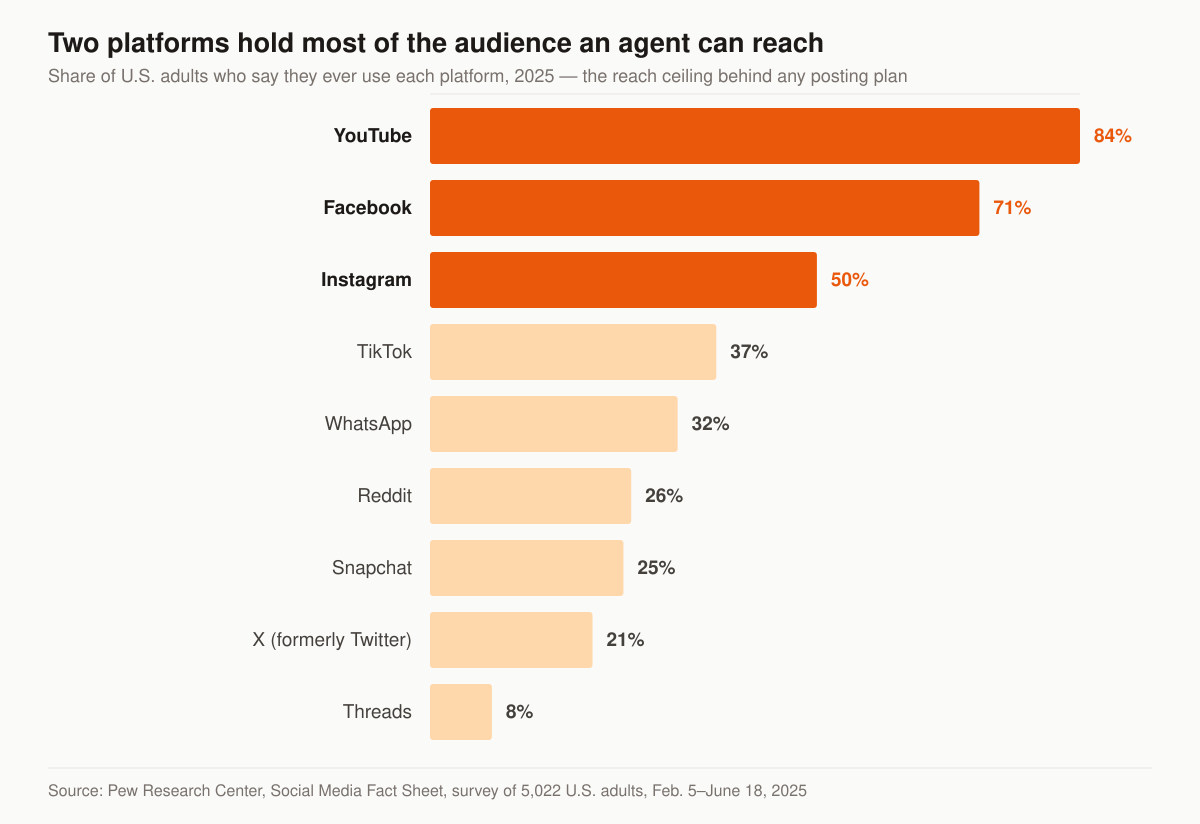
Share of U.S. adults who say they ever use each platform. Source: Pew Research Center, Social Media Fact Sheet, survey of 5,022 U.S. adults, Feb. 5–June 18, 2025.
Two caveats before you read that as a ranking. Pew published no 2025 figure for LinkedIn or Pinterest; the most recent readings in the same series are from the survey dated June 10, 2024 — 32% for LinkedIn and 36% for Pinterest — so LinkedIn’s absence from the chart is a gap in the data, not a collapse in the platform. And total reach is not your reach. The age split decides more for an insurance book than the headline does: among adults 65 and older the same 2025 survey puts YouTube at 64%, Facebook at 57% and Instagram at 19%, while among adults 18 to 29 Instagram runs at 80% and Facebook at 68%. That single divergence is why a senior-market page and a young-family life page should never run the same calendar, and it is the reasoning behind the cadence table below. The senior-market side of it is broken out in social media for final expense agents.
How often should insurance agents post? A realistic cadence
Cadence beats volume, and the table below is a sustainable operating rhythm rather than a maximum. Pick your primary platform and hold the floor for a year.
| Platform | Frequency | Format that earns reach |
|---|---|---|
| 3–5 posts/week | Short video, question posts, local photos; Stories for warm audiences | |
| 3–5 posts/week + Stories most days | Reels (15–30s) for reach, carousels for depth | |
| LinkedIn (commercial lines) | 2–3 posts/week | Text-first POV posts, niche explainers, client spotlights |
| Google Business Profile | 1–2 updates/week | Photos, review responses, short updates — feeds local search, not just social |
| YouTube | 2–4 Shorts/month, long-form optional | Repurposed vertical video; explainers if you enjoy filming |
| TikTok | Optional, 2–3/week if at all | Only if you already produce vertical video consistently |
Batch-record in one sitting and schedule the week. If Instagram is your primary channel, our Instagram playbook for insurance agents covers pillars, Reels structure, and the DM handoff in detail.
Which dates already hand you a post idea?
The hardest part of a content calendar is the blank week. It is also avoidable, because a good share of the insurance year runs on fixed public dates — enrollment windows, storm seasons, awareness months — that are published a year ahead and searched every time they come around. Build the grid once against those dates and a third of next year’s posts pick themselves.
Every window below is set by the agency or organization that owns it, so you can schedule against it without guessing. The post angle column is the hook the date hands you, not a claim about results.
| Window | Dates | The angle it hands you |
|---|---|---|
| Medicare Open Enrollment | October 15 – December 7 | Education-only reminders that the window is open; no plan names, no premiums, no benefit figures |
| Medicare Advantage Open Enrollment Period | January 1 – March 31 | What this narrower window allows: switch Medicare Advantage plans, or drop one and return to Original Medicare |
| Marketplace Open Enrollment | November 1 – January 15 | The December 15 cutoff for coverage starting January 1, then the February 1 start for later enrollments |
| Atlantic hurricane season | June 1 – November 30 | Pre-season documentation posts; the statistical peak is September 10, so the prep content runs in May |
| Eastern Pacific hurricane season | May 15 – November 30 | The same prep content, shifted two weeks earlier for books on the West Coast |
| National Preparedness Month | September | Home inventory, document storage, and the photograph-it-now post, with a national campaign behind it |
| Life Insurance Awareness Month | September | Coverage-gap education in the month the rest of the industry is already talking about it |
Sources for those dates: Medicare’s two windows and what each one permits come from medicare.gov, which lists Open Enrollment as “October 15-December 7” and the Medicare Advantage Open Enrollment Period as “January 1-March 31”. The Marketplace dates and the December 15 cutoff come from healthcare.gov, which states that “Coverage starts for those who enroll in or change plans December 16 through January 15” on February 1. The hurricane season dates and the September 10 peak come from the National Hurricane Center. National Preparedness Month is run each September by FEMA’s Ready campaign, which has done so since 2004. Life Insurance Awareness Month is a Life Happens campaign; the organization says it “created and coordinates Life Insurance Awareness Month (LIAM) every September” in its about page.
Two things to keep straight when you use this. First, a date is not permission: what you may say inside a Medicare window is still governed by CMS marketing rules, and the January-to-March window has its own constraints, which we cover in the OEP rules breakdown. If the fall window is your season, AEP marketing strategies for agents covers the channel mix around it, and the birthday runway that feeds it is mapped in the turning-65 marketing system. ACA agents working the November-to-January stretch will find the pipeline mechanics in how ACA agents fill their pipeline during OEP. Second, seasonal posts age badly if you date-stamp them into the caption and then reuse the graphic next year — write the copy so the year is implied by the posting date, not baked into the image.
What insurance agents should NOT post
A year of good content can be undone by one post that draws a carrier complaint, a compliance letter, or a disabled ad account. The rules differ by lane.
Paid social has platform rules. Since January 21, 2025, Meta requires campaigns for financial products and services — a list that explicitly includes insurance products — to be declared under its “Financial products and services” Special Ad Category when the advertiser is based in the US or the audience is in the US. Once a campaign sits in that category, Meta limits or removes audience options: age, gender, ZIP code, exclusion targeting, lookalike audiences, and saved audiences, with some interest targeting unavailable and location targeting expanded to a wider radius. Organic posts are not declared under the category — but the moment you boost one, it is an ad and the rules apply.
Regulated lines have regulator rules. Medicare content is governed by CMS marketing rules the moment it promotes plans, benefits, or carriers — the education-vs-marketing line is covered in our CMS rules guide. And any lead your posts generate still has to be dialed legally; our TCPA compliance guide covers consent and record-keeping.
Reviews and testimonials have a federal rule of their own. Two of the ideas above — featuring a Google review, and telling the story of a policy that paid — sit directly under the FTC’s Rule on the Use of Consumer Reviews and Testimonials, in effect since October 2024. 16 CFR 465.2(a) makes it “an unfair or deceptive act or practice and a violation of this part for a business to write, create, or sell a consumer review, consumer testimonial, or celebrity testimonial that materially misrepresents, expressly or by implication” any of three things: “That the reviewer or testimonialist exists”; “That the reviewer or testimonialist used or otherwise had experience with the product, service, or business that is the subject of the review or testimonial”; or “The reviewer’s or testimonialist’s experience with the product, service, or business that is the subject of the review or testimonial.” Paragraph (b) extends the same three prongs to disseminating a testimonial the business “knew or should have known” misrepresented them, and paragraph (c) reaches reviews procured from “its officers, managers, employees, or agents, or any of their immediate relatives” for posting on a third-party platform — but only “when the business knew or should have known that the review materially misrepresented” one of those same three things.
There is a carve-out worth knowing before you stop asking clients for reviews entirely. Under § 465.2(d)(1), paragraphs (b) and (c) do not apply to reviews or testimonials “that resulted from a business making generalized solicitations to purchasers to post reviews or testimonials about their experiences with the product, service, or business”. Emailing your whole book and asking them to review you is not the conduct the rule targets. Asking your cousin to write one is, and so is putting words in a real client’s mouth. The asking mechanics are in our guide to getting more Google reviews.
Beyond the formal rules, the standing don’ts:
- No public rate promises or premium quotes — underwriting decides the number, not your caption.
- No “everyone qualifies” claims — absolute qualification language is how agents get reported.
- No plan-specific Medicare content without compliance review — educational posts only, until your FMO signs off.
- No client information without written permission — names, photos, claim details, even grateful ones.
- No carrier logos or materials without approval — carriers police brand use, and co-op rules vary.
- No bought followers or engagement pods — inflated metrics suppress your reach with the real audience.
- No fear-bait with identifiable people — wreck photos and disaster footage of real locals reads as exploitation, because it is.
We provide marketing services, not licensed insurance advice; you are the licensed party, so confirm specifics with your own compliance counsel.
Turning post ideas into a system
Ideas are the cheap part. The agents who get business from social media run a system: a five-bucket rotation, a batch-recording habit, a cadence they hold for a year, and a compliance check before anything regulated goes live. Pick fifteen ideas from your line’s section, map them to the next five weeks, and start.
If you would rather have operators run the calendar, the editing, and the compliance guardrails while you sell, that is exactly what our insurance social media service does. Or grab a free marketing audit and we will tell you whether organic social is even the right next lever for your book — sometimes it isn’t, and we will say so.
- Instagram for Insurance Agents: The Organic Playbook That Actually Moves Pipeline
Instagram for insurance agents: an organic playbook covering content pillars, Reels, posting cadence, and the compliance rules that keep posts clean.
- Social Media for Final Expense Agents: Organic, Paid, and Compliant
Social media for final expense agents: which platform the 65-plus buyer uses, what Meta's Special Ad Category removes, and the TCPA and FTC posting rules.
- Insurance PPC Cost Per Click by Line: What You Actually Pay, and How to Pay Less
Insurance PPC cost per click by line: 2026 published benchmarks, how Google prices each click, the enrollment calendar, and levers that cut cost per sale.
- How to Run Facebook Ads for Insurance Agents (Step by Step)
A step-by-step guide to how to run Facebook ads for insurance agents: Special Ad Category setup, creative that converts, lead forms, and TCPA-safe compliance.