40 Content Ideas for Final Expense Agents You Can Steal This Week
The best content ideas for final expense agents answer one buying question at a time — what coverage costs at a given age, who qualifies with health conditions, how fast beneficiaries get paid — in cheap repeatable formats: short video, FAQ post, review prompt. Judge every idea by booked calls, not reach.
Most “marketing ideas” lists for agents are filler. This one is a working swipe file: 40 content ideas for final expense agents you can run this week, grouped by job, each tied to why it moves a number — leads, booked calls, or cost per acquired sale.
Updated for 2026: the formats below reflect current platform rules — including Meta’s Financial Products and Services Special Ad Category, which has covered insurance ads in the US since January 2025 — and the shift of buyer questions into AI assistants. The measurement rule hasn’t changed: an idea earns its slot by moving leads or close rate, nothing else.
For context on what “working” looks like, we run our own final-expense and senior-market lead operation, so these ideas are measured against live campaigns, not theory. The rule that never changes: an idea earns a place in rotation only if it lowers cost per lead or lifts close rate.
How to use this list (so it isn’t just busywork)
Pick two or three ideas per week, not twenty. Each piece should answer one question a real prospect asks. Then tag the link so you can trace a lead back to the exact format that produced it. An idea you can’t measure isn’t a strategy — it’s a hobby.
Three rules before you publish anything:
- One question per piece. “What does final expense cost at 68?” beats a generic “learn about final expense.”
- Answer it in the first 10 seconds or first sentence. Older buyers and AI engines both reward a direct answer up front.
- Stay compliant by default. Don’t imply you know a viewer’s health or age in ad copy, honor consent, and route clicks to a clean landing page. Compliance is a trust signal, not a tax — more on that in our guide to marketing compliance for insurance agents.
The 40 ideas, by job
The table below is the fast version. The sections after it add the reasoning and the formats that pull best.
| # | Idea | Format | Job it does |
|---|---|---|---|
| 1 | “What does final expense cost at age 65/70/75?” | Short video + post | Captures cost-shoppers |
| 2 | Can you qualify with diabetes / COPD / heart condition? | FAQ article | Pre-qualifies leads |
| 3 | Graded vs. level benefit, explained in 60 seconds | Video | Reduces sales-call friction |
| 4 | How fast does the beneficiary get paid? | Post + infographic | Answers the real fear |
| 5 | “Burial insurance vs. final expense — same thing?” | Comparison table | Wins definition searches |
| 6 | 3 mistakes people make buying final expense | Carousel | Positions you as the expert |
| 7 | Why your rate goes up if you wait | Short video | Creates urgency honestly |
| 8 | Client win (anonymized payout story) | Post | Social proof |
| 9 | “Day in the life” of a final expense agent | Reel | Humanizes you |
| 10 | Review-request text after every issued policy | Automation | Builds reputation |
| 11 | Google Business Profile post, weekly | GBP | Local visibility |
| 12 | Answer top 10 call questions as 10 posts | Batch content | Feeds search + AI |
| 13 | Retarget video-viewers with a quote offer | Meta ad | Cheap conversions |
| 14 | Lead-magnet: “Final expense buyer’s checklist” | PDF + landing page | Email capture |
| 15 | Email drip for non-buyers (5 touches) | Automation | Recovers lost leads |
| 16 | “How I picked your carrier” transparency post | Post | Differentiator |
| 17 | Spanish-language version of your top 5 posts | Translation | Untapped audience |
| 18 | Local Facebook group value posts (no pitch) | Organic | Warm pipeline |
| 19 | “Is final expense a scam?” — answer it head-on | Article | Captures skeptics |
| 20 | Carrier comparison for a specific health profile | Table | High-intent traffic |
| 21 | Short FAQ video for each objection you hear | Video series | Pre-handles objections |
| 22 | Holiday/seasonal “get your affairs in order” angle | Seasonal post | Timely reach |
| 23 | Testimonial video (with consent + disclosure) | Video | Trust at scale |
| 24 | “How much do you actually need?” calculator post | Interactive | Engagement + qualifying |
| 25 | Behind-the-numbers: average payout in your state | Data post | Authority |
| 26 | Repurpose every call FAQ into a blog Q&A | Content | AEO/GEO ranking |
| 27 | YouTube Shorts of your best 60-second answers | Video | Evergreen reach |
| 28 | Partner content with a local funeral home | Co-marketing | Referral pipeline |
| 29 | “Why I stopped cold-calling” story | Post | Relatable + on-brand |
| 30 | One-question poll (engagement + research) | Story | Audience insight |
| 31 | Annual “best carriers this year” roundup | Article | Recurring traffic |
| 32 | Address the “I already have life insurance” objection | Post | Reframes need |
| 33 | Quick myth-busting series (1 myth per post) | Series | Shareable |
| 34 | Landing page per ad angle, not one for all | Web | Higher conversion |
| 35 | SMS follow-up within 5 minutes of a lead | Automation | Speed-to-lead |
| 36 | “What to bring to the appointment” post | Post | Reduces no-shows |
| 37 | Explain guaranteed-issue whole life simply | Video | Captures hard-to-place |
| 38 | Reputation reply: respond to every review publicly | GBP | Trust signal |
| 39 | “How to read a final expense quote” walkthrough | Video | Builds confidence |
| 40 | Repurpose one webinar into 15 micro-clips | Batch | Content multiplier |
How do final expense agents get leads from content?
Final expense agents get leads from content by answering one buying question per piece, then putting a capture step next to the answer: a quote form under the cost video, a checklist download inside the FAQ post, a retargeting audience built from every viewer. The content earns the click; the capture step earns the lead.
Map the swipe file to that job and the path gets obvious:
| Ideas | What they do | The capture step |
|---|---|---|
| 1–8 | Answer the cost, qualifying, and payout questions buyers already search | Quote form or callback button under the answer |
| 13 | Retarget the people who watched 50%+ of a cost or qualifying video | Quote offer on a matching landing page |
| 14 | Trade a buyer’s checklist for an email address | Landing page + instant delivery |
| 15 | Recover the people who asked and didn’t buy | Five-email drip, then a call |
Ideas 1–8 create the demand; 13–15 catch it. Publishing without a capture step is how an agent works at content for a year and generates nothing — the traffic arrives, reads the answer, and leaves with no way to raise a hand. If you want that pipeline built as a system rather than a habit, that’s exactly what our insurance content marketing service does.
What content should final expense agents post?
The first cluster (ideas 1–8, 19–20, 31–32) is where most leads hide — these are the content ideas insurance buyers actually search for. People near a final expense decision type cost and qualifying questions into Google and, increasingly, into AI assistants. Every honest answer you publish is a piece of final expense content that does qualifying work before the call.
Ground the cost answer in a real number instead of a range you made up. The National Funeral Directors Association’s 2023 General Price List study puts the national median cost of a funeral with casket and burial at $8,300 and a funeral with cremation, including the alternative cremation casket and urn, at $6,280. That single figure is a post, a video, and the honest framing for a coverage-amount conversation.
Pair the written answer with a 45–90 second face-to-camera video. One recording becomes three assets: organic post, ad creative, and landing-page embed. Caption it, and write the captions on the assumption that the viewer has the sound off.
If you want the deeper playbook on turning call questions into ranking pages, our insurance content marketing service is built around exactly this: a question-to-page pipeline that compounds. It’s also how you get recommended by ChatGPT and other AI engines — structured, direct answers are what they cite.
What the cost answer should actually say
We treat idea 1 as the anchor of the whole file, and it falls apart when the answer is a vague range. Publish the itemized figures instead. NFDA’s 2024 Cremation & Burial Report reprints the 2023 General Price List medians in full, and the list goes well past the two headline numbers.
The table below is the whole cost answer in one place — publish it, source it, and let the prospect find their own row.
| Service (2023 national median charge) | Median |
|---|---|
| Adult casketed funeral, viewing and ceremony, then burial (vault excluded) | $8,300 |
| Adult casketed funeral, viewing and ceremony, then cremation | $6,280 |
| Immediate burial, container provided by the funeral home | $3,720 |
| Immediate burial, container provided by the family | $2,995 |
| Direct cremation, container provided by the funeral home | $2,750 |
| Direct cremation, container provided by the family | $2,645 |
| Metal burial casket (line item) | $2,500 |
| Rental casket (line item) | $1,095 |
| Urn (line item) | $295 |
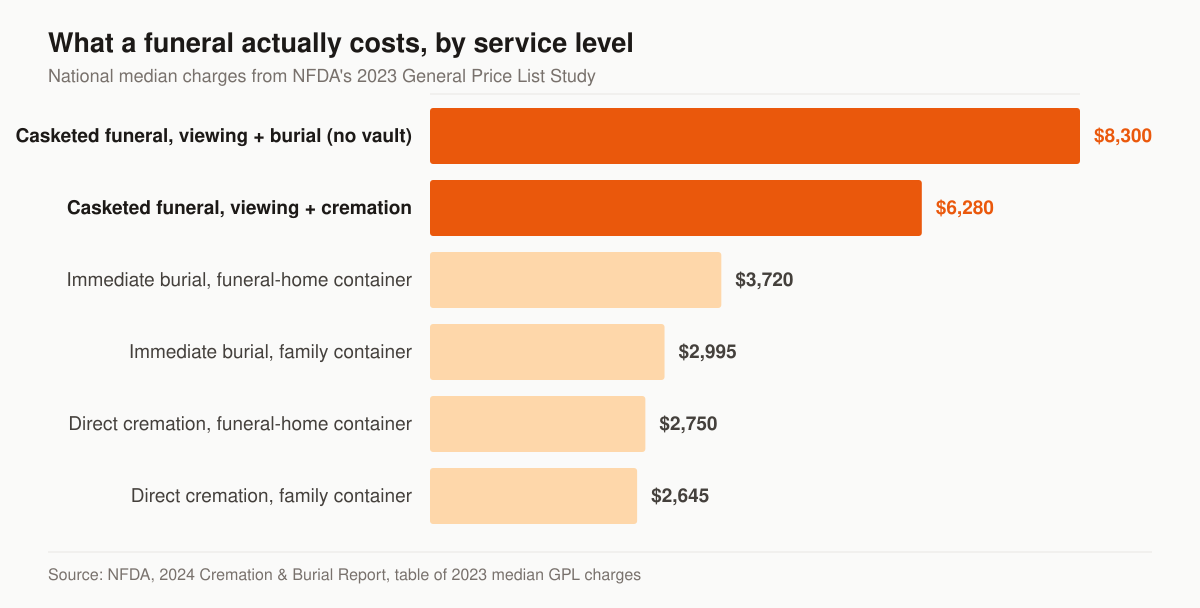
Chart: 2023 national median GPL charges, from NFDA’s 2024 Cremation & Burial Report.
Two things make this worth an afternoon of production. The first is the spread: $2,645 to $8,300 across the same page, which is why “how much coverage do I need?” has no single answer and why a policy sized to a round number is a guess. The second is provenance. NFDA’s December 2023 release describes the study behind it: a survey mailed to 5,219 NFDA-member funeral home owners on July 7, 2023, with 809 anonymous responses, accurate within plus or minus 3.4% at 95% confidence. Say that out loud in the video. Citing your source is content nobody else in your market bothers to produce.
One caveat to build into the piece so it ages well. The same report states that the next NFDA GPL study will be conducted in 2025, and the release notes the burial median rose 5.8% over the prior two years, from $7,848 to $8,300, while the cremation median rose 8.1%, from $5,810 to $6,280. Date the figure in the copy and diary a refresh. A cost post carrying a stale number is worse than no cost post, because the prospect who checks will assume the rest is stale too.
Which disposition are you actually quoting?
Here is the question the swipe file’s cost ideas usually skip, and it changes the number you say on camera. NFDA’s 2024 report projects that in 2025, 63.3% of U.S. dispositions will be cremations and 31.9% burials — compared with 59.2% cremations and 35.9% burials in 2022. Its 2025 edition, summarized on the association’s media center page, projects a 63.4% cremation rate and a 31.6% burial rate for 2025, with cremation reaching 82.3% by 2045.
The practical consequence for content: an agent who opens with the $8,300 burial figure is quoting the shrinking share. So make disposition the first question in the piece, not an afterthought. “Are you planning a burial or a cremation?” is a 20-second video of its own, and it earns the follow-up — the family that says cremation with a service is looking at $6,280, and the family that says direct cremation is looking at $2,645 or $2,750 against the $8,300 burial figure. That is a policy-size conversation grounded in the family’s actual plan instead of a default.
It is also a clean cross-link. A prospect who lands on the disposition post and turns out to be uninsurable belongs in your guaranteed issue explainer; one who is ready to price a policy belongs in the final expense sales funnel you already run.
Social and video ideas (10–13, 21–30, 33, 37, 39)
Social proof and humanizing content do a different job than search content: they warm the audience you already reached. A few principles that hold up:
- Show the payout, not the pitch. An anonymized claim story — what the family had to file, and how quickly the benefit was paid once it was — outperforms any feature list. Describe the process; never name a client, and never invent a number.
- One objection, one clip. Every objection you hear on calls is a 30-second video. Build the series once; it pre-handles objections for years.
- Retarget viewers, not strangers. People who watched 50% of a video are your cheapest conversions — and on Meta, retargeting is now one of the few precise tools you have left. Since January 21, 2025, Meta requires US advertisers to run financial products and services ads — insurance products included — inside the Financial Products and Services Special Ad Category, which restricts age, gender, ZIP code, exclusion targeting, lookalike and saved audiences. You cannot target seniors by age anymore. Let the creative do the qualifying: say the words “final expense” and “burial coverage” in the first three seconds and the wrong audience self-selects out.
For the channel-specific mechanics, see our breakdowns of Facebook ads for insurance agents and social media for final expense agents.
Where does each idea get published?
Two audiences read final expense content, and they do not sit in the same places. The buyer is usually 55 to 80. The adult child who forwards the video, joins the call, or writes the check is usually 30 to 60. Pew Research Center’s Social Media Fact Sheet, from a survey of 5,022 U.S. adults conducted February 5 to June 18, 2025, splits platform use by age, and the gaps are wide enough to make the posting decision for you.
The table below is the distribution plan: publish where the age band you are addressing already is, and stop paying attention to platforms neither band uses.
| Platform | Ages 30–49 (adult children) | Ages 50–64 | Ages 65+ (the buyer) |
|---|---|---|---|
| YouTube | 92% | 85% | 64% |
| 80% | 74% | 57% | |
| 62% | 40% | 19% | |
| TikTok | 44% | 30% | 12% |
| 40% | 30% | 20% | |
| X (formerly Twitter) | 25% | 16% | 10% |
Read down the last two columns and the plan writes itself. YouTube and Facebook are the only platforms in Pew’s list that a majority of 65-and-older adults report using, which is why ideas 27, 39 and the video series in 21 belong on YouTube and why idea 11’s weekly Google Business Profile post plus a Facebook post covers the buyer’s whole surface area. Instagram at 19% is not where you reach the buyer — it is where you reach the daughter, which is a legitimate second job and the reason ideas 9, 29 and 33 are worth cross-posting there rather than skipping.
The same split shows up in AI assistants, and it points the opposite way from the usual advice. Pew’s June 2025 short read on ChatGPT use, from a survey of 5,123 U.S. adults conducted February 24 to March 2, 2025, reports that 34% of U.S. adults have ever used ChatGPT: 58% of adults under 30, 41% of those 30 to 49, 25% of those 50 to 64, and 10% of those 65 and older. So the assistant is not answering your buyer’s cost question yet — it is answering the question their son typed while researching on their behalf. Write for both: the page a 68-year-old reads, and the clean, sourced paragraph an assistant can quote to a 45-year-old.
Lead-capture and follow-up ideas (14–18, 34–36, 40)
Reach without capture is wasted spend. These ideas turn attention into a contact and a contact into a booked call:
- One landing page per ad angle. A “diabetic-friendly coverage” ad should land on a page about exactly that — not your homepage.
- Speed-to-lead. Text within five minutes. The drop-off after that is brutal; see our lead follow-up cadence for the full sequence.
- A drip for non-buyers. Five emails over two weeks work the leads that a two-call follow-up leaves behind. Set it up once with email automation.
For the monthly-touch layer that keeps past clients and unsold leads warm long after the drip ends, a done-for-you agency newsletter handles the writing and sending for you.
Which proof ideas are worth building first?
Ideas 10, 16, 28 and 38 all buy the same thing — evidence that you are safe to let in the door — and there is published research on how families behave when they are shopping for exactly this kind of service. The 2024 Annual NFDA Consumer Study, reported inside the 2024 Cremation & Burial Report, found that 67.4% of consumers visited a funeral home website when they planned a funeral or memorial service and 34.4% said their first interaction with a funeral home was online. Among consumers who use Facebook, 47.9% had visited a funeral home’s Facebook page, and 33.9% said they had used the services of a funeral home they found on Facebook. On reviews, 51.1% said an online review either solidified their decision or steered them toward a particular firm.
State the limit plainly, because it matters: those respondents were choosing a funeral home, not an insurance policy, and NFDA measured funeral-home shoppers. What transfers is the shape of the behavior — the same family, on the same subject, checking a website, a Facebook page and a set of reviews before they call anyone. That is the case for treating ideas 10 and 38 as infrastructure rather than nice-to-haves, and our guide to getting more Google reviews has the request scripts.
The transparency idea (16) has the sharpest support in the same study. Of consumers who contacted more than one funeral home, 71.2% received a General Price List; of those who received one, 94.5% felt it was helpful and easy to understand and 78.2% thought it should be mandatory for funeral homes to post their prices online. Measured across all consumers, 59.2% said they would be much more likely to engage a funeral home if it had its GPL posted online. Nearly half of consumers, 48.3%, called or visited more than one funeral home when they planned a funeral. Price opacity is the friction, and the agent who publishes how commissions work, which carriers they represent and why is answering a question the prospect was going to ask a competitor anyway. If you want a model for what that looks like on a page, our roundup of final expense agent website examples picks apart the layouts that do it well.
The funeral-home partnership in idea 28 has a larger addressable list than a single town suggests. NFDA’s media center puts 15,401 funeral homes in the United States, roughly 75% of them family- or privately owned. Independently owned businesses can decide to hand out your explainer over a coffee; a chain cannot. Start with the ones nearest your existing book.
Offline content still counts
Offline content is the same swipe file printed on paper, and in the final expense market it still outperforms its reputation. The buyer is 55–80, checks the mail, and reads what arrives. Four formats carry the load:
- Direct-mail letter angles. The same hooks that work on video work in an envelope: “What a funeral actually costs in your county,” or “Can you still qualify with diabetes?” Our final expense mailer templates are four free, editable pieces — a 6x9 postcard, a reply-card letter, a turning-65 letter, and a follow-up referral piece.
- Seminar handouts. A one-page cost-and-qualifying FAQ left on every chair is the offline version of idea 12 — and it keeps working after the room empties.
- Senior-center and funeral-home flyers. Pair with idea 28: a funeral home that hands out your coverage explainer is a referral pipeline with a printer.
- Medicare cross-sell touchpoints. Your existing Medicare book already trusts you. A single “have you covered the funeral bill?” insert in an annual review letter is the cheapest final expense lead you will ever generate.
Is final expense insurance hard to sell?
Final expense insurance is simple to explain and hard to earn trust for. The product is small whole life with easy underwriting — no medical exam on most guaranteed-issue and simplified-issue plans — so the friction is credibility, not complexity: an older buyer is deciding whether you are safe to let in the door.
That is precisely why content is leverage here rather than decoration. An agent the prospect has already watched answer three cost questions on video is not a stranger calling at dinner time; they are the person who explained the thing. The sale gets easier in proportion to how much of it happened before the conversation started.
The agents who find it hard are usually selling from a cold list with no published answers behind them. The fix isn’t a better script — it’s a body of work the buyer can find, plus a follow-up cadence that doesn’t quit after two calls.
What to do this week
Don’t run all 40. Run three: one cost/qualifying answer (search), one payout or testimonial story (proof), one follow-up automation (capture). Measure each against booked calls and cost per acquired sale, kill what doesn’t earn its slot, and double the rest.
Budget the decision honestly before you start. Producing two or three pieces a week, editing the video, building the landing page and wiring the follow-up is a job, and the realistic choice is whether you do it or buy it. Our published pricing puts the ongoing content engine in the Growth tier at $3,500 a month, with Foundation at $2,500 covering the site, local SEO and on-page work underneath it and Full-Funnel at $5,500 adding managed ads and automation on top. Compare that against the hours the list above actually takes, then pick a lane and stay in it — an abandoned content habit costs more than either number.
If you’d rather have the question-to-page-to-lead system built for you, start with a free marketing audit — we’ll show you which of these ideas your market is already searching for and where your current funnel leaks. For the broader strategy, our final expense marketing overview ties content, ads, and follow-up into one measurable book. And if the constraint is publishing on a schedule rather than picking topics, a done-for-you agency newsletter turns three ideas a month into a send you never have to write.
- Digital Marketing for Insurance Agents: The Channel-by-Channel Playbook
Digital marketing for insurance agents, channel by channel: which of SEO, PPC, social, email, and AI search to run first — by line and budget. Free audit.
- The Insurance Agency Marketing Plan That Fits on One Page
Build an insurance agency marketing plan in 7 steps: positioning, channels by line, quarterly budget, KPIs, compliance. Free fill-in one-page template.
- 45 Marketing Ideas for Insurance Agents, Ranked by Effort and Impact
45 marketing ideas for insurance agents, ranked into four tiers by effort and impact. Every idea notes the line it fits, from final expense to P&C.
- Insurance Agency Marketing Budget: What It Costs, and the Cost-Per-Sale Math Underneath
Insurance agency marketing budget and costs: 7-12% of gross revenue steady, 15-20% growing, with the monthly figure by tier and agency retainer bands.