Social Media for Final Expense Agents: Organic, Paid, and Compliant
Social media for final expense agents works in two lanes: organic content that builds trust over months, and paid lead generation that buys appointments now. Most agents should run paid first for cash flow, layer organic for cost-per-lead reduction, and treat compliance as a hard gate, not an afterthought.
Most final expense agents treat social media as a hobby that occasionally produces a lead. That is backwards. Done right, social is two separate machines: a paid engine that buys appointments on a known cost per lead, and an organic engine that lowers your blended acquisition cost over time. This page covers both, plus the compliance rails that keep you out of trouble.
For reference, we run our own final-expense lead operation, so what follows comes from running paid and organic together, not from picking one.
Paid vs. organic: which lane to run first
Paid and organic solve different problems. Paid solves cash flow. Organic solves cost. If you need appointments this week, paid is the answer. If you want your cost per lead to drift down over a year, organic is the lever. Here is the honest comparison.
| Factor | Paid social (Facebook/Instagram ads) | Organic social (posting, video, groups) |
|---|---|---|
| Time to first lead | Days | Weeks to months |
| Cost structure | Pay per lead, scales with budget | Time cost, compounds over time |
| Predictability | High once dialed in | Low early, steady later |
| Volume ceiling | High, limited by budget | Limited by audience size |
| Best for | New books, fast volume | Reducing blended cost, trust |
| Main risk | Wasted spend on bad creative | Inconsistent posting kills it |
The sequence we run:
- Start paid to generate dated appointments and prove the funnel converts.
- Add organic once you can commit to a posting cadence you will not abandon in three weeks.
- Retarget your organic audience with paid ads, which is where the two engines compound.
If you want the appointments handled for you rather than built in-house, our done-for-you insurance social media service runs both lanes against a target cost per lead, and the tier you land on is published on our pricing page rather than quoted after a discovery call.
Which platform actually reaches a final expense buyer
Before you film anything, settle the question that decides where the hours go. Pew Research Center’s Social Media Fact Sheet, built on a survey of 5,022 U.S. adults conducted February 5 to June 18, 2025, reports platform use by age band. For the age group a final expense agent is licensed to help, the ranking is not the one the marketing internet assumes.
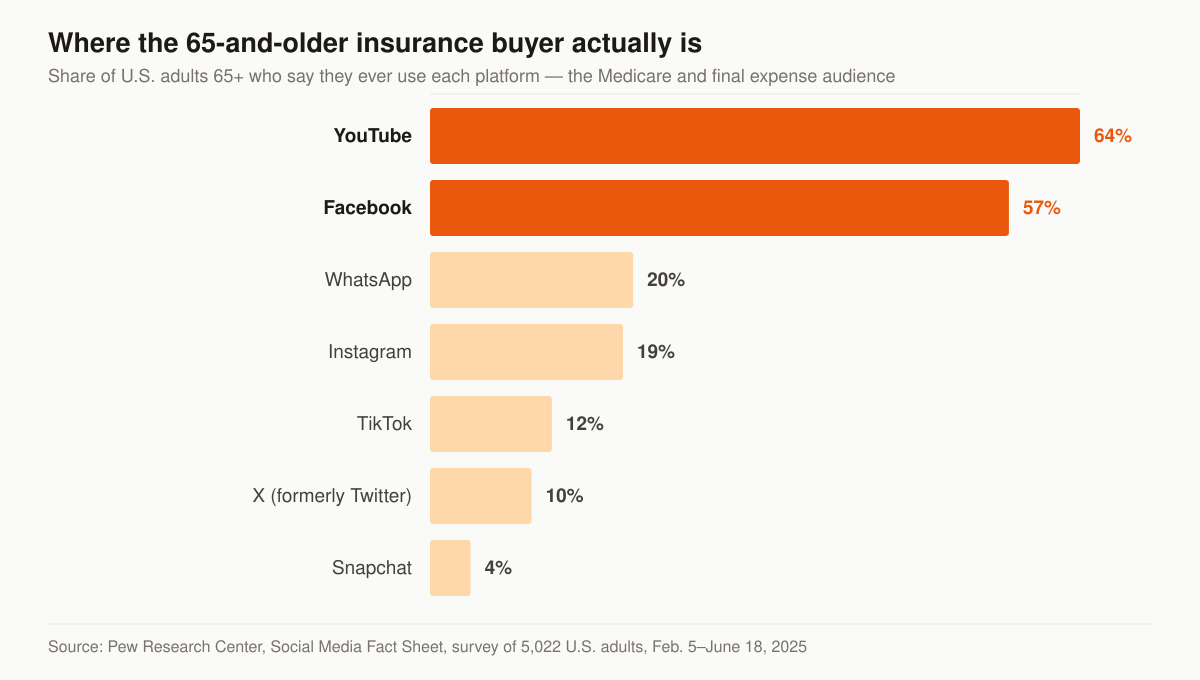
Share of U.S. adults 65 and older who say they ever use each platform. Source: Pew Research Center, Social Media Fact Sheet, survey of 5,022 U.S. adults, Feb. 5–June 18, 2025.
Two platforms clear half of that age group: YouTube at 64% and Facebook at 57%. Instagram reaches 19% of it and TikTok 12%. Across all U.S. adults the same survey puts YouTube at 84%, Facebook at 71%, Instagram at 50% and TikTok at 37% — so the general-population advice you read about short-form video is written for an audience that is not yours.
Reach is only half of it; habit is the other half. In a separate Pew survey of 5,123 U.S. adults conducted February 24 to March 2, 2025, Americans’ Social Media Use 2025 states that “About half of U.S. adults say they visit each of these platforms at least once a day. This includes 37% who visit Facebook several times a day, and 33% who say the same of YouTube.” Daily TikTok use sits at 24% of adults and daily X use at 10%.
| Platform | Ever use, adults 65+ | Ever use, all U.S. adults | What we do with it on a final expense book |
|---|---|---|---|
| YouTube | 64% | 84% | Long-form answers the buyer searches for later; evergreen, not feed-dependent |
| 57% | 71% | Where paid runs and where the page lives. The default, not one of several | |
| 20% | 32% | Follow-up channel for existing clients, not prospecting | |
| 19% | 50% | The adult daughter, not the policyholder. See our Instagram playbook | |
| TikTok | 12% | 37% | Recruiting and brand, if you already have spare hours |
| X | 10% | — | Skip |
Pew also notes that daily Facebook use peaks in the two middle age bands, at 58% of 30- to 49-year-olds and 54% of 50- to 64-year-olds. That matters more than it looks. The 50-to-64 band is your pre-retiree and your buyer’s adult child at the same time, and it is on the platform every day. One channel carries both audiences, which is why we do not spread a final expense book across five accounts. Pick Facebook, add YouTube when you can hold a camera steady, and let the rest go.
How paid social actually works for final expense
The biggest surprise for new agents: you cannot target seniors directly. Insurance falls under Meta’s Special Ad Category, which removes age, gender, ZIP, and detailed-interest targeting. So the targeting moves into the creative itself. Your headline, image, and offer must self-select the right buyer.
What that looks like in practice:
- Creative does the targeting. Plain-language hooks about covering funeral costs, no medical exam, and locking in a rate self-filter for the right age band.
- Lead forms beat landing pages early. Instant forms on the platform cost less per lead and load instantly on a senior’s phone. Move to dedicated landing pages once volume justifies the testing.
- Test 4–6 creatives at a time. One winner usually carries the account. Kill losers fast; do not nurse them.
- Speed-to-lead is the multiplier. A lead form means nothing if you call it two days later. Dial inside five minutes or the close rate collapses.
Budget honestly. Spending $50 and quitting teaches you nothing. You need enough volume for the platform to optimize and for you to read cost per lead without lying to yourself. For a deeper breakdown of what clicks actually cost by line, see our insurance PPC cost data.
What the Special Ad Category removes, and what it leaves you
It is tempting to read “Special Ad Category” as a setting you can argue with. It is not. Meta’s Business Help Center says that starting January 21, 2025, “using this category is required for financial products and services campaigns for advertisers based in the United States or showing ads to audiences in the United States. Ads may be rejected if an appropriate category is not chosen.” The category description on the same page covers “Ads that promote or directly link to a financial products and services offer, including credit,” and links out to a separate policy page for what qualifies. Read that page rather than guessing, and select the category rather than waiting to see whether the ad clears review.
What the category does to the audience panel is spelled out on the same page: “Certain audience options are limited or unavailable for these ads for advertisers based in or reaching the US and advertisers reaching Canada and certain countries in Europe: age, gender, ZIP code or postal code, exclusion targeting, lookalike audiences and saved audiences. Some interests will also be unavailable when you create your audience. Audiences based on city or pin drop locations will include an expanded radius.”
Read that list slowly. Two entries on it change how a final expense campaign has to be built.
What you lose and what survives, with the workaround we use for each. The left two columns are Meta’s own list; the right column is our routing rule, not a finding.
| Targeting tool | Status under the category | What we do instead |
|---|---|---|
| Age and gender | Limited or unavailable | Write the age into the creative. A hook about covering a funeral bill self-selects |
| ZIP or postal code | Limited or unavailable | Target city or pin drop and accept the expanded radius; qualify state on the call |
| Exclusion targeting | Limited or unavailable | You cannot exclude existing clients, so suppress them in your CRM, not the ad set |
| Lookalike audiences | Limited or unavailable | The seed-list shortcut is gone. Creative testing replaces it as the optimization lever |
| Saved audiences | Limited or unavailable | Rebuild audiences in the ad set each time; keep a written spec so it stays consistent |
| Some interests | Some unavailable | Do not build a campaign whose only hypothesis is one interest that may vanish |
Meta’s list of limited options does not name custom audiences, and Meta’s own advice on the page is direct: “We encourage you to broaden—not restrict—your audience.” Both points push the same way. Retargeting a warm audience you built yourself from page engagement and video views is still on the table, and Meta is telling you to run cold prospecting wide rather than narrow. If your ad account is disabled rather than an individual ad rejected, that is a different process with a different fix; our Facebook ads guide for insurance agents covers the account-level rules in more depth.
What a social lead should cost, and the number that decides it
Cost per lead is the number agents ask us about first and the wrong number to manage to. Start with the benchmark anyway, because you need a floor to argue with. WordStream’s 2025 Facebook Ads Benchmarks report puts the average cost per lead for leads-objective campaigns across all industries at $27.66. In its industry table, Finance & Insurance shows an average click-through rate of 0.98% and an average cost per click of $1.22.
Keep those two figures apart: the $27.66 is an all-industries average for leads-objective campaigns, and the $1.22 click and 0.98% click-through rate are the Finance & Insurance row. Neither is a final expense number, and the report does not publish one. Treat them as the order of magnitude you are arguing with, then measure your own. The field we check first when a cost per lead drifts is the instant form: ask for six fields and the cost climbs whether or not the creative is good. Ask for the four you will actually dial on.
Then move up a level. The number that decides whether the campaign is worth running is cost per acquired sale, and close rate moves it as hard as lead price does.
Lead price against close rate, as arithmetic. These are not our results and not benchmarks — they are the multiplication you should run on your own two numbers before you judge a lead source.
| Cost per lead | Closes 1 in 4 | Closes 1 in 6 | Closes 1 in 12 |
|---|---|---|---|
| $9 | $36 per sale | $54 per sale | $108 per sale |
| $18 | $72 per sale | $108 per sale | $216 per sale |
| $28 | $112 per sale | $168 per sale | $336 per sale |
| $45 | $180 per sale | $270 per sale | $540 per sale |
Read across the rows and the point lands: a $45 lead that closes at one in four costs less per sale than an $18 lead that closes at one in twelve. We treat a conspicuously cheap lead as a question rather than a bargain: either someone else has already worked it, or the form was frictionless enough that the person filling it in did not know what they were signing up for. We unpack the full version of this in final expense lead cost vs. true cost per sale, and the dialing side of it in our insurance lead follow-up cadence.
What organic content should actually be
Organic social for final expense agents fails when it looks like a brochure. It works when it looks like a person who happens to sell insurance. The job is trust, not reach.
The content that earns trust is narrow and repeatable:
- Plain answers to real questions: “Does final expense require a medical exam?” “What happens to the policy if I miss a payment?”
- Short face-to-camera video. Seniors and their adult children trust a face over a graphic.
- Myth correction. Price is the misunderstanding worth attacking. LIMRA and Life Happens’ 2025 Insurance Barometer Study reports that about three-quarters of adults overestimate the true cost of life insurance, and that 41% of adults say they are only somewhat or not at all knowledgeable about it. Correct one myth per post.
- Proof of process. Show how a claim gets paid, how fast, to whom. Mechanism beats adjectives.
You do not need to be on every platform. Facebook is where the senior market and their decision-making children actually are. Instagram has a narrower role for the adult-children audience. Pick one, post consistently, and stop chasing trends. For a fuller content system, our guide to content ideas for final expense agents gives you a quarter’s worth of posts, and our 75+ insurance social media post ideas covers the other lines you may cross-sell.
Why the 65-plus prospect is defensive, and what that means for your profile
There is a reason a senior lets your call ring out and then looks you up. The FTC’s report to Congress, Protecting Older Consumers 2024–2025, reports that in calendar year 2024 the Consumer Sentinel Network took in more than 6.5 million reports, that about 36% (421,031) of the fraud reports carrying age information came from people 60 and older, and that 109,580 of those indicated a monetary loss. Reported losses from people 60 and older “totaled nearly $2.4 billion, up from about $1.9 billion in 2023.”
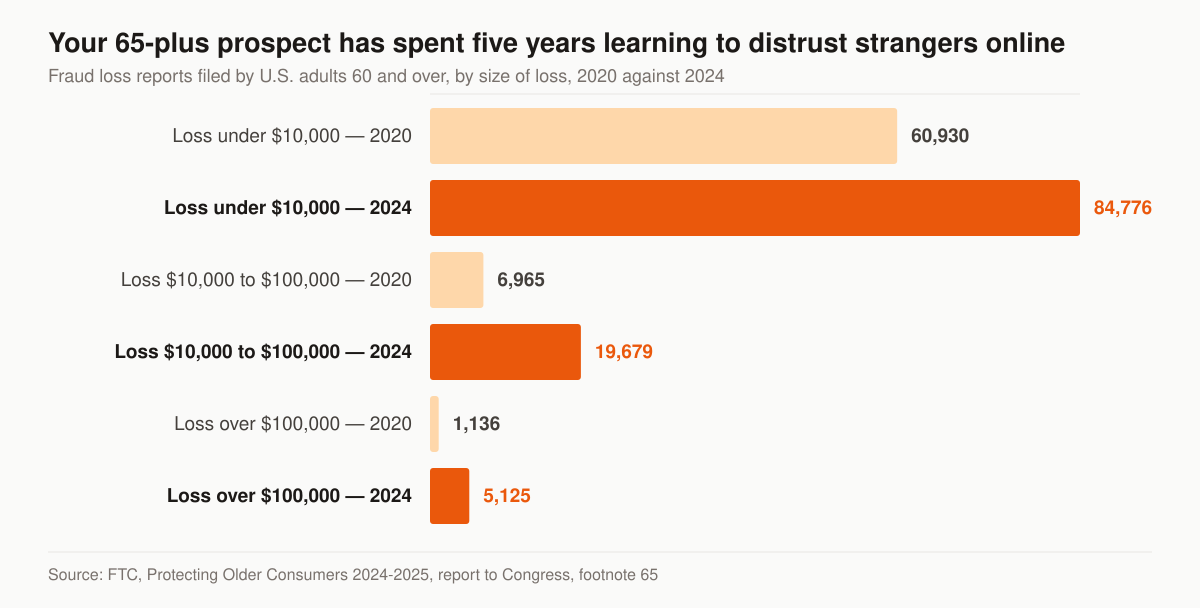
Fraud loss reports filed by U.S. adults 60 and over, by size of loss. Source: FTC, Protecting Older Consumers 2024–2025, report to Congress, footnote 65.
The FTC’s own footnote gives the shape of the change: from 2020 to 2024 the number of older adults reporting a loss over $100,000 rose 351%, from 1,136 reports to 5,125; reports of losses between $10,000 and $100,000 rose 183%, from 6,965 to 19,679; and reports of losses under $10,000 rose 39%, from 60,930 to 84,776.
Now read the encouraging half of the same report. About 74% of older adults’ fraud reports “did not indicate any monetary loss.” The FTC’s reading, controlling for population size, is that older adults filed reports about frauds they spotted but avoided losing money to at a much higher rate than people ages 18 to 59. Your prospect is not gullible. Your prospect is screening, and screening hard.
That single fact should change how you build the profile a stranger lands on:
- Be findable off-platform. A Facebook page with no matching website, no license number and no other trace reads as a shell. Send the click to a real insurance landing page, not a link tree.
- Show your face and your name in the same frame. A stock graphic with a phone number is exactly what a scam looks like to someone who has been trained to spot one.
- State your licensure and your state. Boring credentials are the reassurance a screener is hunting for.
- Never ask for anything sensitive in a DM. Not a Social Security number, not a bank account, not a Medicare number. A legitimate agent moving that request into a private message is indistinguishable from an imposter doing the same thing.
- Let third parties vouch. Public reviews on a profile you do not control carry weight a self-published testimonial cannot. Our guide on getting more Google reviews as an insurance agent covers how to ask without stepping on the rules below.
Compliance is the gate, not the afterthought
This is where agents get hurt. A lead form does not make a lead compliant. TCPA requires prior express written consent, with clear disclosure of who is calling and that automated dialing technology may be used. The consent language and where it sits on the form determine whether you can legally dial.
Three things to get right:
- Consent language must be explicit and visible. Bury it and a plaintiff’s attorney will find it.
- Keep records. Store the consent, timestamp, IP, and form version for every lead. If you cannot prove consent, you do not have it.
- Know what changed. The FCC’s one-to-one consent rule was vacated in January 2025, which loosened one specific requirement, but the core TCPA consent obligations did not disappear.
On the platform side, Meta’s Special Ad Category rules are not optional; violating them gets ad accounts disabled, not warned. Treat compliance as a trust signal you can show prospects, not a tax. We provide marketing services, not licensed insurance advice; you are the licensed party, so confirm specifics with your own compliance counsel. For the working rules, read our TCPA compliance guide for agents buying leads.
What prior express written consent actually has to say
It is easy to read the obligation as “get consent” and stop there. The regulation is more specific, and it is short enough to read in full. Under 47 CFR 64.1200(f)(9), the term “prior express written consent means an agreement, in writing, bearing the signature of the person called that clearly authorizes the seller to deliver or cause to be delivered to the person called advertisements or telemarketing messages using an automatic telephone dialing system or an artificial or prerecorded voice, and the telephone number to which the signatory authorizes such advertisements or telemarketing messages to be delivered.”
Four things in that sentence are load-bearing for a lead form. It has to be in writing. It has to bear a signature. It has to authorize the seller — named. And it has to carry the phone number the person is authorizing you to reach.
Paragraph (f)(9)(i) then requires the agreement to include “a clear and conspicuous disclosure” informing the signer that “(A) By executing the agreement, such person authorizes the seller to deliver or cause to be delivered to the signatory telemarketing calls using an automatic telephone dialing system or an artificial or prerecorded voice; and (B) The person is not required to sign the agreement (directly or indirectly), or agree to enter into such an agreement as a condition of purchasing any property, goods, or services.” Paragraph (f)(9)(ii) settles the format question agents ask about instant forms: the term “signature” includes “an electronic or digital form of signature, to the extent that such form of signature is recognized as a valid signature under applicable federal law or state contract law.”
Note what the rule requires and what it does not. It does not require the calls to be made by hand, and it does not exempt a lead just because it came from a social platform rather than a landing page. The obligations attach to the dialing method and the consent record, not the source of the form.
The consent record we keep on every social lead, and the clause each field answers to. Field names are ours; the obligations are the regulation’s.
| What you store | Why it exists |
|---|---|
| The full disclosure text as displayed, and the form version | § 64.1200(f)(9)(i) requires a clear and conspicuous disclosure; you have to be able to show which one |
| The signature artifact and timestamp | § 64.1200(f)(9) requires an agreement in writing bearing a signature; (f)(9)(ii) allows an electronic one |
| The specific phone number submitted | § 64.1200(f)(9) ties the authorization to the number the signatory gave |
| The named seller shown on the form | § 64.1200(f)(9) requires the agreement to authorize the seller, which means the seller is identified |
| Every revocation and the date received | § 64.1200(a)(10), below |
The one-to-one consent question that dominated 2024 is settled for now, and it is worth knowing what the court actually held rather than the version that circulates second-hand. In Insurance Marketing Coalition Limited v. FCC, No. 24-10277 (11th Cir. Jan. 24, 2025), the court wrote that it agreed “with IMC that the FCC exceeded its statutory authority under the TCPA because the 2023 Order’s new consent restrictions impermissibly conflict with the ordinary statutory meaning of ‘prior express consent.’” It granted the petition, vacated Part III.D of the 2023 Order, and remanded. That vacatur removed the proposed one-seller-at-a-time restriction. It did not touch the definition quoted above, which is the one you have to satisfy.
Revocation is the obligation agents overlook, and it has a clock on it. Under 47 CFR 64.1200(a)(10), a called party may revoke consent “by using any reasonable method to clearly express a desire not to receive further calls or text messages from the caller or sender.” The paragraph lists per-se reasonable methods, including the words “stop,” “quit,” “end,” “revoke,” “opt out,” “cancel,” or “unsubscribe” sent in reply to an incoming text message. Then the deadline: “All requests to revoke prior express consent or prior express written consent made in any reasonable manner must be honored within a reasonable time not to exceed ten business days from receipt of such request.” The same paragraph adds that callers “may not designate an exclusive means to request revocation of consent,” so a policy of “reply STOP or nothing counts” does not hold. Note the scope: paragraph (a)(10) governs calls and texts made pursuant to paragraphs (a)(1) through (3) and (c)(2) of that section.
One practical mercy is written into paragraph (a)(12). A single confirmation text acknowledging a revocation does not itself violate the rule, as long as it “merely confirms the text recipient’s revocation request and does not include any marketing or promotional information, and is the only additional message sent to the called party after receipt of the revocation request.” If it goes out within five minutes it is presumed to fall within the consumer’s prior express consent; later than that and the sender has to show the delay was reasonable. Build the acknowledgement into your automation and send it fast.
Posting reviews, testimonials and screenshots without an FTC problem
The proof pillar is where an agent account can cross a federal line without meaning to. Since 2024 there is a rule directly on point: the FTC’s Rule on the Use of Consumer Reviews and Testimonials at 16 CFR Part 465.
Three provisions matter for a final expense agent posting to Facebook.
One: the testimonial has to be real, in three separate ways. Under 16 CFR 465.2(a) it is an unfair or deceptive act or practice for a business to write, create, or sell a consumer testimonial that materially misrepresents, expressly or by implication, “That the reviewer or testimonialist exists”, “That the reviewer or testimonialist used or otherwise had experience with the product, service, or business that is the subject of the review or testimonial”, or “The reviewer’s or testimonialist’s experience with the product, service, or business that is the subject of the review or testimonial”. Section 465.2(b) extends the same prohibition to disseminating one, where the business “knew or should have known” it materially misrepresented those things. A composite client, a paraphrased quote attributed to a named person, and an AI-written five-star review of your own agency all sit inside that language.
Two: an insider testimonial needs a disclosure. Under 16 CFR 465.5(b)(1), disseminating a consumer testimonial by one of your “officers, managers, employees, or agents” without “a clear and conspicuous disclosure of the testimonialist’s material relationship to the business” is a violation, when the relationship is not otherwise clear to the audience and you knew or should have known about it. Your downline agent, your spouse and your office manager all count. Section 465.5(c)(1) reaches an officer or manager who solicits or demands a consumer review from an immediate relative, employee or agent, but only where the solicitation results in an undisclosed review and the officer or manager encouraged the reviewer not to disclose, did not instruct that the relationship be disclosed clearly and conspicuously, or knew or should have known the review appeared without disclosure and failed to take remedial steps.
Three: on social media, the disclosure has to be unavoidable. 16 CFR 465.1(c)(4) says that in “an interactive electronic medium, such as social media or the internet, the disclosure must be unavoidable”, and that a disclosure “is not clear and conspicuous if a consumer must take any action, such as clicking on a hyperlink or hovering over an icon, to see it.” A disclosure below the “see more” fold, or in the first comment, does not meet that description. Section 465.1(c)(8) adds a point aimed squarely at this market: where the practice “targets a specific audience, such as children, the elderly, or the terminally ill,” ordinary consumers “includes members of that group.”
While you are in Part 465, note § 465.8(b), which makes it an unfair or deceptive act or practice to “Purchase or procure fake indicators of social media influence” that you knew or should have known were fake and that materially misrepresent your “influence or importance for a commercial purpose”. Section 465.1(j) counts followers, views, likes, saves and shares among those indicators. Buying followers to make a new agent page look established is now a rule violation, not just a bad idea.
The workable version of the proof pillar, then, is narrow. Post the mechanism rather than the outcome: how a claim gets filed, what the beneficiary has to produce, how long a carrier took to pay. Show a redacted approval page where you have written permission to. Send people to public review platforms you do not control. And if you have no client story you can document, say nothing rather than invent one — our insurance marketing compliance guide for agents walks the wider advertising rules that sit on top of these.
A realistic 90-day plan
You do not need a content team. You need a sequence you will actually finish.
- Days 1–30: Launch one paid campaign with 4–6 creatives and instant lead forms. Set a target cost per lead. Dial every lead inside five minutes.
- Days 31–60: Start posting two organic videos per week. Add a retargeting audience built from page engagers and form openers.
- Days 61–90: Cut the worst creatives, scale the winner’s budget, and review blended cost per lead across both lanes.
Track one number above all others: cost per acquired sale, not cost per lead. A $25 lead that closes at 1-in-4 beats a $9 lead that closes at 1-in-12. The cheap lead is often the expensive one. We unpack that in final expense lead cost vs. true cost per sale.
Where to go from here
If you are running social yourself, the honest move is to start paid, prove the math, and layer organic once the posting habit sticks. If you would rather have operators run it against a number, that is exactly what we do.
Before you scale spend, make sure the back half of the funnel can carry it. A social lead that sits for a day is a wasted media dollar, and the phone conversation is where the policy is actually written — our guide to selling final expense over the phone covers that half. If you are still deciding how much of the book to build on social at all, marketing for final expense agents puts the channel next to direct mail, search and referrals.
Want us to look at your current setup and tell you what your real cost per lead should be? Grab a free marketing audit and we will show you the math on your own funnel, not a generic case study. You can also browse how we structure final expense lead generation to see where social fits in the larger book, or read the monthly programs and what each one includes.
Social media for final expense agents is not a magic channel. It is two machines and a compliance gate. Run them in order, measure the right number, and it becomes the most predictable line in your marketing.
- How to Run Facebook Ads for Insurance Agents (Step by Step)
A step-by-step guide to how to run Facebook ads for insurance agents: Special Ad Category setup, creative that converts, lead forms, and TCPA-safe compliance.
- Insurance Social Media Post Ideas: 75+ Posts by Line of Business
75+ insurance social media post ideas for auto, home, life, Medicare, final expense, and commercial agents, plus a cadence table and compliance rules.
- Facebook Ads vs Google Ads for Insurance Agencies: Which Wins?
Facebook ads vs Google ads for insurance agencies: intent, cost, lead quality, and which channel fits final expense, Medicare, and auto — plus how to run both.
- Instagram for Insurance Agents: The Organic Playbook That Actually Moves Pipeline
Instagram for insurance agents: an organic playbook covering content pillars, Reels, posting cadence, and the compliance rules that keep posts clean.