Insurance PPC Cost Per Click by Line: What You Actually Pay, and How to Pay Less
Insurance PPC cost per click depends on which keyword you buy, not on the industry. LocaliQ's 2026 benchmarks put blended Finance and Insurance search CPC at $3.39, under the $5.42 all-industry average — an account-wide figure that hides what a single head term costs. Track cost per acquired policy.
If you run paid search for an insurance book, you already know the sticker shock. The head terms in some lines cost more per click than a sandwich, and the invoice arrives whether or not anybody filled in a form. That is not a reason to avoid paid search. It is a reason to be precise about which clicks you buy and what happens after the click.
This post lays out what the published data says about insurance PPC cost per click, explains the mechanism Google uses to price each click, maps the weeks of the year when each line’s auction gets hot, and walks through the levers that move cost per acquired policy down. The framing here is “operator showing the books,” not theory: where a number appears, it comes from a published source you can open and check, and where a number is our own planning assumption, it says so.
Insurance PPC cost per click by line
CPC varies more by line than most of the agents we talk to expect. A Medicare keyword and an auto keyword live in completely different auctions, and they behave differently in November than they do in June.
These are the planning bands we budget against when we scope an account — our own working assumption, not a published dataset. We put them in writing because a starting number beats no number, but treat each band as a hypothesis to test against your own search terms report, not a benchmark to be held to.
| Insurance line | Planning band we budget against | Competition / notes |
|---|---|---|
| Final expense | $6 – $20 | High intent, lower per-click than health/auto |
| Term life insurance | $7 – $22 | Crowded by online carriers and aggregators |
| Medicare (Advantage / Supplement) | $15 – $45 | Seasonal spikes around AEP; CMS rules apply |
| Health insurance | $18 – $50 | One of the most expensive consumer verticals |
| Auto insurance | $20 – $55+ | Largest carrier ad budgets; head terms very high |
| Commercial / business insurance | $20 – $50 | High policy value justifies aggressive bidding |
Two patterns hold across every line. First, broad head terms (“life insurance”, “Medicare plans”) cost far more than specific long-tail or local terms (“final expense whole life no exam Ohio”). Second, the lines with the biggest carrier ad budgets — auto and health — set the ceiling, because nationally-known brands bid to defend share regardless of immediate ROI.
For the senior market specifically, final expense and Medicare are where the agents we work with compete. We break down the lead economics behind those clicks in our guide to final expense leads cost versus the true cost per sale, and how seasonality reshapes the Medicare auction in our piece on Medicare AEP marketing strategies.
What the published benchmarks actually say about insurance CPC
Now the number you can check. LocaliQ and WordStream publish annual search advertising benchmarks drawn from thousands of their customers’ Google Ads and Microsoft Ads campaigns. Their 2026 search advertising benchmarks report the Finance and Insurance category as follows.
Insurance buys clicks cheaply and gets them clicked more than average — then loses them at the form.
| Metric | Finance & Insurance | All industries |
|---|---|---|
| Average cost per click | $3.39 | $5.42 |
| Average click-through rate | 9.83% | 6.64% |
| Average conversion rate | 2.64% | 8.18% |
| Average cost per lead | $74.44 | $66.69 |
Read those four cells together and the story inverts the folklore. On a blended, account-wide basis the insurance click is not expensive at all — $3.39 against a $5.42 all-industry average, and below the average for that dataset rather than above it.
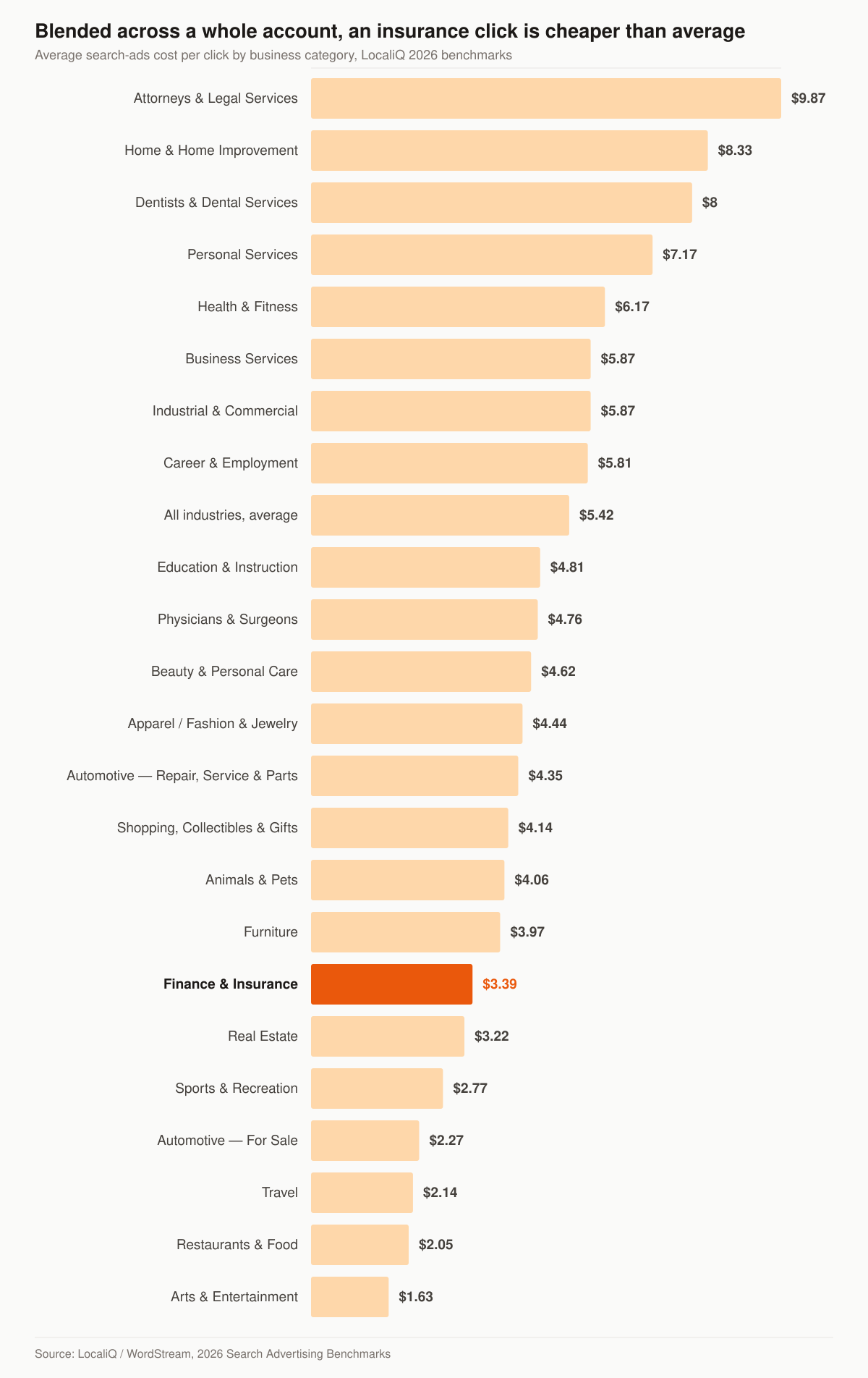
Average search-ads cost per click by business category. Source: LocaliQ / WordStream, 2026 Search Advertising Benchmarks.
So why does the invoice feel expensive? Because the conversion rate collapses to 2.64%, the lowest of the twenty-three categories in that report, and the cost per lead lands at $74.44 — above the $66.69 all-industry average despite the cheaper click. The auction is not where insurance agents are losing. The page after the click is.
Three caveats before you plan a budget around any of this, because they are exactly why the benchmark and the planning bands above do not match. These are blended averages across every keyword an advertiser runs, including brand terms and cheap long-tail, so no individual head term is priced at $3.39. “Finance and Insurance” also bundles banks, lenders and fintech in with agencies. And it is one company’s aggregated account data, not a Google-published rate card. Use it to sanity-check your account average, not to forecast the price of “medicare advantage plans near me”.
Why insurance CPCs are so high
The premium you feel on a head term is a function of three things stacked on top of each other.
- Lifetime value justifies the bid. A single Medicare Advantage enrollee or a placed life policy is worth hundreds to thousands of dollars over its life. When the prize is large, advertisers tolerate expensive clicks. The auction price rises to whatever the highest-value buyer can stomach.
- The buyers are deep-pocketed. You are not just bidding against other agents. You are bidding against national carriers, lead aggregators reselling the same click multiple times, and comparison sites monetizing every visit. They have data and budgets that an independent agency cannot match on raw bid.
- The format is regulated and constrained. Compliance narrows your options. TCPA governs how you can contact leads, CMS rules govern what you can say in Medicare AEP marketing, and Meta’s Special Ad Category limits targeting on social. Fewer ways to differentiate on targeting means more pressure on the auction itself.
The takeaway: you will rarely win insurance PPC by outbidding the auction. You win by converting the same click better and feeding the algorithm better signals, so your effective cost per policy beats competitors who only watch CPC. Where the auction is genuinely unaffordable for a local agent, pay-per-lead Local Services Ads sidestep the CPC model altogether — you are billed per contact, not per click, so the click price stops being the constraint.
You do not pay your bid: how Google actually prices the click
Most CPC advice stops at “lower your bid,” which misreads the billing. Google’s own documentation is specific about the gap between the number you type and the number you are charged.
On the bid itself: “Your max. CPC is the most you’ll typically be charged for a click, but you’ll often be charged less.” And on the ceiling: “If you enter a max. CPC bid and someone clicks your ad, that click won’t cost you more than the maximum CPC bid amount that you set.” Google names the difference: “The actual amount that you pay is called the actual CPC”, and it is the figure the account reports in the Avg. CPC column.
What sets the actual CPC is Ad Rank. Google defines it as “a set of values that are used to determine whether your ads are eligible to show and if eligible, where on the page your ads are shown (if at all) relative to other advertisers’s ads”, calculated “based on many factors, including your bid amount, the quality of your ads and landing page, the Ad Rank thresholds, the competitiveness of an auction, the context of the person’s search” — and, at the end of the same list, “the expected impact of assets and other ad formats”.
Then the sentence that should reframe how an agent thinks about a $45 keyword: “So, even if your competition has higher bids than yours, you can still win a higher position at a lower price by using highly relevant keywords and ads.”
The thresholds are the part almost nobody reads. Google says “Ad Rank thresholds determine your ability to compete in an ad auction”, that they are “determined dynamically at the time of each auction”, and — the line that matters for pricing — “Your actual CPC is calculated based on your Ad Rank, including the thresholds and competition from other advertisers.” On quality: “To help maintain a high quality ad experience for consumers, lower quality ads have higher thresholds.”
There is one counter-intuitive consequence Google spells out. “If your ad is the only one that’s eligible to show, (for example, because none of your competitors meet their Ad Rank thresholds), you’ll pay the reserve price (the threshold rounded up to the minimum billable unit in your country, for example to the next penny in the U.S.). This means that depending on your ad quality and Ad Rank thresholds your ad could be relatively expensive, even when no ads show immediately below it.”
For an insurance agent in a thin rural market, that kills a comforting assumption. Being the only advertiser on “final expense insurance [small town]” does not mean the click is nearly free. You pay the reserve price, and your own ad quality sets where that reserve sits. This is also why “raise Quality Score to get a discount” is the wrong mental model. Google’s own Quality Score documentation says the number is “not a key performance indicator and should not be optimized or aggregated with the rest of your data”, and then, flatly, “Quality Score is not an input in the ad auction. It’s a diagnostic tool to identify how ads that show for certain keywords affect the user experience.” Relevance is real and it does move your price, but it works through the Ad Rank threshold, not through a coupon on the 1-10 column. Our Google Ads setup guide for agents walks through the account structure that produces the relevance in the first place.
Why the same keyword costs you more than it costs the agent one state over
Two agents can bid on the identical keyword and see different average CPCs, and the reason is documented rather than mysterious. Google lists what varies the thresholds: “Your ad quality”, “Ad position”, “User signals and attributes such as location and device type” — with the parenthetical that “thresholds can vary country by country” and “for example, mobile versus desktop” — and “The topic and nature of the search”.
The Ad Rank definition adds the rest of the context: “the person’s location, device, time of search, the nature of the search terms, the other ads and search results that show on the page, and other user signals and attributes.” And Google notes the recalculation is per-auction: “Your ad position can fluctuate each time depending on your competition, the context of the person’s search, and your quality at that moment.”
Each documented factor maps to a control you already have in the campaign, which is what makes this worth reading rather than shrugging at.
| What Google says varies the price | Where it shows up for an agent | The lever you hold |
|---|---|---|
| Ad quality raises or lowers your threshold | Generic ad copy against a homepage landing page | Message-match the ad to the keyword and the page |
| Ad position carries a higher threshold higher up | Chasing the top slot on a head term | Accept position three on the expensive term; own position one on the long tail |
| Location varies thresholds | Statewide targeting across mixed-cost metros | Split expensive metros into their own campaign with their own bid |
| Device type varies thresholds | Mobile clicks that ring a phone nobody answers | Bid adjustments plus an ad schedule matched to staffing |
| Topic and nature of the search | “Insurance quote” versus “insurance license” | Negatives, tighter match types, intent-split ad groups |
| Reserve price when you are the only eligible ad | A thin rural or niche auction | Do not assume low competition means a cheap click; check actual CPC |
One footnote closes the loop between this section and your Quality Score column. Google lists factors “related to your ad quality that might not be captured by Quality Score,” and names four of them: “Devices used in search”, “Location of user”, “Time of day”, “Assets”. So the diagnostic in your keyword table is silent on precisely the variables that make your CPC differ from another agent’s on the same keyword. If you are trying to explain a price gap and the Quality Score column looks fine, that is the documented reason it can look fine.
None of that is exotic. It is the ordinary work of splitting a campaign so that expensive contexts and cheap contexts stop sharing one bid.
When each line’s auction gets expensive: the enrollment calendar
For the health and senior lines, competitive pressure is not a mood — it is a set of dates in the Code of Federal Regulations. Every carrier, field marketing organization and lead vendor in the country is buying the same weeks, because those are the only weeks in which most of their prospects can act.
For Medicare Advantage, 42 CFR 422.62(a)(2)(iii) provides that “Beginning in 2011, the annual coordinated election period for the following calendar year is October 15 through December 7.” Part D runs on the same dates under a provision of its own rather than a cross-reference: 42 CFR 423.38(b)(3) provides that “Beginning with 2011, the annual coordinated election period for the following calendar year is October 15 through December 7.” A second window follows in the new year: 42 CFR 422.62(a)(3)(i) provides, for 2019 and subsequent years, that “Except as provided in paragraphs (a)(3)(ii) and (iii) and (a)(4) of this section, an individual who is enrolled in an MA plan may make an election once during the first 3 months of the year to enroll in another MA plan or disenroll to obtain Original Medicare.” Note the scope limiter — that election belongs to people already enrolled in an MA plan, which is why the January-to-March auction rewards switch messaging rather than first-time enrollment messaging.
Turning-65 demand runs on a different clock and does not stop in December. 42 CFR 422.62(a)(1) sets the initial coverage election period as a window that “begins 3 months before the month the individual is first entitled to both Part A and Part B” and ends on the later of “The last day of the second month after the month in which they are first entitled to Part A and enrolled in Part B” or, after May 15, 2006, “the last day of the individual’s Part B initial enrollment period.”
For the Exchange market, 45 CFR 155.410(e)(4)(i) sets the annual open enrollment period for benefit years beginning January 1, 2022 through January 1, 2026: “Subject to paragraphs (e)(4)(ii) and (iii) of this section, the annual open enrollment period begins on November 1 of the calendar year preceding the benefit year and extends through January 15 of the benefit year.” Read the opening clause before you set a campaign end date. Under 45 CFR 155.410(e)(4)(ii), “For State Exchanges, for the benefit years beginning on or after January 1, 2025, a later annual open enrollment period end date may be adopted”, so January 15 is the end date on the federal platform, not a nationwide cut-off — if you advertise in a state that runs its own Exchange, check that state before you switch the campaign off. The end date changes again in 2027. Under 45 CFR 155.410(e)(5), for benefit years beginning on or after January 1, 2027, open enrollment for all Exchanges “must begin no later than November 1 and must end no later than December 31 of the calendar year preceding the benefit year”, and “must not exceed 9 weeks in duration.” Same demand, fewer days to buy it in.
Here is the calendar an insurance PPC budget has to be shaped around, with the citation for each window.
| Line | Peak buying window | Regulatory citation | What it does to your plan |
|---|---|---|---|
| Medicare Advantage / Part D | October 15 – December 7 | 42 CFR 422.62(a)(2)(iii); 42 CFR 423.38(b)(3) | Front-load budget; expect your own CPC to rise against your off-season baseline |
| Medicare Advantage switchers | January 1 – March 31 | 42 CFR 422.62(a)(3)(i) | Message to existing MA enrollees, not to first-time enrollees |
| Turning 65 | Rolling, per birthday | 42 CFR 422.62(a)(1) | The one senior-market campaign that can run twelve months a year |
| ACA / Exchange, through benefit year 2026 | November 1 – January 15; State Exchanges may end later | 45 CFR 155.410(e)(4)(i), (e)(4)(ii) | Overlaps AEP; two lines competing for the same November budget |
| ACA / Exchange, benefit years from 2027 | Starts by November 1, ends by December 31, max 9 weeks | 45 CFR 155.410(e)(5) | A shorter window concentrates demand; plan daily budgets accordingly |
| Final expense, term life, P&C | No federal window | — | Deliberately counter-cyclical: these auctions are quietest when Medicare is loudest |
That last row is the planning insight worth acting on. An agency writing more than one line can move budget away from the health lines in Q4 and into the lines nobody is fighting over that month. For the AEP side of this, see our Medicare AEP marketing strategies and the rules that apply during the January window in Medicare OEP marketing rules for agents; for the Exchange side, how ACA agents fill their pipeline during OEP. This is a summary of published regulation, not legal advice — read the sections yourself at eCFR 42 CFR 422.62, eCFR 42 CFR 423.38 and eCFR 45 CFR 155.410.
Who else is in the auction with you
Bid pressure has a face. In the personal lines, the advertisers setting the ceiling on auto and home keywords are running national brand budgets that no independent agency competes with on spend.
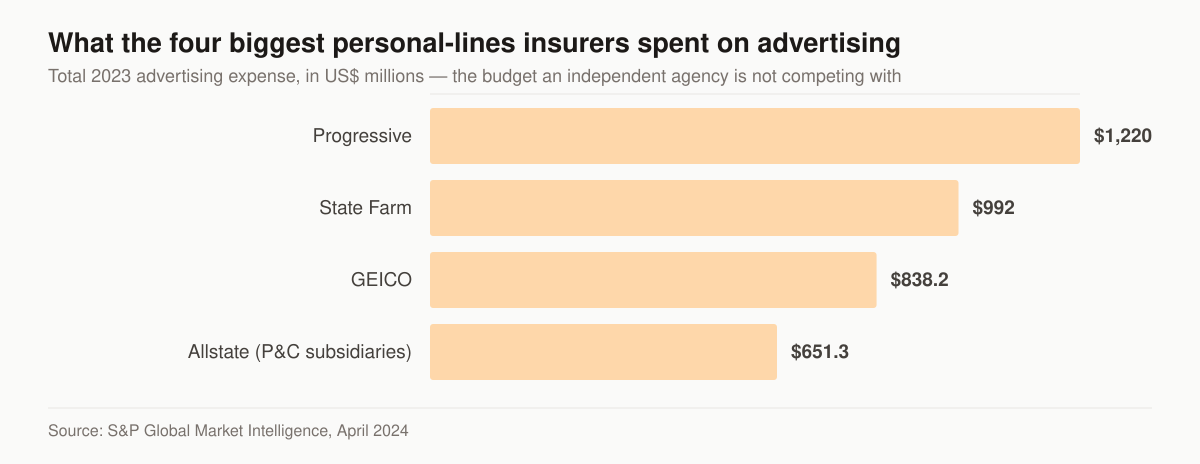
Total 2023 advertising expense, US$ millions. Source: S&P Global Market Intelligence, April 2024.
Those figures are total advertising expense across every channel, not search spend. Read them as scale, not as an auction bid. The practical conclusion holds either way: on “car insurance quote” you are a rounding error in somebody’s brand budget, and the winnable ground is the specific query a national brand writes no landing page for. Our guide to how auto insurance agents win clients online works through what that looks like in the P&C lines, and exclusive versus shared auto insurance leads covers the buy-instead-of-bid alternative.
The second class of bidder is less visible and more damaging to your CPC: lead aggregators. They can pay more for the same click than you can, because they sell the resulting contact to several agents rather than one. You are bidding against a business model with a different unit economics, not against a competitor with a better strategy.
CPC is the wrong number — track cost per acquired policy
A high cost per click is not the problem. A high cost per policy is.
This is arithmetic on assumed inputs, not measured client data — it exists to show which variable dominates. Same $1,000 of spend, two funnels.
| Scenario | CPC | Clicks | Conv. rate | Leads | Close rate | Policies | Cost per policy |
|---|---|---|---|---|---|---|---|
| Cheap clicks, weak funnel | $7 | 143 | 4% | ~6 | 1-in-8 | ~0.7 | ~$1,400 |
| Pricey clicks, strong funnel | $35 | 29 | 14% | ~4 | 1-in-5 | ~0.8 | ~$1,250 |
The $35 click wins because the funnel behind it is better, and it wins at five times the click price. That is the whole game. If you only optimize CPC, you optimize the one number in the chain that you control least.
Note where the leverage actually sits. The click price moved by a factor of five between those two rows and barely changed the outcome; conversion rate and close rate did the work. That matches the benchmark data above, where the insurance click is below the all-industry average and the cost per lead is above it.
What you can afford to pay for a click
The question we get asked is “what should a click cost?” The answerable question is “what can this click be worth to me?” — because that number, not a benchmark, is your bid ceiling.
Work backwards from the policy. Take your first-year commission on a placed case, multiply by the share of leads that close, multiply by the share of clicks that become leads, and you have the most a click can be worth before you are buying revenue at a loss. Every one of those inputs comes from your own CRM, which is the point.
A worked example with assumed inputs, to show the shape of the calculation rather than to predict your numbers.
| Input | Assumed value | Running result |
|---|---|---|
| First-year commission per placed policy | $600 | — |
| Leads that close | 1 in 6 | $100 of commission per lead |
| Clicks that become leads | 4% | $4.00 of commission per click |
| Target margin on acquisition | 50% | Bid ceiling around $2.00 per click |
Run your own numbers through that and one of two things happens. Either the ceiling clears the price of the keywords you want, in which case bid confidently and stop worrying about the benchmark. Or it does not — and the fix is upstream of the bid. Doubling the click-to-lead rate doubles the ceiling. Selling a line with higher first-year commission doubles it again. Buying pay-per-lead inventory instead, or Local Services Ads, takes the click price out of the equation entirely.
This is also the calculation that tells you whether paid search belongs in your plan at all this quarter. We work through the whole allocation question in how to set an insurance agency marketing budget, and the line-specific version for final expense in is final expense PPC worth it.
How to lower your insurance CAC
Customer acquisition cost is CPC divided by the product of every conversion step that follows. Improving any downstream step compounds. Here is the order we attack it, highest-leverage first.
- Fix the landing page before the bid. Paid traffic sent to a slow, generic homepage converts at the low end of that 2.64% category rate. A dedicated, fast, single-offer page can double conversion rate, which halves CAC at the same CPC. See how we build these in our insurance landing pages service.
- Tighten match types and negatives. Broad match without aggressive negative keywords burns budget on “insurance jobs”, “insurance license”, and tire-kickers. A disciplined negative list is the fastest waste-cutter in any new account.
- Improve relevance to lower your threshold, not to earn a discount. Google’s mechanism is explicit: lower quality ads carry higher Ad Rank thresholds, and your actual CPC is calculated from your Ad Rank including those thresholds. Tight ad-group themes and message-matched pages are how you move that lever. What they will not do is hand you a fixed percentage off, and any agency quoting you one is describing a coupon Google does not offer.
- Feed offline conversions back to Google. Import booked appointments and issued policies, not just form fills. When the algorithm bids toward revenue instead of raw leads, it stops buying cheap junk clicks and starts buying clicks that close.
- Mind the line-specific rules. For Medicare, stay inside CMS marketing rules for agents. For any lead you call, keep your consent and contact practices inside TCPA compliance for agents buying leads. Compliance is not just risk management — disapproved ads and account suspensions are silent CAC killers.
We treat those five as the standing order of work on an account, and the reason the order matters is that steps one and two change the denominator while step three changes the price. Doing three first, on a page that converts at 2%, buys cheaper clicks that still do not close.
Cheaper clicks that still close
Not every lever is a bid. Five ways to buy the same intent for less, in rough order of how quickly they pay off.
- Trade head terms for long tail. “Medicare plans” and “final expense whole life no exam Ohio” are different auctions with different thresholds. The long-tail query has less competition, a tighter ad-to-query match, and — because it names the product and the constraint — a searcher closer to a decision.
- Split the geography. Google documents that thresholds vary with the user’s location. A single statewide campaign averages an expensive metro with a cheap county and gives you one bid for both. Splitting them is a thirty-minute change that stops the cheap county from subsidising the expensive one.
- Run the second auction. LocaliQ’s benchmarks are drawn from “Google Ads and Microsoft Ads” campaigns together, and the same report tells advertisers they “can easily copy your Google Ads campaigns to Microsoft Ads using the import feature within the platform”. Whether it prices lower for your keywords is an account-level question, but the cost of finding out is small.
- Match the ad schedule to who answers the phone. A click that becomes a voicemail is a click you paid full price for and converted at zero. Dayparting to the hours your team actually picks up does not lower CPC; it raises the share of clicks that count.
- Buy contacts instead of clicks where you can. Local Services Ads bill per lead rather than per click. That is not automatically cheaper, but it moves the risk of a non-converting click off your invoice, which matters most in the lines where the click price is highest.
If you are weighing paid search against paid social rather than tuning it, we compare the two channels head to head in Facebook Ads vs Google Ads for insurance agencies.
Which leaves the one question a benchmark table cannot answer: who runs the account once you know the numbers. Negative keywords, match types, geographic splits and the offline-conversion import are weekly work, not quarterly work, and the benchmarks above only pay off if somebody is actually doing them between renewals.
Where to go from here
If your account is live but the math does not work, look at the funnel, the match types and the conversion signal before you touch the bid — that is where the published benchmark says insurance loses, and it is where the arithmetic above says the leverage is. We manage this end to end inside our insurance PPC management service — or, when search and social have to answer to a single cost-per-policy number, inside the wider insurance advertising program — and we benchmark click costs across lines in more depth in our Google Ads guide for insurance agents.
On what that costs: managed paid ads sit in the Full-Funnel tier at $5,500 per month, and your media budget is a pass-through paid straight to Google or Meta rather than marked up by us. The full ladder, including the $2,500 Foundation and $3,500 Growth tiers, is on our pricing page.
Want a second set of eyes on your numbers? Get a free marketing audit and we will pull your CPC, conversion rate, and cost per policy by campaign, then show you the two or three changes that move the needle first.
- How to Set Up Google Ads for Insurance Agents: Step by Step
How to set up Google Ads for insurance agents: campaign structure, settings, bidding, keyword and LSA setup, TCPA-aware compliance, and conversion tracking.
- Facebook Ads vs Google Ads for Insurance Agencies: Which Wins?
Facebook ads vs Google ads for insurance agencies: intent, cost, lead quality, and which channel fits final expense, Medicare, and auto — plus how to run both.
- Insurance Social Media Post Ideas: 75+ Posts by Line of Business
75+ insurance social media post ideas for auto, home, life, Medicare, final expense, and commercial agents, plus a cadence table and compliance rules.
- Social Media for Final Expense Agents: Organic, Paid, and Compliant
Social media for final expense agents: which platform the 65-plus buyer uses, what Meta's Special Ad Category removes, and the TCPA and FTC posting rules.