Final Expense Leads Cost: Why Cost Per Sale Is the Only Number That Matters
Final expense leads cost per lead vs true cost per sale describes two different numbers: what you pay for one lead versus what you pay to write one policy. True cost per sale divides total lead spend by policies issued, so a $9 lead at a 1-in-12 close rate actually costs about $108 per sale.
It is easy to shop final expense leads by sticker price. That is the wrong number. The price on the lead is not what the lead costs you. What it costs you is lead spend divided by policies placed — and as the worked table further down shows, those two numbers can sit more than a factor of ten apart.
This post walks the final expense leads cost per lead vs true cost per sale math, with a worked table you can copy into a spreadsheet. The point is simple: stop comparing leads. Start comparing cost per sale.
Two numbers, not one
There are two costs in play, and confusing them is how agents talk themselves into a bad deal.
- Cost per lead (CPL): the price you pay for one lead. A direct-mail card, a Facebook form, an aged data record. This is the number on the invoice.
- True cost per sale (CPS): your total lead spend divided by the number of policies you actually write and keep on the books. This is also called your cost per acquisition.
CPL is what the vendor wants you to look at. CPS is what your P&L looks at. A $7 lead and a $22 lead can produce the exact same cost per sale — or flip — once close rate and contact rate enter the math.
For context on how raw lead prices vary by source and exclusivity, our breakdown of what final expense leads actually cost by channel lays out the ranges before we layer the close-rate math on top.
What a final expense lead costs before any of this math
Cost per sale starts with a real invoice, so it is worth knowing what the market publishes before you argue about close rates. Two sellers put enough detail in public to compare.
Insurance Leads Guide publishes a 2026 price range for each final expense lead type. Read across the top of those bands and the market spans nearly five to one, from social media leads to live call transfers.
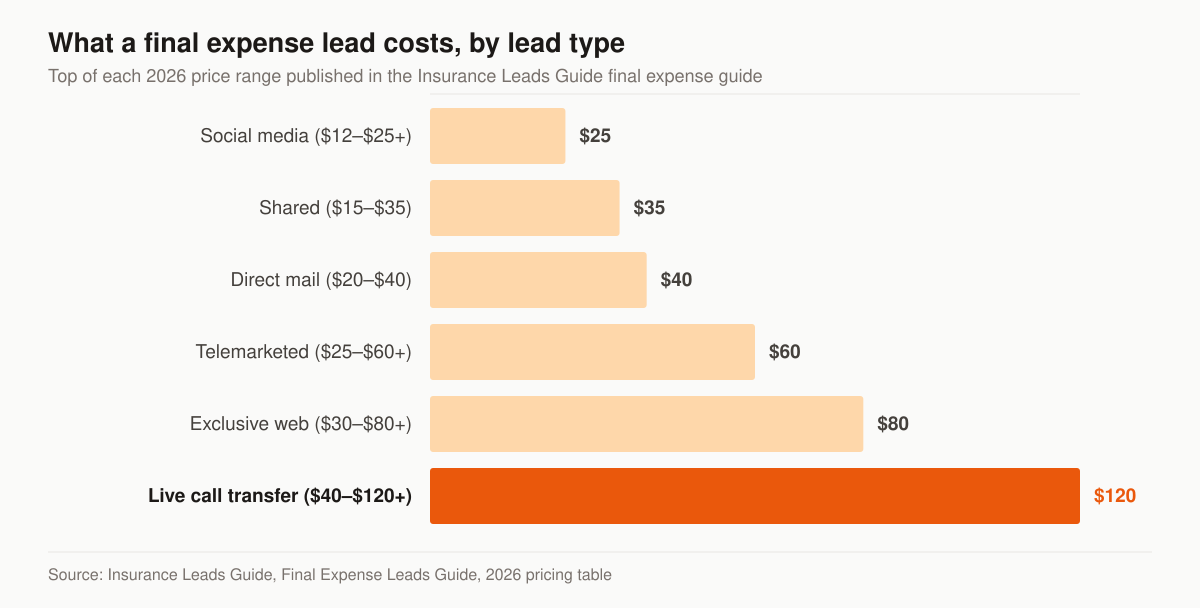
Chart: top of each published price band, from Insurance Leads Guide’s 2026 final expense leads guide.
This table sets the two published final expense price lists we could verify beside each other, worded as each publisher states them.
| Lead type | Published price | Publisher |
|---|---|---|
| Social media leads | $12–$25+ | Insurance Leads Guide, 2026 pricing table |
| Shared leads | $15–$35 | Insurance Leads Guide, 2026 pricing table |
| Direct mail leads | $20–$40 | Insurance Leads Guide, 2026 pricing table |
| Telemarketed leads | $25–$60+ | Insurance Leads Guide, 2026 pricing table |
| Exclusive web leads | $30–$80+ | Insurance Leads Guide, 2026 pricing table |
| Live call transfers | $40–$120+ | Insurance Leads Guide, 2026 pricing table |
| Fresh final expense leads | “$20-$45 each” | Aged Lead Store, final expense leads page |
| Aged, 15–45 days | $1.50–$1.88 | Aged Lead Store, published age tiers |
| Aged, 46–85 days | $0.62–$1.25 | Aged Lead Store, published age tiers |
| Aged, 86–180 days | $0.40–$0.75 | Aged Lead Store, published age tiers |
| Aged, 181–365 days | $0.25–$0.50 | Aged Lead Store, published age tiers |
| Aged, 365+ days | $0.15–$0.30 | Aged Lead Store, published age tiers |
Three things fall out of reading the two lists together. First, “a final expense lead” covers products separated by nearly three orders of magnitude on price, from fifteen cents to $120 and up, so a quoted number means nothing until you know the type, the age and the exclusivity behind it. Second, the two publishers do not agree on the fresh end: Insurance Leads Guide puts direct mail at $20–$40 while Aged Lead Store describes fresh final expense leads generally as “$20-$45 each,” which is close enough to treat as the same band and far enough apart to insist on a written quote. Third, the price you are quoted buys a different amount of competition at each end — Aged Lead Store’s page says fresh leads “get called by 5-20 agents within the first hour,” while the same page puts agent competition on aged leads at one to two callers.
Direct mail is the one channel with a published response rate to work from: Insurance Leads Guide states that direct mail “maintains 1-2% response rates with costs around $20-$40 per lead.” That response rate is the reason a mail lead costs what it does, and it is also the reason a mail campaign has a floor — the mail house prints whether anyone replies or not. Our breakdown of final expense mailer templates covers what changes that reply rate, and aged final expense leads covers the far end of the same price curve.
The formula
True cost per sale is one line of arithmetic:
True cost per sale = Cost per lead ÷ Close rate
Close rate here means policies placed per lead worked — not per lead contacted. If you write 1 policy for every 12 leads, your close rate is 8.3% and you divide by 0.083. That is the same as multiplying CPL by 12.
A fuller version loads in the leakage the simple formula leaves out:
Fully-loaded CPS = (CPL × leads per issued policy) ÷ placement rate
Placement rate is the share of issued policies that actually stay on the books past the chargeback window. Lapses and non-payment quietly raise your real cost per sale.
Contact rate is the multiplier hiding inside the close rate
Close rate gets the attention, but it is really two rates multiplied together: the share of leads you reach at all, and the share of the people you reach who buy. Confuse them and every number downstream is wrong.
The reach half is the one you do not control. Pew Research Center surveyed 10,211 U.S. adults between July 13 and July 19, 2020 and found that 19% say they generally answer a cellphone call from an unknown number. Sixty-seven percent said their practice is not to answer an unknown number but to check a voicemail if one is left, and 14% generally ignore both the call and the voicemail. That survey is about phone behavior in general rather than insurance leads specifically, and it predates much of the carrier-level call labeling now in the network, but it sets the shape of the problem: an unrecognised number is a minority-answer event, and a lead you cannot reach still shows up on the invoice.
Sellers publish their own reach figures, and they are not flattering either. Aged Lead Store’s comparison table puts contact rate at 50–65% on fresh leads and 25–35% on aged leads of 30 to 90 days, against close rates of 5–8% and 1–3% respectively.
This table runs one lead price through three contact rates, so the cost of a conversation is visible before anyone is sold anything.
| Cost per lead | Contact rate | Cost per conversation |
|---|---|---|
| $9 | 50% | $18.00 |
| $9 | 30% | $30.00 |
| $9 | 19% | $47.37 |
The arithmetic is ours, not a survey: cost per lead divided by contact rate. The point of running it is that the middle column is cheaper to move than the price column. Voicemail strategy, dial timing, caller ID registration and a second and third attempt all raise contact rate, and none of them require renegotiating with a vendor. We treat the contact rate as the first thing to fix on any lead source, before touching the price, and the cadence that does it is set out in our insurance lead follow-up cadence.
A worked example
This table walks the same $1,000 of lead spend across four common lead types, so the cheapest lead and the cheapest sale can be seen not to be the same row.
| Lead type | Cost per lead | Leads from $1,000 | Close rate | Policies written | True cost per sale |
|---|---|---|---|---|---|
| Aged data (bulk) | $2 | 500 | 2% | 10 | $100 |
| Shared internet lead | $9 | 111 | 6% | 6.7 | $149 |
| Direct-mail card | $28 | 36 | 18% | 6.4 | $156 |
| Exclusive real-time lead | $20 | 50 | 14% | 7.0 | $143 |
The prices and close rates in that table are illustrative inputs chosen to make the arithmetic legible, not quotes from a price list — the published bands are in the table further up, and they run higher on the fresh end than these round numbers do. Swap in your own figures and the structure of the answer does not change.
Read the last column, not the second. The $2 aged record and the $28 mail card both feel like opposite ends of the market, yet they land within $56 of each other on cost per sale. The exclusive real-time lead — pricier per piece than the shared lead — produces a lower cost per sale because its close rate more than doubles.
The lesson is not “buy cheap” or “buy exclusive.” It is: the close rate, not the price tag, sets your cost per sale. A lead you can reach and a lead that converts is worth paying up for. We dig into that tradeoff in our piece comparing exclusive versus shared final expense leads.
What one placed policy has to pay back
A cost per sale is only good or bad against the commission on the other side of it, and that side has published numbers too.
LIMRA and the Life Insurers Council released their 2024 Final Expense Survey Report on June 12, 2025. Twenty-eight life insurance companies reported 1.06 million policies sold in 2024, up 10% year over year, and U.S. final expense new annualized premium of $1.05 billion, up 16%. Of the sales reported, 85% were simplified-issue policies with an average face amount of $14,535; the remaining 15% were guaranteed-issue policies with an average face amount of $9,786. Independent distribution sold 86% of the policies reported, affiliated distribution 10%, and direct-to-consumer channels 4%. LIMRA states the limit of its own study plainly: the survey “is not a comprehensive view of the U.S. final expense market, but offers a snapshot of sales trends for participating companies.”
Keep three numbers separate, because they get used interchangeably and they are not interchangeable. Face amount is the death benefit. Premium is what the policyholder pays. Commission is a percentage of the premium, not of the face amount.
This table separates the three figures a final expense sale gets described with, and names who published each one.
| Figure | Published value | Source |
|---|---|---|
| Average face amount, simplified issue | $14,535 | LIMRA-LIC 2024 Final Expense Survey, 28 companies |
| Average face amount, guaranteed issue | $9,786 | LIMRA-LIC 2024 Final Expense Survey, 28 companies |
| Average annual premium used in a vendor’s own ROI example | $720, or $60 a month | Aged Lead Store, final expense leads page |
| First-year commission rate | “90-110% first-year commission on smaller policy amounts ($5,000-$25,000)” | Insurance Leads Guide, 2026 |
| First-year commission per policy | “$400-$700” | Aged Lead Store, final expense leads page |
| Renewal commission | “3-4% annually” | Insurance Leads Guide, 2026 |
Now the test. Put your true cost per sale beside your own first-year commission on a placed policy, not beside anybody’s average. If the commission clears the cost per sale with enough room to fund the next batch of leads before the money arrives, the source is fundable. If it clears by a few dollars, you are working for the lead vendor. And note what the renewal figure does to the argument for scale: at 3–4% a year, renewals on a small final expense policy do not rescue a broken acquisition cost — they reward one that already works. The contract level underneath all of this varies more than agents expect, which we lay out in final expense commission levels for agents.
Chargebacks, and the part of cost per sale that arrives late
Every formula above assumes the commission stays paid. It does not always, and the rules are published — not by lead vendors, but by carriers, in the administrative handbooks they give contracted agents.
Take one that is public. The Accendo Final Expense Administrative Sales Handbook, issued by Accendo Insurance Company — an Aetna affiliate in the CVS Health family — carries an effective date of 6/17/20 and a revision date of October 21, 2020. On cancellations it says: “If a policy is cancelled, withdrawn or not taken within the first 30 days of policy receipt, 100% of the premium will be refunded to the applicant and 100% of commissions will charge back to the agent.” On rescission it says: “If a policy is rescinded for material misrepresentation within the two-year contestability period, commissions will charge back to the agent.”
Read those two sentences as a cost line and the picture changes. A sale is not final at issue. It is provisional for the first 30 days on a not-taken basis and exposed to rescission for two years where material misrepresentation is involved.
This table lists what one carrier’s published handbook says will pull a final expense commission back, and when.
| Trigger | What the handbook says happens | Window |
|---|---|---|
| Policy cancelled, withdrawn or not taken | 100% of premium refunded to the applicant, 100% of commissions charged back to the agent | First 30 days of policy receipt |
| Policy rescinded for material misrepresentation | Commissions charge back to the agent | The two-year contestability period |
| Advanced commission on a cancelled policy | The advance becomes unearned commission and charges back to the agent’s commission account | Whenever the cancellation lands |
| Two rejected EFT transactions | The commissions advance charges back to the agent’s commission account and changes from advance to paid as earned | On the second rejection |
| Replacement policy | No advance commission is paid, and the first-year rate is 90% of the producer’s current rate, paid as earned | At issue |
The handbook adds two operational details worth planning around. A policy whose premium is paid by direct bill is not eligible for advance commissions at all under that document, and a chargeback that pushes an agent’s commission account negative stops commission payments until new submitted business brings the balance back positive. That second rule is what turns a placement problem into a cash-flow problem: the unpaid month is not the month the policy lapsed, it is every month after it until fresh business covers the hole.
Two caveats before anyone treats this as universal. This is one carrier’s document for its own products, and the handbook itself states that where its descriptions conflict with the terms of an agent’s contract, the contract terms control. Your carrier’s windows, advance percentages and not-taken rules will differ. Pull your own handbooks and build the table for the carriers you actually write — that exercise sits alongside choosing them, which we cover in best final expense carriers for agents. The reason it belongs on a cost-per-sale page is simple: everything in that table lands in the denominator, and none of it appears on a lead invoice.
Why agents get this wrong
Three habits inflate the real number while the agent stares at the sticker price:
- Counting issued, not placed. A policy that lapses in month two and triggers a chargeback was a cost, not a sale. Placement rate belongs in the denominator.
- Ignoring contact rate. A $9 lead you reach 40% of the time is not a $9 lead. Unworkable leads still cost money. Speed-to-dial and a real follow-up cadence move this more than any price negotiation.
- Mixing batches. Averaging a great direct-mail drop with a dead aged list hides which source is funding the agency and which is bleeding it.
The fix is boring and effective: tag every lead by source, track policies placed by source, and divide. Our note on why cheap leads can carry the highest true cost per sale covers the same trap from the “free leads” angle.
Two levers, two purchases. Lowering the price side means sourcing better inventory — a lead-purchasing transaction, so buy leads direct from getinsureleads, our sister brand built for exactly that. Lowering the conversion side is a marketing build. We don’t sell leads on this site; we build the systems that generate them, and that is the lever the rest of this section is about.
How to read a lead vendor’s own ROI table
Lead sellers publish ROI examples. They are useful, and they are written by the party being paid, so read them as arguments rather than as findings. Here is a real one, reproduced row for row from Aged Lead Store’s final expense leads page.
This table reproduces the ROI example one aged-lead seller publishes on its own final expense page, exactly as the rows appear there.
| Input | Published value |
|---|---|
| Monthly lead budget | $200 |
| Cost per lead, aged 46–85 day | $0.80 |
| Leads purchased | 250 |
| Contact rate | 30% |
| Contacts made | 75 |
| Close rate, of total leads | 2% |
| Policies written | 5 |
| Average annual premium | $720, or $60 a month |
| Average commission, 80% first year | $576 per policy |
| Total first-year commission | $2,880 |
| ROI | 14.4x, $2,880 divided by $200 |
Four things are worth checking before you copy that structure into your own spreadsheet, and none of them require accusing anyone of anything.
- The close rate is defined. The row reads “close rate (of total leads)”, not of contacts. Read a 2% figure as a close-of-contacted rate and you have quietly multiplied the projected sales by more than three, because the same table only makes contact with 75 of the 250.
- The premium and the commission level are assumptions, not your contract. The example runs a $720 annual premium at an 80% first-year rate. Insurance Leads Guide publishes a first-year band of “90-110%” on policies of $5,000–$25,000. Neither figure is your contract; yours is on your carrier’s schedule.
- The table stops before any chargeback. It ends at first-year commission. Nothing in it accounts for the not-taken window or a lapse inside the advance period.
- The seller states its own limits. The same page carries the line: “Close rates and commission figures reflect typical industry benchmarks — actual results depend on follow-up consistency, product knowledge, local market conditions, and lead age.”
The same page also publishes a fresh-versus-aged comparison that is more revealing than the ROI box. Against fresh leads, it puts aged leads of 30 to 90 days at $0.40–$2.00 per lead rather than $20–$45, at a cost per sale of $15–$100 rather than $300–$700, with contact rates of 25–35% rather than 50–65% and close rates of 1–3% rather than 5–8%. Those ranges are wide enough to contain both a good decision and a bad one, which is the honest state of the market. A published range tells you what to test, not what you will get. For how the vendors themselves differ, see our roundup of final expense lead generation companies.
How to lower true cost per sale
You have exactly three levers. Cost per lead is only one of them, and usually the weakest.
- Raise close rate. Better contact discipline, a tighter phone presentation, and faster first-dial all lift placed policies per lead. This is the highest-leverage lever because it sits in the denominator.
- Raise placement rate. Sell to budget, set draft dates that match Social Security deposits, and qualify health honestly up front. Fewer chargebacks, lower CPS.
- Lower cost per lead — last. Negotiate volume or test a cheaper source only after the first two levers are tuned, and only if close rate holds.
This table pits a price cut against a close-rate lift on the same $9 lead, which is the comparison worth running before you spend an hour negotiating with a vendor.
| Lever pulled | Change | New cost per sale (from $9 lead) |
|---|---|---|
| Baseline | 6% close | $150 |
| Cut CPL 20% | $9 → $7.20 | $120 |
| Raise close rate 20% | 6% → 7.2% | $125 |
| Raise close rate to 10% | 6% → 10% | $90 |
Cutting the lead price 20% saves you $30 per sale. Lifting close rate from 6% to 10% saves you $60 — and it compounds across every lead you already bought. That is why our own book leans on close-rate infrastructure over bargain hunting; we run a real final-expense lead operation, and the leads only pay off because the follow-up does.
How many leads a monthly budget actually buys
Before close rate enters the picture, a budget buys a quantity, and the quantity decides whether the source can be measured at all. Run $1,000 a month against the top of each published band.
This table divides a $1,000 monthly lead budget by the top of each published price band, so volume and price sit in the same view.
| Lead type, at the top of its published band | Price | Leads from $1,000 a month |
|---|---|---|
| Aged, 365+ days | $0.30 | 3,333 |
| Aged, 46–85 days | $1.25 | 800 |
| Social media | $25 | 40 |
| Shared | $35 | 28 |
| Direct mail | $40 | 25 |
| Telemarketed | $60 | 16 |
| Exclusive web | $80 | 12 |
| Live call transfer | $120 | 8 |
The division is ours; the prices are the published bands listed earlier. Aged Lead Store does the same arithmetic on its own page, stating that at its prices “a $200 monthly budget buys 160-320 leads.”
Two consequences follow, and they matter more than the ROI comparison. The first is capacity: 3,333 aged records is a dialing operation, not a solo agent’s month, and buying them without the dial hours to work them converts a cheap lead into a wasted one. The second is measurability, and it is the bigger trap at the bottom of the table. Eight live transfers cannot tell you what live transfers cost per sale. One extra sale in that batch and the measured cost per sale halves; one fewer and it doubles. The budget bought inventory but not information. Sizing that decision against everything else you spend is what our insurance agency marketing budget breakdown is for.
How big a test has to be before the number means anything
This is the discipline the cost-per-sale formula quietly depends on, and it is easy to skip, because a cost per sale can be calculated from any sample size at all — including a sample of one.
The arithmetic is unforgiving at small numbers. At a 6% close rate, 50 leads carries an expectation of three sales. Write four instead of three and your measured close rate reads 8%; write two and it reads 4%. Nothing about the source changed. The same two-sale swing on 500 leads moves the measured rate by a fraction of a point. Cost per sale inherits all of that volatility, because the sale count is the denominator.
Aged Lead Store’s own guidance on this is the same, which is notable given that larger orders are also better for the seller: it recommends starting with at least 500 leads, on the stated grounds that smaller samples produce unreliable results because of variance.
We treat a lead source as unmeasured until it has produced enough placed policies to survive one sale going the other way, and we say so in reporting rather than presenting an early cost per sale as a result. That means holding a source long enough to judge it, and it means not killing a source in week two on a number that was never stable. It also means the test has to be funded as a test — the budget for finding out what a channel costs is not the same budget as running it.
Put your own numbers in
Pull your last 90 days. For each lead source, you need four figures: leads bought, total spent, policies placed (after chargebacks), and the dates. Then:
- Divide spend by leads → your real CPL by source.
- Divide policies placed by leads → your real close rate by source.
- Divide CPL by close rate → your true cost per sale by source.
- Compare that to your first-year commission per placed policy.
If commission comfortably clears cost per sale, scale that source. If it does not, the lead was never cheap — it was just cheaply priced. For agents who want this modeled against their actual carrier comp and lead mix, a free marketing audit will run the spreadsheet with you, and our broader final expense marketing playbook shows where the lead math sits inside a full agency funnel. To set the budget those numbers imply, use our agency marketing budget and cost-per-sale math.
Rented leads and owned leads behave differently in the formula
One last distinction, because it changes which lever you are even allowed to pull. A purchased lead is a per-unit cost that resets every month: stop paying and the inventory stops. A lead your own site, search presence or ad account produces is a fixed monthly cost spread over however many leads it generates, which means the cost per lead falls as volume rises instead of holding flat.
That is not an argument that one is better. It is an argument that they enter the same equation differently, and both belong in it. A retainer is an acquisition cost exactly as a lead invoice is, and it should be judged the same way — against placed policies, not against traffic.
Our own numbers are published so you can run that comparison without a sales call. Programs are priced at $2,500 a month for Foundation, $3,500 for Growth and $5,500 for Full-Funnel, with one-time website builds from $2,500 to $8,000, and ad spend billed straight through to the platforms rather than marked up. Put whichever figure applies into the numerator, divide by the policies placed in the same period, and you have the same cost-per-sale number you just calculated for your lead vendor. Where the crossover falls depends entirely on your close rate and your premium, which is why we would rather you ran it than took our word for it. What an owned pipeline actually involves is set out on our insurance lead generation page, and the build-versus-buy question specifically is worked through in burial insurance lead generation, build versus buy.
The headline holds: final expense leads cost per lead vs true cost per sale is the whole game. One number is a price. The other is a profit decision. Track the second one and the lead market stops being a guessing game.
- Aged Final Expense Leads: What They Are and When the Math Works
Aged final expense leads cost a fraction of fresh leads. Here's what they are, the ROI math that decides if they work, and when to skip them.
- Exclusive vs Shared Final Expense Leads: A Cost-Per-Sale Breakdown
Exclusive vs shared final expense leads, compared on real cost-per-sale math, contact rates, and close rates so agents can pick what actually pays.
- Final Expense Lead Generation Companies for Agents: A Buyer's Map
A practitioner's breakdown of final expense lead generation companies: the vendor types, real cost-per-sale math, and when building your own wins.
- How to Get Final Expense Leads: Sources, Costs, and Contact Rates
How to get final expense leads: five sources compared on cost, exclusivity, and contact rate, plus a 30-day plan to prove your first channel pays.