Who we serve
Group Life Insurance Marketing for Agents
Group life insurance marketing for agents sells to a buying committee, HR, the CFO, and often a broker of record, over a 30-to-90-day cycle tied to the renewal date, not a single household in one sitting. It runs on LinkedIn and search authority content, employer-targeted ads, and follow-up built for slow B2B decisions.
Free · 15-minute teardown · no pitch deck
- We run our own final-expense book
- No pitch deck — we screen-share real numbers
- TCPA-aware · CMS/AEP-compliant · Meta Special Ad Category
- Core Web Vitals < 2.0s LCP
Agents who expand into the employer market often carry consumer tactics into a B2B sale and stall. Group life insurance marketing for agents is a different machine. You are not convincing one person at a kitchen table — you are getting on the calendar of an HR manager, surviving a CFO’s cost review, and timing it all to a renewal date you don’t control. The agencies that win the group market build for that reality.
We’ve spent years running a real senior-market lead operation. Group benefits is a longer cycle than final expense, but the discipline transfers directly — the same conversion systems and ad rigor that fill our senior-market clients’ pipelines map cleanly onto a B2B funnel.
Two layers, two pages. This pillar is the execution layer — the targeting, content, renewal-timed outreach, and enrollment systems we build for benefits producers. For the strategy layer — the three buyers, firmographic targeting, and the outreach cadence written as a sequence — read marketing group life and employee benefits alongside it.
Who actually buys, and why it changes the marketing
A group sale has a committee, not a buyer. Your marketing has to speak to each seat. The table below sets the four seats side by side with the concern each one brings to the meeting and the hook that earns you the meeting in the first place.
| Decision-maker | What they care about | Hook that earns the meeting |
|---|---|---|
| HR / Benefits manager | Cost, participation, enrollment workload | “Lower your renewal increase without cutting coverage” |
| CFO / Owner | Total spend, business continuity, risk | “What a key employee’s death actually costs the P&L” |
| Broker of record | Incumbency, relationship | You displace by proving better service or price |
| Employees | Take-home impact of voluntary benefits | Enrollment campaigns, not prospecting |
If one piece of creative tries to talk to all four, it lands with none. Business life insurance marketing wins when each offer matches the problem on one person’s desk.
How big the group life market is, and where the gap sits
Two public datasets tell a benefits producer where the prospects actually are, and both are free to read before you spend anything on targeting.
The first is the coverage side. The Bureau of Labor Statistics measures both access to a benefit and participation in it through the National Compensation Survey. In March 2025, 59 percent of private industry workers had access to life insurance benefits, 58 percent participated, and the take-up rate among those with access was 98 percent. Split by establishment size, the picture changes completely.
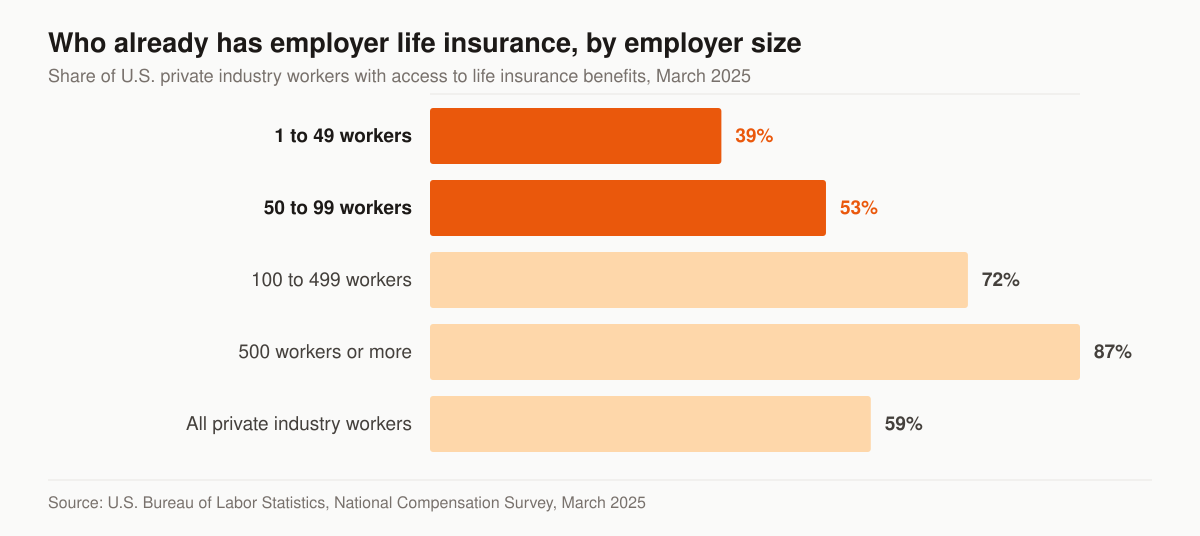
Access to life insurance benefits among private industry workers, March 2025. Source: U.S. Bureau of Labor Statistics, National Compensation Survey, table 5.
Read that as a prospecting map rather than a market statistic. At 500 workers and up, 87 percent of workers already have access, so the sale there is normally a displacement — you are unseating a broker of record, not creating a plan. Below 50 workers only 39 percent have access, so the conversation is far more often a first-time one about whether to offer the benefit at all. Those are two different messages, two different pieces of content, and two different sales cycles, and running one campaign across both underperforms on both ends.
The second dataset is the sales side. LIMRA’s 2024 workplace benefits sales surveys, which LIMRA says represent at least 90 percent of their respective annualized premium markets, put workplace life insurance new premium at a record-high $4.5 billion in 2024, up 8 percent from 2023 — a fourth consecutive year of growth. Term products represent just over 80 percent of workplace life insurance sales. In the fourth quarter of 2024, workplace life insurance new premium was over $925 million, a 10 percent jump on the prior year, and while the number of employer groups sold fell 1 percent, participants rose 9 percent. Patrick Leary, corporate vice president and head of LIMRA workplace benefits research, attributed the run to the labor market: “Throughout 2024, employers continued to use their workplace benefits programs to compete for talent in a tight job market. Our research finds more than 60% of workers are at least somewhat more inclined to stay with their employer because of their benefits package so it is not surprising that workplace benefits sales remained strong.”
The table below sets the three workplace lines side by side using LIMRA’s 2024 new-premium figures, because it shows which adjacent product carries enough volume to be worth a second campaign once you hold the group.
| Workplace line | 2024 new premium | Change vs. 2023 |
|---|---|---|
| Life insurance | $4.5 billion | Up 8% |
| Disability insurance | $4.2 billion | Up 2% |
| Supplemental health products | $3.3 billion | Up 8% |
U.S. workplace benefits new premium, 2024. Supplemental health includes critical illness, accident, cancer, hospital indemnity and other supplemental health products. Source: LIMRA.
The marketing consequence of that table is that a group life win is the entry point to two markets of comparable size sitting on the same census, the same HR contact, and the same renewal date. That is the case for treating the first sale as an acquisition cost against three lines rather than one.
The three offers under one B2B brand
Group life, voluntary benefits, and key-person coverage share an audience but need separate angles:
- Group life and voluntary benefits — speak to HR about cost control, participation rates, and retention. This is employee benefits marketing for agents at its core: renewal benchmarks, census-based quoting, and clean enrollment.
- Voluntary / worksite benefits — once you hold the group, the marketing shifts to employee enrollment: short-form education, deadline-driven communication, higher participation.
- Key person and buy-sell — this speaks to the owner and CFO about continuity and succession, not to HR. It’s a distinct funnel that converts on business risk, and it’s deep enough to deserve its own playbook in our key-person and buy-sell insurance marketing guide.
The channels that fit a B2B cycle
Consumer life leans on Facebook and direct response. Group benefits leans on authority and precision targeting:
- LinkedIn — organic thought leadership plus paid targeting by company size, industry, and role. This is the highest-intent way to reach HR and finance directly.
- Search and SEO — employers research “benefits renewal,” “voluntary benefits options,” and “key person insurance” before they ever call. Ranking for those terms makes you the firm they discover, not the one cold-calling. Our insurance SEO approach is built for this slow-intent traffic.
- Follow-up sequences — B2B decisions take 30–90 days. Email and LinkedIn sequences keep you present until the renewal window opens. The lead-generation systems we deploy are designed for multi-touch B2B nurture, not one-and-done.
- GEO / AI search — increasingly, HR teams ask ChatGPT and AI Overviews “how do I lower our group life cost?” Structured, answer-ready content gets your firm cited in those answers — a moat most benefits brokers haven’t built yet. That surface is the job of our AI search and GEO service.
None of the four produces a meeting on its own inside a 30-day window. What they do is compound: the search page makes the LinkedIn message credible, the LinkedIn message makes the email sequence a warm follow-up rather than a cold one, and the sequence carries the relationship to the only date the buyer can act on.
Building the prospect list: the firmographics that predict a group case
Group benefits marketing fails more often on the list than on the creative. A perfectly written cost-benchmark asset sent to 4,000 companies with no shared characteristic produces nothing; the same asset sent to 200 employers in one industry, in one size band, whose plan year starts in four months, produces meetings. We build the list from signals that can actually be observed from outside the company.
The table below is the six-signal screen we apply before a name goes into a sequence, with where each signal is read and why we treat it as predictive.
| Signal | Where it is read | Why we treat it as predictive |
|---|---|---|
| Headcount in the 20–99 band | LinkedIn company size facet, the employer’s own careers page | BLS access rates are lowest below 100 workers, so this band holds the highest share of employers with no life plan to displace |
| Recent headcount growth | LinkedIn company growth rate facet, volume of open roles | A group adding lives re-rates at renewal, and a re-rate is when an employer shops |
| A first HR or benefits title appearing | LinkedIn job title and seniority facets | We read the first dedicated benefits hire as the point at which an informal plan gets reviewed formally |
| Plan year or renewal month | The employer’s Form 5500 filing, where one exists | It sets the only window in which the buyer can act, which sets your send date |
| Industry | LinkedIn company industry facet | It decides which carriers will quote the risk and what participation on voluntary lines tends to look like |
| Multiple named owners | State business registry, the employer’s about page | Buy-sell and key-person exposure sits on the same account, which is a second offer for the same acquisition cost |
This is the point where a B2B list stops resembling a consumer lead file: you are not buying 5,000 records, you are qualifying 200 and knowing something specific about each.
Where the public data on employer benefit plans actually lives
Benefits producers routinely pay for prospect data that is partly available for free, and just as routinely assume the free source covers a market it does not. Both mistakes come from not knowing what the Form 5500 dataset contains.
The Department of Labor publishes structured filing data from the Form 5500 and Form 5500-SF in its Form 5500 datasets. In its own description, “The Form 5500 Annual Report is the primary source of information about the operations, funding and investments of approximately 800,000 retirement and welfare benefit plans,” and the 2009-and-later datasets are, per the DOL, “typically updated around the first of each month, give or take a few days.” For a benefits marketer that is a searchable list of plan sponsors, plan years, participant counts, and the insurers and service providers attached to them.
The limit is the one that matters for your list. Under 29 CFR 2520.104-20, the administrator of a welfare plan that “covers fewer than 100 participants at the beginning of the plan year” and meets the conditions in paragraph (b) “is not required to file with the Secretary an annual or terminal report.” The conditions in paragraph (b) are specific rather than general: benefits paid from the employer’s general assets, or provided exclusively through insurance contracts whose premiums are paid by the employer from general assets or partly from employee contributions — with those contributions “forwarded by the employer or employee organization within three months of receipt” — plus, for an insured plan, refunds returned to contributing participants within three months and participants told at entry how refunds are allocated, and the plan not being subject to the Form M-1 requirement.
Two practical consequences follow. First, the sub-100-life market — the same band where the BLS chart above shows the lowest coverage — is largely invisible in the public filings, so that list has to be built from firmographics rather than downloaded. Second, the 100-participant test runs at the beginning of the plan year, and the regulation’s own worked example says so: a plan with 75 participants at the start of the plan year and 105 at the end still qualifies for the exemption “because it had fewer than 100 participants at the beginning of the plan year and otherwise satisfied the conditions of the exemption.” A fast-growing employer therefore shows up in the data a year later than it grows, which is exactly one renewal cycle of warning if you are watching for it.
Worth noting for the compliance-explainer content this section suggests: the exemption is narrow. Paragraph (c) states it “does not exempt the administrator of an employee benefit plan from any other requirement of title I of the Act, including the provisions which require that plan administrators furnish copies of the summary plan description to participants and beneficiaries.” A small employer that files nothing still owes its people an SPD — a genuinely useful thing to be the broker who mentions.
The renewal calendar: what an employer should hear, and when
A group benefits pipeline is a calendar problem before it is a creative problem. The buyer cannot act outside the window, so outreach that arrives in the wrong month is not early — it is wasted. We build the sequence backwards from each prospect’s plan year.
The table below maps one employer’s renewal countdown to the single message that belongs in that month and the channel it should run on.
| Window | What the employer is doing | The message that belongs there | Channel |
|---|---|---|---|
| 9–12 months out | Nothing benefits-related | Authority content: cost drivers, participation benchmarks, compliance explainers | Search, LinkedIn organic |
| 6 months out | Budget planning begins | A benchmark asset sized to their industry and headcount | Email, LinkedIn message |
| 4 months out | Deciding whether to market the plan | Capabilities, carrier access, and a census request | Email, then call |
| 3 months out | Gathering quotes | Proposal, side-by-side, and a plan for enrollment | Meeting |
| 60 days out | Committee decision | Answers for the CFO on total cost, answers for HR on workload | Meeting, follow-up email |
| 30 days out | Enrollment planning | The enrollment communication plan, dated | Email, worksite scheduling |
| Effective date onward | Employees choosing | Enrollment campaign on the voluntary lines | Email, worksite, print |
| 30 days after | Plan live | A referral conversation with the CPA or attorney who advised them | Call |
The reason to run it as a calendar rather than a newsletter is that a newsletter fires on your schedule and a renewal fires on theirs. That distinction is what the email and marketing automation build is for, and it is why the first month of an engagement is spent capturing plan-year dates rather than writing copy.
What LinkedIn targeting actually gives you
LinkedIn is the channel that most benefits producers name and fewest use precisely. Its Campaign Manager targeting is organized into facets, and the ones that matter for a group benefits campaign are the company and job-experience sets: company size, company industry, company growth rate, company revenue and company name on the firm side; job title, job function, job seniority, years of experience and member skills on the person side. Location is required. Matched audiences let you upload a company list of your own, which is how a firmographic screen like the one above turns into an actual audience.
The constraint to plan around is stated on LinkedIn’s own targeting options page: “The minimum audience size required to run an ad set is 300 member accounts.” Stack location plus company size plus job seniority plus a narrow industry in a single metro and a benefits audience falls under that floor quickly, at which point the ad set will not run at all.
Our rule when that happens is to widen geography before widening titles. A benefits decision-maker two metros away is still a benefits decision-maker; a marketing manager in your own city is not, and loosening the seniority filter to clear the 300-member floor buys reach by spending it on the wrong people. The alternative when a market genuinely is too small for paid reach is to stop paying for it — run the same list through direct outreach and referral instead, which is what appointment setting is built for.
Emailing HR and CFOs: what CAN-SPAM requires of B2B outreach
Email is the backbone of a 30-to-90-day B2B follow-up sequence, and a persistent myth in benefits sales is that the rules only bite on consumer email. They do not. The FTC’s own compliance guide is explicit: the CAN-SPAM Act “covers all commercial messages, which the law defines as ‘any electronic mail message the primary purpose of which is the commercial advertisement or promotion of a commercial product or service,’” and it adds the sentence that settles the question — “The law makes no exception for business-to-business email.” The FTC puts the exposure at “up to $53,088” for each separate email in violation.
The requirements are short enough to build into a template once:
- Accurate header information. The From, To, Reply-To and routing information “must be accurate and identify the person or business who initiated the message.”
- A subject line that matches the message. The FTC’s phrasing is that it “must accurately reflect the content of the message” — which rules out the fake-reply and fake-referral subject lines that circulate in B2B prospecting templates.
- A disclosure that the message is an ad, made clearly and conspicuously.
- A valid physical postal address. The FTC accepts a street address, a registered PO box, or a private mailbox registered with a commercial mail receiving agency.
- A clear opt-out, which you must be able to process “for at least 30 days after you send your message,” and must honor “within 10 business days.” You cannot charge a fee, demand identifying information beyond an email address, or make the recipient do more than send a reply or visit a single web page.
- Responsibility you cannot outsource. Hiring a sending vendor does not move the liability: per the FTC, “the company whose product is promoted in the message and the company that actually sends the message may be held legally responsible.”
One nuance is worth knowing before you write the enrollment emails later in this page. The Act treats “transactional or relationship” messages differently, and one of the five categories the FTC lists is content that “provides information about an employment relationship or employee benefits.” An enrollment communication to an employer’s own workforce may sit in that category where a cold prospecting email plainly does not. The FTC also warns that “the law views these categories narrowly,” so the call on any specific enrollment message belongs to counsel and the plan sponsor, not to a marketing calendar. The wider set of advertising rules a licensed producer works under is covered in insurance marketing compliance for agents.
Marketing voluntary benefits without pulling the plan into ERISA
Voluntary and worksite products are the natural second sale after a group life win, and they carry a compliance question that lands squarely on the marketing collateral rather than on the policy. Some group or group-type insurance programs sit outside ERISA entirely, and whether they do turns on what the employer does — including what the employer says in the enrollment material a broker writes.
The safe harbor is at 29 CFR 2510.3-1(j). It excludes from the terms “employee welfare benefit plan” and “welfare plan” a group or group-type insurance program offered by an insurer to employees or members of an employee organization where all four of the following hold: no contributions are made by the employer or employee organization; participation is completely voluntary for employees or members; the employer or employee organization “receives no consideration in the form of cash or otherwise in connection with the program, other than reasonable compensation, excluding any profit, for administrative services actually rendered in connection with payroll deductions or dues checkoffs”; and, in the language that decides most marketing questions, the employer’s sole functions with respect to the program are, “without endorsing the program, to permit the insurer to publicize the program to employees or members, to collect premiums through payroll deductions or dues checkoffs and to remit them to the insurer.”
That third clause is where enrollment collateral lives. “Permit the insurer to publicize” and “endorse” are different acts, and the line between them runs through the wording, the letterhead, and the voice of the material. An enrollment flyer written so that the employer appears to recommend the product is doing something the safe harbor does not contemplate. So is a benefits portal page where HR presents the voluntary line the same way it presents the employer-paid one.
We do not give legal advice, and the determination is fact-specific and belongs to the plan sponsor’s counsel. What a marketing partner owes the broker is simpler and still valuable: enrollment assets that are drafted in the insurer’s voice by default, a review step before anything goes out under an employer’s name, and a producer who knows why the question is being asked. That drafting discipline is part of how we run insurance content marketing for benefits accounts.
Enrollment marketing: the job that starts after you win the group
Winning the group is the start of the marketing, not the end of it. The number an HR buyer actually feels a year later is participation, and participation is a communications outcome.
The BLS figures set the ceiling honestly. Among private industry workers with access to life insurance benefits in March 2025, 98 percent participated; in establishments with 1 to 99 workers, access was 42 percent and participation 41 percent, a take-up rate of 97 percent. Read that carefully before you quote it to a prospect: BLS’s table does not split employer-paid basic life from employee-paid voluntary coverage, so a take-up rate that high reflects benefits that are largely employer-funded and often automatic. It is evidence that basic group life is close to its ceiling once offered, not evidence about what a voluntary line will do.
That is precisely why the enrollment work concentrates on the voluntary layer, where an employee makes a real choice and a deadline actually matters:
- One decision per message. An email that asks an employee to consider four products asks them to do nothing.
- A dated window, repeated. Enrollment is a deadline event; the communication plan should look like one, with a launch, two reminders, and a final-day send.
- Manager-relayed, not just HR-broadcast. A note that arrives from the person an employee reports to is opened. Give the employer that note pre-written.
- Take-home framing, not policy framing. The employee is deciding what leaves each paycheck, so the material should lead with the per-pay-period figure and the coverage it buys.
- A post-enrollment report to HR. Participation by location and by product is the artifact that makes your renewal conversation easy a year later.
None of that requires new channels. It requires the sequence to exist, dated and written, before the plan goes live rather than in the week enrollment opens.
On buying leads vs. building the pipeline
B2B benefits leads exist, but they’re thin, pricey, and inconsistent in intent. If you want to test purchased business-owner or group leads alongside what you generate, do it through a real lead supplier — you can buy leads direct from getinsureleads rather than treating a marketing partner as a lead vendor. Our job is the system that produces your own pipeline; the sister brand handles direct supply. That separation keeps your acquisition costs honest and your data clean.
How to measure a group benefits marketing program
Cost per lead is the wrong unit for a sale that takes three months and a committee. A group program is judged on meetings with the right title, on how many of those meetings survive to a proposal, and on lives bound per renewal month — and most of those numbers live in the agency’s CRM rather than in an ad platform.
The table below is the reporting set we hold a group benefits program to, with where each number is read and the decision it drives.
| Number | Definition | Where it is read | The decision it drives |
|---|---|---|---|
| Cost per booked meeting | Channel spend divided by meetings held with a qualifying title | Ad platform spend joined to the CRM | Compares LinkedIn, search and outreach in one unit |
| Right-title rate | Share of meetings held with HR, finance or an owner rather than a gatekeeper | CRM | Separates a targeting problem from a messaging problem |
| Meeting-to-proposal rate | Proposals issued divided by meetings held | CRM | Tells you whether the offer or the discovery is failing |
| Proposal-to-bound rate | Groups bound divided by proposals issued | CRM, carrier reporting | Where pricing and carrier access show up |
| Lives per group won | Total covered lives divided by groups bound | Carrier reporting | The case-size number that sets what a meeting is worth |
| Pipeline coverage by renewal month | Active opportunities against each month’s renewals | CRM | Exposes the months you will have nothing to close |
| Voluntary participation rate | Enrolled employees divided by eligible employees, by product | Carrier or enrollment platform reporting | Judges the enrollment campaign and sets up the renewal |
The two numbers to instrument first are cost per booked meeting and pipeline coverage by renewal month, because between them they answer the only two questions a benefits producer can act on this quarter: is the reach working, and will there be anything to close in March.
What a group benefits marketing engagement costs
We publish prices, because a benefits producer comparing shops should not sit through a discovery call to learn the band. There are three monthly tiers and one entry build.
The table below shows what each published tier runs and the kind of benefits practice it usually fits.
| Tier | Monthly | What it runs | The practice it fits |
|---|---|---|---|
| Foundation | $2,500 | Optimized site and landing pages, local SEO with the Google Business Profile, on-page SEO, monthly reporting | A producer whose site does not yet stand up to a CFO’s search before a meeting |
| Growth | $3,500 | Everything in Foundation, plus the ongoing SEO and content engine, AI-search visibility, and reputation and reviews | A benefits practice that needs authority content and AI-search presence running together |
| Full-Funnel | $5,500 | Everything in Growth, plus managed paid ads on Google and Meta, landing-page CRO, marketing automation and CRM, and full-funnel reporting | An agency running paid reach and renewal-timed automation across a named account list |
| One-time build | $2,500–$8,000 | A credible B2B site, built once | A producer whose site is the reason employer meetings stall |
Growth is where we point most benefits practices, because the group buyer researches before they respond and the asset that earns the meeting is content rather than an ad. Media sits a tier higher, in Full-Funnel, which is the honest place for it: managed paid reach is a recurring job, not a bolt-on. Your media budget is a pass-through paid directly to Google and Meta rather than part of the fee. The full breakdown of what sits inside each tier is on the pricing page, and how to think about the spend against a case size this large is covered in the insurance agency marketing budget guide.
A note on compliance and proof
Group benefits touch ERISA, plan documents, and employer fiduciary duties — so marketing claims must be factual and cost figures defensible. We keep creative to mechanisms and numbers, never hype, because a careless “guaranteed savings” line is a reputational and compliance liability for the licensed broker. That discipline is the same reason our final-expense lead operation stays clean at volume: every claim ties to a figure or a process.
It applies to this page too. Every number above is public and linked — BLS for coverage, LIMRA for premium, the eCFR for the regulations, the FTC for the email rules — and where a first-party figure would be more persuasive, we have left a marker for the agency to fill rather than an estimate.
If you want to see where your employer pipeline leaks — targeting, content, or follow-up — start with a free marketing audit. We’ll map your renewal calendar against your current reach and show you the gap, built by people who actually generate insurance leads for a living. You can see every line we serve on the insurance niches hub, or get in touch if you would rather talk the economics through before anything is scoped.
Deeper guides
Go deeper on Group Life Insurance Agent Marketing
The services behind it
Guides that go deeper