Service
Insurance Lead Generation for Agents, Run by People Who Buy Leads Daily
A lead engine run in your name, in whichever line you write — exclusive, consented prospects and dialer-ready live transfers, tracked all the way to issued policies instead of just form fills.
- We run our own final-expense book
- No pitch deck — we screen-share real numbers
- TCPA-aware · CMS/AEP-compliant · Meta Special Ad Category
- Core Web Vitals < 2.0s LCP
Insurance lead generation for agents is the build and daily operation of a system that produces qualified prospects — through compliant Facebook and Google campaigns, exclusive and live-transfer leads, and tracked follow-up — instead of reselling you a recycled list. What separates providers is whether they actually run lead campaigns themselves, or just flip a shared file.
What you get
What your insurance lead generation for agents program includes
- A lead-mix plan sized to your line, your dial capacity, and your target issued policies — the exact split of exclusive Facebook leads vs. live transfers, with a monthly volume target
- Compliant paid-acquisition campaigns built in your own ad account and pixel — Meta lead ads (under Special Ad Category rules) and Google Search targeted to buyer intent in your line, not a reseller's shared list
- Conversion-built landing pages with TCPA consent capture wired into every form, so every lead is documented and yours
- A speed-to-lead follow-up cadence loaded into your CRM (or a CRM we stand up) so no lead dies in a spreadsheet
- End-to-end tracking from ad click to issued policy on one dashboard — cost per lead, contact rate, and cost per issued policy
- A weekly creative-test queue of new angles, audiences, and offers pulled from the same campaigns we run daily on our own final-expense book, adapted to your line
- A monthly reporting call and dashboard tied to cost per issued policy, not impressions or cheap form fills
How it works
How the insurance lead generation for agents engagement runs
- 01
Lead-engine teardown
We pull your current lead sources, spend, contact rates, and close rate, then map where cost per issued policy is leaking and what monthly volume is realistic for your line, your market, and your dial capacity.
- 02
Build & instrument
We stand up the campaigns in your ad account and pixel, build the consent-capture landing pages, and wire lead flow into your CRM with a speed-to-lead follow-up cadence.
- 03
Launch & feed the pipeline
Campaigns go live and exclusive leads and live transfers start hitting your pipeline at the agreed mix — every one consented and attributed to its source.
- 04
Tune to cost per issued policy
We test creative, audiences, and offers weekly, shifting spend toward what actually issues policies rather than what produces the cheapest form fill.
- 05
Report & scale
Monthly dashboard and call on cost per lead, contact rate, and cost per issued policy; we scale spend only into the segments where the sale math holds.
Most “insurance lead generation” offers are really lead reselling: a vendor scrapes or buys a list, splits it among ten agents, and lets you fight over who dials first. The line you write doesn’t change that math — final expense, Medicare, term life, annuity, auto, home, commercial P&C — a shared list is a shared list. You can build a real book that way, but you pay for it in contact rates, burnout, and cost per acquisition.
We come at it from the other side of the desk. Final expense is where we prove it: we run final-expense lead campaigns for our own production every day — buying the media, writing the compliant creative, and tracking every lead to an issued policy. This service is that same machine, built and operated in your name, in whichever line you write.
What insurance lead generation actually includes
A complete lead engine is more than a form. In every line, it covers:
- Compliant paid acquisition — Facebook/Meta lead ads (under the Special Ad Category rules that cover insurance) and Google Search, targeted to buyer intent in your line.
- Exclusive and live-transfer volume — leads that belong to you, plus warm transfers when you want a dialer-ready pipeline.
- Conversion-built landing pages — fast, single-purpose pages that turn clicks into consented leads.
- Tracked follow-up — a CRM cadence so leads don’t die in a spreadsheet (see insurance lead follow-up).
- Honest reporting — cost per lead, contact rate, and cost per issued policy.
Buy leads from a vendor, or generate your own?
These are two different cost structures, and they are rarely priced against each other honestly.
Buying is a per-unit purchase. You pay a vendor for a record, the record arrives, and when the engagement ends you own the record and nothing else. The price is legible, volume can start this week, and the marginal cost does not fall — the thousandth lead costs what the first one did, because the vendor’s own acquisition cost has not changed.
Generating is a fixed build plus media. You pay once for the landing pages, the tracking and the campaign structure, then pay Google or Meta for clicks. Cost per lead moves as the creative and the audience get tuned, and the pixel, the audience data, the creative library and any organic rankings stay attached to your account rather than the vendor’s.
Neither wins outright. A book that needs dials on Monday buys; a book that wants a lower cost per sale next year builds. We run both because a built engine takes weeks to reach the volume a purchase reaches in a day, and a purchased file has no downward pressure on price. Build versus buy, worked through one line end to end walks the same comparison with the arithmetic attached.
The table below sets the two side by side on the terms that actually decide the choice — what you are paying for, what remains yours afterwards, and how quickly each one turns on.
| Question | Buying from a lead vendor | Generating in your own account |
|---|---|---|
| What the money buys | A contact record, priced per lead | A build, then media spend |
| Marginal cost over time | Flat — the rate card is the rate card | Moves with creative and audience quality |
| What you keep afterwards | The records you already received | Pixel, creative, pages, audience data, rankings |
| Time to first volume | The same week | Weeks, while the campaign learns |
| Who holds the consent record | The vendor’s form and its retention policy | Your form, your archive |
| Exclusivity | Whatever the contract defines it as | Exclusive by construction |
| Where quality problems get fixed | A credit request | The campaign itself |
What an insurance lead costs, by line and by lead type
ActiveProspect — the company behind the TrustedForm consent-certificate product and the LeadConduit routing platform — publishes a cost guide with two sets of figures. Its cross-line table gives shared web leads at $10 to $45 per lead, exclusive web leads at $45 to $120 per lead, live transfer leads at $80 to $200 or more per transfer, and aged leads at $0.50 to $15 per lead. Its FAQ then breaks two lines out separately: auto leads at roughly $10 to $25 shared, $30 to $80 exclusive and $50 to $150 for live transfers; life leads at roughly $20 to $45 shared, $75 to $150 exclusive and $80 to $200 or more for live transfers.
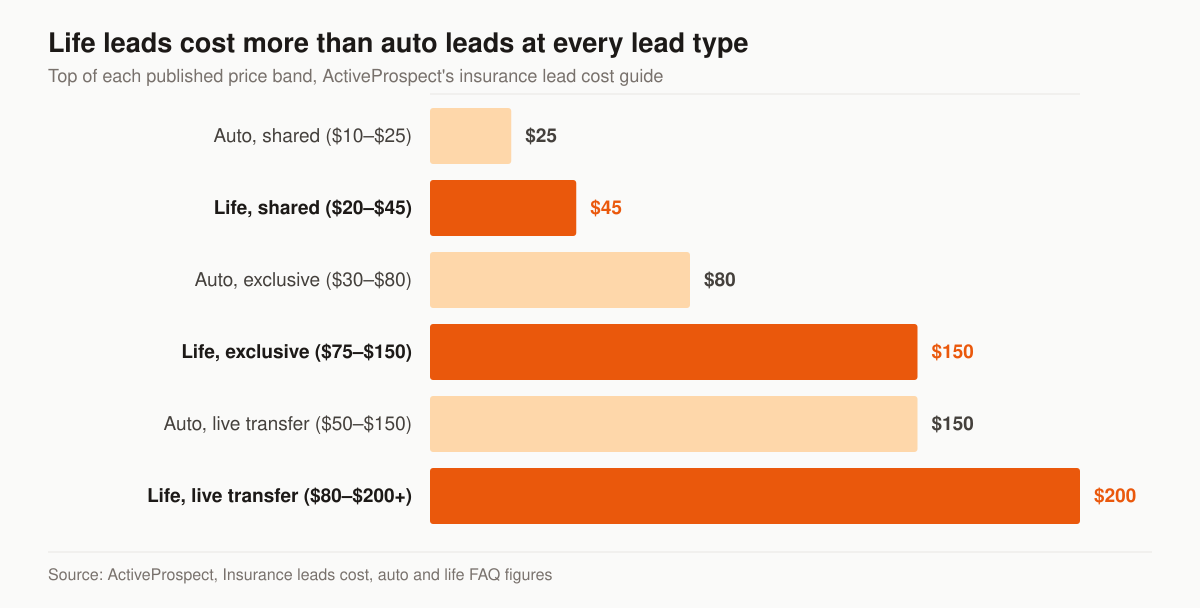
Source: ActiveProspect, “Insurance leads cost: How much does it cost to buy leads?”, auto and life FAQ figures. Bars show the top of each stated band.
Two cautions before those numbers reach a budget. They are one publisher’s stated ranges rather than a market survey, and that publisher sells lead-quality software, so read them as orientation. The guide is candid about this itself: it opens the pricing discussion with the line that there is no single standard price list, and attributes the spread to line of business, lead type, exclusivity, filter depth and source transparency. The second caution is definitional. The same words carry different meanings on different rate cards — “exclusive” can mean exclusive forever or exclusive for seventy-two hours, and “real time” can mean the moment the form posted or the moment the vendor’s batch job ran.
The table below is ActiveProspect’s cross-line price range for each lead type, with the trade-off each row carries.
| Lead type | Published range per lead | What the price is buying |
|---|---|---|
| Aged leads | $0.50 – $15 | Older records; lower response and conversion |
| Shared web leads | $10 – $45 | Lower cost, sold to several agents, more competition |
| Exclusive web leads | $45 – $120 | Sold to one buyer; higher intent, better conversion potential |
| Live transfer leads | $80 – $200+ | A warm phone handoff, closest to sales-ready |
ActiveProspect puts the exclusive premium at roughly two to three times the shared price, which lines up with the bands above. That premium is only worth paying if your contact and close rates move by more than the multiple — which is a measurement you take, not a fact you assume. For the final-expense version of that arithmetic, exclusive versus shared final expense leads works it through with the price bands for that line, and aged final expense leads covers the bottom row.
Why the cheapest lead can carry the highest cost per sale
Cost per lead is a purchase price. Cost per issued policy is a business result. They move independently, and a program can improve one while destroying the other.
The chain has four multipliers between the two numbers: how many leads you reach at all, how many of those you get into a real conversation, how many of those you write, and how many written policies actually issue and stay on the books. A lead that costs a fifth as much and gets contacted a fifth as often has produced no saving. It has produced the same cost per sale plus five times the dialing labour, and labour is the input agencies systematically forget to price.
ActiveProspect’s guide makes the same point at the extreme end for life: it says that after factoring in close rates — which it puts as “often in the 2 to 3 percent range” for purchased life leads — and follow-up time, total acquisition cost per life client “can easily reach $2,000 to $3,000.” That figure is the publisher’s characterisation of industry analysis rather than a study result, and it is specific to purchased life leads, so treat it as an argument for measuring your own chain rather than a number to plug into a forecast. The mechanism it describes is real regardless of the size of the number: a low per-lead price and a low close rate multiply into a high per-client cost.
The practical instruction is that you cannot compare two vendors on price alone, ever. You compare them on cost per issued policy, per source, over enough volume to mean something. Final expense leads: cost per lead versus true cost per sale sets that calculation out for one line, and the free lead-engine teardown runs it against your actual numbers.
How the engine changes by line of business
The mechanism is identical across lines. What changes is where the volume comes from, which rulebook governs the creative, and how long the lead takes to turn into a policy. Pick your line for the specifics.
Table: the dominant lead channel, the compliance constraint that shapes it, and the line-specific page for each line an independent agent writes.
| Line you write | Where the volume comes from | The constraint that shapes it | Line-specific page |
|---|---|---|---|
| Final expense | Meta lead ads plus live transfers | Meta’s Special Ad Category limits age and ZIP targeting | Exclusive final-expense leads |
| Medicare | Search, with T65 and AEP seasonality | CMS marketing rules, tightest during AEP | Medicare lead generation |
| Term & whole life | Search plus Meta, year-round demand | Underwriting stretches the gap between lead and issued policy | Life insurance lead generation |
| Annuity | Search plus seminar and webinar funnels | Suitability review on every claim in the creative | Annuity leads for agents |
| Mortgage protection | Meta plus new-homeowner trigger data | The buying window closes fast after the closing date | Mortgage protection lead generation |
| Auto & home | Local search and the map pack, not paid social | Local intent beats broad targeting on cost per sale | Auto · Home |
| Commercial P&C | Search plus outbound to named accounts | Long cycles with several people on the decision | P&C agency marketing |
| IUL & group life | Search plus referral and B2B funnels | The product needs explaining before the ask lands | IUL · Group life |
If your line isn’t listed, it is almost certainly a variant of one of these rows — the full niche lineup has the rest, and the free marketing audit maps yours specifically.
Lead types, compared
Table: the four lead types we buy and run, compared on cost per lead, contact rate, and which kind of agent each one suits.
| Lead type | Cost per lead | Contact rate | Best for |
|---|---|---|---|
| Shared internet / direct mail | Lowest | Low | High-volume dialers on a budget |
| Exclusive Facebook | Medium | Medium–High | Agents who want their own pipeline |
| Live transfers | Highest | Highest | Closers who want dialer-ready volume |
| Aged leads | Very low | Low | Filler between fresh-lead drops |
The right mix depends on your dial capacity and close rate — which is exactly what we map in the free marketing audit. Deciding that mix month after month, and which channel earns the next dollar of budget, is a leadership job; agencies without a marketing head in the seat usually hand it to a fractional CMO for insurance agencies.
What a shared lead looks like from the other side of the form
The InsideSales.com/MIT Lead Response Management Study is best known for its response-time statistics, but the authors also ran an informal test on themselves that is worth reading alongside the statistics. They filled out web forms with lead providers in the mortgage and insurance industries and recorded what happened next.
The company president submitted a mortgage quote request with one provider and received seven calls in total. The first arrived in thirty minutes. The last arrived three days later. On the insurance side, their sales manager filled out a health-insurance questionnaire at 4pm and got no call at all that day; the first of five calls came at noon the following day and the last two days after that. One rep submitted at 8:30am and had a first call in one minute, a second in three minutes and a third an hour and forty-five minutes later. Another submitted at 10am, got one call after two hours, and noticed nothing further.
That is what a shared lead is, described from the consumer’s chair: as many as seven strangers calling about the same form, spread over three days, in no coordinated order. Two things follow for an agent buying that file. Contact rate is not a property of the lead, it is a property of your position in the queue. And the prospect’s willingness to talk is being consumed by the agents ahead of you, which is a cost you pay but do not see on the invoice.
This was 2007 data, and it was the authors’ own anecdote rather than part of their statistical analysis. It is included as a description of how shared-lead distribution reaches the consumer, not as a prediction of what your own file will do. If your current inbound is telemarketed rather than opt-in, the upstream problems are different again — telemarketing insurance leads and what they really cost covers the do-not-call and consent questions that sit ahead of the dial.
Minutes, not hours, decide whether the lead is ever contacted
The statistical half of the same study is the reason speed-to-lead is built into every engine we run. Dr. James Oldroyd of MIT’s Sloan School of Management and InsideSales.com examined three years of data across six companies that generate and respond to web leads — over fifteen thousand leads and over one hundred thousand call attempts — to answer one question: when should companies call web-generated leads for optimal contact and qualification ratios?
Four findings from that study shape the follow-up cadence:
- The odds of contacting a lead called in five minutes versus thirty minutes drop 100 times. From five minutes to ten minutes alone, the odds decrease by five times.
- The odds of qualifying a lead called in five minutes versus thirty minutes drop 21 times, and by four times between five and ten minutes.
- The odds of calling to contact a lead decrease by over 10 times in the first hour; the odds of calling to qualify decrease by over 6 times in the same window.
- 4pm to 6pm was the strongest window the study found for making contact — it reports that window as “114% better than calling at 11 to 12am, right before lunch.”
The study also reported a finding the authors did not expect: after twenty hours, every additional dial a rep makes “actually hurts your ability to make contact to qualify a lead.” They were explicit that they could not explain why, and that stopping at twenty hours is unrealistic for a real team.
Three caveats belong with these numbers. The study is from 2007. It measured contact and qualification, and states plainly that it “did not address close ratios.” And the six companies studied were not insurance agencies. What survives all three caveats is the shape: the decay is steep, it is measured in minutes rather than days, and no amount of script quality recovers a lead that went cold before the first dial. That is why the build includes an automated first touch rather than a promise to call back, and why appointment setting is the layer that usually goes in next.
The consent record is half of what you are actually buying
A lead is two things: a contact record and a documented permission to use it. Agencies price the first and inherit the second, which is how a cheap file becomes an expensive problem.
The federal rule that governs the dial sits at 47 CFR 64.1200. Paragraph (a)(2) prohibits initiating “any telephone call that includes or introduces an advertisement or constitutes telemarketing, using an automatic telephone dialing system or an artificial or prerecorded voice” to the lines and numbers described at (a)(1)(i) through (iii) — which cover, among others, “any telephone number assigned to a paging service, cellular telephone service, specialized mobile radio service, or other radio common carrier service, or any service for which the called party is charged for the call” — other than with the prior express written consent of the called party. Note both scope limiters in that sentence: it is about telemarketing content, and it is about calls placed with an autodialer or an artificial or prerecorded voice. A manually dialed call with a live agent is a different analysis, and one your counsel should run rather than your marketing vendor.
What counts as that written consent is defined at (f)(9): “an agreement, in writing, bearing the signature of the person called that clearly authorizes the seller to deliver or cause to be delivered to the person called advertisements or telemarketing messages using an automatic telephone dialing system or an artificial or prerecorded voice, and the telephone number to which the signatory authorizes such advertisements or telemarketing messages to be delivered.” The agreement has to carry a clear and conspicuous disclosure that the signer is authorising those calls, and that the person “is not required to sign the agreement (directly or indirectly), or agree to enter into such an agreement as a condition of purchasing any property, goods, or services.” A signature includes an electronic or digital one where that is valid under applicable law.
Read against a lead invoice, that definition is a checklist. Whose name appears as the seller in the consent language the consumer actually saw? Which phone number did they authorise? Can the vendor produce the form as rendered, on the date it was submitted, rather than a description of it? A vendor who cannot answer those three questions is selling you a record without the half of it that makes the record usable. Our TCPA compliance guide for agents buying leads turns the same questions into a vendor audit. We provide marketing services, not legal advice; you are the licensed party.
What changed when the one-to-one consent rule was vacated
In 2023 the FCC promulgated a rule that would have added two restrictions to what “prior express consent” means for telemarketing and advertising robocalls: consent could authorise no more than one identified seller at a time, and the calls had to be “logically and topically associated with the interaction that prompted the consent.” The petition against it was brought by the Insurance Marketing Coalition, described in the opinion as “a consortium of over twenty entities[] representing a cross[-]section of insurance industry stakeholders.”
It did not. On 24 January 2025 the Eleventh Circuit decided Insurance Marketing Coalition Limited v. FCC, No. 24-10277, and held that the agency had exceeded its statutory authority. The court’s reasoning was textual: “the TCPA’s text is clear: Callers must obtain ‘prior express consent’—not ‘prior express consent’ plus.” Its disposition was to “grant IMC’s petition for review, vacate Part III.D of the 2023 Order, and remand for further proceedings.”
Three things are worth being precise about, because the vacatur is routinely over-read.
First, what fell is Part III.D of the 2023 order and nothing else. The court noted expressly that “The 2012 Order is not at issue in this case” — the written-consent requirement and the (f)(9) definition quoted above survive untouched. Second, the holding was about agency authority, not about whether one-to-one consent is a good idea; the court said atextual good policy cannot overcome clear text, which is a statement about who gets to make the rule. Third, the case was remanded, so the FCC retains the file. A future rule written on firmer statutory ground is a live possibility, and a buying practice built on the assumption that consent scope no longer matters is a practice built on a remand.
What we do with that: nothing changes in how the engine is built. Consent is captured per form, the seller is named in the language the consumer reads, the form as rendered is retained, and the record travels with the lead into the CRM. That posture was correct before the 2023 order, during it, and after the vacatur, which is the point.
What has to happen the moment a lead says stop
Revocation is the paragraph that catches agencies with a working funnel and a lazy back end. It sits at 47 CFR 64.1200(a)(10), and it is written broadly on purpose.
A called party may revoke consent “by using any reasonable method to clearly express a desire not to receive further calls or text messages from the caller or sender.” The rule then names methods that are reasonable per se: an automated interactive voice or key-press opt-out on a call; the words “stop,” “quit,” “end,” “revoke,” “opt out,” “cancel,” or “unsubscribe” sent in reply to an incoming text; or a website or telephone number the caller designated to process opt-outs. Crucially, that list is a floor, not a ceiling — if a reply text uses other words, “the caller must treat that reply text as a valid revocation request if a reasonable person would understand those words to have conveyed a request to revoke consent.”
Two operational numbers come out of the same paragraph. Requests made in any reasonable manner “must be honored within a reasonable time not to exceed ten business days from receipt of such request.” And callers “may not designate an exclusive means to request revocation of consent” — so a system that only accepts the literal word STOP on the SMS channel is not compliant, however tidy it is to build. Paragraph (a)(12) permits one confirmation text back, provided it “merely confirms the text recipient’s revocation request and does not include any marketing or promotional information”; sent within five minutes, it is presumed to fall within the consumer’s prior express consent.
The build consequence is a single suppression list that every channel reads before it fires, populated from replies, calls, form submissions and inbox mail alike, rather than one opt-out list per tool. That is a CRM architecture decision, which is why it gets made during the build rather than after the first complaint — see the CRM comparison for insurance agents if that layer is still being chosen.
Calling hours, the national registry, and the list you keep yourself
Three more provisions of the same section shape a dialing operation, and each carries a scope limiter that gets dropped when it is quoted casually.
Calling hours. Under 64.1200(c)(1), no person or entity shall initiate any telephone solicitation to a residential telephone subscriber “before the hour of 8 a.m. or after 9 p.m. (local time at the called party’s location).” The limiter is “local time at the called party’s location,” which for a multi-state book means the dialer has to know the prospect’s time zone, not yours.
The national registry. Paragraph (c)(2) prohibits telephone solicitation to a residential subscriber registered on the national do-not-call registry, and says such registrations “must be honored indefinitely, or until the registration is cancelled by the consumer or the telephone number is removed by the database administrator.” The safe harbor for an error requires, among other conditions, a process using a version of the registry “obtained from the administrator of the registry no more than 31 days prior to the date any call is made,” with records documenting the process. Thirty-one days is a scrub cadence, and it is the kind of thing a lead vendor claims and an agency never verifies.
Your own list. Paragraph (d) requires anyone making telemarketing calls to a residential subscriber to maintain an internal do-not-call list, with a written policy available on demand and trained personnel. Under (d)(3) a request must be recorded “at the time the request is made,” honored within a period that “may not exceed ten (10) business days from the receipt of such request,” and — the sentence that matters for anyone outsourcing dialing — “If such requests are recorded or maintained by a party other than the person or entity on whose behalf the call is made, the person or entity on whose behalf the call is made will be liable for any failures to honor the do-not-call request.” Under (d)(6), the request must be honored for five years.
That last clause is the reason we do not treat a vendor’s suppression list as a substitute for yours. Liability follows the seller, not the subcontractor.
Medicare leads run on a second rulebook
If any part of your book is Medicare Advantage, the TCPA is only the first layer. CMS regulates lead generation directly, through the plan’s contracts with third-party marketing organizations — and the definition at 42 CFR 422.2260 reaches past the vendor to the agent: a TPMO “means organizations and individuals, including independent agents and brokers, who are compensated to perform lead generation, marketing, sales, and enrollment related functions as a part of the chain of enrollment.”
42 CFR 422.2274(g)(3) requires plans to ensure that a TPMO conducting lead-generating activities must, when applicable, “Disclose to the beneficiary that his or her information will be provided to a licensed agent for future contact” — verbally on a telephone call, in writing on mail or other paper, and electronically through email, online chat or other electronic messaging — and “Disclose to the beneficiary that he or she is being transferred to a licensed agent who can enroll him or her into a new plan.”
Paragraph (g)(4) then governs what happens to the data afterwards: “Beginning October 1, 2024, personal beneficiary data collected by a TPMO for marketing or enrolling them into an MA plan may only be shared with another TPMO when prior express written consent is given by the beneficiary,” and that consent “must be obtained through a clear and conspicuous disclosure that lists each entity receiving the data and allows the beneficiary to consent or reject to the sharing of their data with each individual TPMO.”
Read the second one next to the vacated FCC rule. A per-entity consent requirement that the Eleventh Circuit struck down for telemarketing generally still stands, in a narrower form, for Medicare Advantage beneficiary data — because it comes from CMS under a different statute, not from the FCC under the TCPA. Two points of housekeeping: Part 422 is Medicare Advantage, and the parallel Part D provision is at 42 CFR 423.2274. The full set of clauses to put in front of a Medicare lead vendor is on our Medicare lead generation page, and the appointment-side rules are in the scope of appointment and TPMO guide.
What Meta’s Special Ad Category takes away from insurance targeting
Paid social for insurance is not the same product it is for other advertisers, and the difference is a platform rule rather than a best practice.
Meta’s Business Help Center states that it introduced a Special Ad Category for “Financial products and services,” and that “Starting January 21, 2025, using this category is required for financial products and services campaigns for advertisers based in the United States or showing ads to audiences in the United States. Ads may be rejected if an appropriate category is not chosen.” Meta says the limited audience-selection tools attached to these ads exist “to help protect people from unlawful discrimination across our platforms.”
The cost is targeting. For advertisers based in or reaching the US, Meta says certain audience options are “limited or unavailable” for these ads: “age, gender, ZIP code or postal code, exclusion targeting, lookalike audiences and saved audiences. Some interests will also be unavailable when you create your audience. Audiences based on city or pin drop locations will include an expanded radius.” Advantage+ catalog ads are subject to the same limitations.
For a final-expense or Medicare advertiser, that limits or removes the two dials the playbooks were written around — age band and ZIP. What replaces them is creative that self-selects. If you cannot tell the platform who should see the ad, the ad has to tell the audience who it is for, in the first line, in language the right person recognises and the wrong person scrolls past. That is a copy discipline rather than a targeting setting, and it is the practical reason the insurance Facebook ads service is built around a weekly creative-test queue instead of an audience-tuning ritual.
The channels that produce leads without a per-lead invoice
Paid acquisition is the lever that turns on first, and a program that never builds anything else is renting its pipeline permanently. Three owned channels compound instead:
Local search. For auto, home and commercial P&C especially, the buyer is searching with local intent and the map pack is the shelf. A Google Business Profile that is complete, categorised correctly and actively reviewed produces contacts with no per-lead cost attached — the work is in the setup and the maintenance, which is what local SEO for insurance agencies covers.
Reviews and referrals. A review is a lead source with a delay, because it changes the conversion rate of every other channel that lands on your profile. The mechanics of actually collecting them are unglamorous and mostly about asking at the right moment — see how to get more Google reviews.
Organic content. Slowest to start and cheapest to run once it does. A page that answers a real buying question keeps answering it, and can be quoted by an AI assistant rather than clicked, which is a different measurement problem and the same underlying asset.
The honest framing is sequencing, not superiority. Owned channels take months and produce compounding volume; paid channels take days and stop the day you stop paying. An agency that needs policies this quarter and a business next year runs both, and shifts the ratio as the owned side starts producing. Insurance leads without cold calling is the version of this argument for agents trying to get off the dialer entirely.
How many leads do you actually need?
Volume targets get set backwards — from a budget — when they should be set from a policy count. The arithmetic runs in one direction and needs four of your own numbers.
Start with the issued policies you want in a month. Divide by your close rate on presentations to get presentations needed. Divide by your presentation rate per contacted lead to get contacts needed. Divide by your contact rate per lead to get leads needed. Multiply by cost per lead to get the media budget, then divide the total media budget by issued policies to get the number that actually matters.
Worked with placeholder inputs — substitute your own before this means anything: twelve issued policies a month, a 20% close rate on presentations, gives sixty presentations. If one in three contacted leads sits for a presentation, that is 180 contacts. At a 25% contact rate, that is 720 leads. At $30 a lead, that is $21,600 in lead cost and $1,800 per issued policy. Change contact rate from 25% to 40% and the same twelve policies need 450 leads and $13,500 — the same close rate, the same offer, $8,100 less in lead cost.
That single line is the argument for speed-to-lead, exclusivity and follow-up cadence in one place. Contact rate is the multiplier furthest upstream, so it moves the budget more than anything downstream of it. It is also the number a per-lead invoice never contains, which is where the teardown usually starts. Every figure in the worked example is an illustrative placeholder chosen to show the arithmetic, not a benchmark and not a forecast.
What to ask a lead vendor before you sign
Whether we are buying volume alongside your generated leads or you are auditing an existing vendor, the same questions get asked. They are largely about definitions, because that is where the money hides.
The table below lists the seven questions we put to a lead vendor, what a straight answer sounds like, and what the question is actually testing.
| Ask this | A straight answer sounds like | What it tests |
|---|---|---|
| How is “exclusive” defined in the contract? | Sold once, never resold, with a written term | Whether exclusivity has an expiry date |
| Show me the consent language as the consumer saw it | A rendered capture of the form on that date | Whether (f)(9) consent actually exists |
| Which seller is named in that language? | Your agency, or a named list you appear on | Whether the consent reaches you at all |
| How is the number scrubbed against the registry? | A documented process and a scrub cadence | Whether the (c)(2) safe harbor conditions are met |
| What is the return and credit policy, in writing? | Named reasons, a window, a stated percentage cap | Whether bad leads cost you or them |
| How old is the record at delivery? | A timestamp on the lead, not a description | Whether “real time” means real time |
| For Medicare: how do you meet the (g)(3) disclosures? | The exact wording and where it appears | Whether the TPMO obligations are being met |
A vendor who answers all seven is not necessarily cheap, and that is fine. A vendor who answers none of them is selling records with unknown provenance into a channel where liability follows the seller. If you are shortlisting, the final expense lead-generation companies comparison applies the same questions to named vendors.
Why who runs the lead engine decides your cost per sale
Two providers can quote the same cost per lead and deliver wildly different cost per sale. The variables — creative angle, audience, speed-to-lead, consent quality, follow-up cadence — only get tuned by someone running campaigns daily. We tune ours on our own final-expense book, so the recommendations come from a live dashboard rather than a course; the ones that are line-specific get re-tested in your line before they touch your budget.
What we report on, and what we leave out
Impressions, reach and “leads touched” all rise when a program is working and also when it is spraying. They are cheap to report and thin to read, so they are not on the monthly dashboard.
The table below lists what the monthly report carries, what each figure measures, and what it is compared against.
| Metric | What it measures | Reference point |
|---|---|---|
| Cost per lead, by source | Media spend divided by leads, per campaign | Your own pre-launch baseline |
| Contact rate | Share of delivered leads reached by a person | Your own pre-launch baseline |
| Speed to first contact | Minutes from form submission to first outbound touch | Set at build; watched weekly |
| Presentation rate | Share of contacted leads that sit for a presentation | Agreed with your closers |
| Cost per issued policy | Total program and media spend divided by issued policies | The number we grade the program on |
| Placement and persistency | Written policies that issue and stay on the books | Your carrier reporting, not ours |
| Opt-out and complaint rate | Revocations and complaints per thousand contacts | Watched as a compliance signal |
Nothing on that list is an industry average dressed up as your result. The reference column says “your own pre-launch baseline” deliberately: published lead-generation benchmarks describe someone else’s book, someone else’s lead sources and someone else’s definition of a lead. Measure the four weeks before launch, then measure against that.
What insurance lead generation costs here
Lead generation is not sold as a standalone line item; it runs inside a monthly tier. The published tiers are Foundation $2,500/mo, Growth $3,500/mo and Full-Funnel $5,500/mo. This program maps to Full-Funnel — the tier that carries managed paid ads on Google and Meta, landing-page conversion work and marketing automation together, because a lead engine is the three of those wired into each other rather than any one of them alone. If the pages, forms and tracking need building first, a one-time build runs $2,500–$8,000. The full breakdown, including what is not in the monthly price, is on the pricing page.
Two costs sit outside that fee and are billed to you directly. Media spend is a pass-through paid straight to Google or Meta and is never marked up by us. Purchased lead volume, if the mix includes it, is billed by the lead vendor at the vendor’s rate — the ranges earlier on this page are the market you will be quoting into. Software — CRM, dialer, call tracking — is billed by its own vendors on their own volume models. Insurance agency marketing budget works through how those layers stack against revenue.
How long before the pipeline fills
Three clocks run at different speeds, and conflating them is how a program gets judged in week three on a metric that cannot have moved yet.
Lead volume moves first. Campaigns can be live and delivering inside the first weeks, because volume is a function of spend and approval, not of learning. Cost per lead moves second — it needs enough conversions for the platform to optimise and enough creative iterations to find the angle that works in your line, which is a matter of weeks rather than days. Cost per issued policy moves last, and in life and annuity it moves last by a wide margin, because underwriting sits between the sale and the issue. A policy written in month one may not issue until month three, which means the first honest read on the number that matters arrives a quarter after launch.
None of that is a revenue promise. It is the order the parts come online, so the monthly report gets read against the right clock instead of the wrong one.
What lead generation will not fix
Four problems present as lead problems and are not, and it is cheaper to name them before the engagement than after.
No capacity to work the leads is a staffing problem. Buying more volume into a team that cannot dial what it already has raises spend and lowers contact rate at the same time — the arithmetic above shows exactly what that does to cost per issued policy. An offer nobody wants is a product and copy problem; more leads reach the same “no” faster, and the fix starts with the landing page and the copy that set the expectation. A close rate that lags your peers is a sales-process problem, and lead quality is a comfortable place to file it — worth ruling out before you change vendors. And a carrier or product mix too narrow for the market you are advertising into caps everything downstream; you can only write what you are appointed for, and the targeting has to respect that footprint rather than fight it.
Where lead generation sits in the rest of the stack
This service is the top of the funnel, and it compounds with the layers under it:
- With appointment setting, fresh leads get contacted and booked before the decay curve above takes them.
- With paid search management, buyer-intent search volume gets added to the paid-social mix.
- With the sales funnel build, the pages and stages between the click and the application get connected to each other.
Ready to see where your lead spend is leaking? Start with a free lead-engine teardown, browse the full services lineup this plugs into, or talk it through with the team.
Guides that go deeper
Frequently asked questions
What's the difference between exclusive and shared insurance leads?
Which lines of insurance do you generate leads for?
How much do insurance leads cost?
Do you sell leads, or generate them for me?
Is insurance lead generation TCPA compliant?
Do I own the ad account, the pixel and the leads?
Can you generate leads in states where I am not appointed?
What is the difference between a lead and an appointment?
See exactly where your agency is leaking leads.
15 minutes. We screen-share our own live lead dashboard and tear down your funnel line by line — no pitch deck, just numbers.
- Site speed & conversion
- Local + AI-search visibility
- Ad efficiency
- Your cost per lead vs ours
No obligation · no pitch deck