Who we serve
Annuity Leads for Agents
Annuity leads for agents are pre-retirees, typically 55 to 70, weighing a rollover, an RMD decision, or moving money somewhere safe. The channels that produce them compliantly are educational seminars, safe-money paid social, and SEO for rate-and-alternative searches. Because the ticket is large, speed to first contact and suitability screening decide who actually closes.
Free · 15-minute teardown · no pitch deck
- We run our own final-expense book
- No pitch deck — we screen-share real numbers
- TCPA-aware · CMS/AEP-compliant · Meta Special Ad Category
- Core Web Vitals < 2.0s LCP
Annuity leads do not behave like final-expense or term-life leads, and treating them the same is why so many agents burn money on them. The buyer is not reacting to a fear of leaving a funeral bill. They are sitting on a lifetime of savings, staring at a rollover or an RMD, and deciding — slowly, cautiously, and often with a spouse in the room — where that money goes next. Annuity leads for agents are worth generating well precisely because the ticket is large and the decision is deliberate.
This is a spoke under our annuity marketing pillar. If you want the underlying channel engine that powers it, start with our insurance lead generation service. If you specifically want to understand the annuity buyer and the channels that reach them compliantly, you are on the right page.
Below: who the buyer is, how much money the market is actually moving and into which product, the channels that produce leads compliantly, the lead products you can buy and what each one costs on the vendor’s own published page, exclusive versus shared, why rate-comparison search is worth owning, how seminars convert, what the best-interest standard does to your intake form, what federal telemarketing law says before you dial a purchased record, and the metrics that tell you a channel is paying.
Who the annuity lead actually is
Picture a 62-year-old two or three years from retiring. They have a 401(k) or an IRA they spent a career building, and one dominant fear: watching a market drop erase a chunk of it right when they can no longer wait for it to recover. That fear — sequence-of-returns risk, though they will never call it that — is the psychological engine behind almost every annuity inquiry.
The three triggers that turn that background anxiety into a form fill:
- Rollover in motion. They are leaving an employer or consolidating accounts and the money is briefly liquid and decision-ready.
- RMD pressure. They are approaching or past the required-minimum-distribution age and want a tax-aware income plan.
- Safe-money migration. A CD matured, or a market scare pushed them to want principal protection for part of the portfolio.
Marketing that names the trigger outperforms marketing that names the product. “What happens to your 401(k) the year before you retire?” pulls better than “Learn about fixed indexed annuities,” because the first speaks to the fear and the second speaks to a category they do not yet trust.
There is also a demographic tailwind under all of this, and it is worth quoting rather than paraphrasing. In LIMRA’s March 23, 2026 release on final 2025 annuity sales, Bryan Hodgens, senior vice president and head of LIMRA research, said: “We are currently in the middle of Peak 65, where 4.1 million Americans are turning 65 each year”. Your marketing does not have to manufacture the moment. It has to be present when the moment arrives.
How much money is moving, and into which product
Channel choice follows product reality, so start with what the market actually bought. LIMRA’s U.S. Individual Annuity Sales Survey, which LIMRA describes as representing “93% of the total U.S. annuity market”, put total U.S. annuity sales at $464.1 billion in 2025, a 7% increase, in final results published March 23, 2026. Fourth-quarter sales jumped 14% to $117.2 billion, which LIMRA described as the ninth consecutive quarter of $100+ billion in sales.
This table is LIMRA’s full-year 2025 sales by product line, with the year-over-year change it published for each.
| Product line | 2025 sales | Change vs 2024 | Securities registration required |
|---|---|---|---|
| Fixed-rate deferred (incl. MYGA) | $165.3bn | +6% | No |
| Fixed indexed (FIA) | $127.9bn | +1% | No |
| Registered index-linked (RILA) | $79.5bn | +20% | Yes |
| Traditional variable (VA) | $63.1bn | +8% | Yes |
| Single premium immediate (SPIA) | $14.4bn | +6% | No |
| Deferred income (DIA) | $4.8bn | -3% | No |
Source: LIMRA, final U.S. retail annuity sales, published March 23, 2026. LIMRA noted that 2025 was the fifth consecutive year of annual sales growth for fixed indexed annuities and the eleventh for RILA.
Read that as a targeting instruction. If you hold an insurance-only licence, the two largest lines on the list — fixed-rate deferred at $165.3 billion and fixed indexed at $127.9 billion — are both inside your appointment. That is where your lead offer, your landing page and your rate content should point. RILA is growing fastest in percentage terms and is the one you cannot write without a securities registration, so building content around it feeds a case you have to refer away.
The compliant channels that produce annuity leads
No single channel owns this buyer. Each reaches a different moment in a long decision.
This table compares the four channels that reliably produce annuity leads, by the job each one is good at and the compliance constraint attached to it.
| Channel | Best job | Speed | Compliance note |
|---|---|---|---|
| Seminar / dinner events | Warm, high-intent, face-to-face trust | Slow to fill, high close | Invitation copy stays factual; no guaranteed-return hooks |
| Safe-money paid social | Intercept market-anxious pre-retirees at scale | Fast | Sell education, never a return; see the ads spoke |
| SEO (“annuity rates,” “MYGA vs CD”) | Capture active researchers cheaply | Slow, compounds | Honest rate and comparison content only |
| Referrals (clients, CPAs) | Highest trust, lowest cost | Steady | Straightforward, relationship-driven |
Lead with the channel that matches your capacity. A producer who can fill a room should run seminars and feed the follow-up with paid social. A producer building a durable practice should invest in SEO and a converting funnel so the pipeline lowers its own cost over time. We normally build two or three of these rows at once rather than betting a year on one, then use annuity appointment setting so nothing generated ever leaks. The paid-social row has its own platform rules, which we work through on the annuity Facebook ads spoke.
The lead products you can buy, and what each one really is
“Annuity leads” is not one product. Vendors sell at least seven distinct things under the same phrase, and the difference between them is how much of the work is already done when the record reaches you.
This table sorts the annuity lead products on the market by what actually arrives and what you still have to do.
| Product | What arrives | What you still own | Where it fits |
|---|---|---|---|
| Targeted data list | Names and addresses matched to demographic criteria — no expressed interest | Everything: the mail piece, the postage, the response handling | Direct mail campaigns you run yourself |
| Direct-mail response | A reply card or call from someone who answered your mailer | Qualification, contact, booking | Seniors who still respond to paper |
| Internet form lead | A web form fill with contact details and light detail | Speed to first contact, qualification, nurture | Volume at the top of the funnel |
| Call-verified lead | A form lead a vendor has phoned to confirm interest and details | Contact, qualification depth, booking | Cutting bad-data waste |
| Warm (live) transfer | A prospect handed to you live on the phone | The entire conversation, from hello | Producers who can take calls on demand |
| Fact-finder transfer | A live call where financial detail was gathered before handoff | The recommendation conversation | High-ticket cases where context matters |
| Pre-set appointment | A scheduled slot on your calendar | Showing up prepared, and the close | Producers whose bottleneck is dialing |
Vendors describe their own products in these terms. Financialize lists its annuity lead options as “call-verified prospects, warm transfers, and fact-finder transfers”, states that leads are delivered “Within 24 hours”, and describes exclusivity as “1 lead = 1 advisor”. Lead Concepts positions annuity leads as targeted data lists and direct-mail strategies, with a separate seminar-lead product in its ordering form. Pinnacle Financial Services sells a life and annuity pre-set appointment program that books “State and Federal employees” — the page names teachers, hospital employees, police, firemen and veterans as the pool, all of whom it describes as pension eligible or holding individual retirement accounts.
Nothing on that list is inherently better than the rest. They fail differently. A data list fails on your creative. A form lead fails on your response time. A transfer fails if you cannot pick up. A pre-set appointment fails if the screening criteria were not yours.
What annuity leads cost, and the number that decides it
Vendor pricing for this line is mostly quoted on a call, which makes the few published prices worth reading closely.
This table lists annuity-lead prices that vendors publish on their own live pages, with what the price does and does not include.
| Vendor | Published price | Unit | What the page says it covers |
|---|---|---|---|
| Retirement Prospects | “$32 per lead” | Per exclusive lead | Plus “a one-time $299 fee for set-up and exclusivity”; leads local to you “within 10 miles or a distance you select” |
| Pinnacle Financial Services | “$64 per appointment” | Per kept appointment | “No up-front startup costs. Only pay for appointments that are kept. You are not charged for canceled or rescheduled appointments.” |
Prices as published on each vendor’s page at the time of writing; check the live page before you budget against them.
Neither price is your cost of acquisition, and treating cost per lead as the decision metric is how agents end up defending a cheap channel that never produces a case. The figure that settles it is cost per issued case, which is your channel spend divided by the cases that actually issue and stick. To model it you need four of your own numbers — contact rate, qualified-conversation rate, appointment-to-application rate, and average premium per issued case — and one from your contract: your commission percentage. Pinnacle publishes a band for the industry it recruits into, stating that agents “can expect upwards of 100% of the first years premium as a commission on life insurance, and between 6% and 8% commission on annuities (on average)”. Run your own contract’s number, not that one.
That arithmetic is also what makes owned channels defensible. A purchased lead costs the same on the thousandth unit as the first. A ranking page, a seminar list and an email file get cheaper per case every quarter they run. Our managed programs are published rather than quoted: Foundation at $2,500 per month, Growth at $3,500, Full-Funnel at $5,500, plus a one-time website build of $2,500–$8,000. The pricing page lists what sits inside each tier.
Exclusive versus shared annuity leads
An exclusive lead is sold to one producer. A shared lead is sold to several, which means the prospect fields several calls and the conversation starts as a comparison rather than an introduction. On a low-ticket line that trade can pay. On a six-figure rollover, being the third caller is a poor place to begin.
Exclusivity is a contract term, not a property of the data, so read what the term actually promises. Retirement Prospects states that “each prospect is matched with only one professional and we put that in a written guarantee”. Financialize states “1 lead = 1 advisor”. Both are clear, and both are worth pressing on with four questions before you sign:
- Exclusive for how long? A lead sold once today can be resold later as an aged lead unless the contract says otherwise; ask for the window in writing.
- Exclusive against whom? Per producer, per agency, or per carrier appointment — these are different promises.
- Exclusive in what geography? Retirement Prospects defines its radius as “within 10 miles or a distance you select”; a wider radius means more volume and more overlap with your own marketing.
- What happens to a bad record? Ask for the replacement policy in writing, and what evidence they require.
One more habit worth building: treat unlabelled performance numbers on a vendor page as marketing rather than measurement. Financialize’s annuity leads page prints “90% agent connect rate” and “36% average close rate” without stating the population, the period, the denominator or who counted. Those may be real internal figures. They are not verifiable from the page, so they do not belong in your model — ask for the definition and the sample before you price against them.
Why “annuity rates” and “MYGA vs CD” are searches worth owning
The safe-money prospect is not searching for you. They are searching for a comparison, and the thing they are comparing against is a bank rate they can look up in a single search. Knowing what that rate is tells you what your content has to answer.
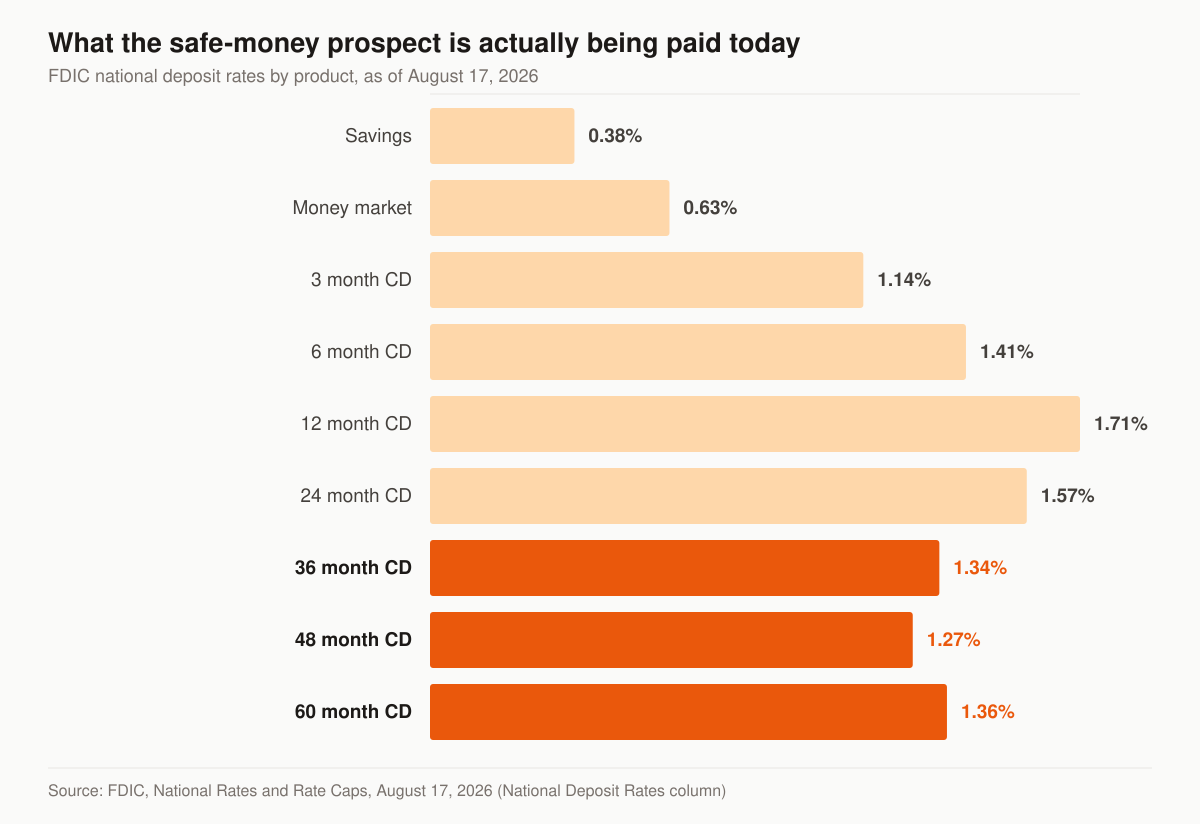
FDIC national deposit rates by product, as of August 17, 2026. Source: FDIC, National Rates and Rate Caps.
Two details about that data matter when you write the comparison page. The FDIC defines the national rate as “the average of rates paid by all insured depository institutions and credit unions for which data is available, with rates weighted by each institution’s share of domestic deposits” — so it is an average across the whole market, not a shelf rate at a competitive online bank, and a rate-shopping prospect will have found a higher one. And the FDIC’s own footnote states that “money market and certificate of deposit rates represent an average of the $10,000 and $100,000 product tiers”, which is roughly the deposit size an annuity conversation starts at.
So the searchable questions are narrow and answerable: how a MYGA’s guarantee differs from FDIC insurance, what a surrender schedule does that a CD maturity does not, how the tax treatment differs on a non-qualified deposit, and what happens at the end of the guarantee period. Write one page per question, answer it in the first paragraph, and link the set together. That is the content architecture our insurance SEO service builds, and it is the part of the pipeline that gets cheaper rather than more expensive.
Seminars and dinner events, from the room to the calendar
The seminar is still the highest-trust annuity channel because it does in one sitting what a landing page cannot do at all: it lets a cautious 64-year-old watch you explain something difficult, in front of other people, without being asked to buy. The channel fails on logistics, not on concept.
The sequence that holds it together:
- Buy or build the invitation list against a trigger, not just an age band — pension-eligible employees, recent retirees, a ZIP with a maturing-CD skew.
- Keep the invitation factual. Invitation copy is advertising and is subject to your state’s insurance advertising rules; guaranteed-return language belongs nowhere near it.
- Register digitally, so you hold an email and a phone number before anyone walks in.
- Book the one-on-one review from the room, while intent is at its peak.
- Work the non-bookers as a nurture list, not a dead file.
That last step is where the channel quietly pays for itself. Retirement Prospects, which generates leads and then invites them to events, reports of its own file: “In our experiments, we find that 1/3 of these people attended a seminar when we kept inviting them over a few months.” Treat that as one vendor’s account of its own list rather than an industry benchmark — but the shape of it is the point. Attendance is a function of how long you keep inviting.
The room-to-calendar mechanics, including the confirmation cadence that protects the show rate, are covered in depth on annuity appointment setting.
Suitability is not an afterthought — it shapes the intake
Here is what separates annuity lead generation from every other line: what you do with the lead is governed by a best-interest standard. The NAIC’s Suitability in Annuity Transactions Model Regulation (#275) was revised in 2020 to require that recommendations be in the consumer’s best interest, and most states have adopted a version of it. Your IMO or carrier will also impose its own suitability and documentation requirements on every submitted case.
The NAIC’s own description is worth reading in its words. It states that the membership “approved revisions to Model #275 in February of 2020 clarifying that all recommendations by agents and insurers must be in the best interest of the consumer and that agents and carriers may not place their financial interest ahead of the consumers’ interest in making a recommendation”, and that “The model now requires agents and carriers to act with ‘reasonable diligence, care and skill’ in making recommendations.” On the same page, last updated 11/1/2023, the NAIC stated: “To date, 40 states have adopted the model revisions.” Adoption moves, and a model regulation is not law until a state enacts its version — so confirm the current status in every state you write in rather than relying on a count from a page.
That has a practical marketing consequence: your intake form and first call should start gathering the picture a suitability review needs — approximate age, the source and rough size of the money in motion, income needs, time horizon, and existing holdings. A lead that arrives with that context is not just more compliant to work; it is dramatically easier to close.
It also changes how you judge a lead vendor. A record with a name, a phone number and a checkbox is thin under a best-interest standard, because none of the fields a suitability review needs are present. A fact-finder transfer, by contrast, arrives with the financial context already gathered — which is exactly why it costs more per unit and why it can still be the cheaper route to an issued case.
What federal law says before you dial a purchased annuity lead
Buying a record does not buy permission to call it. The rules live in 47 CFR 64.1200, and the paragraphs each carry their own scope, so read the opening clause rather than the summary.
Written consent. Section 64.1200(f)(9) defines the term: “prior express written consent means an agreement, in writing, bearing the signature of the person called that clearly authorizes the seller to deliver or cause to be delivered to the person called advertisements or telemarketing messages using an automatic telephone dialing system or an artificial or prerecorded voice, and the telephone number to which the signatory authorizes such advertisements or telemarketing messages to be delivered.” The agreement must also disclose that “The person is not required to sign the agreement (directly or indirectly), or agree to enter into such an agreement as a condition of purchasing any property, goods, or services.” Note the scope: that written-consent standard attaches under paragraph (a)(2) to a call or text that “includes or introduces an advertisement or constitutes telemarketing, using an automatic telephone dialing system or an artificial or prerecorded voice.”
The do-not-call registry. Paragraph (c)(2) bars a telephone solicitation to “A residential telephone subscriber who has registered his or her telephone number on the national do-not-call registry”, and adds that “Such do-not-call registrations must be honored indefinitely, or until the registration is cancelled by the consumer or the telephone number is removed by the database administrator.” The safe harbor at (c)(2)(i) is available only to a caller that can show the violation resulted from error within a routine business practice meeting written-procedure, training, recording and database standards — including using a registry version “obtained from the administrator of the registry no more than 31 days prior to the date any call is made.”
Hours, and the established-business-relationship carve-out. Paragraph (c)(1) prohibits a telephone solicitation to a residential subscriber “before the hour of 8 a.m. or after 9 p.m. (local time at the called party’s location)”. And the definition of “telephone solicitation” at (f)(15) excludes a call “To any person with whom the caller has an established business relationship” — a carve-out that describes your existing book, not a list you just bought.
Revocation. Paragraph (a)(10) lets a called party revoke consent “by using any reasonable method to clearly express a desire not to receive further calls or text messages from the caller or sender”, treats the replies “stop,” “quit,” “end,” “revoke,” “opt out,” “cancel,” or “unsubscribe” as reasonable per se, requires that revocation requests “must be honored within a reasonable time not to exceed ten business days from receipt of such request”, and states that callers “may not designate an exclusive means to request revocation of consent.”
Practically, that means three things when you buy: get the consent record and the originating URL with every lead, keep your own suppression list current, and route purchased records through a process your counsel has reviewed. Federal law is the floor — several states impose stricter rules on the same call. Our longer treatment sits in TCPA compliance for insurance agents buying leads.
Speed-to-lead for a high-ticket sale
On a large annuity case, first contact is not a formality — it is where the frame gets set. The agent who reaches the prospect first, sounds credible, and books the review call usually controls the rest of the decision.
- Contact in minutes, not hours. Automated instant routing to your phone or CRM the moment a lead submits.
- Lead with the trigger, not the product. Reference the rollover, the RMD, or the CD — the thing they were actually worried about.
- Book the review, do not pitch. The first call earns a calendar slot for an income review, nothing more.
- Capture suitability context early. Age band, money in motion, and time horizon on the first touch.
- Nurture the slow deciders. Many annuity buyers close on the fourth or fifth touch; a sequence keeps you present without pestering.
Speed is a systems problem, not a discipline problem. If a lead has to pass through an inbox before it reaches a phone, no amount of intent fixes the delay. The routing and cadence layer is our insurance email and SMS automation service; the underlying follow-up structure is set out in our insurance lead follow-up cadence.
Aged annuity leads and the long nurture
An aged lead is a record that was generated weeks or months ago and is resold at a fraction of the fresh price. The intent is colder and the phone number is more likely to be stale. What has not changed is the trigger: a rollover that was still in motion in March may have been decided in April, or may still be sitting unresolved in September.
Aged records reward a different workflow. Do not dial them like fresh leads and judge the channel on the first pass. Load them into a nurture file, lead with education rather than an appointment ask, and watch for the second trigger — a new employer, a maturing CD, an RMD birthday. Vendors build the same assumption into their own tooling: Retirement Prospects describes supplying “an autoresponder email sequence that sends 8 emails (one email message every 4 days) to every lead” plus a newsletter that “automatically sends every 30 days”.
The same logic applies to your own non-converters, and they are cheaper than anything you can buy. A seminar registrant who did not attend, a form fill that never answered, a prospect who chose a CD renewal this year — each is a dated trigger with a known date attached. That file is an asset if someone is working it and a liability if nobody is.
The numbers that tell you a channel is working
Cost per lead is the number vendors quote and the number that hides the problem. A channel is judged on the whole chain, and each link fails in its own way.
This table is the measurement chain we ask an annuity producer to track, and where each step usually breaks.
| Metric | What it tells you | Where it typically breaks |
|---|---|---|
| Cost per lead | Channel input price | Compared across products that are not comparable |
| Contact rate | Whether the data and your speed are sound | Bad numbers, or a lead sitting in an inbox |
| Cost per qualified conversation | Whether the targeting matched the offer | Volume channels with no qualification step |
| Appointment set rate | Whether the offer is a review, not a pitch | Asking for the sale on the first call |
| Kept appointment rate | Whether the booking was warm and close in time | Long gaps and generic confirmations |
| Application rate | Whether the prospect was suitable at all | Screening skipped to protect the appointment count |
| Cost per issued case | The only channel verdict that survives audit | Rarely tracked, because it needs carrier data back |
| 90-day persistency | Whether the case was right, not just written | Cases sold on rate alone |
Track the chain for one quarter before you rule on a channel. A source with a high cost per lead and a strong application rate can beat a cheap source that never reaches an issued case, and you cannot see that from the top of the funnel.
Where AI search now sits in annuity lead generation
A share of the research that used to happen on a results page now happens inside an assistant. A pre-retiree asking “is a MYGA better than a CD” may read a synthesized answer and never click, which means the question is no longer only whether you rank but whether you are the source the answer was built from.
That does not require a new channel. It requires the same content written differently: the direct answer in the opening lines rather than the fifth paragraph, primary sources named and linked, tables that carry the comparison, and a clear statement of who you are licensed as and where. The reasoning behind that, applied to this niche, is in AI search for annuity agents, and the managed version is our AI search and GEO service.
Buying versus building annuity leads
Building owned demand through seminars, SEO, and a funnel compounds and produces exclusive prospects — but it takes months to reach full volume. If you need annuity prospects this quarter, you can buy leads direct from getinsureleads, our sister brand. We build marketing systems on this site; we do not sell leads here. The strongest producers do both: purchased volume covers the current pipeline while owned channels lower blended cost for next year.
For the full playbook on earning your own annuity clients, see how to get annuity clients with marketing, and make sure whatever you generate lands on a converting annuity agent website and funnel.
Start with the math
Before you spend on any channel, get the funnel modeled from lead to booked, suitable appointment — that is the number that decides which channel is worth running for your book. A free marketing audit maps your current annuity pipeline and shows where the cost actually sits, so you build the channel that pays rather than the one that sounds good.