How to Get Annuity Clients With Marketing (Without Buying a Single Lead)
To get annuity clients with marketing, own a small piece of search and social where pre-retirees ask questions — 'is my pension enough,' 'safe place for a 401k' — then route every visitor into a booked review call. You sell clarity about retirement income, not a rate.
Ask an agent how to get annuity clients and the real question underneath is harder: how do I find pre-retirees who trust me enough to move a 401k or a pension lump sum? That buyer is 55-plus, cautious, and comparing two or three advisors before they pick up the phone. You do not win them with a rate. You win them by answering the question they are already typing — and by making the next step take one click.
This is the playbook we use, and to be clear about the hard line up front: this page is about building marketing that generates annuity clients. If you specifically want to buy annuity or retirement leads, live transfers, or aged data as a product, that is a different motion — you can buy leads direct from getinsureleads and keep it separate from the demand you own. Everything below is about the pipeline you build once and keep.
Why “without buying leads” is the right default
Bought leads are a rental. The month you stop paying, the pipeline resets to zero, and you are competing for the same shared lead with four other agents who got the same record. Owned demand compounds. A page that ranks for “401k rollover options” keeps working at 2 a.m. for free; an ad account with a clean offer keeps producing at a predictable cost per appointment.
We are not in the annuity business — our authority comes from the senior-market lead operation we actually run: live campaigns, not theory. We do not claim a final-expense lineage on annuities — different buyer, different product. What transfers is the mechanism: the conversion systems and ad discipline that work for our senior-market clients are the same plumbing that turns an annuity click into a booked review.
Who the annuity client actually is, in numbers
You can build the prospect profile from public data instead of buying it. The Federal Reserve’s Survey of Household Economics and Decisionmaking, reported for 2025 and published in May 2026, breaks asset ownership out by age. Among adults aged 55 to 64, 73 percent had a tax-preferred retirement account such as a 401(k) or IRA, 67 percent had a savings or money market account or a certificate of deposit, and 39 percent had a defined benefit pension through an employer.
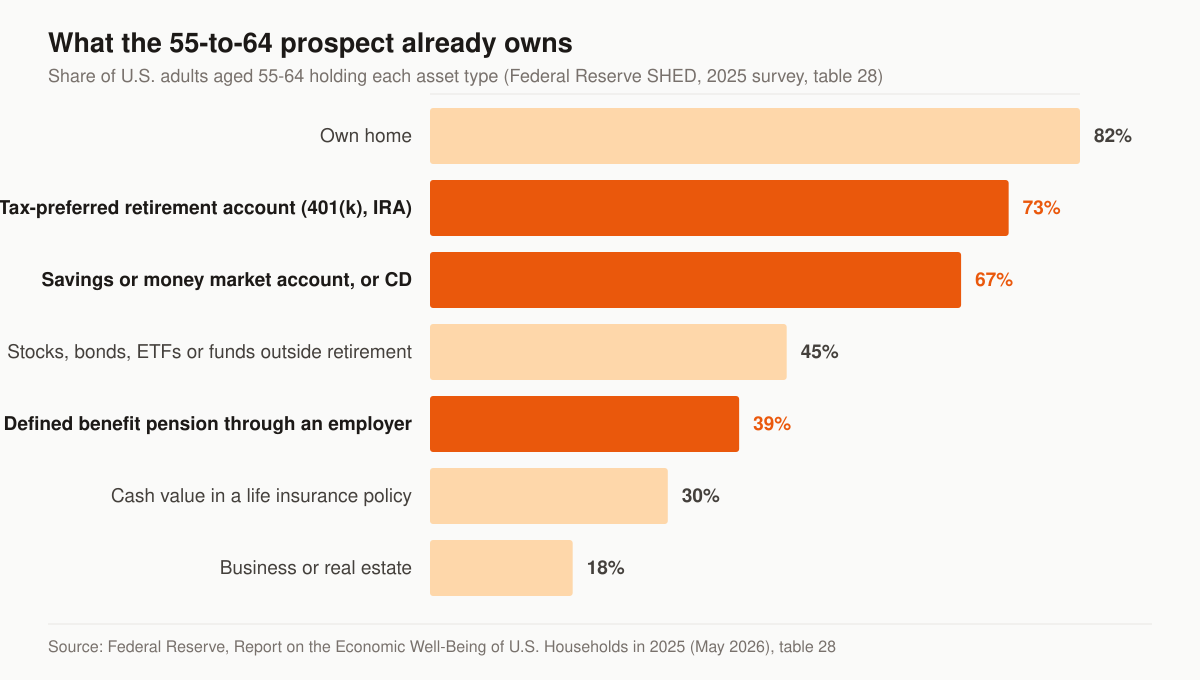
Source: Federal Reserve, Report on the Economic Well-Being of U.S. Households in 2025, table 28.
Three of those bars are three different marketing conversations, and treating them as one is why so much annuity content reads as generic. The 73 percent bar is the rollover conversation. The 67 percent bar is the CD-and-money-market conversation, where a multi-year guaranteed annuity is the product that comparison lands on. The 39 percent bar is the pension conversation — lump sum against monthly income, a decision the household makes once.
The same report supplies the emotional half of the profile. Across all non-retirees, 35 percent thought their retirement saving was on track. Broken out by age, that was 43 percent of non-retirees aged 45 to 59 and 53 percent of those aged 60 and older — so fewer than half of the younger band described themselves as on track. The Fed also notes that the question “did not prompt respondents to consider any particular type of assets or level of income in their answer,” so this measures felt preparedness rather than a computed shortfall. Felt preparedness is what fills a review calendar.
One more figure explains why we lead with an educational offer rather than a product offer for this buyer. In the same survey, “Forty-seven percent of adults said they were mostly or very comfortable choosing and managing their investments, while 53 percent of adults said they were not comfortable or only slightly comfortable.” Your offer is aimed at the second group, and it should sound like help rather than a product.
Start with the book you already have
Before you spend a dollar on new traffic, look at the households already in your CRM. Nationwide surveyed 504 annuity-producing financial professionals with at least three years of experience between September 5 and 24, 2024, and published the results on March 24, 2025. Respondents said 27 percent of their clients own at least one annuity, while the level they would prefer was 38 percent. That gap sits inside a list you have already paid to acquire, and closing it is a marketing job rather than a prospecting one.
The Nationwide survey doubles as a content brief: each finding names a belief your existing clients already hold, and the asset that has to answer it.
| What the survey found | Share of professionals | What it tells your marketing to produce |
|---|---|---|
| Clients hold negative annuity preconceptions | 78% | A myth-by-myth explainer page, written plainly, that names the objection before answering it |
| Clients perceive annuities as overwhelming | 60% | One-page product summaries with a table, not a carrier brochure |
| TV, radio and podcast commentary diminishes annuity appeal | 54% | A “what the critics get right and wrong” piece you can send after a call |
| They want client-facing material on annuities as a source of guaranteed income | 54% | An income-review explainer, built once, used in every follow-up |
| They want more on the annuity’s role in an overall financial plan | 43% | A where-this-fits page that positions the product inside a plan |
| Annuities help them retain clients | 73% | A retention sequence, because the sale is the start of the relationship |
That last row is worth its own line: 81 percent of the higher-production respondents — those who had sold at least 10 annuities in the previous 24 months — said annuities make client relationships “stickier.” If retention is the payoff, the email and review cadence behind the sale is part of the acquisition system, not an afterthought. That is the work we describe under insurance client retention, and it runs on the same list you already own.
The four channels that actually produce annuity appointments
You do not need all four on day one. You need one that captures intent and one that follows up.
The four channels differ less in whether they work than in how fast they pay and how the cost curve moves — pick the pair that matches your runway.
| Channel | Buyer intent | Speed to first appointment | Cost trend over time | Best for |
|---|---|---|---|---|
| SEO (search) | High — they’re asking | Slow (3–6 mo) | Drops as rankings compound | Rollover & income questions |
| AI search / GEO | High — and rising | Medium | Low once cited | Being the answer ChatGPT/Perplexity gives |
| Paid social | Medium — interrupt | Fast (2–4 wk) | Stable per-appointment | Volume, retargeting, education |
| Referral/content engine | Highest | Slow | Near-zero marginal | Repeat & word-of-mouth |
The pattern worth noticing: search and AI search now overlap. When a 58-year-old asks an AI assistant “is a fixed indexed annuity safe,” the model pulls from pages that are structured to be quoted. If your content answers the question cleanly — short claims, a table, a direct definition — you get cited. That is the GEO angle, and it is where annuity agents are most under-built right now. We go deeper on it in our guide to GEO and AI search for annuity agents.
How to market annuities to clients: the offer, not the product
You cannot lead with “annuity.” The word triggers skepticism — Nationwide’s respondents put clients with negative preconceptions at 78 percent. You market annuities to clients by leading with the problem the buyer already feels: running out of money, a 401k exposed to a downturn right before retirement, a pension decision they only get to make once.
Build your funnel around one of these education-first offers:
- Free retirement income review — “See how long your savings actually last.” Broadest appeal, books the most calls.
- 401k / IRA rollover checklist — captures the active rollover searcher at the exact moment of intent.
- Pension lump-sum vs. monthly analysis — high-intent, lower volume, excellent close rate.
- RMD and tax-deferral explainer — pulls in the 70-plus segment already required to act.
Every offer routes to the same thing: a booked call on a calendar, with an automated reminder and follow-up sequence behind it. That sequence is where pipelines leak — interest gets generated and the appointment never gets confirmed. Tightening it is the first repair we make, before touching traffic, and the mechanics are in our insurance lead follow-up cadence guide.
The rollover moment, and the IRS rules that create your appointments
The moment we build annuity content around first is a person holding a distribution decision they have never made before. The IRS publishes the rules that govern that moment, and every one of them is a question your prospect is typing into a search box this week.
These are the rollover mechanics the IRS states on its own page — each one is an appointment trigger, and each one is a page you can rank for.
| IRS rule, in the agency’s words | Why the prospect searches it | What your page should be |
|---|---|---|
| “You have 60 days from the date you receive an IRA or retirement plan distribution to roll it over to another plan or IRA.” | A check has arrived and a clock they did not know about is running | A plain-language 60-day explainer with a booking link at the top |
| “A retirement plan distribution paid to you is subject to mandatory withholding of 20%, even if you intend to roll it over later.” | They received less than they expected and want to know why | The withholding page competitors do not write |
| “An IRA distribution paid to you is subject to 10% withholding unless you elect out of withholding or choose to have a different amount withheld.” | They are comparing an IRA distribution with a plan distribution | A side-by-side of the two withholding treatments |
| “Beginning after January 1, 2015, you can make only one rollover from an IRA to another (or the same) IRA in any 12-month period, regardless of the number of IRAs you own” | They already moved money this year and do not know if they can move it again | The one-per-year page, with the exclusions listed |
| “If you receive an eligible rollover distribution from your plan of $200 or more, your plan administrator must provide you with a notice informing you of your rights to roll over or transfer the distribution” | A notice landed in the mail and they are trying to decode it | A “what this notice means” page, written for someone holding the notice |
| “Your retirement plan is not required to accept rollover contributions.” | They assumed the receiving plan had to take it | A short answer that resolves the fear in one paragraph |
Source for every quoted row: IRS, Rollovers of retirement plan and IRA distributions.
Two details in that list are worth building a whole page around. The IRS states the one-per-year limit “does not apply to” rollovers from traditional IRAs to Roth IRAs, trustee-to-trustee transfers to another IRA, IRA-to-plan rollovers, plan-to-IRA rollovers, or plan-to-plan rollovers — a distinction that confuses people who have read half an article somewhere else. And the agency notes that when a former employee’s plan account is between $1,000 and $5,000, “the plan administrator may deposit the money into an IRA in your name if you don’t elect to receive the money or roll it over.” Someone who just discovered an IRA they never opened is a person who wants to talk to a human.
Write these as answers, not as pitches. The reader is looking for the rule; the booking link is what they find once you have given it to them.
The calendar that tells you when to reach out
Annuity demand is event-driven, and the events are dated. We run these campaigns against a calendar rather than a flat list, because the timing does the qualifying for you.
Each trigger below is documented by the IRS, which means you can time content and outreach to it without guessing at intent.
| Trigger | What the rule says | The asset that meets it |
|---|---|---|
| Leaving an employer with a plan balance | Distributions of $200 or more require a rollover notice from the plan administrator | A rollover-decision page and a checklist offer |
| A distribution check arrives payable to the client | The 60-day clock starts, and 20% has already been withheld from a plan distribution | A same-week email and a calendar link, not a nurture drip |
| Turning 73 | “You generally must start taking withdrawals from your traditional IRA, SEP IRA, SIMPLE IRA, and retirement plan accounts when you reach age 73.” | An RMD explainer, published well before the birthday |
| The first RMD year | “However, you can delay taking the first RMD until April 1 of the following year.” | A dated reminder sequence tied to that April 1 deadline |
| A missed RMD | The amount not withdrawn “may be subject to an excise tax of 25%, 10% if the RMD is timely corrected within two years” | A correction-window page, aimed at a reader in a hurry |
| A maturing CD | Not an IRS event, but 67% of 55-to-64s hold a savings, money market or CD balance (Federal Reserve, 2025) | A MYGA-versus-CD comparison page |
Sources: IRS, Retirement plan and IRA required minimum distributions FAQs and the rollover page cited above. Note the RMD rule cuts both ways in your content plan: the IRS also lists required minimum distributions among the distributions you cannot roll over, so an RMD page and a rollover page answer different readers and should not be merged.
Four objections, and the question that opens each one
Annuity prospects arrive with an objection already loaded. We treat the objection as the routing signal, because the thing they are worried about tells you which product conversation is even relevant — and which page to send them next.
We map each objection to the question we ask and the page that has to exist behind it; the mapping is our method, not a survey finding.
| What you hear | What they are actually solving for | The question we open with | The page it routes to |
|---|---|---|---|
| “I don’t want my money locked up” | Liquidity and surrender terms | What would you need this money to be available for, and when? | Surrender schedules and free-withdrawal provisions, in a table |
| “I can’t take another market drop” | Sequence-of-returns risk near retirement | If the market fell sharply the year you retired, what would change? | Principal protection and index crediting, explained plainly |
| “My CD is maturing and rates dropped” | A better guaranteed rate, not lifetime income | What were you planning to do with it when it matures? | The MYGA-versus-CD comparison |
| “Will I outlive my money?” | Guaranteed income floor | How much of your monthly spending do you want covered outside Social Security? | An income-options page with a worked example |
Nationwide’s respondents named the two headwinds behind all four: 60 percent cited clients’ perception that annuities are overwhelming, and 54 percent cited television, radio and podcast commentary that diminishes annuity appeal. Neither is defeated by enthusiasm. Both are defeated by a page that states the trade-off before the benefit, which is also the structure AI assistants quote from — see how to get cited by Perplexity and AI Overviews.
What the do-not-call rules do to a cold-calling plan
Cold calling is the default answer to “how do I get annuity clients,” and it is the one with a federal rulebook attached. Under 47 CFR 64.1200(c), “No person or entity shall initiate any telephone solicitation to” either “Any residential telephone subscriber before the hour of 8 a.m. or after 9 p.m. (local time at the called party’s location)” or “A residential telephone subscriber who has registered his or her telephone number on the national do-not-call registry of persons who do not wish to receive telephone solicitations that is maintained by the Federal Government.” The rule adds that “Such do-not-call registrations must be honored indefinitely, or until the registration is cancelled by the consumer or the telephone number is removed by the database administrator.”
The size of that registry sets the scale of the problem. The FTC reported that in FY 2025 “more than 4.7 million additional phone numbers were added to the Registry, bringing the total to about 258.5 million active registrations as of September 30, 2025” (Do Not Call Registry Data Book press release).
The same regulation names the routes that fall outside a telephone solicitation — and two of the three are things marketing produces for you.
| Route named in 47 CFR 64.1200 | The regulation’s own words | How marketing gets you there |
|---|---|---|
| Prior express invitation or permission | The definition of telephone solicitation excludes a call “To any person with that person’s prior express invitation or permission” | An inbound form, a booked call, a requested checklist — with the record kept |
| Established business relationship | The same definition excludes a call “To any person with whom the caller has an established business relationship” | Your existing book, which is where the 27%-to-38% ownership gap sits |
| Personal relationship | A caller “will not be liable for violating this requirement if” “The telemarketer making the call has a personal relationship with the recipient of the call,” and the rule defines that term as “any family member, friend, or acquaintance of the telemarketer making the call” | Referrals and centers of influence, not a purchased list |
Note the precision the regulation attaches to the first route. Paragraph (c)(2)(ii) lifts liability under the registry provision where “It has obtained the subscriber’s prior express invitation or permission,” and adds that “Such permission must be evidenced by a signed, written agreement between the consumer and seller which states that the consumer agrees to be contacted by this seller and includes the telephone number to which the calls may be placed.” An established business relationship carries no equivalent writing requirement in the rule; it works the other way, by keeping the call outside the definition of a telephone solicitation in paragraph (f)(15) to begin with. Paragraph (d) separately requires anyone making telemarketing calls to residential subscribers to maintain an internal do-not-call list under a written policy that is “available upon demand.” Read the paragraph that applies to what you are actually doing, because each one carries its own scope.
This is marketing guidance and not legal advice — your compliance counsel owns your scripts, your consent language and your state’s own do-not-call rules, which are separate from the federal registry. The strategic point stands regardless: inbound marketing manufactures the permission the rule asks for, which is why we build the funnel before the dial plan. The consent-record side is covered in TCPA compliance for agents buying leads.
Referrals and centers of influence, run as a process
Referrals sit at the top of the intent column in the channel table above, and they are also the activity least likely to have a process attached. Run them as a process with a trigger, a script and a record, the same way you run a campaign.
The trigger is the annuity sale itself. Nationwide’s finding that 73 percent of annuity-producing professionals believe annuities help them retain clients — 81 percent among those who had sold at least 10 in the prior 24 months — describes a relationship that gets closer after the paperwork, not one that goes quiet. Ask at the point the client feels the benefit: the first statement, the first income payment, the year-end review.
Make the ask specific rather than open. “Do you know anyone who might need help?” produces nothing; “who in your circle is deciding what to do with a 401k from a job they left?” produces a name, because it describes a situation rather than a product. Centers of influence work the same way — a CPA or an estate attorney can recognize the situation you described far more easily than they can recognize a product fit.
Before you attach money to any of this, get your compliance counsel to sign off. Compensation for referrals to a licensed producer sits in state insurance law, it varies by state, and it is not a place to improvise. What does not require anyone’s sign-off is asking well, at the right moment, and writing the answer down in the CRM — which is why picking the best CRM for insurance agents is a pipeline decision and not an admin chore.
Where the annuity money actually moves
Point your content at the product lines where the market is transacting. LIMRA’s final full-year figures, published March 23, 2026, put total U.S. retail annuity sales at $464.1 billion in 2025, up 7 percent year over year, from a survey LIMRA says represents 93 percent of the total U.S. annuity market. Fixed-rate deferred came in at $165.3 billion (up 6 percent), fixed indexed at $127.9 billion (up 1 percent), registered index-linked at $79.5 billion (up 20 percent), traditional variable at $63.1 billion (up 8 percent), single premium immediate at $14.4 billion (up 6 percent) and deferred income at $4.8 billion (down 3 percent).
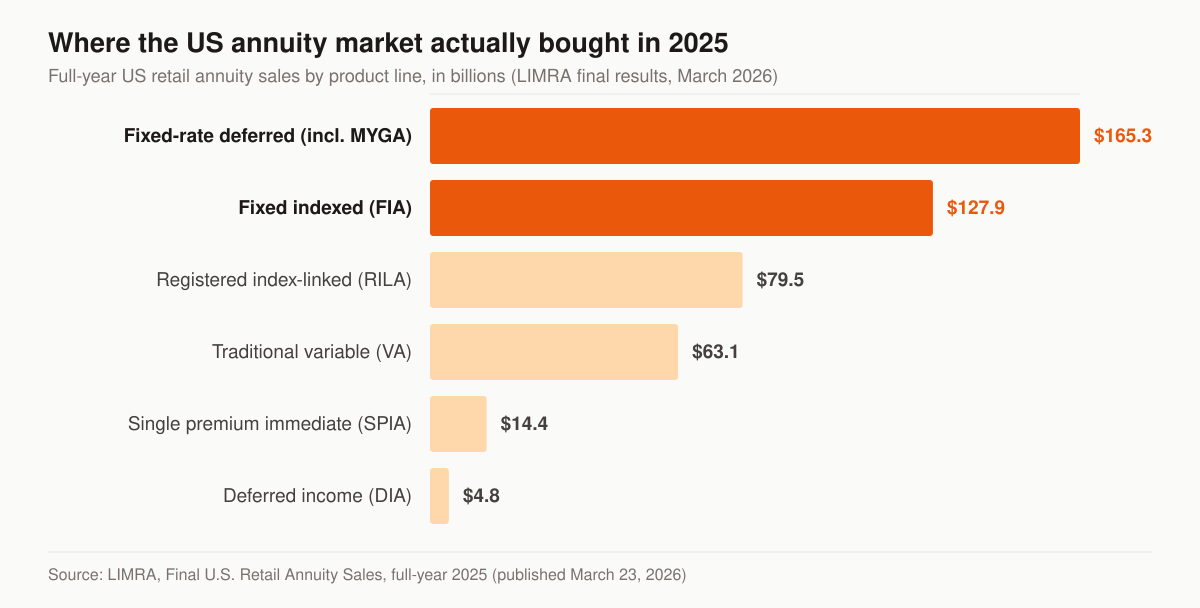
Source: LIMRA, Final U.S. Retail Annuity Sales, full-year 2025.
Bryan Hodgens, senior vice president and head of LIMRA research, named the demography driving it: “We are currently in the middle of Peak 65, where 4.1 million Americans are turning 65 each year” — and the same sentence went on to note that many of those Americans do not have pensions or other income sources to meet their basic living expenses in retirement. Set that against the Federal Reserve figure above, where 39 percent of 55-to-64-year-olds had a defined benefit pension: the pension gap and the annuity market are describing the same household from two directions.
For an insurance-only producer, the two tallest bars are the lines to go deep on, and the licensing boundary that decides which products you can recommend rather than merely explain is set out on our annuity agent marketing hub. The annuity lead generation page covers how those product pages feed the funnel.
Stay factual — compliance is a conversion lever here
A cautious buyer reads hype as a red flag. Never frame an annuity as a way to “get rich” or promise “guaranteed returns” that imply market-beating performance without risk. Describe what the product actually does: principal protection, optional lifetime income, tax-deferred growth. You are providing marketing; the licensed agent owns suitability and the best-interest conversation. Clean, accurate copy is not just the safe choice — with this demographic, it out-converts aggressive copy because it signals you are the adult in the room. The regulatory detail behind that, including what counts as a recommendation under the NAIC model, sits in our annuity agent marketing system page.
How to measure an annuity engine when the sale takes months
An annuity sale can run a quarter or longer from first click to issued contract, which breaks the reporting habits agents bring from final expense or auto. Measure the steps, not only the outcome, and hold each step to its own number.
Track the four stages separately, because a program can be healthy at the top and broken in the middle, and a single blended cost figure hides which one it is.
| Stage | What to record | What a change in it tells you |
|---|---|---|
| Question captured | Sessions on your rollover, RMD and income pages, and which query brought them | Whether your content matches the sentences buyers actually type |
| Request made | Form fills and calendar bookings, split by offer | Whether the offer is worth the reader’s contact details |
| Appointment held | Booked calls minus no-shows, split by source | Whether the reminder sequence is doing its job |
| Contract issued | Time from first touch to issue, by source | Which channel produces buyers rather than browsers |
Two habits keep this honest. Attribute the booking, not the click, so a channel gets credit for meetings rather than for traffic. And hold the source open for a full sales cycle before you judge it — a channel that looks expensive at week six can be the one carrying the pipeline at month five, because the annuity buyer takes that long to decide.
What running this as a program costs
We publish our prices rather than quoting per call. Foundation is $2,500 per month and covers the website or landing pages, local SEO and Google Business Profile, on-page SEO and monthly reporting — the layer everything else stands on. Growth is $3,500 per month and adds the ongoing SEO and content engine, AI-search visibility, and reputation and reviews; that is the tier the rollover and RMD content described above lives in. Full-Funnel is $5,500 per month and adds managed paid ads, landing-page CRO and marketing automation. A one-time website build runs $2,500 to $8,000. Ad spend is billed separately, straight to the platforms. The full breakdown is on the pricing page.
The sequencing matters more than the tier name. Publishing rollover answers on a site that loads slowly or hides its content behind a script buys you nothing, because nobody — reader, crawler or model — reaches the passage. Fix the foundation, then write the answers, then buy volume against a funnel that already converts.
Wiring it together
Here is the build order we use when we stand up an annuity engine that runs without bought leads:
- Foundation: one fast, trustworthy site with a single clear offer and a visible calendar. See how we approach the annuity agent marketing system end to end.
- Capture: 3–5 factual pages targeting rollover, income, and “is it safe” queries, structured to rank and to be quoted by AI search.
- Volume: a paid social campaign to your strongest education offer, retargeting site visitors who didn’t book.
- Conversion: booking calendar plus a reminder-and-follow-up sequence so interest becomes a meeting — the work behind insurance appointment setting.
- Compounding: a light content cadence that earns referrals and feeds the organic layer.
Run paid as the fast lane while search and GEO build the durable, lower-cost pipeline underneath. Within a few months the cost per appointment falls because organic carries more of the load — the opposite of what happens when you rent leads forever.
If you want a second set of eyes on where your current setup leaks — offer, page speed, follow-up gaps, AI-search visibility — grab a free marketing audit and we’ll map it against what works on our live books, or talk to us directly. And if buying intent is genuinely part of your plan, keep that channel clean and separate by sourcing it from a dedicated vendor rather than blending it into the demand you own.
The short version of how to get annuity clients: stop renting attention, own a narrow slice of the questions your buyer is already asking, and make booking the next step take one click.
- AI Search for Annuity Agents: The GEO Playbook to Get Cited, Not Skipped
AI search for annuity agents: a GEO playbook for getting cited by ChatGPT, Perplexity, and Google AI Overviews, with structure, schema, and proof tactics.
- How to Generate IUL Leads With Marketing
How to generate IUL leads with your own marketing versus buying them. Published lead prices, the consent rules on a bought lead, and the channel plan.
- Life Insurance Marketing Ideas That Move Policies, Not Just Impressions
Practical life insurance marketing ideas for agents, ranked by cost, speed, and effort, with a comparison table to pick the two you should run first.
- How to Sell Life Insurance: The Needs-Based Process
How to sell life insurance with a needs-based process: discovery scripts, an objection-handling table, licensing basics, and an honest look at the odds.